Showing posts with label Paul Giamatti. Show all posts

Saturday, December 16, 2023

The Holdovers

Saturdays are usually "Take Out the Trash" Day. Not today. This one is a gem, not to be tossed aside.

A Very Special After-School Special

or
Today's Lesson is the Battle Between the Cock-eyed and the Philistines.

Paul Hunnan (Paul Giamatti) is a "lifer" at the Barton Academy for boys. A former student of Barton, he is now an old, crusty professor of classics to the (as he describes them)"philistine" and "vulgarian" sons of the rich, privileged and selfish. The kids have been dumped at the Academy by their self-possessed parents, and although the Academy has a good pedigree, a lengthy history and tradition, and good educational standards, the students will be passed through, however meager their achievements and retention, given pressure from their rich donor parents. 
 
Except by Hunnan, who does not grade on the curve, but rather on reality, and calls them as he sees them, which, given a particular ocular deficit, one might think he is over-compensating. He's already by reprimanded by the Academy president—whom he had the indignity of teaching as a teen—that if he keeps failing the scions of Senators and Captains of Industry, he might be handed his papers. But, overly principled and disheartened by the lethargy and unscrupulousness of the times (which is 1970—you can tell because the film is in a blocky aspect ratio), he continues to grade as he sees fit, and takes comfort in his study of the past, where we were learning our lessons as a humanity. At least, we were learning. Now (as he will say later) "the world doesn't make sense anymore. I mean, it's on fire. The rich don't give a shit. Poor kids are cannon fodder. Integrity is a punch line. Trust is just a name on a bank."
But, he persists—he really has nowhere to go—casting cultured pearls before swine. The kids are dismissed by Academy staff as "rich and dumb"—not just by the faculty, but by the kitchen staff, as well—but they are necessary for the continuance of the Academy. And their employment.
What the kids think is readily dismissed, as they're just passing through, even if barely passing. It's merely one more hurdle of legacy before enjoying the ranks of privilege. But, their contempt is obvious, with Hunnan and his exacting standards, being singled out for particular ridicule. He can't be "gamed," so he's a "Nazi." In conversation with the Academy's cafeteria engineer, Mary Lamb (
Da'Vine Joy Randolph) about her late son—killed in Vietnam—he mentions that he taught her son one semester, calling him "very insightful," to which she responds "He hated you. Said you were a real asshole."
 
"Well, like I said." as he's heard it all before. "Sharp kid. Insightful." The kindest thing said about him is by one of the better students, Angus Tully (Dominic Sessa), who just says "That poor wall-eyed bastard."
That "poor wall-eyed bastard" is going to have it even rougher with the coming holiday. Every year, some faculty drone is assigned to stay over at the Academy for "babysitting" the poor slob students who, for whatever reason, can't go home for Christmas and must stay on campus. It's the worst job in the world. The School's shut down, the heat turned off—everybody has to bunk in the infirmary which is still warm—and the meals (Mary's staying the holidays, too) are whatever's left because nobody's going to deliver anything until January. But, Hunnan is determined to make the burden productive, keeping the hapless students busy with studies and calisthenics. For the six, it's a Holiday in Hell.

As it is for Hunnan and Mary.
That's the set-up, which sounds vaguely familiar in a Scent of a Woman (American version) kind of way. But, The Holdovers is so far afield of that movie that they practically can't be compared. There will be some whittling down of the cast, leaving only one student—Tully—left behind, with Hunnan and Lamb. That nicely simplifies things and allows it to focus on the issues of those souls, with the to-be-expected sanding down of rough edges and the meshing of gears and sensibilities. Compromises are made to the point where three disparate people—make that four—are there for each other to sooth extremes and come to each other's aid. People change, but for the most remain the same to their cores.
It's a bit like comfort food, this movie, as so many of the films of Alexander Payne—working (as he did with Nebraska) from an original script not of his own devising—are. Sure, the characters are flawed, sometimes doing things that are inexplicable, but in the service of lessons learned and ruts overcome. And the director doesn't do anything fancy with cinematography, just puts the camera where it will do the most good, and appreciating the simplicity of something so basic as a sustained fade.
My Lambcast colleague, Howard Casner, had a nice little turn of phrase for it: "a feel-good movie that actually feels good." There are no discernible manipulations and hair-pin turns to reach the desired outcomes. It all feels organic and well-played, but not theatrical or melodramatic. Things evolve, naturally, bringing you to the point where you think that this is the way the world should work, even as the screenplay never compromises in its assertion that the world doesn't. And the trinity of actors—Giamatti (perpetually dickish and donnish), Randolph (who could have turned Octavia Spencer in the role, but stays underplayed and real) and Sessa (an air of suspicion rarely leaves his face)—spark off each other and generate a steady warmth without glowing about it.
It's a film of modest means and great decency. In all manners of the term.

Saturday, September 9, 2023

Shoot 'Em Up/The Brave One (2007)

Oh, a two-fer for "Take Out the Trash" Day, both written at the time of these mis-fires' discharges.

"Guns Don't Kill People....But It Sure Does Help!"

"The Angriest Man in the World," Mr. Smith, is sitting on a street bench in a squalid part of town. He's introduced with a Leone-style close-up of only his eyes. Then, cut to his face. It's Clive Owen in full wide-eyed coma look. He brings a carrot up to his face and loudly crunches into it.

What's Up, Doc? 

Well, it's certainly not anybody's IQ.

Next, a very pregnant woman runs past him (shot none too elegantly), followed by a speeding car that noisily and gratuitously slams into another car, trapping the driver. He gets out the passenger door, spewing paper and fast-food bags and garbage out of his car onto the street.


There...right there...maybe two minutes into the film is the only amusing idea in the whole movie. And it was only amusing to me because it reminded me of my car. 
But that's it--the only thing I enjoyed in the entire film, no help from director Michael Davis. In the sums-it-up Shoot 'Em Up, Clive Owen's "Mr. Smith" finds himself charged with protecting a baby, just like Children of Men, but without all that boring social commentary and stuff. With the help of a lactating prostitute (Monica Belluci, shot through a vaseline-greased lens, and utilizing the time-honored 60's-style "Bad Italian Actress" technique), Smith and child evade Mr. Hertz (a bug-eyed Paul Giamatti, reminding me that it was only a few years ago that he starred in stuff like Big, Fat Liar) who has an infinite number of disposable goons, with an infinite number of bullets that seem predisposed to not hit anything, while Smith's gun hits something (usually lethally) every time.
Shoot 'Em Up
tries to align itself with
the Warner Bros. cartoons of Bugs and Elmer but has not the wit, the style or the precise timing (Giamatti starts the movie with a Merrie Melodies lisp, but inexplicably drops it a few minutes in). I was really hoping that at some point Owen would hit him in the face with a frying pan, so we'd see Mr. Hertz's face flatten out, but no such luck.
And, of course, after every set-piece or innovative killing technique (Smith kills with a carrot--twice) there are the
inevitable one-liners that haven't been so eye-rollingly bad since Roger Moore was James Bond, with all the sophistication of the chat-room droolings of pre-teens. After a simultaneous shoot-out and screw where both participants reach their ...climax, Owen turns to the camera and in his best Terminator-in-Chief drone says, "That's what I call shooting your wad." But then there's "Eat Your Vegetables.." (after a carrot-killing), "That's what I call a hand-job," and the immortal "Fuck you, you fuckin' fuckers!" That kind of lummoxy aside reached its satiric punch-line with the antics of "McBain" on "The Simpsons," but it gives me hope that someday I can get just such a writing job. At the end, Belluci looks at Owen and says "What took you so long?" I half expected the lame-ass line that ended Robert Altman's The Player: "Traffic was a bitch."
According to this flick, there's nothing worse than "a pussy with a gun." I dunno, how about "a pussy with a movie camera but without an original idea in his head, a lick of talent, or the smarts God gave a radish?" Yeah. That's worse. A lot worse.
-----------------------------------------------------------------------------
Oof. Talk about your awkward segues.

"The Angriest Woman in the World" Erica Bain (
Jodie Foster) by the end of The Brave One is in the same mode: "Who's the Bitch now?" she screams as she mows down one of the men who beat her into a coma, killed her fiancee...and stole her dog. Not only does she get her revenge, but she gets her dog back (oh...spoiler alert!), so everything's all right, right?*

Never mind that for the preceding two hours--that feel like four--she's bided her time by capping the asses of whatever scum of the earth crossed her path. At least she's an equal opportunity vigilante: one group's Latino, another is black, and three separate white guys--bonus points for the rich one.

Were I John Hinckley, I'd stay in prison.
The critical rags are calling this "
Dirty Harriet,"
* but that's all wrong. Its the daughter of Death Wish, the Charles Bronson viscerally charged revenge-actioner with the same formula and practically the same resolution--except with a gun rather than the earlier film's non-cinematic plea-bargaining.
Erica is a radio-journalist--well, an audio-documentarian, whose love affair (and experience) with New York extends as far as her ear-buds, spinning chatty little stories about the "myth" of old New York, and what gentrification is taking away. Tellingly, one of the first things we see her doing is recording her own foot-steps as she walks the city streets. From there, she goes to her little iso-booths and spins her valentines to "the safest big city in the world" (except it's missing a couple of prominent buildings downtown, and not to gentrification).
After the attack, she's even more isolating, and butches up her wardrobe, symbolically shedding her skin to become a new person that she doesn't know or understand. Oh, and there's that shooting-people-in-subways thing. "Inside you is a stranger," she narrates to herself. "Why don't my hands shake? Why doesn't anyone stop me?" Pretty soon she's doing it not because she's threatened, but because she can, and in a perverse cat-and-mouse game strikes up a friendship with detective Terrence Howard, who is feeling increasingly powerless to stop the newly-empowered vigilante messing up his mean streets. I came away thinking "never give Terry Gross a gun."
Of all people, Neil Jordan (The Crying Game, Interview with a Vampire) directs this,
** and his way of showing fear and Erica's world out of whack is with slowly tilting shots with a steadicam (with its gyroscope knocked out), which made me think we were heading for the Penguin's dastardly bird-themed lair. It's a little tough to take this stuff seriously when it reminds you of the old "Batman" show. About the only pleasure in the film is the beyond-cynical banter of Howard and his partner investigating the crime scenes (My favorites: "Guy had a rap sheet longer than my dick" "No priors?" and "Any idea what killed him?" "Could be the fall--could be the crowbar stuck in his head--I'm thinkin' 70/30, maybe 50/50"). And a tiny scene with a police desk-clerk who routinely mantras "I know how difficult it can be, but if you will be patient and have a seat an officer will be down shortly to help you." It makes the same point about institutional disinterest in 20 seconds that it takes the whole of In the Valley of Elah to make.
And the acting. Even with this type of material,
Foster takes it right down to her marrow, until she no longer looks like the same person. There is a terrific scene of her and Howard in a diner not talking about what they're talking about while "You Don't Know Me" echoes over the PA that's very well done.


Wish it were in another movie.

* 2023 Update: "The dog bit." I thought it was a lame pull-for-the-heart-strings back when this was released, and even more so when John Wick stole it as a semi-serious/semi-jole motivation in that increasingly-escalating-with-diminishing-returns series.
 
** "Dirty Harry," the police-as-vigilante movie was co-written by Rita Fink.

*** Yes, but Joel Silver produces. That might be the answer.

Thursday, June 8, 2023

The Last Station

Written at the time of the film's release right at Oscar-time. Subsequently, Sandra Bullock won Best Actress for The Blind Side and Jeff Bridges won Best Actor for Crazy Heart.
 
"War and Peace with Mr. and Mrs. Tolstoy"
“All happy families resemble one another; each unhappy family is unhappy in its own way.”

First line of "Anna Karenina"

One of the last of the Oscar nominated films has finally arrived in the area, that being Michael Hoffman's film of The Last Station, based on the novel by Jay Parini,* subtitled "A Novel of Tolstoy's Last Year." It tells the story of the last turbulent year in Lev Tolstoy's life** (the author is played by Christopher Plummer, nominated for Best Supporting Actor—Plummer's first nomination) when he was being pulled in two different directions: by his own ideology of anti-materialism—and his desire to create a communistic society around himself that included donating the rights of his work to the Russian people—and the conflicting desires of his family to leave the rights to his family guaranteeing an inheritance to his wife (Helen Mirren, nominated for Best Actress) and children.
It culminates in the story behind a famous photograph—Tolstoy, a Russian hero, had his life very well-documented
***—of a forlorn scene as Mrs. Tolstoy, the Countess Sofya—strains to see through the window of the train station where her estranged husband lay dying.
It begins with the arrival of Valentin Bulgakov (
James McAvoy) to the Telyatinki commune, where the young student has been chosen by Tolstoy's acolytes to serve, officially as Tolstoy's secretary, and unofficially as a go-between (and spy) between them and the Countess Sofya in their effort to change the writer's will and pass the rights to the masses. She is having none of it, despising her husband's followers ("No wonder I'm so lonely! I'm surrounded by morons!"), especially Vladimir Chertkov (Paul Giamatti)—"a sycophant and a pervert"—whose desire it is to set Tolstoy up as a visionary for the communist ideology—as interpreted through his own vision, of course.
Bulgakov is a total naif, desirable to both sides: familiar with Tolstoy's work and philosophy to appeal to the Tolstoyans, and young and innocent to the others. For Tolstoy, he's a boon—a young man with ideas that don't sound like echoes of his own. At their first meeting, Tolstoy is delighted with Bulgakov and wants to know about his writings; Bulgakov is overcome: "You are Lev Tolstoy and you ask me about my work?" That's part of the appeal. During a walk through the fields the author confesses he's not a very good Tolstoyan and confesses a cherished memory of a past love affair. "You mustn't torture yourself so!" stammers Bulgakov. "Torture!" Plummer as Tolstoy roars. "You are a virgin!"Not for long.
Bulgakov attracts the attention of Masha (Kerry Condon), who is only too eager to help Bulgakov break the commune's celibacy edict. She's a character created by Parini to serve as a love interest, but it has the effect of turning the story a bit into "Tolstoy in Love." It distracts a bit, but gives Bulgakov a romantic's eye towards the conflicts within the group and as he is pushed and pulled between the two telegraphs his intentions. She does serve a purpose besides love scenes.
Hoffman (
Restoration, Soapdish, 1999's version of A Midsummer Night's Dream,) keeps things light and sun-splashed throughout, simulating natural light as much as possible, showcasing the performances of the principles over overt directorial flourishes for the most part. And the performances are the reason to see the film—Mirren has a fine time with the manic possibilities of her role, and Plummer exudes warmth as the elderly Tolstoy with maybe a little too much twinkle in his eyes—there are pictures of the man at that age where the eyes are pretty flinty.
The screenplay makes the most of the elderly author swaying from one loyalty to the other, weakening his health and resolve.
Although Mirren may not win for her performance—too much competition from Meryl Streep and Sandra Bullock—Christopher Plummer might pull an upset win garnering an Oscar representing his body of work (which has only increased of late).
* Parini worked on an early screenplay of the novel with Anthony Quinn, and the film is dedicated to him.

** It's "Lev" in the movie, as in Russia. "Leo" is an Anglicized version of the name.

*** One of the joys of the film is to see some of the silent footage of Tolstoy and his family played next to the closing credits.

Wednesday, April 29, 2020

Duplicity

Written at the time of the film's release...

"All's Fair in Love and War"

After screenwriter Tony Gilroy's powerful directing debut with Michael Clayton, one looked forward to what the talented triple-threat would come up with next, considering that film's street-smarts, sharp characterizations and deft direction. What we got is Duplicity and it's a wisp of a movie, a comedy without laughs, and a drama without weight; a shell-game; much ado about nothing; more in keeping with Gilroy's in-name-only association with the "Ocean's Eleven" series than his better efforts.

As with
Michael Clayton, the playing field is the backrooms of corporate America, where warring CEO's protect their fiefdoms from interlopers and pitch pre-emptive strikes to keep them at bay. Their knights: a string of white-ops intelligence teams who spy on the competition, using the techniques once used in political battle-fields. That back-drop is nothing new: John le Carré's been using the "corporate espionage is every bit as sordid as political espionage" gambit in his works since the fall of Russia. le Carré even went so far as to suppose spy agencies ginning up threats to justify their budgets and existence, just as they do in the business world. Need a purchase order? Create a threat, and the money rolls right in.

Gilroy sets the tone early by beginning his film with a lo-mo credit crawl where Corporate heads Tom Wilkinson and Paul Giamatti grapple at each other like pawing animals in a zoo. The silliness of these two going at each other in artfully composed tableau should be funnier than it is, but the whole thing feels like such a surreal con that you don't buy it for a second. Hence, the stakes in the story seem minor, even the McGuffin* is tame, as the two adversaries are pharmaceutical companies. In the middle of it are two ex-spies Ray Koval (Clive Owen, nattily rumpled) and Claire Stenwick (Julia Roberts), who know each other only too well, she having stolen some Air Force secrets from him during a one-night stand at a Dubai fete years ago.** 
The encounter stings Koval, and now, years later, he's realizing that Stenwick is the Player on the Other Side in their current Corporate Wars. It's an interesting study of two people so locked in strategic thought that they might drown standing in quick-sand, so pre-occupied are they with motivation and nuance and who might try to move first. Interesting, but not always entertaining. At times, the mind-games approach "Get Smart!" absurdities, as both sides play the "I'm thinking they're thinking I'm thinking that they're thinking" game. A little of that goes a long way, especially if the protagonists don't have a smile on their faces when they're saying it. And the humor is only of the clever variety in Duplicity, not particularly the amusing kind.
Still, it's one of those movies that travels well: to Rome, New York, London and the Bahamas, the costumes are fine, but the whole thing has all the zing of champagne left open overnight (composer James Newton Howard tries to add some zip by tossing in some Spanish dance music). It all seems too familiar and a bit too flat.

It's also one of "those" movies that demonstrates that Julia Roberts' most valuable asset may be her ability to smile under duress. 


* After Hitchcock's name for "the secret" that parties try to retrieve in a suspense film, usually it doesn't matter what it is—after the story of the man who inquired to another man what was in his suitcase: "It's a McGuffin, for trapping lions in the Scottish Highlands." "But there aren't any lions in the Scottish Highlands!" "Then, that's no McGuffin!"

** This also seems overly familiar with Prizzi's Honor, Undercover Blues, and Mr. & Mrs. Smith as previous warring spy-couple films.

Saturday, December 21, 2019

Fred Claus

Written at the time after suffering the film's release...

Sibling Revelry 

I know what you're asking: Is this a Christmas Movie where someone has to SAVE CHRISTMAS and do they?

Short answer: Yes.

Come to think of it, just about every Christmas Movie is about SAVING Christmas. From the Martians, from the Grinch, from Tim Allen, from adults, from the Gubernator, from just about everything, except all the right-wing nutters who really DO think there's a War on Christmas. Excuse me, Xmas.

The "SAVING Christmas" movie is so prevalent, it could be a genre all to itself. As long as you threaten Christmas verbally, physically, psychically or by omission, in the real or fantasy-sense, that's all that's required. How many movies or stop-motion animation specials can you name? Swell, I just came up with dinner-table conversation for this Christmas. And believe me, I looked at this blog's budget, that's all you're getting (I need the lumps of coal to heat the house).
So, in Fred Claus it turns out that Clement Moore didn't know a thing about Santa Claus' older, dumber, bitter brother. That's right, the Clauses had another son, who after the birth of little Nicholas, was left parched of his parents' affections. I mean, c'mon, how can you compete against a really cute fat baby whose first words are "Ho Ho?" It doesn't take long before Fred has transitioned from Promising To Be The Best Big Brother In The Whole World to throwing things at the little saint's head.
Fred goes off to the Real World, while Nick becomes an icon with a Factory-town at the North Pole with an indentured population of elves. Guess the North Pole is outside the jurisdiction of fair and best practices law. Anyway, Santa has built up quite the little illegal monopoly up there, plus there's the stress of reading every kid's mail, producing the specifically-requested toys for delivery and then shipping them all in one night on a twelve hour turn-around. Add to that, this year there's an Efficiency Expert (played by Kevin Spacey--when did he stop knowing how to be funny?) prowling around who seems determined to Shut Santa Down, though "Why" and "For Whom" goes unanswered (and the possibilities dance like sugar-plums in my head--China? Wal-Mart?).**
Then, Fred calls out of the blue, wanting to borrow money, and Nick is SUCH a Nicely Overwhelming Holiday Icon that he can't say no. Well, he does attach a rider saying that Fred has to work it off at the North Pole determining who is "NAUGHTY" and who is "NICE" and then condemning the former children to an unhappy Christmas. Despite this, Santa still has the snow-balls to say to his wife "I'm a Saint, sweetheart. Tough love is a little difficult for me!"
Not for me, sweetheart. "Tough" love is the only love this flick will get.

It's all meant to be whimsical, but one walks out wanting to "clock" a bell-ringer. The North Pole seems to have all the charm of a Wal-Mart town, with exactly the same sort of benefit-policy for their work-force. To determine who will be stamped "Naughty" or "Nice" Santa and his pint-sized voyeurs in the "Judgmental" Department have a magic snow-globe that they use to spy on every child's behavior. You think Homeland Security is a threat to privacy--you've never ever thought about peeping Santa. Just the emphasis that Santy sees you when you're sleeping and knows when you're awake (just like the NSA!) is probably not too jolly an idea to bring up during these liberty-crushing times, but Fred Claus makes it a key plot-point.
The cast does what it can, in its best "Tim Allen/Chevy Chase-in-overdrive" way, but it all amounts to hanging tinsel on a dead tree. Vaughn pulls off some nicely ad-libbed fast-talk. Paul Giamatti as Santa has a bit more sand to it than you might expect--but you just know the rest of the cast said "Hey, Giamatti's in it--there's gotta be something to this," so you have Rachel Weisz (as "Girl-friend"), Miranda Richardson (as Mrs. Santa), Kathy Bates as "Mom" Claus, all vamping, waiting for the movie to become better. And it doesn't.
Maybe next Christmas, kids.* Maybe instead of saving Christmas, someone should try to save the Christmas Movie.
* Okay, there is one scene that works. Fred decides to go to a support group for "overshadowed" brothers, and among them is Frank Stallone, Roger Clinton, and Billy Baldwin. That scene is genuinely funny, as the 'brothers" gamely mock themselves.

** Doesn't all this turning of childhood fantasy into a corporate metaphor a little creepy? Saving Christmas, Pshaw! How about saving childhood?

Tuesday, September 3, 2019

American Splendor

American Splendor (Shari Springer Berman, Robert Pulcini, 2003) There's a lot of debate among graphic connoisseurs (comic-book fans) about which of the glut of "spandex movies" have captured the "essence" of its three-color source. 

It's a puzzler, because the media communicate differently. Comics create a story-telling flow through still images--the reader must fill in the gaps* and that covers a lot of story-telling problems and physical impossibilities that films, if they are to represent reality, have to compromise. The geeks argue the "Spider-man" films are a good representative of the comic, but it takes more than re-creating iconic poses. 

There are those in my circle who consider the first Hellboy film to closely follow its graphic predecessor, and it does to a degree, though the insertion of an unlikely "Beauty and the Beast" romance is more in line with Hollywood sensibilities than Mike Mignola's. For a more literal translation of a comic source Robert Rodriguez took Frank Miller's "Sin City" black and white minimalist post-card approach and used it as a storyboard for his film--which exposed the heavy-breathing hyper-silliness of the source material.
The movie I'd vote for? Well, obviously American Splendor --the story of schlubby guy Harvey Pekar who chronicles his sorry-ass life in a comic book that he writes and is drawn by various illustrators, achieving something like a mosaic effect, much as the movie does. It (the movie) is, mostly dramatized—Paul Giamatti plays Pekar, and it was his break-out role—but sometimes illustrated, animated, and the real Harvey even pops on to give a dose of reality. 
In form and content, the film becomes the comic while not straying away from movie "fundamentals" of pace and movement, while also incorporating graphic techniques to give a sense of the book's "style." Of every "comic" movie I've seen, American Splendor gives you a sense of the worth of its source, while not compromising it. It may even, like any good film adaptation, inspire you to seek out the source material.

Friday, September 30, 2016

The Ides of March

Written at the time of the film's release.

"'The Situation' in The Situation Room"
or
"A Little Problem with the DnC"

The bobble-head version of George Clooney is back in The Ides of March, the new film directed by...George Clooney. You remember the bobble-head Clooney, don't you? It was the loosey-goosey version of the actor that was popular during his "ER" days, a combination of casualness and arrogance, and it made up his persona in his early film career, before the time he decided that he'd get serious about things after the debacle that was Batman & Robin.

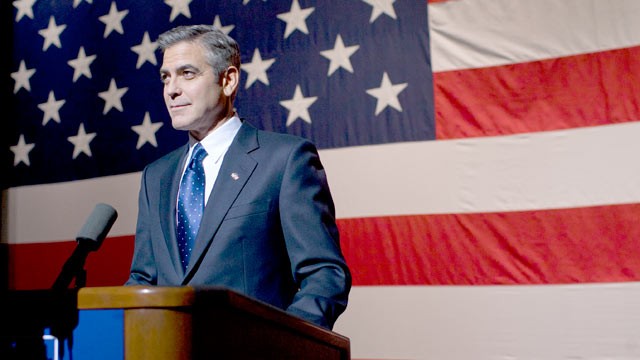
Well, that wobble of the head returns in Ides, adapted from the play by Beau Willimon (by Willimon, Clooney and Grant Heslov) called "Farragut North." I've always seen that wobble as an indication that whichever character he played with it had a lack of moral rectitude, an imperfection of the spine or sensibility that disconnected the head from the rest of the persona—a flaw that lent unpredictability to what actions they'd take, a toss of the head like a toss of the coin. And it is one of the ways that Clooney telegraphs what his Governor Mike Morris, candidate for President on the democratic ticket, might be capable of. It keeps you guessing, whatever the words from his mouth might indicate, about the actions this man might take in his run for power.
It is tough to express surprise at the roads political films—or films about politics—might take these days. They're all about disenchantment with the process and how power—or even the quest for it—corrupts. It's an old saw that goes back long before Shakespeare and back to The Greeks. And very few films—or plays—about the Court of Kings, fact or fictional,  can look clear-eyed at the process, thinking that ideals might remain intact. Even Mr. Smith Goes to Washington deals with the innate corruption of government and pleads for a clinging to of ideals from our public servants...or even an acknowledgment that they are servants, rather than our Masters. What was nice about things like the television series "The West Wing" was that, despite the maneuverings, manipulations and moral morasses that went with the job, public service was declared an altruistic aspiration, a noble thing, however down and dirty things got to accomplish anything. Most, though, like The Candidate or All the Kings Men (any version) have it as a "given" that compromise of purpose, process and principles are par for the course, that it is next to impossible to determine the true measure of a political man. The only variable is how corrupt that man (it's usually a man, and white) can be. Post-Watergate and The Lewinsky Affair, even a film like Absolute Power assumes, without doubt, that The President of the United States is capable of the most craven of murders. The Ides of March doesn't swerve from that cynicism.
The film begins with
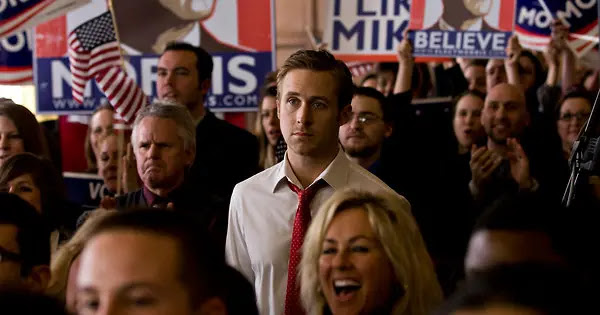
Morris' Head of Communications, Stephen Myers (the ubiquitous Ryan Gosling—if his Drive performance is a "1" and Crazy, Stupid Love is a "10," in dramatics, this is is an average "5") approaching a microphone, coming slowly into focus, a process that is completed when he is at the podium—the shot will be mirrored later in the show. He begins to slap-dashedly spew homilies about his religion, and then the speech deteriorates into babble. Not that it is important, he is merely a stand-in, checking a microphone for his candidate at ;a technical rehearsal for a televised debate. It would pass without much notice, except at the real debate, Morris uses the same lines words for words defending his lack of religion when challenged on the point. It is clear, at that point, that Myers is Morris' surrogate, putting words in his mouth, articulating the governor's message, packaging the man to appeal to the lowest common denominator and the highest number of registered voters.
The campaign manager is
Paul Zara (Philip Seymour Hoffman), a jaded veteran of the political trenches, spinning, manipulating and point-man for acquiring the parties' nomination a few months down the road. Zara is the Big Picture Packager, Myers is Dr. Details. On the other side is campaign manager Tom Duffy, who is played by Paul Giamatti—and let me just say what a pleasure it is to see Hoffman and Giamatti, two of the best character-spinners in movies today going up against each other. It is a match made in Political Purgatory.

Before too much gets underway, Clooney introduces another character in a shot that tracks her movements, flouncing, buffed, polished and toned, towards campaign HQ: this is
Molly Stearns, intern (Evan Rachel Wood) and just the way Clooney introduces her puts you on alert that she is important to the drama, far more than her job of bringing coffee would indicate. Wood is a fine actress, and as with Down in the Valley, she's able to convey twin faces of innocence and corruption, the theme of the film at which she is the fulcrum. Already one sees where things are going, but one wonders if Clooney has the directing chops to make it fresh.
He does...kinda. There are nice little touches of how the film seems to bifurcate into twin halves reflecting each other,
* the actors make the dialog snap and there's just enough "play" in the film to keep you guessing about what is "real" or political theater. And there's one scene that's shot very simply—a tension-inducing pull-in to a black van that makes you suspect the worse (which, for some it might be) that is rather nifty.

Ultimately, though, as well as the film is presented and played, it is not telling us anything we don't already know...or fear...that hasn't been said for the last 60 years, when, post-Eisenhower and the star-struck Kennedy years, we ditched the notion that politicians are concerned with the People, rather than their prestige and the perks. The Ides of March has no spine of its own to speak of and brings us nothing new, offering no solution (not even providing dramatic satisfaction)...but merely more of the same, just like every election season

* Clooney did a good interview with Charlie Rose about the film—Rose has a cameo for verisimilitude, as do a few other familiar talking heads—in which he said "The first half of the film is for democrats and the second half is for republicans." Exactly right.