Showing posts with label David Dobkin. Show all posts

Saturday, December 21, 2019

Fred Claus

Written at the time after suffering the film's release...

Sibling Revelry 

I know what you're asking: Is this a Christmas Movie where someone has to SAVE CHRISTMAS and do they?

Short answer: Yes.

Come to think of it, just about every Christmas Movie is about SAVING Christmas. From the Martians, from the Grinch, from Tim Allen, from adults, from the Gubernator, from just about everything, except all the right-wing nutters who really DO think there's a War on Christmas. Excuse me, Xmas.

The "SAVING Christmas" movie is so prevalent, it could be a genre all to itself. As long as you threaten Christmas verbally, physically, psychically or by omission, in the real or fantasy-sense, that's all that's required. How many movies or stop-motion animation specials can you name? Swell, I just came up with dinner-table conversation for this Christmas. And believe me, I looked at this blog's budget, that's all you're getting (I need the lumps of coal to heat the house).
So, in Fred Claus it turns out that Clement Moore didn't know a thing about Santa Claus' older, dumber, bitter brother. That's right, the Clauses had another son, who after the birth of little Nicholas, was left parched of his parents' affections. I mean, c'mon, how can you compete against a really cute fat baby whose first words are "Ho Ho?" It doesn't take long before Fred has transitioned from Promising To Be The Best Big Brother In The Whole World to throwing things at the little saint's head.
Fred goes off to the Real World, while Nick becomes an icon with a Factory-town at the North Pole with an indentured population of elves. Guess the North Pole is outside the jurisdiction of fair and best practices law. Anyway, Santa has built up quite the little illegal monopoly up there, plus there's the stress of reading every kid's mail, producing the specifically-requested toys for delivery and then shipping them all in one night on a twelve hour turn-around. Add to that, this year there's an Efficiency Expert (played by Kevin Spacey--when did he stop knowing how to be funny?) prowling around who seems determined to Shut Santa Down, though "Why" and "For Whom" goes unanswered (and the possibilities dance like sugar-plums in my head--China? Wal-Mart?).**
Then, Fred calls out of the blue, wanting to borrow money, and Nick is SUCH a Nicely Overwhelming Holiday Icon that he can't say no. Well, he does attach a rider saying that Fred has to work it off at the North Pole determining who is "NAUGHTY" and who is "NICE" and then condemning the former children to an unhappy Christmas. Despite this, Santa still has the snow-balls to say to his wife "I'm a Saint, sweetheart. Tough love is a little difficult for me!"
Not for me, sweetheart. "Tough" love is the only love this flick will get.

It's all meant to be whimsical, but one walks out wanting to "clock" a bell-ringer. The North Pole seems to have all the charm of a Wal-Mart town, with exactly the same sort of benefit-policy for their work-force. To determine who will be stamped "Naughty" or "Nice" Santa and his pint-sized voyeurs in the "Judgmental" Department have a magic snow-globe that they use to spy on every child's behavior. You think Homeland Security is a threat to privacy--you've never ever thought about peeping Santa. Just the emphasis that Santy sees you when you're sleeping and knows when you're awake (just like the NSA!) is probably not too jolly an idea to bring up during these liberty-crushing times, but Fred Claus makes it a key plot-point.
The cast does what it can, in its best "Tim Allen/Chevy Chase-in-overdrive" way, but it all amounts to hanging tinsel on a dead tree. Vaughn pulls off some nicely ad-libbed fast-talk. Paul Giamatti as Santa has a bit more sand to it than you might expect--but you just know the rest of the cast said "Hey, Giamatti's in it--there's gotta be something to this," so you have Rachel Weisz (as "Girl-friend"), Miranda Richardson (as Mrs. Santa), Kathy Bates as "Mom" Claus, all vamping, waiting for the movie to become better. And it doesn't.
Maybe next Christmas, kids.* Maybe instead of saving Christmas, someone should try to save the Christmas Movie.
* Okay, there is one scene that works. Fred decides to go to a support group for "overshadowed" brothers, and among them is Frank Stallone, Roger Clinton, and Billy Baldwin. That scene is genuinely funny, as the 'brothers" gamely mock themselves.

** Doesn't all this turning of childhood fantasy into a corporate metaphor a little creepy? Saving Christmas, Pshaw! How about saving childhood?

Thursday, November 20, 2014

The Judge (2014)

Father Thy Honor
or
"You're a Big Boy"

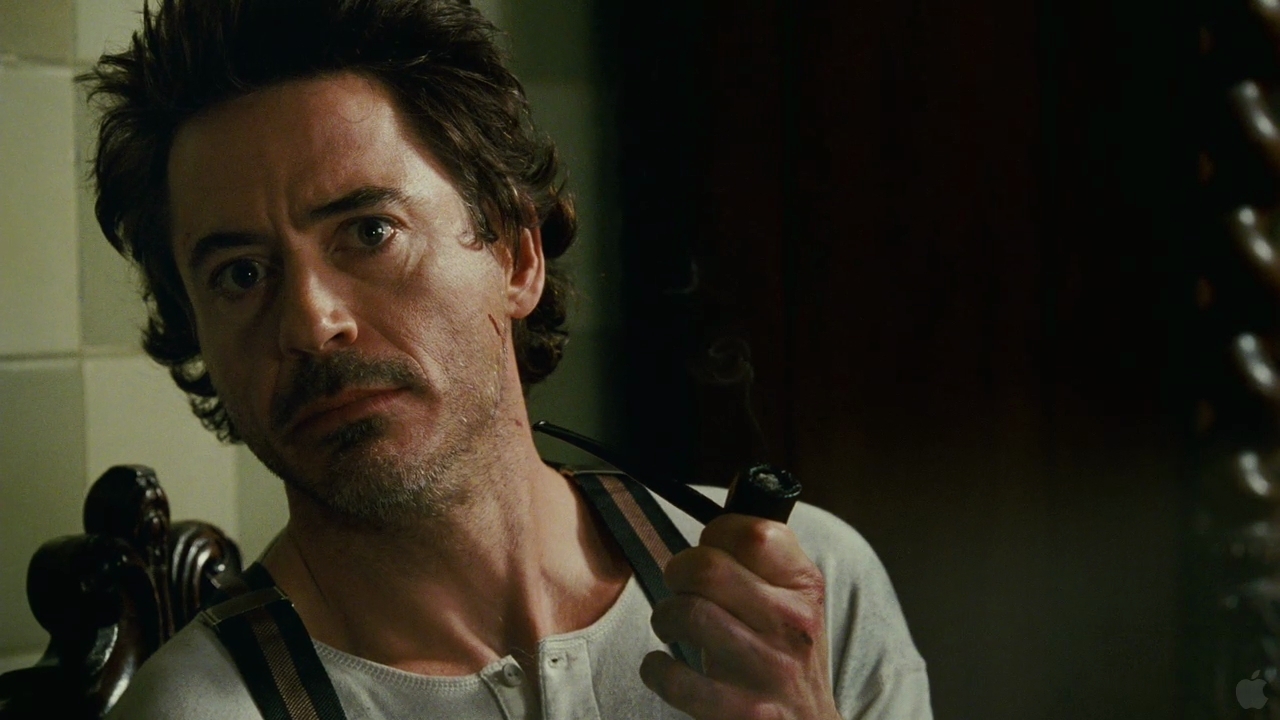
Robert Downey Jr's production company, Team Downey, produced its first feature, The Judge, and the verdict is a little mixed. One might dismiss this as a "vanity" project—he is headlining it, after all, if it wasn't such an effort to allow him to stretch out of his comfort zone as an actor (and Downey could hardly be said to have a "comfort zone") out of the iconic roles (Iron Man, Sherlock Holmes) that made him the most popular and successful actor in Hollywood.

And it is a bit of risk-taking on the actor's part. His smart-ass lawyer, Hank Palmer, is good—almost too good—at what he does in the courtroom. When asked how he feels defending the guilty, he shoots back "Innocent people can't afford me." Outside of the oak chambers, though, he's a bit of a mess. A lone wolf due to his off-putting sardonic nature, he's estranged from any family he's known; his wife is cheating on him and they're in the pre-nup phase of a divorce, and he has no contact with his family in his hometown of Carlinville, Indiana ("Grampa Palmer is dead to me," he says to his daughter when she asks why she can't go back there with him).
That's a particularly cruel and snarkily ironic way to say it to her, given the circumstances. Because he is going back home to Carlinville. His Mom is dead, and not just in a relationship way. She is dead, and he's been called home for the funeral after a decades long leave of absence. He hasn't been called by his father (Robert Duvall), who is a judge in Carlinville, but by his older brother Glen (Vincent D'Onofrio), who has never left. And so, Hank reluctantly but dutifully, drives to Indiana, knowing that disaster awaits him.

He doesn't know the half of it.

It's around this time (about fifteen minutes in) that The Judge gets in trouble, both in its story-line and behind the camera. Director David Dobkin (Shanghai Knights, Wedding Crashers) does a tight shot of Palmer driving back to Carlinville, pulls back from the SUV, then swoops around the vehicle to a high-overhead tracking shot of the surrounding (legitimately, quite lovely) countryside. It's a nifty high-tech shot, a combination of studio shot, motion graphics tracking and CGI.

But why? One could reach for an answer (moving from Palmer's self-contained city-view to the more bucolic , slower-paced country life of his youth), but...we're not there yet, and neither is the character. There is a lot of effort made to impress, and all quite unnecessarily. Dobkin is gilding the cinematic lily and without much rationale. That's a problem prevalent throughout The Judge, with an awful lot of craft going into too little art (one could say this about a lot of superhero movies, too). It times it distracts from what is going with the true focus of the story and where its strengths lie—situation and performance. Perhaps Dobkin didn't think he had enough to do, in which case, he hasn't learned one of the best rules of directing—do as little as possible. This flaw extends to camera placement and lighting, which is too often too dramatic—especially in the inevitable courtroom scenes, where it would appear none of the attorneys could actually read their notes, so dark and brooding is the lighting in these scenes (Spielberg's "prestige" cinematographer Janusz Kaminski did the photography).
"Justice is blind" they say
—probably because they didn't turn on the lights in the courtroom.
Yeah, it is dark in there, but one could say not much light is shed on the judicial process—this is more of a family drama, with familial conflicts representing the conflicts between judging and defending. Here, it's all tied up in a nice little bow. Soon after the funeral, the two Palmer's are locking horns, until the elder is placed under arrest for vehicular homicide—a felon the judge put away several years previously is out of jail and killed on the street, and the judge's car bears the marks of a collision with a body. The judge does not remember the incident—he swears he does not remember. And the animosity between father and son bubbles to the surface and becomes inextricably tangled with the advocacy/adversarial nature of court proceedings. Dad doesn't approve of his son's methods and so shuns his services for a defense; the son distrusts the father while also desperately seeking the approval the judge rarely dispenses. It's a torturous analogy—the two can only link and come to an understanding through the reversal of roles of judge to defendant and defense to prosecutor, and rely on their ingrained judicial respect to get at "the truth, the whole truth, and nothing but the truth."
So help me, God, I found the whole experience a little precious. Yes, there are interesting complications to distract: why the judge is reluctant to discuss the case for reasons physical, philosophical, and practical; the smarty-pants prosecutor (Billy Bob Thornton, bless him) whose ideals make him a vested opponent of the whole defense team; the victim's family whose vehemence only excludes torches and pitch-forks; and the township, which is divided between supporting the life-long judge and bringing him down for the justice he has meted out over the years.
The direction is problematic, but the performances can't be faulted across the line. Even Vera Farmiga, one of our best actresses, who is reduced to "the girlfriend" role, manages to rise to the occasion, and Downey and Duvall are well-matched flinty combatants, who, even as their characters veer off into territories that are hard to comprehend dramatically or logically (do either of these guys have any sense of self-preservation?) still manage to invest their characters with a sort of truthiness just short of perjury that makes one suspend disbelief...at least while the movie is going on. It's only in the cold light of deliberation that one comes up with a hung jury.