Showing posts with label Animation. Show all posts

Wednesday, November 13, 2024

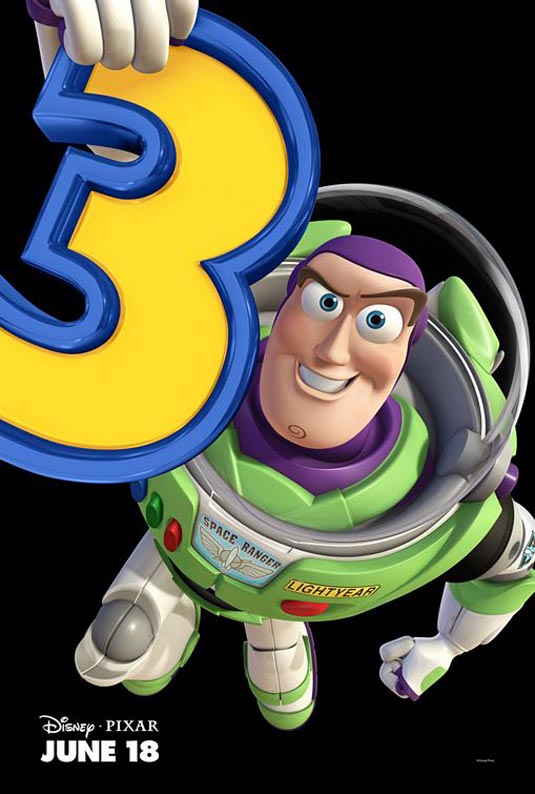
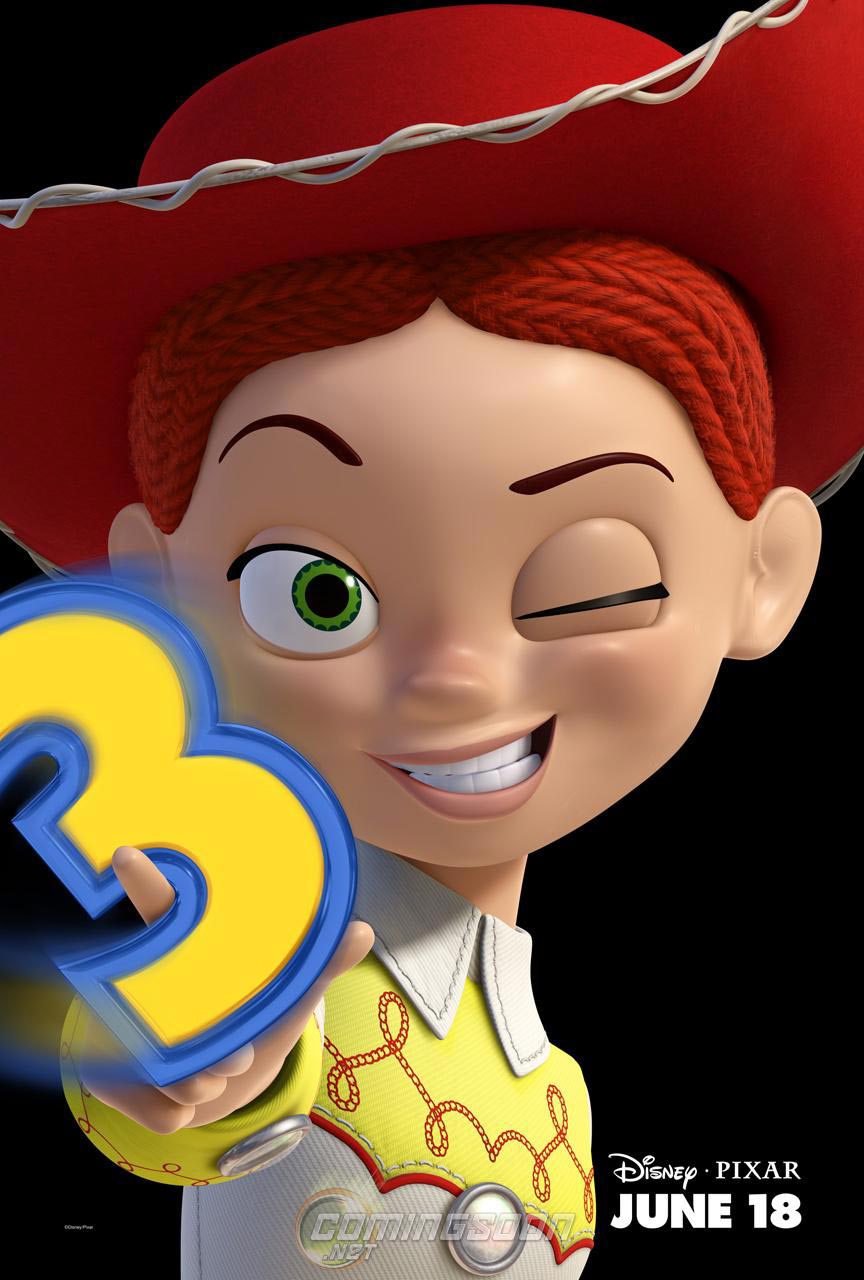
Toy Story 3

A lot of times I write and I "make do." It's alright. I think I got the point across.

And sometimes, I nail it. It's rare, but I'm capable of it. Even if the movie is just about toys. I remember a comment for this post (on that "other" site) was simply "Dude. It's Toy Story 3." (Where are you, Simon?) Yes. And good movies about love can come from anywhere.


Written at the time of the film's release...

"And if You Can't Be with the One You Love, Honey..."

One has suspected a subtle sub-text in the "Toy Story" series—every Pixar film has evoked that feeling (which is why they tower over Dreamworks and every other animation supplier and make even their rivals' three-dimensional films seem more two-dimensional) since the first film premiered (what was it?) fifteen years ago.
 
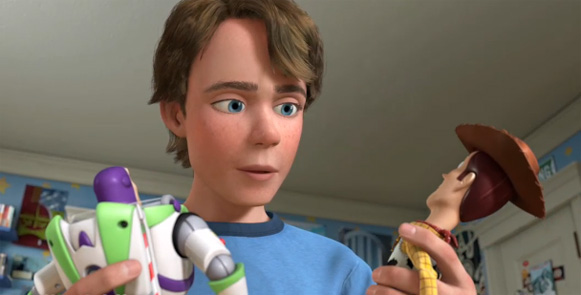
 Toy Story 3 is no less rich in sub-text. Sub-texts like the given that the toys have stayed the same, but their little owner Andy has grown up and is on his way to college by the time we hit 3; First sub-text: Change or be passed over. Any one looking for a job in these troubled times has had to be confronted with their inadequacy in some department while they're winning the daily bread. And like the toys of "Toy Story," time may be their enemy, staying consistent while the world evolves too quickly.
But, at the pace-making heart of the "Toy Story" movies has been one constant, and that is its contemplation of the nature of Love, which puts it in the same movie-case with such seminal works as
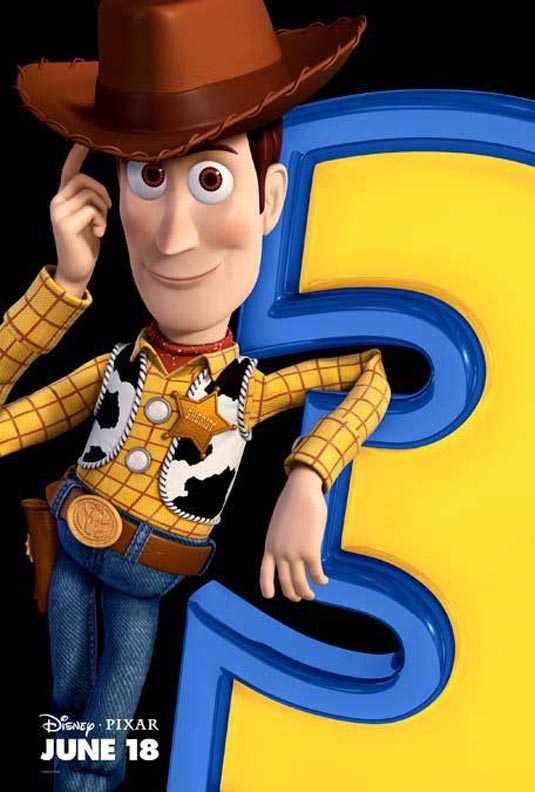
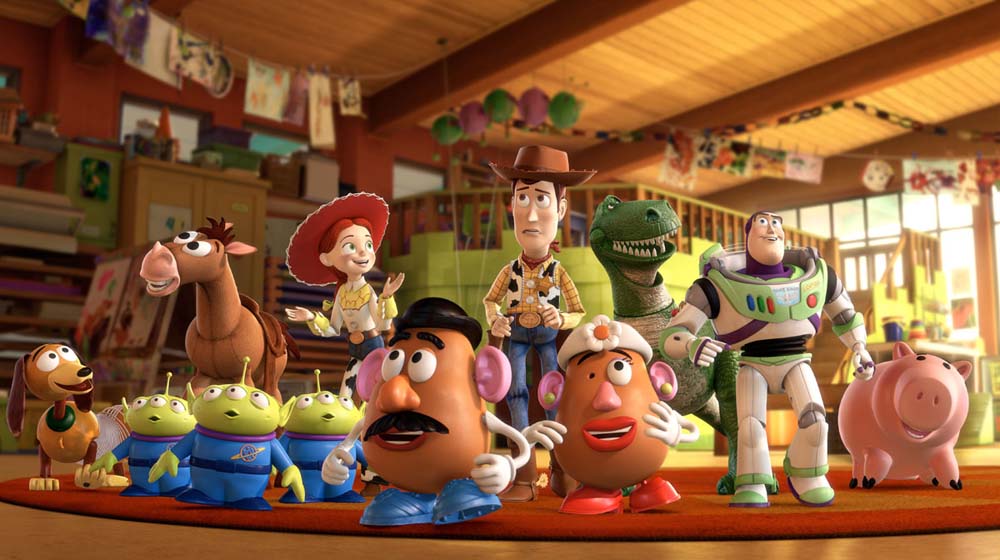
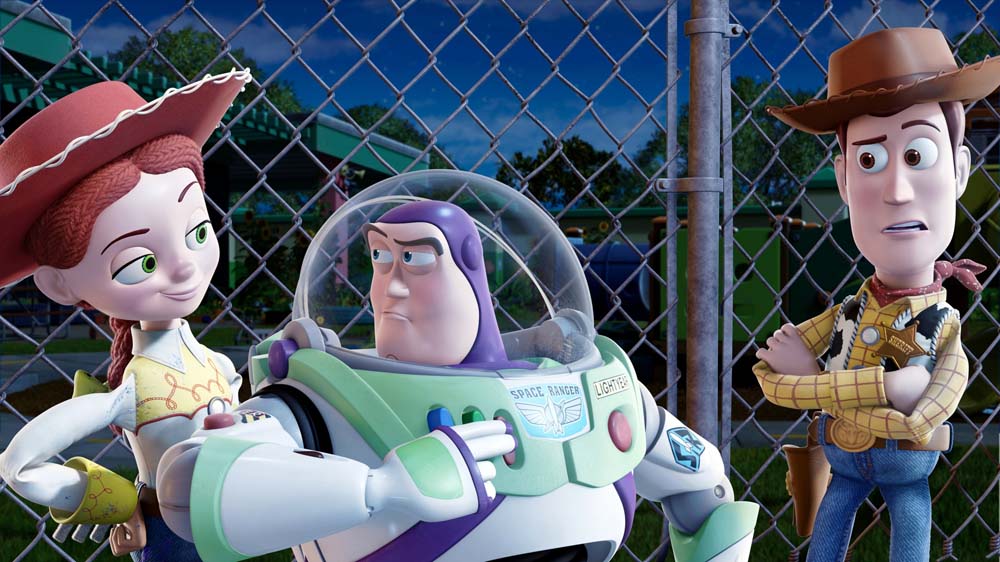
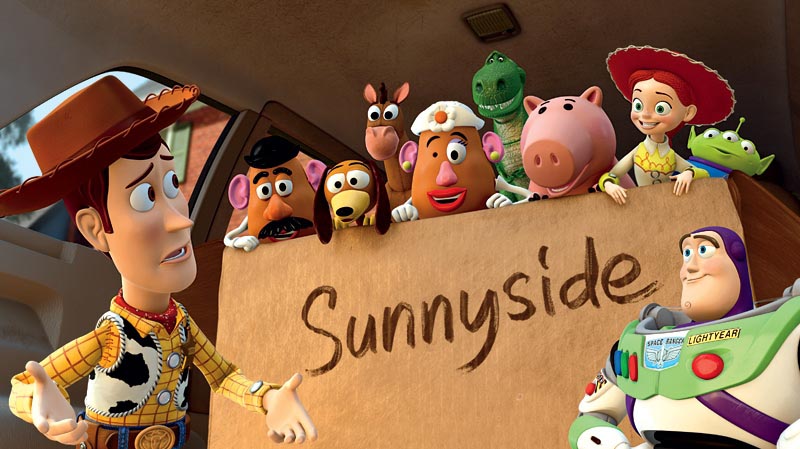
Vertigo and A.I. In the first Toy Story, cowboy-doll Woody (voiced by Tom Hanks) watched in horror as the affection of his beloved Andy was supplanted by the new space-age toy Buzz Lightyear (voiced by Tim Allen). The stakes doubled in Toy Story 2 when we witnessed the discarding of cow-girl Jessie (voiced by Joan Cusack) as her owner grew up and put away childish things (see the video below). And we witnessed Woody turned from an object of play to a rarified objet collectionner, the very definition of a "trophy love." Toy Story 3 takes Jesse's plight and applies it to the entire toy corps, facing abandonment (the attic) and, worse, discarding (at the sidewalk on garbage day). The toy soldiers take action and evacuate the premises first: "Once the garbage bags come out, the army men are the first to go" barks the commander (R. Lee Ermey) before para-sailing out of Andy's bedroom window. 
 
The others are left to contemplate their fate. 
 
Play-time's over.*

There is one axiom I've held to my heart from the moment I first recognized its truth—I'm sure it originates elsewhere, but I first read it from thriller writer John D. MacDonald: "Love is not the opposite of Hate; love and hate are merely two sides of the same coin. The opposite of love is indifference."
 
There are a lot of instances of indifference on display in Toy Story 3 (though certainly not at the hands of the creative team behind it, who have filled it with pithy circumstance and finely-wrought detail in a cartoonish 3-D photo-realism
**). But, so is love, in the through-line from the first movie, first warbled in Randy Newman's opening song "You've Got a Friend in Me." It is the banding together of the community, standing stuffed shirt to plasticene shell through adversity, the toys' answer to "Can't We All Just Get Along?" All the movies have centered around the toys—diverse as they are—keeping the group together, and welcoming the new. That reaches its dramatic climax here as the team locks hands as they face absolute destruction in a truly frightening version of Hell.
The forging of the community has been a theme running throughout the history of film (especially Westerns) since Edison, certainly John Ford, and we've all seen those films where the protagonist loses a family in order to gain another, sometimes not by choice. Those bonds are infused with strength to take on all comers and all challenges, but the heart of that coming-together has always been the one unofficial but over-arching Commandment: Love thy Neighbor.

 
I mentioned putting away childish things earlier. That's from The Bible (1 Corinthians 13), and looking over that verse again, I saw images spring up from Toy Story 3—"And though I bestow all my goods to feed the poor, and though I give my body to be burned, and have not love, it profiteth me nothing," particularly.  But especially its last devastating quality in its check-list of Love's qualities, which always makes me tear up a little when I contemplate it, and I contemplate love and loss. For toys break, batteries corrode, fabric burns and plastic will melt. But Love "never faileth."
 
Love never dies.
 
To Infinity.
 
And Beyond.
 
* How many times have we said that, as adults, mourning the loss of childhood from adult responsibilities?

** But, man, you want to see Pixar push the envelope?  Check out the sophisticated opening short Day & Night, a wordless combination of 2-D and 3-D, line animation and computer graphics, filled with rich imaginative ideas and a brilliant sound design.  The work of animator Teddy Newton, this little gem, puts him at the top of exciting animators to watch.

Friday, October 11, 2024

Frankenweenie (2012)

In this recycled review, I spend a lot of time complaining about Tim Burton recycling material...("...the nerve!")

Speaking of nerves and things, this was written at the time of the film's exhumation....

Recycled Material From the Grave
or
"I Can Fix This..."

Really, it's a little soon for Tim Burton to be re-making one of his own films—albeit his first live-action short for Disney. One worries that maybe he's run out of ideas, or that he's simply doing what he's always done—take a property and combine it with that goofy blend of the kinky and ghoulish that he has made his own...it's just that this time the property is his...and he's already made it his own once. Maybe, he looked at this product of his younger self with limited resources and thought "I can do better. I can do more." Or along the lines of young Victor Frankenstein, he looked at it his earlier creation and vowed "I can fix this."
At the time of the live-action short, Disney looked at the product of their young animator...and promptly dumped it...only acknowledging it when Burton became an A-list director (with some studio hesitancy) with the first "Batman" film.
* Now, Disney is crowing about its brand new Burton movie, and one can only imagine the wry smile that must produce for the director. It was natural for Disney to want an expansion—they owned the property—and although this new version of Frankenweenie has a lot of (dare I say) re-animation of material, it did give Burton a chance to give it a little more depth and play around without the inhibitions of live action.
I say inhibitions rather than limitations because the differences are exhibited in a weird and rather contrary way, given that the film is done with puppet figures: emotion. The character of
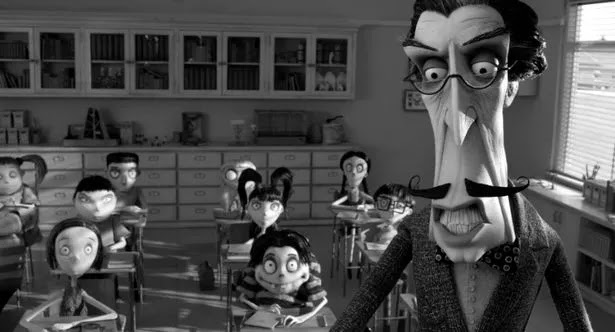
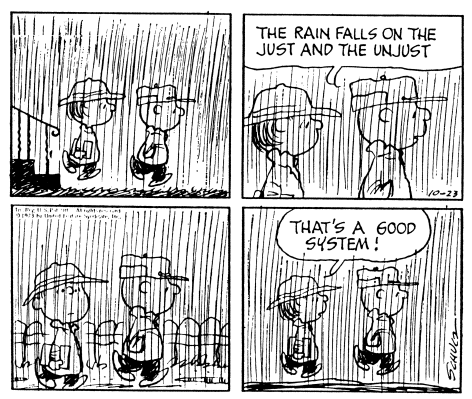
Sparky exhibits a far greater depth of moods than a trained pit-bull terrier could exhibit in live action, not only in its darker moments, but especially in moments of joy—the animation of the dog running elicits fond feelings immediately, as the puppet is rarely touching the ground in motion, not unlike Charles Schulz's "Peanuts" kids who hover over the ground in transit. And although the human figures are Burton cyphers (resembling the human character designs of his first film Vincent) they are still soulful, their eyes expressing more emotions than their faces will betray.
Given that the subject matter is about a mad scientist of a little boy who runs the parallel path of his literary namesake to re-animate his beloved dog, killed in a traffic mishap, there's a lot of room for high emotion there, and far more than in the motivations of the original story.

But, Burton takes it further and makes it more than about young Victor. Taking pages from The Nightmare Before Christmas and Batman Returns, he stages the denouement at a city festival that brings all parties together in one spot, the communal experience gone awry.
Seems that Victor's work has attracted a lot of attention among his classmates, and as there's a science fair going on, all the kid's are doing the same thing—literally, the same thing, bringing to life their dead pets with very mixed results, and providing Burton a chance to explore other species of monster movies (and recreating scenes from them) than just the one, paying tribute to each, just as he does by including a scene from friend Christopher Lee's turn as "Dracula."
Like Victor's experiment, this is a labor of love as Burton—just as with the earlier short—resurrects the movies he loved as a kid, long-buried memories that never really leave, and have influenced Burton throughout his career. It's a fun, resonant electrification of his earlier work, with just enough fresh in it to make it worth the effort and bring it back to new life in leeched black-and-white (which Burton always manages to make look sumptuous). Now, if only we could see something wholly new and original from him, that would be some experiment.

The original Frankenweenie


Brad Bird's "Family Dog" (from Steven Spielberg's "Amazing Stories") based on animation designs by Tim Burton

* It did find it's way to Paul Reubens who'd been trying to find a suitable director to collaborate on his long-in-the planning Pee-Wee Herman movie he'd been dreaming about.  Frankenweenie convinced him to contact Burton.


Friday, October 4, 2024

How to Train Your Dragon

We looked at Chris Sanders' new film, The Wild Robot, yesterday, so here's a look at one of his previous efforts, written at the time of the film's release.

It should be noted that How to Train Your Dragon has gone on to have two sequels, five shorts based on it, and a live action remake scheduled for late next year that will star Gerard Butler—one of the voices of the first one! (Is that a first? Does James Earl Jones in both versions of The Lion King count? Yeah, I guess it does.)
 
"Dragon Everyone to Your Level"


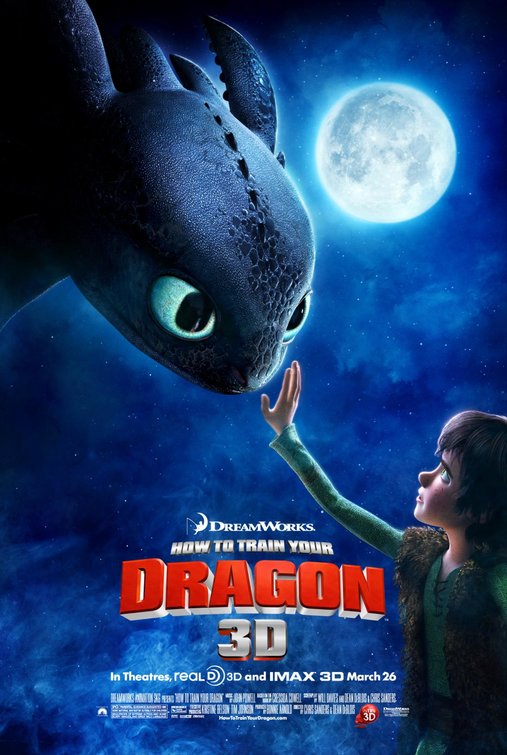
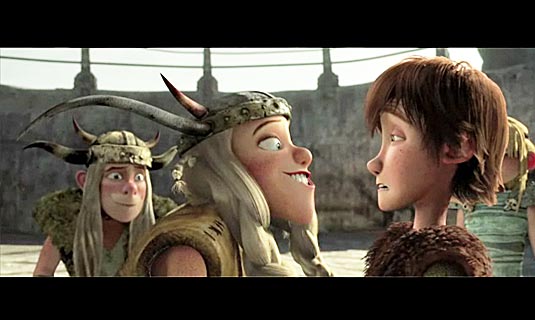
Okay, it's "Old Yeller" done in fire-breathing naugahyde. It's a kid's animation movie, so it's going to be fast-paced, lively and have a "Can't We All Just Get Along" ending (in a creepy Rumsfeldian "the enemy of my friend/enemy is also my enemy" way). The casting is terrific, especially of Craigy Ferguson as a Viking machinist (Wait a tick...Vikings were Scottish?). Gerard Butler has the role of father to the protagonist and plays it as if he was always pointing to Sparta on a map. Jay Baruchel (the star of She's Out of My League) does voice-cracking wonders with the voice of our hero, Hiccup, who is just not Viking material, but manages to subdue—even win the trust of—a dragon (seems the flying butane-breathed lizards have traits just like house-dogs and cats). Still, keep the extinguisher handy in case of fur-balls.

No points to
How To Train Your Dragon for originality (as I haven't read the book, I don't know if that's where the problem flies, but I suspect it's merely that DreamWorks animations—2-D or 3-D, line or pixel—are so formulaic in construction at this point, splicing pop-culture and source, that they have a tendency to blend together at the same point in time as your eyes cross—is this a Katzenberg trait?). There's always an out-of-time attitude displacement to these things where every character has the traits of a stand-up comedian and the homogenized values of a sit-com, that you have to keep reminding yourself—"Viking, Vikings, Vikings." 
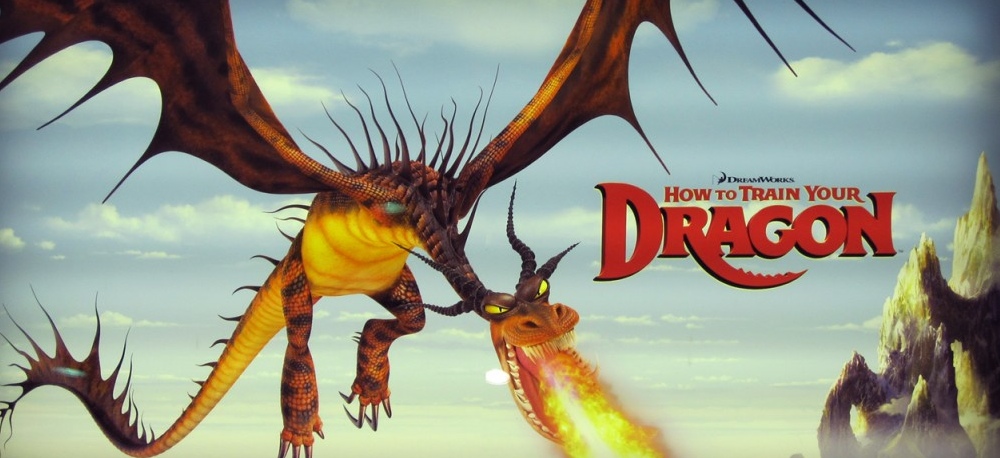
However, major points for execution. The technology of these things increases with one being released every six months, and How To Train Your Dragon has a nifty design scheme that reminds one of impossibly constructed children's play sets—the Viking village is the niftiest little chock-a-block city since "Sweethaven" in Robert Altman's Popeye. The dragons are cartoon lunacy out of Tex Avery and the full-blown Vikings, like Hiccup's Viking-father, Stoick, are madly out of proportion humans who'd wobble and flail if there weren't some pen-and-ink gravity keeping them up-right and bounding. 
Conversely, the other extreme is impressive, as well. The look of clouds and ocean waves has never looked more real—the look of coastal waters has never seemed more real, whatever coding and algorithms used to simulate the wave action are spot-on and
indistinguishable from photo-realism. I saw How to Train Your Dragon in 2-D, but the 3-D must be quite impressive, it certainly was in Monsters vs. Aliens, and there seemed to be no over-loading of nose-brushing effects that has been the bugaboo of the process.
All around it's a satisfying effort that will please the kiddies, and provides enough entertainment value to keep adults from nodding off, or rolling their eyes. The cookie-cutter nature of the plot is the only thing that keeps it from being an absolute must-see.

Thursday, October 3, 2024

The Wild Robot

"If I Could Talk to the Animals"
or
"What Do You See When You Look at Him?" 
"Crushing Responsibility"
 
Watching movies is always subjective. Your favorite movie may be someone else's bane (I don't plan or participate in "Movie Nights"). And one becomes selective. I'm particularly selective when it comes to animated features—I grew up watching Disney and Looney Tunes (the best!) and the output of Hanna-Barbera (limited animation and derivative plots), but also recognized those elements that were excellent where others left a lot to be desired—the Jay Ward output had really limited animation but the writing was clever and often brilliant). 

I'll hold off watching the Troll movies, or the Sing! movies or anything else that looks like it might push my negative buttons (the one that goes "Eject" for example) because I'm older in years and I'm at the point where I don't want to waste the fleeting hours I have left to me.*
 
So, yeah, I'm picky, as are you. I will not MISS a new Pixar Studios release and SEE it in a theater—I don't care how big your flat-screen is, it can't do justice to Coco—and I will usually see a new Disney feature because the early Pixar brain-trust is involved with those. With everything else, I'm choosy.
The Wild Robot was an easy "go". Based on Peter Brown's children's book, it tells the story of a utility robot, a model of the Rozzum series (this one's #7134 and voiced by Lupita Nyong'o, who is both precise and subtle), who, after a freighter capsizes in a typhoon, is washed up on an uninhabited island, more or less intact, and switched on accidentally by curious otters and proceeds to perform its duties—which is to help, solve a problem, and complete a task. Simple. Like a robot! But a robot in a forest does not compute. It's digital and everything on the island is so...organic! The animal-life is scared of this chrome trespasser and they just want to run and hide, despite the Rozzum's constant inquiries "Do you need...assistance?"
But, if there's anything about the Rozzum, is that it can learn—emulating a crab climbing a cliff saved it from being smashed by a large wave—and so, it sits and goes into "Learning Mode" until it is able to decipher the squeaks and grunts and chirps the animals make and understand it as communication tools, and the first thing they ask is "Are you here to kill us?" "Negative," it replies, but seeing the futility of trying to help these animals, Rozz decides to activate its homing retrieval beacon, but it attacked by the bear, Thorn (
Mark Hamill), who breaks it. No retrieval, no "phone home."
Speaking of breaking, Rozzum's initial clumsiness leads to disasters several minor instances and one major familial one. It falls into a nest, destroying the family, with the exception of one egg. As the rest of the family is beyond repair, "Roz" takes the one egg and, seeing as there's a life-form inside, decides to keep it safe—a herculean task as there's a hungry fox named Fink (
Pedro Pascal), who just happens to be peckish for an omelette. After the two come to a self-beneficial truce, Fink, in his own conniving way, helps Rozzum to understand what it is she is protecting, and once the egg has hatched a gosling—that imprints itself on Roz—instructs Roz on what goslings (and some foxes) can eat.
Now, there's already a lot of story there, and this Wild Robot is made up of a lot of recycled material: the "fish-out-of-water" trope, the Chuck Jones cartoon "8-Ball Bunny" ("Oooo! I'm dyyyyyin'!"), E.T.:the Extra-terrestrial, Wall•E, Noah's Ark—that will come later—and several other bits and pieces snatched from other media and cultures. But, there's another one that it takes a final page from and that's Bambi—like that movie, The Wild Robot acknowledges death and that "nature is red in tooth and claw." There is a pecking order on this little island and the small things get eaten by larger things and there is the risk that a character you might like won't last too long.
This makes the care of the newly-hatched gosling—Rozzum labels it "Brightbill" (played by
Boone Storm and Kit Connor, at different stages of development)—that much more imperative. Roz has no idea how to raise a gosling and complete the task, so Fink suggests a neighbor opossum named Pinktail (Catherine O'Hara), who has plenty of off-spring, thank you, for some mothering advice. This comes down to three skill-sets: keeping the gosling fed, teaching it how to swim, and teaching it how to fly before the geese on the island make their winter migration off the island.
Food's not a problem, Fink is good at finding food—especially food that Brightbill can't eat (so, more for Fink) and Roz builds a shelter out of stones to make an enclosure to ensure its charge's safety. Teaching it to swim and teaching it to fly are other matters in terms of complexity. Oh, Roz can pull up facts on buoyancy rates and aerodynamics, but it's not the same. This little runt is going to need some extra-mentoring if it is ever going to leave the nest that Roz has constructed.
All this with the added story-rule that there are predators and there are prey and Brightbill is a tasty little morsel of a nugget. And as one gets to meet other creatures, like 
Matt Berry's grumpy beaver, Ving Rhames' falcon, or Bill Nighy's old goose, you realize that not every living thing on the island gets along. As someone says in Nature, "kindness is not a survival skill." All Roz wants to do is complete the task, as is its protocol. But, motherhood is just not in the programming.
So, there's a lot of basics familiar from other sources, but, the trick is trying to do it better and make it unique despite the provenance. That is something The Wild Robot does very well, taking the story places that the others hadn't and giving you fresh insights, while also charming the heck out of you. That seems to be the Dreamworks Animation trick—taking familiar things but making them seem bright and shiny again. They do that in the story...and in the artistic side of things, as well.
Where the Pixar pixelators seem to have the goal of making things look as photo-realistic as possible, Dreamworks goes another direction. I noticed it with their Puss-in-Boots: The Last Wish, a push against the reality of things and, instead, making things more impressionistic. It might be that it helps reduce the render-time of complicated images, but one can safely say that the complexity of images isn't sacrificed—there's a scene with a tree that explodes into a kaleidoscope of butterflies that is simply breath-taking to behold. The result, especially in the animation, is to give it a story-telling schmere that only increases the wonderment of what you're watching.
That is some amazing creativity on display, and between that and the directions that the story takes (and despite a jolting action-oriented third act), The Wild Robot is one of those great animation products that deserve to be considered a classic, going beyond its programming to become something very special.
 
It's the easiest "go/no go" decision you could make at the movies this year.

* I just finished reading "Opposable Thumbs," a not-bad book by Matt Singer about the history of "Siskel & Ebert at the Movies" in all its incarnations, and as much as those guys LOVED movies and LOVED reviewing movies, they got to a point where they said "if you think the movie's garbage, get up and leave! Life is too short and too precious to waste."

Saturday, August 10, 2024

Robot Dreams (2023)

Saturday is traditionally "Take Out the Trash" Day, but this Saturday, we'll make an exception with this wonderful little animated film.

"Do You Remember..."
or
The Counter-point to "Rust Never Sleeps"
 
"What a piece of work is a man!"
William Shakespeare

Interesting way that Shakespeare says that. "Piece of work"...like a construction. A machine. And what is our relationship with our machines, to whom we are both master and slave? 
 
When Stanley Kubrick was working on the story that would be completed by Steven Spielberg as A.I.: Artificial Intelligence, one of the push-backs he got was whether human beings could love mechanical beings. He found nothing odd about it. How many of us anthropomorphize our devices: how many of us name our cars or festoon our work-stations with family pictures and beloved ephemera? A high percentage in my experience. 

And it's been the subject of many movies of late: her and Blade Runner (both versions, but especially Blade Runner 2049 with its "Joi" holographic companion) or the lesser-known Robot & Frank.

Pablo Berger's amazing Robot Dreams (based on the graphic novel/children's story by Sara Varon) looks very retro, employing a deceptively limited animation style (but within a complex background of New York, circa 1980's) to tell a tale of emotion, companionship, complexity and Fate without a word of dialog...a feat that belies any lack of sophistication in the process. That the world is populated by animals, well, that's a once-remove to push a point, the same way Zootopia does. 
Dog (that's his name..."Dog") lives in New York City, and it's dull, solitary existence. He plays pong. He makes a TV dinner in his micro-wave (which he drinks with "TaB"). He watches TV. He looks out the window and sees happy couples. He's lonely, as lonely as one can be in the most populous city in the country. An ad pops up asking "Are you alone?" and before you can say "but, wait, there's more!" he's ordering what they're selling—a robot companion, the "Amica 2000." It arrives and he spends much time on the construction and deciphering of the instructions.
But, once Robot's lights all turn green, they become fast friends, walking around Manhattan, Central Park, and doing the things one does in New York—eating hot dogs, roller-skating in the park, sight-seeing, going home, watching TV...it's Fun City, and all set to the happiest song ever written: Earth, Wind and Fire's "September" (the movie makes great use of the song, breaking it down, and using it in various forms throughout the movie).
Dog and Robot became constant buddies and inseparable friends. Then, Dog takes Robot to Playland, where they spend a great day on the beach, flying kites and swimming. A nap in the sun for both of them ends with Dog indicates it's time to go. But, Robot can't move. He's rusted. Dog tried to get Robot off the beach, but he's much too heavy, so they agree that Dog should leave Robot there, find a way to repair Robot, and in the morning, they can go home. But, when Dog rushes out there to get Robot, he finds the beach shut down for the season and he can't get to Robot and is charged with trespassing. Another attempt, he gets arrested. When he appeals to the Parks department, he is denied. All he can do is wait until next year when Playland opens again.
In the meantime, Robot is left on the beach...and he dreams. What else can he do?
 
Pretty simple story-line, but Berger imbues it with detail and much humor, reminding one of the ingenuity employed by directors of the silent age—while also paying homage to such diverse directors as Hitchcock, Kubrick, and Allen.
We'll leave the synopsis there, as where Berger and his co-scenarist Varon take the story becomes more complex and richer, having to do with experience and nostalgia and how you never really lose those no matter what else you lose along the way. it could be a fanciful rom-com if the trajectory of events didn't run counter to the expectations of that genre. It's sweet and sad, but has a particular life-affirming quality that warms the heart and is instantly relatable, even if you're nothing like the denizens of this animated New York and merely a poor player of a human being.
I can't recommend this one highly enough and one hopes that you get the chance to catch it in a theater where it should be seen.
 
And as for the question of emotional attachments to our devices, it's not so fanciful an idea, either. Every computer, lap-top, smart-phone, and pad you own has memory. And it's all about you. 

Friday, May 3, 2024

Hundreds of Beavers

Beavers and Butting Heads
or
Frankly, My Dear, I'm Gonna Build a Dam!

Doldrums. You get stuck in them and circle around not making any progress. This kind of drudgery can lead to a lack of enthusiasm, depression (if it goes too far), and the missing of posting opportunities because...meh...why bother? It makes you do things like take a negligible romp such as The Ministry of Ungentlemanly Warfare and try to apply some critical rigor to it. Such activity should be punished by writing 100 times on a blackboard the old Alfred Hitchcock line "Ingrid, It's Only a Movie!"
 
The solution, of course, is to slap yourself around a little, get the hell out of your rut and do something different. Take a chance. 
 
Like going to your local art-house theater to see a movie that looks so nuts and so juvenile that any attempt at critical pretentiousness is a completely pointless exercise. 
Such a movie is Hundreds of Beavers, a sort of mixed-media "Looney Tune" of live action and anything else that could be thrown onto the screen, be it animation, stop-motion and line-drawing, CGI, green-screen, puppets, people in costumes, and what-not ("what-not" encompassing things I couldn't figure out—it goes by so fast!). None of it is done with what you would call "finesse," feeling at times that it has the technical look of a "Clutch Cargo"® cartoon*; it's definitely "lo-dig'".
Hundreds of Beavers
tells the story of Jean Kayak (
Ryland Brickson Cole Tews), a North American settler and prosperous apple-jack distiller and seller (and consumer), who has his business destroyed when beavers weaken the supports for mammoth kegs, sending them careening down a snowy mountain to crash into his house and explode in his fireplace, destroying his business and his apple orchard. Jean is, at once, homeless, work-less, thirsty and dang hungry, but finds that all his attempts to survive are undone by Fate and his own clumsiness. Somehow he must survive in the wintry wilderness by only his wits. Or half of them, anyway.
Because Jean is not the most adept outdoorsman. Food is abundant, but he can't fish, he can't hunt, nor does he have the tools to accomplish much. He must live off the land—starting fires (the wind blows them out), hunting rabbits (they beat him up), stealing eggs (always out of reach and birds like to peck his head), fishing (no bait), and anything he finds by accident are soon consumed by the local wildlife. Plus, his learning curve is nearly flat, requiring much trial and error, but mostly error, each go-'round a new and painful lesson.
Finally, he manages to land some fish, taking them to the local merchant (
Doug Mancheski) for trade. At the post, he meets the merchant's lovely and provocative daughter (Olivia Graves), a furrier, as well as a Master Fur Trader (Wes Tank), who takes him under his wing to teach him the ways of the wild.
It could be Jeremiah Johnson done as a silent comedy (although it's not silent, the film is almost purely visual), by way of Buster Keaton done through a Chuck Jones lens, and cavorts into Fritz Lang territory as Kayak learns the true nature of what the busy beavers are up to in his neck of the woods. Imagine a Peter Sellers comedy (re-imagined by Terry Gilliam) with the reckless disregard for the laws of Nature—and physics—of a "Roadrunner" cartoon played at double-speed and you'll get the idea.
At times, it gets a little too complicated and maybe there are a few too many call-backs, but excess doesn't seem to be something the filmmakers were worried about. One can't deny that at many points it's just laugh-out-loud funny and endlessly inventive to the point of being ingenious, and one's affection grows as the film builds and builds until you finally give yourself over to the film while admitting that Beavers might have bitten off more than it can chew.
But, then, there is nothing wrong with that. One would rather see a movie "swing for the fences" than merely get by, leaving wasted potential like so much popcorn on a theater floor. By embracing old and new technology and with its dedication to cramming as much goofiness into its comparatively meager one hour forty-right minutes, Hundreds of Beavers manages more laughs per nickel spent than any movie release I've seen in the last ten years.

A selection of "Hundreds of Beavers" posters....
    
Clearly, these guys have a lot of time on their hands...
 
* Clark Haas