Re-Tooling Pinocchio
or
"All Good Things Require Patience"
Good Lord, we're certainly in a nostalgia craze right now, but then self-isolation will do that to you. Spielberg did Fabelmans, Mendes does Empire of Light, and now del Toro makes a film that was inspired by an early childhood movie memory of his youth, his own version of Pinocchio. I can't fault him; I loved that movie as a child—and was obsessed with it, too. But, that was Disney's Pinocchio made in 1940. It's of a different time and a different sensibility.
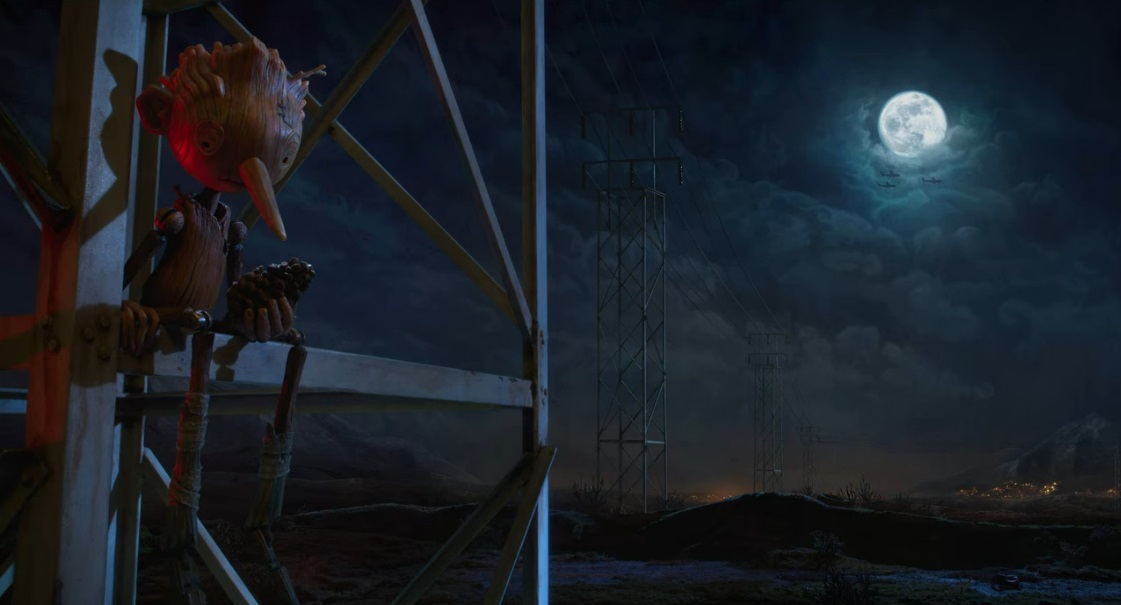
Guillermo Del Toro's Pinocchio is quite another creature entirely. For one thing, it's set in the fascist Italy of the 1930's. And the puppet is a puppet, never losing his bark (as it were) and without the embedded wish of being a real boy. He's real enough and high on, if not life, anthropomorphism. But, he's a block of wood, cut from a tree, without the benefit of paint or clothes as per the Disney version (and the recent Robert Zemeckis adaptation on Disney+).
And this version isn't 2D animation or CGI as with those. This is stop-motion animation, that pain-staking movie-making done (as with most animation) frame by frame. I've always had a soft spot for this type of work, be it from its earliest days of King Kong, through the mesmerizing work of Ray Harryhausen to the improvements of "go-motion" developed by the wizards like Phil Tippett for the Star Wars films. To think of these guys, with their little play-sets, moving their figures inch by perceptible inch, bearing in mind the incremental differences in perceptible motion and speed!) to create the illusion of life on film reveals not only the imagination but the science and mechanics of making moving pictures. We won't even talking about the commitment of walking to a studio knowing you'll probably only get a minute of film done (if you're lucky) every day.
 So, hats off to Mark Gustafson, who co-directed this—while del Toro was off directing live features, promoting them, winning Oscars, getting married and supervising his vision of what "his" Pinocchio story should be. Gustafson's work is incredible...and convincing. You get lost in this world and its creatures, all with their individual quirks and personalities (they move differently—by design, Gustafson's design). Those are determined by del Toro, they are brought to life by Gustafson's steadfast and steady work.
 You know the story. Simplified, the story goes like this; Gepetto is a wood-carver/toy-maker who makes a humanoid marionette with the wish that it might be a real boy. Supernatural powers animate the puppet and, after the usual chaos that an energized blunt instrument can inflict, Gepetto insists that the thing go to school to be socialized, forgetting that society sees Pinocchio as a puppet walking around without strings and thus, something exploitable. Pinocchio gets gathered like kindling and tied up in a traveling show. Much searching occurs until getting swallowed by a whale, at which point, Pinoke proves his worth saving everybody and is rewarded.
 But, it's the details. Disney's version leaned on the "wants to be a 'real' boy" wish, starlet-pretty fairies, anthropomorphized animals, and an emphasis on good behavior (while, curiously, demonstrating smoking, drinking, gambling, and vandalism) tent-poled with a lot of classic songs that perpetually show up in modern culture as well as hawking trips to Disneyland. The lesson to it all is "Always Let Your Conscience Be Your Guide," which implies that the conscience leads to good behavior that is accepted by society, the church, and the family. And that "being a real boy" is the sine qua non of life.


As they say at "CinemaSins": "That's speciest!"


The sight of Pinocchio (Gregory Mann) gallivanting cluelessly and curiously around his work-shop filled with sharp objects understandably freaks out the hung-over Gepetto. And his instincts are to curb his enthusiasms or, failing that, lock him in the closet to minimize the damage he causes. It's easiest to do the latter, ironically when he's going to church) But, Pinocchio cannot be contained and he follows his "Papa" to the humble chapel adorned with a crucifix built by Gepetto.


And it adheres to the "Always Let Your Conscience Be Your Guide" maxim in a way that works in a complicated way where Society may not always be in the right. I like that. Like the movie itself, its heart is is exactly the right place where it should be, even if there is no heart in evidence.
This is a Pinocchio I can admire, no strings attached.


.jpg)