Showing posts with label Helena Bonham Carter. Show all posts

Tuesday, November 5, 2024

Merchant Ivory

Merchant/Ivory
(Stephen Soucy
, 2023) The name of "Merchant Ivory" has long been prejudiciously associated with a certain type of Oscar-bait movie, long on dialogue, high on landscapes, and attracting English actors of such a high caliber that they usually end up on Oscar short-lists for their performances. They have such a high pedigree that you'd never know that the films were lower budgeted than what was evident on-screen, and that the films were made by the skin of the teeth of Merchant Ivory Productions, sometimes risking scuttling the projects before they could be finished, and leaving the actors with a malevolent "Never again..." ("It required an immense amount of stamina" says Emma Thompson "to work for Merchant Ivory") only to be entranced, seduced, cajoled and convinced by either Merchant or Ivory to come back for another go-'round. And despite suspicions that they were being flim-flammed (once again), they did come back. Because to be in a "Merchant Ivory" film was a prestige gig.

The team (which wasn't just producer Ismael Merchant and director James Ivory, but screenwriter/novelist Ruth Prawer Jhabvala and composer Richard Robbins) wasn't afraid to buck current movie trends, go its own way, and chart its own course, self-assured that there was no down-side to going high-brow. And the new documentary Merchant Ivory quite giddily tells the story of the mess in the kitchen that provides the elegant meal. "It'll probably be something you're wildly proud of" says costumer Jenny Beavan of each MP project, "but...."
The beginning of the story involves the meeting of James Ivory (from Klamath Falls, Oregon) and Ismail Merchant (born in Mumbai—although it was Bombay at the time) at the Indian Consulate in New York, where there was a reception for a documentary Ivory had made in India. The two became partners, personally and professionally, their first project together an adaptation of Ruth Prawer Jhabvala's "The Householder"—her husband told her not to get involved with them, but she became enchanted with Merchant's Bali-hoo and "I liked the razzmatazz." It was not the smoothest first film of the partnership as the money ran out, but Ivory hated shooting in the Delhi heat, and when it came time to edit the film, they turned to Indian filmmaker Satyajit Ray to put it together. Merchant sold it to Columbia Pictures "by some miracle" and used the profits to make their next film Shakespeare Wallah.
They made four films in India and then went international with some weird choices: Savages, The Wild Party, but then settled down with such high-brow fare as 1979's The Europeans, 1983's adaptation of Jhabvala's Heat and Dust, and 1984's The Bostonians, until things exploded (mind you, it was an elegant, mannered explosion) with 1985's A Room With a View, which not only received tremendous critical acclaim and great box office, but also was nominated for the Best Picture Oscar. Rather than sign with any studio, Merchant Ivory chose to stay independent and in 1987 took the company public.
Produced by Cohen Media Group (which now owns the entire Merchant Ivory catalog) Merchant Ivory tells the story of the film-making team: Ismael the producer, James the director, but also, essentially and unquestionably, in what one of the participants calls "the Merchant Ivory vortex," Ruth the writer and Richard the composer. The four of them, each with a different personality—Ismael voluble and hyperbolic, James "quietly determined," and "unneurotic," Ruth the arbiter of taste and Richard the musical soul—formed a social and working club-house of essential ingredients, each with their specialty, but in close collaboration that influenced their projects and shaped the direction of the company and the films produced by it.
It's divided into six chapters, but, like the company itself, doesn't seem to adhere to each chapter's subject matter, cascading into other stories that spring to mind, but essentially telling the overview of the story in a chronological order, with particular asides for projects that garnered particular attention. They are:
 
Chapter One The Wandering Company: how two opposites in temperament and origins joined forces as independent film-makers—each had made documentaries by that time—and as a couple and began making relatively inexpensive films in India, the first of which brought Ruth Prawer Jhabvala into the mix (she adapted her own novel for them) as Muse, Arbiter of Taste, and the Book-Cracker, who would boil things down to essentials and if something wasn't up to her standards, she'd fix it.
Merchant's first visa to the U.S.: notice how he scratched out "Profession"
 
Chapter Two: the Mystic Masseuse: the story of Ismael Merchant, a man of Big Dreams and wide contradictions—gay, Muslim, a wheeler-dealer and con-man ("Yeah, sure, he was" says Ivory), extravagant in his ideas and juggling deals in order to achieve them, but never selling out to a studio in order to maintain independence over his company's work. Crew members talk of his being on the set constantly imploring Ivory—"Shooot, Jim! Shooot!"—shaking their head in astonishment "This rascal has done it again!" Hopkins ruefully smiles as he says "He can talk the birds out of the trees."
 
A Room with a View (1985) A water-shed moment for the company when international success comes to them after years of defying expectations and scraping by financing their films. Their dedication to authors like Henry James and E.M.Forster pays off and brings them critical and audience acclaim as well as much attention from the many awards groups. They are still financially rocky, but are no less dedicated to their favorite authors.
Chapter III: The Unspeakable Vice of the Greeks James Ivory, being the last survivor of the Merchant Ivory core, talks about his growing up as something of an outsider—adopted, intellectual, closeted—but collaborators and actors talk about how he's the least problematic director they've ever worked with and he comes across as easy-going, honest, unapologetic, with no regrets and certainly no resentfulness.
Maurice (1987)
Ivory wanted to make an adaptation of Forster's posthumous novel of homosexuality and class, which Merchant had qualms about—after the success of A Room with a View, why risk it—but "the vortex" went ahead with it with Jhabvala begging off, calling it "sub-Forster" but coming back to fix a crucial plot-point.
Chapter IV Only Connect
The film looks at the life and accomplishments of Ruth Prawer Jhabvala, winner of the Booker Prize for her own work, and her essential partnership with Merchant Ivory—she garnered the most Oscars for her work of the group (along with the costume departments) and her ability to write illuminating dialog for any character, no matter how repressed—and her screenplays are notably free of descriptions—made her the foundation of so much of what was great about Merchant Ivory.
Howard's End 1992 It was Jhabvala who raised the challenge to the team that this Forster work was "a mountain you have to climb" and the film garnered multiple Oscar nominations and an Oscar for Emma Thompson and she and Helena Bonham Carter and Samuel West go into vivid detail about the challenges and memories of working on the film, which was immediately followed up by
 
The Remains of the Day 1993 Most of the people being interviewed agree that this was the apex of the Merchant Ivory group and quite a few focus on Anthony Hopkins' performance for special mention, with Thompson calling out a particular scene with how Hopkins set up the tone and flabbergasted her with his performance. At one point Hugh Grant says "If someone said to me show me perfect film acting, I'd show them Tony Hopkins in Remains of the Day and, in fact, The Remains of the Day is one of the best films I've ever seen let alone been in.
 
Chapter V You Mean a Great Deal to this House This segment focuses on the life and career of Richard Robbins, who was something of a musical savant and began composing for the Merchant Ivory films with The Europeans and worked on every score up until The White Countess in 2005. As is stated in the film, his was probably the most notable director/composer collaborations since Herrmann and Hitchcock or Rota and Fellini.

Chapter VI Head and Heart The last segment talks about the Best of Times, The Worst of Times: Merchant Ivory began to work with big-time studios and working with bigger budgets, which made what they could do a bit easier, but the team began to splinter—Merchant began directing his own films (with Ivory ever-present as an advisor)—and then, time took its toll: Merchant died in 2005, Robbins in 2012, and Jhabvala in 2013. 
 
Only Ivory survives to tell the tale, and he's still working—he's the oldest recipient of an Oscar for his screenplay of Call Me By My Name, directed a film in 2022 (at the age of 94) and he's executive produced four films that are coming out in the next year. It's a fascinating story, with ample amounts of clips, and interviews with some of the finest raconteurs in entertainment. And it does exactly what Cohen Media Group wants it to do—it makes you want to seek out these films and the books they're based on.

Wednesday, May 24, 2023

Les Misérables (Musical; 2012)

The Song of Angry Men
or
"To the Barricades!"

I realize I am not the man to do a critical analysis of Les Misérables, the filmed version of the long-running staged presentation of the concept album produced by Claud Michel Schönberg, Alain Boublil and Jean Marc Natel, (from the novel by Victor Hugo) for many reasons: 1) I'm not terribly fond of musicals, finding the form unnatural and artificial—the inclination to burst into song having the requirement of being necessitated by the surge of emotion, which, if you do it too much, is a bit unsufferable—but, if the words and music are clever, born out of character and need, my prejudices can be batted away in the sweep of sheer admiration; 2) I’ve never seen “Les Miz” on stage, so this is my first exposure to the material, which I found musically strong, with nice linking strains between songs, but the lyrics, for the majority of it, trite and of the “Moon-June” variety, and the propensity to insert (with a guillotine) moments of light-heartedness in the midst of the most dramatic moments; 3) I have never liked the direction of Tom Hooper (who directed the mini-series “John Adams” with a heavy emphasis on unnecessary dutch angles, tortured compositions, and camera movement “baggage” for its own sake, and then directed The King’s Speech with a somewhat less gaudy eye, but a penchant for “gilding the lily” of competent performances with camera and lens tricks.
So, Les Misérables is almost a “perfect storm” of things I don’t like in movies, making me feel a bit uncomfortable about even attempting to discuss it without the need to eviscerate it like an after-meal chicken. Oh, there are things I thought were marvelous—the grittiness of it, the general down-troddeness of the whole thing, the brio of the effort in dragging it, naturalistically, to the screen, when everything cries out to leave it on the stage where it seems the presentation would be at its optimum.
So, kids, let’s get started. I’ll leave out the show itself, which has more than silenced its original critical drubbing by becoming the wildly popular “people’s choice” at the box office, entirely appropriate given its liberté/fraternité themes. Vive “Les Miz” and all that.But the stage presentation was already an odd ying-yang of performers belting out their inner emotions to the cheap seats, confessing their shame at the top of their lungs. To then bring it back down to intimacy, forcing powerful song material to be played out with naturalistic emotions—crying, snuffling, doubt—then compounds the confusion by compromising the musical material from its original intentions.
Then, director Hooper further piles on the emotional dissonance by shooting everything in very tight close-up, so we have intimate emotions couched in thundering expressiveness delivered at a timid range right in our faces. Hooper did no service to his actors here, threatening to expose every mis-step of their performances (which, by the way, was sung and recorded on set in real time) so close that the audience can’t miss it.
How’d they do? Admirably well, considering. Anne Hathaway will surely win an Oscar for the “I Dreamed a Dream” sequence alone, finding the right balance of giving the song its due, while also expressing the grief, humiliation and moments of rage in her character.
*
Towards the end of the film, Eddie Redmayne pulls off a similar gift with “Empty Chairs at Empty Tables” and, surprisingly, Amanda Seyfried makes the most of her moments with a high, feathery voice that doesn’t betray fragility. Hugh Jackman and Russell Crowe are other matters. Both great performers with musical pasts (the former on Broadway, the latter with his vanity band), both are very capable, but the material, production and presentation get the better of both of them, exposing Jackman’s reedy voice (somewhere between Anthony Newley and David Bowie) and Crowe’s pop sensibility to pitch to the note he’s seeking.
The unlikeliest successes are Sacha Baron Cohen and Helena Bonham Carter, as the unscrupulous Thénadier couple, because their song is a knockabout one with lots of stage business letting them loose from the trap of Hooper’s tight framing, and because Cohen is allowed to throw in a couple of ad-libs (in beat, mind you) between lyrics, allowing a little bit of fresh air into the proceedings.
For me, it was a train-wreck that seemed to go on forever, with only a couple of bright spots to give me hope. But, given the production’s history, I’m sure the people will rise above it all, despite the tyranny of the direction on display.

* One of the best lines at the Golden Globes was Amy Poehler’s about Hathaway’s performance: “I have not seen someone so totally alone and abandoned like that since you were on stage with James Franco at the Oscars."  And, yes, she did win the Best Supporting Actress Oscar.
  **  The creators of the stage version must have realized this, too, as they keep turning up and their capering has a tendency to undercut the heavy drama. Entertaining, yes, but at the expense of the rest of the play.

Wednesday, April 27, 2022

Sweeney Todd: The Demon Barber of Fleet Street

Written at the time of the film's release...

"Tim Burton turns everything into 'Sweeney Todd,' so this should be a natural"
Ken Levine, Nov. 18 2007
 
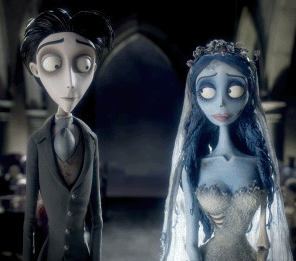
Truer words were never spoken. Tim Burton DOES turn everything into "Sweeney Todd" so there couldn't be a better pairing of director to subject matter. Burton has supervised two of the darkest animated musicals ever made (The Nightmare Before Christmas, and Corpse Bride) and turned them both into charming, imaginative films without once sugar-coating or denying the nightmarish imagery that unearthed those ideas. His favored composer, Danny Elfman (MIA from this film), is a disciple of Bernard Herrmann, whose work was the inspiration for the music lines of Stephen Sondheim's shock-opera. Burton's "usual suspects," Johnny Depp and Helena Bonham Carter , star and, though the major worry was whether they could carry their tunes, they both do exemplary jobs. Depp, especially, only achieves heights of performance in song, so interior is his Todd. And though Carter may not be quite as brassy so much as tremulous, she does more than hold her own with some of Sondheim's trickier tongue-twisters.
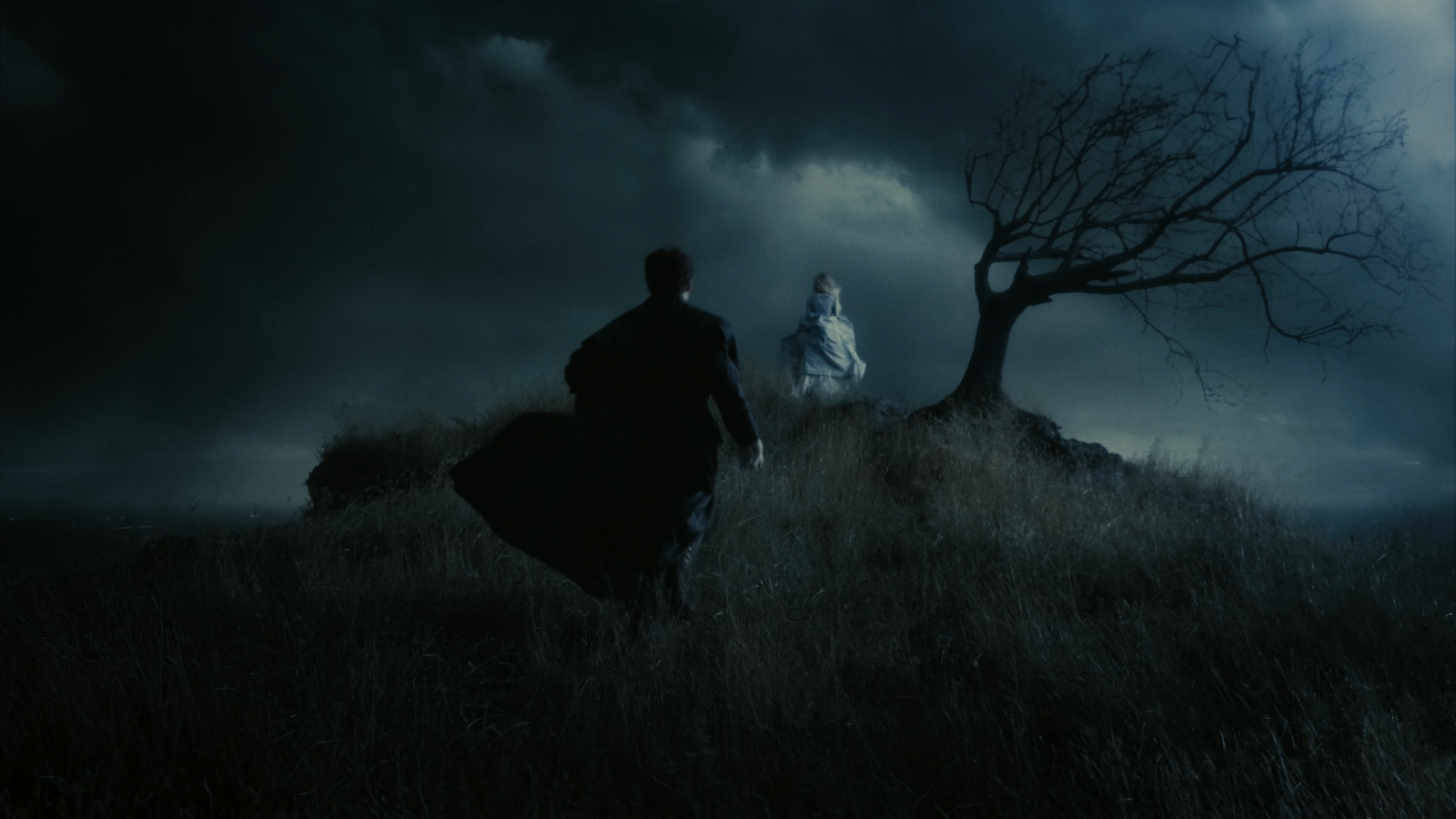
Where Burton's Sweeney Todd excels, though, is the design of the thing--from the Edward Gorey-ish 2-D titles to the Pieta-like coda, the film is a masterpiece of muted design and cinematography with a palette restricted to various shades of gray--the visual equivalent of music in minor chords.
With one exception, of course. The appearance of blood is always startling. Every murder produces a blood so red that it nearly jumps out of the screen. And Burton can't resist taking the Hammer Films one better. When
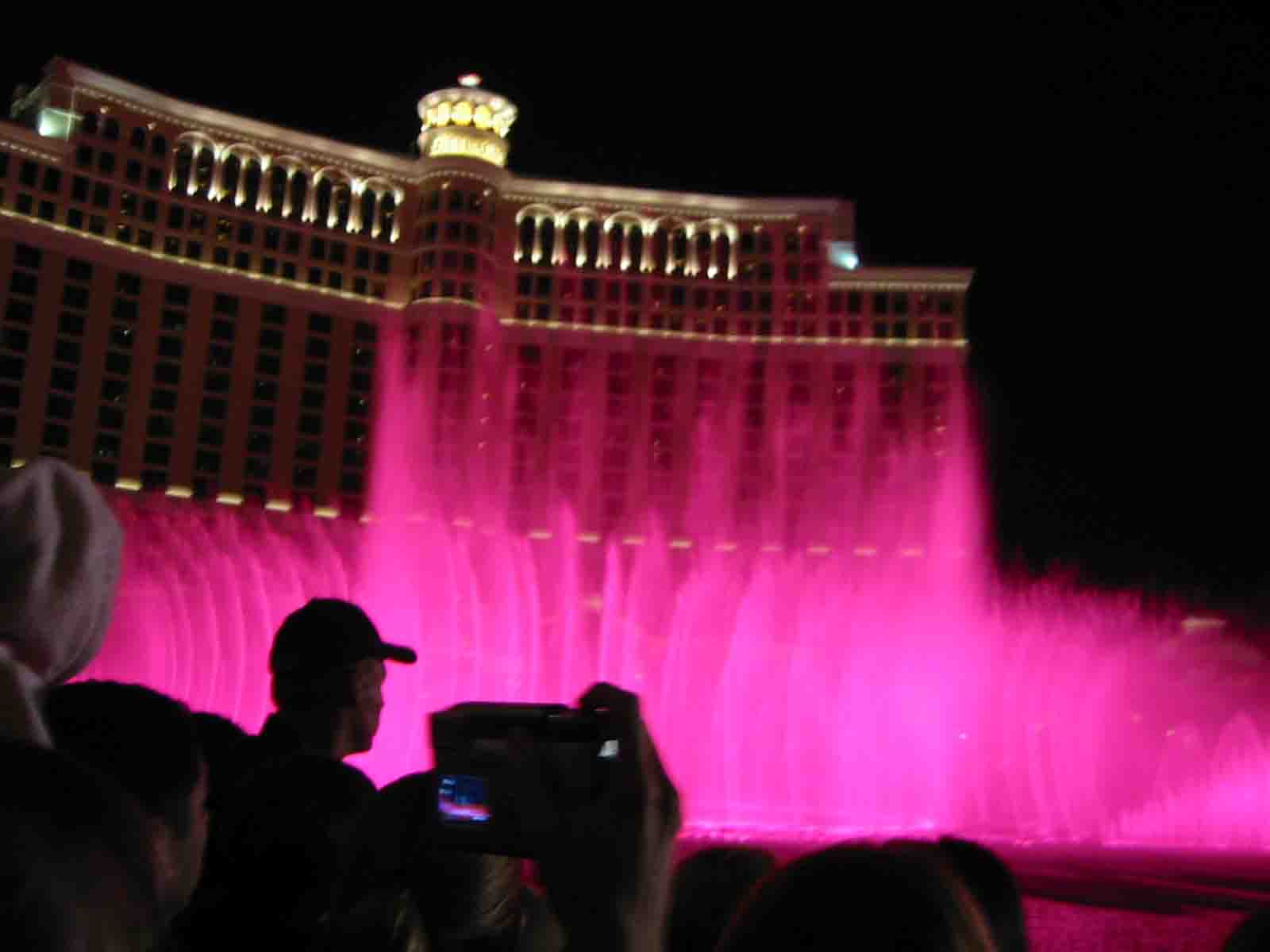
Sweeney Todd takes his razors to give his customers a once-over, there is no fanciful, theatrical whip-saw and it's over. Depp goes in and saws at the neck like he's cutting a thick roast, at which point the special-effects boys take over, producing arterial geysers of blood that spray--once, hitting the camera lens--in patterns that rival the fountains at the Bellagio
It's over-done, and in coagulating close-up as well, but given the interior-ness of
Sweeney Todd, it's about the only cathartic action in town. And the bodies really start piling up. I'm sure Sondheim was attracted to the subject matter of a swinish London so mired in nastiness, it more than figuratively begins to feed on its own, and the themes of a transformed man and his insatiable and destructive quest for vengeance was what drove Burton, but the gleefully torrential blood-shedding exposes the adolescent in Burton's tendencies--it's his darkest, grisliest film since Sleepy Hollow--and one wishes to see more of the Burton who could turn out a film like Big Fish


Thursday, March 24, 2022

The King's Speech

The Oscars are this weekend (Lord, help us!) and there are a couple of Best Picture winners I haven't re-published from "The Olde Site." So, rather than doing anything "newish" I'll opt, instead, for "timely."
 
I'm not a fan of The Oscars (like everybody), but I watch it (like everybody) and I complain about it the next day (like everybody). You can't seem to have one without the others. People enjoy complaining about them but wouldn't dare miss watching them. Everybody has some Oscar-decision that's an obscenity in their eyes...and there are some that are questionable (my Saturday "Trash" post will be one of them)*.  But, most of the time, I just don't care. The Oscars, being voted on within a year of each film's release, are always going to be short-sighted, with absolutely no chance of being able to judge a film's lasting legacy. The decisions are always factored by politicking or prestige. Maybe trendy. But probably not. They'll always be there whether one watches them or agrees with them.
 
Written at the time of the film's release. And there's some post-Oscar bashing at the end.

"Crossing Your Threshold"

or
"Let's Take it from the Top: 'In Our Darkest Hour...'"

One of my favorite observations from Jerry Seinfeld was his remark that more people are scared of public-speaking than of death: "In other words, more people would rather be IN the coffin, than delivering the eulogy..."

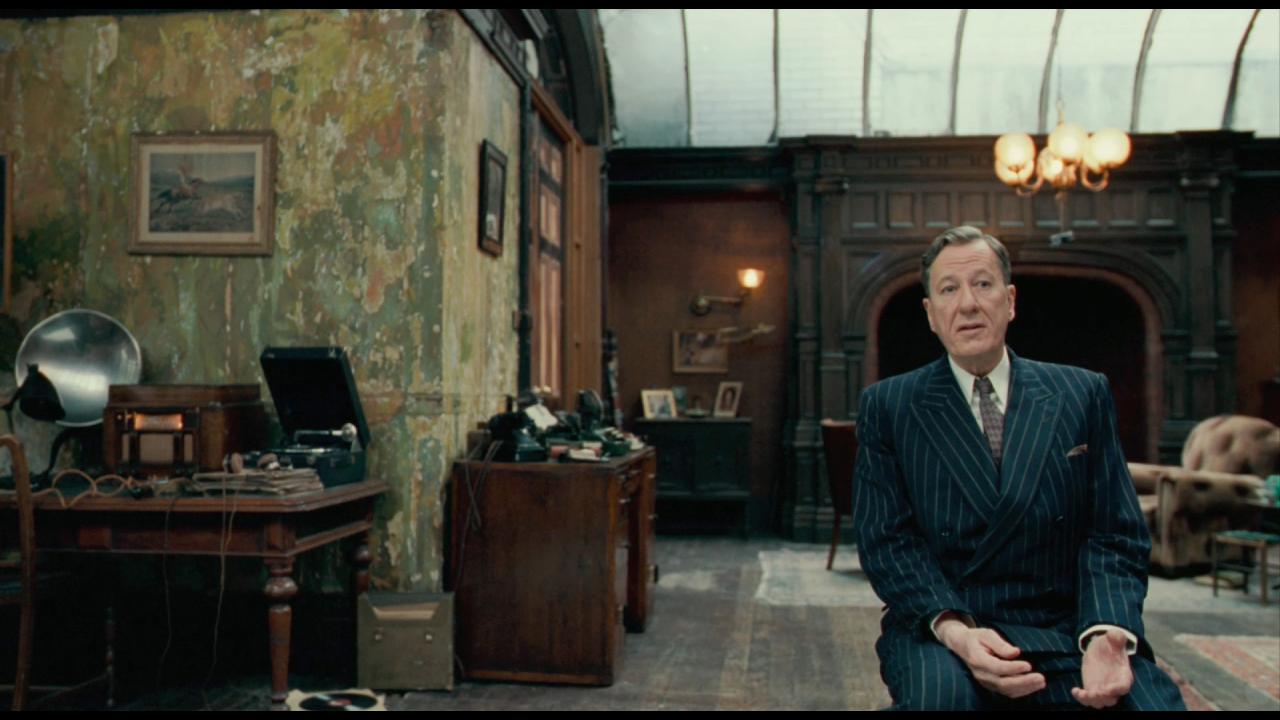
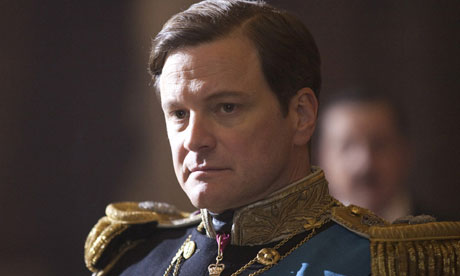
In The King's Speech, this year's Oscar-bait from The Weinstein Company, King George VI (Colin Firth, spot on, really) would rather be dead than speak in public. It's too bad, then, that his father, George V (Michael Gambon) beats him to the choired invisibule, and the next in succession, Edward (Guy Pearce, in an extraordinarily adroit performance) is too much of a self-absorbed ponce to sacrifice "the woman he loves" for such a small thing as the welfare of all of Britannia.

George VI, or Albert, the Duke of York (as he is dubbed before coronation),
has a persistent stutter, and a concurrent inferiority complex, given his heightened awareness of his condition and his responsibility—director Tom Hooper makes it clear in his direction and editing choices that we are constantly aware of his audiences' reactions to his stammers, faults and failings, even the portraits of his forebears stare in frozen, condescending judgement.*
It is up to his wife, Elizabeth (Helena Bonham Carter, bi-polarly different than her roles for Hubby Burton and Harry Potter)—"Call me 'Liz'" she sweetly says at one point late in the movie—wants to fix the problem, not because her husband is the man who could be King, but because the underlying psychological whipping he imposes on himself is making him miserable. He doesn't even have the wherewithal to blurt out a bedtime story to his two adoring princesses, Elizabeth and Margaret.

With a capricious older brother and an ailing father-king, he is not the most confidence-inspiring potential potentate who can, as his father bellows "stand between us, the jack-boots and the proletarian abyss." And given that the position is more public than ever, what with the King needing to address his subjects via radio, the air of confidence is more important than ever, and Albert's failings as such are even more readily apparent in the Theater of the Mind. Not only is the Empire shrinking for the Royals, but the world is, too, and their enemy's reach is the range of a V-2 rocket.

Presentation is all now, sometimes even more than the message. During the viewing of a newsreel, the Royal Family gets a glimpse of the Player on the Other side, Adolf Hitler at the Nuremberg Rally. "What's he saying, papa?" asks a daughter. 


"I don't know," replies the envious Albert. "But he says it rather well."
What do the simple folk do, when they have to carry the burdens of the entire Nation on their backs without hesitancy, and with grace. The short answer is, they don't—the situation is somewhat unique.

Enter Lionel Logue
(Geoffrey Rush), full-time vocal coach, hopeful actor...Australian. He is visited by one "Mrs. Johnson"—the future Queen-Mum—to enquire about services, all the royal outlets proving inefficient, taxing and embarrassing for Albert. Logue has no idea who he's really dealing with—in all senses—explaining that his methods are "unorthodox and unusual."


"Not my favorite words," she sighs.
This is a cracklingly well-done film, subtle and efficient and literate—the script (by David Seidler) leading down as many paths as Logue has techniques, but the most interesting aspect is how the two men, Lionel and Albert (who Logue insists on calling "Bertie" to allow mutual approachability) must rise and lower each other to the occasion, Logue relying on his actor's discipline to gain respect, while Albert uses Logue to gain insight to the common man, essential to his tutelage. And the actors are terrific, not only the ones mentioned, but a small delegation of familiar faces maximizing their small roles. Derek Jacobi makes an early appearance, Anthony Andrews appears as P.M. Stanley Baldwin, Claire Bloom as Queen Mary, and Timothy Spall, doing a fair turn as Winston Churchill  It culminates in a moving sequence as the new King must make a radio address to reassure the public after the declaration of war on Germany. Incongruously set to the second movement of Beethoven's Seventh Symphony, George VI, alone, with his coach conducting, must pick his way through his speech, every syllable a struggle to maintain control—the music behind him halting and building. I tell ya, I dropped tears, it's an extraordinary last act to an extraordinary movie.

Now...the rating. The King's Speech is rated "R" (in the United States) for the silliest of reasons—a short sequence where Logue badgers Albert into cursing like a sailor, including a string of "F"-bombs that kept it from achieving the lighter "PG-13," although the film really credits an ever lighter "PG." Don't be put off by the prigs of the Ratings Board. This is a fine, fine film.

* ...but in a style not as annoying as his work on the HBO series "John Adams," and less conventional than his work on The Damned United.

Post-Oscar Bashing: Best Picture? Nah. Not in that gang of 10. But a safe, respectable choice. You can't complain about the script or the performances (I could about director Hooper's win, but as was clear in his acceptance speech, without Hooper—and his Mum—there would have been no film, and the script was certainly worthy). But, ultimately, it's the Best Picture Harvey Weinstein could buy...as has been the case before. Still. Great film. But not Best Picture...not with 127 Hours, True Grit, Toy Story 3 in the running.

Friday, October 23, 2020

Dark Shadows (2012)

Written at the time of the film's bloody resurrection...

Camping Vamps and Risible Damp
or
"What Strange Terrain is This?"


"Dark Shadows" has been a cult favorite for Baby-Boomers for more than 40 years (ouch!), long before it was fashionable to have vampires as fodder for young adults. The ABC soap opera ran for several seasons of afternoons replacing the standard plot-lines of cheating spouses and long-lost family secrets with long-buried family relatives—that often didn't stay buried—and a full range of gothic ghoulery that plundered every horror story in the crypt-library, including vampires, werewolves, Frankenstein-ish monsters, time-travel, parallel dimensions and ghost stories. Why, they even robbed from "The Crucible" and "The Turn of the Screw" and got people interested in the I-Ching, for howling out loud. In fact, I kept expecting the fern in their front hallway to turn into Chthulu!
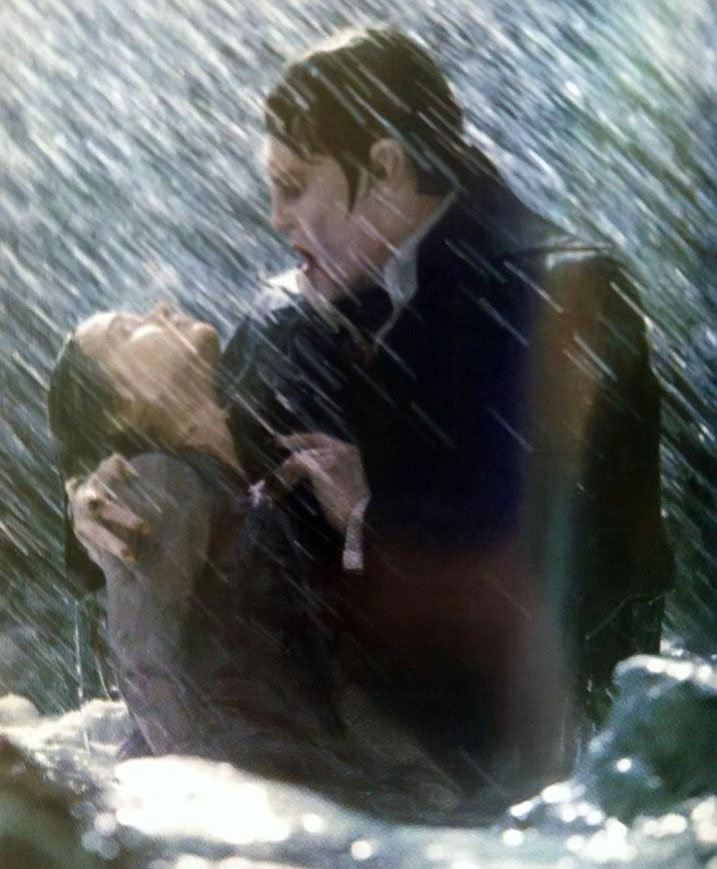
It was a TV habit of mine when I was a kid, timed perfectly to be the after-school tonic for a parochial school education, an occult chaser for the catechism, all those crucifixes I was surrounded by during the day being used for other purposes. It was also a fixation for Tim Burton and Johnny Depp, Burton digging the horror genre and Depp grooving on the character of Barnabas Collins (played by the late—or is he?—Jonathan Frid, who puts in a very brief cameo here along with a couple of other cast-mates), the reluctant vampire who pursued hearts, rather than the blood that pumped through them. The result of their dual obsessions is this version of
Dark Shadows, produced by Depp, directed by Burton.
"It is said that blood is thicker than water," narrates Barnabas Collins (Depp), over the strains of Robert Colbert's alto flute-through-echoplex composition "The Secret Room" from the original series. "It binds us, confines us, curses us." For a moment, things are fairly serious as the 18th century story of young Collins scion Barnabas is unearthed, with his spurning of the witch Angelique Bouchard (Eva Green) and her subsequent dark revenge, killing the Collins elders, forcing the suicide of Barnabas' love Josette and turning him into an eternally cursed vampire. She subsequently sets the townsfolk on the monster who chain him into a coffin and bury him for all eternity.

Depp and Burton get it right at the beginning: Barnabas learns his fate.
The worst-laid plans of mages and men...Eternity is cut short around 1972 as the construction of a new McDonald's in Collinswood unearths Barnabas and he lays waste to a construction crew (who must have been getting overtime working at night!) with an explanatory "You have no idea how thirsty I am!" 
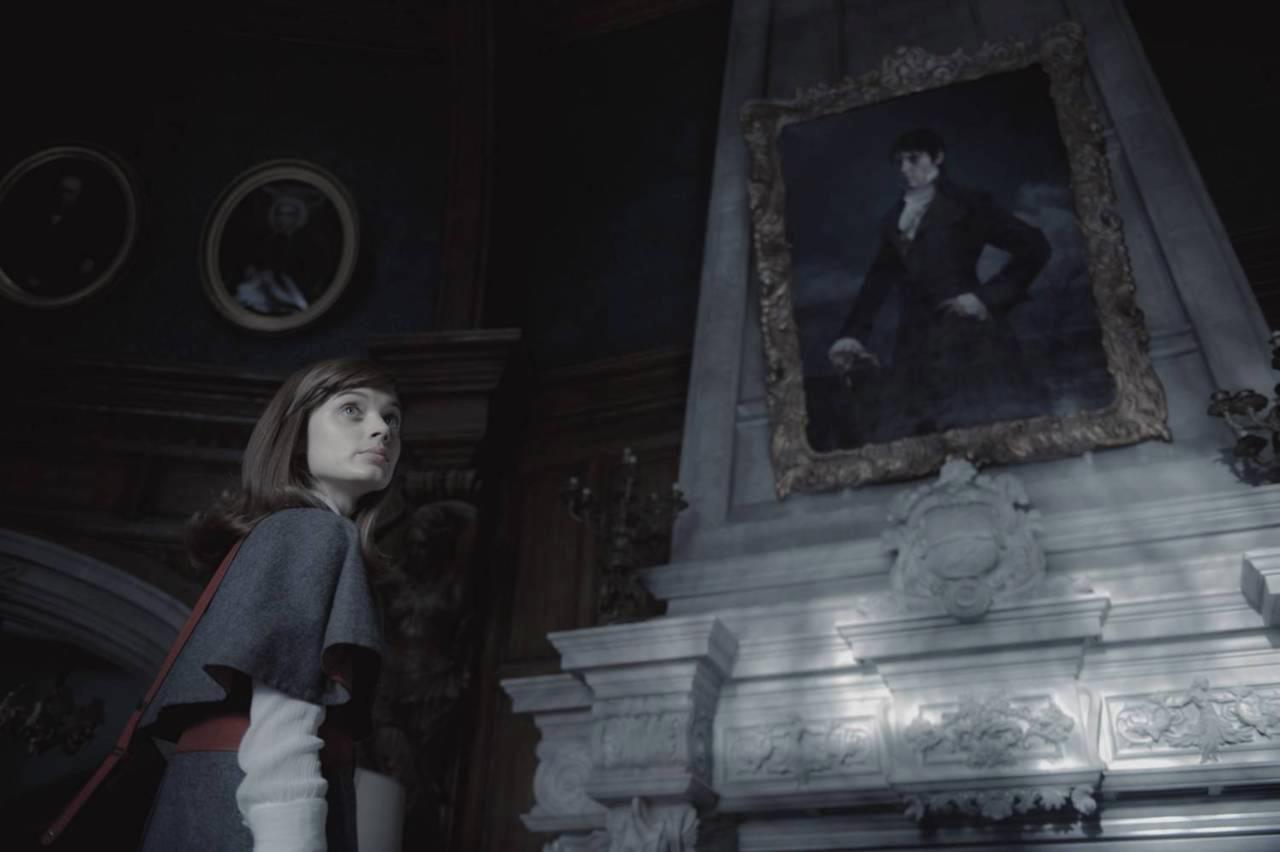
On a parallel course, Maggie Evans (Bella Heathcote, the latest in a long line of Burton ingenues with thin necks topped by big heads with huge eyes and "big" hair) is on a train to Collinswood where she has applied for a job as a governess to young David Collins (Gulliver McGrath), who is having psychological issues from the disappearance of his mother at sea. Abruptly, she decides to change her name to Victoria Winters, indicating a past she wants to run away from, as The Moody Blues tune "Knights in White Satin" burbles over the soundtrack. Hey, Burton may be onto something here. The combining of '70's kitsch and some of its more mordant songs with the gothic mood of "Dark Shadows" works well, setting the tone of the series and the morbid fascination my generation had with it. Can "Don't Fear the Reaper" be far behind?
Then, things get a little weird. She's picked up by a VW van of hippies, and there's some stoned comedy about how they're so wasted, and Vicky is cool, man, and it's easy laughs and you wish it was more clever. It becomes apparent quickly that Burton will be playing this for laughs, which is fine (he always does to a certain extent), but the original material is already so melodramatic and over-the-top that the humor undercuts the effectiveness of what drama there is that ekes through the dramatic stares and the vamping poses. "Dark Shadows" was always "camp" entertainment in the broad sense, but to broaden it even further nullifies whatever chills and thrills can be drained from it. This is why Frid's performance on the show was such an anchor for it—he played it absolutely straight, and in fact, ramrod-stiff; you didn't make fun of Barnabas for fear of his wrath—or his breaking down in tears.
Depp's Barnabas is tortured, of course, but risibly so (in a performance that's a combination of Frid's formality, some Max Schreck thrown in, and a bit of Ed Wood cast-mate Martin Landau's incarnation of Bela Lugosi). And there's the "otherness" factor that Depp brings to so many of his roles, as if he's in a different movie from everybody else—he walks through it, and everybody reacts, usually comedically and derisively. In part, that's the point: it ties in with Burton's feelings growing up as being an outsider-geek, looking on at the rest of the world that he found strange, while it found him odd (and there's a mirroring through-line of humor throughout the film of Barnabas, out of his time, observing to some horror the eccentricities of 1970's life, that reflects it).
*
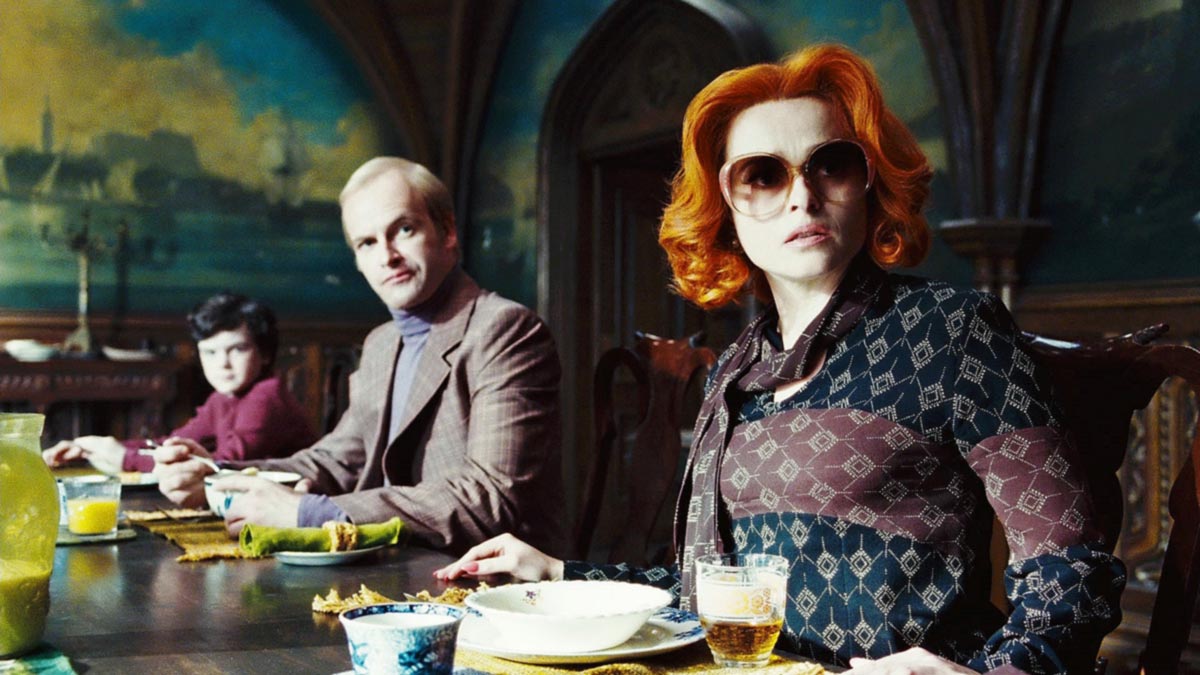
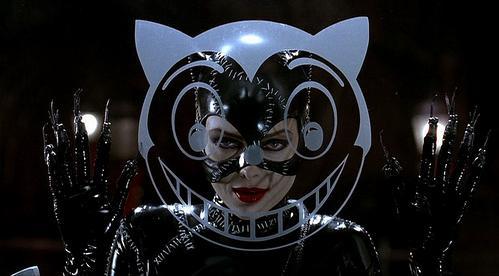
But Collinwood's odd family doesn't bat an eye when Victoria shows up and doesn't react to the disrepair of the gothic Collinwood mansion or to David's assertion that he speaks to his dead mother, and she follows quite readily when the ghost of Josette appears floating down the hallways, whispering "He's coming..." Barnabas' arrival, in Victorian array and the palest of skin, and the oddest of manners only brings up temporary suspicions, but the matriarch of the house (Michelle Pfeiffer, who played Burton's Catwoman) readily accepts him as family, even after revealing his vampirism. The cast is uniformly fine, gamely being archly camp throughout, but the one performer who's best at it is Green, who clearly relishes the villainess role and has fun with it, taking it in some very odd, even poignant places.
It looks great. Burton's films always do, with a superb design sense and his knack for picking terrific, seemingly impossible angles to shoot from. But, like a lot of Burton films, it tends to fall apart in story, snatching hasty explanations and Deus ex machina to get out of trouble, or to provide the director with a bizarre concept that may seem right in retrospective sub-context, but that comes out of nowhere, randomly and jarringly. One has to stop, back-track, only to realize that, no, this has never been mentioned before, and why now?
One suspects it's a whim, a passing "wouldn't-it-be-crazy-if" thought passed between Depp and Burton as they geek out, rocking in their corners, internal logic no longer mattering as much as a superficial entertaining notion. As such, Dark Shadows accomplished their goals. Yeah, it's entertaining, but highly insubstantial, a mere spirit of a movie.

"Yes, yes" I hear you cry. "But, don't you think it was better than the OLD "Dark Shadows"? I mean, have you seen it lately?"

In truth, I have.
My frustration with Burton is not that he desecrated the memory of a classic television show—even with the air fragrant with the nostalgic scent of Mom's Apple Pie, I'm not convinced that "Dark Shadows" was anything more than a quickly put-together variation of soap programming with elements of gothic romance/horror tossed onto it. No, my problem with Burton's version is that he didn't try to make it better, but chose to just mock the absurdity of it. Not much sticking your neck out there, even for a vampire movie. 

But, then, maybe he didn't try because he already saw what happened when somebody did try to do it semi-seriously. That someone being show creator Dan Curtis.

House of Dark Shadows
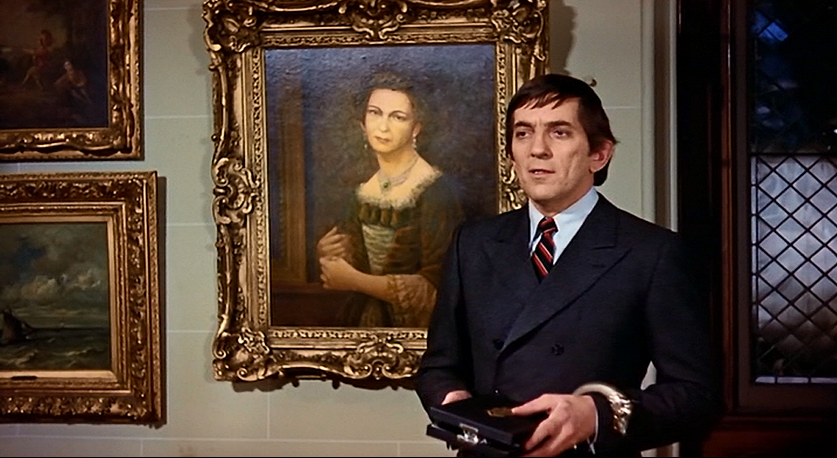
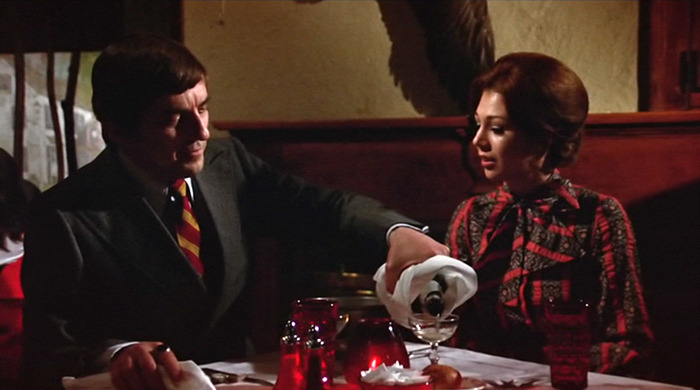
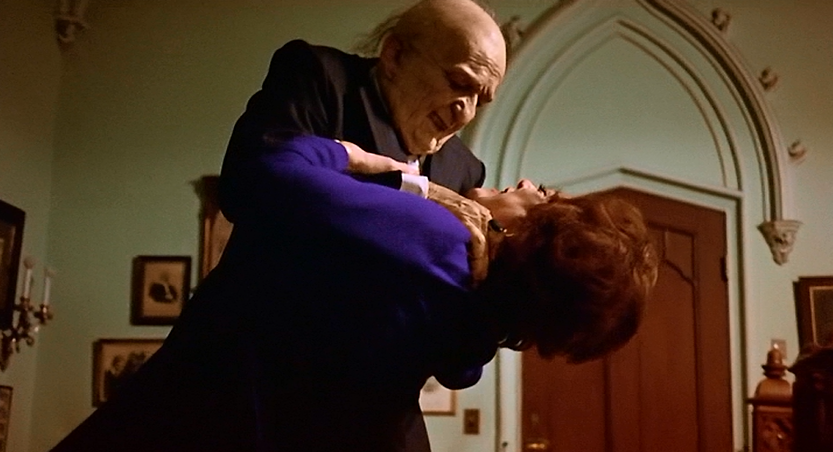
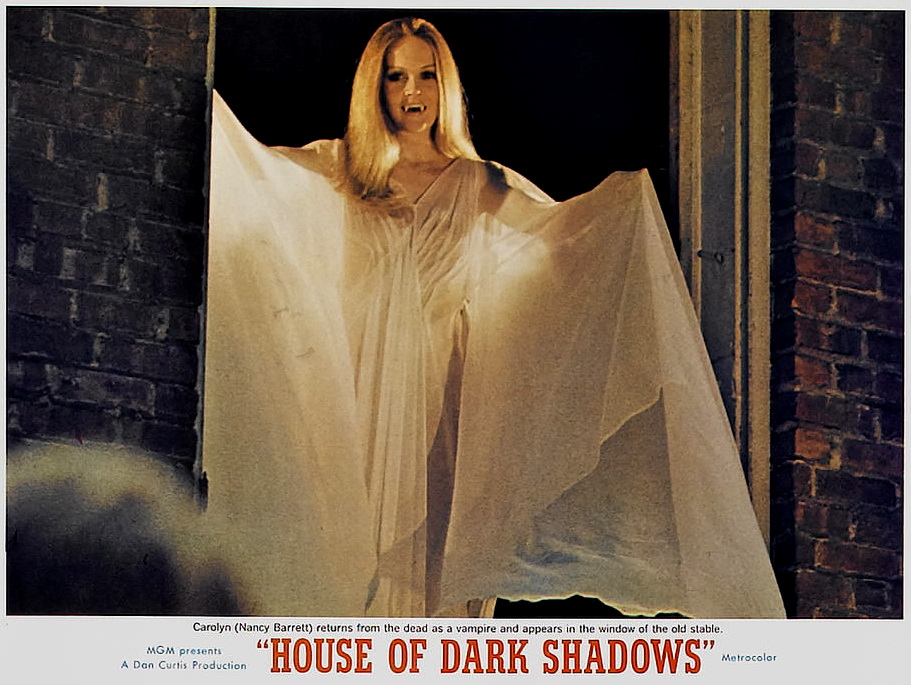
(Dan Curtis, 1970) Filmed while the soap-opera was still running (and so a lot of cast-members "disappeared" for 29 days from the taping). They dragged out the "big-guns" and did a 2 hour version of the "Barnabas Arrives at Collinwood" storyline with Jonathan Frid's character withheld from sight—except for his black onyx ringed hand—until he shows up as the "lost Collins cousin from England." He meets nanny Maggie Evans (Katheryn Leigh Scott), who bears an uncanny resemblance to his lost-love Josette, Dr. Julia Hoffman's (Grayson Hall) attempts at curing him, then, in a fit of jealousy, reneging, turning him into his aged 200 year old self (make-up by the amazing Dick Smith), and a vampire-hunt that ends in a lot of Collins-family vampires. The first is Carolyn Stoddard (Nancy Barrett) who's blond, pretty, and looks good in the Hammer label of diaphanous lingerie, so a lot of screen-time is given to her—poster-acreage, too—even though Barrett was not the most skilled of actresses. The soap languished through repeated exposition and lingering looks in its story-line Monday through Thursdays and put all the "good stuff" on cliffhanger Fridays, and so, compressing it all in one movie makes the movie feel camp and hysterical. Still, once the movie gets going, Curtis starts to be a bit more free with the camera and compositions—it's like half-way through he realized he wasn't dealing with the old studio RCA TK46's anymore and could do something beyond waist-level. Still, in such a quick time-frame, the story doesn't coagulate too well and makes you realize that long-form eased the mis-match of gothic romance and horror.

Night of Dark Shadows
(Dan Curtis 1971) House of Dark Shadows made money, enough to green-light a sequel and, as the television series had been canceled, a newly unencumbered Curtis started on a direct sequel to the earlier film. Jonathan Frid, worried about the curse of type-casting, bowed out of participating. But, the story of Angelique Bouchard, witch and  former lover of young Barnabas, had never been told, so Curtis and series writer Sam Hall cobbled together a story of a young couple (David Selby and Kate Jackson) who inherit the Collinwood estate, only for the man to be haunted, then possessed, by the spirit of his Collins ancestor, who had an affair with his brothers' wife, Angelique (Lara Parker), resulting in her being hung as a witch, and him entombed with her. A somewhat similar story had been used in the series involving Selby as Quentin Collins, but the Angelique angle was new. Returning were John Karlen and Nancy Barrett, as well as Grayson Hall (the writer's wife) and Thayer David.

Anyone who sees Night of Dark Shadows will understandably come away from it wondering what they just saw, and if they'd missed something. They had. The film, was originally 2 hours long, but M-G-M thought that was too long for a movie they'd planned to put as the B-movie in double-bills (No, really, they used to do that), and so they insisted that Curtis cut half-an-hour out of the film—and he had 24 hours to do it. With such hack-work, any slow build-up was excised, and so Night comes off as poorly as a U.S. released foreign film that only includes highlights...and a bit of a muddle. 

Oh...and studios still do that.

* This also sets up a series of sight-gags that are somewhat clever, as Barnabas never seems to be able to find appropriate sleeping arrangements at Collinwood.