Showing posts with label Guy Pearce. Show all posts

Saturday, February 22, 2025

The Brutalist

A Hell-hole of His Own Design
or
"I Just Don't Appreciate It. I Cherish It"
 
These days get me down.

Brady Corbet 's The Brutalist (made for an incredibly modest $10 million) comes with all the showmanship brio of those old "roadshow" films of the 1950's and 1960's, back in the day before the trend today where every movie became its own sole inhabitor of a given theater's screen...when movies openly defied the "bargain-prices-for-the-masses" concepts of the now-extinct double-bill for the self-proclaimed "importance" of the single solitary roadshow attraction. Those "big, important" presentations did not survive the decade of the 1960's when the more independent and youth-oriented...and cheaper...films (which defied the portentousness ambitions of their more gaudy studio products) took over both screens and audiences' interests. The Brutalist has the ambitions and trappings of those roadshow attractions: VistaVision photography, an Overture (all 30 seconds of it, really) and an intermission at the 2/3rd mark to give you a recess to escape during its 3½ hour length.
Not that it's really needed. The Brutalist moves along at a quick, if somewhat trance-like pace, but without any of the sweep that you'd expect in the blockbuster format. And that intermission comes at a time when there is an interruption of the story-line—a work-project is stopped—and the film takes up a few years later after everyone has moved on and must once again begin the project after law-suits are settled. A less time-consuming interstitial or an added narration might have been enough to impart that information, but I guess the filmmakers wanted to impart the sense of time being wasted...The Brutalist began production in 2018 and didn't start photography until March 2021 and was delayed by the pandemic until further work in 2023. An intermission probably felt organic to the process.
But, it isn't, really. It just marks the demarcation point where the movie starts to unravel. The "Part 1" of the film--and, yes, it has "chapters"--"The Enigma of Arrival" sees the arrival of László Tóth (Adrien Brody), a Polish architect, who has barely survived the Holocaust and arrives in post-war New York, ahead of his wife Erzsébet (Felicity Jones) and niece Zsófia (Raffey Cassidy), to do what so many refugees and migrants have done—try to make a new life for themselves after leaving a life with little prospects. At this point, Corbet is happy to provide every detail in his story-telling and make some bold choices doing so. Toth's arrival in New York—when he finally is able to emerge from the dark hold of the ship and into the sunlight—is highlighted by his first glimpse  of the Statue of Liberty—but Corbet presents it to us upside-down, as if we were looking back at it from behind. This might have been just for practical purposes—you shoot up at Lady Liberty so you don't have to show the New York skyline, which looked very different in 1946 than it did at the time of filming.* It also says something, vaguely (if one is looking for such things) about the Ancestry.com fairy-tales of immigrants braving the unknown to "make a better life" for themselves than what they would find on their home-soil.
But, The Brutalist takes those stories that have become so familiar on "Finding Your Roots" and turns it—like the Statue of Liberty—on its head. Ship's manifests and census records can tell you the "when" of things, but not the "how" of things—of prejudice by the already-established immigrants (all of them being immigrants, ironically, except for the indigenous tribes and there was a "final solution" reserved for them, as well), of huddled masses forced into "Little" communities of slums, and of hard-scrabble existences, supposedly based of hard work and fortitude, but mostly based on dumb, stupid luck and the seizing of opportunity. And will, a basic will to survive.
The Brutalist rubs your broken nose in it. Toth is initially welcomed in Philadelphia by his cousin, Attila (
Alessandro Nivola) who runs an established design-furniture store, Miller and Sons, and takes him in, hiring him for his design-work and giving him a little room in the back of the storeroom. The cousin has assimilated ("Who's Miller?" "Me" Who are the sons?" There aren't any"), changed his name, become Catholic, married a shiksa wife (Emma Laird) and she is less than pleased with the arrangement. An initial job to design a modernist chair for the store-window produces a tube-dominant functional design that would hardly attract customers.
But, the company gets a commission—the children (
Joe Alwyn, Stacy Martin)of a rich businessman, Harrison Lee Van Buren, Sr. (Guy Pearce), want a library constructed in his mansion while he is tending to his ailing mother. The job has its challenges—the desired location is all vaulted windows letting in sunlight that could fade the valuable first editions. What to do? Toth has a solution and it is a bold one.
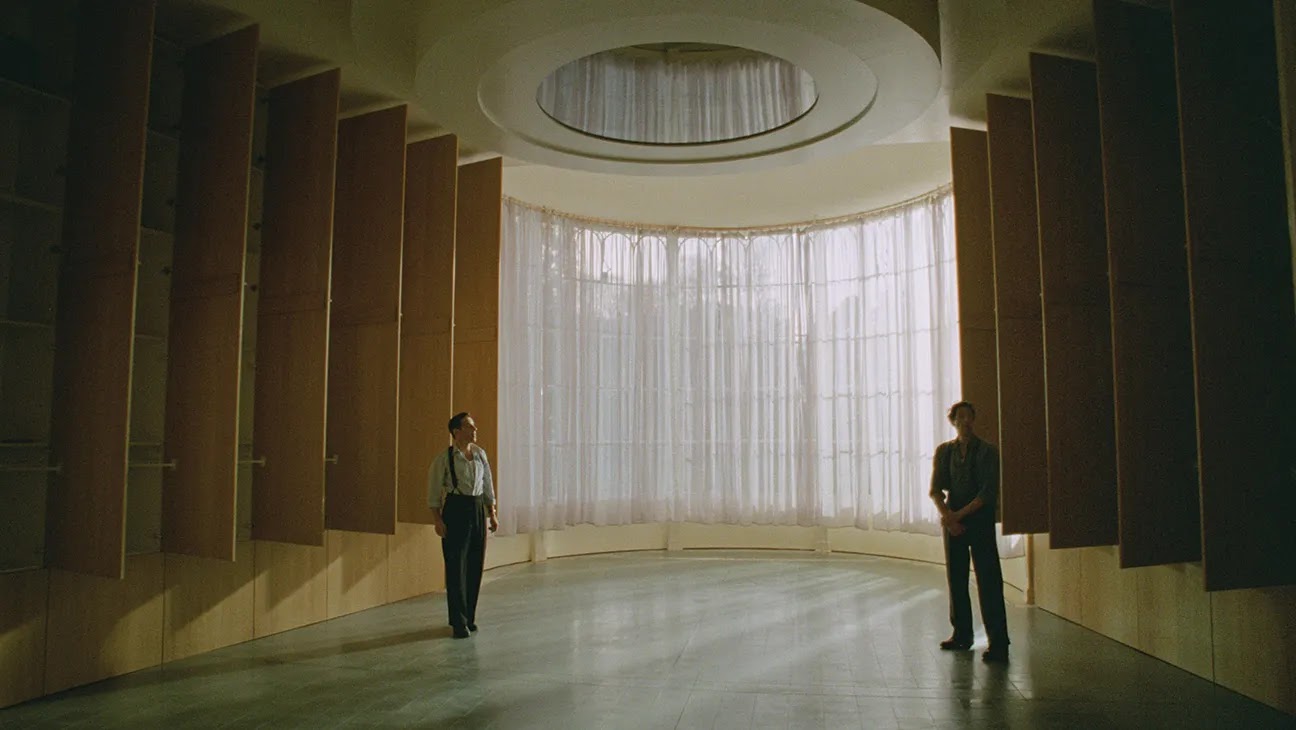
Keep the windows. Protect the books. Cantilevered doors hide the shelves and their precious burdens. But when Van Buren the Elder comes back, he isn't pleased ("I don't like surprises!"—Pearce, here, is at his foaming, berzerker best) because there's a BLACK man (one of the workers) in his drive-way, everything's different and his Mother's in the car. Get OUT! Get OUT NOW! No explanation is heard or good enough. "Miller and Sons" doesn't get paid for the commission. They have to pay the expenses. They'll be lucky if they're not sued. So, "of course", cousin 
László gets sacked by his own cousin. The assimilation gets set back a few years...if it was ever going to happen at all.
The Brutalist has a pace, but it's a herky-jerky one, sort of like the phrase a friend reminded me of the other day: "The days go slow, but the years go quick." Flash forward three years. László is a laborer shoveling coal, living in a charity house, addicted to heroin, his only friend is Gordon (Isaach De Bankolé) a single father also down on his luck—he was the guy seen in the driveway that Van Buren was so incensed about—working at the same facility. Then, one day Van Buren the Elder shows up at his work, invites him to lunch, and tells him a story.
At lunch, he shows Toth an article in an architectural magazine, extolling Van Buren and the library's aesthetic, and the magnate has done some digging, found out the name of the man who created the masterpiece he now owns and for which he, the owner, has been lauded. He's researched him, discovered the architectural work he did in Europe before the war, and...pays him for the work he did on the library. Toth's work has made Van Buren an exemplar of an aesthetic—even if he didn't know the name of the man who designed it or anything about why the fuss being made about his library—and he invites him to a dinner the next night so he can meet his society's circle and maybe...how he can be used in the future. Toth celebrates by taking the money and buying heroin.
At the dinner, Toth is fêted by the Van Burens, where he is treated as an honored guest and treated with an air of "your not one of us but we like what you do." He meets Van Burens' lawyer, the only other Jew at the table, who offers his work to try and patriate
Erzsébet and Zsófia out of Eastern Europe to America. And something else. The next day, Van Buren tells him of "a vision" he wants him to design and build. "Something boundless. Something new." There's a site on the highest point of his property overlooking the village of Doylesville, where he wants to build a tribute to his late Mother, a center consisting of a gymnasium, a library, a gathering center...oh, and per Doylesville request...a chapel. A Protestant chapel. Toth, thinks Van Buren—still aglow from his reflected light of Toth's work—is obviously the man for the job.
Maybe he is, but he's certainly the most handy. And, given Van Buren's patronage, if not sponsorship, he's the one who can achieve Van Buren's "vision." But, first, Toth needs to get his own vision approved, which is where Van Buren, who pulls a lot of strings, is at his most useful—besides funding the project.
And why shouldn't he fund it? It's a Van Buren version of a Pyramid, the grandest tombstone his mother—and probably any member of the Van Buren family could have. Toth's designs are different, large, blocky made of concrete and though not really brutalist in design, the brutalist school was very influential in the production of
government buildings and slums—and prisons. But a prominent negative-space crucifix atop it seems to reassure the doubters. The rest of the movie is of Toth's struggles—and they are constant—in trying to keep the integrity of his design (despite middle-men, budget-cuts, capricious "second-thoughts") in a Sissyphussian environment of anti-semitism, xenophobia, and just plain interference for interference's sake.
It's an example of that disease that suffuses American business (and I suppose any business), "office politics." For whatever reasons, egos clash, contrariness becomes the norm and the "Bad CEO" lords over the chaos, letting it happen, because he likes people "doing their jobs" even if it's at cross-purposes ("Leslie is a bastard." "Yes, he is. That's what we pay him for."). Toth tries to negotiate the madness, maintaining his vision of Van Buren's vision, and retreating into heroin when the pain becomes unbearable. Watching it unfold is like being a functionary at a terrible job at a terrible company, choking on its own cholesterol-like dysfunction.
And the building itself, the "Van Buren Institute", that great Pyramid to an industrialist's vain-glory? We never really get to see it. What we get to see are empty corridors and walk-ways, a vast inner chamber at its core, seemingly a shell of a building housing mazes and catacombs that a despondent man can get lost in and die. We never really get to see its scope or the wonders that might have impressed and inspired in the first place. It's a big vacuum in the center of the movie that might have done more than provide ambiguity. It's a "commission," nothing more. An idea, unrealized, at least in terms of the movie.
If that wasn't frustrating enough, the movie has a coda. It's 1980 and Toth is elderly, in a wheelchair, attending another 
fête, a retrospective of his work, and, because he is too weak to speak, his niece speaks for him, and says something that hit me with a thud and make me bitterly leave the theater, questioning the writers and if they knew what they were writing.
"Don't let anyone fool you, Zsófia" he would say to me as a struggling young mother raising my daughter during our first years in Jerusalem, "no matter what the others try and sell you, it is the destination, not the journey."** 
 
Well, that's just bullshit. Only an artist—be they architect or a manipulative director—an entrepreneur or politician (with visions of dictatorship dancing in their heads) can go along with that "the ends justify the means" thinking. Human experience informs us, changes us, manipulates our thoughts and our ideas. Often it is the journey—not the destination—that is important (Erzsébet after coming to America says this: "This place is rotten. The landscape, the food we eat. This whole country is rotten."). Yes, it's good to have goals. But, what do you have to become to achieve them? Is it worth getting what you want by—where you want— by sacrificing everything but the dream?
 
The sportscaster Red Barber had a wonderful rejoinder for the old "whoever has the most toys, wins" mind-set: "God doesn't count the toys. He counts the scars."
But, the edifice will excuse it all. After all, people still flock to the Pyramids; nobody cares what kinds of horrors inspired them or carried them out. Our Edifice Complex negates all that. Why (he says sarcastically) maybe the slavery was worth it, Ozymandias...
 
Tell that to the wrecking ball.
This piece has taken me forever to write—despite "The Last Word" at the bottom of the page I do not always find writing bad reviews "fun"—and I've been listening to and reading rave reviews for this film, trying to understand what they're seeing that I'm not. All I can conclude is that the framing, cinematography, and acting (all of which are quite good) have overwhelmed any critical thinking about content. "Style over substance".*** "Miller and Sons." That old trick. But not for me.
 
I like ambiguity. I cherish it in movies if it's not a stunt (as Hollywood so often makes it). You can even be vague about things. But, The Brutalist asks questions that it doesn't bother to answer, nor does it seem to care, as if a point of view was something beneath it to attempt. I shouldn't have to divine what it's attempting to say (if anything). It should be there on the screen so that I can share the artist's thoughts. That's the very basis of communication and the DNA of film. But, Corbet's film tries so hard not to tell a story, or to advocate for anything, other than that life, even a life devoted to your craft, is misery. In the end, The Brutalist is neither inspirational or aspirational. As such, as a work of art...it is useless.
I wouldn't be at all surprised if this wins the Oscar for Best Picture.
 
These days get me down.

* I've always loved the story Sidney Lumet tells—in his book "Making Movies" (©1995, Vintage Press)—of meeting his hero, director Akira Kurosawa, and asking him why he had framed one particular shot in Ran the way he did and the Japanese Master told him that if he'd panned the camera one inch to the left, the Sony building would have been visible and one inch to the right, an airport, neither of which were appropriate to a samurai movie. It's not all inspiration and artistic intent.
 
** Here's the thing—not even Toth believes that, if we're to believe the screenplay. If he had, why then would his time at Buchenwald inspire the dimensions of the Van Buren Institute (in the same speech, his niece says this: "The building referenced his time at Buchenwald as well as the deeply felt absence of his wife, my Aunt Erzsébet. For this project, he re-imagined the camp's claustrophobic interior cells with precisely the same dimensions as his own place of imprisonment, save for one electrifying exception; when visitors looked 20 meters upwards, the dramatic heights of the glass above them invited free thought; freedom of identity. He further re-imagined Buchenwald and his wife's venue of imprisonment in Dachau on the same grounds, connected by a myriad of secret corridors re-writing their history and transcending space and time so that he and Erzsébet would never be apart again.") So...in other words...his journey through the war years inspired the destination. Or is the niece putting words in the mouth of the elderly Toth, for his benefit to burnish his image, and so is she also a part of the same self-aggrandizement as, say, the nefarious benefactor Van Buren? Is everybody in this movie corrupt?
 
*** I'm reminded of the story Jerry Lewis told about Stanley Kubrick, who was wandering around during the days of making 2001: a Space Odyssey while Lewis was struggling to edit his abortive The Day the Clown Cried. Kubrick was sitting in the back of the editing room just hanging out, taking it all in when Lewis said over a particularly frustrating "cut," "That's it! You can't polish a turd!" To which Kubrick responded (after a thoughtful pause): "You can if you freeze it..."

Thursday, March 24, 2022

The King's Speech

The Oscars are this weekend (Lord, help us!) and there are a couple of Best Picture winners I haven't re-published from "The Olde Site." So, rather than doing anything "newish" I'll opt, instead, for "timely."
 
I'm not a fan of The Oscars (like everybody), but I watch it (like everybody) and I complain about it the next day (like everybody). You can't seem to have one without the others. People enjoy complaining about them but wouldn't dare miss watching them. Everybody has some Oscar-decision that's an obscenity in their eyes...and there are some that are questionable (my Saturday "Trash" post will be one of them)*.  But, most of the time, I just don't care. The Oscars, being voted on within a year of each film's release, are always going to be short-sighted, with absolutely no chance of being able to judge a film's lasting legacy. The decisions are always factored by politicking or prestige. Maybe trendy. But probably not. They'll always be there whether one watches them or agrees with them.
 
Written at the time of the film's release. And there's some post-Oscar bashing at the end.

"Crossing Your Threshold"

or
"Let's Take it from the Top: 'In Our Darkest Hour...'"

One of my favorite observations from Jerry Seinfeld was his remark that more people are scared of public-speaking than of death: "In other words, more people would rather be IN the coffin, than delivering the eulogy..."

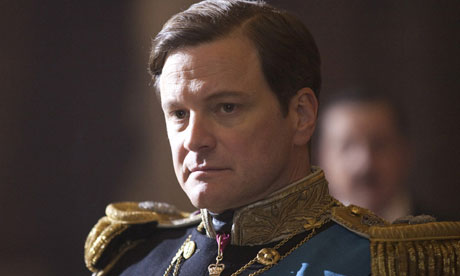
In The King's Speech, this year's Oscar-bait from The Weinstein Company, King George VI (Colin Firth, spot on, really) would rather be dead than speak in public. It's too bad, then, that his father, George V (Michael Gambon) beats him to the choired invisibule, and the next in succession, Edward (Guy Pearce, in an extraordinarily adroit performance) is too much of a self-absorbed ponce to sacrifice "the woman he loves" for such a small thing as the welfare of all of Britannia.

George VI, or Albert, the Duke of York (as he is dubbed before coronation),
has a persistent stutter, and a concurrent inferiority complex, given his heightened awareness of his condition and his responsibility—director Tom Hooper makes it clear in his direction and editing choices that we are constantly aware of his audiences' reactions to his stammers, faults and failings, even the portraits of his forebears stare in frozen, condescending judgement.*
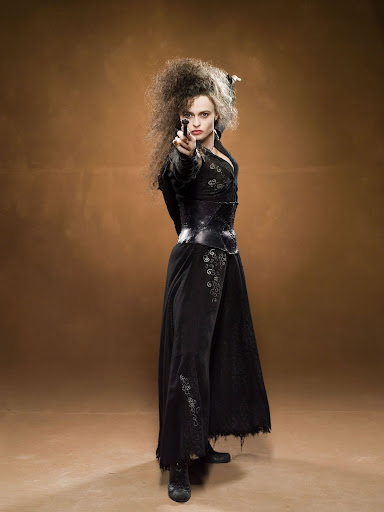
It is up to his wife, Elizabeth (Helena Bonham Carter, bi-polarly different than her roles for Hubby Burton and Harry Potter)—"Call me 'Liz'" she sweetly says at one point late in the movie—wants to fix the problem, not because her husband is the man who could be King, but because the underlying psychological whipping he imposes on himself is making him miserable. He doesn't even have the wherewithal to blurt out a bedtime story to his two adoring princesses, Elizabeth and Margaret.

With a capricious older brother and an ailing father-king, he is not the most confidence-inspiring potential potentate who can, as his father bellows "stand between us, the jack-boots and the proletarian abyss." And given that the position is more public than ever, what with the King needing to address his subjects via radio, the air of confidence is more important than ever, and Albert's failings as such are even more readily apparent in the Theater of the Mind. Not only is the Empire shrinking for the Royals, but the world is, too, and their enemy's reach is the range of a V-2 rocket.

Presentation is all now, sometimes even more than the message. During the viewing of a newsreel, the Royal Family gets a glimpse of the Player on the Other side, Adolf Hitler at the Nuremberg Rally. "What's he saying, papa?" asks a daughter. 


"I don't know," replies the envious Albert. "But he says it rather well."
What do the simple folk do, when they have to carry the burdens of the entire Nation on their backs without hesitancy, and with grace. The short answer is, they don't—the situation is somewhat unique.

Enter Lionel Logue
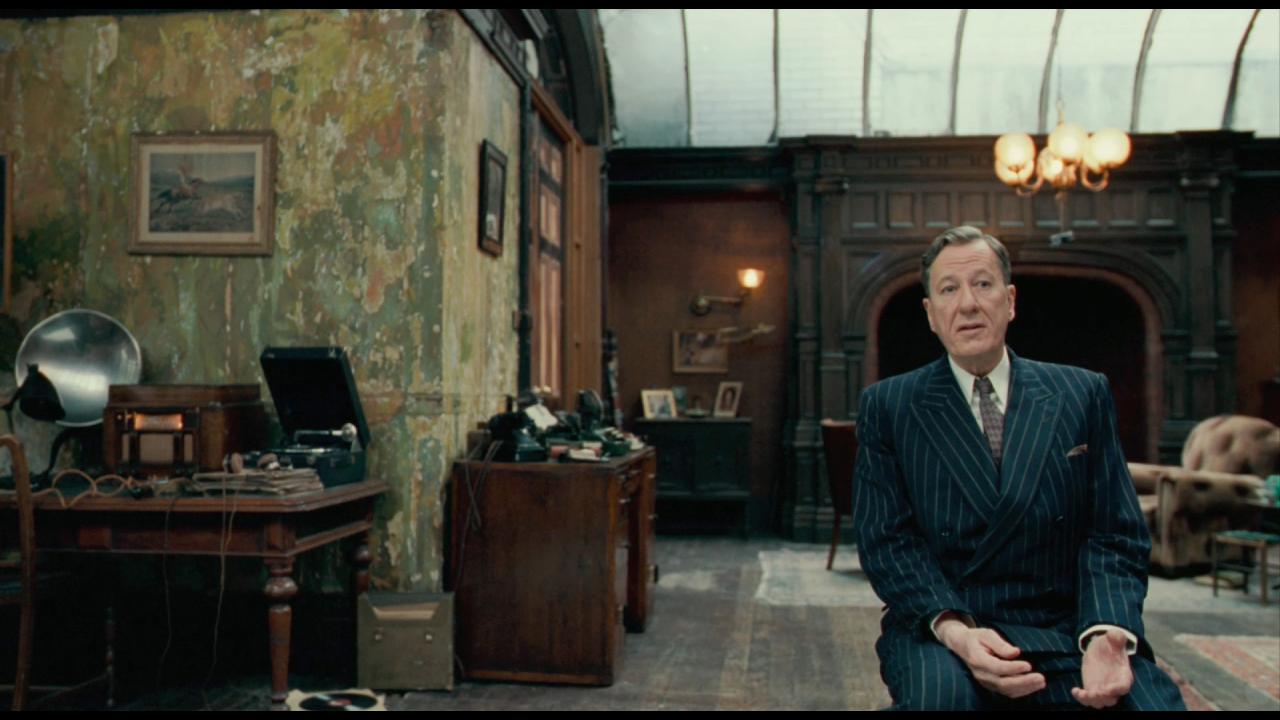
(Geoffrey Rush), full-time vocal coach, hopeful actor...Australian. He is visited by one "Mrs. Johnson"—the future Queen-Mum—to enquire about services, all the royal outlets proving inefficient, taxing and embarrassing for Albert. Logue has no idea who he's really dealing with—in all senses—explaining that his methods are "unorthodox and unusual."


"Not my favorite words," she sighs.
This is a cracklingly well-done film, subtle and efficient and literate—the script (by David Seidler) leading down as many paths as Logue has techniques, but the most interesting aspect is how the two men, Lionel and Albert (who Logue insists on calling "Bertie" to allow mutual approachability) must rise and lower each other to the occasion, Logue relying on his actor's discipline to gain respect, while Albert uses Logue to gain insight to the common man, essential to his tutelage. And the actors are terrific, not only the ones mentioned, but a small delegation of familiar faces maximizing their small roles. Derek Jacobi makes an early appearance, Anthony Andrews appears as P.M. Stanley Baldwin, Claire Bloom as Queen Mary, and Timothy Spall, doing a fair turn as Winston Churchill  It culminates in a moving sequence as the new King must make a radio address to reassure the public after the declaration of war on Germany. Incongruously set to the second movement of Beethoven's Seventh Symphony, George VI, alone, with his coach conducting, must pick his way through his speech, every syllable a struggle to maintain control—the music behind him halting and building. I tell ya, I dropped tears, it's an extraordinary last act to an extraordinary movie.

Now...the rating. The King's Speech is rated "R" (in the United States) for the silliest of reasons—a short sequence where Logue badgers Albert into cursing like a sailor, including a string of "F"-bombs that kept it from achieving the lighter "PG-13," although the film really credits an ever lighter "PG." Don't be put off by the prigs of the Ratings Board. This is a fine, fine film.

* ...but in a style not as annoying as his work on the HBO series "John Adams," and less conventional than his work on The Damned United.

Post-Oscar Bashing: Best Picture? Nah. Not in that gang of 10. But a safe, respectable choice. You can't complain about the script or the performances (I could about director Hooper's win, but as was clear in his acceptance speech, without Hooper—and his Mum—there would have been no film, and the script was certainly worthy). But, ultimately, it's the Best Picture Harvey Weinstein could buy...as has been the case before. Still. Great film. But not Best Picture...not with 127 Hours, True Grit, Toy Story 3 in the running.

The Hurt Locker

The Oscars are this weekend (Lord, help us!) and there are a couple of Best Picture winners I haven't re-published from "The Olde Site." So, rather than doing anything "newish" I'll opt, instead, for "timely."
 
I'm not a fan of The Oscars (like everybody), but I watch it (like everybody) and I complain about it the next day (like everybody). You can't seem to have one without the others. People enjoy complaining about them but wouldn't dare miss watching them. Everybody has some Oscar-decision that's an obscenity in their eyes...and there are some that are questionable (my Saturday "Trash" post will be one of them)*.  But, most of the time, I just don't care. The Oscars, being voted on within a year of each film's release, are always going to be short-sighted, with absolutely no chance of being able to judge a film's lasting legacy. The decisions are always factored by politicking or prestige. Maybe trendy. But probably not. They'll always be there whether one watches them or agrees with them.
 
Oh. And this was written at the time of the film's release.

Moonwalking Through the Kill-Zone
or
"Cravin' a burger. Isn't that strange?"
 
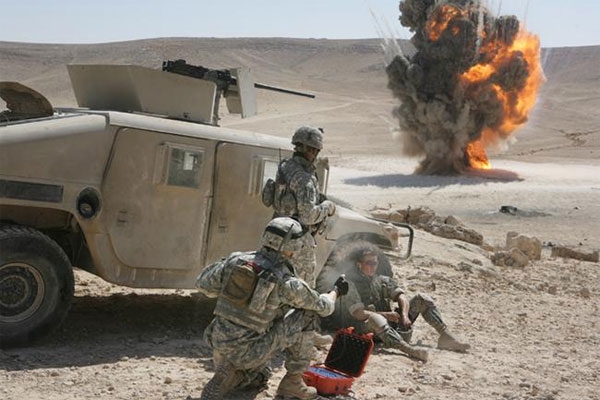
A lone figure walks down an alien landscape in a space-suit of Kevlar and crash-helmet, his only companions are his breath and his thoughts. Death surrounds him, and he walks towards the only certain death he knows of: a make-shift explosive device, conceived in cunning and hate that he must dis-arm in order to save himself, his comrades, and the watching by-standers, one of whom just might be waiting to explode the device. It is not some forbidden planet, or an anarchic Western town, but it could be. It's downtown Iraq, and it comes down to one man walking and facing his fear.
 
Kathryn Bigelow will probably never be considered a "superstar" director.
That's too bad, because she's miles ahead of the so-called "young Turks" doing action movies these days. Instead of following current trends, she adheres to the rock-solid action direction styles of
Anthony Mann and Don Siegel: let the audience know what's going on, and one other thing that too many directors these days forget—an audience has to know the territory their heroes walk through to fully present the dangers they face. In The Hurt Locker
she may use a hand-held camera a bit too much to re-create the verisimilitude of war-footage, but it comes in handy to lock you into the searching point-of-view of Bravo Company's of Bomb "Tech's" and "Post-Bomb Assessors"—"The Blasters"—in Iraq's Camp Freedom ("They changed it from Camp Liberty to Camp Freedom because Camp Freedom sounds better," says veteran Sergeant JT Sanborn (Anthony Mackie) to the new Team Leader Staff Sergeant William James (Jeremy Renner, looking like a cross between Nathan Fillion and Brendan Fraser, like most of the principals of The Hurt Locker, his performance is understated and full of small nuances). 
James is described as "a rowdy boy" and "reckless." Before his arrival,
"the suit," that cumbersome Kevlar get-up which would protect anyone but the man who needs it most, has been the last resort in a disarmament situation. But that's not good enough for James. He likes to disarm the things by hand, and collect the odd bit of equipment for a trophy that "could have killed" him. He'll go in with "the suit" first, and puzzle the thing out, something that doesn't win him prizes with his team-mates, especially Specialist Eldridge (Brian Geraghty), because the longer it takes James to disarm a bomb, the more vulnerable his team-mates are to snipers.
It doesn't take long for the team to realize that James loves his work a little too much, and that it may kill them before their tour is up. Bigelow keeps a running track of the "
short-timer" count-down as the situations become more dire and the traps more intricate, electronically and ethically.
War films have gone through a weird evolution from the time they were conscious enough to move beyond the "good guys vs. bad guys" (while still acknowledging that both sides share their share of casualties. But it's been since the Korean conflict that movies started to go deeper
into the psychosis of war—not the PTSD issues, but the psychosis of being inside the conflict. One of the counselors at Camp Freedom ineffectually tells Eldridge "You know, this doesn't have to be a bad time in your life." Easy for him to say. All Eldridge can think about is the best outcome of the war—surviving it. And when his orders come down to "Be smart. Make a good decision" it's tough to say what is a good day and what is a bad day. 
But lately, war-films have taken a look at the man on the line and what makes a good soldier, and it comes down to
a blurred combination of self-sacrifice and controlled psychopathy. Whatever the motivations its the results that count. We've seen that theme in Hell is For Heroes, and Patton, Apocalypse Now, The Burmese Harp, Full Metal Jacket, and Flags of Our Fathers. How the soldier compartmentalizes the war experience to survive and even stay sane through the fire determines his ultimate worth as a soldier and as a human being. It is that perspective, of life is brief increments, that keeps a soldier walking alone in The Now, where "The Big Picture" is unseen in the limited view of his path, unknowable and brutally finite—the past a bitter memory, the future an empty promise, and today is walked with the high of High Noon.
 
* For instance, there's the case of How Green Was My Valley beating out Citizen Kane for Best Picture of 1942 (as well as Sergeant York and The Maltese Falcon). And yet, I can't kick about the choice because I love both films, and I can certainly see why someone would prefer Ford's classic against Welles "Greatest Film Ever Made."

Saturday, January 26, 2019

Mary, Queen of Scots (2018)


The Godmother
or
"They Are Sisters" (In a World Without Love)

It seems that every decade has to have their own movie about Mary, Queen of Scots and her struggle with the reigning Queen Elizabeth I, her cousin. She has been portrayed by Katherine Hepburn, Vanessa Redgrave, and recently (in Cate Blanchett's "Elizabeth" films) by Samantha Morton. The various films sway between sides being taken, finding Mary either a bold, presumptive opportunist, or a wronged legitimate heir to the throne (and Elizabeth portrayed as a calculating shrew). It all depends on whether you're Protestant or Catholic, Anglophile or Spec-Historian, "Team" Tudor or "Team" Stuart. There are a lot of sides, just as there were at the time things were going down in "The Isles" in the 16th Century.

The latest "take" on the saga is based on historian John Guy's book "My Heart is My Own: The Life of Mary Queen of Scots" and it, judging by the film based on it—the latest Mary, Queen of Scots—seems to want it both ways, emphasizing more of what the women had in common than in what separated them.
They may have had their differences but but both shared uneasy paths due to their sex. Henry VIII (Elizabeth's father by Anne Boleyn, wife #2) had only one male heir, (by Jane Seymour, wife #3)—who would become King Edward VI at the age of nine(!)—and the older half-sisters Mary (by Catherine of Aragon, wife #1) and Elizabeth—due to Henry's many wives and his way of dealing with the Church to attain them—were considered, by decree, illegitimate. Edward died at the age of 25 and named the Lady Jane Grey, the daughter of Henry VIII's sister, his successor. The reason? Mary was a Roman Catholic, and Henry and Edward had spent a lot of time and effort getting out from underneath the Pope's robes to go back to The Church. Lady Jane didn't last long, Mary claimed the throne and lasted five years trying to return Catholicism to the primary faith, and was succeeded by Elizabeth, who didn't like it and reversed it.
Now, bear with me here: Mary was the daughter of King James V of Scotland, the son of James IV and Mary Tudor, who was Henry VIII's sister, thus making Mary and Elizabeth cousins (I'll give you a moment...). James V died when Mary (Queen of Scots, his daughter) was six days old and she—at that age—became Queen of Scotland.* There weren't many things she could do regally at that age, of course, so the leadership of Scotland was done by regents, all male and all probably bitter that their Queen was a baby. A female baby, at that. Anyway, Henry VIII's finagling caused a lot of trouble for his relations' when they got to The Big Chair. For both Mary and Elizabeth, the toughest part of their job was being the female rulers of men. The monarchy has always had a history of men in the shadow of the throne trying to thrown their own shade, and Mary and Elizabeth both had to deal with leading reluctant dance-partners, who wanted to decide the moves themselves.
Josie Rourke's film details the issues that Mary Stuart (played here by Saorise Ronan) had to contend with—a viable claim to England's throne, her Catholic faith when England had turned Protestant (after flirting again with Catholicism), recent widowhood and the desire for an heir apparent. Her probably too-quick decision to marry a cousin, Henry Darnley (Jack Lowden) who was not only a drunkard, a would-be usurper of the crown, but also gay (or at least bi-sexual), creating in one nuclear family, all the larger issues she had to deal with. Her regents resented her forthrightness, her taking her own counsel rather than theirs, her alignment with the Pope rather than a devotion to Christ, and her own ambitions to be Queen of England, not just Scotland.  
Her marriage to Darnley did produce one heir, James (who did ascend to the throne after Elizabeth's death), but men were only too willing to take her as wife to try to take her authority as Queen away from her. 
Watching Mary's trials and tribulations across the way must have had a large influence on Elizabeth (played by Margot Robbie), who, famously, never married—was it due to a fear that her authority would be usurped?—and adapted a stance that, given the wrangling among the roosters of her own court, she had to adapt a male attitude id she was to maintain her authority. She had been denied the throne once, and incarcerated for part of that time, so she knew how quickly fortunes could change, even without mis-steps that might hasten it. It was the very nature of Nature, being a part of the Empire's rule of succession.
The movie traces both women's struggles to keep power in a male-dominated world, while they also eyed each other across the way, admiringly but acquisitively, each seeing the threat the other poses. They posture and correspond, their meanings hidden between the lines of their prose. Being cousins, and female, they take more diplomatic means rather than direct words and actions than they do against their male challengers.

It is inevitable (at least, in the movies) that they meet, although they never did in real life. And Rourke stages it obliquely—Mary travels to England for safe-keeping, as she's under threat from her own people—and, in a plain laundry-house, they hold a conversation through layers of hanging sheets (metaphors, anyone?), Mary moving them, Elizabeth cloaked, hiding behind them, until the veils are removed and the conversation becomes more direct and revealing, with Elizabeth summing up Mary thus: "Beauty—bravery—motherhood—you seem to have surpassed me in every way (but) your gifts are your downfall.
And Mary spits out the threat: "Should you murder me, remember—you murder your sister and you murder your Queen."

If you know history, you know how THAT turned out.
Rourke's film is sumptuous in location-work, costumes and hair and make-up—it takes quite a bit of masterful work to make Margot Robbie look unattractive—and the performances are incredibly detailed and lived in (it's also quite fun to see David Tennant play a villain, but he has a lot of company among the Scottish characters).
One appreciates all the work involved, but Mary, Queen of Scots feels a bit stale, despite raunching it up with a couple sex scenes that feel unnecessary. The film opens up a bit when Mary and Elizabeth are not embroiled in fights with the conniving men in their lives, showing them at peace with themselves and with others. It's in those places where Mary, Queen of Scots feels best. One must assume that the two queens would agree—that their jobs would be so much easier without men.
"England does not look so different from Scotland."
"Aye, they are sisters..."


* It is probably at this time that you're thinking the American idea of democracy and voting for your country's leader might not be a bad idea, despite recent turns of events.