United 93 (Paul Greengrass, 2006) "The War on Terror" turned the tide before it was even declared. The efforts of the crew and passengers of United flight 93 insured that, as they assessed the situation quickly, made decisive plans and executed them unselfishly, in the process saving an unimaginable number of lives. Who knows, besides the dishonored dead, what the target was? We don't know. We can't know. But, after that, every airline passenger became more vigilant, and everybody who didn't put their seats in an upright position (or try to light their shoes) was seen with suspicion. Anyone who attempted anything—short of hogging the overhead compartments, blocking the aisles in conversation, stealing somebody else's honey-nuts, or (god forbid) talking incessantly about themselves THE ENTIRE FLIGHT—against the common good, would be taken down and taken down hard, if not by security officers, then by the passengers themselves (and you had better luck with the security officers). Flight 93 was when the terrorists started losing 55 minutes after the battles had begun.
Greengrass' ingenious attempt to recreate the events on 9-11 leading up to and during that horrific flight (in real time, one might add) crackles and pops with a cinema verité energy that makes the most mundane of the circumstances take on an ironic heft. We all know how the story went—only if merely how it ends—and it makes all the participants victims and their every action and utterance weighted with irony, their moments, being finite, that much more important. The dawning realization that their rudimentary transport had become part of an organized plot to turn their flight into a weapon of targeted destruction is both horrific and inspiring, moving fast through the stages of grief, they decide to make the best of the situation in which they suspected they would not survive, and acted unselfishly to at least stop any further loss of life wherever they were heading, and, maybe, doubtfully, save their own. In an unfolding world of uncertainty, they acted for the greater good.
It's an amazing story—civilians becoming warriors, victims not settling for that role. And Greengrass' version is done without stars, no grand-standing, just the director's insistence on verisimilitude and energy, not amping the story with false heroics, but only the genuine ones, and enhanced by its own choice not to editorialize.
Showing posts with label Iraq War. Show all posts
Thursday, September 11, 2025
Wednesday, April 23, 2025
Warfare
or
"Look for the Blood and the Smoke! That's Where We Are!"
Warfare just drops you into it. The film, written and directed by Alex Garland (Ex Machina, Civil War) and Ray Mendoza (who lived it) tells the story of an insignificant little troop deployment of Navy SEALS in Ramadi, Iraq in 2006 to lend support to a Marine operation nearby (in fact only 300 meters away!). Standard stuff. In and out. No mess no fuss.
They come in under cover of darkness, enter a strategically placed household, subdue the inhabitants, isolate them, put them out of operations' way, then monitor for any suspicious activity among the locals, any amassing, any weapons sightings, any what we call in the U.S. "assembly." Just basically "watch the backs" of the Marines. The radio contact is "5 by," they are well-armed and well-ammo'd, and they have a bird's eye view of the area from aerial surveillance that can track any warm body that comes into view. And they're frequently being updated on the mission status. Everything is nominal. From that point on, the movie runs in "real time."
Alpha One pumping up before the mission.
On top of that, they've punched a hole in the outer wall of an upstairs bedroom for Elliott Miller (Cosmo Jarvis), their lead sniper, to lay prone on a mattress for hours on end, peering through the telescopic sight of his M110 SASS rifle to take out anyone or anything that seems suspicious or out of place at a market across the street. It's maximum concentration for minimum movement, but you can't be too careful. Anything suspicious could be prelude to an attack on them, and if you have to pull a trigger to prevent yourself or your troop from dying, that's the job.
Of course, when the clock is ticking and you're just waiting for the sortie to be over, everything looks a little suspicious. But no shots are fired. Sure, they're being watched...by people who duck so they're not being watched...and the aerial view shows there might be some amassing on the roofs, but things are merely heightened anticipation and they can be Bradley'd out of there within minutes. It's going to be fine.
Until a grenade is dropped through that sniper's nest hole into the bedroom where Miller and another SEAL are positioned. They're able to move quickly and out of the blast-radius, but the resulting explosion instantly turns the monitoring mission into an evac mission. Miller's left hand is bleeding, but treatable if they can get him back to the base quickly and so Bradley tanks are called while the crew sweats the minutes it will take to get them out of there. They are under attack, after all. And the sooner they can get Miller out the better. But, even with the best equipment American tax-dollars can buy, they are still trapped in a house (along with the civilians) and targets. They're surrounded.
And things will only get worse.The legal disclaimer ("This is a work of fiction", etc. etc) at the end of the movie is unlike any I've seen. I didn't have time to write it down and I haven't found anything that quotes it on the internet, but basically it says it's based on a true incident that was parsed from several interviews (and Mendoza was part of the SEAL team) and any inaccuracies are entirely due "to memory." And, indeed, Miller—who's a real guy—has no recollection of the incident, even though he lost a limb, received severe burns and lost the ability to speak. In part, Mendoza wanted to make the film for him and dedicated it to him.And from what I've been reading online, a lot of Iraq vets are saying that it's brutally accurate. If true, it is harrowing what we put our fighting men through, even if the the mission depicted was only in a support capacity. There is no safe place in a war-zone (for anybody) and no action taken does not attract a reaction. And with the sophistication of the weaponry, the destruction is catastrophic. It makes you wonder why anybody does it? Why do governments launch wars knowing that the end-result is winning rubble and destroyed infrastructure? What is "gained" by that? But, over the last couple years, that's all we've seen on a day-to-day basis, escalating destruction and death over cratered territory. For what?
I've also read some online critiques that the film is "pointless." Hardly. Not if the portrait it paints is as accurate as has been said and the filmmakers have accomplished their goal, ignoring the jingoism, the cliches, the false melodrama and cheap theatrics in the name of creating drama. It's dramatic enough without inserting fudged ironies into it. The conflict is real without back-story and motivation. The real motivation is living through it, plain and simple. You can say that "war is hell", but Warfare makes it look like insanity. And as director Sam Fuller used to say the only glory in war is surviving it. Giving it to us straight, while we're sitting in our comfortable theater seats, is hardly pointless...especially if it makes us think twice.The most telling part of Warfare is when the echoes die and the dust settles and the SEAL team gone, and the family of the occupied house come out of hiding and see the slippery blood-trails and multitudes of cartridges on the floor, the holes in the wall, and devastation left behind. Then, there's a shot of the street that moments before was a killing field as villagers come out of their doorways, some armed, some not, walking past body-parts through the smoke that has been left behind. Mendoza has enough wherewithal to include them in the aftermath of the destruction, and one can't help but think that somewhere they're thinking the same thought as you.
Wednesday, September 11, 2024
The Lucky Ones (2008)
A review of one of the films from the post 9-11 environment, written at the time of the film's release.

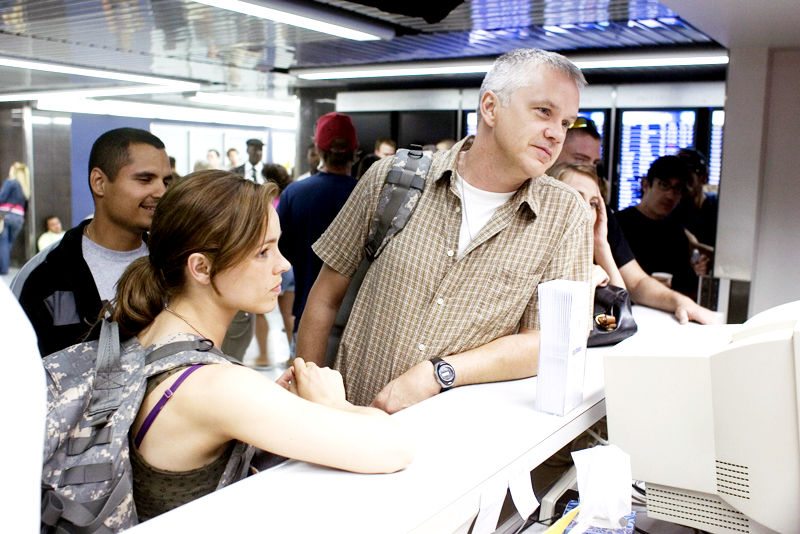
The Lucky Ones (Neil Burger, 2008) Every war, every "police action," seems to have its "re-patriation" film. World War 1 had The Razor's Edge, 2—The Best Years of Our Lives, Vietnam—Coming Home. The Lucky Ones involves returning troops in the ongoing Iraq War, different from their cinematic (and real) fellow troops in that they're not coming home. They're on a 30 day leave before going back as part of the "stop-loss" program. So, this takes place as more of an interruption to their service. What happens when the environment is not so regimented, or as dangerous. The three come back from the war altered, and all have specific goals in mind, all of which change when they actually touch boots to ground in the States.
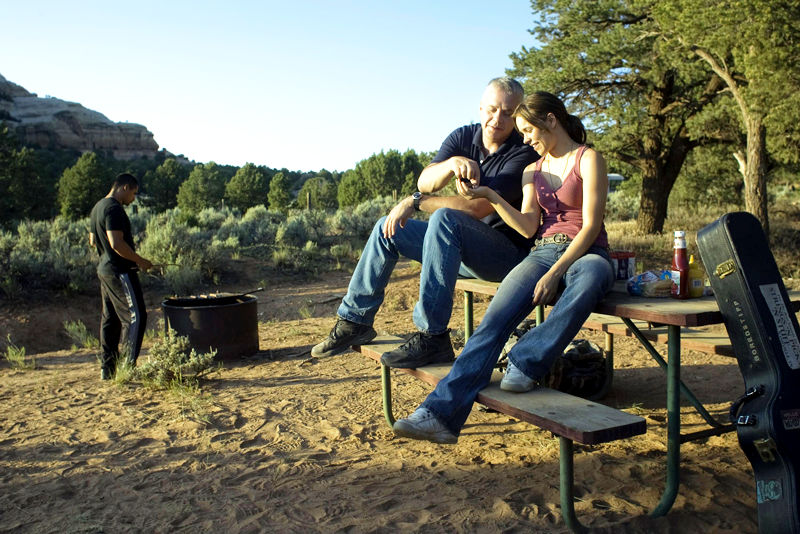
It follows three vets—Cheaver (Tim Robbins), an older sergeant just off his third and last tour, T.K. (Michael Peña), wounded, but gung-ho about going back, and Colee (Rachel McAdams), a neophyte coming back with a mission and a hole in her leg. They're all damaged: Cheaver is psychologically out-of-whack; T.K.'s purpose is to get back to his fiancee to see if "his equipment" still works after being wounded; Colee wants to find the family of the guy she hooked up with there and return his guitar to them. Meeting on the flight state-side, they decide to pool resources to get where they're heading. But, like any road-trip, there are detours, changes of plan, and the occasional loss of bearings. Stability is not to be found at home for any of them, and the trip only reinforces the perception that their fellow soldiers are the only ones who've "got their back."
Some of the episodes reach a bit, while some feel natural, and mostly the film avoids easy answers—less than it avoids mention of the war, except for a brief opening scene. The Lucky Ones is less concerned with Iraq, than it is with the soldier's plight, caught in the demilitarized zone of not fitting in either here or there. Putting them on the road—in transit—reflects that sense of rootlessness (as most road-movies do) that these perpetual soldiers must have that is unique to this era's soldiers. The film never really tackles that subject head-on, as it almost has a duty to do, instead relying on the various "missions" and destinations to define the characters. Ultimately, the film has nowhere to go once those stories are used up, and the film ends on a logical melancholy note.
Where it shines is in the performances. As with the war, Burger and his co-writer Dirk Wittenborn are quiet about the soldiers, presenting them as rather independent pawns in a much bigger game, their choices on the road sometimes unconventional, and not S.O.P. But McAdams, Pena, and especially Robbins (this is some of his subtlest work in the past decade and nice to see), breathe a likable humanity into their characters, buffering the moments of manipulation and contrivance. You like these guys and want them to succeed, even if they are a bit unreadable—enough so that some of their choices surprise, even deep into the movie. That The Lucky Ones manages to do that is no small accomplishment.
Friday, September 8, 2023
Farenheit 9/11
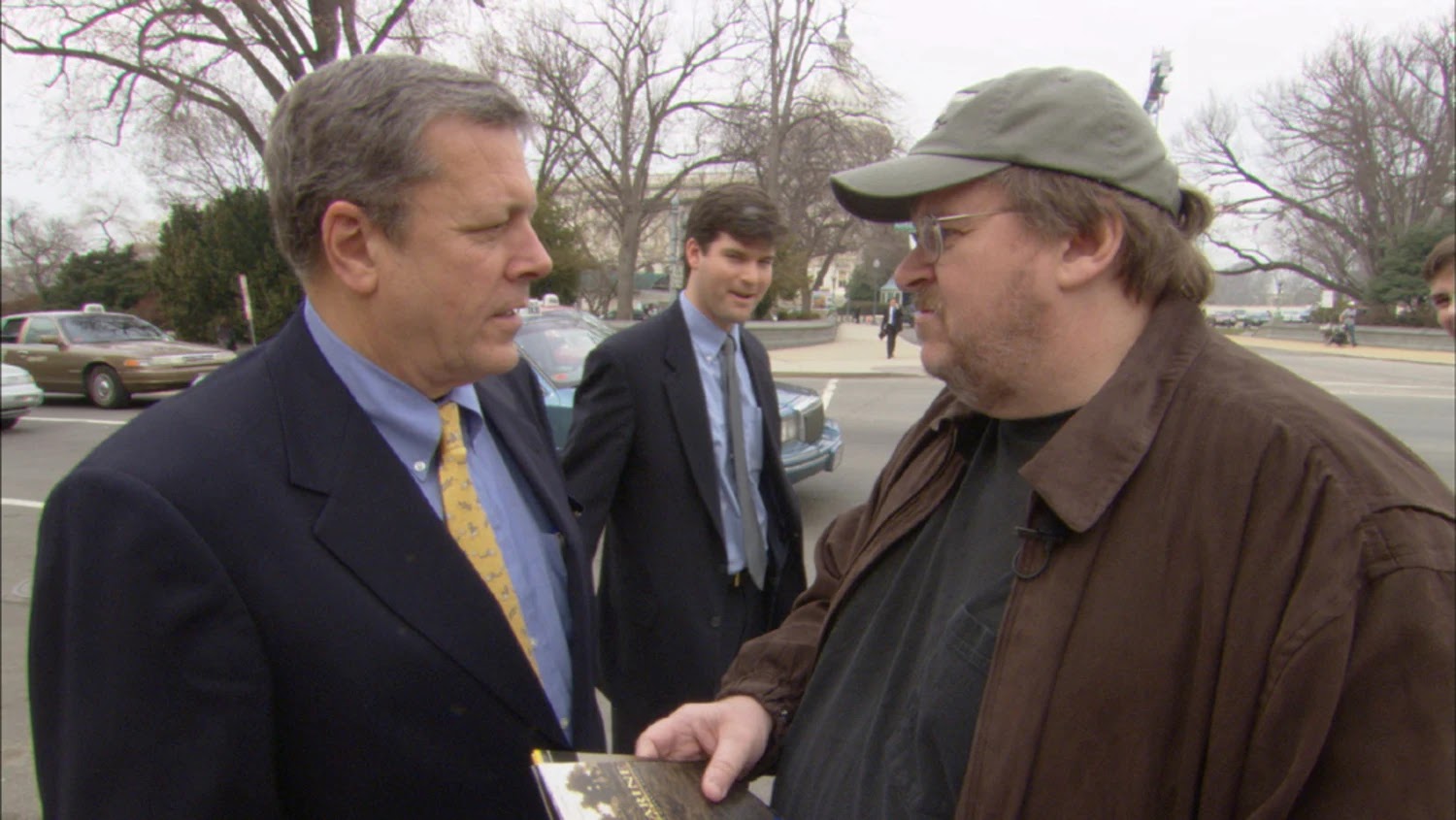
Farenheit 9/11 (Michael Moore, 2004) "Everyone’s getting along just fine backstage, the Teamsters are helping Michael Moore into the trunk of his limo,” cracked Steve Martin after Moore won Best Documentary at the 2002 Oscars (for Bowling for Columbine) and used his speech (accompanied by all the Documentary nominees) as a passionate speech against the Iraq War. The "Shame on you, Mr. Bush" speech was then expanded into this film, which debuted before the 2004 election, but didn't seem to make a dent in Bush's re-election over the swift-boated John Kerry.It might have been the tone. Rather than educate or inform, Moore's documentary was a bit of a rant, although delivered in a calm, soothing, particularly patronizing tone. For all the juxtaposition of images—of Donald Rumsfeld complimenting the precision of aerial strikes while an Iraqi child's head is being sewn up, President George Bush making a "kill the terrorists" comment to the Press, and then (without an edit, mind you) returning to his golf game ("Now watch this drive"), the excruciating class-room reading of "My Pet Goat" after being informed that "America is under attack" (Moore's narration muses: "Was he thinking, "I've been hanging out with the wrong crowd. Which one of them screwed me? Was it the man my daddy's friends delivered a lot of weapons to? Was it that group of religious fundamentalists who visited my state when I was governor? Or was it the Saudis? Damn, it was them. Better blame it on [Saddam Hussein]")Moore's narration hammers the point home, but comes off as snarky and maybe a little too calculating for a moment rife with unanswered questions and the burden of responsibility that must have weighed heavily on the President. He might also have thought of his personal safety—"they can't find me in a school-house"—of who in D.C. was in charge, and if the attacks were limited to New York. Or he might have just been contemplating the unbelievability of it (as we all did), even though at that moment there was a memo on Condoleeza Rice's desk—one of several, maybe—warning of an attack but not sure when.Questions linger as History moves forward: the whisking away of Bin Laden's family members out of the States on the last flights out before the air-travel embargo (Why them? How did it happen so fast, and who had the foreknowledge that Bin Laden, specifically, was behind it that the families needed to be evacuated? Where are they now?); the rush to Afghanistan to upend the tentative stranglehold of the Taliban who were providing training camps to Al Qaida (Understandable, given the intel and lack of cooperation coming out of the place); the wholly unnecessary push to Iraq to depose Saddam Hussein on trumped-up WMD suspicions (there have been no repercussions for that or the cherry-picked evidence); the decision to support Pakistan (ignoring the democratically-voting India, who was already an ally) when that country seemed unable and unwilling to control its borders, and were ultimately revealed to be harboring Bin Laden. Whose decision was that? Is that where Bin Laden's family fled to—or back to Saudi Arabia—did we know this? Is this why—at one point—Bush stated that finding Bin Laden was no longer his highest priority? One can spout maxims like "keep your friends close but your enemies closer" but at what point do you admit your alliances are stabbing you in the back?The images that stick, though, are the war profiteers who saw a great opportunity for making big bucks once the soldiers who'd fought and bled to clear the area and make it safe for the carpet-baggers to exploit. What's happened to those investors? What's happening now in Iraq? Are the lights on? Is there potable water? Is there any evidence of the U.S. doing any good besides the scars and rubble? In this election year, we're being asked: Are we better off? Shouldn't we also be asking—are they? Do we just make a mess and have no moral obligation to cleaning it up? And if anybody has profited from this, at the expense of the lives of our soldiers, why aren't they in jail?But, back to Farenheit 9/11: the less important issue is should Moore's work be considered under the category of documentary. To be sure, there is no objectivity in documentaries—every shot, every edit is informed and influenced by some editorial perspective—but Moore's output is more in the line of illustrated advocacy, starting with a point of view and the content cherry-picked (that term again) to enforce that point (rather than letting the content drive the conclusions). Moore's staged interviews and stunts are all strategically geared to his theses. At that point, his films are no longer documents, but propaganda. So what, you say? It's an important distinction if you're searching for truth—to be informed—rather than being told what to think.
Labels:
2004,
9/11,
Documentary,
F,
Iraq War,
Michael Moore
Thursday, March 24, 2022
The Hurt Locker
The Oscars are this weekend (Lord, help us!) and there are a couple of Best Picture winners I haven't re-published from "The Olde Site." So, rather than doing anything "newish" I'll opt, instead, for "timely."
I'm not a fan of The Oscars (like everybody), but I watch it (like everybody) and I complain about it the next day (like everybody). You can't seem to have one without the others. People enjoy complaining about them but wouldn't dare miss watching them. Everybody has some Oscar-decision that's an obscenity in their eyes...and there are some that are questionable (my Saturday "Trash" post will be one of them)*. But, most of the time, I just don't care. The Oscars, being voted on within a year of each film's release, are always going to be short-sighted, with absolutely no chance of being able to judge a film's lasting legacy. The decisions are always factored by politicking or prestige. Maybe trendy. But probably not. They'll always be there whether one watches them or agrees with them.
Oh. And this was written at the time of the film's release.
or
"Cravin' a burger. Isn't that strange?"
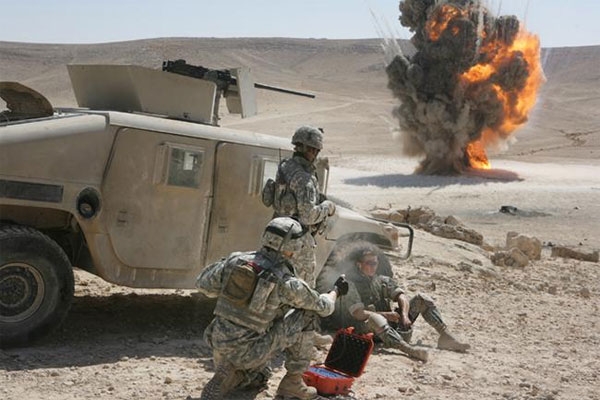
A lone figure walks down an alien landscape in a space-suit of Kevlar and crash-helmet, his only companions are his breath and his thoughts. Death surrounds him, and he walks towards the only certain death he knows of: a make-shift explosive device, conceived in cunning and hate that he must dis-arm in order to save himself, his comrades, and the watching by-standers, one of whom just might be waiting to explode the device. It is not some forbidden planet, or an anarchic Western town, but it could be. It's downtown Iraq, and it comes down to one man walking and facing his fear.
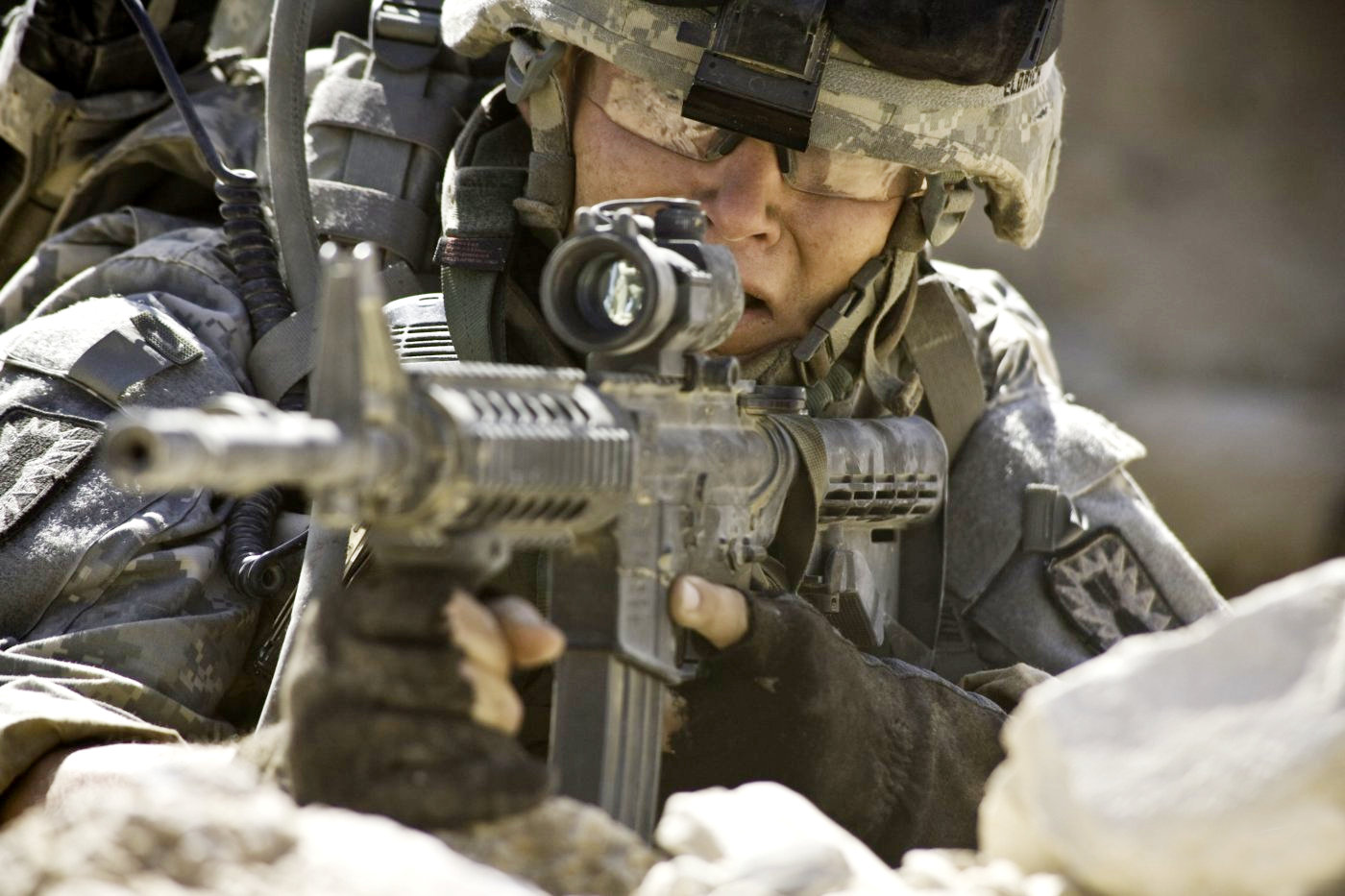
Kathryn Bigelow will probably never be considered a "superstar" director.That's too bad, because she's miles ahead of the so-called "young Turks" doing action movies these days. Instead of following current trends, she adheres to the rock-solid action direction styles of Anthony Mann and Don Siegel: let the audience know what's going on, and one other thing that too many directors these days forget—an audience has to know the territory their heroes walk through to fully present the dangers they face. In The Hurt Locker she may use a hand-held camera a bit too much to re-create the verisimilitude of war-footage, but it comes in handy to lock you into the searching point-of-view of Bravo Company's of Bomb "Tech's" and "Post-Bomb Assessors"—"The Blasters"—in Iraq's Camp Freedom ("They changed it from Camp Liberty to Camp Freedom because Camp Freedom sounds better," says veteran Sergeant JT Sanborn (Anthony Mackie) to the new Team Leader Staff Sergeant William James (Jeremy Renner, looking like a cross between Nathan Fillion and Brendan Fraser, like most of the principals of The Hurt Locker, his performance is understated and full of small nuances).
James is described as "a rowdy boy" and "reckless." Before his arrival, "the suit," that cumbersome Kevlar get-up which would protect anyone but the man who needs it most, has been the last resort in a disarmament situation. But that's not good enough for James. He likes to disarm the things by hand, and collect the odd bit of equipment for a trophy that "could have killed" him. He'll go in with "the suit" first, and puzzle the thing out, something that doesn't win him prizes with his team-mates, especially Specialist Eldridge (Brian Geraghty), because the longer it takes James to disarm a bomb, the more vulnerable his team-mates are to snipers.
It doesn't take long for the team to realize that James loves his work a little too much, and that it may kill them before their tour is up. Bigelow keeps a running track of the "short-timer" count-down as the situations become more dire and the traps more intricate, electronically and ethically.
War films have gone through a weird evolution from the time they were conscious enough to move beyond the "good guys vs. bad guys" (while still acknowledging that both sides share their share of casualties. But it's been since the Korean conflict that movies started to go deeper into the psychosis of war—not the PTSD issues, but the psychosis of being inside the conflict. One of the counselors at Camp Freedom ineffectually tells Eldridge "You know, this doesn't have to be a bad time in your life." Easy for him to say. All Eldridge can think about is the best outcome of the war—surviving it. And when his orders come down to "Be smart. Make a good decision" it's tough to say what is a good day and what is a bad day.
But lately, war-films have taken a look at the man on the line and what makes a good soldier, and it comes down to a blurred combination of self-sacrifice and controlled psychopathy. Whatever the motivations its the results that count. We've seen that theme in Hell is For Heroes, and Patton, Apocalypse Now, The Burmese Harp, Full Metal Jacket, and Flags of Our Fathers. How the soldier compartmentalizes the war experience to survive and even stay sane through the fire determines his ultimate worth as a soldier and as a human being. It is that perspective, of life is brief increments, that keeps a soldier walking alone in The Now, where "The Big Picture" is unseen in the limited view of his path, unknowable and brutally finite—the past a bitter memory, the future an empty promise, and today is walked with the high of High Noon.
* For instance, there's the case of How Green Was My Valley beating out Citizen Kane for Best Picture of 1942 (as well as Sergeant York and The Maltese Falcon). And yet, I can't kick about the choice because I love both films, and I can certainly see why someone would prefer Ford's classic against Welles "Greatest Film Ever Made."
Thursday, March 25, 2021
Body of Lies
Written at the time of the film's release.
At the time of writing the Iraq War had been going on since March of 2003 and "officially" ended December of 2011—three years after this was written. The war in Afghanistan began in October, 2001 and is still on-going.
"Killing the Future with the Past"
There have been a great-many films about The Iraq War; emphasis on the "many," not so much on the "great." None have penetrated the box-office top five, and the movie-going public, with a constant dose of it (when things are going badly) on the news, have made the conscious decision to avoid paying attention at every opportunity. It may seem a disparaging thing to note, but, the public seems to have better sense than the government representing it.
Body of Lies with the one-two star punch of DiCaprio/Crowe, under the direction of Ridley Scott did manage to gain an audience (though not enough to topple the reigning champ-Beverly Hills Chihuahua), and it's just as well—it's a summation of just about every "Bush-war" film that has gone before, without adding anything new.
Part of the problem is Ridley Scott, who more often cares about how his films look than what they say. Part of the problem is William Monahan's script (which covers much of the same ground as the other films dealing with a high-tech war in a low-tech country, where boots on the ground see more than eyes in the sky--it just got there last, is all). And the other problem is that the war has gone on so long, that we might be running out of things to say about it, at least until some of the secrecy veil is lifted about the machinations going on in the marble halls and scrub rooms of Washington and Virginia.
Not to say the film doesn't have a lot to say. At one point--with a tight deadline to meet--I checked my watch to see if the film was about to wrap up, it being so full of incident and detail, and was shocked to see that an hour hadn't even gone by yet. There was still another hour to go! There is such a flood of realistic sounding information that it probably resembles the tsunami of information Homeland Security has to sift through with their Cray's. All of that research, all that sound and fury and the all the movie comes up with is "Tell the Truth."
Thanks. We knew that going in.
The points writer and director make are obvious:
DiCaprio, in "The Big Sandbox", has more of a grasp of what's happening, despite his getting marching orders from puppet-master Crowe in Langley. Scott repeatedly makes the point as DiCaprio curses at Crowe over his ear-bud, while Crowe's character is dealing with domestic needs at home. While DiCaprio's Robert Ferris is doing wet-work, Crowe's Ed Hoffman is SUV-ing the kids to school, with all the icy coolness of the uninvolved. And that happens frequently.
Ultimately, it's a waste of time, and is another of the many Ridley Scott projects that looks good, but doesn't add up to much in the long run. We've seen this story before.
Now, give us a good ending.
Tuesday, August 18, 2020
W.
Written at the time of the film's release. I took out a long rant about the Bush Administration (when I wrote it Bush was still in office) and I wanted my prejudices out front. Here, the prejudices are for Oliver Stone's issues with film-making (for the most part).
Plus, the venom I spewed at that time, seems almost quaint considering what has come after him since. Bush has been heard to remark about Trump "He makes me look pretty good." Michelle Obama and he are "besties," insisting on sitting together whenever "the formers" must gather. And Clinton and he act like they're joshing brothers, after Clinton and his father became close friends, post-presidencies (Clinton BEAT Bush in in the 1992 presidential election, but it didn't matter...).
One must acknowledge grace in our leaders...when they lead...and show us the way.
"Somethin' 'Bout Bein' in the Barrel"
Oliver Stone is no one's idea of an objective film-maker, if there is such a thing. Once a screenwriter puts pen to paper, they've already started manipulating the movie to their point-of-view, whether it's from the left, right, center or upside-down (Why do you think they're called "directors?"). So, no one should be surprised that Stone has an ax to grind, with W..
Stone is a director of heart, but he frequently by-passes his brain when making his points. So, Platoon, still his best film, hi-jacks the gritty depiction of grunt jungle-fighting with Stone's own conflicted "Daddy" issues, his "Pvt. Chris Taylor" having to choose between two superiors with different moral ways of engaging the enemy. Lincoln and every fantasist depicting moral choice has put angels and devils on our shoulders. Stone burdens us with His Old Man. That same scenario was transferred to High Finance, with his very next film Wall Street. I haven't seen every film of Stone's, but most of them are concerned, in some capacity, with paternal conflicts. And because he's a better propagandist than scenarist, most Stone films stop dead whenever we get to each Stone "thesis," invariably a Message being presented by a single character who has center-stage and our undivided attention. JFK, a dazzling technical exercise of photography and editing, comes positively unglued in its presentation of conflicting conspiracy scenarios for Pres. Kennedy's assassination (Kennedy being another Stone father figure--"Our murdered King," as he's described in the screenplay (completely by-passing any thought that we might, you know, be living in a democracy with a representative government), until Kevin Costner's prosecutor Jim Garrison places in his summation a theory on military-industrial conspiracy behind the Vietnam War, a Stone obsession.* In W. Dick Cheney—Richard Dreyfuss clearly enjoys being given the opportunity to play him**—stops an Iraq War strategy session to pontificate on securing Middle East interests for oil exploitation for a hundred years. Give the man points for passion, but his movies become such a glut of emotion that the point becomes lost in the gnashing of teeth and the wringing of hands. His bio-pic of Nixon was such a slap-dash affair, it seemed like a badly-cast TV-movie gloss-over, skipping from high-light to low-light in time to shoe-horn the next commercial (A weirdly fictional conversation between Chairman Mao and Nixon was Stone's show-stopper there). By the end, with its End-Credits playing over a Mormon Tabernacle Choir-rendition of "Shenandoah," one almost felt some sympathy for the man. Nixon, not Stone.
W. (his too-early summation of the second Bush Administration) suffers the same problems. It's a gloss of recent events, interspersed with flash-backs to the wastrel days of the young George W. Bush (played throughout by Josh Brolin),*** drunk with entitlement and just about anything else he could find. Particular heed is paid to his relationship with "Pappy" George H.W. Bush (James Cromwell, though he seems nothing like Bush the Elder, displays quiet bluster and submerged weakness), in which the good-for-nothing son is particularly eaten up, not by his own failures, but by his father's view of them.
The best part of the film—oddly for Stone—is Bush's conversion to The Faith. Struggling with his alcoholism, determined to become a Public Figure (as private industry success constantly eludes him), he is converted by Pastor Earl Hudd (Stacy Keach, playing it straight, and doing some of the best work of his long career), introducing Bush to the second "Daddy," the Divine One, slotting this film into the standard Stone scenario. One knew, as soon as Bob Woodward revealed that Bush, prior to the invasion of Iraq, didn't consult his father/former President, but, instead, relied on the advice of a "Higher Father to appeal to," that Stone would obsess on it and exploit it. The film-maker takes the one relationship as far as it will go, creating a fantasy sequence where Bush 41 challenges Bush 43 to fisticuffs, but Stone doesn't have "the stones" to have W. duking it out with his Savior, J.C.
That battle's still to come.
Stone starts "W." with a Sergio Leone close-up of Bush's steely gaze, what impressionist Frank Caliendo says "like he's always got the sun in his eyes." It's another fantasy sequence, where W. acknowledges the cheers of an empty baseball stadium from center-field--what he'll later reveal as "his favorite place on Earth." The movie will end back on those eyes, searching, confused, disoriented--having lost a pop-fly "in the lights." Those distorted lights show up twice more in the movie--in that previously mentioned conversion scene, as well as when a hung-over Bush collapses while jogging. That's it? That's what we get? A half-assed light show? Is Stone saying he's abandoned by God, or that Bush is overwhelmed by his circumstances? The metaphor's too half-baked to communicate as solid concept clearly.
One could look at W.'s story in Shakespearean terms, as a modern day Prince Hal, whoring and wenching in his oats-sewing days to become the Monarch his father couldn't be. The difference is Hal had Falstaff as guide to the back-alleys of Agincourt. George W. Bush is his own King. And his own Fool.
But Oliver Stone is too busy making room for his "Daddy" theories to create a proper condemnation. As with Nixon, you start to actually sympathize with the man. Any illumination into the man or the effect of his Administration is lost in the lights. To Stone, he is just another Yalie "poor little lamb who has lost his way."
Bah. Bah...and Bah.
* Any judge would have gaveled the irrelevancy, but Stone's judge was played by the real-life Garrison.
** Dreyfuss had a lovely phrase about working with Stone on W. when he was on "The View:" "You can still be a fascist...even if you're on the left."
**Josh Brolin does fine work, but the performance feels a bit "one-note," having to nail the too-familiar Bush mannerisms and vocal tendencies.
Tomorrow—merely by coincidence, another "period" film.
Plus, the venom I spewed at that time, seems almost quaint considering what has come after him since. Bush has been heard to remark about Trump "He makes me look pretty good." Michelle Obama and he are "besties," insisting on sitting together whenever "the formers" must gather. And Clinton and he act like they're joshing brothers, after Clinton and his father became close friends, post-presidencies (Clinton BEAT Bush in in the 1992 presidential election, but it didn't matter...).
One must acknowledge grace in our leaders...when they lead...and show us the way.
"Somethin' 'Bout Bein' in the Barrel"
Oliver Stone is no one's idea of an objective film-maker, if there is such a thing. Once a screenwriter puts pen to paper, they've already started manipulating the movie to their point-of-view, whether it's from the left, right, center or upside-down (Why do you think they're called "directors?"). So, no one should be surprised that Stone has an ax to grind, with W..
Stone is a director of heart, but he frequently by-passes his brain when making his points. So, Platoon, still his best film, hi-jacks the gritty depiction of grunt jungle-fighting with Stone's own conflicted "Daddy" issues, his "Pvt. Chris Taylor" having to choose between two superiors with different moral ways of engaging the enemy. Lincoln and every fantasist depicting moral choice has put angels and devils on our shoulders. Stone burdens us with His Old Man. That same scenario was transferred to High Finance, with his very next film Wall Street. I haven't seen every film of Stone's, but most of them are concerned, in some capacity, with paternal conflicts. And because he's a better propagandist than scenarist, most Stone films stop dead whenever we get to each Stone "thesis," invariably a Message being presented by a single character who has center-stage and our undivided attention. JFK, a dazzling technical exercise of photography and editing, comes positively unglued in its presentation of conflicting conspiracy scenarios for Pres. Kennedy's assassination (Kennedy being another Stone father figure--"Our murdered King," as he's described in the screenplay (completely by-passing any thought that we might, you know, be living in a democracy with a representative government), until Kevin Costner's prosecutor Jim Garrison places in his summation a theory on military-industrial conspiracy behind the Vietnam War, a Stone obsession.* In W. Dick Cheney—Richard Dreyfuss clearly enjoys being given the opportunity to play him**—stops an Iraq War strategy session to pontificate on securing Middle East interests for oil exploitation for a hundred years. Give the man points for passion, but his movies become such a glut of emotion that the point becomes lost in the gnashing of teeth and the wringing of hands. His bio-pic of Nixon was such a slap-dash affair, it seemed like a badly-cast TV-movie gloss-over, skipping from high-light to low-light in time to shoe-horn the next commercial (A weirdly fictional conversation between Chairman Mao and Nixon was Stone's show-stopper there). By the end, with its End-Credits playing over a Mormon Tabernacle Choir-rendition of "Shenandoah," one almost felt some sympathy for the man. Nixon, not Stone.
W. (his too-early summation of the second Bush Administration) suffers the same problems. It's a gloss of recent events, interspersed with flash-backs to the wastrel days of the young George W. Bush (played throughout by Josh Brolin),*** drunk with entitlement and just about anything else he could find. Particular heed is paid to his relationship with "Pappy" George H.W. Bush (James Cromwell, though he seems nothing like Bush the Elder, displays quiet bluster and submerged weakness), in which the good-for-nothing son is particularly eaten up, not by his own failures, but by his father's view of them.
The best part of the film—oddly for Stone—is Bush's conversion to The Faith. Struggling with his alcoholism, determined to become a Public Figure (as private industry success constantly eludes him), he is converted by Pastor Earl Hudd (Stacy Keach, playing it straight, and doing some of the best work of his long career), introducing Bush to the second "Daddy," the Divine One, slotting this film into the standard Stone scenario. One knew, as soon as Bob Woodward revealed that Bush, prior to the invasion of Iraq, didn't consult his father/former President, but, instead, relied on the advice of a "Higher Father to appeal to," that Stone would obsess on it and exploit it. The film-maker takes the one relationship as far as it will go, creating a fantasy sequence where Bush 41 challenges Bush 43 to fisticuffs, but Stone doesn't have "the stones" to have W. duking it out with his Savior, J.C.
That battle's still to come.
Stone starts "W." with a Sergio Leone close-up of Bush's steely gaze, what impressionist Frank Caliendo says "like he's always got the sun in his eyes." It's another fantasy sequence, where W. acknowledges the cheers of an empty baseball stadium from center-field--what he'll later reveal as "his favorite place on Earth." The movie will end back on those eyes, searching, confused, disoriented--having lost a pop-fly "in the lights." Those distorted lights show up twice more in the movie--in that previously mentioned conversion scene, as well as when a hung-over Bush collapses while jogging. That's it? That's what we get? A half-assed light show? Is Stone saying he's abandoned by God, or that Bush is overwhelmed by his circumstances? The metaphor's too half-baked to communicate as solid concept clearly.
One could look at W.'s story in Shakespearean terms, as a modern day Prince Hal, whoring and wenching in his oats-sewing days to become the Monarch his father couldn't be. The difference is Hal had Falstaff as guide to the back-alleys of Agincourt. George W. Bush is his own King. And his own Fool.
But Oliver Stone is too busy making room for his "Daddy" theories to create a proper condemnation. As with Nixon, you start to actually sympathize with the man. Any illumination into the man or the effect of his Administration is lost in the lights. To Stone, he is just another Yalie "poor little lamb who has lost his way."
Bah. Bah...and Bah.
** Dreyfuss had a lovely phrase about working with Stone on W. when he was on "The View:" "You can still be a fascist...even if you're on the left."
**Josh Brolin does fine work, but the performance feels a bit "one-note," having to nail the too-familiar Bush mannerisms and vocal tendencies.
Tomorrow—merely by coincidence, another "period" film.
Labels:
2008,
Bio-Pic,
Bruce McGill,
Drama,
Elizabeth Banks,
Iraq War,
James Cromwell,
Jeffrey Wright,
Josh Brolin,
Oliver Stone,
Politics,
Richard Dreyfuss,
Scott Glenn,
Thandie Newton,
Toby Jones,
W
Wednesday, September 11, 2019
No End in Sight (2007)
September 11, 2001. Eighteen years ago today. We started the war in Iraq on September 26, 2001. We are still there eighteen years later. This year, 20 U.S. soldiers were killed in Afghanistan, 11 in Iraq (By contrast, the Soviet Union pulled out after nine years of their Afghan war). More than likely, we'll be there next 9-11 anniversary well. We should always remember 9-11. We should also remember we are still fighting wars over it and the sacrifice of the men and women who have fought there...and continue to fight there...with no end if sight. Maybe we should remember this first.
This was written at the time of the film's release...in 2007. That was 12 years...and three presidents...ago.
"There are 500 ways of doing it wrong, and only 2 or 3 ways of doing it right. Little did we know we'd have to go through all 500 ways."
Charles Ferguson's comprehensive dissection of the Iraq War is as clinical as an autopsy—and just as much fun. It's the only movie in memory that has the bodyguards and security force listed in both the front and end credits. Using news footage from a variety of sources and interviews with a comprehensive number of people who had boots in the sand (but only one of the decision makers who had their heads there), Ferguson precisely points to the errors made by the bureaucrats in the Bush administration, who made up their minds before they had the facts, and then cherry-picked the ones (however few) that skewed with their assumptions. It's a pattern that has represented this administration from...well, probably from its inception. Rather than look at the facts and draw conclusions (what's called the "scientific" method), these officials use an Academic approach, the lawyer's approach, the PR approach, and sift the facts that much their presumptions. Then to sell it, they spin it with homilies from the glib ("stuff happens!") to the ignorant ("there is no insurgency in Iraq, but there is a high degree of domestic violence") when the results are not what they expected. And the people in charge of carrying out these pipe-dreams are the bureaucrats and neophytes who are owed a favor, and under-perform in times of crisis.
And when they resign under a cloud, they get a medal.
One gets more than a sense of blundering from No End in Sight, one gets a sense of the arrogance in the face of incompetence, and lays blame on four individuals, Bush, Cheney, Rumsfeld and Rice, with able assistance from Paul Wolfowitz, none of whom served in the military, but asked that military to do the impossible while tying their hands.
The interviews are culled from both the U.S. and Iraq, reporters, military, active and retired, grunts and advisers, the haunted looks on their faces and the barely-contained disgust in their tones speak volumes of how success was constantly foiled by the decisions of the Bush administration and its cronies who seemed determined to follow the least effective, most destructive, most expensive path, leaving Iraq with sporadic electricity, water every other day, cities in ruin and a populace half of which is unemployed due to American actions, and the other half subject to violence and the constant threat of kidnapping and desperate to find a solution—any solution. In this chaos, with a void in leadership, the desire for a strong leader is seen in the fundamentalist clergy, who seem destined to be the next elected leaders and the enemies of the U.S.
"I don't "do" quagmires," says Rumsfeld (twice) in the film. Wrong again. He does them exceedingly well.
No End in Sight is a must-see, because it goes beneath the headlines that have hardly explained the war to the American public. And it goes a long way in explaining how corruption of the political system can lead to high levels of incompetence, as has been seen with both Iraq and New Orleans. And it does so without any snarky sarcasm, or cheap shots (at least none that aren't provided by the Administration's own words and actions). But there's no audience for the information. In the huge auditorium where I saw the film, there were only two people: me, and another guy.
You can also watch the film...for free...at this address: https://tubitv.com/movies/461858/no_end_in_sight
This was written at the time of the film's release...in 2007. That was 12 years...and three presidents...ago.
"There are 500 ways of doing it wrong, and only 2 or 3 ways of doing it right. Little did we know we'd have to go through all 500 ways."Charles Ferguson's comprehensive dissection of the Iraq War is as clinical as an autopsy—and just as much fun. It's the only movie in memory that has the bodyguards and security force listed in both the front and end credits. Using news footage from a variety of sources and interviews with a comprehensive number of people who had boots in the sand (but only one of the decision makers who had their heads there), Ferguson precisely points to the errors made by the bureaucrats in the Bush administration, who made up their minds before they had the facts, and then cherry-picked the ones (however few) that skewed with their assumptions. It's a pattern that has represented this administration from...well, probably from its inception. Rather than look at the facts and draw conclusions (what's called the "scientific" method), these officials use an Academic approach, the lawyer's approach, the PR approach, and sift the facts that much their presumptions. Then to sell it, they spin it with homilies from the glib ("stuff happens!") to the ignorant ("there is no insurgency in Iraq, but there is a high degree of domestic violence") when the results are not what they expected. And the people in charge of carrying out these pipe-dreams are the bureaucrats and neophytes who are owed a favor, and under-perform in times of crisis.
And when they resign under a cloud, they get a medal.
One gets more than a sense of blundering from No End in Sight, one gets a sense of the arrogance in the face of incompetence, and lays blame on four individuals, Bush, Cheney, Rumsfeld and Rice, with able assistance from Paul Wolfowitz, none of whom served in the military, but asked that military to do the impossible while tying their hands.
The interviews are culled from both the U.S. and Iraq, reporters, military, active and retired, grunts and advisers, the haunted looks on their faces and the barely-contained disgust in their tones speak volumes of how success was constantly foiled by the decisions of the Bush administration and its cronies who seemed determined to follow the least effective, most destructive, most expensive path, leaving Iraq with sporadic electricity, water every other day, cities in ruin and a populace half of which is unemployed due to American actions, and the other half subject to violence and the constant threat of kidnapping and desperate to find a solution—any solution. In this chaos, with a void in leadership, the desire for a strong leader is seen in the fundamentalist clergy, who seem destined to be the next elected leaders and the enemies of the U.S.
"I don't "do" quagmires," says Rumsfeld (twice) in the film. Wrong again. He does them exceedingly well.
No End in Sight is a must-see, because it goes beneath the headlines that have hardly explained the war to the American public. And it goes a long way in explaining how corruption of the political system can lead to high levels of incompetence, as has been seen with both Iraq and New Orleans. And it does so without any snarky sarcasm, or cheap shots (at least none that aren't provided by the Administration's own words and actions). But there's no audience for the information. In the huge auditorium where I saw the film, there were only two people: me, and another guy.
You can also watch the film...for free...at this address: https://tubitv.com/movies/461858/no_end_in_sight
Subscribe to:
Posts (Atom)