I'm re-running this piece as today marks the 100 Anniversary of the publishing of The Great American Novel, "The Great Gatsby".
It is in the public domain; the copyright expired January 1, 2021.
"There are no second acts in American lives"
F. Scott Fitzgerald
Maybe in America, but in Hollywood, there are. We call them "remakes." Like Dashiell Hammett's "The Maltese Falcon"; Warner Brothers did three versions beforethey got it rightand then, wisely, they stopped. If they tried it again, the end-result would be reviled, because it would inevitably and unenviably be compared to the 1942Humphrey Bogart-John Huston version and it would be found lacking, not only as a film, but as an adaptation of the source material. It is so close, in spirit, if not the letter, there'd be no point. You can't improve on it. But not "the great American novel"—"The Great Gatsby," written in 1925 by F. Scott Fitzgerald, who was finding his feet trying to define the American culture that was exploding out of the fortunes garnered during The Industrial Age into The Post-Gilded Age. It seems that every decade somebody unearths it from American Literature 101 and tries again to do right by it. And the attempts started the year after it was published...
"For we must consider that we shall be as a city upon a hill, the eyes of all people are upon us; so that if we shall deal falsely with our God in this work we have undertaken, and so cause Him to withdraw His present help from us, we shall shame the faces of many of God's worthy servants, and cause their prayers to be turned into curses . . ."
John Winthrop, 1630
(Herbert Brenon, 1926) Based on the Broadway adaptation byOwen Davis and directed byGeorge Cukor, the silent adaptation in the words ofNew Yorker critic Richard Brody "got the parties right"—why wouldn't they being so close to the source?—and featuredWarner Baxteras Gatsby,Lois Wilsonas Daisy Buchanan,Neil Hamiltonas Nick Carraway andWilliam Powellas George Wilson (eh? Powell could have played either Gatsby...or Tom Buchanan...and nailed it), this version (despite extensive searches) is one of those silent films that has been lost through the ususal causes of time, neglect, poor storage and the explosive nature of its nitrate stock. The only evidence remaining of it is the trailer, which you can see below, old sport.
Reportedly, Scott and wife Zelda saw it in 1927 and walked out half-way through. Their opinion Zelda mentioned to their daughter Scottie in a letter: "We saw The Great Gatsby at the movies. It's ROTTEN and awful and terrible and we left."
The secret of a great success for which you are at a loss to account is a crime that has never been found out, because it was properly executed.
Balzac
(Elliott Nugent, 1949)Richard Maibaum—who is best known for scripting so manyJames Bond films—was the guy behind the '49 version, urging friendAlan Laddto make it. As producer-writer of the film, Maibaum had casting control, and as Ladd saw it as a great acting opportunity (and Paramount had him under contract), the studio used it as a carrot to influence Ladd to do other films. Maibaum and the original director John Farrow(interestingly, father ofMia, see below) disagreed over who should play Daisy and when Farrow wouldn't let go of the idea ofGene Tierney, he was canned over Maibaum's choice, Betty Field. This version starts in the present as Nick Carroway (Macdonald Carey) and Jordan Baker (Ruth Hussey), old married couple, visit Gatsby's simple grave ("But it's not him, Nick, it's not his style." "No, he'd have fancied something like Grant's Tomb.") etched with an inscription from the Bible—Proverbs 14:12 (which is "There is a way that seemeth right unto a man but the ends thereof are the ways of death.")
Just to position us time-wise, Carey's Nick lamely has to add "He seems like someone we knew in another time, another life, another world..." Well, it was "the Jazz Age" and Prohibition and, since then, there'd been a world war (with selfless rationing) where everyone was doing their part (as legend goes), but it is only useful hand-holding for those who have no idea the story takes place in the past (it doesn't help that knowledge that the fashions and dances are more contemporary, but the cars have a vintage feel). One would think one could get a clue from the dates on the head-stone, though.
This moral distancing from the story probably served a short-sighted convenience at the time, post-World War II, but it certainly doesn't serve the story very well. Perhaps it was to provide an enveloping "Happy Ending"—it all turned out all right in the end for Nick and Jordan, the secondary characters, so everything's fine. Too bad about the folks the story is about, though, huh?
In the book it is rumored that Gatsby once killed a man, but the 1949 makes it clear that he has...at least one...as he guns down a car full of holes and sends it crashing while on a bootlegging run. Ladd's Gatsby is less a man of mystery than a man of many mysteries, none of them seeming to ring true. We see Gatsby accompanied by Myron Lupus (Ed Begley) and "man" Klipspringer (Elisha Cook, Jr.) the day Gatsby drives up to "the valley of ashes" to find the lavish house at West Egg. Lavish it may be, but this version of "Gatsby" has a studio feel to it, all back projection and false sky-prosceniums. It's slightly claustrophobic and, despite the abundance of faux-white marble around, looks fairly cheap. Gatsby buys the West Egg mans' and walks outside through studio-"fog" to see the beckoning light from the Buchanan dock "just" across the way.
Cut to a party with Nick Carroway in attendance, but no idea why he's there. He runs into Gatsby purely by accident, suspecting him to be just another partyer and, after "bouncing" one of his "bootlegger" pals from the premises, imposes on Nick to host "the get-together" with cousin Daisy (Betty Field), he takes the opportunity during one of his parties to explain his history with an out and out fabrication that even Nick sees right through, so he tells another one about working for a man who bequeaths him a tidy sum of money. "That was in the old days when I was a sucker. Then I wised up." He doesn't waste any time asking Nick—second-cousin to Daisy Buchanan—to arrange a meeting, even offering some stock market business: "Every man has his price, Mr. Carroway. What's yours?"
The meeting is arranged with an anxious Gatsby and an ambivalent Nick and the affair between the two parted lovers begins anew. At least, that's what we're lead to assume—Ladd was so concerned about his image that he does not allow his Gatsby to be shown kissing a married woman. In fact, there's a lot of self-censorship going on: it's okay to show Gatsby plugging away at his gangster rivals, but any extra-marital affairs, whether between Gatsby and Daisy (or Tom Buchanan (Barry Sullivan) and Myrtle Wilson (Shelley Winters, nice casting that) or lost between scenes; there's even an attempt by Daisy and Tom to try to warn Gatsby that he's being hunted by a murderous George Wilson (Howard DaSilva), just to show you that they're not "bad people," despite all appearances to the contrary. That's just not the book.
Where the movie shines is in Ladd's portrayal of Gatsby—movie-star confident, but almost child-like in his devotion to Daisy (when the Buchanan's attend a Gatsby party, Ladd's host is only too anxious to steal her for a dance and the look on his face is ecstatic), which leads to a dull confusion of realization when his dreams go south. It's a nice portrayal, even if it's been buffed to appease the censors. And there's something of a practical casualness when he's seen shooting people at the beginning, a reflection of the casual cruelty that will lead to his down-fall later in the movie.
(Jack Clayton, 1974), The only reason Paramount's head of production,Robert Evans, wanted to make a movie of "The Great Gatsby" was because his wife (at the time) Ali MacGrawwanted to play Daisy Buchanan.*That was enough for Evans—at the time, the Paramount "golden boy"—to start an elaborate pre-production of a multi-million dollar picture, hiring his Godfather directorFrancis Ford Coppolato write the script and Jack Clayton to direct. Then, MacGraw signed to doThe GetawaywithSteve McQueenand the Evans-MacGraw marriage collapsed. Evans was not about to continue the picture with MacGraw in thelead, so he went casting to no real satisfaction, untilMia Farrow, who'd worked with the producer on Rosemary's Baby wrote him a note that said "Bob, can I be your Daisy?" She was signed, which rounded out an otherwise excellent cast, which included one veteran from the 1949 version—Howard DaSilva, who played the cuckolded George Wilson in that version, plays Meyer Wolfsheim "the man who fixed the 1919 World series" (who was identified as "Myron Lupus" in the 40's version—showing that the latter film wasn't afraid to tackle the anti-semitism of the novel or the prejudices of the moneyed upper-class as expressed byTom Buchanan, played snakily byBruce Dernin "the Redford version").
This was the first adaptation I had seen, and my memories of "The Great Gatsby" are always associated with the season of Summer. I read the book during a vacation and this one was released in that season and it's reflected in the shimmering cinematography suffused with scrimmed lenses and star-filters as well as the veneer of sweat carefully applied by the make-up staff that provides its own kind of veil for the stars. The '74 Gatsby has a distance to it that separates its audience with a gauzy wall that undercuts the drama and makes us not care a fig about the people in it. Everything looks great, but the figures in the center could use some work.
Part of the fault lies in the stars: Robert Redford is a great choice for Gatsby as a vision of the man, but Redford is an intelligent actor who has always fought his looks, and here he overthinks it. His meeting with Nick is faltering, fumbling, and a bit embarrassed, it is not that of a man setting up the gambit for which he has compromised his integrity and risked his soul. The only time you see a flash of how good Redford could be is when he nearly comes to blows with Tom Buchanan—Clayton cuts to his fist tightening, then to a close-up of Redford flashing his million dollar smile. He wants the fight. He's the poor boy who didn't get to marry the rich girl and wants to paste the face of the guy who did.
William Goldmandesperately wanted to do the screenplay for Gatsby—at the time Truman Capotewas taking a stab at it—but came away delighted with Coppola's screenplay. Not the movie made from it, however ("they basically ignored it" said Coppola). Goldman blamed Clayton's direction—"Jack Clayton is a Brit...he had one thing all of them have in their blood...a murderous sense of class," he wrote in his follow-up to "Adventures in the Screen Trade", "Which Lies Did I Tell?" The people, the revelers, are fools and he shows the squalor, rather than the foolish hope that befalls every one that burns the candle at both ends, gambles on a "get-rich-quick" scheme, or thinks that there might be a reckoning.
That's the spirit you want to end the Tragedie of "The Great Gatsby." What does Clayton's version leave us? With a tacked on credit sequence of decamping partiers over a squeamish version of "Ain't We Got Fun?" Maybe they wanted to leave us with something upbeat to walk up the aisle to, rather than contemplate what has gone before. I remember seeing that part of the movie as a slap in the face. It made a facile treatment only that more cynical.
* Well, maybe not the only reason—Evans still harbored the idea of becoming a movie-star despite having much more power in Hollywood that a mere actor would. Given his ego and the dream-world in which he lived, he might have imagined himself in the Gatsby role, as he certainly lived the lifestyle. He certainly must have saw himself as some prototype of Gatsby. But, after this movie's box-office, his productions became more desperate, less sure—he was set up to star with Jack Nicholson in the second part of the Chinatown trilogy—and he became addicted to drugs and it all came crashing down. He must have certainly read the Gatsby novel...he just didn't heed it.
"Yours in Great Depression" During the Baz Age or I'm Half Crazy All for the Love of You....
There have been several versions of F. Scott Fitzgerald's Great American Novel that have hit the big screen since the novel was first published in 1925, and nobody seems to get it right, if "right" can be got at all. There's a "lost" silent version with Warner Baxter, a 1949 version adapted by Richard Maibaum with Alan Ladd that emphasized Gatsby's gangster roots, the Robert Evans vanity production of 1974 with Robert Redford and Mia Farrow, directed bloodlessly by Jack Clayton. It's a challenge to produce such a tragedy that has a boisterous first act, and such a downer of a second, but that is what makes it so special, and so American. In fact, the best version must be taken out of the novel, which was written in the midst of the period in which it was set, and take into account future events—the stock market crash in 1929 and the following "Great Depression," which sounded the death-knell for The Jazz Age with a long sustained flat note. Fitzgerald's prescient, cautionary novel proved historically accurate with 20/20 foresight to the extent that you cannot make a movie of it un-ironically, given the past that was its future, and you cannot make a complete movie of it while remaining blind to what it did not foresee in reality, but captured artistically and thematically.
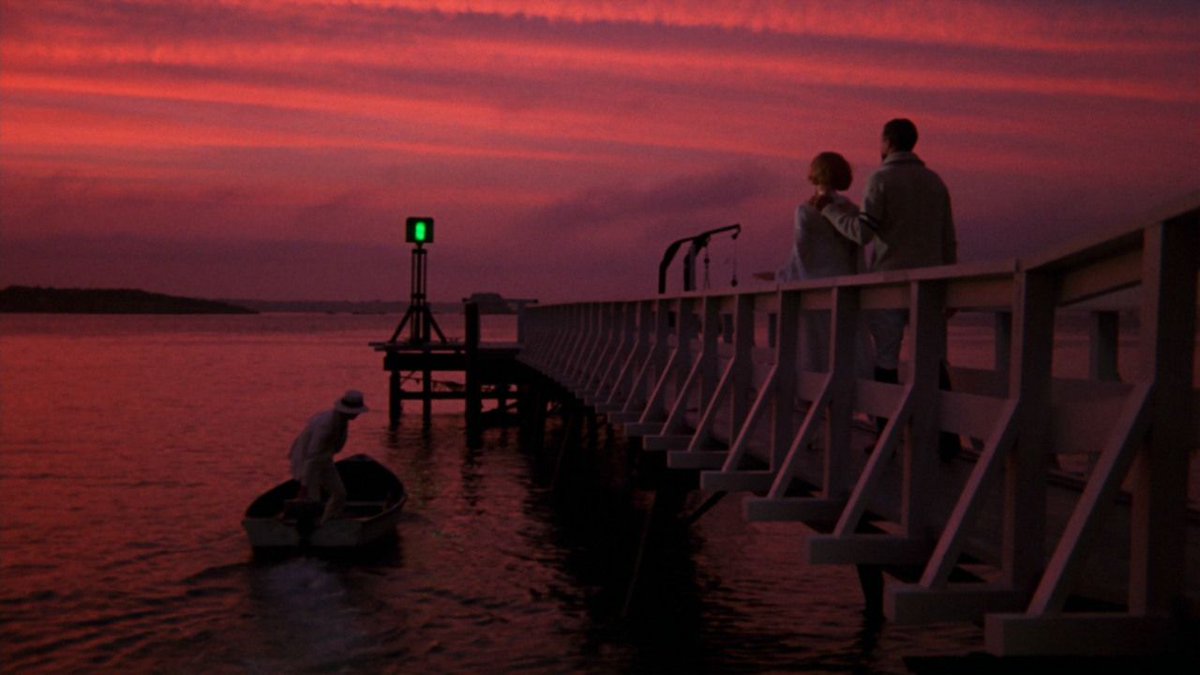
Baz Luhrmann's version of The Great Gatsby jumps into that irony with both feet and splashes around in it, kicking and squealing like a child drunk with a secret. It was a weird decision to film it in 3-D, but given the way Luhrmann uses it, in vivid eye-popping colors, emphasizing the swoop of camera moves and the solidness of glass partitions, and the illusion of the reflections shimmering over it—and particularly in how he photographs our last views of East Egg, in a way that rather lovingly visualizes the novel's last line ("So we beat on, boats against the current, borne back ceaselessly into the past")—one begins to wonder any other way to do it.** In a way, the movie feels like one big "Vertigo zoom" in three-dimensions (starting at the beginning credits) with an art-deco pattern that falls away to the production company logos and ending with an unfamiliar one—until you see it pop up again in Jay Gatsby's monograms.
Then, we begin the touchstones, green light on the dock, the Egg's, the parties, the infinite closet of shirts, the infidelities, "the man who fixed the 1919 World Series" (played by Bollywood superstarAmitabh Bacchan...) Dr. T.J. Eckleburg, Oculist (correctly spelled this time—it wasn't in the 1974 version), the fights, all done in Luhrmann's hyper-speed (which is maintained throughout, as opposed to his previous filmAustralia, which flagged after the first 45 minutes), in a style somewherebetweenPreston Sturges, Sam Raimi, andTex Avery, making the performances somewhat inconsistent (but more on that later). The swooping, veering style allows for some fore-shadowing plummets down skyscrapers and serves as a visual counter-point to Jay-Z's thumping, pumping soundtrack, which is surprisingly synchronous, although slightly discordant and certainly anachronistic. It does lend the film a sense of vital excitement, however shallow, that communicates to the spirit of those times to the "youngsters" in the audience.
"One big 'Vertigo' zoom"
The neatest touch that the director throws into this Great Gatsby is the framing story paralleling F. Scott Fitzgerald, as Nick Carraway (Tobey McGuire), incarcerated in a sanatorium to dry out, composes the story at the behest of his psychiatrist (Jack Thompson), which allows Fitzgerald's words to flow out and become part of the story (the name of the sanatorium is Perkins Sanatorium, after Fitzgerald's editor, the brilliant Max Perkins, a nice little in-joke) and become part of the narrative, succinctly and effortlessly, providing a touch of elegance and perspective to the visual shenanigans.
Even that is a little problematic, as you can't believe those words and that phrasing are coming out of McGuire's googly-eyed Candide in this version—Sam Waterston's Nick in the '74 vintage and even Paul Rudd's in the 2000 BBC take, both have the mature feel for Carraway's observer/muse/co-dependent enabler—something you can't see in McGuire. It's a miscalculation, but not due to any mis-casting issues, so much as Luhrmann's ADD approach to direction.
Leonardo DiCaprio's Gatsby is prone to such inconsistency as well. After establishing Gatsby as a figure of extravagant mystery and a certain false style, Luhrmann has him marching up to Nick's cottage, servants in line behind, an image that recalls a parade. It brings a laugh, but is far too comic for the character. Sure, he's nervous, anticipating the forthcoming tea, and he's slightly out of his element. But the effect takes away from all aspects of the character, even though it plays into Gatsby's too-romantic notions of reclaiming his past. Nor does it help that DiCaprio still looks like a boy-child here.
But where the casting falls off the most isCarey Mulligan as Gatsby's lost-love, Daisy Buchanan, the instrument of his downfall. It's a tough character to cast, as difficult asGone with the Wind's Scarlett O'Hara, seemingly worldly-wise (but actually sheltered), and fatally shallow, selfish in the moment, and murderously practical in the long run.** She needs to be someone who can dash all hopes by merely averting her gaze, and fascinating enough to attract it. And she has to evoke some sympathy for her acts, despite her flaws and practiced weaknesses. As good an actress as Mulligan is (and has been), her Daisy comes across, finally, unknowable and not interesting enough to be an object of obsession, as she must be for the whole tale to work.
In fact, it would be tough to think of a modern actress who could be so cool in her actions, and attractive to risk everything for. Stanwyckcould do it, and Hepburn (Katherine), but it would take a full infusion of actorly personality to pull off. With Mulligan, there's no spider's web of promise, only a longing weakness, around which the story can revolve. And at the pace Luhrmann spins the film, that character needs to have a substantial spine to keep it from flying apart, to make you realize what someone would risk everything for, and that spine can't be made of pixel-dust.
It's not there. Luhrmann provides substantial spectacle and very crowded frames with detailed evocation of the times, but the people caught in it cannot hold the thing together. It's just another variation of the theme. As such, it's an interesting, but not a great "Gatsby." Maybe—in another decade, after the book has aged a century—some entrepreneurial spirit, with hope and devotion in their eyes, will take on "Gatsby" and, rather than repeat, try to re-create the past and give us a truly great "Gatsby."
"Gatsby believed in the green light, the orgastic future that year by year recedes before us. It eluded us then, but that's no matter—tomorrow we will run faster, stretch out our arms farther...And then one fine morning--
So we beat on, boats against the current, borne back ceaselessly into the past."
F. Scott Fitzgerald
"The Great Gatsby"
** The 3-D also helps the special effects, which, in Luhrmann's vision have a distant postcard version of things and see quite a bit distanced from the real live action going on out front. In fact, I imagine the film looking pretty crummy in 2-D, especially in the shots where the large estates look like models (this was confirmed when I later saw it on television).
** “Her face was sad and lovely with bright things in it, bright eyes and a bright passionate mouth, but there was an excitement in her voice that men who had cared for her found difficult to forget: a singing compulsion, a whispered “Listen,” a promise that she had done gay, exciting things just a while since and that there were gay, exciting things hovering in the next hour.”
The F.B.I. (Love) Story or "What Determines a Man's Legacy is Sometimes That Which Isn't Seen"
J. Edgar Hoover ruled the Federal Bureau of Investigation for 45 years under the Department of Justice. Over the course of his tenure, he made the FBI his personal weapon in defending the nation from threats as he saw them, even as they changed form—from Bolshevik radicals to hayseed bootleggers and bank robbers to Communists to Civil Rights Activists to his very bosses. He did this unsubtly and unequivocally with press-trumpeted raids and whispered-about secret files that, if it didn't make him (as the phrase goes) "the most powerful man in the country," he was certainly the most feared. It was always assumed that Hoover had "the goods" on everyone, and guaranteed his long-held government post with weapons in manila files.
When he died (in office), Hoover's mug had the well-known face of a haggard bulldog—keeping secrets is something that can age you rapidly—and keeping secrets is something Hoover did best. Not only those of others, but his own. Rumors swirled about the nature of his relationship with FBI Associate Director Clyde Tolson—that they were secretly gay lovers rather than "gentleman cops," that Hoover was a cross-dresser, and that the reason Hoover didn't pursue the gangsters of La Cosa Nostra in the '40's and '50's was because of compromising photographs in the hands of Meyer Lansky. Nothing has ever been confirmed. It's all just rumor, the smirking kind that the powerful get (but there's never any proof).
Which is why news of a Hoover bio-pic, written by Dustin Lance Black and directed by Clint Eastwood seemed so intriguing. Eastwood isn't afraid to take chances, turning cliches on their ear and Black's clear-eyed script for Milk garnered an Oscar. Their filmJ. Edgarpromised "red meat," of the kind that could be delightfully and salaciously chewed.
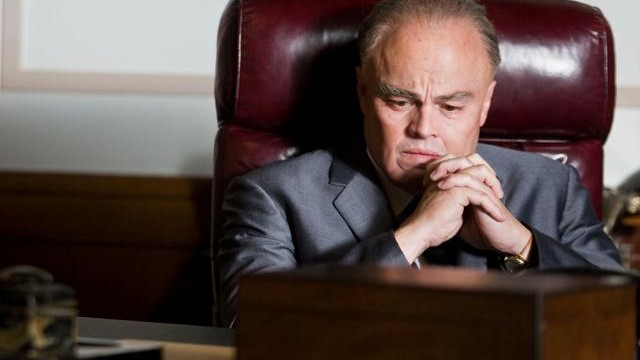
And the two men have taken chances...but not with the result you would think. Rather than being a rant or skreed, J. Edgar is actually a sympathetic look at the FBI director and his peccadilloes and shortcomings. There's nothing hysterical (save for one fist-fight that breaks out between Leonardo DiCaprio's Hoover and Armie Hammer's Tolson) in script or direction, but it offers a look at a severely closeted man who had to be in the times he lived and with the mantle he carried. Ambitious, yes. Paranoid, certainly. Vain and glory-hunting, without a doubt. Hoover craved the spotlight and his role in being "Head G-Man,"while at the same time operating in the shadows, single-mindedly hoarding the secrets of others, while keeping his own is the height of ironies. At the same time that he espoused the Bureau ethic for red-blooded American males as agents, one wonders if it is done for appearances' sake, a beard that would mask his own leanings while also serving as a "hiding-in-plain-sight" revelation of his own taste in men.
Black and Eastwood conduct the story-telling in flashback, as Hoover in his latter years, decides to set the record straight, dictating his memoirs to an amusingly rotating number of agent-stenographers who disappear as soon as a point is questioned, or a weakness revealed. The story is a white-wash, reflecting the man's "official" view of the Bureau's history in a mix of incident and myth. At many times, J.Edgar is a bit reminiscent of Citizen Kane, with its fracturing point-of-view, shifting perspective, and ironic commentary on some of the incidents.*
It also shares Kane's sense of the unattainable summation of a life. C.F. Kane's had little to do with "Rosebud," just as Hoover's gay leanings was a small part of his whole story. It began with a controlling mother (Judi Dench), determined to keep young John Edgar from becoming a drunk like his father. Groomed to become "the most powerful man in the country," Mother Hoover controls her son's life to make him the image of the perfect son, diction lessons to force past a stammer, impeccable grooming, and the enforcement of all of her prejudices. And the nullification of any behavior less than manly. He is made in the image of his Mother's "perfect son," even though that image may be completely counter to reality. It sets him on a lifelong course of fighting her battles, never really being his own man, as much as posing in the presentation he wanted to project. A performance. An act. Myth and lies.
It is a story soaked in ironies: the man who kept secrets on everybody, but the biggest being his own; the investigator who saw no harm in exposing other's private lives, while keeping an iron grip on his own; the policeman who targeted and made war on many enemies, the primary one being himself. Black and Eastwood present a case for sympathy, even empathy, for a man who shaped, and was shaped, by his times, who rose through the ranks of power in society, to not be shunned by it, and who searched for verifiable fact while living in denial, and closeted by the bureau of his own making.
Hoover and Tolson at their regular table at The Stork Club.
* Not to mention that DiCaprio's "old-man" make-up makes him look more like the aged Charles Foster Kane than the jowly Hoover (still, it's better than the never convincing make-up that Hammer sports as an aging Tolson), and the shots of Hoover witnessing the Inaugural parades of Franklin Roosevelt and Richard Nixon are shot from the same angle as the "newsreel" shot of Kane in a balcony appearance with Adolph Hitler.
Grann's book is a fine read—it spent 49 weeks on the New York Times non-fiction best-seller list—breaking down the story into three narratives: of Mollie Burkhart (played in the film by Lily Gladstone) of the Osage Tribe, who saw three of her sisters and her mother die (under suspicious or downright murderous circumstances) in a short space of a few years; of Tom White (played in the film by Jesse Plemons), a former Texas Ranger, recruited by the Bureau to investigate the murders—his unique way of assembling a team and having them blend in with the community was a bit unpracticed, but did lead to convictions; and a modern post-investigation appraisal. When Martin Scorsese announced it for his next movie with Robert De Niro and Leonardo DiCaprio
starring it was originally just going to focus on the FBI investigation with DiCaprio as White.But DiCaprio had other ideas—he wanted to play "a villain" and so the film was re-tooled by Scorsese and Eric Roth to feature more of the role of Ernest Burkhart, husband of Mollie and his role in the web of deceit and murders...all to obtain the headrights (the land mineral rights owned by full-blooded Osage tribe-members) to their oil-rich pocket of Oklahoma, that made the Osage "the wealthiest people per capita" in the nation. The Osage became prosperous with their oil stipend, creating a power dynamic where they ostensibly ran things in Fairfax, Oklahoma, but they were also targets for any scam and flim-flam the other residents could concoct in order to benefit from their prosperity.
And that included marrying into the money, the oldest way for profligate men to get a sustainable nest-egg and not waste it all in a short period of time. If there's children, then there's always inheritance, or better yet, the idealistically labeled "trust-fund," that can be exploited as long as no one is following the trail of money. In Fairfax, Oklahoma, the trail was not only monetary, but one merely had to trace family ties and the obituary column to see that something was surfacing besides oil.
Clocking in at a back-breaking 3 hours 20 minutes, Killers of the Flower Moon begins where most Scorsese movies do, following the bad guys. Ernest Burkhart (DiCaprio) exits the train to Fairfax after serving in the First World War and receives a warm welcome from his uncle, cattleman William Hale (De Niro), who is perfectly agreeable to taking Ernest under his wing, despite his lack of experience. Under an avuncular pretense, Hale gives his nephew the lay of the land, giving him a book on the Osage people ("Do you read?") and asking pointed questions about his taste in women. Hale speaks the Osage language and extends his avuncular charm to express support for the Native land-owners, especially dealing with the white city officials, the police and Sheriff, the local doctors, even the undertaker (that'll come in handy!). He also is quite familiar with the local underworld (even handier!), and his network makes him less than a town father, and more of a puppet-master.
Burkhart is his primary puppet, lending support to a romance between Ernest and Mollie Kyle (Underwood, who in her mandarin understated way, steals the show as well as hearts), who is already seeing signs of poor health in her family, who have a tendency towards diabetes. And when a "specialist" is needed for some special work to be done, Hale uses his nephew as a go-between, the better to keep his immaculate hands clean.
But, the center cannot hold. In the community, the deaths become less and less isolated and more overt, culminating in a house-bombing that kills Mollie's sister and her husband, who has been asking questions and connecting dots, while resisting any overtures to share information with Ernest. That signs his death warrant and the egregiousness of the crime—the sheer audacity of it—mandates outside help. Private detectives had been hired before...but had disappeared never to be heard from again. A meeting between tribes leaders and President Calvin Coolidge allows Mollie to make an entreaty...and for once, the Great White Father keeps his word.
This is where Plemons' Tom White from the Bureau of Investigation comes into town from Washington, and it only takes a couple of inquiries to determine that he's being stone-walled...by everybody. Evidence goes missing, records disappear, stories are vague and sometimes conflicting. But White brings in some other agents with varying backgrounds to infiltrate the town and integrate themselves into both the White and Native communities. Then, they share information and find the links...and discrepancies. And they attack from within.
If the film has a fault in conception, it is in the sheer repetitiveness of the crimes (although, to be clear, the crimes DID happen as depicted and over that long period of time, which shows how frustratingly slow any shred of justice could be brought to so insular and complicit a community). But, the numbing volume of the crimes strains credulity and patience for an audience, even one used to the slow process of justice and the bull-headedness that passes for politics but stinks like conspiracy. Not to minimize the scope of the crimes, but to see every one of them played out through the machinations of Hale through the prevarifications of DiCaprio's Burkhart makes it a long stretch of the same thing repeated over and over.
Gladstone is the acting highlight of the film, and De Niro—although a bit too long in the tooth to be playing Hale—does a good turn as evil posing as the friendly neighbor.
DiCaprio, though, is an issue. Sure, he's good box-office (and he's an Executive Producer on the film), but it may be time for the long string of Scorsese collaborations to end. At times, one can see him using Brando tricks and an occasional Jack Nicholson strategy in his acting, but mostly he seems to have based his performance on a frowny-face emoji (😠). His face freezes into the same petulant scowl, no matter the circumstances, whether he's unhappy, concerned, frustrated, murderous or cornered. And, the deeper you get into the movie, the lower the corners of his mouth drop until you wonder if his jaw will just drop off once they carve far enough. It's a disappointing performance, considering how integral DiCaprio made himself to the film.
It may be time to kick him off the raft, Marty.
As his character is in the film, DiCaprio is the film's weakest link.
Still, Killers of the Flower Moon resonates, as one more early example of a nation's systemic racism hiding in the shadows and swept under the rug, something that, although denied in all corners of the continuing national reckoning, continues to raise its ugly head.
Ernest Burkhart, Mollie Kyle Burkhart (on the right), and William Hale,
 "There are no second acts in American lives"



 "Yours in Great Depression" During the Baz Age


.jpg)