Showing posts with label Claire Bloom. Show all posts

Thursday, March 24, 2022

The King's Speech

The Oscars are this weekend (Lord, help us!) and there are a couple of Best Picture winners I haven't re-published from "The Olde Site." So, rather than doing anything "newish" I'll opt, instead, for "timely."
 
I'm not a fan of The Oscars (like everybody), but I watch it (like everybody) and I complain about it the next day (like everybody). You can't seem to have one without the others. People enjoy complaining about them but wouldn't dare miss watching them. Everybody has some Oscar-decision that's an obscenity in their eyes...and there are some that are questionable (my Saturday "Trash" post will be one of them)*.  But, most of the time, I just don't care. The Oscars, being voted on within a year of each film's release, are always going to be short-sighted, with absolutely no chance of being able to judge a film's lasting legacy. The decisions are always factored by politicking or prestige. Maybe trendy. But probably not. They'll always be there whether one watches them or agrees with them.
 
Written at the time of the film's release. And there's some post-Oscar bashing at the end.

"Crossing Your Threshold"

or
"Let's Take it from the Top: 'In Our Darkest Hour...'"

One of my favorite observations from Jerry Seinfeld was his remark that more people are scared of public-speaking than of death: "In other words, more people would rather be IN the coffin, than delivering the eulogy..."

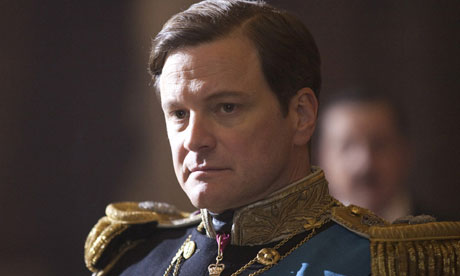
In The King's Speech, this year's Oscar-bait from The Weinstein Company, King George VI (Colin Firth, spot on, really) would rather be dead than speak in public. It's too bad, then, that his father, George V (Michael Gambon) beats him to the choired invisibule, and the next in succession, Edward (Guy Pearce, in an extraordinarily adroit performance) is too much of a self-absorbed ponce to sacrifice "the woman he loves" for such a small thing as the welfare of all of Britannia.

George VI, or Albert, the Duke of York (as he is dubbed before coronation),
has a persistent stutter, and a concurrent inferiority complex, given his heightened awareness of his condition and his responsibility—director Tom Hooper makes it clear in his direction and editing choices that we are constantly aware of his audiences' reactions to his stammers, faults and failings, even the portraits of his forebears stare in frozen, condescending judgement.*
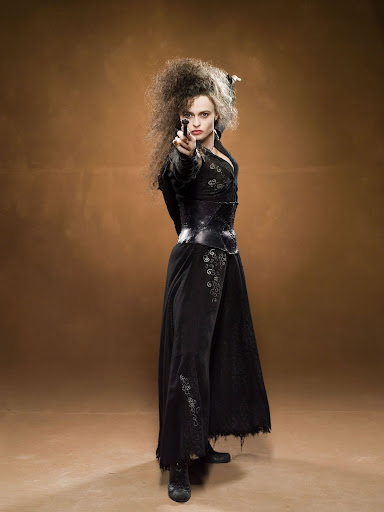
It is up to his wife, Elizabeth (Helena Bonham Carter, bi-polarly different than her roles for Hubby Burton and Harry Potter)—"Call me 'Liz'" she sweetly says at one point late in the movie—wants to fix the problem, not because her husband is the man who could be King, but because the underlying psychological whipping he imposes on himself is making him miserable. He doesn't even have the wherewithal to blurt out a bedtime story to his two adoring princesses, Elizabeth and Margaret.

With a capricious older brother and an ailing father-king, he is not the most confidence-inspiring potential potentate who can, as his father bellows "stand between us, the jack-boots and the proletarian abyss." And given that the position is more public than ever, what with the King needing to address his subjects via radio, the air of confidence is more important than ever, and Albert's failings as such are even more readily apparent in the Theater of the Mind. Not only is the Empire shrinking for the Royals, but the world is, too, and their enemy's reach is the range of a V-2 rocket.

Presentation is all now, sometimes even more than the message. During the viewing of a newsreel, the Royal Family gets a glimpse of the Player on the Other side, Adolf Hitler at the Nuremberg Rally. "What's he saying, papa?" asks a daughter. 


"I don't know," replies the envious Albert. "But he says it rather well."
What do the simple folk do, when they have to carry the burdens of the entire Nation on their backs without hesitancy, and with grace. The short answer is, they don't—the situation is somewhat unique.

Enter Lionel Logue
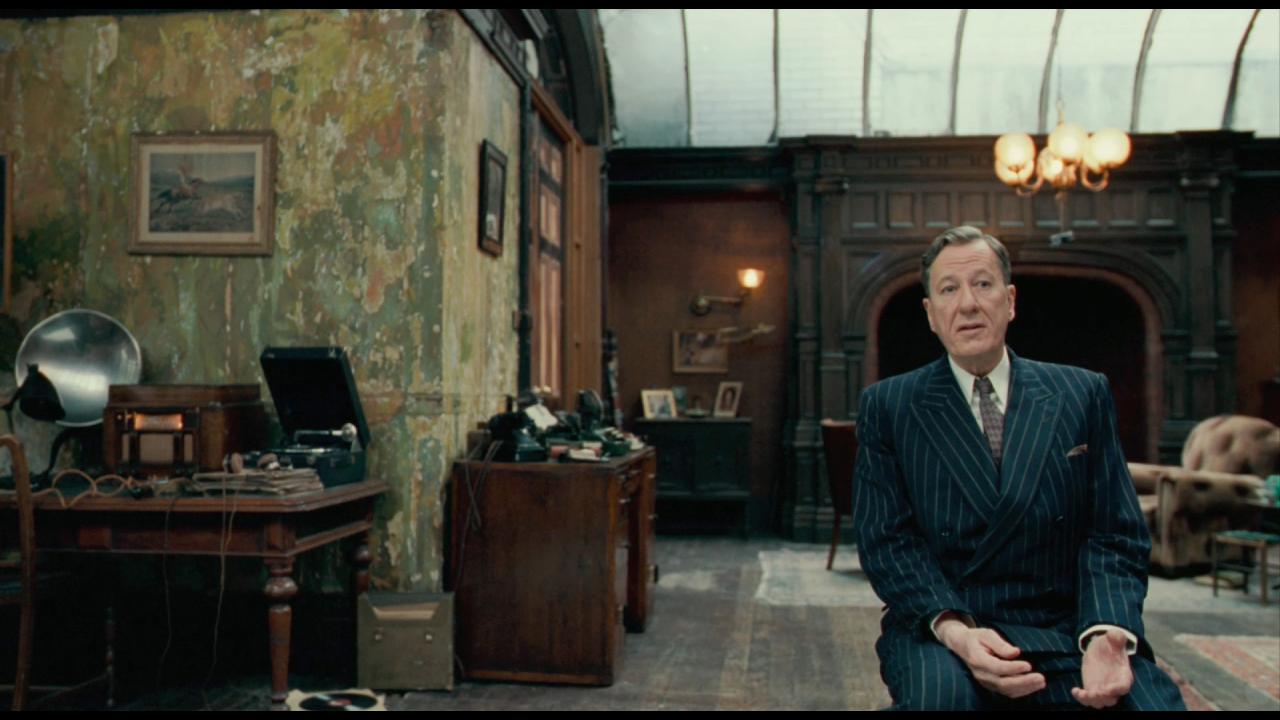
(Geoffrey Rush), full-time vocal coach, hopeful actor...Australian. He is visited by one "Mrs. Johnson"—the future Queen-Mum—to enquire about services, all the royal outlets proving inefficient, taxing and embarrassing for Albert. Logue has no idea who he's really dealing with—in all senses—explaining that his methods are "unorthodox and unusual."


"Not my favorite words," she sighs.
This is a cracklingly well-done film, subtle and efficient and literate—the script (by David Seidler) leading down as many paths as Logue has techniques, but the most interesting aspect is how the two men, Lionel and Albert (who Logue insists on calling "Bertie" to allow mutual approachability) must rise and lower each other to the occasion, Logue relying on his actor's discipline to gain respect, while Albert uses Logue to gain insight to the common man, essential to his tutelage. And the actors are terrific, not only the ones mentioned, but a small delegation of familiar faces maximizing their small roles. Derek Jacobi makes an early appearance, Anthony Andrews appears as P.M. Stanley Baldwin, Claire Bloom as Queen Mary, and Timothy Spall, doing a fair turn as Winston Churchill  It culminates in a moving sequence as the new King must make a radio address to reassure the public after the declaration of war on Germany. Incongruously set to the second movement of Beethoven's Seventh Symphony, George VI, alone, with his coach conducting, must pick his way through his speech, every syllable a struggle to maintain control—the music behind him halting and building. I tell ya, I dropped tears, it's an extraordinary last act to an extraordinary movie.

Now...the rating. The King's Speech is rated "R" (in the United States) for the silliest of reasons—a short sequence where Logue badgers Albert into cursing like a sailor, including a string of "F"-bombs that kept it from achieving the lighter "PG-13," although the film really credits an ever lighter "PG." Don't be put off by the prigs of the Ratings Board. This is a fine, fine film.

* ...but in a style not as annoying as his work on the HBO series "John Adams," and less conventional than his work on The Damned United.

Post-Oscar Bashing: Best Picture? Nah. Not in that gang of 10. But a safe, respectable choice. You can't complain about the script or the performances (I could about director Hooper's win, but as was clear in his acceptance speech, without Hooper—and his Mum—there would have been no film, and the script was certainly worthy). But, ultimately, it's the Best Picture Harvey Weinstein could buy...as has been the case before. Still. Great film. But not Best Picture...not with 127 Hours, True Grit, Toy Story 3 in the running.

Friday, December 29, 2017

The Spy Who Came In From the Cold

Over Christmas, I had great fun reading "A Legacy of Spies," the new novel by John le Carre. In it, the events of le Carre's earlier book "The Spy Who Came In From the Cold" come back to haunt the British Secret Service—The Circus, as le Carre dubbed it—as those who are still living are sued by living relatives for damages incurred by the events of the story. Is it some Russian plot? No. It is mere gold-digging. The plaintiffs are blackmailing the Service to reveal what they know...or suspect...if they are not payed handsomely. It is always fun for me to read le Carre but the nostalgia factor of coming back to the old characters, even if in passing, was a bit of a thrill. And whenever Alec Leamas was mentioned in the book, I still had trouble imagining Richard Burton's face and manner. I wrote this in 2011, some time before Tomas Alfredson's excellent version of Tinker Tailor Soldier Spy reached theaters—I should post my review of that here when I'm done with the clutch of Holiday released movies.

The Spy Who Came In From the Cold (Martin Ritt, 1965) With the anticipation of the Christmas release of a film version of Tinker Tailor Soldier Spy, it would do well to revisit the world of George Smiley, "Control," and the duplicity of agent-turned-novelist John le Carré's "kitchen-sink" version of spies. Although Smiley and the others would loom large in his later novels (especially the "Karla Trilogy"), they're mere background characters in The Spy Who Came In From the Cold, the focus of the tale being operative Alec Leamas (Richard Burton), former head of the West Berlin branch of "The Circus," who must go behind enemy lines—in fact, one of the toughest of them, the Berlin Wall—as a potential "mole"* to ferret out who, among their Cold War equivalency on the other side, might be a double agent for the Soviets, the one who is responsible for the death of one of Leamas' contacts. To "Control" (Cyrilm Cusack), the head of "The Circus"  it is a rare opportunity to do some damage control and, possibly, if they can take advantage of an agency power-struggle, some harm. 
His identity is kept the same—The Circus wants Leamas and his background history out in the open—but he is demoted in rank and stature, and, depressed and drinking heavily, he becomes bait for Soviet recruitment to betray information. That's the mission, become a decoy on the "inside," another "double" feeding the Soviets false information, while trying to find out if there's a player on the other side in The Circus feeding information to the Russians.** 

Oh, what a tangled web the Cold War weaves.

Taken to East Berlin, Leamas is interrogated by a suspicious Russian administrator named Fiedler (Oskar Werner) who (rightly) suspects Leamas of being a "plant." Fiedler suspects a British "mole" already underground in the Soviet service and so sweats Leamas for any information to discover who that might be. Ultimately, Leamas is undone by what so many of le Carré's heroes or anti-heroes are susceptible to, the warmth of human contact—a failing that trips up a lot of the author's protagonists. Leamas "comes out of the cold," the world of spies, and his friends, relations or lovers—the thread of decency and honesty they provide—are used against him.
For the fact of the matter is the Spymasters of "The Circus" are cold-hearted bastards ("without sympathy" as "Control," played by Cyril Cusack, ponders)—they have to be to combat their enemies—and they're just as capable of betraying their own as those they fight.  
Case in point: George Smiley (played here by Rupert Davies). He would become le Carré's most celebrated character, but here he's a bit of a functionary, and he's just as cold-hearted as the rest. In the "Tinker, Tailor..." timeline, "Control" was long since dead, having been driven out by "the new broom" from his station, which had left him suspicious and paranoid (ultimately with good reason) with Smiley his only trusted colleague. 
When the BBC made a television mini-series of "Tinker...", Smiley was famously played by Sir Alec Guinness and (as le Carré amusingly notes in his new forward to "Tinker, Tailor...,") because of that he "lost control" of the character. But Smiley (however sympathetically Guinness played him) is also a "cold-hearted bastard"—if he wasn't, he wouldn't have lost the vital clue that was exploited by his enemies. He gives as bad as he gets, and, even at his most triumphant, takes little joy in what he does.
Davies as George Smiley in The Spy...
In such a world, Ritt's direction is entirely appropriate—low-key, almost documentary in feel on the streets of London—in drab black-and-white, not the high-contrast color of other spy films of the era. There is nothing glamorous about it, and the circumstances play out slowly and subtly—in fact, after a debriefing by his boss, the shift in tone is so dreary one suspects one is watching a different film. It is part and parcel of the subterfuge—it works on us as it does for Leamas' Sov' recruiters (most prominently Michael Hordern).
And the script—now there's an interesting tale. A beginning draft was written by Hollywood veteran Guy Trosper, who died subsequently. Taking over was poet-playwright Paul Dehn. Dehn had written the final polish on the James Bond spy film Goldfinger (amusingly, as the two films could not be more polar opposite), and was the mainstay-writer for the "Planet of the Apes" sequels. But, Dehn knew the world of spies well—during the second World War, Major Paul Dehn was the "Political Warfare" officer at the BSC training headquarters "Camp X" (where among the trainees were Roald Dahl and Bond creator Ian Fleming). *** Dehn was well-versed in spy-craft, deceit, and keeping secrets and his distillation of le Carré's novel brings the moral duplicity to the fore, while keeping the audience guessing on whose side is whom.
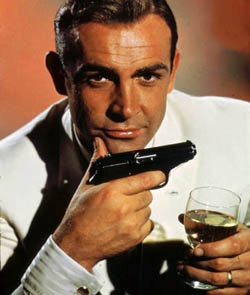
If the film has one flaw, it is the casting of Burton as Leamas. Burton was too good, too charismatic an actor/star to play a functionary like Leamas (it's about the same as "buying" Sean Connery as a spy (which was part of the joke of the Bond series)—he's someone you'd notice walking into a room, and thus, hardly spy material. But, Burton's presence, no doubt, got the film made, so the point is a bit moot. Still, if its ideas and mysteries of the State and the heart you want more than action and fireballs (shall we say if you want to be "stirred and not shaken?"), The Spy Who Came in From the Cold is a fine, bracing tonic.

Smiley's before they were emoji's: Alec Guinness and Gary Oldman

* The term "mole" is a le Carré invention—his spy-circles code-name for a double agent hiding in plain sight within one of the other spy agencies, Soviet or British, and relaying information to "the other side."

** There has been a rich history of double agents throughout the annals of spy-dom, the most significant of which were "The Cambridge Five"—Kim Philby, Donald Duart Maclean, Guy Burgess, Anthony Blunt, and a fifth (and possibly more)—who'd been recruited during their college years, passed information to the Russians during WWII, and subsequently during the post-War years through the early 1950's. "Tinker, Tailor, Soldier, Spy" (and the other two of the le Carré "Karla" novels) and le Carré's subsequent "A Perfect Spy" are inspired by "The Five" and their Russian puppet-master.

*** And, interestingly, one of the people who asked, and was briefly considered, to run Camp X...was Kim Philby!

Saturday, October 25, 2014

Olde Review: The Haunting (1963)

This was part of a series of reviews of the ASUW Film series back in the '70's. Except for some punctuation, I haven't changed anything from the way it was presented, giving the kid I was back in the '70's a break. Any stray thoughts and updates I've included with the inevitable asterisked post-scripts.

The Haunting* (Robert Wise, 1963) Robert Wise, who directed The Haunting is a supreme craftsman of film. he was formerly a film editor, one of the men who pasted Citizen Kane together, in fact, and thus knows how to compose his shots to make interesting stretches of film. He knows how to manipulate an audience, how to shock, how to fool. He can direct your attention to what he wants you to see. He is also quite adept at using special effects, thus he can pull off such projects as The Day the Earth Stood Still, West Side Story, The Andromeda Strain, and The Haunting. However, when it came to characterization, Wise usually falls flat on his face,** as was evident in West Side Story, The Sound of Music, and Two People. So, what you have in Robert Wise is the perfect disaster-movie director, and he fulfilled that label when he directed The Hindenburg last year. I can guarantee that your spine will be pleasantly chilled by The Haunting.
Unlike Rosemary's Baby, The Haunting does take place in odd, creepy surroundings--The Olde Hill House--and you have such things as a creaky metal circular stairway, convenient for a suicide, whispering corridors. Take a brooding mansion, some brutal situations, and some brutish ghosts and one quakingly susceptible person and you have the formula for this type of gothic. Whether its successful or not depends on whether the director can stir them up to make them a) original, which is unlikely, or b) scary, which you can do in a myriad number of ways, cinematically. Although The Haunting is not really the former, it is certainly the latter, so you might want to take a spare hand along Saturday night to clutch.
Maybe not. You see, there's a situation where....well, I'm not going to give it away. Find out for yourself, and...sleep well Saturday night.

Broadcast on KCMU-FM on October 22 and 23rd, 1976.

My criticism of Wise's ability with actors is unfair and untrue. He tended to cast talented actors when he could, and The Haunting is full of them--Richard Johnson, Claire Bloom, and Julie Harris, along with Russ Tamblyn (from West Side Story) and Lois Maxwell. The Haunting still holds up as a chilling film, and it's because of the way Wise (and scenarist Nelson Gidding) set the movie up with a prologue outlining the sad history of the elegant but dreerily off-kilter chiaroscuro of "Hill House," lovingly photographed with an eye towards the odd angle and moving attention to the side of the frame. The one section I still recall vividly is the long camera lift going up the circular stairs preceding a suicide victim's climb, then their feet dropping into frame, and Wise then double-timing back down those stairs. It just creeps you out and prepares you for further shocks in other rooms.
Wise shoots in widescreen black-and-white, all the better to photograph shadows in, and cranks up the sound design of the creaks, moans, whispers and poundings reverberating down the corridors. Wise wracks nerves expertly, and manipulates the audience, pushing the cliched tropes of The Old Dark House as far as they can go, while also suggesting horrors, rather than throwing them in your face (as is the current para-norm).  The planning and execution make one ill at ease, as if the way the film is shot suggests that the very milieu of the movie is haunted and not normal. Plus, Wise (originally an editor) is the master of the shock-cut, both the set-up and the splice. Wise could do anything, in any genre, and was one of the great craftsmen of the American cinema.

* Not to be confused with the inadequate 1999 remake produced by Steven Spielberg and directed by Jan de Bont. Those two thought you could create the same creepiness in vivid color and with digital effects....pffft...Kids!

** Oh, I don't know.  West Side Story boasts a lot of fine performances--it's Richard Beymer's Tony that's the exception. And while Christopher Plummer is at his most...restrained in The Sound of Music, everyone else is fine. The quartet of researchers in The Andromeda Strain are more full developed than Michael Crichton's original characters, and one can't forget Paul Newman's work as Rocky Graziano in Somebody Up There Likes Me, Steve McQueen, Richard Attenborough, Richard Crenna, and Mako in The Sand Pebbles, Susan Hayward in I Want To Live, and William Shatner in Star Trek: The Motion Picture
... Whoops, killed that argument!