Showing posts with label John le Carré. Show all posts

Wednesday, April 18, 2018

The Russia House

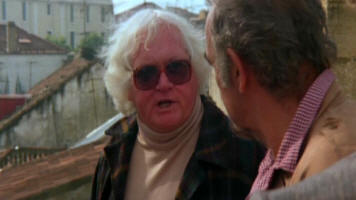
The Russia House (Fred Schepisi, 1990) "Nowadays, you have to think like a hero merely to behave like a decent human being!" Bartholomew "Barley" Scott Blair (Sean Connery), barely getting-by book publisher, deep in his cups at a Russian Book Fair, seals his fate with those words. His words spark an idea in one of his audience-members and a plan of international repercussions is set in place. 

Some time later, he is sought out specifically—by a young Russian woman—not with a potential manuscript to be overseen for publishing, but with documents containing secrets of Soviet nuclear capabilities from a very reputable source. He soon finds himself wanted by both British Intelligence and the Russians, both looking for a hero in a final End Game in the Cold War in John le Carré's indictment of spies who don't even have the sense to come in from the cold.
Scott Blair becomes a hapless go-between for secrets, dispensed by a radical Russian scientist code-named "Dante"* (Klaus Maria Brandauer) who is willing to betray his country for The Good Fight for World Peace. He's enlisted his lover Katya (Michelle Pfeiffer) to contact Blair—the one man "Dante" trusts to smuggle his journals into the West for the purpose of publishing them. But "The Russia House," that wing of the Intelligence Service looking East, gets wind of it first and enlists Barley in an effort to learn as much about Russian nuclear capabilities as they can. Soon, he's wired for sound, followed by surveillance by the Brits (working with U.S. Intelligence) and embarks for a Russia about to collapse in Soviet dis-Union. He's starting to fall himself—for Katya—but, constantly monitored and miked, he'll have to resort to whispering sweet nothings in her ear. It couldn't be more appropriate.
It's a master-stroke to get Connery to play this non-spy in John le Carré's literary world of "anti-Bond's." His long association with 007 is cast aside as he approaches the role bearded, curly-haired and gray, crotchety...and vulnerable, set upon by the author's tweedy grey men smug in their patriotism but lacking in honor. Tom Stoppard's screenplay takes a few bends out of le Carré's labyrinthine plot, but none of the complications in the ethics and politics of strange bedfellows in matters of the State and the heart. The production is top-notch, filmed in Portugal and the Soviet Union, with an eye-popping cast of character actors supporting the Connery, Pfeiffer, Brandauer troika. On the British side are James Fox, Michael Kitchen, Ian McNeice, and...Ken Russell! The Americans are Roy Scheider, J.T. Walsh, and John Mahoney, all salamander-cool and not to be trusted.
But the best part of The Russia House is the sub-text, which is all le Carré's. Distrustful of his brethren in the spy-hood, the author has always been able to forecast a new sin for them to exploit or fall prey to, and David Cornwell (le Carré's nom de réalité) could see the upcoming glasnost and perestroika and see the frosty battles continue un-thawed. Nothing worse or nosier than a spy with nothing to do and not know it. So he looked forward and looked to the past and compared and contrasted.
Remember this, if you must: a bitter cad who sticks his neck out for nobody, a committed idealogue fighting impossible odds, and the woman who is caught in between them. It's Casablanca. But the milieu is wrong. Where the 1945 film is about choosing "the cause" and "the good fight" in a "mixed up, crazy world," in the world of The Russia House, lives are being lost in a quest for worthless secrets...worthless because the other side already has them. The only thing to be gained in the cat-and-mouse games being played are the budgets being authorized for the cat and the mouse. In such a compromised clime, the problems of two little people do amount to much more than a hill of beans, they are a world-entire of pledges to be kept and sanctity to be upheld. They are the only ideals left amidst the corruption. In such a world, the fundamental things no longer apply. And by basing his story on that timeless tale of love and sacrifice, le Carré throws into stark relief the world of today and that world. Of a "mature, grown-up love" held against a world playing games...no matter what the future brings, as time goes by. 


* In the book, he was, more appropriately, "Goethe"—the man who wrote about making deals with the devil, rather than about his territory.

Friday, January 5, 2018

Tinker Tailor Soldier Spy (2011)

Written at the time of the film's release.
 
Spies Like Us
or
Eyes Wide Shut* (The Fine Art of Concealment)

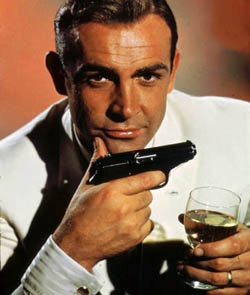
I love spy movies. Growing up in the 1960's, with the advent of the James Bond films—an amalgamation of Ian Fleming's novels and the films of Alfred Hitchcock (particularly North By Northwest)—and concurrent with the 60's embrace of the "anti-hero," my perceptions of movies were warped and laser-beamed with the image of duplicity, secrecy and emotional coolness.  Spies are not nice people—it doesn't matter what kind of cars they drive—they are both untrustworthy and trustworthy, they make moral judgments (sometimes snap decisions) of who is worthy of each. Keepers of secrets, cataloguers and manipulators of weakness, spies use people as weapons, ignore collateral damage and sleep the sleep of the just knowing that the ends justify the means. Fleming's secret agent was the last vestige of the romantic spy (despite the many imitations that ensued), a double-crossroads between the old and the new—a "gentleman-spy," chivalrous, but more than willing to plunder the spoils of war, and a thug...but with exquisite taste.
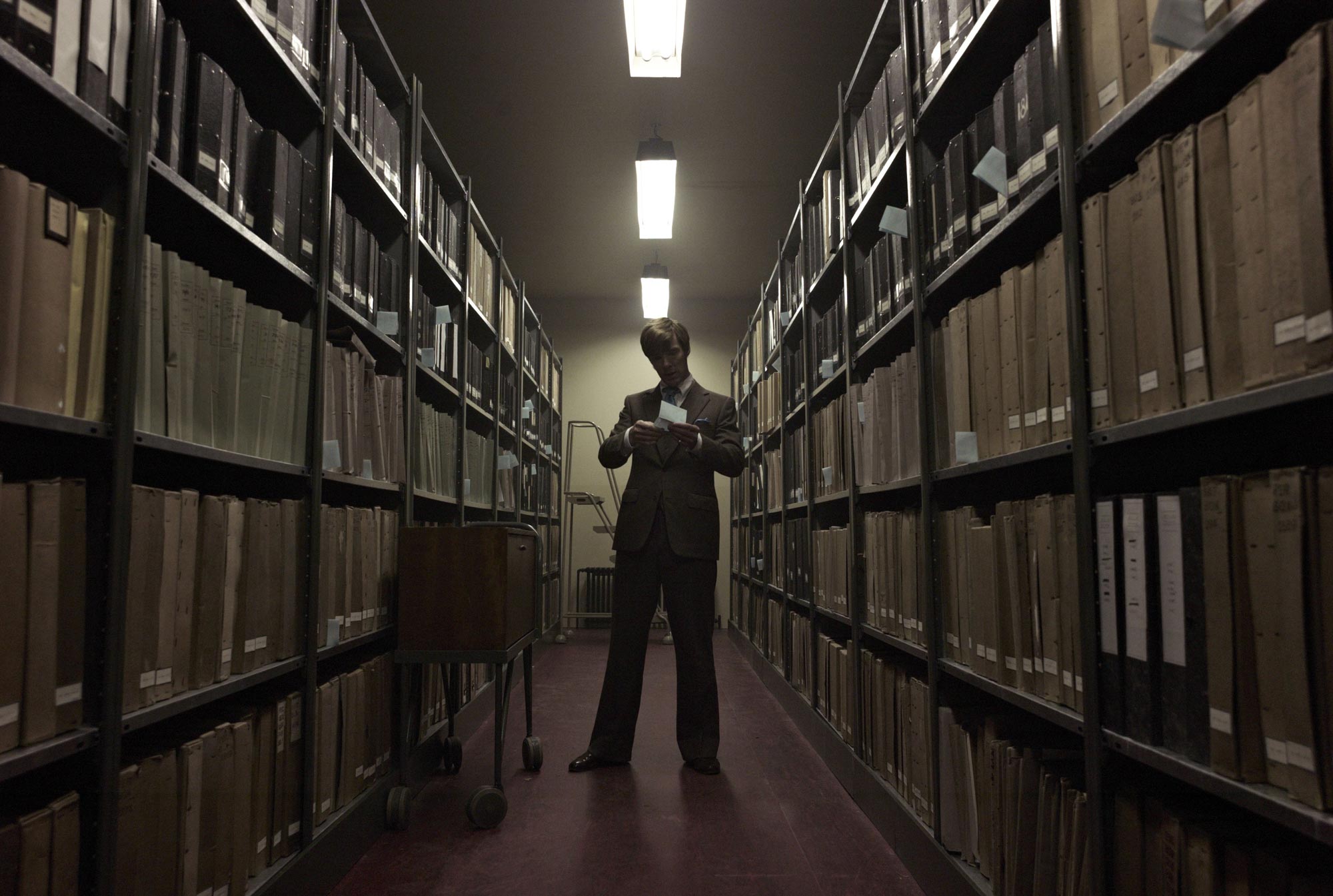
But the gold standard ("finger"-less division) for the times, which embraced the Cold War** were the novels of John le Carré (French for "The Square," which reflected the author's choice of creating novels around the moral rectitude of naive and sentimental men in an amoral world) who wrote about spies as functionaries and bureaucrats, rather than super-men with toys, and the epitome of those was "Tinker, Tailor, Soldier, Spy," the first novel in "The Karla Trilogy,*** which pitted two spymasters against each other in a fight to The Brandenburg Gate—the mysterious Russian, Karla, and George Smiley, an agent for British Intelligence (which le Carré dubbed "The Circus"). Smiley had appeared as a minor character in previous le Carré books, but with "Tinker..." he became the focal point, not only the best man in the service, but also its weakest link, intellectually smart as a whip, but emotionally dull as a stump.  In it, he is called upon to investigate his own former Intelligence agency, as there is suspicion that there is a "mole"—a double agent—very high up in the ranks.****  A thick book, filled with intricate detail and Dickensian characterizations with deep motivations, it was adapted (like the film, without commas in the title) in 1979 into a 7-part mini-series by the BBC and director John Irvin with Alec Guinness as Smiley, a version which was considered definitive.
When word that Peter Morgan had scripted a film version, it seemed inconceivable that such a compressed time-frame could do the novel justice.
And, incredibly, it does...even at times going the mini-series one or two better...by integrating sequences that le Carré never bothered with or thought of that throw in a lot of information in a very short space of time, the difference between a novelistic and cinematic experience: a Christmas party at the Circus, where knowing glances are exchanged between brother-spies and covert operations are, even there, in effect;***** the shooting of Jim Prideaux (Mark Strong, quite different from how we've seen him before in his villainous roles of late) on a secret mission from Control (John Hurt) to try to learn the identity of "the mole" in their ranks; a warning to Peter Guillam (Benedict Cumberbatch) to "get his house in order" that leads to a painful personal decision that reflects certain issues among the suspects; and an interrogation scene that adds tragic ramifications to the story of Ricki Tarr (Tom Hardy), but also illuminates the cruel humor of the Russian strategist, Karla.
And the "Cold War" scenario gets even chillier given Swedish director Tomas Alfredson's handling of the film.  The men investigating and being investigated (Ciarán Hinds, Colin Firth, Toby Jones, and David Dencik) are already cold fish, but with the script and Alfredson's direction, they're almost completely cyphers, the only glimpses of a personal life are revelatory of each man's weaknesses.  Also, Alfredson's framing schemes involve as much mis-direction as direction, shooting above, over, around and through as many obstacles and distractions, frames and panes of glass, a maze of obfuscations that confuse the path to true seeing, putting us in the same position as the story's primary Truth-Seeker, George Smiley (Gary Oldman).
Early on, Smiley visits an oculist to get a new pair of huge owl-like glasses to see more clearly before embarking on his secret mission for the government. Those glasses also provide another barrier to his eyes, the window to his soul. Oldman's performance is brilliant, deceptively simple—but that's not the point.  One is struck, perpetually, throughout the film, of how much Oldman conveys with the simplest—and smallest—of movements. It is to the actor's credit (and Alfredson's) that so much of the actor's performance is seen from behind, his face unseen, but it matters not; George Smiley is not given to overt actions, but covert ones, minor moves of chess-pieces that mark the battles in intellectual wars.  His brevity and economy in everything—that weighs so heavily on his personal life and makes him vulnerable, comes to the fore here, making this odd performance a perfect encapsulation of the role and is a further refinement and definition of the character of le Carré's greatest creation—George Smiley—betraying nothing, always betrayed.


* The origin of the phrase "Eyes Wide Shut," the title of Stanley Kubrick's last film, originates as a colorful turn of phrase in le Carré's original novel "Tinker Tailor Soldier Spy" (Kubrick and David Cornwell— le Carré's real name—were good friends, although Kubrick never enticed him to work on a script with him). It's the scene where Connie Sachs is explaining what happened to the Russian double-agent Polyakov and how he was seduced by a "honey trap" (le Carré spy-code for a female counter-agent) and how Polyakov, against his better judgement, walked in with "his eyes wide shut." That turn of phrase is not in the movie, probably BECAUSE of the association with the Kubrick film.

** When detente eased the tensions between the West and East, le Carré presciently set his rifle-sights on the next enemies of the state—capitalists and industrialists who pledged allegiance to the almighty dollar rather than to any flag or deity.  Supposedly, trade partners don't war against each other (hence, the genesis of the EU and NAFTA), but has the damage those entities wrought on the world economy really been beneficial?  Is anyone winning, when we all go down together?

*** The others in the series are "The Honourable Schoolboy" and "Smiley's People."

**** This parallels the true life upheaval MI-6 went through in the 1950's, with the Cambridge Five scandal.

***** One inspired touch is The Circus Crowd singing along with an old song that I only thought I remembered—the title tune from a long-forgotten Bond knock-off (sung by Sammy Davis, Jr.) called The Second Best Secret Agent in the Whole Wide World, which nicely plays in with British Intelligence's subordinate view of themselves as "also-ran's" to their American "Cousins" in the CIA. 

Friday, December 29, 2017

The Spy Who Came In From the Cold

Over Christmas, I had great fun reading "A Legacy of Spies," the new novel by John le Carre. In it, the events of le Carre's earlier book "The Spy Who Came In From the Cold" come back to haunt the British Secret Service—The Circus, as le Carre dubbed it—as those who are still living are sued by living relatives for damages incurred by the events of the story. Is it some Russian plot? No. It is mere gold-digging. The plaintiffs are blackmailing the Service to reveal what they know...or suspect...if they are not payed handsomely. It is always fun for me to read le Carre but the nostalgia factor of coming back to the old characters, even if in passing, was a bit of a thrill. And whenever Alec Leamas was mentioned in the book, I still had trouble imagining Richard Burton's face and manner. I wrote this in 2011, some time before Tomas Alfredson's excellent version of Tinker Tailor Soldier Spy reached theaters—I should post my review of that here when I'm done with the clutch of Holiday released movies.

The Spy Who Came In From the Cold (Martin Ritt, 1965) With the anticipation of the Christmas release of a film version of Tinker Tailor Soldier Spy, it would do well to revisit the world of George Smiley, "Control," and the duplicity of agent-turned-novelist John le Carré's "kitchen-sink" version of spies. Although Smiley and the others would loom large in his later novels (especially the "Karla Trilogy"), they're mere background characters in The Spy Who Came In From the Cold, the focus of the tale being operative Alec Leamas (Richard Burton), former head of the West Berlin branch of "The Circus," who must go behind enemy lines—in fact, one of the toughest of them, the Berlin Wall—as a potential "mole"* to ferret out who, among their Cold War equivalency on the other side, might be a double agent for the Soviets, the one who is responsible for the death of one of Leamas' contacts. To "Control" (Cyrilm Cusack), the head of "The Circus"  it is a rare opportunity to do some damage control and, possibly, if they can take advantage of an agency power-struggle, some harm. 
His identity is kept the same—The Circus wants Leamas and his background history out in the open—but he is demoted in rank and stature, and, depressed and drinking heavily, he becomes bait for Soviet recruitment to betray information. That's the mission, become a decoy on the "inside," another "double" feeding the Soviets false information, while trying to find out if there's a player on the other side in The Circus feeding information to the Russians.** 

Oh, what a tangled web the Cold War weaves.

Taken to East Berlin, Leamas is interrogated by a suspicious Russian administrator named Fiedler (Oskar Werner) who (rightly) suspects Leamas of being a "plant." Fiedler suspects a British "mole" already underground in the Soviet service and so sweats Leamas for any information to discover who that might be. Ultimately, Leamas is undone by what so many of le Carré's heroes or anti-heroes are susceptible to, the warmth of human contact—a failing that trips up a lot of the author's protagonists. Leamas "comes out of the cold," the world of spies, and his friends, relations or lovers—the thread of decency and honesty they provide—are used against him.
For the fact of the matter is the Spymasters of "The Circus" are cold-hearted bastards ("without sympathy" as "Control," played by Cyril Cusack, ponders)—they have to be to combat their enemies—and they're just as capable of betraying their own as those they fight.  
Case in point: George Smiley (played here by Rupert Davies). He would become le Carré's most celebrated character, but here he's a bit of a functionary, and he's just as cold-hearted as the rest. In the "Tinker, Tailor..." timeline, "Control" was long since dead, having been driven out by "the new broom" from his station, which had left him suspicious and paranoid (ultimately with good reason) with Smiley his only trusted colleague. 
When the BBC made a television mini-series of "Tinker...", Smiley was famously played by Sir Alec Guinness and (as le Carré amusingly notes in his new forward to "Tinker, Tailor...,") because of that he "lost control" of the character. But Smiley (however sympathetically Guinness played him) is also a "cold-hearted bastard"—if he wasn't, he wouldn't have lost the vital clue that was exploited by his enemies. He gives as bad as he gets, and, even at his most triumphant, takes little joy in what he does.
Davies as George Smiley in The Spy...
In such a world, Ritt's direction is entirely appropriate—low-key, almost documentary in feel on the streets of London—in drab black-and-white, not the high-contrast color of other spy films of the era. There is nothing glamorous about it, and the circumstances play out slowly and subtly—in fact, after a debriefing by his boss, the shift in tone is so dreary one suspects one is watching a different film. It is part and parcel of the subterfuge—it works on us as it does for Leamas' Sov' recruiters (most prominently Michael Hordern).
And the script—now there's an interesting tale. A beginning draft was written by Hollywood veteran Guy Trosper, who died subsequently. Taking over was poet-playwright Paul Dehn. Dehn had written the final polish on the James Bond spy film Goldfinger (amusingly, as the two films could not be more polar opposite), and was the mainstay-writer for the "Planet of the Apes" sequels. But, Dehn knew the world of spies well—during the second World War, Major Paul Dehn was the "Political Warfare" officer at the BSC training headquarters "Camp X" (where among the trainees were Roald Dahl and Bond creator Ian Fleming). *** Dehn was well-versed in spy-craft, deceit, and keeping secrets and his distillation of le Carré's novel brings the moral duplicity to the fore, while keeping the audience guessing on whose side is whom.
If the film has one flaw, it is the casting of Burton as Leamas. Burton was too good, too charismatic an actor/star to play a functionary like Leamas (it's about the same as "buying" Sean Connery as a spy (which was part of the joke of the Bond series)—he's someone you'd notice walking into a room, and thus, hardly spy material. But, Burton's presence, no doubt, got the film made, so the point is a bit moot. Still, if its ideas and mysteries of the State and the heart you want more than action and fireballs (shall we say if you want to be "stirred and not shaken?"), The Spy Who Came in From the Cold is a fine, bracing tonic.

Smiley's before they were emoji's: Alec Guinness and Gary Oldman

* The term "mole" is a le Carré invention—his spy-circles code-name for a double agent hiding in plain sight within one of the other spy agencies, Soviet or British, and relaying information to "the other side."

** There has been a rich history of double agents throughout the annals of spy-dom, the most significant of which were "The Cambridge Five"—Kim Philby, Donald Duart Maclean, Guy Burgess, Anthony Blunt, and a fifth (and possibly more)—who'd been recruited during their college years, passed information to the Russians during WWII, and subsequently during the post-War years through the early 1950's. "Tinker, Tailor, Soldier, Spy" (and the other two of the le Carré "Karla" novels) and le Carré's subsequent "A Perfect Spy" are inspired by "The Five" and their Russian puppet-master.

*** And, interestingly, one of the people who asked, and was briefly considered, to run Camp X...was Kim Philby!

Tuesday, July 12, 2016

Our Kind of Traitor

Our Man in Nirvana
or
It was My Mother...You Get Sentimental.

It seems to be another good year for John le Carré adaptations. The BBC did a quite honorable version of his 1993 "The Night Manager", and this, Our Kind of Traitor—one of David Cornwell's shorter books—is just concise enough to make it to feature film length without feeling like cheating the source. I have a particular love for le Carré's books, as I've been reading them since the Cold War days with their intricate chess strategies between spy networks, undermined by human frailties and loyalties, often drawn with Dickensian complexity and piquancies. With glasnost, le Carré's antagonists moved from behind the Iron Curtain and into the boardrooms of friendly nations, criminals by nature but with an undercover veneer of prosperity and prominence. Their goals were not political (were the others, really?) so much as a craven desire for power...and more of it and taking down any threats to acquiring it. Although the targets were different, the battles were business, as usual.

His protagonists are not larger-than-life secret agents hiding in plain sight, but government functionaries, rumpled men, flawed and quite extraordinary in their ordinariness, or Hitchcockian innocents caught in the gears of machinations they were quite unaware of working in the background. 

Le Carré's characters either are professionals keeping secrets or amateurs having secrets thrust upon them, but are compelled by their Nature to do the best they can, even to the point of sacrifice. Sometimes they suffer for their efforts and sometimes they can't accomplish their goals with 100% satisfaction. In the current political climate, such might be labeled "losers." They've always been heroes to me, even if they're mourned rather than lauded.


But, the stakes have changed. In the earlier simpler times, they've fought for ideals, for governments. But, around the time of "The Russia House," that changed. In that version of Casablanca-turned-on-its-head, it is not that "the problems of two little people don't amount to a hill of beans in this crazy world," but they weigh a lot more in a topsy-turvy crazy world of overstuffed bureaucracies in which ideals are sacrificed for not much and for the most worthless of McGuffins. The loyalties are spoken very plainly in that novel (and film) by it's ex-pat Brit: "You're my country now." When the country of your birth proves undeserving of loyalty, better to take it personally, on a human level, and protect what you can...and what you should.
Perry Makepiece (Ewan McGregor) is good at keeping secrets. A teacher on Holiday in Marrakech with his lawyer-girlfriend Gail Perkins (Naomie Harris), he's trying to patch things up with her after having an affair with one of his students. But Gail is diffident, not trusting him, and business back home pulls her away from a dinner at an expensive restaurant, leaving Perry alone. What do you do to fill the gaps left by absence?
Perry is invited by a fellow restaurant patron, a garrulous, gregarious Russian, Dima (Stellan Skarsgård, looking the worst for wear but giving one of his best performances) to join him for some after-dinner drinking. Drinking leads to gamesmanship and an invite to a party with sex, drugs and rock and roll, but when Perry stumbles on a rape in progress, he interferes despite being physically outmatched by the perpetrator. Dima interjects, and perhaps noting Perry's tendency to "white knight," invites him and Gail to his daughter's birthday party. When Perry comes back in the morning, his lawyer-lover cross-examines him about where he's been and why he's scruffed up, suspecting that he's catting around again. But, Perry tells her about his encounter with Dima and mentions the birthday party. Gail is reluctant, but accompanies him.
At the party, the two are overwhelmed by Dima's extravagance (his daughter is given a camel for her birthday...a camel, not a pony) and by his generosity with his time and his family. But, at some point Perry and Dima disappear, leaving Gail fuming a bit, but this may be one of those times when it's best not to find out too much.

Dima gives Perry a flash-drive, which he wants delivered to "MI6." Dima is a money launderer for a Russian drug cartel, which is going through a spate of extremely hostile take-overs by a kingpin calling himself The Prince. A friend of Dima's, a fellow "account manager," has been murdered, along with his wife and oldest daughter and Dima suspects his organization's next, and when that happens...Perry is tasked to contact Intelligence so that Dima can get his family, and with luck himself, to the West. Perry agrees. He doesn't tell Gail.
At customs, Perry reveals what he's got and authorities detain him, bringing in investigator Hector Meredith (Damian Lewis) and Luke Weaver (Khalid Abdalla) to question him for hours, leaving Gail quite peeved. When she finds out about all the hub-bub at the airport hub, she thinks Perry has gone mad—what has he gotten himself into now? A suspicious alliance forms between Perry and Hector, who has his own reasons for handling all this personally—he's on the "outs" at the Service, due to the arrest and incarceration of his son for drug possession, a prosecution pushed for by a government official (Jeremy Northam) Hector has been investigating for collusion with the Soviets. He's warned by his boss, Billy Matlock (Mark Gatiss, co-creator and "Mycroft" of the new "Sherlock") to not take it too personally or any gains might be "disappeared" again.
But, it's personal for everybody. As personal as family. And governments, bureaucracies and spies know bupkis about "family values." They know little about trust. And act accordingly.
Performances by the cast are measured and assured throughout, everyone having outstanding moments and director Susanna White keeps things low-key and lived-in. Its another fine adaptation of le Carré with no false notes or grand-standing. Definitely recommended, it's my kind of movie.

Sunday, August 3, 2014

A Most Wanted Man

What Allah Provides 
or
"No.  Yes.  Maybe"

The last movie Anton Corbijn directed was The American, a pretty good movie about one particular gun-for-hire, in a network of them, that is considering retirement before being retired permanently and against his will. Starring George Clooney, it had the feeling of a Western set in the more rustic parts of Italy and clothed in the dark shades of spy-paranoia (Corbijn's previous film was Control, a bio-pic of singer Ian Stuart and, before that, music videos for the likes of U2 and Metallica) that was only undermined by a last-minute jag of sentimentality and heavy symbolism.

His latest doesn't run too far afield of that genre, an adaptation of John Le Carré's post-9/11 anti-terror study
A Most Wanted Man.  Le Carré wrote the best of the spy novels of the 60's and 70's (still does, in fact), catching attention with "The Spy Who Came From the Cold," his "Smiley/Karla" trilogy—"Tinker Tailor Soldier Spy," "The Honourable Schoolboy" and "Smiley's People." As he was a former cog in British Intelligence, le Carré wrote of spies realistically as rumpled, foibled functionaries, in stark contrast to the notorious spies of the Bond decade; heads turn when James Bond's supposedly "secret" agent walks into a room, whereas le Carre's could enter and then leave without ever being noticed...or cared about.  He stuttered a bit when the Berlin Wall fell and the Cold War ended—his "The Russia House" and "The Tailor of Panama" showed intelligence operatives struggling to maintain their relevance...and operating budgets—but after 9/11, Le Carré, ever the humanist, turned his baleful eye to the gears of government security and how human beings can be buried in an avalanche of metrics, statistics and damnable lies. 


I've always seen his "The Russia House" as an Eastern-bloc version of Casablanca, where "the problems of two little people" not only amount to more than "a hill of beans in this crazy world," but are actually more important than the high-stakes gamesmanship of self-important foreign powers. That's a theme running throughout his books, which has only increased as he's railed against U.S. tactics in the war on terror, where there is more "bully" than "pulpit."

McAdams watches Dobrigyin be caught in the middle
The titular man most wanted is Issa Karpov (Grigoriy Dobrigyin), a half-Chechen, half-Russian Muslim who has escaped torture and imprisonment and washes up in Hamburg to hide out from his pursuers and lay claim to a fortune banked away by his gangster-father. He is hooked up with a human-rights attorney Annabel Richter (Rachel McAdams) to secure the funds from banker Tommy Brue (Willem Dafoe), who had done business with his father. But Karpov is being watched by a secret anti-terrorist investigation unit headed by Günter Bachmann (Philip Seymour Hoffman, in his last completed role before his death from drugs), whose operatives are shadowing Karpov, and deflecting the objections of the more hard-line Hamburg intelligence (led by Rainer Bock).
Bachmann (Hoffman) in his office.  The cluttered cork-board has lately
become a signifier of a crazy person in film-culture.
Bachmann and his team (including Daniel Brühl and Nina Hoss) are keeping constant track of Karpov—one of the amusing though-lines of the movie is that, however unlikely, you find his operatives in the background of so many scenes, blending in—but don't see him as a terrorist threat, but merely a means to an end. For awhile, they've been tracking Dr. Faisal Abdullah (Homayoun Ershadi), a publicly moderate Muslim lecturer and philanthropist, who they suspect of funneling money to terrorist groups, and Karpov's inheritance may be just the thing to draw his operation out. For most of the movie, Bachmann works two fronts—out on the streets with his informers and operatives and new recruits and in the boardrooms with the officials and other units, all looking for the "big score" and devote as much time to how they can stab each other in the back as much as their foes.
Bachmann out in the cold
It's an unglamorous, ugly side of espionage, as le Carré always presented it, with secret agendas among the secret agents. Hoffman is brilliant in this, gutted on many levels, a seducer of all sorts, turning his extended network to his aims by exploiting their best hopes and away from their worst fears, while he assuages himself with a steady stream of booze and cigarette smoke. Lies are at the heart of every spy story—of the benign facade covering evil intent and the exploitation of good intent to accomplish it, even at the risk of expunging the good in the erasing of evil.

And that's the tragedy of it, as le Carré has always presented it. You can't make a better world by simply eliminating the worst elements of it. You have to replace it with something better, or evil will simply exist in another form, and we will end up making the same mistakes again and again.

Because what's the use of Intelligence, if you don't learn anything?