Showing posts with label Emily Mortimer. Show all posts

Thursday, January 23, 2025

Redbelt

Written at the time of the film's release. 

 
Redbelt (David Mamet, 2008) One considers carefully before accusing David Mamet of writing a fairy tale.* But, considering the genre in which he's working—the sports film, which is almost always a glucose-encrusted, tears-of-joy-stained fantasy (aren't they, basically, "Cinderella stories?")—one also must admit that he's taken as much of the slop out of the form as he can. And if it strains credulity a bit, well...."you gotta sell a story."

Michael Terry (Chiwetel Ejiofor) is an ex-military, mixed martial arts/self-defense instructor with an emphasis on ju-jitsu, running a small not prosperous training center in the land of make-believe, L.A. He's a good man doing good deeds, cloistering himself, looking to achieve his own personal best (like so many Mamet men). That he believes in honor, and the proper way ("There's always an escape") would appear to be a weakness. But incidents happen to break the hermitic seal of Terry's life and he soon finds that good deeds do not go unpunished. Encounters with an attorney with coping issues (Emily Mortimer), one of his students (Max Martini), a past-his-prime action star (Tim Allen) and his producer (Joe Mantegna) convolute to seemingly improve his life...but at a cost.
Money and legal issues force him to cross a line he'd never thought to cross—and as a result, he becomes a participant in an exhibition match with all its gloss, hyperbole, myth-making and BS. That the match is based on an anecdote that he casually mentions at a swank party, but rigged to take the chance out of it, only compounds his anger and humiliation at the corruption that he's taking part in, and he must find his own way out of a trap of his own devising. A way of his own devising.
It must have been an interesting puzzle for Mamet: "How do I make my own version...my own version...of the most manipulative and phoney-baloney film genre out there and still make it 'Mametian?" And still make it "mean" something. The disciplines and the hierarchical nature of non-exhibition MMA that feed Terry are in direct contrast to the gladiator aspect of the money game, which in the Mamet tradition, is a rigged contest. Even rigged, both Golden Rules
** are in play.
Mamet's films usually exhibit stillness, but here, action is used as exposition and Mamet the director fails to do anything but document the moves, and none too well, at that. Clarity is sacrificed for speed, and no matter how long Ejiofor has trained for those scenes—he's great in the role, by the way—his efforts are for naught due to Mamet's direction and cutting of them. The cast is uniformly excellent with Mamet stock company players
Ricky Jay and Joe Mantegna breezing through their roles. and Ejiofor making a superb protagonist, aided and abutted by Alice Braga as his practical wife. Tim Allen drains the comedy out of himself and is a bit of a revelation in his well-observed role as an actor coasting. You always knew there was a good actor inside the goof-ball and it's interesting to see him come out. Mamet's story-telling, casting and working with actors has never been in question. It's his use of the camera, now, that needs perfecting if he intends to pursue more action oriented films.

* It's not like he hasn't done that before. You could make a case that The Untouchables is so far from the reality of the Elliot Ness-Al Capone story that it's a blood-soaked fairy tale of revenge. But how much that was Mamet, and how much was director Brian DePalma or the producers one can't say.
 
** 1. "Do Unto Others as They'd Do Unto You" 2. "The One With the Most Gold Makes the Rules"

Tuesday, September 12, 2023

Match Point

Match Point (Woody Allen, 2005) The box office was good for Match Point, Allen's first hit in years, and one wonders why. The film is accomplished and assured, simple in execution but morally complex, one of those little Woody Allen morality puzzles that update the classics (in this case, "Crime and Punishment", as well as any number of "bad-boy makes good" novels, where all you need is a compromised conscience to make it in the world). The BBC put in money, so the locations are in Great Britain (it's good to get out of New York once in awhile). The actors are young and skew to a lower movie-going demographic (although except for Scarlett Johansson, the actors are not box-office draws)--but there are no "tunes" on the soundtrack, merely ironically chosen opera extracts sung by Caruso (complete with vinyl surface noise).

Allen considers it one of his best films.
Despite the accents and strange new territory, it's undeniably Allen-town with its
chilly empty spaces pointedly deliberately composed, its couples colliding and splintering, an act of insanity out of the blue, and a late touch of magic that chills.
But it's one of those Allen movies where the literary seams show,
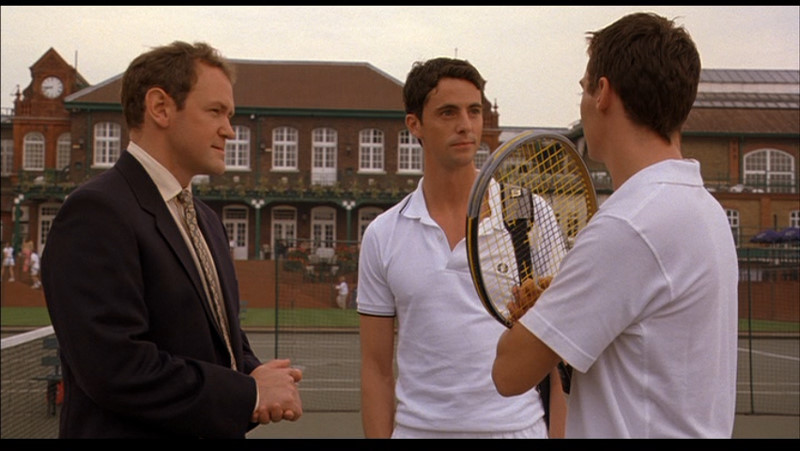
his long empty corridors reverberating with the classics of the past informing his movie, with some of the echoes coming from his old Brooklyn haunts; I kept thinking that Chris Wilton, the slippery tennis pro (the only thing that's true about him is, surprisingly, he is a tennis pro!) reminded me of Leonard Zelig, the "human chameleon," who, in his insecurity, would conform to whatever group he was with, even physically changing to accomplish it.
But more than the literary seams show.
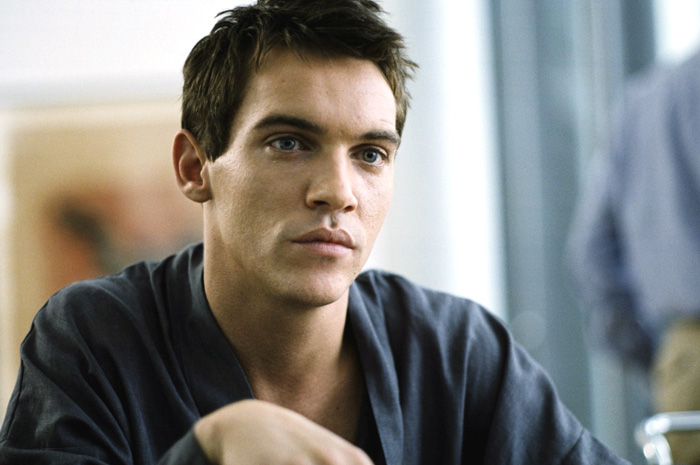
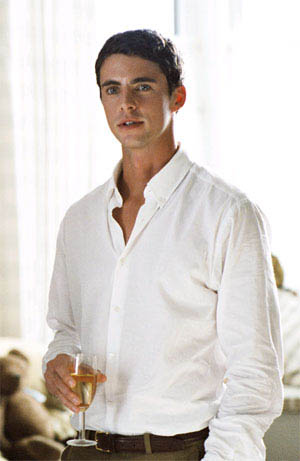
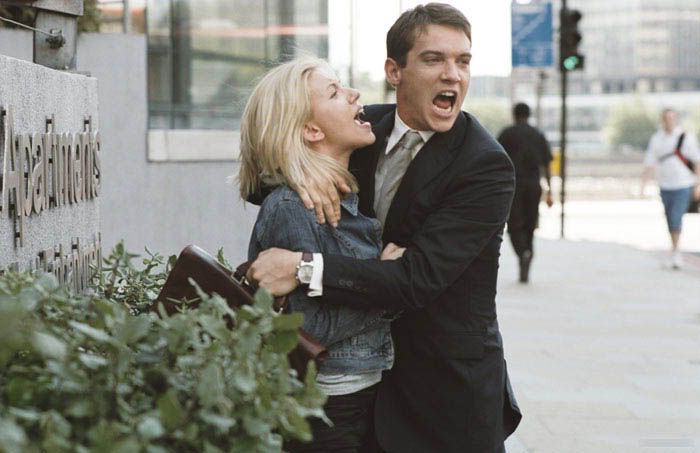
Jonathan Rhys Meyers, who plays Wilton, isn't a fast enough actor to make his sudden shifts of tone and snap-excuses sound credible; there needs to be an ad-libbed looseness to his answers, rather than the studied RADA responses Meyers provides. The rest of the cast play their parts as required: Brian Cox (always good), as Wilton's chief enabler; Matthew Goode (interesting to see him in this role after Watchmenin this part, he's much snappier playing a member of the effete elite); Emily Mortimer, thanklessly perfect in a thankless role; Scarlett Johansson as the Victim of Fate, smart enough to know herself, but not know her role in the world.

So, what's different? Why this Woody Allen movie doing well, when the previous ones hadn't? Allen had been, piece by piece, removing the musty-Woody-Allen-tropes from his movies to no effect at the box office. What made
this one different?
Then, it hit me.


There's no "Woody Allen" character in it. No stand-in's with comically stuttering neuroses. No "fools" that make a point. No sad clowns in the corner. This time, Woody Allen is behind the camera. For good.

Thursday, August 3, 2023

Suspensions of Disbelief —"Like, yeah-Huh!"

On my earlier film blog, I would sometimes pair up movies I'd seen recently if they had some slight connection. This is one of those. 

Juno became a smash hit, despite my reservations and Diablo Cody—and Jason Reitman—went on to do some stellar work. Both are working on things. Ellen Page is now Elliott Page, and is now identifying as a male. One thing that hasn't changed is his amazing talent. I don't change things when I move these posts from the old blog to the new blog, unless I find mistakes, so I've kept Elliott's name as it was at the time of the writing, which was at the time of the film's release. 

Director Craig Gillespie, who made Lars and the Real Girl, made I, Tonya, Cruella, and the min-series "Pam and Tommy", as well as directing Diablo Cody's mini-series "The United States of Tara."
 
--Sacred Vessels in the Land of Addictionary.org

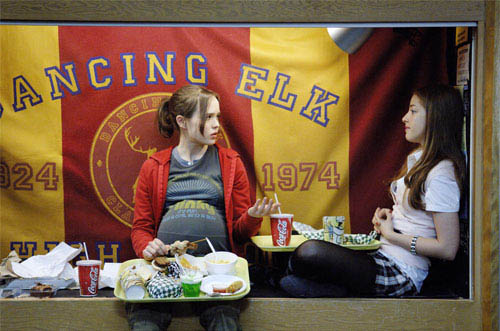
Juno is a film so dominated by its script (by Diablo Cody*) and its actors (they're all television veterans with countless man-hours before the camera) that all director Jason Reitman has to do is get out of the way-though in the transitions he routinely cuts on the 1's of the pervasively twee-rock soundtrack to maintain the air of perkiness. The kids that dominate this film about lower-middle-class families making the most of a bad situation—well, bad in the timing—are so pervasively cute and clever in their articulation and word-play that one wonders if they hail from some part of the country where the main sport is Scrabble, and instead of MySpace they all hover around "Addictionary.org." 
Ultimately one has to ascribe to it the same rule that one applies to Bette Davis movies where everyone always has the perfect come-back: "They have better writers than we do."
But the same troubles. Juno MacGuff (Ellen Page) starts the movie pregnant and pissed. And pissing. She's buying the home-pregnancy tests out of the box one at a time from the convenience store and using their facilities to test it. "You better pay for that pee-stick when you're done with it," says the clerk (played by "The Office's Rainn Wilson). "Don't think it's yours just because you marked it with your urine!" She gets the unholy pink "x" and starts to puzzle out how to proceed: telling parents, telling sperm-donor, what to do with said spawn, yadda yadda yadda.
Juno skips along dealing with all these crises and quite a few more, and never slides into bathos, preaching or "after-school special" earnestness. The characters are all people for whom regrets are a waste-of-time, and are too busy doing their best to do too much navel-gazing. Well, almost all. One walks away charmed, and admiring the cleverness and the near-occasion of bravery the movie displays. And there are no bad performances. Anywhere. No actor lets this material touch the ground, whether its the stunningly decent work by vet-thesps like Alison Janney and J.K. Simmons, but also wise work by Michael Cera, Jason Bateman, and, yes, Jennifer Garner. But the big bouquet goes to Ellen Page who carries the movie on her slim shoulders and always finds a way to make the dialog sound like she's just saying it off the cuff. That's a tough trick to pull for an entire movie--an entire comic movie--this entire comic movie. Frankly, it would've been easier giving birth.
------------------------------------------------------------------ 
It Takes a Sex Toy to Raise a Village
 
 
 Everybody likes Lars (Ryan Gosling). Lars is 27, lives in the carriage-house of the family home. Keeps to himself. He goes to work, eats, attends church, chops wood.

And that's about it.

Lars is socially retarded to an alarming degree, so much so that he feels it hurts to be touched. His family worries about him. They feel guilty. They don't know what to do.

But Lars does. He's surrounded by people with relationships, so he decides to get one. But that touching thing...that's a problem.

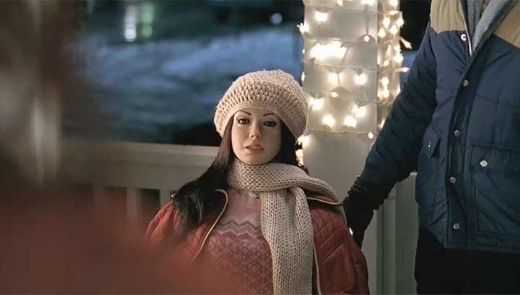
Then one day, Bianca shows up, a mail-order girlfriend. Lars tells his brother and sister-in-law that he has a girl-friend and he'll bring her over for dinner. They're elated. Then they find they didn't need the extra setting. Bianca's a sex-doll. Fairly realistic looking, but she doesn't move. At all. Lars has to carry her, until he gets her a wheelchair. He cuts her food for her. Eats it, too.
In a case of intervention, all four go to the doctor (Patricia Clarkson, being warm but acting cold), who takes one look at Bianca and worries out loud that she needs weekly treatments for her alarmingly low blood pressure, and uses the opportunity to find out exactly what is going on with Lars. She advises that they should play along--"Bianca's in town for a reason," she says. "But, people will laugh at him!" says his harried brother, played by a note-perfect Paul Schneider. "You, too," says the doc.
Lars and the Real Girl
could be perverse, and if Lars actually had relations with Bianca, people wouldn't be enjoying this movie nearly so much. Nor would it be as enjoyable if the entire town didn't, for the sake of Lars, go along with the story and accept Bianca. And that acceptance happens almost immediately. Sister-in-law Karin informs her coffee klatsch friends that Bianca is anatomically correct, and one of them says, "Soooo...she's just one of the girls, then..." The pastor of the church goes along with it. Everybody does. Ev-e-ry-bo-dy. Which set off some reality alarms for me. There aren't any disaffected youth, or jerks or morons in this town? Hell, if any of the kids from Juno lived there, Lars would be getting the "stink-eye," at least. And in a land where every inflatable Christmas lawn ornament is at risk, Bianca has it REALLY easy.
Still, it's an enjoyable film, full of heart in the right place, and offers lots of enjoyable surprises in screenplay, performance (it's hard to believe this is the same
Ryan Gosling from Fracture) and overall tone. One wishes there was a second there where one could believe in it.
---------------------------------------------------------------------------------

* Diablo Cody has such a fresh, smart way with dialog that one hasn't been as excited by a screen author's work since Zach Helm, who wrote Stranger Than Fiction. Since Helm went on to create the lead balloon Mr. Magorium's Wonder Emporium, one doesn't want to be too effusive in one's praise, lest one set oneself up for disappointment.

Wednesday, March 25, 2020

Sucker Punch (2011)

Written at the film's escape. Further thoughts after the repeat, with some video point/counter-point.

"Girls Acting Badly (Acting Badly)"
or
"Showgirls—The Sequel"

Look. I'm a healthy, red-blooded American male and I can certainly appreciate gorgeous, pouty young women in provocatively scanty attire. But Zack Snyder's semi-new Sucker Punch just made me angry. And not just because the thing is so derivative as to be wholly unoriginal—that's usually not a deal-breaker with me, as my enthusiasm for Star Wars or Rango will attest.

But don't tell me you're making a movie about empowering women while objectifying them to the Nth degree in the manner of a "women-in-prison" film. A women-in-prison film with a red-curtain veneer of strip-club in it. Don't make an action film where giant things toss the femi-ninjas through walls and across rooms without their make-up getting messed up (violence without consequences), and don't make the message of your film "Fight" and contrarily show 4/5 of those fighters being taken down (through their own actions) and the only one survivor being the one who isn't sure of the struggle. 

The messages are so mixed as to be incoherent.
But one shouldn't expect nutrition from eye-candy.

It's all about the illusion in this one, the presentation, and the surface. It's "Alice in Green-Screen-Bump-and-Grinder-land: the Video-Game." All paste-up and no depth, just a good job of dry-wall, in the de-saturated style of Sky Captain and the World of Tomorrow.* Looks greatBut rotten to the core.
And it is too bad. We need more women-heroes. We need more women-hero movies. We just need someone with more enlightenment to create them so that they don't simultaneously make them strong and tear down the message by tarting them up (like William Moulton Marston, the shrink who created "Wonder Woman" and liked to put her in bondage situations). I'm not saying all women-characters should be pedestal-toppers. Let's just not kick the dignity out from underneath them.
And any writer worth his word processor shouldn't be undercutting his message, anyway.

If you're going to lower the bar so far you have to dig a trench six feet deep to do so, you might as well complete the job, dig the grave and toss the whole enterprise into it.
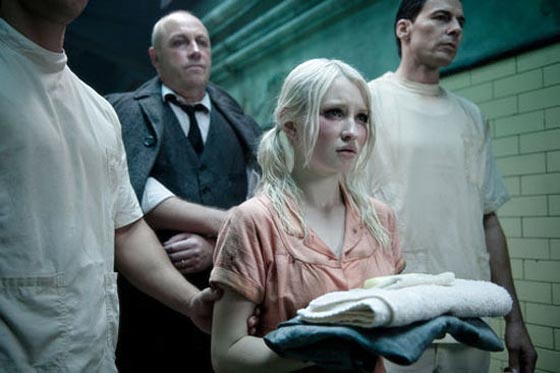
Young "Baby Doll" (Emily Browning) is having a bad time of it. Her mother dies, and she and her sister are left in the care of her evil step-father (Gerard Plunkett) with nothing but abuse on his mind. "Baby Doll" (that's her only name) tries to shoot him when he attempts to rape her sister, but ends up killing her with the bullet, instead. As if this scenario weren't dire enough, Snyder films it all over-cranked to give it a lethargic, dreamy "bad portent" feel.  It's the type of overkill you can expect throughout the entire movie. No lock goes bolted or unbolted except in clanking close-up. Nothing is relevant unless it's in your face (AND it's in IMAX).
ES-F has "Baby Doll" committed to the Lennox House for the Mentally Insane, where he bribes an orderly (Oscar Isaac, no scenery goes un-chewed) to lobotomize "Baby Doll" to shut her up so he can inherit his wife's fortune uncontested and in the five days before the doctor (Jon Hamm, who's actually subtle in this movie) arrives for the procedure, the girl fantasizes a scenario in which she's not in an asylum, but a strip-club/bordello and she recruits four other girls—"Blondie" (Vanessa Hudgens), "Amber" (Jamie Chung) and the sisters, "Rocket" (Jena Malone) and "Sweet Pea" (Abbie Cornish)* to plan an escape, an escape concocted in a "delusion within a delusion" (Hello, Inception!) when she rehearses her dance number for the john (whose the lobotomist in the slow-mo reality) to whom her virginity will be sold in five days. This dance number is apparently so erotic that it paralyzes all, male and female, who watch it, so that the other girls can acquire those articles needed to escape.
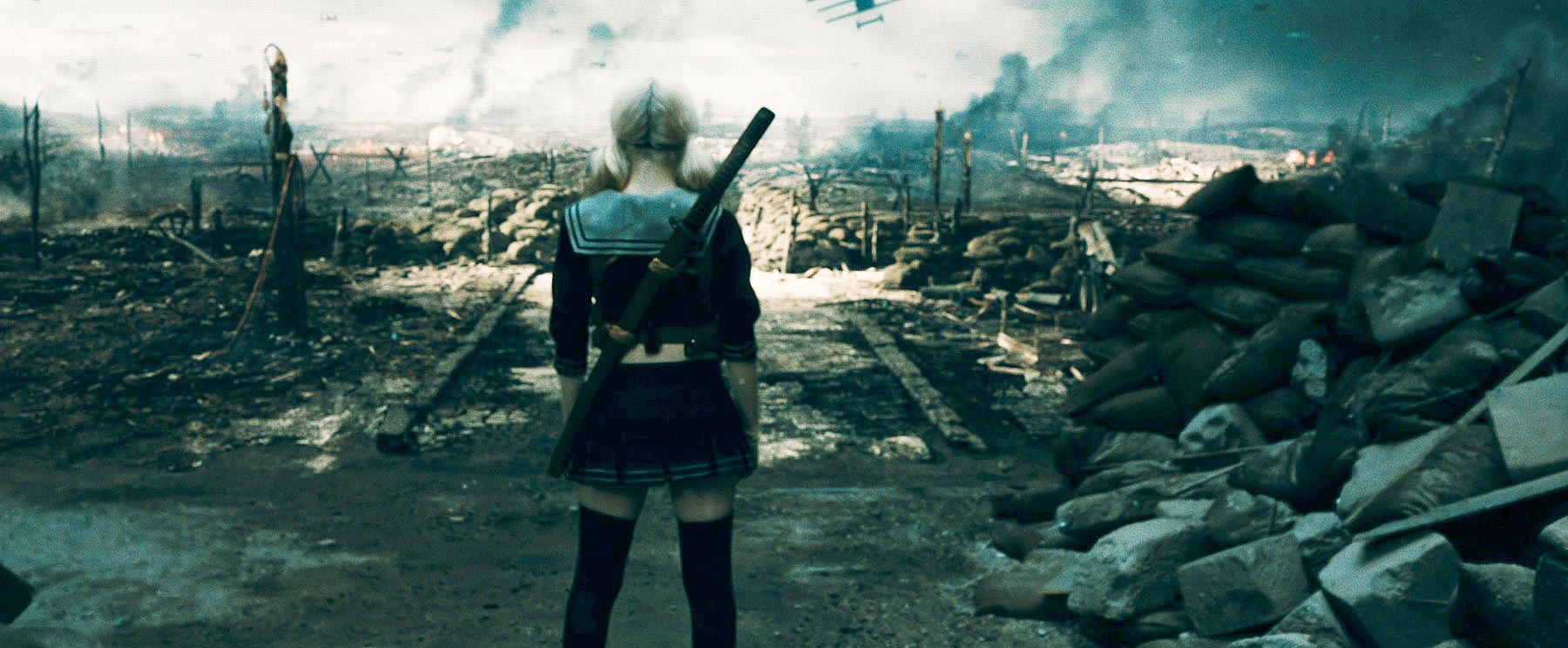
We don't see the dance. We see the resulting fantasies "Baby Doll" imagines in order TO dance, and these make up the action scenarios in the film: the first, a snowy martial arts fight with three giant statues; the second, a WWI fight in the trenches with steam-punk Nazis; the third, a Peter Jackson-ish Middle-Earth with dragons and Orcs; the fourth, a SCI-FI battle on a bullet-train that's part super-hero and part Matrixit becomes readily apparent that most of the thought and work of this film went into these second-level fantasy sequences, all played out over Moulin Rouge!-styled song mash-ups.
It is also apparent that the entire movie is a pre-lobotomized fantasy (only I think they got the timing wrong!).
So many good ideas are borrowed from other movies. But, just because the ingredients are good doesn't mean the dish they create doesn't taste like dog-food. I used to be a fan of Zack SnyderI thought 300 was dumb, but had flashes of clever presentationI genuinely admired his adaptation of Alan Moore's Watchmen, and still do. But now with the 1-2 sucker-punch of Legend of the Guardians: the Owls of Ga'hoole*** and...Sucker Punch, I'm going to have to do a gut-check before dropping all pretense that I can be objective before going to see another of his films. 

Which will be the new "Superman" film. I don't even think The Blue Boy Scout can pull a rescue of that one. We shall see...
After-thoughts: First off, "I am shocked, shocked" that there is objectification going on in this movie. It IS Zack Snyder, after all, who made 300 and who is equally adept at showing both male and female pulchritude—actually, with all the super-hero movies out there, maybe that's WHY we go to movies anymore. Also, the film has a lot of Japanese manga sensibility to it, so, the women will be big-eyed, and under-dressed. Blame pop-culture, where a lot of this film resides.

I still think the narrative is confused, and it depends on whether you think it is "Baby Doll's" story (which I think it is, as the long preamble would indicate) or whether it is "Sweet Pea's" story (and "Baby Doll" is merely the "body-image/avatar" in her mind used to escape). That's an interesting interpretation, but I don't think I believe it, but it just goes to show how porous the scenario is that you can pour that defense into it and it seems to stick.

Also, the "violence without consequence" comment? It's fantasy sequences, and so "Looney-Tune" rules apply. And "derivative" might have been part of the point, given the pop-culture "call-backs" for the fantasy sequences, which are all "quest" narratives. 

Snyder has a habit of throwing so much information into his movies—sometimes to the point of obfuscation—that narratives can become muddled (which is very problematic when he has to do a course correction, as he had to do with his DCEU movies, where his films are left with dangling plot threads that never get resolved...even with his "extended cuts"), but there is a real problem when it's a point of debate of who the protagonist is and what has been accomplished on all planes of the endeavor.

There are some interesting points about "empowerment" and how, in the war between men and women, that empowerment may be merely exploiting the weaknesses of your opponent (starting with their own feelings of superiority), without having to "own" the means of exploitation. It made me wonder how much of a woman's time is spent "in disguise" for survival. We all do, to a certain extent, but what a different world might come of dropping pretense and just "being." I must, at least, thank Sucker Punch for putting that thought in my head.

Below, two videos on the film: one, with a condescending chip on its shoulder, but a surprising number of good points; and the other from the long-running (and entertaining) "Cinemasins" series that still takes things to task while acknowledging the meta-narrative.


* We'll be talking about this tomorrow (digital fingers crossed) and Rango when we delve into a couple of "shelter-in-place" weeks of Westerns.

** Throughout, I kept imagining the nasty Twitter message Jane Campion would be sending her Bright Star lead after seeing this movie. 

*** Now, the question is: do I re-publish the reviews for these films or just do a "Now I've Seen Everything Dept." career overview of Zack Snyder? The latter would probably have better insight than the "first-blush" reactions.

Tuesday, January 1, 2019

Mary Poppins Returns

Impractically Perfect In Every Way
or
Wind's in the East, Mist Comin' In/Like Something is Brewin', About to Begin/Can't Put Me Finger On What Lies in Store/But I Feel What's To Happen All Happened Before...

Having experienced Walt Disney's Mary Poppins as a child back when it was released in theaters away away back in 1964 and having it seared into my memory as a favorite—even after an adult re-appraisal had me concluding that P.L.Travers iconic flying nanny was something of a bitch—I had many reservations going into Disney's Mary Poppins Returns. 

One should never do that. It's just bad form. It could preemptively spoil one's enjoyment of such things, even if said things are, by nature, sequels, given to expectations and reflections of the first. Prejudices. Better to walk in with the expectations of a child—"Tell me a story!" Take it from there. Put away childish things and preconceptions. Leave the past behind, even though there are traces of echo informing your opinion. Nostalgia is for sissies. Don't let the old influence the new and just (forgive me for using the phrase in regards to another Disney film) "let it go."
(Okay, enough hedging, how is it?) Terrific, actually. I'm not a fan of musicals, but when they're exceptionally well done and the songs have a reason for being there and play with the language, then I become a fan of them. And Mary Poppins Returns delivers. I know when I'm enchanted by a movie—a smile has appeared on my face—and I was flashing incisors throughout most of the movie for just the sheer brio and panache of it. I have minor picayunish quibbles—consigned to near the wrap-up—but I won't spend much time on them. Best to concentrate on what's good, and there's plenty.
The Songsthe filmmakers don't shy away from it, they know they have tough competition from such Sherman Brothers songs as "A Spoonful of Sugar," "Chim-Chim-Cher-ee," "Feed the Birds," "Stay Awake," and, of course, "Supercalifragilisticexpialidocious." But they face it head on, not with an overture, but with the first song, the place-setter, featuring Lin-Manual Miranda's "leerie" (lamplighter) on the rounds turning off the gas-lights around London.

Director Rob Marshall (of Chicago and Into the Woods) stages this with lovely swooping camera movements that allow the eye to breathe a little while never distracting from the song, but the song is a gem, and just the first of extraordinarily tuneful melodies that have added complications and variations to the patterns, less repetition, with dexterously placed book-smart, syncopated lyrics by Marc Shaiman and Scott Wittman (with consultation from the surviving Sherman Brother, Richard M.). Maybe too dexterous, too complicated for wee folks to wrap their tonsils around. That may not be a bad thing, but might work against the songs becoming immediate "hummable" (that requirement for greatness) standards. It doesn't make them any less noteworthy, though, and there's precious little "filler" material amongst them.
The PlotThe story has Mary Poppins (an extraordinary Emily Blunt) returning to the Banks house at Cherry Lane at the time of "The Great Slump." The Banks children, Michael (Ben Whishaw) and Jane (Emily Mortimer) are now grown and in crisis. Michael still lives there with his three kids, Anabel (Pixie Davies), John (Nathanael Saleh) and Georgie (Joel Dawson), and trying to cope with recent death of his wife and the imminent foreclosure of the family home. Sister Jane is a constant presence helping with the children's care, even though in many ways they are now more grown up than their grieving father, a starving artist who has recently taken a clerk's job at the Fidelity Fiduciary Bank that his father worked for. The head of said bank is the scoundrelly William Wilkins (Colin Firth in slow burn mode) who is a grasping opportunist and has little good about him (save for some laudable anti-discriminatory hiring practices).
The kids are little adults, aware of the family crisis, and in need of a childhood, which Ms. Poppins is there to provide, but also to help Michael get through this rough patch, and help all heal with the grieving process, and not look to the past but embrace the present and the possibilities of tomorrow. Oh..SPOILER ALERT!
Grief is quite a mature theme for a kid's movie (as was the original's premise of the saving of Mr. Banks, who had lost the ability to be a father while handling the role of the bread-winner*). But, Michael, after a life of arrested development (way to go, Mary!) following his bliss sketching and letting his wife deal with the financial ramifications, is now at his wit's end taking an actual job in order to make ends meet, and providing for his family (minus one). Boo to the hoo. This puts a lot of pressure on poor Ben Whishaw to not make Michael a pathetic loser, but, the actor manages to make the character understandable and sympathetic, which shows how fine an actor Whishaw is.

And since we're on the subject: 
The PerformancesLook, we all love Julie Andrews—even if you've never supported her movies—and her Mary Poppins is, indeed, practically perfect in ever way. But, give it up to Emily Blunt, her Mary is better, a bit more like the P.L.Travers conception, with less of the obviously loving looks in the eye, but more of the controlling, adroit, slightly conceited, but no less incandescent spirit that is Mary Poppins ("We're on the brink of an adventure, children. Don't spoil it with questions!"). Given her precedent, then she must be perfect in every way. Rest assured, she is, with occasionally surprising additions of sauciness. I'd hire her to look after my kids in a heart-beat.
How is Lin-Manuel Miranda?—he's a surprising choice to portray a cockney labourer, but does he have the charisma to pull it off? Oh, yeah. Miranda has that "gotta dance" enthusiasm that can go either way in one's affections, but the man is such a trooper, he's immediately ingratiating, and welcome every time he appears.

Universally, every performance is accomplished and twinkly, the kids not cloying, and actually endearing, Julie Walters' housekeeper is a stitch, the cameos by Meryl Streep (at one point, Miranda says "I can't quite place your accent..."), Angela Lansbury, and Dick Van Dyke are delightful, all in service to a marvelous entertainment.

Which leads to...
The ProductionThe staging and direction by Marshall is sumptuous, accomplished, but feels a bit elephantine, almost a bit like the difference between the original Mary Poppins and George Cukor's film of My Fair Lady (the poster displayed above even resembles Bob Peak's poster for that film) released around the same time.** I put that down to the editing, which was a bit snappier in Robert Stevenson's film, but also because computer animation allows for greater scrutiny of images, in contrast to the matte paintings of the original.*** That might account for the feeling of "lingering" in the film. This is merely a "quibble" on my part.

But, when it comes to the traditional animation, Marshall insisted on "old-school" with line-drawn animation for the "Royal Daulton China" sequence, which is seamless and is the best integration of live-action with cartoon since Disney first experimented with it in 1923. It is all-together great and leads to a Music Hall sequence that is delightfully presented and shows off Blunt's and Manuel's musical talents at full throttle. 
I had a big smile on my face throughout a large part of Mary Poppins Returns, the kind that I rarely get most times, but happens in those instances when  a movie not only transports me, but challenges me because it is so smart and accomplished, and where there's ample craftsmanship in every aspect, but it also evokes delight. 

There is so much sturm and drang in movies these days, that it is wonderful to see a good movie that is so sweet during the Holiday season. Makes me nostalgic for those special event movies that catered to the whole family in those times and where everyone would enjoy themselves...and the movie.
Walking out, I thought to myself that the only thing the original had that this one lacks is memory.

But, give it time. This one will become just as cherished and only be more appreciated with repeat viewings.


* Oh, this is just silly, but it makes me think of a mash-up of Mary Poppins with The Godfather where Mary visits Lake Tahoe to help Michael Corleone not lose his family while trying to protect them. 

** In that year's Oscar race, there was a bit of a controversy: Julie Andrews was nominated for Best Actress for Mary Poppins, but also nominated was Audrey Hepburn who was chosen by Warners President Jack Warner to play the role of Eliza Doolittle, which Andrews had originated on Broadway to great acclaim. The choice of Hepburn over Andrews was considered a great snub, but left Andrews available to do Poppins, her first film role.  When Oscar time rolled around, the Academy chose Andrews for Best Actress.

*** The masterful work of Peter Ellenshaw, whose work is acknowledged in the film.


Tuesday, June 26, 2018

Hugo

Written at the time of the film's release.

"One for the Kid"
or
"The Secret in the Clockworks"

Okay, okay.  Let me get this straight...a Martin Scorsese "Kid's Picture?"  In 3-D?

Honestly, I laughed when I saw the preview.  What could be more incongruous than the director of Mean Streets, Taxi Driver, Raging Bull, and Goodfellas making a film for the kiddies.*  I mean, face it, if Scorsese made a baseball film half the players would be killed by line drives. What's next? Spielberg making a snuff film? Kevin Smith making a good one?

Well, will wonders never cease?
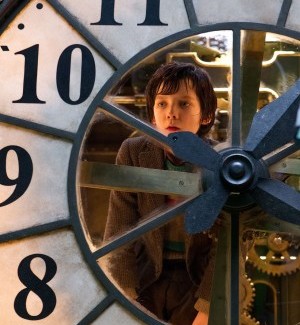
Hugo, the film that Scorsese made for the youngsters runs about 2 hours 8 minutes but feels longer, probably because it has so much on its plate.  A period piece—set post-WWI—about a young orphan, Hugo Cabret (Asa Butterfieldpossessing the most angelic urchin face since Elijah Wood) who caretakes the extended clockworks inside Paris' Montparnasse station, it also contains a brief history of the birth of the film era, an extended history of the career of French film pioneer Georges Méliès (Ben Kingsley) as well as being a feature-length advocacy piece for one of Scorsese's pet projects, film restoration.  But, lest one imagine a long lecture on the subject, it is so embedded in the film's story as to seem nearly invisible—a message hidden in a film of glass-sugar, so as to make the medicine go down.
Hugo ekes out a mouse-like existence, away from the orphanages, maintaining, unseen, the intricate, but elaborate clockworks that the trains run and the people depend onFrom the crystal clock-faces he can see life passing by and through, the scraps of left-over food that can provide a meal, and across the way the toy-maker's shop (with the very cranky proprietor) from whom he steals the tools and odd-parts to try and repair the last link to his late father (Jude Law, briefly), an amateur watch-maker, who took it upon himself to repair a mechanical automaton, discovered at the museum where he worked—the mechanical man's purpose no one knows

From his vantage-point, Hugo is at the hub of the station's bustling activity and many side-stories, but when the need or the hunger arises, he'll make time to enter that world through any number of vents, passageways and access-doors, usually one step ahead of the persistent Station Inspector, who is trying to maintain his own kind of order in the depot.
It may be a PG rated kids movie, but it is still Scorsese, so there are dark elements running all the way through, like Dickens. And Scorsese is never one for a light touch, no matter what the rating is or to whom the demographic is targeted. Still, it is Scorsese's breeziest project in years, recalling the set-bound, intricate work he did on New York, New York all those years ago. But, with the tools of CGI, the scope is huge and the director swoops and swings through corridors and tunnels and crawlspaces with a verve he's never displayed before. It's Scorsese unleashed, not unlike the doberman pinscher partner of the station garde (Sacha Baron Cohen, who displays a fine depth for physical comedy, as well as a Sellers-like ability to plumb perverseness from the lightest subjects), who scampers like a hell-hound through the station's ornately vast spaces (the most elaborate set-piece is a nearly wordless pre-title sequence that is its own CGI 3-D hurdle-fest, that is also a tribute to the silent film era.** 
Yeah, it's a kid movie, but it's also a relentless love letter to cinema, with craning shots the old masters would have busted Union rules for, emulations of the arty interpretive shots from the silent era—things the neo-realist Scorsese has never attempted before—while at the same time taking a toymaker/magician/film-makers' fascination with capturing what James Stewart (in an interview with Peter Bogdanovich) called "little pieces of time."  It is all a bit of magic, a bit of technology, a bit of art, presented with a stylists' eye for the dramatic.  
And Scorsese, with an army of the best at their cinematic craft—Robert Richardson, Thelma Schoonmaker, Dante Ferretti, Sandy Powell and Howard Shore (Shore's score is wonderfully soaring and French-laced)—including such fine actors as Kingsley, Law, Richard Griffiths, Emily Mortimer, Ray Winstone, Christopher Lee, Kick-Ass' "Hit-Girl" Chloë Grace Moretz and A Serious Man's Michael Stuhlbarg, have taken John Logan's intricately geared script-work and constructed a well-oiled entertainment machine taking today's technology to recreate an ephemeral past.

Wonders will never cease. Not with directors like Scorsese. Thank God!
Méliès accompanying himself on banjo in one of his films.


* This brings up one of those stories—the ones you repeat over and over again at Family Gatherings—of my Mother's side of the family, when she and her fellow Bannick sisters went to see Scorsese's Casino...because they thought it might be a musical? (!!!!) Casino. The one that begins with De Niro being blown up in a car, and later, a man's head in put in a vise until his eyes pop out, and Joe Pesci is bludgeoned to a pulpy death with a baseball bat—this, after an even more grisly scene where he has sex with Sharon Stone?

I've often wondered at what point in the film did they figure out there wouldn't be any dancing?

** It reminded me of the kids toy-box of Paris opening of Moulin Rouge!, Baz Luhrmann's zest-fest mash-up of period piece and slash and dash modern culture.