Showing posts with label Domhnall Gleeson. Show all posts

Tuesday, March 8, 2022

Anna Karenina (2012)

Struggling with writing a review of Cyrano, the latest from director Joe Wright. So, in the meantime, here are a couple reviews from his past work that I haven't put up yet.

Written at the time of the film's release...
 
Artificial Intelligence
or
Anna! Karenina! The! Musical!

Tolstoy's "Anna Karenina" is considered by many the greatest novel ever written, and has been adapted so many times (two of them starring Greta Garbo!), one is tempted to name any version "The Last Remake of Anna Karenina." So, the task for director Joe Wright and scripter Tom Stoppard must have seemed daunting, or as one of Zsa Zsa Gabor's later husbands stated it: "You know what you have to do, you just have to find a way of making it interesting."

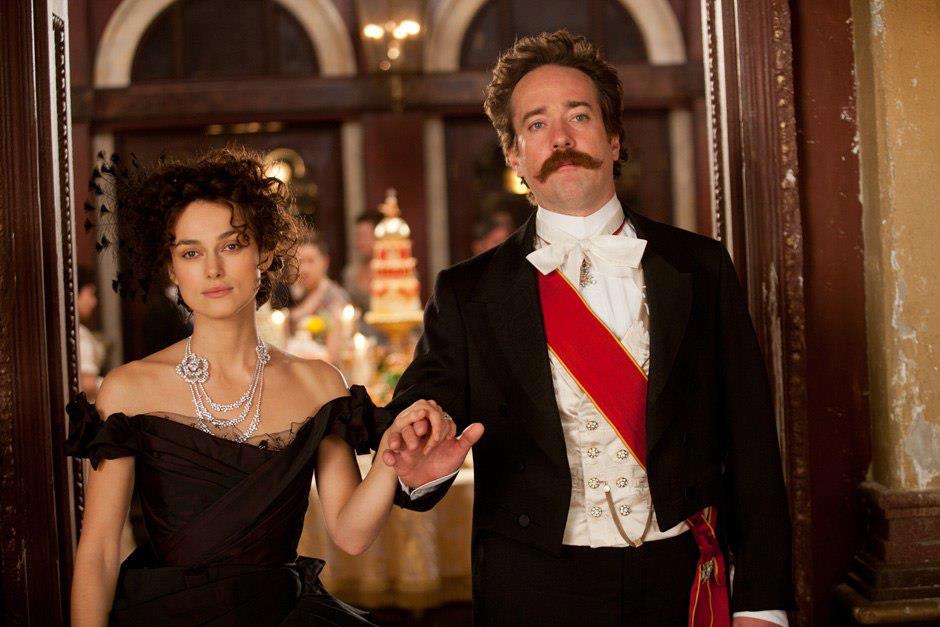
Well, this one is interesting, alright. And it hues closely to Tolstoy's novel in the way that a CliffsNotes Edition sticks close. All the plot points are there, the characters whittled down to their bare essences, or eliminated altogether, and breezily delivered in a theatrical manner, save some significant exceptions. Truth is, Wright makes this version of Anna Karenina the way Baz Luhrmann would, as a grand, operatic experience staged in an extraordinarily choreographed with the emphasis on the "arch" (as in "playfully and affectedly roguish") in Proscenium Arch.
Jim Emerson had a fascinating article* (based around Skyfall) on his "Scanners" blog on the difference between a "theatrical" film and a theatrical film and its use of space as defined by the limitations of the frame and a stage directors' tendency to reflect that frame with its own limitations resembling the dimensions of a stage. 
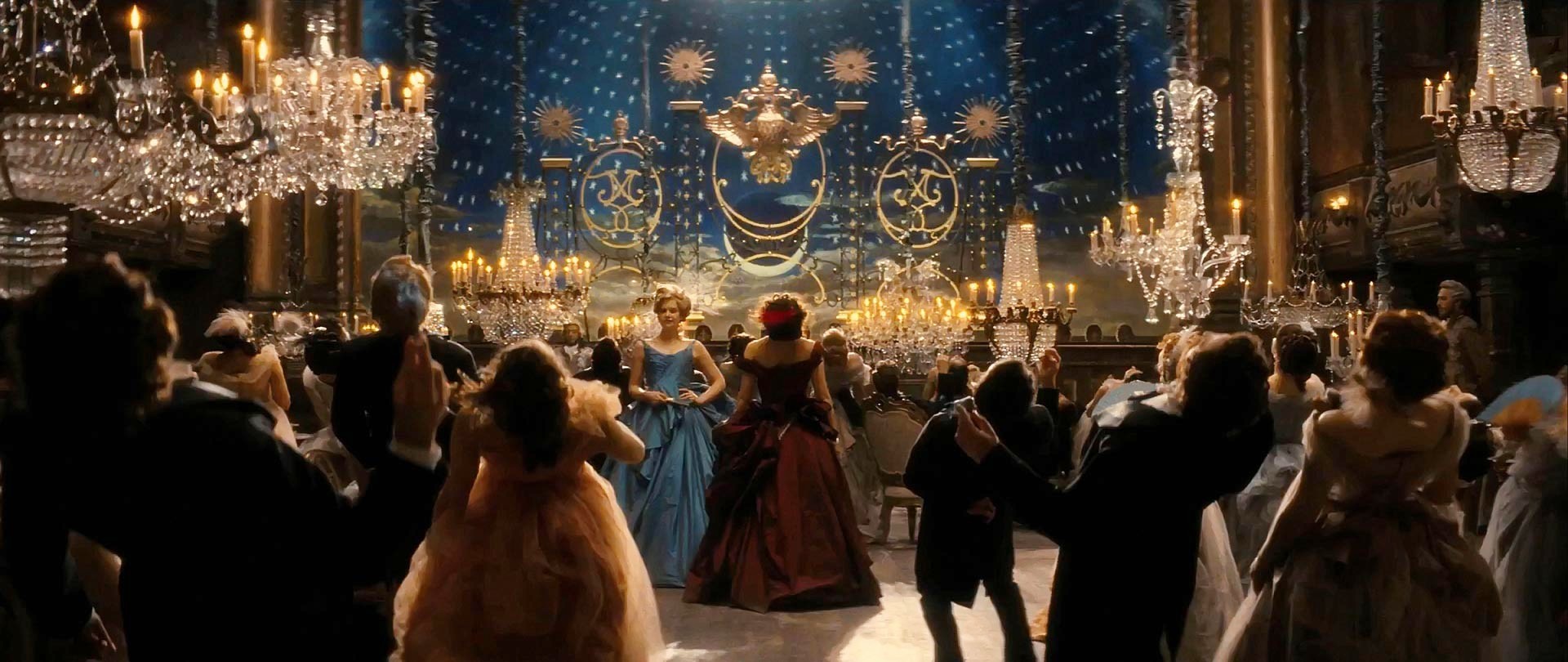
Wright fully embraces that concept and goes further; for the main story of the hoi-polloi and their social and political gamesmanship, all of the action takes place within the false spaces of a theater (at times even using the rafters as locations for traditional street-scenes): train and carriage scenes are decidedly set-bound with no effort made to reflect a "real" world outside the windows; transitions are made "in-camera" without editing, so a very stagy and choreographed bureaucratic work set-up with synchronized rubbing stamping (set to Dario Marianelli's interesting score) segues to a restaurant scene by merely having the "extras" trade in their black business suits for waiter-whites; a formal society ball is not an intricate commingling of dancers that Wright so effectively engineered in Pride and Prejudice, but is an elaborate ballet, where the participants barely touch and their hand movements are intricately swanning in nothing that approaches a traditional dance (at times, to keep track of the principals, the foreground dancers in our field of vision "freeze" to better make out the focus of our attention). Like Francis Ford Coppola's set-bound version of Bram Stoker's Dracula
, It's all very elaborate, "stagey," false, and at times clever but, a lot of the time, merely "showy," like a musical with no libretto, something to separate this "Anna" from the more realistic, even if filmed in-studio, versions. 
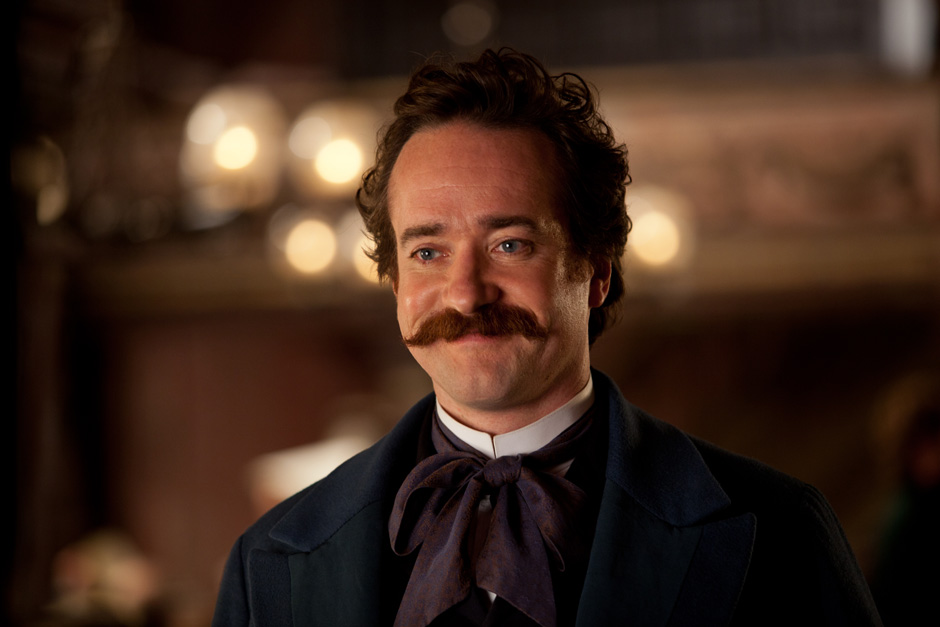
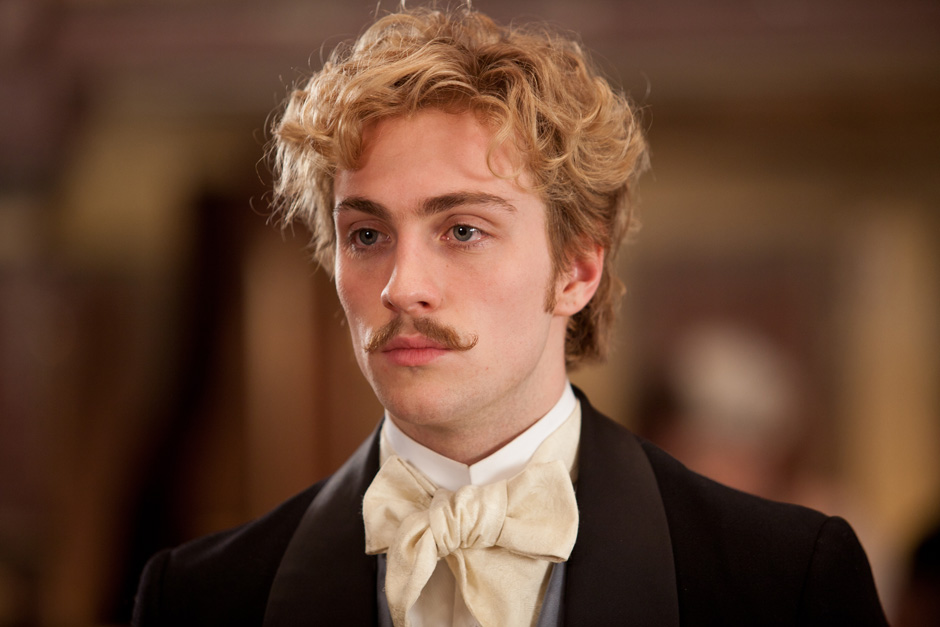
The performances run that way, too. Keira Knightley is an exasperating Anna, conflicted but fatally committed to fully expressing whatever is on the surface of her heart. Her P & P co-star, Matthew McFadyen is a burlesque cousin Oblonsky, fatuously showy in a way that reminds of Kevin Kline performing a burlesque role. Jude Law—not one of my favorite performers—here is exceptional as Anna's cuckolded husband, and is so restrained and non-theatrical, that it sets him apart from almost every other performer, isolating him, and is a good short-hand way of showing why Anna might be dissatisfied with him. Olivia Williams has a small part as the Countess Vronsky, whose son (Aaron Taylor-Johnson) is the very florid object of fascination for Anna.
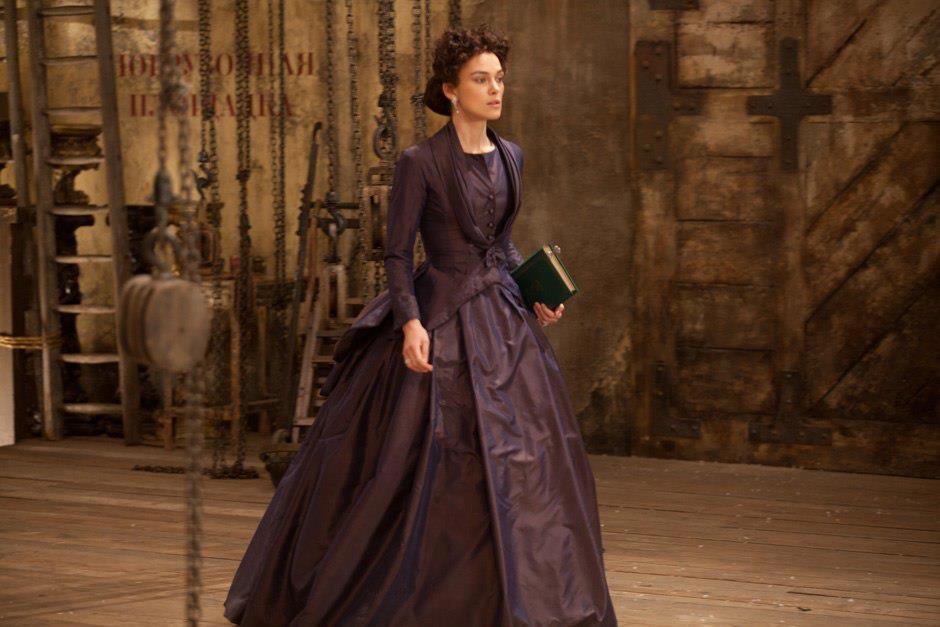
Anna (Keira Knightley) runs from Vronsky at the Ball
and experiences a little fore-lightening from an approaching train.

It's dangerous in a Joe Wright theater.

But, almost the entire film is deliriously fascinated with the artificiality that it undercuts the very real passion and consequences of actions of the people in the film, reducing them to "players" as opposed to human beings.

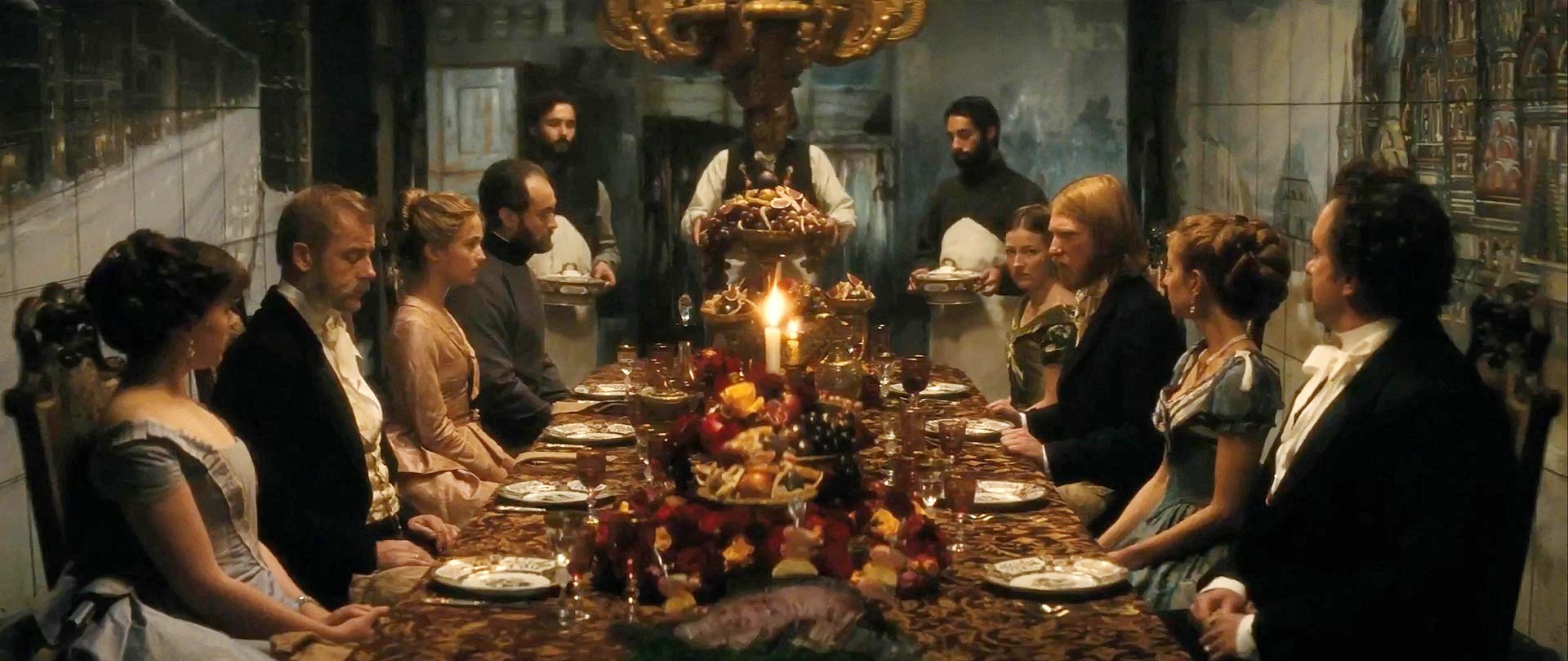
I say "almost" because Wright does change things up to "open up" the segments featuring Levin (Domhnall Gleeson) and Kitty (Alicia Vikander), who already have their disappointing encounter with Vronsky and move on. When they reunite, their segments are set in a real world of sky, clouds and fields befitting the couple who exemplify wisdom, forbearance and patience. Wright puts them in our world, relegating the others to an artificial world that is essentially stage-managed (even at the end with a coda of Karenin and the remains of his family, it is contained in the stage-world that Wright has chosen to house his film.
It's different, even interesting in an oddly disrespectful manner, as the flightiness of the bourgeoisie and their concerns are merely shadow-play and window-dressing—it is true to an extent—but by pushing the metaphor so aggressively, it undercuts any feeling one has for the players in the majority of the film itself, and reveals itself as resembling the tut-tutting of the hypocrites who turn against Anna. I'm not sure that Tolstoy had that intention (even strained through Stoppard), and this film might have benefited  from a less facile presentation that required less stage-craft and something more resembling (I don't know) empathy?

Tuesday, April 14, 2020

True Grit (2010)

Written at the time of the film's revivification.

"Revenge in a Minor Key"
or
"Hoo-raw'd by a Little Girl"

Someone had to save "True Grit" and that the Coen Brothers are in charge of the posse is reason to be appreciative. After their rather opaque film A Serious Man tanked seriously at the box-office (I thought it was that year's best movie), they needed a more accessible property to bring in audiences, and, under the tutelage of Steven Spielberg, the very well-known property (whether by book—written by Charles Portis—or the previous film, directed by Henry Hathaway) is a good match. Fact is, it's a truer match to the source material than the previous version and it displays a love for the novel and Portis' way of telling it, than merely adapting his very good story.
Sure, I love the original 1969 version. But, over time legend has overcome its considerable gifts, overshadowing the story, just as surely as John Wayne's performance overshadowed the movie. True Grit (1969) is an adventure story, where the book is a post-modern comic drubbing of Old West myths. The first film has a lot of those myths intact, those being the myths from Hollywood's westerns, including such at-the-end-of-an-era things as Strother Martin, Jeff Corey, Hank Worden, the opening song, Elmer Bernstein's  Copland-with-brass score, clean streets and available light. The first True Grit is a sun-dappled western romp more pretty than gritty, with Kim Darby (good as she is) having to play young rather than the character, and Glen Campbell (out of his depth) as the Texas Ranger LaBoeuf. It's just so clean, and the enterprise at its core so self-congratulatory that the point of the book gets a bit swamped in the process. 
The Coens take True Grit back to its roots. Keeping in Mattie Ross' arch narration, and casting 14 year old Hailee Steinfeld as the young protagonist is a shift that greatly improves this adaptation. Steinfeld is just severe enough, and, as opposed to the earlier film's Darby, spends her time acting more adult, as opposed to being an older actress acting young. She's a bit arresting, bossing around Cogburn (Jeff Bridges) and horse-trader Hollister (Dakin Matthews), not having to sell the "young" aspect, but merely rise above it.
Like Steinfeld, the rest of the casting is superb. Matt Damon's LaBoeuf is still a glory-hound, but of such fool-hardy self-assurance and puffery that you actually feel a bit sorry when it doesn't pan out to his vision. Josh Brolin does a fine job as Tom Chaney, the initial object of the man-hunt, bigger in myth than he is in real life, and something of a whiner. And Barry Pepper is nearly unrecognizable as Lucky Ned Pepper (I'm sure, no relation), who reveals a gift for rolling around the stilted dialogue he's been saddled with, and who (bless him) acknowledges in his performance the work of the fine actor who preceded him in the role.*
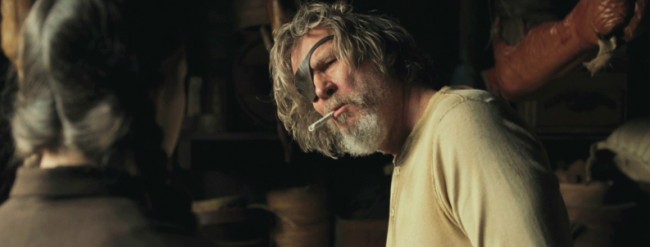
And everyone will be watching Jeff Bridges, because he has small boots to fill—Wayne had little feet—His "Rooster" Cogburn has his eye-patch on the other side (Wayne kept his left eye covered, Bridges his right—that a political statement?), and his deputy Marshall is more dissolute, less jolly, growlier and more willing to admit his infirmities. His drunk is a bit more dangerous and cantankerous (the Coens keep the corn-dodger shooting match between Cogburn and LaBoeuf), although Bridges always tries to invest some dignity in the stumbling, playing it less for laughs than for character. 
The role has little of Wayne's "star" presence, but a nice sunken lived-in quality. His "Fill your hands, you son-of-a-bitch" is not said as a challenge, but in genuine anger, without Hollywood quotation marks. He's superb, and by the time he confronts a Choctaw body-snatcher on the hunt, Wayne's version is cheerfully merely remembered.
But, it goes beyond that for the Coens' version. Their True Grit is steeped in atmosphere, acknowledging racial differences and feeling less like a scout outing on a beautiful spring day.  Confrontations are held in pitch-black night, during snow-flurries, and inclement weather. Nature in its beauty played a big part in the appeal of the 60's Grit, here it is nature in its ambivalence—one gut-wrenching scene taking place in the pitch of night under a dwarfing sky of shining stars. The struggles of the individuals, man and beast, under that canopy are thrown into stark relief with those indifferent points of light. It haunts, and throw one more sharpening aspect of this version that the previous lacked.
For, after the deeds have been done, this Mattie Ross, confidently bossy 14 year old, is given a sight of the carnage her single-minded quest has left in its wake.  There are moments, under that clear sky, of regret that the first film didn't dare preach, and of the destruction such obstinance can wreak. A further coda follows the book's conclusion, that such lessons may not keep, under so strict a host.
It's lovely. It's the book, done in a minor key in an overcast light, not dressed-up and gussied-up, but bittersweet, full of sand, and a lot of grit.

* Okay, I can't keep it a secret, it is so delicious: Robert Duvall played Pepper in the first film, and in a key-scene (with Pepper in close-up) giving instructions to stay with Mattie Ross, Pepper gives a two-fingered hand-signal that was a running gesture of Duvall's iconic (and beloved) Augustus McRae in the "Lonesome Dove" mini-series.  That move calls to mind another gesture echo in classic westerns: John Wayne's grabbing his arm in the last shot of The Searchers in a quiet tribute to the habit of another star of John Ford westerns, Harry Carey.  Lovely, and nearly invisible.


Saturday, February 20, 2016

Brooklyn

Transplanting the Wild Irish Rose
or
Eilish Grows in Brooklyn

Saoirse Ronan (pronounced SUR-sha, in case John Travolta butchers it at the Oscars) is an odd duck of an actress. Born in the Bronx, she first became known for playing the youngest version of authoress Briony Tallis in Joe Wright's film of Atonement, followed it with City of Ember, the tough role as the victim in Peter Jackson's The Lovely Bones, Peter Weir's The Way Back, then switched to action in Wright's atypical Hanna. She's been bouncing around small films and doing voice-work (including "Robot Chicken?") for a couple years, trying to find a match for her oddly porcelain look and fiercely serene presence but seems to be passed over for major roles. She's found her niche in Brooklyn, John Crowley's film of the Colin Toibin novel (adapted by Nick Hornby, flawlessly) as not the most beautiful girl in County Wexford, with few prospects who is sponsored by the local Church to live and work in 1950's New York (1952, specifically, as one of her co-workers mentions she saw The Quiet Man at the movies last night).

On the transatlantic sailing, Eilish Lacey (Ronan) has a bit of a rough time of it, experiencing sickness and territorial fights over a shared bathroom. But, she is assisted by her cabin-mate, Georgina (Eva Birthistle), coming back from a visit back home, on life in New York, getting on in her new station, and most immediately, getting through immigration, where any hint of sickness will have her put in quarantine. "You have to think like an American," she advises Eilish at one point. "Look like you know where you're going."
Where she's going is the boarding house of Mrs. Keogh (Julie Walters, bless her) where Eilish is made to feel, at once, at home and like the new kid on the block. Other lasses are there, as well, and they're so Americanized, they're like from another planet. But, she tries her best to fit in at her work as a salesgirl at Bartocci's department store where her shyness with customers is a stumbling block, and she is crippled with homesickness for home. Her first letter from her sister back in Ireland she carries with her like a talisman. And it only feels worse, sending her into an emotional tail-spin.
But, she makes an effort. Her sponsor, Father Flood (Jim Broadbent) gets her enrolled in book-keeping classes at night, should the counter job fall through, and she volunteers at the Church's soup kitchen at Christmas for the indigent Irish in the city ("They built the bridges and tunnels and highways..." informs Father Flood), and she is moved to tears when one of the gents gets up to sing a traditional Irish ballad.
She tries to socialize a bit more, attending discreet dances, where she tries to learn to dance and she meets Tony (Emory Cohen, who's like a looser, more awkward Edward Norton in New York mode). She excels at class and grows closer to Tony, getting tips from the girls at the boarding house and at work.
Tony is besotted, despite the soft barriers of a "mixed" relationship (She's Irish; he's Italian) and they go dancing, see movies. He walks her home from class. And they start to get "serious," seriously. The girls approve, thinking Tony a "catch" because he's Italian but doesn't talk about the Dodgers and his Mother all the time. An invitation for Eilish to have dinner with his family necessitates an intense lesson in how to properly eat spaghetti. A trip to Coney Island throws her support system into a tizzy, insisting that she buy sunglasses and the best swimsuit ("You don't want to put him off," says Mrs. Keogh).
But, tragedy strikes back home and Eilish travels back to Ireland, where life has changed and the local girl with no prospects is suddenly a cosmopolitan woman, now seen as sophisticated and capable by the locals. She is noticed, both by the local boys and the businesses that wouldn't have hired her before. After her homesickness in New York, she realizes that she could make a life for herself at home.
But, where is that? Is that back in the small town embrace of her birth or the place where she has built a life for herself, despite the odds. She will do well either place. Whichever she chooses, she will break someone's heart, disappoint others, and, no doubt, wonder what might have been, no matter where she is.
But, where is that? Where is home? Where will her future be, knowing that both could provide that?
"Home is home," Tony says at one point. Simple enough, but not much help. Both are home. Both will pull at her heart at some point in whatever the future holds. She is caught in an emotional stasis, wondering what that future will hold with the inevitable "what-might-have-been."
Brooklyn is a film of telling details that seem "just right" from the casting to the dialogue to the locales to the habits. The issues it touches are fundamental: about survival and the pain that growing causes and the struggles of the heart stretched to capacity but unable to occupy two places at once.
None of this would matter one whit if you didn't care about the characters and, as heart-felt and true as Hornby's script is, the film's chief weapon for getting under one's skin is Ronan. She does nothing theatrical here, doesn't "twinkle." never flirts with the audience. Quite the opposite, hers is a quiet performance that doesn't project, is contained and maybe too proud to betray anything, but draws you in despite that. Ronan has always had a "zen" quality to her acting, even as a child, but this may be the perfect melding of actor to role in all of 2015.
Brooklyn is also one of the rare movies where fate made the perfect casting decisions. Ronan was considered too young for the part when it was being prepped and Rooney Mara was cast instead. By happenstance, the movie was delayed, forcing Mara to bow out due to scheduling conflicts (and thus move into her Oscar nominated performance in Carol), and Ronan to age gracefully into the role, to the betterment of both actress and film. In my (worthless) Oscar preferences, I was rooting for Brie Larson to win for Room. She has been displaced and I would be more than happy for Ronan to win, even if they butcher her name.

Thursday, January 21, 2016

The Revenant

In the Country of Mann
or
"This Isn't About the Hunting, Is It?"

The Revenant does in 2 1/2 hours what Anthony Mann* used to do in a trim 90 minutes...and he'd throw in a B-actress love interest to boot. The story of Hugh Glass (played in the film by Leonardo DiCaprio), who survived a bear attack while serving as a guide for a Fort Kiowa (in what would become South Dakota on the Missouri River) pelt-hunting party (which went from 100 men at the beginning to ten at the end), then endured a 200 mile trek to the fort, it is an amazing tale straight out of legend, but has been transmorgrified into a tale of revenge for the big screen. That's not the way it actually happened (the two men who were charged with staying with Glass and left him for dead ended up with no consequences at all), but it's a movie, and the current climate of cinema seems to have demanded that it turn into an obsessive tale of revenge throughout its core.

I wish I could say that the movie thrilled me, but it did not. Perhaps I've seen too much revenge-motivation in films lately (blame those evil superheroes) that I'm a little sick of it—bored by it, even. Maybe it's not just superheroes. Maybe it's the reality show-machinations we've been inundated with or the greedy-gus corporatization of America where it's not enough to make a good life for yourself until you've kept somebody else from having it that has generated this feeling of not just "keeping up with the Joneses," but "getting even" with the Joneses. Do we have to live like a soap opera or The Godfather? I reject that handily. And I object to the real triumph of Hugh Glass in the wilderness being turned into a turf war (that, after all, is what was happening with the Natives—something Iñárritu seems to want to indict them under in this scenario, as well).

The Revenant is receiving all sorts of accolades—and garnered a mail-satchel of Oscar nominations—and one has to give it kudos for being so doggone persistent in recreating the squalor of the world of the Western trapper (credit veteran production designer Jack Fisk for that)—but I think a lot of that hyperbole is for those folks who were a little left behind by the obtuseness of Birdman, and are playing catch up for how good writer-director Iñárritu can be. Here, he's just a little more obvious and on-the-nose than usual, producing great craft, but to a story that says more in the actual truth of it than it does in his dramatization.
It is 1823 and a party of animal trappers are exploring the northern reaches of the Louisiana Purchase by the Missouri River. The group is led by Captain Andrew Henry (Domhnall Gleeson, last seen auditioning for headliner at a Nuremburg rally in Star Wars, squiring Sioarise Ronan in Brooklyn, and exploring the future of dating in Ex Machina, the guy gets around), their guide is that Hugh Glass who is aided by his son Hawk (Forrest Goodluck), when they are caught by surprise during a hunting sortee away from the group by the sound of gunfire. The group is under attack by the Arikara tribe led by Elk Dog (Duane Howard) who is looking for his daughter Powaqa, whom he believes was kidnapped by the trappers. The natives decimate the trappers—the Arikara are portrayed as being VERY good shots, with some rather wicked looking arrow-hits, and the trappers have a tendency to fall down even after a single arrow hit in the leg—and a dozen of them are able to get to their keel-boat to distance themselves with what pelts they can accumulate.
They're in a very bad way. Under pursuit and under-supplied, they have barely enough wares to make the trip worth its while. Then there's "The Griper." Every platoon has to have one, and Fitzgerald (Tom Hardy) is the self-appointed nay-sayer and whiner, the guy who thinks he should be in charge. He'll pick a fight with anybody and when challenged, backs off, complaining about his treatment. Fitzgerald does a little antler-locking with Hawk and it's only Henry's and Glass' interference that keep the two from coming to blows. Hardy, who has been so good for so long, is fiercely committed to the role, creating a sand-paper-irritating character that makes you crave his demise by any means possible. I'd give him an Oscar just so he'd shut up, already.
But, it's Glass who suffers misfortune. Separated from the troop, he unfortunately gets between a mother grizzly and her two cubs and the animal savagely attacks him (the sequence, done with special effects and CGI—of course—is a wonder, horrible and savage, while having a fascinating quality of animal logic—or illogic—to it, and just when you think it's over, it goes on and on). He's found alive, but just barely, and Henry's men do their best to patch him up—Fitzgerald, sensitive soul that he is, notes that Glass' cries of pain might lead the Arikara's right to them. Travoising Glass up steep terrain doesn't make their escape any easier, so Henry charges two men to stay with Glass until they can get a rescue team from the fort to help. Glass' son Hawk won't leave his father's side, and Fitzgerald and the youngest member of the party, Jim Bridger (Will Poulter) volunteer to stay with the guide.
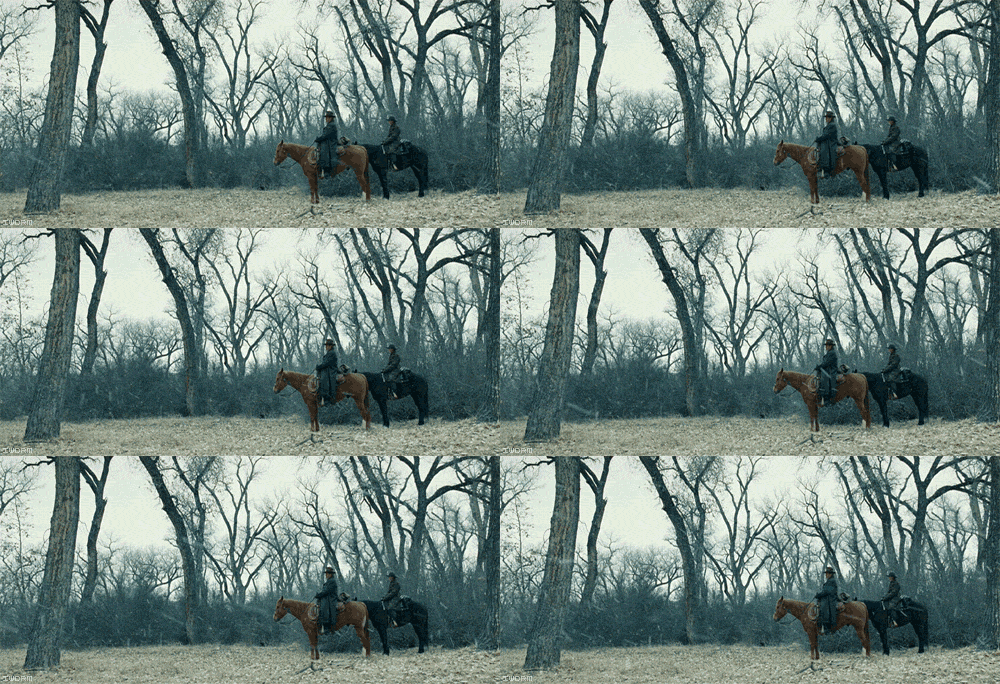
Captain Henry (Gleeson) and Fitzgerald (Hardy) very much alive.
I guess when you're down to ten men, you can't be too picky about volunteers. Fitzgerald is convinced that Glass is done for and is more than willing to finish him off and move on. But Glass' son will have none of it and is the only thing keeping Fitzgerald from abandoning his post and the crippled guide.

Glass didn't have a son, historically, but inserting one into the narrative up's the ante for drama and provides one more subsequent reason for the movie-Glass to swear vengeance beyond what really happened—in reality, he just wanted answers and his rifle back, actually.  
Motivated by the movie's events DiCaprio's Glass gropes out of the sloppily constructed grave Fitzgerald has prepared for him and starts the slow trek back to the fort, evading hostile Natives (still searching), crawling initially, then trudging using a stout branch as a make-shift crutch, and using all the survival skills a lifetime has taught him. This part is true. And except for Glass' radical method for fighting infection and necrosis, it's pretty much the way legend has it. The "revenge" factor is thrown in, as is a back-story that has Glass in moments of fever and dream envisioning the spirit of his Native wife (Grace Dove), killed in a raid by soldiers of a more European military costume, letting the Cavalry off the hook this time.
One of cinematographer Emmanuel Lubezki's magnificent panoramas.
"As long as you can still grab a breath, you fight" is the chief mantra of The Revenant and so there's a lot of breathing on the soundtrack (and, in fact, the film begins and ends with that sound, disembodied from image). But, mid-way through the film another comes into play: "Revenge is in the creator's hands." If, indeed, the Creator cares. The creators of The Revenant care, obviously, but that might be to tie the film into the movie-trend of revenge at all costs. But maybe it's time for there to be a moral re-alignment in films. What made the recent Spectre interesting was its denouement on Westminster Bridge where James Bond has the drop on long-time nemesis Ernst Stavro Blofeld and is emplored by the villain to "finish it." With the authorities standing nearby, Bond merely unloads his gun and says "All out of bullets. And I have better things to do." Even Christopher Nolan took that most vengeful of super-heroes, Batman, and gave him the valuable lesson he never learned in the comics—living well is the best revenge. We have better things to do.

So do we all. Perhaps, revenge should be relegated to villains and not those we consider heroes, who would have better things to do than be compulsively vindictive. Hugh Glass, Jim Bridger, John Fitzgerald, and Captain Andrew Henry all lived without it.

The Hugh Glass marker—Shadehill Lake, SD
A portrait of the real Hugh Glass
Leo in another western
(cleans up real nice, don't he?)


* The reference to director Anthony Mann comes from a series of "psychological" Westerns that director Mann, screenwriter Borden Chase (and others) and star James Stewart made in the 1950's, which showed the deterioration that Nature and Man can cause in even the most charitable of people and showed the parallel between the "civilizing" of raw country and the "civilizing" of man's baser instincts. They're all great films: Winchester '73, Bend of the River, The Naked Spur, The Far Country, and The Man from Laramie. Oh, and there's a trick at the end that's owed to a Howard Hawks subterfuge employed by Humphrey Bogart in The Big Sleep and John Wayne in Rio Bravo. Unfortunately, the person portrayed as dying in 1823 actually died in 1832. Yeah, don't let facts get in the way of enjoying the movie...just like a political campaign.

Friday, May 1, 2015

Ex Machina

She's My Little Deus Coupe
or
"Pardon Me, Ma'am, But You Have Too Much RAM
For a Real Live Girl..."

"Deus Ex Machina" is from the Greek for "God From the Machine" and is a literary term for that point when a dramatist has boxed himself into an unsolvable issue and solves it by a sudden and inexplicable occurrence. Something, or God, intervenes to distract or unite to come to terms. Ever read "The Stand" by Stephen King? There, God literally does intervene in the polarized battle between the good and the evil among the survivors of a world plague. The black monolith of 2001 is a literal "deus ex machina" and could be said to be the movie's protagonist. Even a western like Red River has a "deus ex machina" when Tess Millay, the woman common to both Tom Dunson and Matt Garth, suddenly shoots at them to stop their inevitable father-son death-struggle over dominance.

In Ex Machina, the new movie written and directed by Alex Garland (he wrote, The Beach, 28 Days Later, and Sunshine for Danny Boyle, as well as the adapted screenplays for Never Let Me Go and Dredd), there is no "Deus" as such. Just the pretend-kind, usually associated with those grabbing for power—the "little tin" kind. Appropriate.

It's a lucky day for Caleb Smith (Domhnall Gleeson). A programming functionary at the BlueBook Corporation, which is the leading search engine on the Internet, he has won first prize in the BlueBook staff lottery; the prize is a week-long stay with the company's founder Nathan Bateman (Oscar Isaac) at his retreat who-knows-where. He is air-lifted there (he asks the chopper pilot when they're going to get to Bateman's property and gets the reply that they've been flying over it for the past two hours), and is instructed to follow the river to a relatively small structure that creates a card-key for him and lets him in. Now, this is a "smart" house.
But, looks are deceiving. The vast majority of Bateman's house is underground, with scattered areas of natural growth to maintain an edge of Nature. Caleb eventually finds "Nathan" working out after a bender decompressing from a long session of brain-storming, and it's here that Nathan tells Caleb why he's visiting (after making him sign "the mother of all NDA's"): to conduct a "Turing test" on his latest innovation, a functioning artificial intelligence. It's Caleb's "job" during the week to see just how non-machine-like Nathan's machine is, interviewing it in private (but closely monitored) sessions to see just how "human" this artificial intelligence is.
When he finally "meets" the A.I., named Ava (Alicia Vikander), it is a bit of a shock. Ava is a robot, walking around, speaking, fully functioning. Tough enough that this robot looks human (which would surely prejudice any objective conclusion to the ultimate question), but she is also wholly sympathetic. She/it is trapped in a glass enclosure, asking as many questions as she answers. Before Caleb, the only interaction it had was with Nathan, it's creator/programmer, and frankly, Nathan can be a bit tiring, after awhile, being completely narcissistic, and borderline self-destructive. But "tiring" is not really something concerning a machine. It never tires. It is always "on."  nd, given, it's 24/7 existence, it has a lot of time to think...and calculate.
A couple of things weigh on Caleb. There is his oddly inappropriate sympathy for Ava—she's (it's) trapped in her glass work-space (but what should that matter to a machine, especially a machine with no context of place other than it's station. The other thing, probably related, is that Ava is "female," at least in appearance. Why? Is that part of the test, to see how that affects Caleb's examination (in which case, who is being tested—Ava or Caleb?). Then, there's Ava's need to dress up in a wig and "girl-clothes" to appear human. She aspires. Should a machine aspire to anything? Or is she merely Pinocchio in drag, wanting to be real. But to what end? The back-and-forth between Caleb and Ava becomes personal and invasive. Then, things get very creepy.
During the Caleb/Ava interviews, there is an inevitable power-failure, the main generators of Nathan's house—actually "research facility"—shut down, the back-up batteries kick in and emergency lighting bathes the whole place in a creepy red glow. With the generators shut off, Nathan can no longer monitor the sessions and Ava throws a spanner into Caleb's works; she warns Caleb not to trust Nathan, that he's deceitful, planting a seed of conspiracy in Caleb, and setting the programmer on a quest to find out exactly what Nathan might be doing—and what his plans are for the A.I. program, and Ava in particular. One worrying aspect in this (among many) is that it is Ava who can kill the generators, something Nathan doesn't suspect and explains away by blaming the place's contractors. "I'm workin' on it," he deflects.
Nathan is focused on the project, but he's also a bit of a binger—getting drunk and being a prick to Caleb, questioning his competency and intentions. Caleb wants to know what will happen to Ava if she doesn't pass the test. The answer is simple: she'll be replaced, updated, re-programmed to fix the problems, her memory wiped and a new program, a better program installed. The answer is simple, but troubling; yes, you'd do that with any sub-standard operating system, but (as another movie put it) nobody's sure of what Ava might think about it. 
Ex Machina is very, very simple, but brilliant. It toys with the quest for intelligence—not memory, or mere problem-solving, but in wholly creative and imaginative reasoning...and what the responsibility is to that (for want of a better term) sentience. It calls upon references from The Bible, Greek myth, and, because of that, the "Frankenstein" story in its perambulations on the subject of intelligence and responsibility for it. We're pretty lousy on the record of human rights...are we going to be any better with thinking machines? What will be their function—slaves? Will we have to pay them $15 an hour, or merely the promise of a virus-free environment (does insurance cover that?). Do we tell them about Re-PC? 
The point may be moot—or may not compute. The machines may have the ultimate answer (and where are Asimov's laws of robotics when we need them?). In the meantime, even in Ex Machina's time, the humans aren't faring too well. Caleb gets so bent out of shape by the mind/mainframe games that he even begins to doubt himself, wondering if he might be a robot (good thing Ridley Scott didn't direct this) and injected into the scenario to see if maybe he's the one being tested, a case of the worm Turing. What is Nathan's motivation? For all that, what is Ava's? Can she/it even have motivations?
Ex Machina poses a lot of questions, doesn't provide easy answers and is an exquisite little cautionary tale about man, machine, and perception. How much do we want machines to be "like" us...and to what end? If anything, the idea is to evolve—do we want machines based on our thought processes, patterns and conclusion-jumping when we're doing enough damage ourselves, or do we want to improve on our failings and make something better? In the reverse, why would a machine aspire to be human (it can observe, right?) At one point, Nathan says "Someday the A.I.'s are going to look at us like would looking at fossils in the desert." Quite likely.

But it's doubtful they could make a movie as good as this one is.