Showing posts with label Barry Pepper. Show all posts

Tuesday, April 14, 2020

True Grit (2010)

Written at the time of the film's revivification.

"Revenge in a Minor Key"
or
"Hoo-raw'd by a Little Girl"

Someone had to save "True Grit" and that the Coen Brothers are in charge of the posse is reason to be appreciative. After their rather opaque film A Serious Man tanked seriously at the box-office (I thought it was that year's best movie), they needed a more accessible property to bring in audiences, and, under the tutelage of Steven Spielberg, the very well-known property (whether by book—written by Charles Portis—or the previous film, directed by Henry Hathaway) is a good match. Fact is, it's a truer match to the source material than the previous version and it displays a love for the novel and Portis' way of telling it, than merely adapting his very good story.
Sure, I love the original 1969 version. But, over time legend has overcome its considerable gifts, overshadowing the story, just as surely as John Wayne's performance overshadowed the movie. True Grit (1969) is an adventure story, where the book is a post-modern comic drubbing of Old West myths. The first film has a lot of those myths intact, those being the myths from Hollywood's westerns, including such at-the-end-of-an-era things as Strother Martin, Jeff Corey, Hank Worden, the opening song, Elmer Bernstein's  Copland-with-brass score, clean streets and available light. The first True Grit is a sun-dappled western romp more pretty than gritty, with Kim Darby (good as she is) having to play young rather than the character, and Glen Campbell (out of his depth) as the Texas Ranger LaBoeuf. It's just so clean, and the enterprise at its core so self-congratulatory that the point of the book gets a bit swamped in the process. 
The Coens take True Grit back to its roots. Keeping in Mattie Ross' arch narration, and casting 14 year old Hailee Steinfeld as the young protagonist is a shift that greatly improves this adaptation. Steinfeld is just severe enough, and, as opposed to the earlier film's Darby, spends her time acting more adult, as opposed to being an older actress acting young. She's a bit arresting, bossing around Cogburn (Jeff Bridges) and horse-trader Hollister (Dakin Matthews), not having to sell the "young" aspect, but merely rise above it.
Like Steinfeld, the rest of the casting is superb. Matt Damon's LaBoeuf is still a glory-hound, but of such fool-hardy self-assurance and puffery that you actually feel a bit sorry when it doesn't pan out to his vision. Josh Brolin does a fine job as Tom Chaney, the initial object of the man-hunt, bigger in myth than he is in real life, and something of a whiner. And Barry Pepper is nearly unrecognizable as Lucky Ned Pepper (I'm sure, no relation), who reveals a gift for rolling around the stilted dialogue he's been saddled with, and who (bless him) acknowledges in his performance the work of the fine actor who preceded him in the role.*
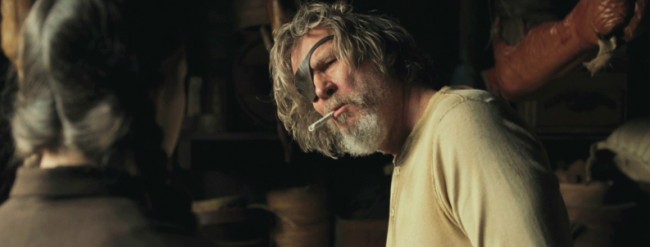
And everyone will be watching Jeff Bridges, because he has small boots to fill—Wayne had little feet—His "Rooster" Cogburn has his eye-patch on the other side (Wayne kept his left eye covered, Bridges his right—that a political statement?), and his deputy Marshall is more dissolute, less jolly, growlier and more willing to admit his infirmities. His drunk is a bit more dangerous and cantankerous (the Coens keep the corn-dodger shooting match between Cogburn and LaBoeuf), although Bridges always tries to invest some dignity in the stumbling, playing it less for laughs than for character. 
The role has little of Wayne's "star" presence, but a nice sunken lived-in quality. His "Fill your hands, you son-of-a-bitch" is not said as a challenge, but in genuine anger, without Hollywood quotation marks. He's superb, and by the time he confronts a Choctaw body-snatcher on the hunt, Wayne's version is cheerfully merely remembered.
But, it goes beyond that for the Coens' version. Their True Grit is steeped in atmosphere, acknowledging racial differences and feeling less like a scout outing on a beautiful spring day.  Confrontations are held in pitch-black night, during snow-flurries, and inclement weather. Nature in its beauty played a big part in the appeal of the 60's Grit, here it is nature in its ambivalence—one gut-wrenching scene taking place in the pitch of night under a dwarfing sky of shining stars. The struggles of the individuals, man and beast, under that canopy are thrown into stark relief with those indifferent points of light. It haunts, and throw one more sharpening aspect of this version that the previous lacked.
For, after the deeds have been done, this Mattie Ross, confidently bossy 14 year old, is given a sight of the carnage her single-minded quest has left in its wake.  There are moments, under that clear sky, of regret that the first film didn't dare preach, and of the destruction such obstinance can wreak. A further coda follows the book's conclusion, that such lessons may not keep, under so strict a host.
It's lovely. It's the book, done in a minor key in an overcast light, not dressed-up and gussied-up, but bittersweet, full of sand, and a lot of grit.

* Okay, I can't keep it a secret, it is so delicious: Robert Duvall played Pepper in the first film, and in a key-scene (with Pepper in close-up) giving instructions to stay with Mattie Ross, Pepper gives a two-fingered hand-signal that was a running gesture of Duvall's iconic (and beloved) Augustus McRae in the "Lonesome Dove" mini-series.  That move calls to mind another gesture echo in classic westerns: John Wayne's grabbing his arm in the last shot of The Searchers in a quiet tribute to the habit of another star of John Ford westerns, Harry Carey.  Lovely, and nearly invisible.


Friday, May 17, 2019

The Battles of Iwo Jima (directed by Clint Eastwood)

Written at the time of each film's release...

Photo Opportunism

Every year, like clockwork,
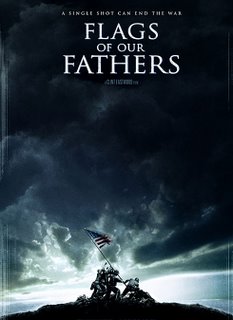
Clint Eastwood makes a new film, and they become instant Oscar-bait. His last one was Million Dollar Baby (Hilary Swank won Best Actress-her second award, and Morgan Freeman won Best Supporting Actor) The year before that, Mystic River (winning Oscars for both Sean Penn and Tim Robbins). Eastwood shoots movies fast in a calm environment and leaves actors alone to do their job. And while most directors are making movies that jump and whirl just to prove they're doing their jobs, Eastwood sets up the shot, does a take or two and moves on. He's efficient, fast, and doesn't do any fancy cutting or post-production. 
In this way, he's very much like his mentor, Don Siegel. Siegel, too, wasn't afraid to throw a little controversy into the mix. Eastwood, a moderate Republican, has made movies recently that have condemned vigilante violence and lack of process (Mystic River), and turned a sympathetic eye to euthanasia (Million Dollar Baby). His recent work is not for the complacent, and Flags of Our Fathers is just as impatient with easy myths and lazy thinking. 
Saving Private Ryan can look at "The Greatest Generation" and sentimentalize them while acknowledging their sacrifice. Eastwood's film has the audacity to question blind patriotism and that sentimentality for the purposes of hucksterism. I'm sure when some neo-con blowhard actually sees this movie there's going to be as much controversy as there was around Million Dollar Baby among panicky right-to-lifers. As it is, I've already heard some CBS radio reporter in Iraq talking about the stationed soldiers "fighting for each other, rather than the cause," a line right out of the movie. How quickly this stuff travels...
Performances are top-notch from a bunch of actors never given their due--here, they shine. Guys like Robert Patrick and Neal McDonough, good actors (whom you know from other things) with odd faces that will never be leading men are revelations here. Gordon Clapp from "NYPD Blue" has one scene of such comic ferocity that you'll never see him the same way again. Ryan Phillipe, thought of as the less-talented of a Hollywood marriage (and ironically they split up right after this film came out), belies that here. Barry Pepper, from Ryan plays an "old vet" of 25, with the slightest veneer of gravitas and bravado. And Adam Beach, of Smoke Signals and the Tony Hillerman adaptations on PBS, has never displayed the potential of his performance here. He has one devastating scene that will get him nominated him for an Oscar and probably win it for him. The day I saw it, there wasn't a dry eye or a nose unsniffled after it. The story of Ira Hayes has been told before on screen and in song, but never so effectively as here.
Eastwood's next movie will be coming out quickly, as he shot it simultaneously with Flags.... It's also about Iwo Jima...from the Japanese perspective-Letters from Iwo Jima.

Eastwood is so good, he's scary.

 -------------------------------------------------------------------------------------------------------------------------

"See you on the other side!"

Somewhere in the planning stages of
Flags of our Fathers, Clint Eastwood had a thought—What was on the minds of the Japanese soldiers who also fought at Iwo Jima? What of the commander who took such a different approach that the badly out-numbered troops could hold off the Americans as long as they did? So with the same crew, and a completely different cast he made another movie on the heels of the previous one that showed the situations and motivations of the defenders of Iwo Jima, based on writings contained in the book "Picture Letters from the Commander in Chief," written and illustrated by the Iwo Jima forces' commander Tadamichi Kurabayashi.

The results,
Letters from Iwo Jima won the National Board of Review's "Best Picture." It's nominated for a Best Picture Oscar, and it incongrouosly won the Golden Globe for "Best Foreign Language Film" ("I guess I have to learn a foreign language now," said Eastwood laconically).
The film is 98% in Japanese with subtitles. Played by a terrific cast (assembled with Eastwood's knack for picking interesting faces) led by Ken Watanabe who after stealing The Last Samurai from Tom Cruise and going to waste in Batman Begins shows how thoroughly he can carry a film. He suggests no one less than Gregory Peck in his portrayal of the American-schooled Japanese tactician who knows the impossible task of defending the last stop to Japan and does so to the best of his ability.
Like that defense strategy Letters is an excavation. In a present day prologue the letters are unearthed by Japanese archaeologists. Flash back to war-time Iwo Jima and the soldiers are digging trenches for the initial beach attack strategy, then digging the elaborate system of tunnels that would prove to be the core of their final strategy. Letters follows several soldiers of various ranks in the days between Kurabayashi's arrival and the fall of the last man. The film wheels between the scenes of the island (filmed in a bleached monochrome broken only by the reds of the Japanese flag, the orange flame of explosions or blood), and of the men's past lives filmed in vivid technicolor. Technically, the film is a wonder. The effects by Digital Domain are photo-realistic, even amidst battles that are shot hand-held and face-close. The explosions singe.
Given the structure, the film is very much in lock-step with such traditonal war-films as, say, The Sands of Iwo Jima, where the personal lives of the individuals in the troop manifest themselves on the battle-field. But the war film it most resembles is the B-movie WWII drama Hell is for Heroes directed by Eastwood's mentor, Don Siegel. Like Letters, Hell... is a view from the trenches, where the conceits of heroism and honor--a constant hook in the dialog of the Eastwood film, everyone talks of honor...or mocks it ("Kashiwara died from honorable dysentery," says a grunt about the whereabouts of a comrade) have no place in the grime and destruction of war. The picking-apart of the hero myth has been the most frequent Eastwood subject. But not even Eastwood has gone as far as Siegel's film to suggest that the maladjusted make the best heroes.
It's interesting that Eastwood has made these two films now: Flags of Our Fathers with its focus on propaganda and the selling of a long war in the face of a populace's flagging enthusiasm, and Letters with its hollow talk of honor and pride in the worst of circumstances. At one point Kurabayashi bitterly reacts to a wire from his superiors, "The Imperial Headquarters is not only deceiving the people, but us as well." The similarities cut across time as well as the disputed borders of the combatants.
And there is a constant reminder of what unites the combatants rather than divides, managing to make the standard war-film trope of "we're more alike than different" that goes all the way back to All Quiet on the Western Front fresh and surprising (that lesson is never hammered home more than in films about the Civil War). The American-trained commanders drink Johnny Walker while grousing about the food, the conditions and their superiors. At times in the dim light the features of the participants blur--it could be any army. Eastwood and his screenwriters--the ubiquitous Paul Haggis and first-time scripter Iris Yamashita work overtime on the ironies, but one stands out. Watch the ivory-handled revolver that Karabayashi wears on his hip. "He must have taken it from an American," says one of the admiring soldiers. He did. But like so many of the twists in Letters from Iwo Jima, it's not in the way you'd think.

Letters from Iwo Jima is an extraordinary film, however, it feels 20 minutes too long (though I've struggled where one can cut it).
Of the two Eastwood Iwo Jima films, I prefer Flags of Our Fathers for being less traditional in its story-telling, and for taking up two subjects--propaganda and the selling of war and patriotism, and survivor's guilt, the practical and mysterious faces of war, that are rarely touched on despite the reels and reels of film that have been dedicated to the subject of battle.


Thursday, August 30, 2018

Disney's The Lone Ranger

Written at the time of the film's release....

...A Cloud of Dust...
or
Depp in the Heart of Texas

The last time "The Lone Ranger" hit the big screen (1981's The Legend of the Lone Ranger, directed by cinematographer William A Fraker), it hit with a resounding thud. It's not that the story wasn't any good, or that the basic idea isn't ripe for story-telling—it's just that the movie was dull, dull, dull, even as it was trying to be more "politically correct," giving John Reid's "Indian companion," Tonto, a bit more respect and hewing a little closer to a generically Native culture.

That was then. This is now.  John Ford made the first modern Western in Stagecoach.  Sergio Leone and Sam Peckinpah made the "post-modern" Western in the 60's. Then, after post-modernism came death. People stopped making Westerns entirely, with hold-outs like Eastwood and Costner and Kasdan and Harris, the tropes of the genre falling into use in, cop movies and martial arts and space fantasy films. But the form stayed pretty much dead and buried. Given the history of the form, and with its emphasis on the spirit world, resurrection of dead men, and its manic quality (especially as its de rigeur for the creatures these days) maybe Gore Verbinski's film of The Lone Ranger (now Disney's) is the first zombie Western.
It fits.* One of the themes galloping through this one is that "nature is out of balance," what with the "Wild" West being invaded by iron horses, the presence of "spirit horses," villains who will eat the hearts of their victims and manically carnivorous jack-rabbits out on the plains. Zombies, okay. But it's a bit of a Frankenstein monster, as well, made up of parts of what has gone before. The final credits say that it was filmed "from Moab to Monument Valley," mostly Utah, and its true, with shots in Zion, Arches National Park, and the Monuments (looking slightly different from the time John Ford filmed them—the calved spires seem to have been digitally erased—although Verbinski has taken a lot of Ford's specific angles several times in the film). 


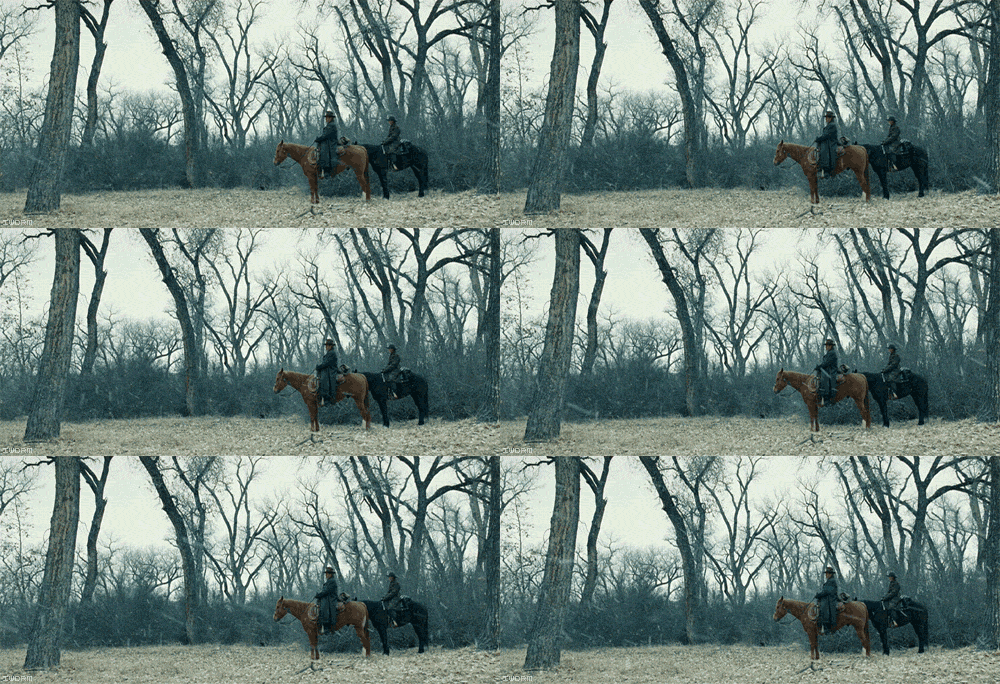
Verbinski's The Lone Ranger on the left; Ford's The Searchers on the right

But it seems like Nature isn't the only one with the problem. The Lone Ranger is a Western out of balance, tipping from side to side and waving its arms frantically while standing on a line between olde Westerns and the post-modern varieties, with full-stops at the Leone era** and the silent era of comedic Westerns, specifically Buster Keaton's The General (not technically a Western, but go with me here) in the film's final bursts of energy. The movie veers from queasy nastiness to whimsy to outright comedy and slapstick, without taking a break for water. The villains are played absolutely straight, from Tom Wilkinson's rail baron to his nasty co-hort, Butch Cavendish (a greasily unrecognizable David Fichtner), while the heroes are bumblers with good intentions, like Armie Hammer's rube of a Ranger,*** and top-billed (above the character and movie title) Johnny Depp's bizarre take on Tonto—well, it's bizarre for Tonto, but not for Depp, as this "Indian companion" would line up well with his other pasty-faced odd-balls like Edward Scissorhands and Barnabas Collins. And, in action, his Tonto acts more like the Sam character in Benny & Joon, there's some Chaplin, but a lot of Buster Keaton in his stone-faced, article-challenged Tonto (the make-up for which is inspired by a painting by Kirby Sattler entitled "I Am Crow," which is neither authentic or historically accurate, but it looks distinctive, which suits Depp's purposes, I suppose). 
The movie runs on two parallel tracks of revenge—the Ranger, John Reid's, and Tonto's—as the two end up joining forces to deal with the guys who ambushed the Ranger's brother and posse, and the guys who wiped out Tonto's village, for which he feels responsible. It's a little late in the game to plead weariness of the revenge scenario—it seems like every movie hero has to have a personal grudge as a pilot light, rather than to "do what they gotta do" through some sense of altruism. Possibly that heroic quality is passé or considered foolish in today's culture, or maybe there's no sense of audience involvement if it isn't seen why the protagonists stand up for what's right.
But, it spends most of its running time moseying through origin stories and the whittling away at the uneasy alliance between Reid and Tonto. Then, once things get going, there's an extended chase sequence featuring the two trains involved in the driving of the golden spike uniting the nation's railways, an "Indiana Jones" type of marathon that explores everything that you can possibly do with two trains running on occasionally parallel tracks (when did they find time to lay all that extra track, one wonders?). The sequence would make the silent comedians gape, and propelled by variations of "The William Tell Overture," provides a lot of entertainment.  It's fun for quite awhile and Verbinski constructs some Rube Goldbergian scenarios that are, once or twice, ingenious.
But, instead of coming at the nick of time, it comes a might too late.  The focus there at the end comes after a lot of wandering aimlessly through the desert, looking for something to do. Granted, its not as dull as the 80's attempt to put the spurs to the franchise, and in parts its entertaining, if one isn't looking for native axes to grind**** or is approaching the material with an already jaundiced eye. One wonders if it was worth doing, or whether "The Lone Ranger" should be allowed to pass into legend, a relic of the thrilling days of yesteryear.


My favorite appearance of Clayton Moore and Jay Silverheels as
The Lone Ranger and Tonto.
Kind of reminds me of how the movie plays them.*****

* Yeah, but one can see that as a strain running through Verbinski's work, especially considering the "Pirates" movies and Rango, where folks are coming back from the dead, or at least the crossing back from whatever spirit-world seems to fit the project.

** Composer Hans Zimmer does a lot of riffing off Ennio Morricone, the most notes taken from For a Few Dollars More (with its tinkling chime contrasting with a heavy-handed forward momentum theme), but also in the comedic grace notes that follow Tonto's shenanigans with a punctuating trill that Leone used for Eastwood's "Man with No Name" in A Fistful of Dollars.


*** Hammer is introduced like Jimmy Stewart's Ransom Stoddard in The Man Who Shot Liberty Valance, the "duded" pilgrim who stands out far too much in the rough West, in a suit so formal he's mistaken for a missionary...by a missionary. It's one of his better performances, showing that he's at his best, comedically, despite (and maybe because of) his blandly handsome looks, in a way that's similar to Cary Elwes. 


**** Most of the talk is focused on Depp and his "white-face" portrayal of Tonto and how authentic it is (not very), which with the existing suspicions people have of the character as demeaned and inferior, has been mostly negative, because, like skin color, its very easy to see and remark upon with what one thinks of as authority. One wonders if such a rehabilitation is possible, given the character's man-servant past, like Robinson Crusoe's "Friday," or The Green Hornet's "Kato" (although it certainly helped if Bruce Lee was in the role, bringing the character up several notches just on ability and charisma—should we mention that Brit "The Green Hornet" Reid is a descendant of The Lone Ranger?), and whether its even worth it to right the past's wrongs. The alternative is to stay in place, and be content—although grousing—with the way things were and just leave it aside.  I think it says something that Depp thought Tonto was the more interesting character to play, as for authentic...is anything Depp does very authentic?  Short answer: No. As for the whole racial thing, I thought the best line was Depp's Tonto griping about the ranger being a "stupid white man," and the Chinese railroad workers grinning and nodding in agreement at him—he's just another American...to them. Now, that's some funny ethnic humor there.


**** It also is inherently racist as it paints Tonto in a bad light, obviously Natives are gluttonous. (*cough*)

Thursday, November 3, 2016

Casino Jack

"The Be$t Government Money Can Buy"
or
"Jack Abramoff (and for my money you can leave out the Abram)"

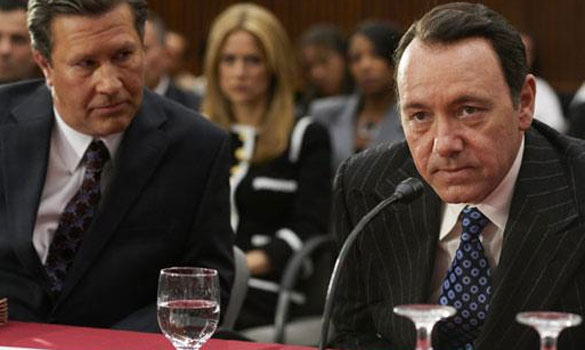
Despite what "The Last Word" at the bottom of the page says, I don't find bad reviews fun to write or to read.  It pains me to admit failure...even if it's someone else's. This one pains me a lot, because it seems like such a slam-dunk—a comedy on the rise and downfall of Washington's most powerful lobbyist, Jack Abramoff, played here by Kevin Spacey in a tour de force of excessive grand-standing. That the film-maker who made it died just before it opened (and that he previously made some things I admire) makes a bad notice that much more greivous to write. That I'm sympathetic with the political views espoused makes it more so.

But to these eager liberal eyes Casino Jack is a hack-job, rather than, say, a sure bet.  Frankly, if you want the story told better, turn to the documentary Casino Jack and The United States of Money, which is a more thorough, even-handed and truthful account (because it's all real footage of these beasts proudly exhorting their dirty deeds) of the shameless fleecing of America and the flagrant influence-peddling of an all-too-willing Congress.*
Film-maker George Hickenlooper—who died in 2010 before the film premiered—and his screenwriter Norman Snider want to make a Dr. Strangelove-type condemnation of the black-as-pitch corruption that Abramoff and his cronies espoused in the name of idealism, but it comes across as a loud, crass, unfunny version of events with the film-maker pushing our faces into scenes and hectoring "this is funny, right?  Funny?  It's funny!" with all the smug self-satisfaction of a preacher cooking marshmallows over a witch-burning...or a politician taking a bribe. Everything is played brooooooooooad, making Stanley Kramer's It's a Mad, Mad, Mad, Mad World seem subdued and tasteful in comparison.
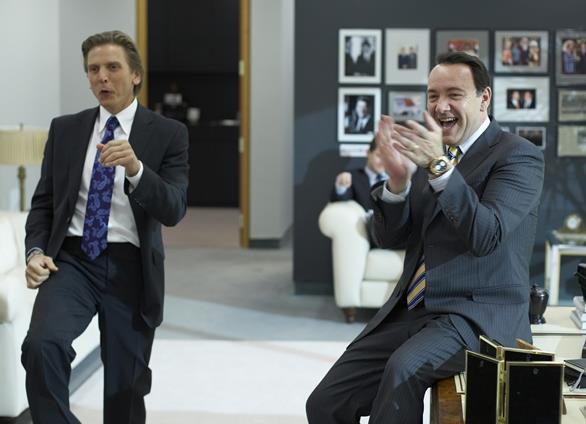
There may be some joy in the pilloring, but the style of film-making and the general volume of the acting makes everything seem obvious and crass (with a capitol "K" street) that the feeling of contempt comes early and stays long past the party is over. Barry Pepper is all caricature as Abramoff's right hand-biter, and Spacey does enough bad impressions of his good impressions that the habit becomes tiresome and annoying. I'll bet he and Jon Lovitz yelled "Act-ing!!" after each one of their takes—there can't have been many from the looks of it—and then giggled like it was actually amusing. It's easy to make fun of wretched excess, and especially hypocritical wretched excess, but the film-makers went overboard with the caricaturish, smirking portrayals of everything and it sinks the picture. They could have played it absolutely straight, and the high-handed antics of these high-ideal crooks would have provided plenty of  spit-takes and sputtering indignation.
But, they had to have "fun" with it, beating any subtlety into the tarmac or marble-flooring. The result is not fun, and only marginally frown-cracking at times.  Good satire has to have an element of cold-blooded revenge to it, with an element of horror in the subject matter, rather than in how it is presented.  Casino Jack goes for the easy-sucker bet, and still comes up craps.  


* Interestingly, the film-maker's earliest credit was the great "making of" documentary Hearts of Darkness, about the ordeal of filming Apocalypse Now...in a reverse of the "truth is stranger than fiction" aspect of the Abramoff story, the true story of Francis Ford Coppola's VietNam epic has more of the tone and feel of Joseph Conrad's "Heart of Darkness" than any of the adaptations (Coppola's and Nicolas Roeg's) made from the source—a lesson this film-maker might have heeded.  Hickenlooper also made such interesting films as the original short of Sling Blade, The Man from Elysian Fields, Mayor of the Sunset Strip, Factory Girl, and was the only one in Hollywood with balls enough to make a film of Orson Welles' last screenplay, the political satire The Big Brass Ring.  Sad to go out on this which such past work as his legacy.