Showing posts with label Classic. Show all posts

Tuesday, March 8, 2022

Anna Karenina (2012)

Struggling with writing a review of Cyrano, the latest from director Joe Wright. So, in the meantime, here are a couple reviews from his past work that I haven't put up yet.

Written at the time of the film's release...
 
Artificial Intelligence
or
Anna! Karenina! The! Musical!

Tolstoy's "Anna Karenina" is considered by many the greatest novel ever written, and has been adapted so many times (two of them starring Greta Garbo!), one is tempted to name any version "The Last Remake of Anna Karenina." So, the task for director Joe Wright and scripter Tom Stoppard must have seemed daunting, or as one of Zsa Zsa Gabor's later husbands stated it: "You know what you have to do, you just have to find a way of making it interesting."

Well, this one is interesting, alright. And it hues closely to Tolstoy's novel in the way that a CliffsNotes Edition sticks close. All the plot points are there, the characters whittled down to their bare essences, or eliminated altogether, and breezily delivered in a theatrical manner, save some significant exceptions. Truth is, Wright makes this version of Anna Karenina the way Baz Luhrmann would, as a grand, operatic experience staged in an extraordinarily choreographed with the emphasis on the "arch" (as in "playfully and affectedly roguish") in Proscenium Arch.
Jim Emerson had a fascinating article* (based around Skyfall) on his "Scanners" blog on the difference between a "theatrical" film and a theatrical film and its use of space as defined by the limitations of the frame and a stage directors' tendency to reflect that frame with its own limitations resembling the dimensions of a stage. 
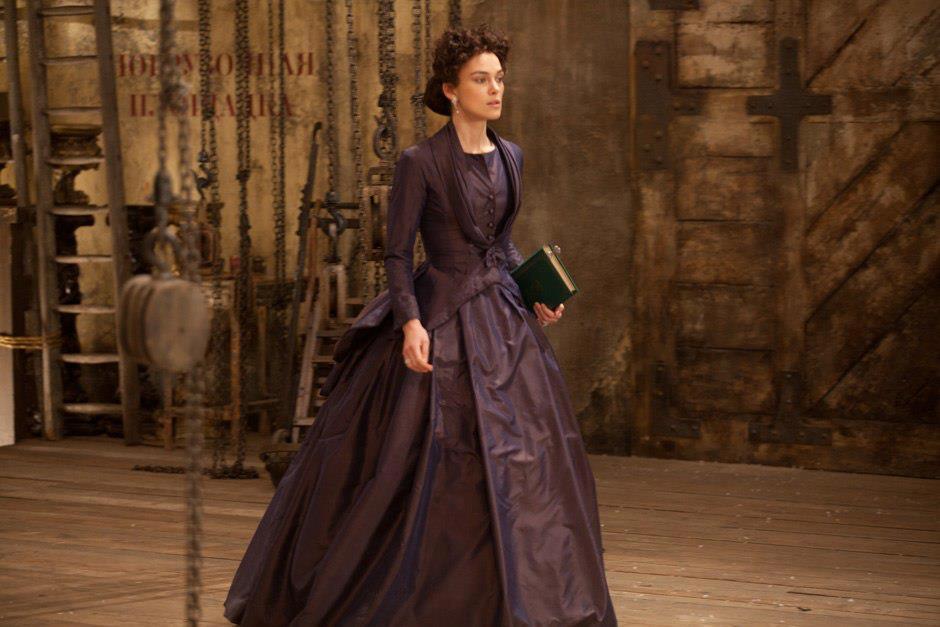
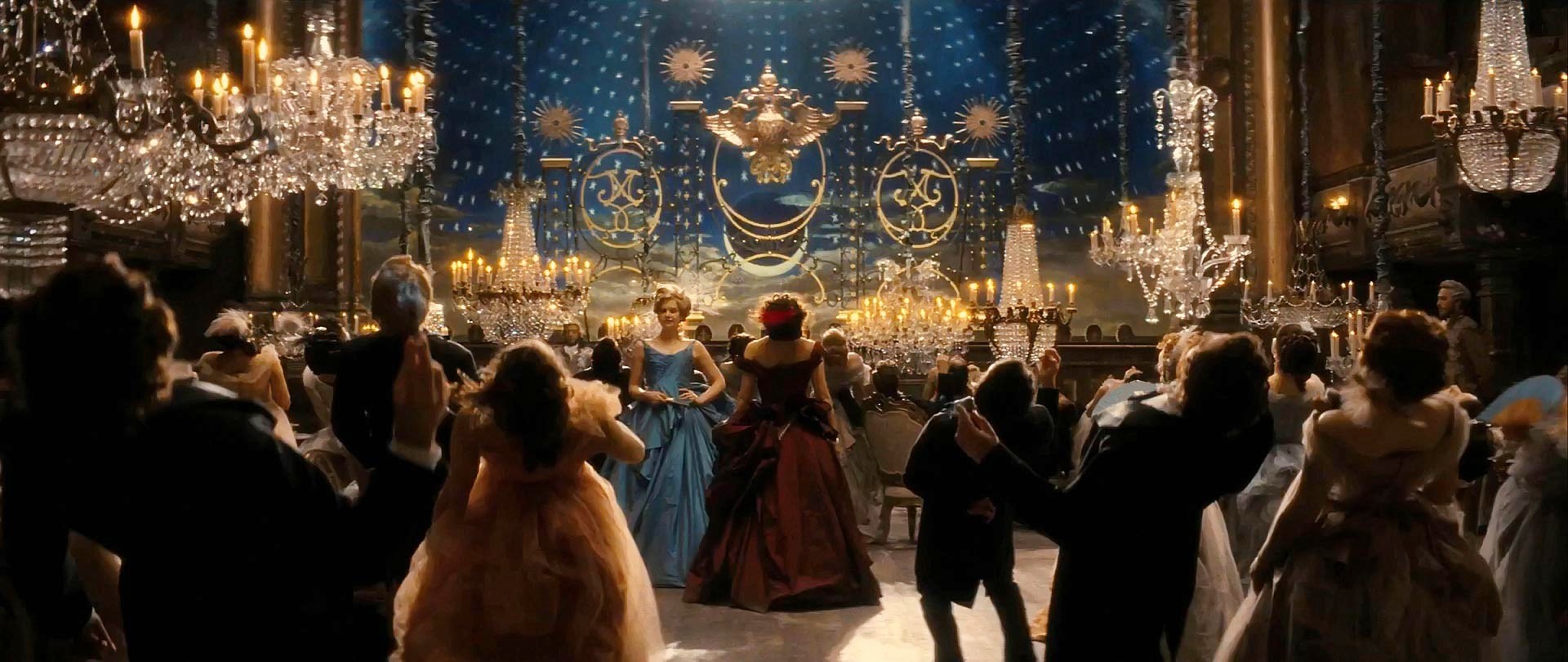
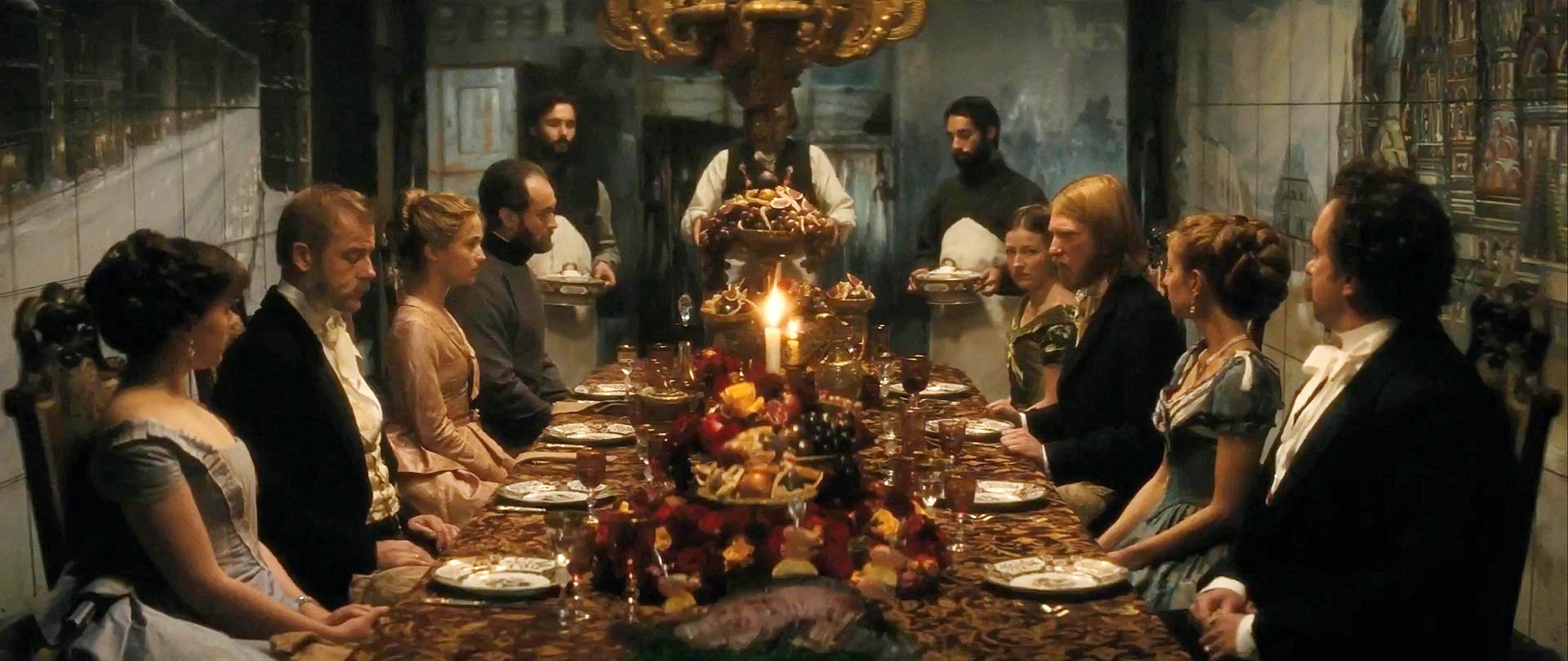
Wright fully embraces that concept and goes further; for the main story of the hoi-polloi and their social and political gamesmanship, all of the action takes place within the false spaces of a theater (at times even using the rafters as locations for traditional street-scenes): train and carriage scenes are decidedly set-bound with no effort made to reflect a "real" world outside the windows; transitions are made "in-camera" without editing, so a very stagy and choreographed bureaucratic work set-up with synchronized rubbing stamping (set to Dario Marianelli's interesting score) segues to a restaurant scene by merely having the "extras" trade in their black business suits for waiter-whites; a formal society ball is not an intricate commingling of dancers that Wright so effectively engineered in Pride and Prejudice, but is an elaborate ballet, where the participants barely touch and their hand movements are intricately swanning in nothing that approaches a traditional dance (at times, to keep track of the principals, the foreground dancers in our field of vision "freeze" to better make out the focus of our attention). Like Francis Ford Coppola's set-bound version of Bram Stoker's Dracula
, It's all very elaborate, "stagey," false, and at times clever but, a lot of the time, merely "showy," like a musical with no libretto, something to separate this "Anna" from the more realistic, even if filmed in-studio, versions. 
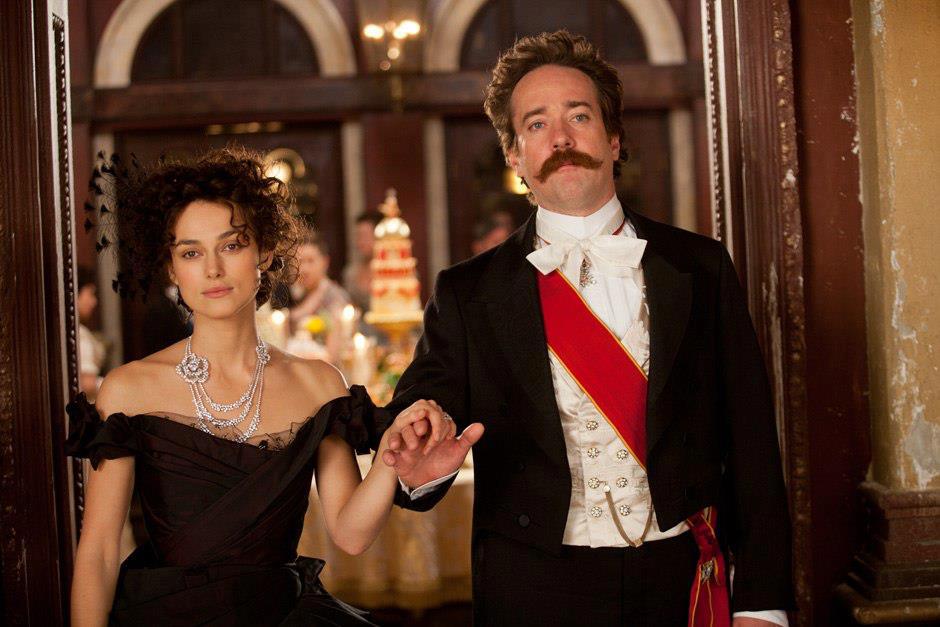
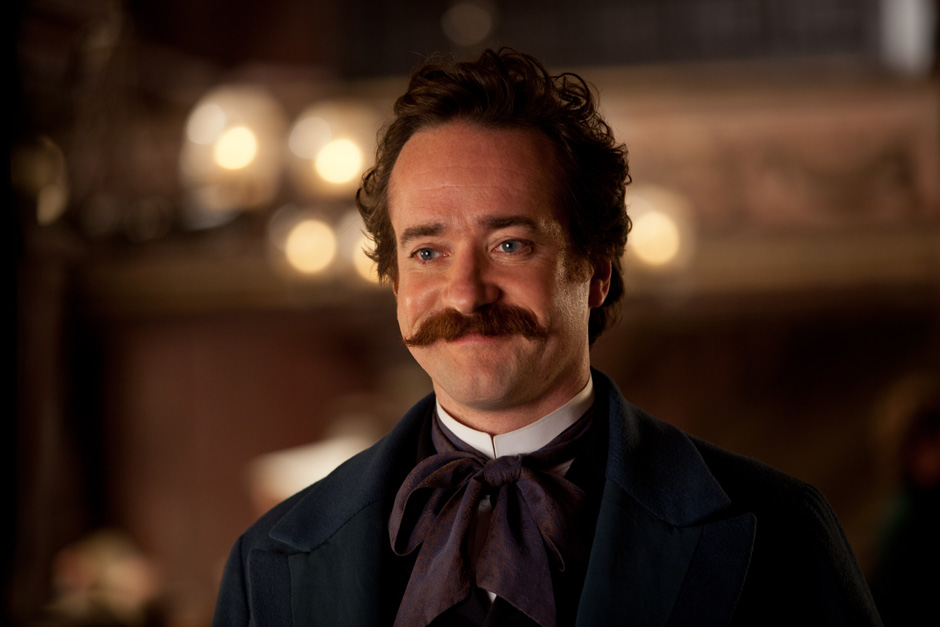
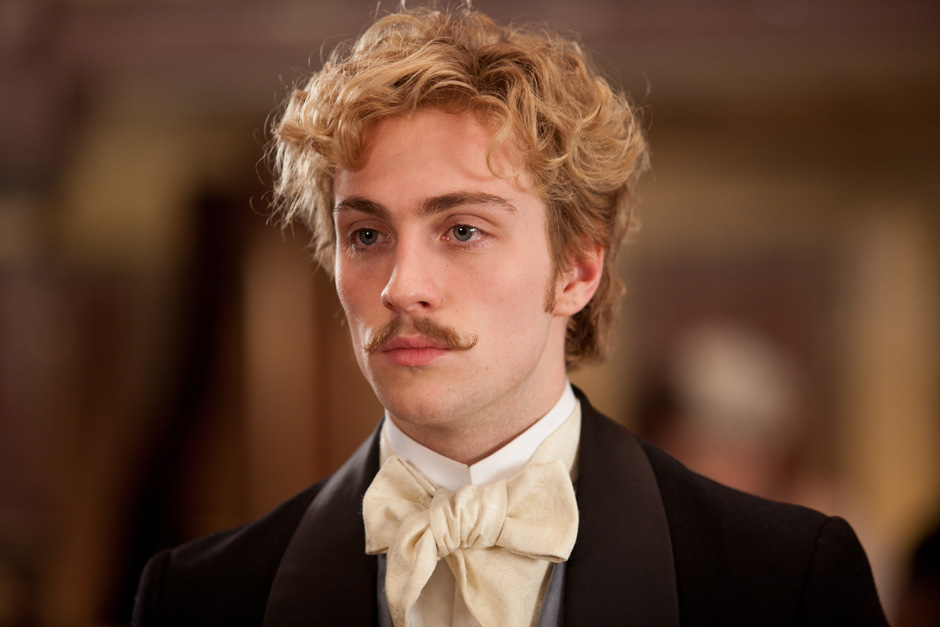
The performances run that way, too. Keira Knightley is an exasperating Anna, conflicted but fatally committed to fully expressing whatever is on the surface of her heart. Her P & P co-star, Matthew McFadyen is a burlesque cousin Oblonsky, fatuously showy in a way that reminds of Kevin Kline performing a burlesque role. Jude Law—not one of my favorite performers—here is exceptional as Anna's cuckolded husband, and is so restrained and non-theatrical, that it sets him apart from almost every other performer, isolating him, and is a good short-hand way of showing why Anna might be dissatisfied with him. Olivia Williams has a small part as the Countess Vronsky, whose son (Aaron Taylor-Johnson) is the very florid object of fascination for Anna.
Anna (Keira Knightley) runs from Vronsky at the Ball
and experiences a little fore-lightening from an approaching train.

It's dangerous in a Joe Wright theater.

But, almost the entire film is deliriously fascinated with the artificiality that it undercuts the very real passion and consequences of actions of the people in the film, reducing them to "players" as opposed to human beings.

I say "almost" because Wright does change things up to "open up" the segments featuring Levin (Domhnall Gleeson) and Kitty (Alicia Vikander), who already have their disappointing encounter with Vronsky and move on. When they reunite, their segments are set in a real world of sky, clouds and fields befitting the couple who exemplify wisdom, forbearance and patience. Wright puts them in our world, relegating the others to an artificial world that is essentially stage-managed (even at the end with a coda of Karenin and the remains of his family, it is contained in the stage-world that Wright has chosen to house his film.
It's different, even interesting in an oddly disrespectful manner, as the flightiness of the bourgeoisie and their concerns are merely shadow-play and window-dressing—it is true to an extent—but by pushing the metaphor so aggressively, it undercuts any feeling one has for the players in the majority of the film itself, and reveals itself as resembling the tut-tutting of the hypocrites who turn against Anna. I'm not sure that Tolstoy had that intention (even strained through Stoppard), and this film might have benefited  from a less facile presentation that required less stage-craft and something more resembling (I don't know) empathy?

Wednesday, November 3, 2021

The Three Musketeers (1948)

The Three Musketeers (George Sidney, 1948) Every few years, a new generation has to put their imprint on Alexander Dumas' adventure tale on the chicaneries and hidden agendas during the rule of King Louis XIII and Cardinal Richelieu, when it seems everyone was challenging the rule of theocracy masquerading as monarchy.  Every time, a group of four actors can be found to collaborate rather than hog the show, a new version is produced and a different spin is put on the first part of the d'Artagnan Romances, telling of a sword-skilled Gascony bumpkin who goes to Paris to join the King's Musketeers of the Guard—knights on the cusp of a new technology who prefer their battles to be sharp and personal—and learns the ways of the world in love, loss, and politics and how they all cross swords.

My favorite version is still Richard Lester's one-and-a-half film epic The Three Musketeers: The Queen's Diamonds and The Four Musketeers: Milady's Revenge for their bawdy humor, down and dirty sword fights and occasional stunt-casting, breezily written by George MacDonald Fraser, lovingly photographed by David Watkin, and (for the first one) cheekily scored by Michele LeGrand in his mock heroic style.
"Gotta swashbuckle!"

But there have been so many others, going back to the silent era. One of the oddest, despite being a fairly straight adaptation is the Technicolor M-G-M version from 1948, starring Gene Kelly as d'Artagnan, high in the step and long in the tooth, where the fights are choreographed more as dance in natural settings.  All movie fights are choreographed to some extent, but the '48 version of "3M" has a particularly dancerly feel with Kelly.  There's a "lark" aspect to the whole thing, with a winking feel as if to say "isn't this all preposterous?" It feels even more so in Kelly's love scenes with June Allyson playing Constance, confidante to the Queen (Angela Lansbury) and daughter (in this one) of his landlord. Their scenes have a campy, artificial leaning, layered over with a version of Tchaikovsky's "Romeo and Juliet" theme, which was probably a cliche for love in '48. It makes any emotional investment in the romance so much embarrassing vapor.
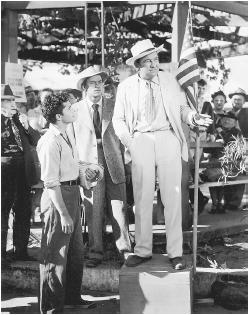
Impressive cast, though, with Lana Turner top-lined (probably to assuage her fears that it was a secondary role) as the villanous Milady deWinter, Vincent Price is finely oily as Prime Minister Richelieu (evidently he was defrocked for the film, owing to pressure from the Catholic Church), Van Heflin a good, but not great Athos, Gig Young as Porthos, and Keenan Wynn providing comedy as d'Artagnan's servant Planchet.

And it has one scene that makes the highlight reels—Kelly's tribute to Douglas Fairbanks, vaulting over (M-G-M stage) French roof-tops to rescue his lady-love. It's nicely staged athleticism, marking a sharp contrast to the play-acting of the rest of the film.

Tuesday, August 15, 2017

The Wages of Fear

The Wages of Fear  (Henri-Georges Clouzot, 1952) Some movies are so good they defy time, place and stay universally fresh, seemingly like they were made yesterday. Clouzot's The Wages of Fear is that kind of movie, and I would call it the best film of 2007 if it was released today instead of 1952. It tells the story of four vagrants (played by Yves Montand, Charles Vanel, Folco Lulli, and Peter Van Eyck) scratching out a living in a remote South American village existing in the shadow (and under the thumb) of an American oil company. 

One of their distant oil rigs goes up in flames, and these four are hired to drive two trucks of nitro-glycerin over unforgiving roads to the inferno to snuff it out. Why take on this task? The answer is simple: $2,000 per man--enough money for each to fly out and make a new life. Why these particular four? They're not union workers, for one thing, and should they die—and the odds are fifty/fifty (hence the two trucks)—they have no families who might sue or require compensation for their loss.
It's a neat little corporate trap, with a limited financial freedom as the prize, and that doesn't cover the obstacles that Nature (and uncaring road-workers!) have along the way. All these desperate times call for desperate measures and the efforts taken can be undone in the blink of an eye, or a flash of fire. For the four, the journey strips them down to their real selves, all pretense and masks disappear in the face of impossible challenges that must be overcome, with the looming threat of annihilation riding behind them. The wages of fear may be death, but The Wages of Fear is a bleak metaphor for life itself.
All of this is played out over a blasted landscape, the results of the presence of Big Oil, and the journey feels like going back through time as well as space, through the spare white jail-bars of a denuded forest, back to the primordial ooze and finally ending up in Hell. By the end one can't help wonder if the fate of Nature and the nature of Fate are intertwined. Except for one fairly amateurish performance this is a near-perfect movie.

Friday, November 4, 2016

All the King's Men (1948)

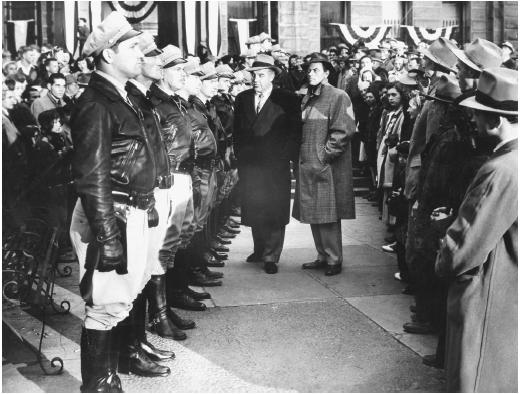
All the King's Men (Robert Rossen, 1948) The Oscar-winner for Best Picture of 1949 and it's hard to argue. Rossen's adaptation of Robert Penn Warren's Pulitzer Prize-winning novel about the corrupting powers of politics, it boasts two powerful (and Oscar-winning) performances: Broderick Crawford as innocent-turned-player Willie Stark (an amalgam of several politicians—as the corruption of power is a fairly universal theme in both the arts and reality—but mostly resembling Huey Long) and Mercedes McCambridge as his cynical-to-the-marrow political assistant.  

McCambridge is so good and so inventive that she might just as well have been given the statue for the next five years. Would that the other performances have been as electric as these two, but one could say that they shine even more brightly next to the lesser lights. 
It's particularly interesting to see Crawford so restrained at the beginning of the film, but once he sees how the game is played he turns on the after-burners and soars over everybody else in the frame with him. Mention should be made of the occasional glimpses of a documentary style in the rally scenes amid the more traditionally blocked studio framing. 
And an interesting stylistic note: the film may seem a bit abrupt in places--but that's because Rossen, determined to get the film below two hours, gave his editor instructions to take most of the scenes and cut precisely thirty seconds from the front of them and thirty seconds from the back (making sure not to clip off any dialogue). What was left was the hard nugget of the scene's core and All the King's Men feels more brutal in its pace and attitude because of this uncompromising strategy. It is a must-see film that shows the dichotomy of the American political system—of appealing to the little guy while also seeking power enough to be able to stand on their necks.
The film was re-made in 2006, with a mind to including the parts that couldn't be utilized in Warren's novel in the more repressed times when the original was made, but ended up looking bloated and shrill. The more soapish aspects of the novel were eliminated from the adaptation of the first film and it has the unanticipated benefit of focusing the film on its larger theme of political corruption and less on human corruption, and, as a result, gives the film a harder, more dangerous edge. Rossen's work is so much more assured and vibrant.