Sunday, February 6, 2022

Don't Make a Scene: Lost in America

The Story: Mansplaining. Oooh. Let's start off Valentine Month with that.

IF you didn't know, the term "mansplaining" has been around since 2008, and, in 2010, The New York Times designated it one of its "Words of the Year." "The Oxford" gives the definition:
"the explanation of something by a man, typically to a woman, in a manner regarded as condescending or patronizing"
...which is described in such a way as to be its own illustration in the dictionary. Here's another example—approximately one-third of every episode of "I Love Lucy" was "mansplaining."
 
Fully 100% of these little "The Story" bits in Every Sunday Scene feature is "mansplaining." (Well, certainly this one is).
 
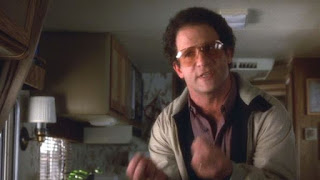
In this scene, David finally "just bursts" after Nancy blows their $100,000 savings on a bad run at the roulette wheel. It is uncomfortable (but not as uncomfortable as the scripted argument is—see below) and is dominated by a David rant that is hysterical and funny and manic—David swings between manic and depressive, and, in fact, their decision to "drop out" has come from his own panic attack before moving into a new house. 
 
It's funny because there's no perspective here. The two have the opportunity to drop out because of their own success. People living paycheck to paycheck don't even consider the move unless they are so desperate they are forced to live in their car, or wander gypsy-like from mobile park to mobile park (I amuse myself sometimes to think what would have happened if the Frances McDormand character in Nomadland had run into the Howards later in life—but, of course, that wouldn't have happened because the Howards barely made it a week in a Winnebago and went back to their past lives because they wanted the romanticism of Easy Rider without the austerity of it—good God, they're in a new Winnebago, for god's sake, not even motorcycles).
 
It just shows what can happen if you believe movies too much—so much of it is myth-making (and manipulative myth-making at that) that (if you WANT to believe it) you can actually believe it might be true. And that goes for television and even so-called "reality" shows (Johnny Carson used to joke that he couldn't get into the "Survivor" series because he knew that just off-camera there was an assistant director with a half-eaten cruller in his hand—so much for privation...and it's why so many people see Donald Trump as competent after watching "The Apprentice"*—and, by the way, "release the out-takes, Burnett").
 
Some might see this scene as male toxicity. I don't. David is so pathetic, one can only see him as funny—he is, after all, the one who got them into this stupid mess, and probably inspired Nancy to "take chances." It IS his fault. And now he's having a tantrum because he is, after all, a child. And so's she. Responsibility makes them both nauseous. It is only when they see that their original life could have been much worse, do they see how good it was and they then go back to it after the biggest detour they've ever taken.
 
The one to reality.
   
The Set-Up: Spurred by the purchase of a new home, upwardly-mobile couple David and Nancy Howard (Albert Brooks, Julie Hagerty) have, instead, "pulled a lateral" and "dropped out" "like in Easy Rider" in order to "touch Indians, see the mountains and the plains and all the things in the song." They get as far as Las Vegas where their liquidated assets are vaporized by Nancy's nighttime binge at a roulette table. Now, at Hoover Dam, after an extended period of passive aggressive silent treatment from David, the two "have it out."

Action!

34 EXT. SIDE OF ROAD - HOOVER DAM VISITOR AREA 
DAVID Where are you going?
NANCY Please come inside?
DAVID What is it? 
NANCY Sit down.
DAVID What is it?
NANCY Just sit down. Now, listen...
NANCY I apologize from the bottom of my heart. I'll make it up to you. 
NANCY I'll make you breakfast in bed for life.
DAVID No, stay away from the food—you'll lose it. 
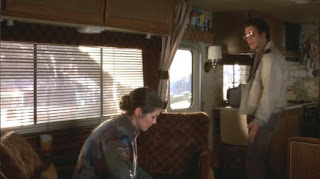
DAVID I just want to know how this happened. I, I can't understand it. How did it happen?
NANCY I don't know; 
NANCY I just held things in for so long, I just burst.
DAVID What did you hold in? What were you holding in?
NANCY Everything. 
NANCY Listen, you know, you weren't the only one whose life wasn't satisfying. I sat in that office for seven years without a window. Sometimes I felt like I was going crazy.
DAVID Why didn't you wake me up? Why didn't you tap me on the shoulder and say "I think I'm having this problem. Is it okay if I go down and lose everything?" Then I could have helped. Maybe I could have said no. 
DAVID I'm sure the Desert Inn has an all-night shrink service along with a spa facility, don't they? 
DAVID Don't you think someone could have counseled us? He would have said, "Look..."
DAVID "...she's gotta let it go somehow. Why don't you spend $10,000 and rent the Goodyear blimp, and then it will fly around and flash positive things." Much cheaper, same result! 
DAVID Why didn't you wake me up? We could have discussed this.
NANCY I didn't understand it until now.
DAVID Oh, great, okay. Well...
DAVID ...congratulations, I'm glad. I mean I'm glad you understand everything. Unfortunately, I'm still screwed up! And we don't have the money to fix me. You're fixed! And now we have like, you know, a couple hundred for me. A hundred thousand for you, a hundred for me. I think I was sicker than you to begin with! 
DAVID Oh, God
DAVID I guess this was my fault. That's what I'm thinking. Maybe I just didn't explain the nest egg well enough. If you had understood—you know, it's a very sacred thing, the nest egg. And if you had understood the nest-egg principle—as we will now call it in the first of many lectures that you will have to get, 
DAVID ...because if we are to acquire another nest egg, we both have to understand what it means. 
DAVID The egg is a protector, like a god, and we sit under the nest egg and we are protected by it. Without it—no protection. Want me to go on? It pours rain. Hey, the rain drops on the egg and falls off the side. Without the egg? Wet! It's over. 
DAVID But you didn't understand it, and that's why we're where we are.
NANCY I understood the nest egg.
DAVID Please do me a favor. Don't use the word. You may not use that word! It's off-limits to you. 
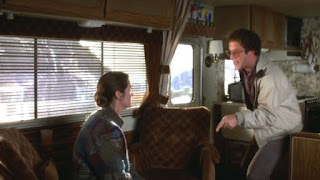
DAVID Only those in this house who understand nest egg may use it. And... 
DAVID ...don't use any part of it, either. Don't use nest, don't use egg. If you're out in the forest, you can point: "That bird lives in a round stick." And, and, you have things over-easy with toast. 
DAVID Oh, gee, 
DAVID ...you know what I'd like to do? I'd like to give you a small punishment before lunch, and I'd like you to write 1,000 times on the pavement: I LOST THE NEST EGG. Come on, "I lost the nest egg"—say it, say it 500 times. 
DAVID "I lost the nest egg. I lost the nest egg. I lost the nest egg. I lost the nest egg. I'm startin' it for you...
DAVID ...you jump in anywhere. I lost the nest egg. I lost the nest egg. I lost the nest egg. I lost the nest egg."
DAVID "I lost the nest egg!"
NANCY Shut up with the nest egg!! 
NANCY And let me tell you something. That's not how you drop out, anyway. 
NANCY If you're really going to drop out, you drop out with nothing.
[She leaves the Winnebago.]
DAVID Oh, you do? 
DAVID Well, where did you read that? The Las Vegas Guide?
NANCY I didn't read it. Friends told me—people who know!
DAVID You don't know anybody who knows. You don't know anybody who ever dropped out, except for us. What are you talking about?
NANCY Alright! Alright! Well, the movie you're basing your whole life on, "Easy Rider," they had nothing. They had no...
NANCY ...nest egg. 
DAVID Bullshit. They had a giant nest egg. They had all this cocaine.
NANCY That's not true. 
DAVID It is true! 
DAVID Linda. They sold cocaine. Okay, wait a second! Wait, wait, wait, wait, wait, wait.
[They both stop.]
DAVID I'm not going to stand here, in front of one of the great wonders of the world and argue about an old movie. 
DAVID I'll go back inside. If you can figure out some plan to make eight hundred bucks last a lifetime, 
DAVID ...
knock on the door. I'll be in there.
[David turns around and walks towards the motor home.]
 
 
Words by Albert Brooks and Monica Mcgowan Johnson
 
 
Lost in America is available on DVD and Blu-Ray from Warner Home Video.


Here is the scripted version of this scene:
 
NANCY I don't want to have an argument in front of those people. 
DAVID Why not? I think those people are entitled to know how stupid you are. 
NANCY This is going to turn into a personal attack, isn't it? 
DAVID What else? A general attack? Who am I going to attack? Nevada? I can't attack the state. It wasn't their fault. I can't attack the motor home. It stayed in the parking lot. I can't attack me. I was fast asleep. By process of elimination, who's left? 
NANCY I am. I'm left, okay? And I'll say it one more time - I'm sorry. 
They are off by themselves now. They have reasonable privacy. They are both very upset. 
DAVID I don't want your apologies. I want to know why? I want to try to understand how it happened. Tell me. How did it happen? 
NANCY I couldn't sleep. 
DAVID You couldn't sleep. I see. Now, I remember nights where I couldn't sleep. I'm just trying to think what I did. Let's see. I tried warm milk or I took a long walk or I took Nytol and then, if all that didn't work, I gave away all the money I ever earned. But you didn't try any of those things first. You just gave away the money first, right? What did you intend to do? Have warm milk afterwards? Tell me. I'm mixed up. 
NANCY You're not even listening. 
DAVID I'm sorry. You're right. Go ahead. You couldn't sleep. Then what happened? 
NANCY I don't remember. I just went downstairs. 
DAVID Why didn't you wake me up? 
NANCY What would you have done? 
DAVID What would I have done? I would have followed you. I would've seen you. I would have watched you take your money and begin to lose it and I would have stopped you at thirty dollars, maybe thirty-two dollars, at the most. I would have said, "Sweetheart, come back to bed. We don't want to fool with our nest egg." You know, Nancy, I think you just considered nest egg to be a term but to me, it was a key to this whole experiment. Why, I considered it like a third person. It was our best friend, our guardian angel. It was going to allow us to do everything we wanted to do. It was going to watch over us during bad times and laugh with us during good times. It was going to help us roam and purchase and eat and explore. It was going to help us make love and laugh and cry and now, it's gone and who's got it? The Desert Inn! They've got our nest egg. They can sure use it, can't they? They don't have their own. They're a poor little organization. They need our nest egg. Gee, I hope they use it wisely. I know someday those mirrors are going to have to be reflocked and the red velvet was looking kind of worn. And those little heart beds are going to need new sheets. I'm glad we could help them pay for that. I'm glad our life savings will go towards making that room look a little prettier. I'm glad we gave it all to them, Nancy. I'm just going to miss the little nest egg, that's all. Won't you, sweetheart? Won't you miss the nest egg? In the middle of the night, won't you feel kind of lonely because little nest egg is paying for the gas in Frank Sinatra's limo? 
NANCY Shut up, David! (begins to cry; she's getting hysterical) Shut up! I don't want to hear nest egg anymore! I don't want to hear that word. Let me tell you something. That's not the way you drop out anyway. If you're really going to drop out, you drop out with nothing! 
DAVID You drop out with nothing? Oh where did you read that? In the Las Vegas Guide? 
NANCY I didn't read that. I know that. 
DAVID Oh, I see. Who told you? 
NANCY Friends, people who know. I don't have to answer you. 
DAVID No. You don't have to answer me. You can't answer me because no one ever told you that. You never had friends who dropped out. You don't know anybody who dropped out except for us. So how the hell did you know that? Come on, tell me? 
NANCY Alright. The movie you're basing your whole life on, "Easy Rider," they dropped out with nothing. They had no nest egg. 
DAVID Bullshit. They had a huge nest egg. They sold cocaine. They didn't get on their motorcycles till their nest egg was giant, fifty times the size of ours. 
NANCY That's not true. 
DAVID Oh, look. I'm not going to stand here, in front of one of the seven wonders of the world and argue about an old movie. I'm going to go now and get back in the motor home and maybe you can wander around out here and figure out something to do. We have eight hundred dollars left and an entire lifetime. See what you can come up with. 
David starts to walk away. 
NANCY We could sell cocaine. 
DAVID (stops and turns around) Well, my God. Why didn't I think of that? Great idea. As a matter- of-fact, I remember after seeing "Midnight Express" I went out of the theater saying to myself, "That's for me. Sex with hundreds of Turkish men." 
David turns around and walks towards the motor home.
 
* Trump initially didn't want to do "The Apprentice" as he thought reality television was "for the bottom-feeders of society." I can see chests swelling with pride over THAT statement. To me, it sounds like a mission statement.

Saturday, February 5, 2022

The Current War: Director's Cut

Written (really) at the time of the film's eventual release.

Saturday is traditionally "Take Out the Trash" Day...


AC/DC
or
Bringing It All to Light

The Current War was produced in 2017 and finally released—to theaters—in late 2019 (after premiering with a different cut at the Toronto International Film Festival in September, 2017). The script had been acquired by The Weinstein Company (after appearing on the legendary store-house of interesting but unproduced screenplays "The Blacklist"), and filmed, executive produced by Martin Scorsese and Steve Zaillian

Then, people finally paid attention to Harvey Weinstein's behavior, and the film, which had a lukewarm reception at the festival, was shelved and sold in the midst of TWC's implosion. Pulling strings with his final cut contract, director Alfonso Gomez-Rejon ordered re-shoots and did some trimming before the film was finally released to theaters in 2019.
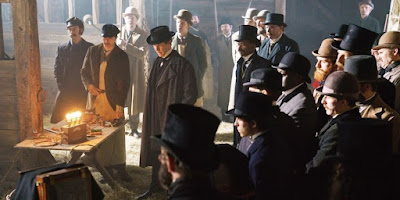
In what might be called its thesis statement, the film begins with top-hatted businessmen walking in the dark through the woods to a clearing, at which point they are blinded by a circle of light that appears magically before them, composed of many singular light bulbs piercing the darkness. From the center of the array walks Thomas Edison (Benedict Cumberbatch) who greets them with "I hope you brought your check-books." He'll need it. For Edison's plan isn't merely the use of light-bulbs, but the invention of something that no one has heard of—the electrical grid. Edison's Big Idea is to create a network of generators—that he'll own—generating direct current to cities and neighborhoods. But, given DC's limited range he's going to have to make a lot of them.
There's money to be made. And where there's money to be made, there is competition. George Westinghouse (Michael Shannon) wants to partner with Edison, but when his overtures are rebuffed, Westinghouse decides to find an alternate system. Alternating Current will travel over greater distances and given its on-again/off-again transmission could be safer and probably cheaper. The two go head-to-head trying to convince local governments to flip the switch, but they're reluctant with two systems in competition.
With the arrival of Nikola Tesla (
Nicholas Hoult) to his employ, Edison thinks he might have an inside track, but Tesla is a mercurial sort and soon bridles at Edison's single-mindedness and leaves, feeling his work is being ignored. He tries to develop his own system, but eventually joins forces with Westinghouse, who has taken his battle to the public.
As every politician knows, the best way to persuade people is with fear. Westinghouse starts a smear campaign claiming that DC is dangerous and should not be allowed in homes. Edison starts to say the same thing about AC and, to prove his point, submits a proposal for a method of execution that is far more humane—the electric chair (despite professing that he would never be a part of weapon development or something destructive to mankind).  When the first use of it sets the prisoner on fire, his reputation is damaged.
The movie sure looks interesting. The director—who's done a lot of second unit work on a lot of good movies—has a slightly cock-eyed way of framing that takes it out of the "vaunted past" look of period films and makes it a bit more surreal. But, despite a terrific cast and some sparks of nice writing, the film doesn't rise above being a more expensive version of one of those "The Inventions That Made America" episodes (but without the teasing before commercials and re-running of footage you've already seen afterwards).
And with all its talk of greatness consisting of what you leave behind, there is more than a little pissing on a live-wire when it shows the blight of a skyline cross-hatched with electrical lines. But, then I don't think the Grid is what it's celebrating: the most moving sequence is when Edison shows off a new invention—a machine that shows hundreds of individual photographs of his late wife that appears to make her move and live again. You spend two hours talking electricity, but ultimately it's about the birth of motion pictures.
 
No wonder Scorsese put his name on it.


Wednesday, February 2, 2022

The Iron Lady

I recently was pulled into a "Meryl Streep Draft" where, like sports brackets, the participants picked what they thought would be the best collection of movies featuring Meryl Streep to win the competition. Weird what film enthusiasts do.

If you want to listen to the podcast where they were selected, it is here.

If you want to vote for me, the ballot is here. If I lose, voting machines will be seized.

Curiously, I did not pick The Iron Lady—I don't think any of us did—although it is Streep's usual competent display (and she won an Oscar—that counts for...something).

Written at the time of the film's release.
 
Keeping Up Appearances
or
"Don't Want to Dig Around Too Much, M'. You Don't Know What You Might Find."

The Weinstein's last bid in 2011 to win an audience of Anglophiles seems a trifle desperate and might be a bit too early to give the subject proper justice, like Oliver Stone's Nixon or W.we're still too close to the Thatcher years to have any sort of perspective, other than a cursory glance at the events that shaped the Conservative years of the '80's. What damage was done, what was gained, is still unknowable, especially given the subsequent Blair years and how British-American relationships changed and coalesced. We get highlights and lowlights, but no illumination, and, instead, we get a look-back, not unlike Nixon's drunken reverie, but this time filtered through Maggie's Alzheimic reflections, with the dementia-figure of her dead husband Denis' presence as a Iago-like devil's advocate (played by Jim Broadbent, in just the way you think he would, a little dotty, but with a puckish edge). Really, both of them deserve a little better, no matter what one thinks of the politics.
But, the Alzheimer's is a good tool if someone wants to do a hatchet-job.  The disease brings the past into crystal clarity (for the afflicted, not for the story-teller), while also undercutting the reliability of the narrator in the present day.  Hardly seems fair, as the two women who wrote and directed
The Iron Lady
(
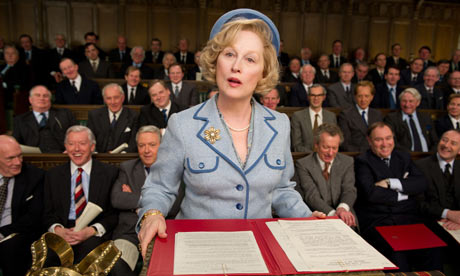
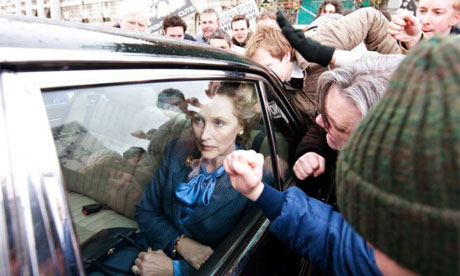
Abi Morgan and Phyllida Lloyd) do seem sincere about presenting the hurdles that Thatcher had to overcome in her ambition to seek change, achieve office, and, in becoming a political animal, save her party and become PM. The role could have easily gone into caricature, were it not for Thatcher's best supporter in the film, Meryl Streep.
The role ultimately won
LaStreep another Oscar (and, say what you will about the "unfairness of it all," she does deserve it—this is an amazing performance) and it contains her hallmark studied approach with the same intricate nuances she brings to every role—the rock-solid accent, the filigreed gestures, the interesting way she fills up the pauses and held-shots with interesting choices that are unexpected, but deeply felt. In the elderly sections, she doesn't quite have the "thousand-yard-stare" I've seen in Alzheimer's patients, but the frailties are there, right down to the quaking-arms-under-pressure and the processing pauses that flash through without making a big deal of them. Streep's always good, good enough that one might take her for granted, but this one's practically a one-woman show and certainly the best thing in a film that's "too little-too soon."


Tuesday, February 1, 2022

Fury (1936)

Fury
(
Fritz Lang, 1936) Fritz Lang's first American film (after fleeing Nazi Germany) taking on a compelling story that, like his German work, exposes the cracks of society within a strong story narrative, this time focusing on this country's scourge of lynching and the fragile way that rights can be trampled by mob rule and political cowardice. Although somewhat compromised by a last-minute studio mandate to tack on a more happy ending to the story, it plumbs the depths of the cruelty that humans can do to each other. 
 
The heads at M-G-M had good reason to be scared. Spencer Tracy stars as an ordinary Joe—Joe Wilson, in fact—engaged to Katherine Grant (Sylvia Sidney) but too poor to get married. Katherine decides to leave Chicago to take a job in the town of Strand, hoping to save enough money so she can come back and marry Joe. For his part, Joe stays in the Windy City with his two brothers, Tom and Charlie, who are mixed in with organized crime. Joe convinces them to go straight and together they open a gas station, which turns enough of a profit that Joe decides to not wait the full year as intended and takes a car to Strand to bring Katherine home, writing her to tell her the time and place they will meet.
His timing could be better. Stopping to camp out half-way between the two cities, he reads about a kidnapping and thinks nothing of it—tomorrow, he'll be in the town of Strand and starting a new life with Katherine.
 
He has no idea that by the next time tomorrow night, his life will be over.
The next morning, driving up to Strand to meet Katherine, he's pulled over by a cop (
Walter Brennan) for his out-of-state plates, suspicious that they might be tied to the kidnappers. When told to empty his pockets, Joe tells him that all he has in his pockets are peanuts that he munches on. "Whole shell?" asks the cop. Yes. That's enough reason to bring him to the sheriff (Edward Ellis), and Joe's questioned about the peanuts—the ransom note had traces of peanut dust on them—and about a $5 bill he's carrying—part of the ransom. Joe protests his innocence and tells the Sheriff to call his brothers, they'll vouch for him. The sheriff, being cautious, puts Joe in a holding cell and tells him he'll do some digging.
Pretty soon—thanks to a little of the arresting cop's bragging and encouragement from what they used to call an "outside agitator" (Bruce Cabot) passing through town—a  crowd starts to gather outside the jail, wanting to talk to the sheriff about the prisoner, demanding to see him. The sheriff posts a guard outside the jail and tells them that there's an investigation and that the prisoner is innocent until proven guilty and protected by the law. The city council is also riled up, but are told the district attorney is looking into the case, but hasn't called back, and they should be patient, despite what the news might bring to the town. He also warns them that unless things come under a little bit more control, he's going to call the National Guard on the crowd.
But, the district attorney is told that the Governor won't send out the Guard—towns don't like troops descending on them and making such a move would be a risky political move. By now, the sheriff and his men have moved back inside the jail because the mob has started throwing bricks and refuse at them. Stymied by the locked and barricaded door, the crowd decides to ram it in and take Joe by force. The police fight them off.
By this time, Katherine has been waiting awhile for Joe at their rendezvous and wondering what's happened to him. She's informed that the Strand police have arrested a "Joe Wilson" for the big kidnapping and he's being held in the town jail. Alarmed, Katherine runs to the town to find what's going on. What she finds is a scene right out of hell...and being filmed for the news reels.
Joe is trapped inside the jail as it's set on fire and can only plead with the crowd as they jeer outside, screaming for his death. As if to seal the deal, one of the mob throws dynamite through a cell window and it explodes. The jail burns to the ground. In the morning, the headlines are also screaming, but the town has fallen silent. When the sheriff's office starts their investigation, the town is substantially quieter, no one is willing to speak, lest they themselves get arrested and the district attorney is having trouble drawing up a case. But, wait...remember that news-reel film? In lieu of selfies, it goes a long way to identifying the perp's.
The district attorney indicts twenty-two people...but for what crime? It's not murder, because no body has been found in all the debris. The newsreel footage shows Joe was in the building, but, due to lack of forensic evidence, it looks like the rioters will get away scot-free. Will there be no justice for poor Joe?
Well, don't feel so bad for "poor Joe." It seems he escaped death, and reveals himself to his brothers staying in town to help authorities. And Joe is mad. Mad that the mob who wanted him to burn to death may not getting everything that's coming to him. He wants the death penalty for all of them, and he's willing to do whatever it takes—in secret—to make sure that they're punished for his death...even though he's still alive. He wants to teach a lesson. But, the lesson is not what he thinks. For Joe has become just as vengeful as the mob that burned down the jail. He has become as bad as they were.
 
Revenge stories have always left a bad taste in my eyes. They perpetuate the myth of "an eye for an eye"—which only makes people more blind. And movies—action movies, thrillers, "adventure" movies—are full of these types of themes, giving an impotent public a visceral thrill, supposedly balancing the books—but with a sledge-hammer. What makes Fury different is that it dares to show consequences where the hunter of tigers...actually becomes the tiger. It shows the lynched become the lyncher. And it's not pretty. It's not even satisfying. It is a wrong piled on top of a wrong and Fury knows it's not right. Sure, the mob is vilified. They should be. But, in seeking his revenge, Joe becomes a villain, too. There's no "they got what they deserved" satisfaction to it when the victim becomes a vigilante with murder on his mind. Lang had just come away from a society that lost any sense of justice and lived by the twisted morals of the mob.
 
He found the same symptoms in America. He'd still find them today.