Showing posts with label Richard E. Grant. Show all posts

Thursday, July 25, 2024

Mountains of the Moon

Mountains of the Moon
(Bob Rafelson
, 1990) A recent book about the quest for the source of the Nile River, "River of the Gods" by Candice Millard tells of the epic journey of British explorers John Hanning Speke and Richard Francis Burton to solve that mystery. It was a quest as perilous and fascinating as that of Lewis and Clark, with two distinctly different personalities of men heading the expedition, which, after surviving travails and hardships on the journey, descended into bickering and enmity when they returned to what they supposed was "civilization."
 
Yeah, well, I've seen that movie. Bob Rafelson, he of Head and Five Easy Pieces, The King of Marvin Gardens, and The Postman Always Rings Twice, was as unlikely a person to tackle this international tale that rivaled fiction, but he managed to pull it off. Not only that, it's one of, if not his best movie. And no one went to see it. And I dare say, very few people know about it. Talk about trying to find something that's "lost."
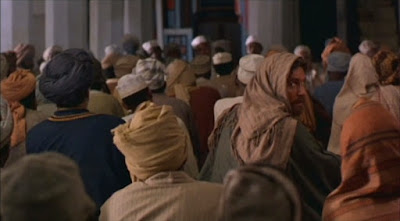
Burton: "...tends to mingle."
In 1854, Speke (Iain Glen) arrives on the East African coast on leave from the Indian Army with the purpose of hunting big game, but as he is informed, the coast "is closed", and it's suggested that he hook up with Richard Francis Burton (Patrick Bergin, easily his best role and his survey party with the Royal Geographical Society, which has been given permission to go deep into Africa. The RGS has bankrolled Burton's journey in order to find "the true source of the Nile"—that river being so important to British trade, it's beginnings will assure King and Parliament that trade will continue to flow not risking any disruptions to the economy.
Speke: his character in one shot. It will provoke an attack on the camp.
Burton just wants to find it and he'll use any excuse: "Every westerner's curiosity has been met with torture, mutilation and death. The river is shrouded in mystery. Who will be the first to discover its source?" For Burton, embarking on such an exploration is just as challenging as mastering another language (he would eventually speak 29) or translating a text ("One Thousand and One Nights," the "Kama Sutra" and "The Perfumed Garden") and for him the journey is as important as the destination as he was always gathering and noting facts, which is why he became one of the few non-Muslims to visit Mecca.
But, if Burton is there to get the lay of the land and everything set upon it, Speke just wants to hunt it. Burton needs a game hunter to supply food en route and Speke is a crack shot—he's hired immediately—but the two men couldn't be more different. For Speke, the goal is the thing, always interested in the target; for Burton, it's the journey, the process, the evidence. Each man will be tested, physically (both suffering from injuries that are horrendous—Burton, his face pierced through both cheeks by a native lance and Speke stabbed multiple times during a native attack) and mentally on their way to find the Nile's source. And despite their differences, they will prove essential to each other. Indeed, one wonders if either of them could have survived without the other.
One sub-plot of the movie is treachery, which both men will find in Africa and in England, belying the British chauvinism towards the African nations when they are equally capable of such behavior themselves, something Burton, in his studies of other cultures and his lectures, is trying to impress on a reluctant class-based society. But, those treacheries, both in Africa and England, will create circumstances that will challenge another major theme—loyalty. 
Burton and Speke are bound to each other in mission and friendship, and neither one would weaken their mutual trust were it not for the machinations of others. For all the tragedy—and triumph—that the two discoverers will encounter on their journey, it is only the influence of others that manages to come between them, sewing discord, and ultimately ending their partnership.
If the movie has a failing, it is that it tends to favor Burton's point of view over Speke's to the latter's detriment. It's easy to see why, though: Burton is a renaissance man, far before his time, and outside the status quo of those of his countrymen. His life was a constant quest for knowledge of the Earth and its peoples and seeking means to communicate similarities than promoting the stereotype of "the other." The movie could have made something of Burton's ego and his way of intimidating others, but he is pretty much given the benefit of the doubt in the movie.
And Speke has the disadvantage of class—too much of it, perhaps. He didn't seek adventure or Burton's loftier schemes (although he inherited Burton's zeal), he sought sport, and circumstances just conspired that he would make history.
Mountains of the Moon has Speke being fooled by the manipulations of others, and, once having discovered the subterfuge, only doubles-down on his claims lest he lose his newly-found reputation. It lays the blame for the two men's disputes entirely on him, when the truth is probably more nuanced.
But, there's a lot to admire, not only in performances—
Fiona Shaw is amazing as Burton's wife-to-be, Isobel, and Bernard Hill has a lovely turn as the legendary Dr. Livingstone, and one corker of a scene where he and Burton compare wounds they'd received on their travels—but also on the technical side, as well. The whole thing was photographed by the now-renowned Roger Deakins, edited by the ubiquitous Thom Noble, sound design by David Lynch's sound-man Alan Splet, with a resounding score by Michael Small. That's a lot of talent behind the scenes, making what's up on the screen so impeccable.
I can't recommend this movie enough. It's a great adventure story like The Man Who Would Be King or even Lawrence of Arabia, made without compromise and in some startling locations. I've always found Rafelson a little indulgent as a filmmaker. Not here. This is an amazing tale, well told by some of the best artisans of the movie-making craft.
 
It may be difficult to find, but the journey will be worth it.
 
The real Burton and Speke
 

Wednesday, February 2, 2022

The Iron Lady

I recently was pulled into a "Meryl Streep Draft" where, like sports brackets, the participants picked what they thought would be the best collection of movies featuring Meryl Streep to win the competition. Weird what film enthusiasts do.

If you want to listen to the podcast where they were selected, it is here.

If you want to vote for me, the ballot is here. If I lose, voting machines will be seized.

Curiously, I did not pick The Iron Lady—I don't think any of us did—although it is Streep's usual competent display (and she won an Oscar—that counts for...something).

Written at the time of the film's release.
 
Keeping Up Appearances
or
"Don't Want to Dig Around Too Much, M'. You Don't Know What You Might Find."

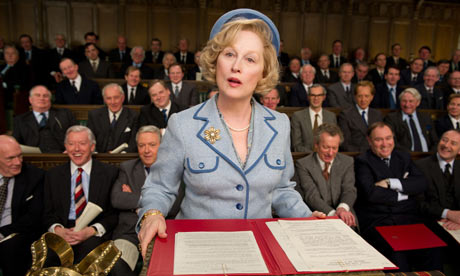
The Weinstein's last bid in 2011 to win an audience of Anglophiles seems a trifle desperate and might be a bit too early to give the subject proper justice, like Oliver Stone's Nixon or W.we're still too close to the Thatcher years to have any sort of perspective, other than a cursory glance at the events that shaped the Conservative years of the '80's. What damage was done, what was gained, is still unknowable, especially given the subsequent Blair years and how British-American relationships changed and coalesced. We get highlights and lowlights, but no illumination, and, instead, we get a look-back, not unlike Nixon's drunken reverie, but this time filtered through Maggie's Alzheimic reflections, with the dementia-figure of her dead husband Denis' presence as a Iago-like devil's advocate (played by Jim Broadbent, in just the way you think he would, a little dotty, but with a puckish edge). Really, both of them deserve a little better, no matter what one thinks of the politics.
But, the Alzheimer's is a good tool if someone wants to do a hatchet-job.  The disease brings the past into crystal clarity (for the afflicted, not for the story-teller), while also undercutting the reliability of the narrator in the present day.  Hardly seems fair, as the two women who wrote and directed
The Iron Lady
(
Abi Morgan and Phyllida Lloyd) do seem sincere about presenting the hurdles that Thatcher had to overcome in her ambition to seek change, achieve office, and, in becoming a political animal, save her party and become PM. The role could have easily gone into caricature, were it not for Thatcher's best supporter in the film, Meryl Streep.
The role ultimately won
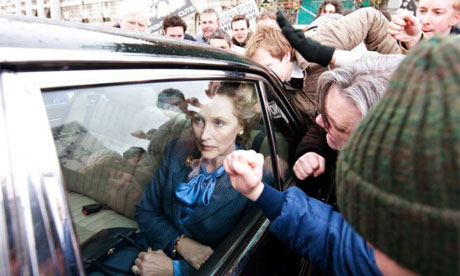
LaStreep another Oscar (and, say what you will about the "unfairness of it all," she does deserve it—this is an amazing performance) and it contains her hallmark studied approach with the same intricate nuances she brings to every role—the rock-solid accent, the filigreed gestures, the interesting way she fills up the pauses and held-shots with interesting choices that are unexpected, but deeply felt. In the elderly sections, she doesn't quite have the "thousand-yard-stare" I've seen in Alzheimer's patients, but the frailties are there, right down to the quaking-arms-under-pressure and the processing pauses that flash through without making a big deal of them. Streep's always good, good enough that one might take her for granted, but this one's practically a one-woman show and certainly the best thing in a film that's "too little-too soon."


Tuesday, March 28, 2017

Logan

Just Claws
or
That Old Man Logan...He Just Keeps "Shnikting" Along...

The X-Men series of films have had their good and bad editions, while the off-shoots of the most popular character from the comics and the films—Hugh Jackman's Wolverine—haven't had a really good film at all.

Until now.

Better late than never, I say, and it's extremely fortunate in that Jackman has stated Logan is his last appearance as Wolverine (yeah, we'll see...never say never). What is ironic is that, in this last Wolverine film, the best thing about it is that it strays from X-Men lore and comes up with a new concept that takes risks, if only because there is no continuity that needs to be saved and no sequel that degrades the stakes the character must overcome by ensuring his return. Logan treads No-X-Man's Land and that territory bears no marks of previous vehicles and feels as entirely fresh as an open road. 
The year is 2029 and all the X-Men are dead. No mutants have appeared in their wake. Their evolutionary pace has been stilled. John Howlett (Jackman) is making his way through life as a limousine driver-for-hire. He's older and not much wiser, suffering now from years of wounds as his healing powers are starting to shut down, while the adamantium lacing his bones is slowly killing him and he keeps himself going through the pain with pills and booze. His fares are enough to allow him to purchase special drugs from a surreptitious hospital contact.* But, they're not for him. They're for a special patient being secreted in Mexico.
That patient is Charles Xavier (Patrick Stewart), former head of the Xavier School for Gifted Children. Elderly now, and suffering from dementia, the old Professor X needs to be heavily sedated, or his mental powers, now erratic, will cause seizures that will paralyze everyone in a very large area surrounding him. One such seizure killed the last remaining X-Men and Xavier is wracked by guilt and depression. He is kept medicated and watched over by Caliban (Stephen Merchant), an albino mutant-tracker, who must stay out of the sun or face debilitating burns.
But, Wolverine is being triangulated: first, he is being sought out by a nurse named Gabriela (Elizabeth Rodriguez), who has with her a young girl named Laura (Dafne Keen)—Gabriela wants to hire Logan to take them to Canada where a secret facility named "Eden" can protect them; the second is Donald Pierce (Boyd Holbrook), a "modified" security agent for an organization named "Alkili Transigen" who is also looking for Gabriela, if only to find Laura, and knows that Logan has been contacted by her. He also seems to know that Professor X is in Mexico and has a great interest in him, as well.
Before you know it, Gabriela is dead, and all parties are in Mexico duking it out, and it is only then that the truth about Laura is known—she is a mutant, raised in the facility of Alkili Transigen to create a new line of weaponized "muties" bred from the ones who have gone before, and she has been cloned from a very specific DNA strain—Logan's. She has the healing powers and the claws, but being female, has a bit more—as in nature, the claws in her hands are for attack, but the ones in her feet, are for defense. Laura, designated "X-23," is a fighting machine, and her skills are ferocious and often devious.
A prolonged attack in Mexico sets the mutants on the run, ostensibly to Canada, but, for the short term, out of the way of Pierce and Transigen's gang of bio-mechanically enhanced "Rievers." But, they're never too far away, having captured Caliban and torturing him to track the fugitives. At the same time, Logan the loner must learn to deal with the possibility of being a reluctant hero for the ones under his charge, something he resists for all the death and destruction in his wake; as he tells Laura, "Bad shit happens to people I care about" "Then I'll be fine," is her aware reply..
It is the best of the Wolverine films, and it might be the best of the X-Men films (they've all blurred in my head these days). Since their inception (X-ception?), Marvel's mutant movies have been plagued by a fuzziness that has more to do with the inability to focus on any one member or conflict because the things are stacked from fade-in to fade-out with too many characters all demanding some amount of screen-time (you can see the same thing happening with the Avengers line of films, only two in). Here, Logan doesn't spend the whole movie ignoring the platitudes of dozens of pep-talkers, it's just him being "Mad Max" wrestling with his own conscience to get in the fight rather than being lectured to, constantly. Just as sure as the adamantium inside is killing him, he's shredding himself internally over his reluctance to commit.
Perhaps taking some courage from the box-office of Deadpool (there is a short, goofy interlude featuring that character pre-film), Logan is rated R—and a hard R—for violence and pervasive shnikting.** It is a problem with the X-Men films—and Wolverine in particular—that this most popular character is also the most violent, slashing, carving, dicing, gashing, eviscerating, and disembowling anything that comes across his path. The comics get away with it by showing the side of the victim that isn't being shredded or by hiding it in a swing-arc. The movies get away with it by keeping the action off-frame or (dare I say it?) "cutting away," thus (dare I say it again?) "under-cutting" the character and his ginzu-power. Logan's Wolverine cuts off hands, heads, guts people, rams his claws into eyes, foreheads and delivers one nasty upper-cut. 
"One nasty uppercut." They should have named him "Pierce"
...and curses like a sailor with a limited vocabulary. But, it's the surgeries that earned the rating. It lends the movie and the character a bit more desperation than we've seen previously and, in so doing, raises the stakes (ouch...can't get away from the puns) of the film.
Director James Mangold did the last unimpressive 'Wolverine-in-Japan" film which managed to not bring to mind any of the strong iconography of the comics in that setting. Here, however, telling a more personal story, with a much-weakened character and with less X-ephemera, that works far better than any previous attempts. And he ends it with a late, craggy Johnny Cash song (not "Hurt" as in the trailers—Mangold directed Walk the Line, the very good Cash bio-pic, by the way) that couldn't be more apt as a coda. Logan is tough and tender, and finally, does the character some justice, and makes the task of replacing Jackman a little bit more daunting. Good on them.
* And, seemingly, an endless supply of gasoline. That limo gets a lot of miles on it, and it's mileage must be incredible, as we never, ever see Logan fill the tank.

** I know, it's supposed to be "SNIKT!" but I was a sound-designer, dude, and when those claws go through wolverine's knuckle skin, it's going to make a "sch" sound so I think it's "SHNIKT!"

Saturday, February 11, 2017

Jackie

Think Back on All the Tales That You Remember...
or
Widow-in-Chief

I was alive when the Kennedy assassination occurred in November, 1963. I know where I was when I heard Kennedy was shot. I know the story. I watched the wall-to-wall television coverage of the events, the lying-in-state, the assassin assassinated, the funeral, the flame. And I've seen the crack-pot video's and conspiracy theories (before conspiracy theories were kewl, dude...). And I believe what I saw those days. Because one crazy person can kill the President, as they've tried since, at least once every decade. You don't need a convoluted plot to shake the world. The world is so unstable, it shakes on its own.

So...Jackie.

This film by Chile's Pablo Larrain, recounts the personal story of First Lady Jacqueline Kennedy not yet Onassis (played by Natalie Portman) through her duties during her tenure, focusing primarily on her televised tour of the White House (an odd choice), the details and aftermath of the Dallas assassination, and an interview she does with a journalist (unidentified, but it would historically be Theodore H. White, as played by Billy Crudup). The film wheels between those events with the interview as a framing device for flashback sequences that one supposes is from the viewpoint of the First Lady—the "suppose" is because you see her nervousness and last-minute advice, minutiae and pep-prep-talk from tech-folks and her secretary on what's-what, what she should do, how she should present herself and her work making The White House "the people's house."
She had to have something to do. Despite a tendency to be reserved, she could not be so in the cut-throat world of politics, which she despised. She and her husband were both young, younger than the Eisenhower's, Truman's, and Roosevelt's (except Teddy) and they became symbols for a re-invigorated America, a telegenic America. And "Jackie," so young, so fashionable, so au courant, became a symbol for women, young women, "house-wives" delegated to the kitchens and nurseries who saw her as capable, elegant and admirable. They wanted to be like her. They wanted to be her.
But, she made it look easy. It wasn't. A woman of High Society, she hated politics and shunned the limelight while enjoying the advantages of it, even though she knew it would be impossible, especially when campaign crowds for John Kennedy doubled when she appeared with him. She suffered two miscarriages before giving birth to her daughter Caroline and son John Jr. Ultimately the couple would lose three children. Death haunted the Kennedy family even before the events of November, 1963.
And then, there was Jack. If one wants to wade through the muck of tabloid reporting, one gets the story of the President's infidelities before two of the toes of one foot get wet. Go in mid-calf and Jackie's revenge-affairs show up, although those revelations are more recent, secrets being loosened from willing confidante's after the woman's death, when she could no longer spin—except in her grave. Jacqueline may have been a more private person, but she knew her power and would wield it with impunity. She also knew the power of her image, as, immediately after the assassination, she chose to continue wearing the blood-spattered pink Chanel suit (only compromising by washing the blood from her face) on Air Force One's return flight with the explanation: "I want them to see what they did to Jack."
That "image" dilemma is what keeps Jackie from being an entirely interesting movie. The "White House Tour" segments are particularly problematic as they show a clearly uncomfortable First Lady trying to negotiate her way through the technology and invasiveness of it, while trying to maintain her composure. Portman has a particularly difficult time during these scenes, trying to convey that coolness combined with a nervousness that seems as artificial as the breathy Marilyn Monroe voice that Kennedy affected when she spoke. The "image" isn't well-conveyed, and the other segments feel less static and controlled.
One would think that the Dallas segments would be the most fascinating, but they aren't. Oh, they are weighted, especially following the assassination, when Jacqueline Kennedy manipulates, cajoles, even guilts to get her way for a national funeral that would hold the nation's attention for as long as possible. But, the most interesting are the interview segments, which show the First Lady with another agenda—to frame the Kennedy years in a glowing romantic light that mythologized it, far beyond the in-fighting and partisanship that actually marked the Kennedy years. In those segments, Kennedy is portrayed as canny, bitter, ironic, and well-aware of her role as both Mrs. Custer and Ishmael. The only part of the film that evokes a chuckle is when she drags on a cigarette and coolly informs White "I don't smoke." Of course, she doesn't.
"I don't smoke..."
One wishes there was more of that, but there is not. When, in 2011, the History Channel produced a television mini-series which featured Katie Holmes as Jacqueline Kennedy, daughter Caroline Kennedy managed to keep it from airing in the U.S. by an interested ABC network by offering, in its stead, a news special playing an interview with Arthur Schlesinger, Jr. that her mother had recorded in early 1964. A deft counter-move, an invisible spin like a pirouette, that would have made her mother proud...and smile. But, it's to the detriment of the movie, which plays it so safely that it makes it dull and uninteresting as both document and drama.