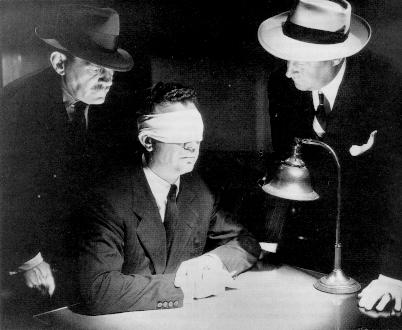
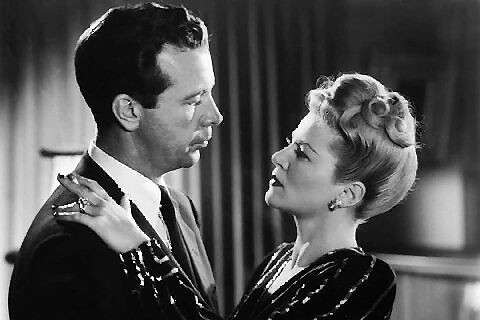
The main departure is the title: Chandler's choice, "Farewell, My Lovely," was ditched after a preview screening because those first viewers were expecting more of a musical, as the movie starred Dick Powell, who was a mainstay of that genre and not the first person casual movie-goers would think of as a slightly soft-boiled detective sifting through the grime of Los Angeles. The name was thus changed to something suggesting more violence than tap-dancing...and probably to protect the innocent.**
Dmytryk and writer John Paxton do a fair job of keeping the first-person narration intact (the set-up is that Marlowe is being grilled by the usual suspicious police and he's giving his side of how things went down), and keeping a steady pace that's surprisingly fast. Although they didn't use Chandler's exact phraseology, they do a nicely watered down, tightened-up version of it for cinema audiences for whom thinking too much of the cleverness of a metaphor as it passes by their cerebellum might slow down a film's momentum. Call it "Chandler Lite." Although a lot of it is quite good, if less surly. One of my favorites is when someone says they don't like Marlowe's manners: "Yeah, I've gotten complaints, but they keep getting worse."
Powell can't get too far from his roots—he does a fancy two-step in the "mausoleum" of a foyer.
It works, especially for the speed of this film. For the role of Marlowe, especially the first one, Dmytryk and the studio made an odd choice in Dick Powell, an A-lister in musicals. But, he's very effective. He's got a lived-in face, like a hound's, not a matinee idol's, slightly doughy (as is his body-type, despite being told he's "in good shape"—that's Marlowe to a wife-beater "T."), and you believe that Powellwould be a reflexive weisenheimer—something about the "hoofer" background. The light comedy experience makes the sarcasm go down very well.
And Dmytryck has the noir feeling down, too, being as he was one of the architects of the style. Begin your movie in transition so the audience has a lot of questions it has to answer, go heavy on the atmosphere and always exit the scene with a sardonic quip. You already know you're in the hands of a master with the sequence that introduces "Moose" Malloy (Mike Mazurki) who just suddenly appears as a menacing reflection in the window that only appears because of the intrusion of a nearby flashing neon light. It's as disconcerting...well, as disconcerting "as a tarantula on an angel food cake", thank you very much! Dmytryck also has fun dancing around the brim of the Hayes Code in the two knock-out sequences of Marlowe being knocked out—always a hallmark of Marlowe stories and fans of inky pools of blackness, Long Goodbyes and Big Sleeps (or "Big Lebowski's," if you'd rather, later).
But, for the record books...Chandler always said that Powell was his favorite version of Marlowe.
* The Big Sleep with Bogart as Marlowe was made the same year, but not released until two years later. ** They finally got around to using the title in the 1975 Dick Richards remake that starred Robert Mitchum, who would have been too pretty for Marlowe in his youth, but had aged into a wrinkled world-weariness that worked. When he was approached by producer Elliott Kastner and financier Sir Lew Grade to play the part—after their first choice, Richard Burton (??!!), had turned it down—Mitchum says that he said: "Why don't you just re-release Murder, My Sweet with Dick Powell and we can all go to the beach?"
“Tall, aren't you?" she said. "I didn't mean to be." Her eyes
rounded. She was puzzled. She was thinking. I could see, even on that
short acquaintance, that thinking was always going to be a bother to
her.”*
Raymond Chandler "The Big Sleep"
Raymond Chandler published "The Big Sleep" in 1939. By 1944, at the time The Big Sleep was being made into a movie, his second novel featuring detective Philip Marlowe, "Farewell, My Lovely," had already been filmed and about to be released under the title Murder, My Sweet (the title changed because Dick Powell was playing Marlowe and, given his past films as a song and dance man, the producing studio thought the original title might make people think it was a musical!).
No one could confuse The Big Sleep for a musical. It was intended to be an detective-genre follow-up to the Bogart-Bacall pairing To Have and To Have Not, the 1944 Howard Hawks movie where the director's intention was to "create a girl more insolent than (Bogart)." That film was a big hit that the Warner Bros. studio wanted to repeat and "The Big Sleep" was put on the fast track for production. Hawks assigned the script to the previous film's team of Jules Furthman and prominent novelist William Faulkner with additional work by a new find, Leigh Brackett, who would have a long partnership with Hawks. The writers turned in their drafts and made the changes apparent in the scene breakdown.
What's interesting is that the scene follows the book* more closely than the script. That's not the way it usually works in Hollywood.
Hawks re-wrote his scripts the night before filming, sanding off the rough edges or sharpening the focus before having to spend real money filming it. Bogart was known for adding a line or two, as well. So, the "You making fun of me?" line that isn't in the Faulkner, Brackett, Furthman script was added just in case audiences weren't "getting" it. And because Chandler used it.
And Hawks eliminated all the business of Marlowe sitting in the chair and maneuvering Carmen from sitting in his lap. Easier just for her to drop to see if he'll catch her (of course he will, as she well knew). Better placement of the "You're cute" line, too. And...Chandler used it.
There is the rumor—although Hollywood rumors are always done with malice and nobody looks good—that Vickers was so good in her role that Bacall's agent (Charles K. Feldman) reached out to studio head Jack Warner to have her part reduced in order to favor his client. That's what Chandler said, anyway.
Or...it might be the simple fact that Carmen Sternwood (although the nexus of the story) as portrayed in the novel is also a drug-addicted nymphomaniac who murders people and gets away with it. Hardly something the Hays Code, the moral watch-dog at the time—would approve. They didn't include the scene where Carmen shows up naked in Marlowe's bed (how could they get that past the censors?) and they don't show the penultimate scene where Carmen (as she has in the past) intends to shoot Marlowe because he doesn't want to sleep with her. Marlowe and Carmen's sister just talk about her problems during a quick-getaway. In the film, the resolution to the mystery is less important than the Bogart-Bacall relationship dynamics.
That's the most important difference between the novel and the film.
The Set-Up: The beginning of the movie. Time to get acquainted.P.I. Philip Marlowe (Humphrey Bogart) goes to meet "four million dollars"—his client. He'll end up meeting the "problem" (Martha Vickers) he's trying to solve...who is considerably cheaper.
Action.
Deletions are crossed-out. Added sections are in green.
FADE IN:
1. EXT. STERNWOOD PLACE - ESTABLISHING SCENE
It is a millionaire's house, big, sprawling, California
style, with clipped lawns and gardens, on a hill above the
now abandoned oil field which was the family's wealth. A
small coupe drives up to the door and stops, and Philip
Marlowe gets out. We just have time to establish him as he
approaches the door -- a husky, self-confident man, well-
dressed but not flashy.
2. INSERT: A BRASS DOORPLATE KNOCKER WITH A BELL BENEATH
lettered
STERNWOOD
3. EXT. FRONT DOOR - CLOSE SHOT - MARLOWE
as NORRIS opens the door. Norris is thin, silver-haired
with a gentle intelligent face.
NORRIS
(holding the door)
Good morning, sir.
MARLOWE
I'm Philip Marlowe. General
Sternwood sent for me.
NORRIS
(opens door,
steps aside)
Yes, Mr. Marlowe. Will you
come in?
NORRISWill you sit here? I'll tell
the General that you're here you have come.
MARLOWE
Okay Thank you.
Norris exits.
Marlowe looks about, interested and curious,
sees something, moves toward it.
5. CLOSE SHOT - MARLOWE
as he stands before a portrait, examining it with curious
interest. It is a portrait of General Sternwood, in
regimentals, beneath crossed battle-torn cavalry pennons
and a sabre.
He is still staring at the portrait when at a
SOUND OFF, he turns and sees CARMEN STERNWOOD approaching.
She is about 20, in slacks, something sullen and hot about
her.
She stops about 10 feet from him and stares at him,
biting the thumb of her left hand.
MARLOWEGood morning.
CARMEN
(after a moment)
You're not very tall are you?
MARLOWE
I tried to be.
CARMEN
Not bad looking, though --
CARMEN
-- you
probably know it.
MARLOWEThanks Thank you.
He goes to a chair and sits down. When he looks up, he
sees Carmen approaching, still staring at him.
CARMEN
(approaching)
What's your name?
MARLOWE
Reilly -- Doghouse Reilly.
CARMEN
(beside the chair now)
That's a funny name.
MARLOWE Think so?
CARMEN Uh-huh.
CARMEN Are you a prize
fighter?
MARLOWE
No. I'm a shamus.
CARMEN
A what?
MARLOWE
A private detective.
CARMEN You're making fun of me.
MARLOWE Uh-huh.
CARMEN
You're cute.
As she speaks, she sits suddenly on the arm of his chair.
As she does so, Marlowe rises, shifts the chair in doing
so, so that to her surprise, Carmen finds herself sitting
in the chair itself.
She stares up, surprised and then
angrily, is about to speak again when they both see Norris.
He has just entered noiselessly, stands beside the chair.
On Norris' face there is now a curious expression of grief,
sadness.
NORRIS
The General will see you now.
Carmen glances up at him, rises quickly as if he
had reprimanded her with words, and exits.
Marlowe looks
after her, thoughtful, a little grim.
NORRIS
The General will see you now.
MARLOWE
(looking after Carmen)
Who was that?
NORRIS
Miss Carmen Sternwood, sir.
MARLOWE
You ought to wean her. She looks
old enough.
The Big Sleep is available on DVD and Blu-Ray from Warner Home Video.
* Here's the first chapter of "The Big Sleep" to show you how close they stuck to the book. And because author Chandler is so damn good at his job.
It was about eleven o'clock in the morning, mid October, with the sun
not shining and a look of hard wet rain in the clearness of the
foothills. I was wearing my powder-blue suit, with dark blue shirt, tie
and display handkerchief, black brogues, black wool socks with dark blue
clocks on them. I was neat, clean, shaved and sober, and I didn't care
who knew it. I was everything the well-dressed private detective ought
to be. I was calling on four million dollars.
The main hallway of
the Sternwood place was two stories high. Over the entrance doors,
which would have let in a troop of Indian elephants, there was a broad
stained-glass panel showing a knight in dark armor rescuing a lady who
was tied to a tree and didn't have any clothes on but some very long and
convenient hair. The knight had pushed the vizor of his helmet back to
be sociable, and he was fiddling with the knots on the ropes that tied
the lady to the tree and not getting anywhere. I stood there and thought
that if I lived in the house, I would sooner or later have to climb up
there and help him. He didn't seem to be really trying.
There
were French doors at the back of the hall, beyond them a wide sweep of
emerald grass to a white garage, in front of which a slim dark young
chauffeur in shiny black leggings was dusting a maroon Packard
convertible. Beyond the garage were some decorative trees trimmed as
carefully as poodle dogs. Beyond them a large greenhouse with a domed
roof. Then more trees and beyond everything the solid, uneven,
comfortable line of the foothills.
On the east side of the hall a
free staircase, tile-paved, rose to a gallery with a wrought-iron
railing and another piece of stained-glass romance. Large hard chairs
with rounded red plush seats were backed into the vacant spaces of the
wall round about. They didn't look as if anybody had ever sat in them.
In the middle of the west wall there was a big empty fireplace with a
brass screen in four hinged panels, and over the fireplace a marble
mantel with cupids at the corners. Above the mantel there was a large
oil portrait, and above the portrait two bullet-torn or moth-eaten
cavalry pennants crossed in a glass frame. The portrait was a stiffly
posed job of an officer in full regimentals of about the time of the
Mexican war. The officer had a neat black imperial, black mustachios,
hot hard coal-black eyes, and the general look of a man it would pay to
get along with. I thought this might be General Sternwood's grandfather.
It could hardly be the General himself, even though I had heard he was
pretty far gone in years to have a couple of daughters still in the
dangerous twenties.
I was still staring at the hot black eyes
when a door opened far back under the stairs. It wasn't the butler
coming back. It was a girl.
She was twenty or so, small and
delicately put together, but she looked durable. She wore pale blue
slacks and they looked well on her. She walked as if she were floating.
Her hair was a fine tawny wave cut much shorter than the current fashion
of pageboy tresses curled in at the bottom. Her eyes were slate-gray,
and had almost no expression when they looked at me. She came over near
me and smiled with her mouth and she had little sharp predatory teeth,
as white as fresh orange pith and as shiny as porcelain. They glistened
between her thin too taut lips. Her face lacked color and didn't look
too healthy.
"Tall, aren't you?" she said.
"I didn't mean to be."
Her
eyes rounded. She was puzzled. She was thinking. I could see, even on
that short acquaintance, that thinking was always going to be a bother
to her.
"Handsome too," she said. "And I bet you know it."
I grunted.
"What's your name?"
"Reilly," I said. "Doghouse Reilly."
"That's
a funny name." She bit her lip and turned her head a little and looked
at me along her eyes. Then she lowered her lashes until they almost
cuddled her cheeks and slowly raised them again, like a theater curtain.
I was to get to know that trick. That was supposed to make me roll over
on my back with all four paws in the air.
"Are you a prizefighter?" she asked, when I didn't.
"Not exactly. I'm a sleuth."
"A--a--"
She tossed her head angrily, and the rich color of it glistened in the
rather dim light of the big hall. "You're making fun of me."
"Uh-uh."
"What?"
"Get on with you," I said. "You heard me."
"You
didn't say anything. You're just a big tease." She put a thumb up and
bit it. It was a curiously shaped thumb, thin and narrow like an extra
finger, with no curve in the first joint. She bit it and sucked it
slowly, turning it around in her mouth like a baby with a comforter.
"You're
awfully tall," she said. Then she giggled with secret merriment. Then
she turned her body slowly and lithely, without lifting her feet. Her
hands dropped limp at her sides. She tilted herself towards me on her
toes. She fell straight back into my arms. I had to catch her or let her
crack her head on the tessellated floor. I caught her under her arms
and she went rubber-legged on me instantly. I had to hold her close to
hold her up. When her bead was against my chest she screwed it around
and giggled at me.
"You're cute," she giggled. "I'm cute too."
I didn't say anything. So the butler chose that convenient moment to come back through the French doors and see me holding her.
It
didn't seem to bother him. He was a tall, thin, silver man, sixty or
close to it or a little past it. He had blue eyes as remote as eyes
could be. His skin was smooth and bright and he moved like a man with
very sound muscles. He walked slowly across the floor towards us and the
girl jerked away from me. She flashed across the room to the foot of
the stairs and went up them like a deer. She was gone before I could
draw a long breath and let it out.
The butler said tonelessly: "The General will see you now, Mr. Marlowe."
I pushed my lower jaw up off my chest and nodded at him. "Who was that?"
"Miss Carmen Sternwood, sir."
"You ought to wean her. She looks old enough."
He looked at me with grave politeness and repeated what he had said.