Written at the time of the film's release in America.
"Staten Kontra Lisbeth Salander" or "The Girl with the Dragon Tat 3"
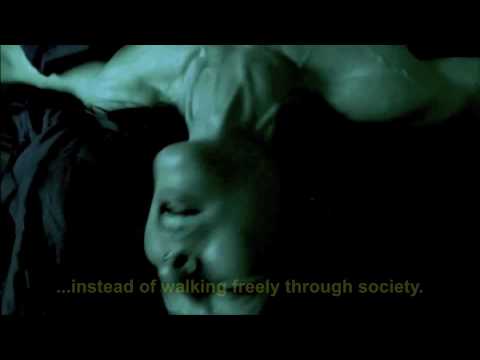
The final film of the Swedish versions of the "Millennium" seriessatisfies, but in the same way that most final films in a trilogy satisfy: loose ends get tied up, the story concludes, we get to say good-bye and leave.
ButThe Girl Who Kicked the Hornets' Nest (akaLuftslottet som sprängdes or "The Air-Castle that Blew Up"*)is the least of these films (the last two directed by Daniel Alfredson, the first more atmospheric one directed by Niels Arden Oplev), partially because the source novel by the late Stieg Larsson is full of detail and waiting for an outcome, and not much else. Also, its lead character starts this one (its story begins mere moments after the last entry's finish) suffering from the horrors she endured in the last quarter of The Girl Who Played with Fire. With a bullet in the brain and the long recovery that entails, the audience is left in the waiting room, for its star attraction to do the voodoo she does so well. But the fine-grinding gears of the plot, and all the complications the series has set up, tends to gum up the works and makes it all seem like a slow-moving version of "Law and Order: Special Victim's Unit."
It is what the novel is, but the book has the advantage of throwing surprises at you all the time, keeping you busy thumbing back through it to keep the details straight. The movie plods along with everyone talking about the one thing that has made the series shine, but is kept somewhat off-stage with only tantalizing glimpses now and then: goth-girl/hyper-hypenate Lisbeth Salander (Noomi Rapace).
That character (and the way Rapace plays her) is what the audience cares about. It's why the "Millennium" series, when it was published in America, replaced the oblique Swedish book-titles (like the first's, which translates aptly as "Men Who Hate Women") to focus on "the girl with the dragon tattoo." It is also why Rapace (though it isn't evident from posters and IMDB listings) is top-billed in the film over her more accomplished co-star Michael Nyqvist. She's the ace in the hole, but the film keeps her comatose, cloistered, incarcerated, and quiet for 3/4 of its length. As Rapace 's performance is so interior anyway, one is focused on every twitch of her lips, fashion statement, or flicker of an eye to sustain interest.
Meanwhile the rest of the world is running around, dealing with conspiracies, death-threats, assassinations, dances with automatic weapons, car-chases, and cartoonish muscle-men in an unsuccessful attempt to compete with the smallest Salander reaction. After two movies watching her running rough-shod out of those who get in her way, the film-makers should have known they couldn't fight their own creation. Only a Final Heat with a Loose End gives the audience its requisite amount of brutal grrrl-action.
Worth seeing, if, like me, you got hooked on the sordid Swedish underpinnings of the story, but don't be surprised if you want to see more when it's done.
* We'll get into these translations later, but if that title confuses you Englishers, substitute "The Ivory Tower" for "Air Castle" and you'll get the idea.
Written at the time of the film's American release....
"If You're Going to Have a Nasty Habit, You Might As Well Do It in Style"
It has been a year since Lisbeth Salander (Noomi Rapace), the multi-hyphenated* titular anti-hero of the "Millennium" series (or The Girl with the Dragon Tattoo) skipped off with a fortune to travel the world on the run from the slugs of Swedish officialdom who might exact revenge. As if... Now, she is pulled back to Sweden, against her better judgement, moving in relative obscurity; her only connection to her partner-in-investigating Mikael Blomqvist (Michael Nyqvist) is virtual, connected to his computer hard-drive. Though she continually scours what he's investigating and reads his columns, there hasn't been contact, e-mail, text, or ping between them in that entire year.
She's been busy enough, though. The events of the first film perpetrated by The Girl Who Played With Fireare coming back to haunt her, as she is evidentially linked to the murders of a "Millennium" journalist (Hans Christian Thulin) and his girlfriend, who have been working on exposing Swedish sex-traffickers with some highly placed officials as customers. That those homicides also lead to the murder of Salander's former "guardian" (in name only) Nils Erik Burman (Peter Andersson), on whom Salander exacted a brutally appropriate revenge in the last film, only make the hunt for her more intense.
This time it's personal (as they say in the trailers). And the fascinating Salander becomes the focus of this story that has her confronting her demons while tangentially attempting to clear her name. In the center of the story, while simultaneously watching from the sidelines, Blomqvist can only dog the elusive hacker's trail, learning more about his enigmatic co-hort/lover and what stokes the fire in her belly, a fire that actually turns the calm, collected Blomqvist into one very angry man, staunchly defending her, while coming to grips with the reasons she "despises men who hate women."
The Girl Who Played with Fire (directed by Daniel Alfredson) is not as good a film, or as fine a mystery as The Girl With the Dragon Tattoo, being much less convoluted (and thus intriguing) and a little more by-the-numbers as far as plotting. There's no real mystery here, as opposed to the first film (and book), but it focuses on what fascinated—and made one vaguely uncomfortable—about the first part of what will ultimately be a trilogy: Salander's burning desire to not just see justice done, but to exact her personal revenge—coldly, clinically, savagely. That it has a feminist slant (and one winces at using the word—these are crimes against human beings, sexually and power-abuse based, that just happen to be women) of turning the tables gives it a certain satisfaction, but I've seen too many Eastwood-directed movies (...heh...) to be entirely comfortable with the vigilante justice angle.
What makes it work, finally, are the lead characters, especially the unconventional renegade that is Salander. Her heart's in the right place, even though her soul is damaged, and the mandarin restraint that Rapace brings her is only betrayed a notch here, but even that still ends up breaking your heart. You can't help but root for her, despite the kindling she leaves in her wake.
And she does leave kindling. The violence that made one queasy about the first film is only slightly muted here, and concentrated to the back-end of the story—a set-piece of violence and tension that contains no catharsis but merely stops, unresolved, leaving the fate of Salander up in the air.
Not to worry, though. The last book, "The Girl Who Kicked the Hornet's Nest" rides the top of the New York Times Best Seller List and looks to be there for quite awhile.
* In my review of the first film I described her thus: "a 22 year old full-time goth-punk chain-smoking, bi-sexual, PTSD'd borderline-schizophrenic, sociopathic, fire-fixated security-investigator-computer-hacker...and part-time judge, jury and executioner. Add to that Blomqvist's inadequate (and slightly hilarious) description of her as "...a very private person."
Investigative reporter Mikael Blomqvist (a nom de plume purloined from the fictional detective Kalle Blomqvist) has just been found guilty of libel for an article he wrote about a powerful Swiss industrialist. In six months he's set for the barry hotel, but in the meantime, he has down-time. He gets an invitation for a job—the coldest of cases, literally and metaphorically—on the remote wintry island that serves as a compound for the Vanger family. The Vangers are the Swiss cousins of all the encrusted old-money families of British and American detective fiction. Be they Baskervilles or Armstrongs or Sternwoods, the "storied" elite families stood in for the Rothschilds and Lindberghs and Morgans and Rockefellers in a literary class warfare that assured the punters that bad things happened to the rich, as well. In fact, it was more than likely to happen to them as money is the root of all things evil. Perhaps.
Money was on the family's mind that Children's Day weekend on the Island, as a family board meeting was taking place, when one of the daughters disappeared, and her father drowned in a boating accident. One of the patriarchs wants to know, finally, forty years after the fact, what happened to the girl, who killed her, and charges Blomqvist (Michael Nyqvist) with the task.
For the disgraced newsie, it's a case of interviews and solitary visits to the caked-in-dust morgues of newspaper offices and libraries. But, though isolated on the Island, he's being watched, not only by the family, but by a security investigator who's hacked his computer.
She's Lisbeth Salander (Noomi Rapace), The Girl With the Dragon Tattoo,*a 22 year old full-time goth-punk chain-smoking, bisexual, PTSD'd borderline schizophrenic, sociopathic, fire-fixated security-investigator-computer-hacker...and part-time judge, jury and executioner. And where Mikael is dusting off old store-rooms, she's mining hard-drives through the back-door for any information that might be useful, like, say, on the creep who's been appointed her guardian. Life has rumpled Mikael, but it's deeply scarred Lisbeth, and the two tarnished angels are linked by more than cyberspace in a mutual interest making peoples' forgotten pasts their field of play.
They were made for each other, and, as both are incapable of seeing a mystery without inserting themselves, fated to team up to solve the question, if it is to be solved.
The Girl With the Dragon Tattoo is one of those whodunnit's much in love with every squeaking trope, and dangling aringarosa of the detective literary genre, and the puzzle is of the classic "Closed Room" variety—a traffic accident cut off the one exit to the bridge when the skull-duggery happened, so the scope of the search is limited to who might have been on that island to perpetrate it. The clues are varied in sources and nature, an old diary the girl kept with no entries that might lend suspicion, the few photographs taken that week-end...and Blomkvist's own memories—the girl was his nanny on Island holidays—provide nagging evidence, as does a single portrait that haunts him, like the Mona Lisa.
There are so many referrals to past films noir and sleuth-cinema that one could get lost in many a blind-alley (not that there are many on a rural Swedish island), but there are more than enough cousins and butlers and drawing rooms to go around—as with the best mysteries, no one is a suspect, but everyone is.
It is violent—there are two upsetting rape scenes that are essential to the plot, ultimately—but there is a cross-running sub-theme of sexual tyranny equating male sexism and domination as a form of fascism (it's an in-bred cousin to the feminism issues that made The Silence of the Lambs more important than a "boogey-man" story) that makes the film interesting philosophically in the genre. Director Niels Arden Oplev stages those scenes in a brutal manner that divorces them from any sexual act and makes them sadistic acts of violence, but one should be warned that there is rough stuff, far beyond cloak-room murders and high tea. The film is unrated, but consider it a hard "R."
It's a cracking pastiche, with the best thing about it being the (English version's) titular character. A product of the very brutality embodied by the mystery itself, the stakes are personal for Salander (and Blomkvist, certainly), but, like the Hannibal Lecter character in Silence of the Lambs, she is such a wild-cannon on deck during the proceedings that her motivations keep your thinking cap distracted from the mystery at hand. As played by Rapace, she is a kabuki-like presence than can turn ninja on a dime, a literal smoking gun, who can make things better or worse, depending on her buried mood, making the film categorical as "Suspense" as well as "Mystery." The other films in the trilogy will be released later in the year. Then, an American remake is planned...at this writing starring Brad Pitt and Carey Mulligan. (Yeah, well, not so much...see below)
* That's what it is known as in English-speaking publishing circles where mysteries series need a unifying "hook" like John D. McDonald's colorful titles for the Travis McGee novels, or "Cat" series of Lilian Jackson Braun. In its native Sweden, the title—"Män som hatar kvinnor "— translates to the more straight-forward and to-the-point, "Men Who Hate Women." The popular series of novels, dubbed the "Millennium Trilogy" (for the publication Blomqvist works for) stopped at three due to the untimely death of its reporter/author Stieg Larsson of a heart attack at age 50, before the first could be published. Michael Nykvist, who starred in the Swedish films, died June 27, 2017
"The Girl With the Dragon, Take Two" or "Once More...with Feeling"
"We come from the land of the ice and snow
from the midnight sun where the hot springs FLOW How soft your fields so green, can whisper tales of gore,
Of how we calmed the tides of war. We are your overlords.
On we sweep with threshing oar, Our only goal will be the western shore."
"Immigrant Song" Led Zeppelin
The American production ofThe Girl with the Dragon Tattoo advertised itself (amusingly) with the tag-line "The Feel Bad Movie for Christmas." Compared to the Swedish-TV version (with Michael Nyqvist and Noomi Rapace), it's actually, if one can believe it given the subject matter, a "kinder, gentler" version.
So, what's different? For those familiar with the first version, many of the locations reveal themselves to be the same. Resolutions are slightly different. The casting certainly is (and more on that later). Editors Kirk Baxter and Angus Wall keep things moving very fast, sometimes abruptly, and scripter Steven Zaillian delivers punchy dialogue dripping with icyclic irony, while keeping the circumstances equally savage and shocking (what else can you expect from from a murder mystery involving in-bred families crusty with krona, corruption, Nazi affiliations, serial killers, sexual violence and "men who hate women"—the original title of the book when published in Sweden?).
It's how director David Fincher (Se7en, Zodiac, The Social Network) approaches the tone that's slightly different, and though still mordantly frigid, this version is a bit more clever in presentation, adding a darkly humorous slant. Sure, the violence is still sickening, but blunted, even handled at times more discretely, making the impact contrarily even more squeamy, while, at the same time, counter-pointing with sly musical choices.*
Too true, not only in terms of Society, but also from the actress who previously took the role (Noomi Rapace, currently starring inSherlock Holmes: A Game of Shadows). She's still the same Salander, the goth-punk, vegan, pierced, bi-sexual hacker-savant who becomes the focus of the series, zipping around the bleak Swedish countryside on her black-on-black motorcycle, but this movies version, in the form of Rooney Mara, is slight (she had to be starring opposite the 5'10" Craig), tiny and even more startling in appearance than Rapace.
There's still the same shock of hair, but with her elfin face, shaved eyebrows and eyes sunk deep into her face, she has the appearance of the walking dead, her head looking often like a skull, and speaking in a dull, listless monotone. Rapace looked like she could kick serious ass (and did in the Swedish productions), but Mara is deceptively tiny, even looking sickly frail, so when she goes on the attack, it's doubly alarming.
We learn more about the little spit-fire in the second and third books of the series (hopefully they'll have their own versions with this cast—as with the Swedish films—because this cast is too good to waste, but the film's poor box-office showing—"The Feel-Bad Movie of Christmas," remember?—may make that unlikely), but Mara's dead-inside interpretation, that only slightly blossoms through the film, is an interesting take, doubly tragic, keenly felt and puts both her character and Blomqvist's into an interesting perspective.
I actually like this version better than the first.
The main title with the Trent Reznor/Karen O version of the Led Zep song.
* The best being what was used in the initial trailers—Led Zeppelin's "Immigrant Song," subtly adapted by producer-composer Trent Reznor (the perfect guy to score this film) for female vocal, while keeping the brutal orchestrations of the original intact. The Main Title sequence accompanying it, is visually arresting, suggestive and creepy, almost a mission statement in tone—black and white, reflecting the film's dark muted color scheme—while suggesting minds, trapped, tortured and squirming like toads.
 "Staten Kontra Lisbeth Salander"