In this one, Laurence Harvey plays a double agent—Alexander Eberlin—working for the British Secret Service. He's upper-class, arrogant, and a snob, but quite good at his job, and when we first see him he is in the business of burying a colleague—killed by the Soviets, apparently, the third agent to meet such a fate recently. The Service is in a tizzy With three men down, they assign Eberlin the job of tracking down the suspected soviet agent behind the killings, whom they identify as Krasnevin. They want the agent tracked down and killed before any more harm can come top one of their own. Seems easy enough.
The only complication—which the British do not know—is that Eberlin himself is Krasnevin. He has been working for the Soviets for years, infiltrating the British Service for years. The man identified in the briefing as Krasnevin is actually his Soviet contact "Pavel" (Per Oscarsson). Somehow, he must convince the British that he can do the job, while at the same time, get back to his masters in the USSR, before he is found out.  One can see why the story would attract director Anthony Mann, who directed a slew of fine films (mostly in the film-noir and western genres) about conflicted men pushed to their self-imposed limits by individuals just that much worse than they are. For Eberlin, it's his fellow agent Gatiss (Tom Courtenay), who is determined to find the traitor in their midst and has a sociopathic zeal to do whatever it takes to bring him to ground. Gatiss, ironically, is the perfect spy, while Eberlin is not. And they're pitched in a mano a mano battle, while Eberlin fights his on a larger scale between nations and their bureaucracies.
 The film itself is not so interesting, save for that one aspect. It has the curious distinction of being one of those spy films with no one to root for, everyone in a pitched battle of wits with merely the size of the arena being the distinction. No, the curious thing is that it feels like two distinctly different films, owing to the fact that it's Mann's last film—he died after finishing principal photography in Britain and while filming in West Germany, where star Laurence Harvey (who had directed The Ceremony in 1963) was picked to complete the film in mid-filming to protect the project's investment. And their styles are decidedly different.


This (I'm fairly certain) is an Anthony Mann shot.
Where Mann has a composer's eye for interesting angles and communicating relationships with where he puts his camera relative to its subject, Harvey's style is less classically-trained (especially with wide-angle compositions) and more geared to current catch-as-catch-can fashion. Mann, also, traditionally, tried to fill the frame with as much detail as possible, those specifics forming patterns to direct the eye to what he thought was important, whereas Harvey seems satisfied just to "get the shot" artfully or not.


This looks like something Harvey shot.
Mann's way has a scope to it, a dimensionality, whereas Harvey's compositions are flat and uninteresting, almost static and off-kilter (something Mann was more than capable of, but to a narrative purpose). It makes it a distracting watch, not because it's a good movie, but because one ends up playing "who shot this?" as a way of passing the time, until, finally, one just runs out of good material to admire and admits that "Harvey did this" for the remainder of the movie.

"Harvey" again
Hardly a way to generate suspense. But a way to get through it, at least. Plus, one has early roles for Mia Farrow, Peter Cook (playing straight but in a disorientingly comic way) as well as Lionel Stander, who's always fun to watch.

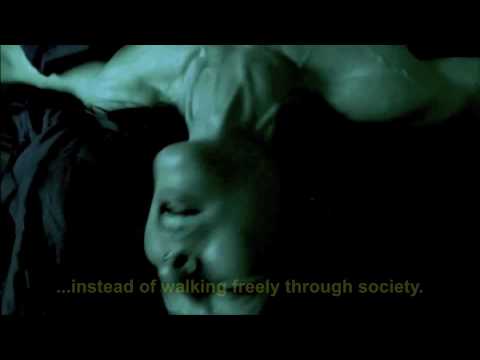
Mann directing? The shadows make me think so.
So. A potentially good film, tragically not living up to it. The film didn't do well at the box-office as the 1960's "spy-craze" was waning, and about to go undercover as comedies. And although Mann is officially credited as being the director on it, I have a hard time thinking of A Dandy in Aspic as his last film.