Silverado(Lawrence Kasdan, 1985) Director Lawrence Kasdan took his big box office successes with Body Heat and The Big Chill and parlayed them into a Big Gamble to revive the western genre with this "all-in" tale (co-written by himself and his brother Mark) of four travelling pilgrims who happen to collide and find enough common ground in skill sets and back-story that they end up resolving each others' business. Why they happen to find each other in all the empty space of the West is a bit of a mystery, but I have a feeling it would have been inevitable as the four of them seem to follow the directions of their own individual moral compasses. Despite their differences, they're going to end up in the same place. Just like the country. Even though it starts out in the dry wilderness of the West, everything seems to be moving to civilizing and taming the wild, except that things aren't exactly going to plan. "Nothing wrong with the land. It's just the people," says one of the settlers of Silverado. That settler's brother gets an example of that at the very start of the film: Emmett (Scott Glenn) is asleep in a shack—at least it has a wood-stove—when the door burst opens and guns start firing. A reach for a holster and one guy is dead, but bullet-holes start blasting through the walls, and the roof explodes from rifle-fire. Emmett fires sight-unseen, anticipating the movements and when he finally exits into the sunlight, three men are dead, two horses are on the loose, but one has stayed. That horse will come in handy twice in the movie: once as transport and once as a clue to why someone would want Emmett dead.
Title sequence. While Bruce Broughton's classic score*starts with the first tremulous chords as Emmett exits the shack (in a move not to dissimilar from the opening shot of The Searchers) to reveal a dawn landscape and the music blossoms into full-throated Americana with a chime announcing the title of the movie, Broughton's main theme is presented over shots of Emmett's character travelling with the two horses across various picturesque landscapes, finally reaching a desert, where he spies a prone figure baking in the sun....wearing nothing but long-johns, his legs nonchalantly crossed as if he'd fallen from the sky that way. Emmett takes out his canteen and tentatively offers the sun-roasted character some water. He croaks something unintelligible. Emmett leans closer and we hear the first words from Paden (Kevin Kline): "Pleased to meet you."
They're also the first words spoken in Silverado, and already it sets the pattern for the dialogue that acts as series of laconic, well-chosen ironic words that make up the bulk of the film's banter ranging from austere sentiments that can have hidden depths of meaning and lines that are clever for their brevity and what's left unsaid. Kasdan has written many impressive original scripts and adaptations over his career, since his first optioned script (for The Bodyguard, sold in 1980 but not filmed until 1992), but none is as rich as this collaboration between the two Kasdan brothers. Over nighttime coffee—Emmett always seems to have coffee—the two men share some history—how Paden got into that predicament (robbed of everything and left for dead by some fellow travelers) and his first summation of his experiences with luck, and Emmett's shack shoot-out ("Aw, I had to get up, anyway" is Emmett's comment). Emmett, it seems, has just been sprung from Leavenworth ("Never been there," says Paden) and he's going to meet up with his brother to reunion with his sister's family. He asks Paden where he's going, and Paden's reply is practically undecided: "Where's the pinto going?"
To the nearest outpost, apparently. The two make an odd pair, riding into the fort—the dusty cowboy and the guy in his skivvies. Emmett flips Paden a coin to buy some clothes to make himself presentable "I'm good for it," he says, and absent-mindedly tips the memory of a hat at a shocked mother and daughter. He may not be needing that coin. Across the way, he recognizes his horse...and his pants...and his shirt...boots...gun-belt and guns. The guys getting ready to mount up, so Paden runs into a general store, grabs a gun, but is stopped by the proprietor—that gun doesn't equal that coin. "Well, what can I get for this?" says Paden in a hurry.
Not much. The gun he gets is falling apart, the cylinder falling out of it, plus a box of cartridges more destined for dirt than defense, given his firearm. He has just enough time to hastily assemble the pistol, load a couple of shots, while the guy who's second hand Paden is riding down on him, shooting from horseback—one shot takes out the business-end of his long-johns and he takes a studied aim and fires the guy right off his (Paden's) mount.
You don't shoot a guy in the middle of the street without attracting attention and the local constabulary has questions and they're not buying a bum's story about getting robbed "Can't you see this horse loves me?" The Cavalry Sergeant (Sheb Wooley, he of The Wilhelm Scream) isn't impressed. "I had a gal do that to me, didn't make her my wife..." But, Paden's name is on the inside of the saddle he says and when he's asked for clarification, a voice in the crowd speaks up "P-A-D-E-N" That's what the saddle says, all right, just like the man says. The man is Cobb (Brian Dennehy) and he and Paden have history. "Where's the dog?" is practically the first thing he asks him. It goes unanswered. In Silverado, some things are best left unsaid, but you will find out about them...eventually, and if you're not in too much a hurry.
Despite the shared past and Paden's recent change of fortunes (or maybe because of them) Cobb offers him a job working with him again. "I've given that up..." Paden says evasively. "So have I," replies Cobb. "I have a legitimate job now." The two commiserate just long enough for one of the men that Cobb HAS hired to be released from the stockade. It's Tyree (Jeff Fahey), who also knows Paden...only too well. "Where's the dog?" he sneers as he rides past him.
Emmett and Paden (with his clothes hanging back on him, again, but still missing his hat) make their way to the town of Turley: Emmett's going to "meet a guy on the way to Silverado." Paden rides along once he finds out there's a saloon and women there. And breakfast. They're on their way to eat when they're mistaken for a couple of trail-hands supposed to lead a wagon-train to the town of Silverado. When the two actually show up, they eye the hands suspiciously when they actually don't count their pre-job half of their wages. Odd.
At breakfast, a tall, dark, dusty stranger named Mal (Danny Glover) walks in and asks for a drink of whiskey and a bed (he's been without either for ten days). He's served, but the place's owner comes out and gets ugly and demands the stranger leave, which he doesn't. That's when three rough types decide to interfere and the stranger makes quick work of them and is only interrupted by the Turley Sheriff Langston (John Cleese) with a Pynton-esque "What's all this, then?" Langston advises Mal that he is not welcome in Turley, as it is his job to keep the peace. "That ain't right," says Mal, but his only defiance is to take a long pull from his whiskey, satisfied.
Langston, charged with keeping the Turley peace, sits down with the other two strangers, Emmett and Paden, and asks their business ("We'd like to stay," says Paden meekly). Emmett inquires about the man he's looking for—"about my size, full of juice, wears a fancy two-gun rig." "I know where that gentleman is..." says Langston.
Next stop: jail, where Emmett's brother, Jake (Kevin Costner) is delighted to see him. But, there's an issue—Jake is in jail for, in his view, "kissing a girl." But that act resulted in unpleasantness escalating to Jake killing a man...for which he is scheduled to be hung the following dawn. Emmett opines that this will certainly disappoint their sister, and he and Paden leave the jail. On their way to the local saloon, Emmett says regretfully he'll have to spring Jake, and Paden tells him he can't be any part of that.
He's spoken too soon. Upon entering the saloon, he recognizes a familiar sight—his hat, on a particularly surly gambler, who, when challenged, briefly stands to draw and quickly sits down again, dead from a shot by Paden. He does get his hat, but also a night in the pokey, at the very least. "It was self-defense!" he says lamely as the door swings shut and locks with a clang. "That what I said!" says his new cell-mate, Jake.
True to form, there is a jail-break made, despite previous protestations, an inside job between the men sharing the cell, and Emmett who has created a distraction by burning down Jake's intended gallows and been standing by the now-three horses to make their escape. They are pursued by a hurriedly pulled-together posse led by Sheriff Langston, but they are stopped in their tracks by some welcome interference from the banished Mal and his Henry rifle.
"Now, I don't want to kill you, and you don't want to be dead..."
And as, the four have mutual interests in the direction of the town of Silverado, they ride together and director Kasdan and composer Broughton make a big show of their side-by-side cantering as a unit, galloping across a magic-houred vista. It's mean to be a "Moment," showing solidarity and unification of purpose as four strangers become one, for a moment, galumphing to a common destination, even though, in their minds, anyway, heading for different destinies.
But, I've always found it amusing—one of those moments where Silverado invokes the overblown melodrama of the "horse-opera" days of the western, edging up to the fence of "camp," but not quite crossing over. The four guys are just too precise of marksmen, always have that "just-so" reply, despite some flecks of shadow seem to be compelled to be on the side of virtue...as when they come across that wagon train again, and volunteer to help recover the party's "stake" after it's been stolen by those very trusting trail-hands they'd encountered earlier. All four are all too willing to risk life and limb in a well-coordinated intervention for a bunch of strangers. Of course, they're the good guys.
That moment of equine synchronicity is always a matter of amusement to me—but not derisively, mind you—not only because it's a bit overblown, accompanied as it is with Broughton's tripletting trumpets, but also because it's just amusing for me to see these four New York Method trained actors riding four abreast like natural cowboys. They carry it off, but it still brings a smile to my face every time.
"After a while, I won't be so pretty. But, this land will be."
It's emblematic of a generally quirky, but nonetheless scrupulous casting that also includes Dennehy's Cobb, Cleese's Sheriff "not from these parts", Jeff Goldblum's snaky gambler (named "Slick"), Roseanna Arquette's prairie flower love-interest, and especially the character of Stella, as portrayed by 4' 9" Linda Hunt ("The world is what you make of it, friend. If it don't fit, you make alterations.")—none would be found at the top of the 8x10 stack as obvious choices for their characters, but there's something about their heft—or lack of it—that immediately communicates a contrast in their interactions that allows the realization of their principled places in the universe to an audience far beyond what the sometimes circumspect dialogue insinuates.
"Welcome to Heaven..."
That goes for The Big Four, too. As the story progresses, fortunes rise and fall, loyalties are tested—sometimes to their limits—but that shot of the four riding astride stays in the mind throughout the movie. You can't imagine these four hombre's of differing, but no less expert skills, going against each other, despite how each one handles (or man-handles) a conflict. But, you can imagine that they make a formidable team, each acting separately, but with similar intentions, choosing their battles and and taking care of them the best way they know how.
Take, for example, the big ending action-piece in the town of Silverado, where, once and for all, personal goals having been met, they take on the last remaining bad guys who have insinuated themselves into the affairs of the town, in a four-fronted military action, each to their own fashion (familiar ones to those folks who have seen a lot of Westerns): Jake goes in loud and flashy;
Mal goes personal with some close-order street-fighting.
Emmett goes street to street, using the whole town as a back-drop, a defense and a weapon;
and Paden—he gets the old-fashioned mano-a-mano gun-down.
Despite their different methods, personalities, and their personal battles, they are still bonded together as a unit as they approach the town of Silverado, where their stories and challenges center on family, loyalty, and their repercussions.
No matter what movie associated with Kasdan I've seen—and I've seen just about everything including the recent standalone Solo (written by Kasdan and his son and directed by Ron Howard)—the strongest, most fully realized, and least dog-eared movie he's made is Silverado (Body Heat comes in a close second). It's almost too perfect, with the dialogue pointed and full of call-backs and reflections ("Didn't have much choice," "Bad luck" "That ain't right..." "Sounds good...") and a sureness of direction that's direct, not too fancy, but does take advantage of the film's widescreen field.
And it is just fun, with nice touches of malice to raise the stakes and make it a bit less larky—to spoil the mood and make you root for the good guys to win. It's an entertainment machine, with heroes who are too competent to fail and rarely miss their mark, with either bullets or words, and all the actors—all of them—are enjoying the ride, and that's infectious.
Time Bandits(Terry Gilliam, 1981) As a filmmaker, Terry Gilliam grew up with the making of Time Bandits, while still maintaining the childish sense of fun and menace that permeated his work before and during his days with the Monty Python flying circus. Time Bandits is a work of pure imagination, a four-ring freak show that just might kill you, where time is the scene of the crime, and even God and Satan are susceptible to the charms of a precocious little boy with a taste for adventure and the voracious team of avaricious little people that he happens to partner up with. One's tempted to say it's Gilliam's version of Snow White or a flipped version of The Wizard of Oz, but that would be taking the piss and anarchy out of it. Those others would not have the temerity or the audacity of just leaving their tween with a heart-warming life-lesson, but actually challenge him to apply it without the benefit of having a safety net. But, in Gilliam's mind, his hero's fate is unarguably better than the unquestioning materialistic zombie-hood that he would be subjected to with his parents.
11 year old Kevin (Craig Warnock) is fascinated with Ancient Greece, which some parents might find a sign of a curious intellect but inspires nothing but neglect in his parents. One night, the wardrobe in his bedroom is shattered by a horse-bound knight who bursts through it and gallops down a forest road that has suddenly appeared—clearly something is amiss in the space-time continuum! The next night, Kevin wants to go to bed early, but instead of a knight-errant, he's visited by a crush of six thieving "little people." They're demoted employees of The Supreme Being (voiced by Tony Jay, but will appear later as a dodderingRalph Richardson)—seems their previous job of designing trees and bushes was sub-par and they're now tasked with fixing rends in the fabric of space-time. But, being particularly (how should we say?) "entrepreneurial" they've seen that their map of black holes can take them to other Earth-eras, from which they can pillage whatever they can carry in a necessarily brief time.
"Necessarily" because they're being pursued by extremes of Good and Evil (aren't we all?), with T.S.B. wanting his map back and the personification of Evil (David Warner, clearly relishing the role) coveting the map, so that he can fix T.S.B.'s mistakes and make the Universe more to his liking.
Gilliam's film then hops and darts and falls into an episodic structure, where the diminutive fugitives "crash" various eras, including Sherwood Forest in the era of Robin Hood (John Cleese, doing a hilarious version of Prince Charles), a campaign of Napoleon Bonaparte's (a nearly incomprehensible Ian Holm), who is obsessed with puppet shows (because they're smaller than him), the HMS Titanic (served "neat"), and, to Kevin's delight, Ancient Greece, where he befriends King Agamemnon (Sean Connery*), who is first seen battling a Minotaur.
Most of it works and works hilariously, even when Gilliam veers into the surreal...and the budgetarily spare. Still, the low-tech miracles Guillam pulls off with limited resources (5 mil' financed by George Harrison's Handmade Films) are awe-inspiring, not only for their realization on film, but also for the sheer visual splendor—and squalor—Gilliam's considerable imagination envisioned (and still does). It's an amazing spectacle, and if the film stutters a bit pace-wise (especially during the Napoleon segment), the delights to the eye tend to gloss over any story-telling problems. Gilliam's pictorial eye would become bolder and his subject matter richer, but Time Bandits was the transition-point between a sketch-comedian/animator and a true film-maker and visionary.
What all the fuss is about
* The script (by Palin and Gilliam) reads: "The warrior takes off his helmet, revealing someone that looks exactly like Sean Connery, or an actor of equal but cheaper stature." Gilliam was shocked that not only had Connery read the script, he wanted the part, and even suggested a disconcerting cameo at the end. ** Northumbrian Tin Soldiers has made sculpts of the bandits, listed as "Dwarf Robbers:"
This was part of a series of reviews of the ASUW film series back in the '70's. Except for some punctuation, I haven't changed anything from the way it was presented, giving the kid I was back in the '70's a break. Any stray thoughts and updates I've included with the inevitable asterisked post-scripts.
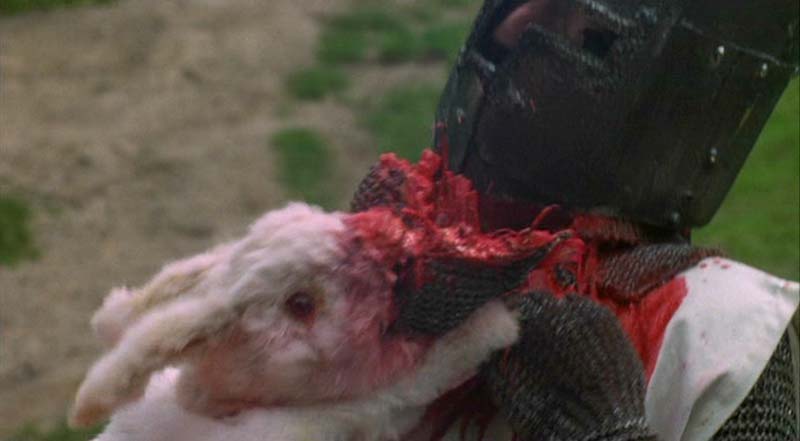
Monty Python and the Holy Grail(Terry Gilliam and Terry Jones, 1975) I also like "Monty Python." It is refreshing to turn on the tube and see total anarchy once in awhile. But, there is such a thing as good, disciplined cinema comedy, which places it above well-made home-movies like Monty Python and the Holy Grail. I mean, these silly gits won't even take the credits seriously, fer chrissakes! It is not without its gory charms (you have to admire people who come up with a blood-thirsty rabbit). Maybe what I'm griping about is this: It is possible to have good screen comedy and a disciplined film at the same time. It's even possible to have it with anarchic comedy as in Howard Hawks' Bringing Up Baby. And it is this discipline that is missing in "The New Comedy" as these films are billed*--they are funny, but they are not graceful. They are really quite slip-shod in the way they have been shot and edited.
"Zis is wot I sink off yo re-fiew!"
Really, the only man who is continuing in the tradition of anarchic comedy and good film-making is, of all people, Mel Brooks, but only because he made two gems of recent comedy--Young Frankenstein and Silent Movie. There is still hope for Woody Allen, if he returns to the style of Sleeper. There is no hope for Monty Python--they would have to change their comedy style--and it wouldn't really be worth it.
The moral to all this is: It may be funny as Hell, but that don't make it a good movie!
Broadcast on KCMU-FM November 4th and 5th, 1976
Poppycock! The style, or lack of it, in Holy Grail, is part of the fun. At times epic, and at other times amateurish, it is the unexpected ways that Python (Monty) has of playing with the medium that makes up the charm (and a great deal of the comedy) of the film. Another look at the film (with the stick removed from my ass) shows it to be messing with the conventions of the fantasy film and of film in general (love the credits with the Norwegian translations) in fresh ways--and isn't that evidence of style? And while Terry Jones, who directed most of Grail, has had a somewhat lackluster directing career, Terry Gilliam has had an amazingly rich (if problematic) one. Style? He has bags of it!
The writer of this review (me, younger and certainly dumber) was hung up on "Filum" as "Aht" and more concerned with adhering to basic rules of "cinemah," rather than working with, without and outside of them to create spontaneous comedy. Sometimes, obeying the rules deprives one of opportunities to expand the discipline to achieve a richer art-form. As for my better alternatives, the hope for Woody Allen that I spoke of was just around the corner with Annie Hall, and after his successes, Mel Brooks made the most conventional and laziest of his comedies The History of the World, Part 1 (after a less-than-inspired spoof of Hitchcock films, High Anxiety.) The dedication he used to bring the look to the movies I mentioned, went away, and he decided that what he was doing was "good enough." It wasn't. On to Broadway...
(Post-script: Ironically Holy Grail also made it to Broadway as "Spamalot" as directed by Mike Nichols)