Showing posts with label Jean Dujardin. Show all posts

Saturday, April 13, 2019

OSS 117: Lost in Rio

Written at the time of the film's release...on video.

OSS 117— Lost in Rio aka OSS 117: Rio Ne Répond Plus (Michel Hazanavicius, 2009) Another one that got away from theaters last year and ended up in the video aisles. Too bad. Because the first of the OSS 117 spoofs starring Jean Dujardin (Cairo: Nest of Spies) was an amusing spoof of the James Bond films, circa early 1960's under the direction of Terence Young—all high-light filming (it didn't rain in a Bond film until 2006's Casino Royale), clueless cool, casual absurdism, star Jean DuJardin's cheery resemblance to Sean Connery mixed with James Coburn's cheesy grin, and a pace that didn't give you a chance to question "Q'est-ce que c'est?"

Cairo: Nest of Spies nailed it. And the sequel: Lost in Rio (literal translation: "Rio Doesn't Answer") was to be filmed partially in the city of Brasilia, a 60's construct that could have been designed by Bond-architect Ken Adam—and played a role in the french spy spoof That Man from Rio.
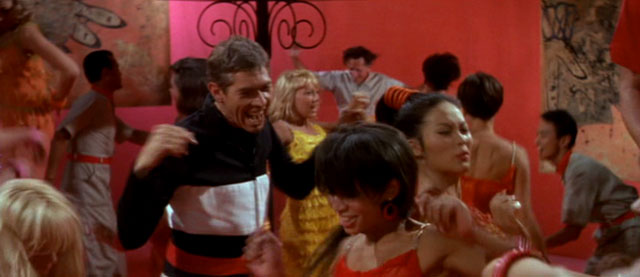
Lost in Rio doesn't disappoint. Establishing the time-frame as 1967, French agent Hubert Bonisseur de La Bath (with newly longish side-burns) enters the play-room of his Swiss villa in Gstaad, and begins to twist with a bevy of snow-bunnies in his Jean-Claude Killy snow-suit to Dean Martin crooning "Gentle on my Mind," documented in groovy split-screen (the year it was used extensively at Expo '67). 
The OSS spoof trademarks are trotted out—the adherence to early Bond director Terence Young's photographic style, that de La Bath's Walther ppk fires an endless supply of bullets from its clip (that's okay, as the enemy's Lugers do the same), he is still cluelessly sexist and racist in his attitudes, this time being particularly rude dealing with the Mossad and the Chinese. Here, he's helping Israeli agents track down yet another Nazi hiding out in Rio de Janeiro, with the passive-aggressive assistance of the CIA's Bill Trumendous (Ken Samuels). 
But, while paying homage to the Bond style, it also goes after Hitchcock (particularly his penchant for staging precarious situations on national monuments)—seems that, to add a little intrigue, de La Bath was once a circus gymnast where an accident gave him a phobia for heights. Where better, then, to have your climax than in/on Rio's most famous monument, the Christ the Redeemer statue that overlooks the entire city. Why, it would almost be blasphemous NOT to take advantage of it, given the film's encyclopedic use of Rio locations and it's slightly broader film references.
The humor is all over the map from subtle film references to absurd slapstick and Dujardin is still an amiable lizard-y presence.  This one wasn't as successful as the first film (hence its straight-to-video status in Region A-The States), but here's hoping they do more.*


* Plans for any more of these films has been side-tracked as both Hazanavicius and Dujardin both won Oscars for their next project, the silent film The Artist. Nothing can ruin a good thing like winning an Oscar. Damn legitimacy, anyway.

Saturday, April 6, 2019

OSS-117: Cairo, Nest of Spies

Written at the time of the film's release...

OSS117: Cairo—Nest of Spies aka OSS 117: Le Caire nid d'espions (Michel Hazanavicius, 2006) If I may speak collectively (and unfairly) for a moment, the French have a singularly exclusive sense of humor running precisely, if more broadly, along the Mel Brooks dictum: "Tragedy is when I cut my finger; Comedy is when you fall down a man-hole and die!"

The French love to laugh at other people. But, like a lot of conservatives, they seem incapable of laughing at themselves. When they make comedies, their sense of the absurd tends to be mixed with the noble—
Jacques Tati's films are restrained manner-comedies mixed with slapstick. Maurice Chevalier was a charming rogue, but never less than charming.

But when
Jean Renoir tried to be satirical about French aristocracy, the citizenry rebelled and Renoir had to cut one of the greatest films ever made, The Rules of the Game, down to a short subject. Don't mention Blake Edwards' Inspector Clouseau to them; they'll throw their dinner plates at you—if only there was enough food on them to cause damage.

The French are farceurs, not comedians.

Now, along comes this charming bon-bon of a spy movie, where they can have their cake and let them eat it, too.
The "OSS117" series is a long-running series of adventure spy novels from Jean Bruce—there's no Bond rip-off here, OSS117 predates "007"—featuring the adventures of the plucky French spy in globe-totting adventures. During the spy-craze of the 60's, there were many OSS films riding the swinging spy tux-tails, starring, among others, Ivan Desny, Luc Merenda, Kerwin Mathews (The Seventh Voyage of Sinbad), Frederick Stafford (Topaz), and pencilled-in Bond John Gavin,* made cheaply in Europe, and successful enough to achieve its own series. But by 1973, with abuses by CIA operatives around the globe, spies went out of favor. The books continued, carried on by the next generation of Bruce's.
And now, the movies have as well, taking the formula that the Bond producers used to keep Bond jogging in bell-bottom tuxes through the 70's—make it more of a comedy, dammit! But where the Broccoli family has seemed incapable of recreating the glory days of Bond—the epitome being From Russia With Love, directed by Terence Young, director Hazanavicius takes the style, the look, and the air of brazen world-weariness that Young injected into that film, and does a fairly transparent job of spoofing the misogyny and arrogance of those initial Bond films.
And it's funny as hell. It takes a while to recognize what Cairo—Nest of Spies is doing and get into the rhythm of the thing: is it serious, is it merely being archly ironic, or is this actually trying to be funny? Because there's no big joke in the opening black and white sequence, you might take the cockiness for real rather than the first signs that Agent OSS117 (the remarkably sunny Jean Dujardin) is remarkably clueless, so caught up in himself and his own shining brilliance that he's too dazzled to realize that things around him have gone horribly wrong. Many situations find him waking up from the distractions of himself to find that he's blown it and has to back-track a bit. 
It's one of the givens of the Bond series that audiences like a "007" film when the agent is enjoying himself. And Hubert Bonisseur de La Bath travels in an impenetrable bubble of self-satisfaction. He even has submerged homosexual urges that he doesn't recognize and that he mis-reads, anyway. He lives in the best of all possible worlds—his own—and his rules are simple: if he doesn't like it, he kills it, seduces it, or ignores it and moves on.
Fortunately, his enemies are just as adept at carrying out a world-enveloping conspiracy: they're not. Where the gears, switches and machinations of most movie-cabals perform flawlessly, this team of neo-Nazi's are more than likely to blow a fuse, or get trapped behind their own secret entrance. As such, there's not an awful lot of suspense (but there isn't in a Bond movie, is there?), and the only concern is how big the explosion will be at the end. OSS117: Cairo—Nest of Spies even manages to do that cheerily.
"OSS117" will return. Can't wait.


* Gavin, who starred in Spartacus and Psycho among others, was set to star in Diamonds Are Forever (1971) until Sean Connery was coaxed back with a record salary. He was paid off to fade into the background, and Ronald Reagan later appointed him Ambassador to Mexico. The best gadget any spy can have is a golden parachute.

Saturday, March 23, 2019

The Artist (2011)

Written at the time of the film's release...

Portrait of the Film as a Young Medium
or
Silents is Golden

First off...GREAT sound-design.

(tap, tap, tap...is this mic' on?)

It's easy to be positively giddy over the success that The Artist has enjoyed (ultimately winning the year's best Picture Oscar). I've enjoyed Michel Hazanavicius' previous pairings with Jean Dujardin—the spy-spoof OSS-117 films—even if they were a little uneven, they managed to nail the ambiance of the films they were parodying, while also chortling over their excesses, even while embracing them. 

And Dujardin is a terrific performer, light on his feet and hitting his comedy points with deft left jabs. In the "OSS" films, it was pretty obvious that he was a superb cross-over entertainer, believable when playing it straight (if ever), but also knowing just how far to push things to trip it into comedy. Unlike Peter Sellers, whose agents always seemed to be harboring deep-set inferiority complexes underneath their pompous egotism, Dujardin was always blissfully clueless, truly believing that he was terrific, and that the strings of pratfalls, misfires and collateral damage were just temporary set-backs, no matter how regularly they occurred, followed by a laugh that was too loud and went on far too long.
The Artist has no problems of pace, or of sequences that fall flat. It takes its strengths from the medium it cherishes—the silent films on the cusp of sound, when the visual art of story-telling was at its peak and was somewhat quashed to accommodate the large pieces of equipment that could squeak and rumble and ruin a fluid camera movement, and when expression was King. The world of film was silent and focused on image—I was struck in a sequence that showed a high angle of a motion-picture theater audience watching a film being projected with symphonic accompaniment, that the eye always wandered to what was on screen—it tells its story with the directness of vision of that particular era (okay, some close-ups belie the time and the film dispenses with fog-filters and other tricks employed then) and the clean image of glamour, even to the simplicity of a cold-water flat of an apartment. 
Faces are carefully chosen for contrast and specificity of character, rather than overall performance, and one can only imagine the voices that accompany the expressions—appropriately, dialog cards are used, but sparingly—nothing aural spoils the picture contained within the frame, widening it or presenting the intrusion of a world outside of it, a point that is made quite literally at one point in one very clever sequence. One is clued in early on, when movie star George Valentin (Dujardin) stands behind the movie screen as his film ends and awaits acknowledgment from the crowd.  Haznavacius holds on his image as he waits—there is only silence—until he raises his fist in triumph at the applause we cannot hear, and which is verified only by the enthusiasm of the crowd in the next shot. The rules are set—we have to trust in what we see, not in what we expect to hear. This is not verisimilitude—the illusion of reality imposed by sound and image—this is a heightened and false world of industrialized artifice, concentrated and crystallized in glamorous black and white fiction, flaws be damned.
"...the eye always wandered to what was on screen"

But, it's more than that. Haznavacius isn't satisfied (as
Mel Brooks was in his own Silent Movie of 1976) with just making a film without sound. He takes pains to evoke the era in which they were made, choosing the Los Angeles locations of the film extraordinarily carefully, to emphasize the arid spaces and chiaroscuro-deco architecture of the time (one nice sequence of a chance meeting on a studio staircase between Valentin—on his way down—and plucky starlet Peppy MillerBérénice Bejo, on her way up—is filmed in the beloved Bradbury Building, as if Fritz Lang or King Vidor had filmed it—straight on—as if to emphasize the ant-like activity of the personnel. And there is a visual grace to the story-telling that evokes the poetry that silent films were capable of in getting their point across without words.

Anything wrong with it? Not really, even the "controversial" use of Bernard Herrmann's "Scene d'amour" from Vertigo is appropriate (far more than it was in 12 Monkeys), with its combination of dramatic urgency and heartbreak, for a sequence it was clearly designed for. There are other films that were released last year with more reach (The Tree of Life) and depth (The Descendents), but The Artist is a great evocation of the joy of cinema, and its possibilities to entertain, even with limited means.
"...when the visual art of story-telling was at its peak"

Sunday, March 2, 2014

The Wolf of Wall Street

Down Wall Street Lay Many Socio-Paths
or
The Bacchanal Stops Here (in the Raging Bull Market)

"May you live in interesting times" says the old Chinese proverb.  With the Chinese holding a good chunk of the U.S. debt and the financial stakes being held by the likes of the degenerates of The Wolf of Wall Street, these are interesting times, indeed, as Martin Scorsese and his frequent collaborator Leonardo DiCaprio present a contemporary tale of Roman excess, only slightly more believable than the horrors they collaborated on with Shutter Island by hoodlums only slightly more endearing than the gangsters of Goodfellas.

That it is also Sorsese's most roaringly entertaining film in awhile says something else.


One must be prepared to be shocked going in—the film starts with a dwarf-tossing contest as a way of letting off steam on "casual Friday" and that's just the beginning—within ten minutes we'll be treated to a rather delicately composed shot of DiCaprio's Jordan Belfort, the late 20th Century descendant of Horatio Alger and Sammy Glick, snorting cocaine from a highly unusual receptacle, and still thoroughly plowed out of his mind that he crashes his personal helicopter onto his property. And over the next three hours—don't worry, the movie zips by, jumping from extreme to extreme every ten minutes like battles in a space epic—we follow a familiar path in the films of Scorsese, of the rise, fall and subsequent grovelling of its protagonist, forced to a penance of knowing how good he had it and never being able to get there again—of having "the secret" and not being able to use it. There has been a critical backlash that perhaps Scorsese and his screenwriter Terence Winter haven't been quite so judgmental in their portrayal of the events of the film, but that's because they've chosen for their principal point of view that of Belfort, himself, who, while breaking every rule in the book to get whatever he wants, violates the fourth wall, continually, as well, addressing the audience and explaining enthusiastically "How He Did It." It's the perverse counter-point to the kind of seminars on selling that Belfort conducts now to make money...and avoid the constant glare of the authorities who took him down.
DiCaprio's Belfort Explains it All to You
It's also the American Dream turned into an American Nightmare. Belfort takes the get-up-and-go spirit of American capitalism and never puts on the brakes. In America, he hears nothing but the sound of opportunity knocking—at every opportunity, in business or his own pleasure—and, like any addictive personality, can't stop. He is given a lunch-lecture on the perverse nature of Wall Street brokering by a mentor Mark Hanna (Matthew McCounaghey, scarily entertaining, again), downing martinis and snorting cocaine at the table, explaining in a rambling monologue about the pressures on brokers pushing "fugazi's" while enjoining Belfort to join him in a fraternal caveman chest-thumping that becomes emblematic of the low-mindedness of every enterprise Belfort takes on subsequently.  For awhile, he does okay, then gets blown out of his job, thanks to the Crash of '87.

He's reduced to making cold-calls on penny-stocks for a boiler room in a strip mall, where Belfort soon establishes himself as a top-tier hustler there, adapting an attitude of hyper-optimism for gullible first-time investors, finding as he does so that he is actually making more money as he gets higher commissions pushing worthless stocks. To push his credibility with buyers further, he establishes a new firm with a neighbor Donnie Azoff (Jonah Hill) and a line-up of friends who are bottom-feeder salesmen and drug pushers. They start a firm with the prestige-dripping name of Stratton Oakmont, aggressively playing the market by promoting bad stocks, then cashing out once the stocks reach a peak, a strategy scam called "pump and dump."
Soon, Belfort and Co. have more money than Croesus, which they re-invest in extravagent lifestyles, primarily booze, drugs—primarily cocaine and quaaludes—and hookers, which are claimed on taxes as entertainment expenses. "
On a daily basis I consume enough drugs to sedate Manhattan, Long Island, and Queens for a month," he crows in voice-over. "I take Quaaludes 10-15 times a day for my "back pain",Adderall to stay focused, Xanax to take the edge off, pot to mellow me out, cocaine to wake me back up again, and morphine...well, because it's awesome." Before too long, he's in a toxic affair with Naomi Lapaglia (Margot Robbie), "a former model and Miller Lite girl," which gets found out by his wife, he's divorced, and married again to his blond dream girl.

"Cinema is a matter of what's in the frame and what's out"--Martin Scorsese
Margot Robbie as "Naomi" Belfort
But, that's not enough. There is no limit to his appetite or avarice. And before long, he's noticed by the IRA and the FBI, which leads him to Swiss banks and offshore investments, and an escalating series of disasters as the risks he takes (along with the drugs) increases.
It culminates in one of the funniest, scariest sequences in movies this year, as Belfort has to call his lawyer from an "outside phone" (his have been tapped by investigators) at the same time a few quaaludes ("Lemmon 714's") past their shelf-date by a few years finally kick in, and leave him a drooling, crawling, babbling mess unable to function, at anything above an autonomic level. Here's that scene, but be warned, this is
NSFW, has multiple f-bombs (this film set a record for fictional films of 569 times over three hours, averaging 3.18 per minute, the clip is five minutes long, so you do the math), and will look bizarre out of context, as it is bizarre and zany enough in the film.

DiCaprio's work here is hilarious, but the entire performance may be the best of his career, a prancing walk-and-talk act with the kind of pugnacious grace that Cagney gave to his gangster roles and Malcolm McDowell gave to his thug in A Clockwork Orange. There's a mad-cap joy to his work, and a genuine desire to make Belfort look as dysfunctional as possible, a prince in the boardroom, but a sad-sack in his private life, that's only matched by Jonah Hill's second-in-command who knows no shame, and may be more out-of-control than Belfort. Margot Robie will be wise to de-glam her next few roles, if she doesn't want to do the next ten "It-girl" roles—after Sharon Stone, Nicole Kidman, Charlize Theron, Angelina Jolie, and every model who's tried to act—as she's barbie-doll-objectified to perfection, but also given some roaring good scenes to spit out. Kyle Chandler is the hang-dogged FBI agent assigned to Belfort, and the movie is full of nice work by a long line of character actors, including bits with Jean Dujardin and Rob Reiner.
As I said, it's the "fullest" film of Scorsese's recent decade of movies, but it won't be everybody's cup of arsenic—the film has been attacked for being sexist and not condemning Belfort more. Both attacks seem a little spurious, as Belfort and Stratton Oakmont were as "Old Boys Club" as it comes, and reveled in declass
é behavior of all stripes—"not only was he a degenerate and a crook but he didn't have a high opinion of women, either" wins the "Sherlock" award for stating the obvious. And, again, the condemnation?  It's there. Belfort out of control looks as ridiculous on-screen as the filmmakers can conspire to make him, short of giving him a "Bozo" nose; just because he is too full of himself (or some other substance) to recognize his ridiculousness does not mean that depiction does not exist. It just means that the character is maintaining his conscienceless attitude and his sociopathic detachment, especially regarding himself. In the Scorsese mixture of bull-headed comedy and tragedy, the protagonists don't recognize condemnation, even if they get it.
It is, after all, "based on a true story."  And a real creep.
The real Jordan and Nadine Belfort in happier, if less sober, times

That "Forbes" article they talk about in the movie.

Thursday, February 20, 2014

The Monuments Men

Guerra Gratis Artis
or
Saving Private Collections

The Olympics are going on, which always reminds of the great debt we owe to the Greeks and to Greek mythology, all of the written records of that civilization that has enriched our lives and manage, over the centuries, to still reflect and caution us, through its stories. And we couldn't thank the Greeks, if we don't, in turn, thank the Jews, who saved those written records of Greek mythology from being destroyed in the many upheavals resulting from so many transitory religious and political conflicts. Long term accomplishments can be utterly obliterated by something so blinkerdly short-sighted. History can be erased.

That, ultimately, and a bit ironically, is the point behind The Monuments Men, George Clooney's new movie, which he directed (and co-wrote with his regular collaborator Grant Heslov). In it is told the tale of the men who, during the second World War, tracked down confiscated art looted from Nazi occupations, if it could be found, in order to return it to its rightful place before the war. They did this during the war in progress.
It sounds like a fool's errand. War is messy. Profoundly messy. To everything. It is chaos incarnate. To think that one could actually try and put some order back into it, while the war is still waging, is more than a little wistful, it's downright barmy, like literally trying to stop a tidal wave with a teacup. It's the idea of someone with an out-sized sense of justice, or a die-hard romantic...or an academic.  

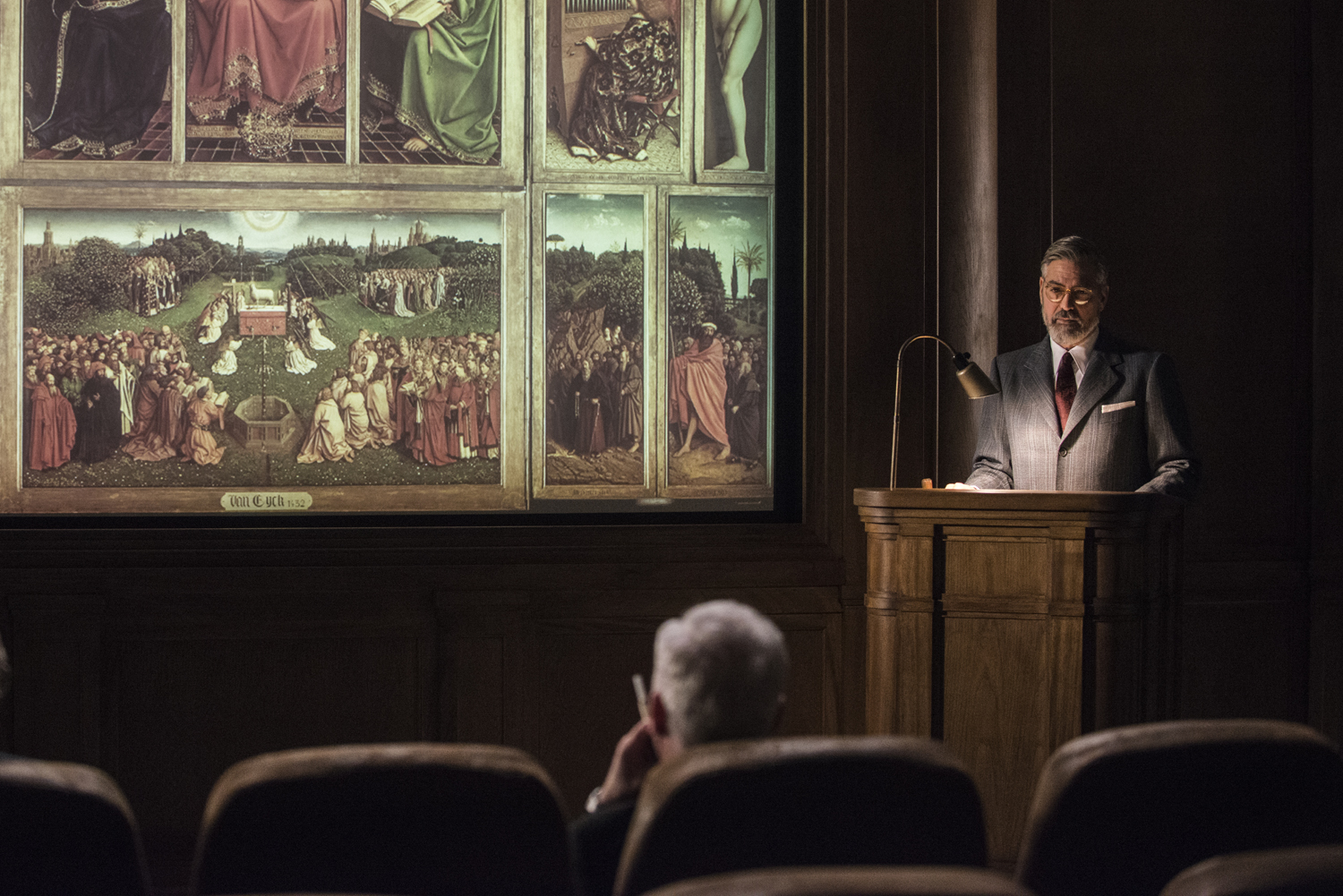
Frank Stokes (Clooney) is a man in a hurry. We meet him giving a lecture to FDR about the situation of certain art pieces in Europe that have gone missing, possibly destroyed or maybe housed for the eventual Fuhrermuseum that has been planned for the Third Reich's future after the war.  With the Nazi's defeat becoming more and more certain, Stokes wants to lead a squad of art experts to track what has become of the missing artistic culture of Europe, lost, stolen or destroyed.  

Roosevelt is a bit more practical. "But, Mr. Stokes, this is war." Stokes won't be deterred. "Who will make sure that Michelangelo's David is still standing. Or that the Mona Lisa is still smiling?" He's given the go-ahead and assembles a small team of art experts, none of whom have any business on a battlefield. And here's where the cast comes in and it is exceptional...and bit quirky. Matt Damon, Bob Balaban, John Goodman, Bill Murray, Jean Dujardin (of The Artist), and Hugh Bonneville (from "Downton Abbey") and...just to keep it from being a complete boy's club...Cate Blanchett as a museum curator who takes notes just as well as the Nazis.

The cast is diverse but quirky. They're paired up—Goodman with Dujardin, Balaban with Murray, Blanchett with Damon—as they go investigating leads. The tone is a sober Kelly's Heroes vibe, with some lightweight dramatics, and episodes of joshing cameraderie. I hate to say it, but it's a bit episodic, like an episode of the TV-series "M*A*S*H," juxtaposing serious and comedic. There are good scenes (the best being Clooney interrogating a Nazi later in the movie), but a lot of things feel slight, depriving the movie from feeling like a whole film, as a series of vignettes, a few highlights and that's it. 
Time Magazine has criticized The Monuments Men for "dumbing down" the story (and there is a certain amount of that), but ultimately it's not a matter of "dumbing down" that keeps Monuments Men from being a good film (or even a good treatment of the story) as it is a matter of scope—the story is too vast to contain in two hours, and the movie concentrates on certain pieces: Michelangelo's "Madonna and Child," and The Ghent altarpiece, and as long as those stories are complete (and we see the vast warehouses of other pieces, which would be handled, I presume, in Monuments Men II) the movie seems satisfied that it is enough.

Except for the film's central theme, brought up at the beginning and the end of the film: "Is a work of art worth a man's life?" Is it worth the lives of the men who undertake this mission (their recruitment is treated rather sketchily, and there is no doubt, waffling, or questioning of it), and is it worth the life of any soldier who might get killed in order to "protect" a building or fresco?* Monuments Men never answers that question other than to say "it's worth it if that soldier chooses it to be" (as if they have any choice, orders being orders and war being war).That answer is not good enough, given the time invested in the film and its characters. 
Still, it's an interesting story of a quixotic crusade for permanence for a world in turmoil...of trying to keep the most beautiful work of human beings from being destroyed by their ugliest instincts.


* That theme is handled much better in Saving Private Ryan, as the men question why their lives are being risked to seek out and find one dog-face.