Night Moves (Arthur Penn, 1975) Harry Moseby (Gene Hackman) is your classic detective as tarnished knight. A lone-wolf ex-jock who plays the cards he's dealt and holds them close to the vest. Nobody gets in, not his wife, not his clients, not even his acquaintances. To accentuate the point, Director Arthur Penn surrounds Harry with glass and view-screens. He's a detective—a peeper—and he's always peering through those wind-shields, portals, and glass-bottomed boats at the world, though a little filtered, a little distorted. They are part of his job, but as they also provide him a view, they are also a hindrance...and a refuge. He can look through these transparent barriers, but he can't touch. And no one can get through to him. Frequently—so frequently you can't miss their use—the windows have one of those distorting fish-eye appliques that bend and distort the world in a round, limited circle—a fish-bowl—appropriate for someone so myopic as Harry.Harry's a loner, so much so that he won't take a job at an information mill because it's "not for him." And he's got a big mouth but just enough suppression instinct that the one it hurts the most is him, and a snide sense of humor that rubs the wrong way. He's so set in his ways that this old dog that won't learn new tricks has begun to chase his own tail. He's investigating himself, or rather, his wife, who's been stepping out on him. When he exposes the affair, everybody involved throws Harry's history back at him, something he avoids at all costs. He's more comfortable analyzing other people's problems to look at his own.The screenplay is by Alan Sharp, and Harry is another solitary guy on a "last run," at a cross-roads that he'll turn after he's done one more job. He'll quit while he's ahead. But his timing is a bit off. The movie starts just as this one case begins: a dirt-job for an aging starlet whose slut of a daughter (Melanie Griffith) has run off to the step-father. It's a family in the Chandler-mystery mode, good money can't hide bad blood-lines. Mom wants her back, but not out of some familial bond. She just wants the child-support. So, Moseby takes a long trip to Florida to try and convince the kid to do something neither of them thinks is a good idea: Go back. And, as in Chandler, that case is just the tip of a dangerous ice-berg, one that improves Harry's vision, but only with 20/20 hind-sight.When I first saw Night Moves—back when it played theaters, I was unimpressed. Now, seeing it at an older age, it looks like a masterpiece, the understated classic that some have said it was. The movie hasn't changed...but I have, and I appreciate the issues in it, and see it with a much better clarity than when I was younger. Getting old does that. I'm just lucky enough to be getting old.
This was part of a series of reviews of the ASUW Film series back in the 1970's (I actually think I need to put the century in now). Except for some punctuation, I haven't changed anything from the way it was presented, giving the snarky, opinionated, and woefully inadequate kid I was back in the '70's a break. Any stray thoughts and updates I've included with the inevitable asterisked post-scripts.
This Friday's ASUW Films in 130 Kane may comprise the best double-bill, with one notable exception, in the entire series. They are Arthur Penn's Bonnie and Clyde and Robert Benton's Bad Company.
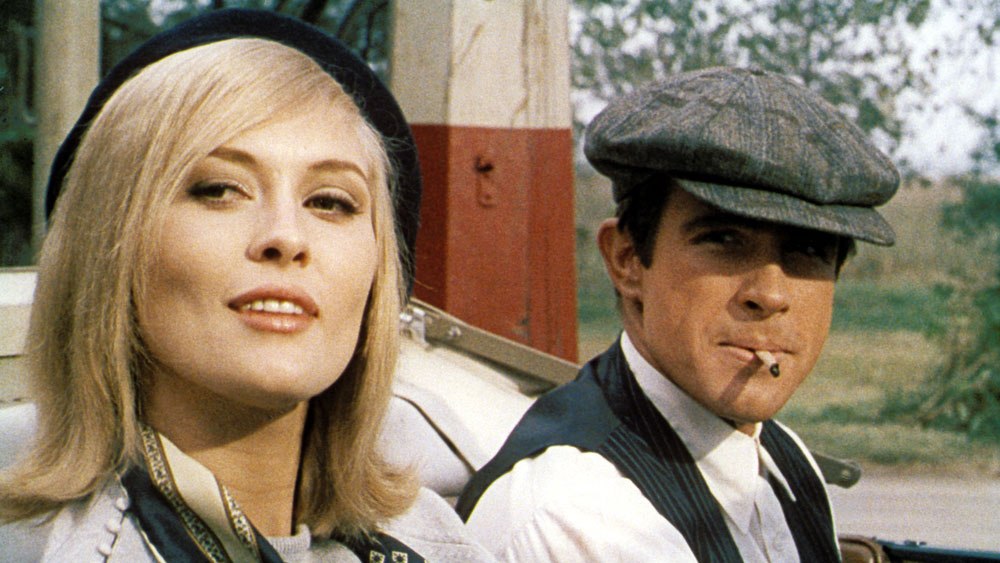
Bonnie and Clyde (Arthur Penn, 1967) Bonnie and Clyde caused quite a stir when it was released in 1967. It was one of the first gangster movies, at least within most casual movie-goer's memories (which isn't much) to treat these people not as psychopaths, but as ordinary people who were caught in the Depression's whirl-pool and didn't know any other way to fight it. In other words, it attempted to de-mythologize the Barrow Gang. Unfortunately, the film created as many myths as it debunked. But then what else can you expect when you have two "beautiful people" like Warren Beatty (who does a fine impression of Warren Oates*) and Faye Dunaway (whose acting wasn't equaled here until Chinatown in 1974).
William Bayer in his book "The Great Movies"** has said "what is also personal about Bonnie and Clyde, and constitutes its unique flavor is its curious blending of comedy and horror, its romanticization of crime as something that is fun, and that also leads to violent, bloody death. Bonnie and Clyde is both real and abstract, a gangster-movie and a comedy-romance. It is a comedy that turns dark, a romance that ends with death."
Death in Bonnie and Clyde is of an explicit nature. It was the first popular film to use the modern film technology to present a heightened violence that created the trend that is still going on today. Of course, no one forgets the slow-motion slaughter of the two at the end--"the dance of death"--it's dream-like quality, because Death's constant presence in their lives has turned it into a dream. Slo-Mo violence has been used after ad infinitum with no imagination and less effect.***
There are other moments: the first violent death of a clerk;**** the performances of Gene Hackman, Estelle Parsons, Michael Pollard, Denver Pyle and Dub Taylor; Bonnie's escape in a corn field; the death of Gene Hackman; the comedic perfection of Evans Evans and Gene Wilder (in his first movie); and probably, best of all, the reunion with Bonnie's parents before their world falls apart.
Yeah, it is Arthur Penn's finest film. Borrowing from the past, but also using his own sense of cinematic imagery, Penn has made a complete, whole film--something that can't be said of his Little Big Man, Night Moves, or The Missouri Breaks with their only occasional moments of brilliance.
Broacdcast on KCMU-FM January 20th, 1977
* I sense "snark" there. I don't think it was related to Oates playing Dillinger in 1973—a film that owes a lot to Bonnie and Clyde, one should mention—but, rather the hyper roles that Oates played in the early 1960's. If you watch Dillinger (which came out six years after Bonnie and Clyde), with Oates as the titular gangster, you'll notice that he plays his role with more gravitas. It's the difference between Oates changing his intensity from a supporting actor getting himself noticed to a star role where there is more depending on the lead.
** Sadly, out of print, and not to be confused with Roger Ebert's "The Great Movies" series of books. Bayer's book was a fairly non-controversial heavy tome with well-written appreciations and beautiful photographs. I've still got it, and still treasure it. I became acquainted with Ebert's two-book series over a weekend, and found them both very enjoyable in Ebert's typically "personal-relationship-with-the-movies" style. All totaled, before his death, he increased the number of "must-see" movies to 379. You can find the list here. *Sigh* No rest for the wicked.
*** The thing that makes Bonnie and Clyde's death-scene in under-cranked motion so well-done (as opposed to most that came after) can be attributed to the editing of Dede Allen, whose scrupulous work for Penn and Sydney Lumet, raised it above the typical use of slow-motion, which is generally used for exploitation purposes. I might have been harping on Sam Peckinpah at the time I made this point, but, despite his reputation, even he only used flashes of slow-motion amidst a fast edited sequence to highlight a story-point, or prolong a moment of shock. Nowadays, the "dance of death" sequence (as it became known) looks a little tame compared to today's cinema carnage. It's still arresting, though.
****Based on a similar shot in Eisenstein's Battleship Potemkin--folks were getting into film-school references at this point, and I think it marks the bifurcation point where directors stopped drawing inspiration from life and, instead, drew inspiration from other movies—to the medium's detriment, I think.
Tomorrow: Bad Company
 Harry Moseby (Gene Hackman) is your classic detective as tarnished knight. A lone-wolf ex-jock who plays the cards he's dealt and holds them close to the vest. Nobody gets in, not his wife, not his clients, not even his acquaintances. To accentuate the point, Director Arthur Penn surrounds Harry with glass and view-screens. He's a detective—a peeper—and he's always peering through those wind-shields, portals, and glass-bottomed boats at the world, though a little filtered, a little distorted. They are part of his job, but as they also provide him a view, they are also a hindrance...and a refuge. He can look through these transparent barriers, but he can't touch. And no one can get through to him. Frequently—so frequently you can't miss their use—the windows have one of those distorting fish-eye appliques that bend and distort the world in a round, limited circle—a fish-bowl—appropriate for someone so myopic as Harry.