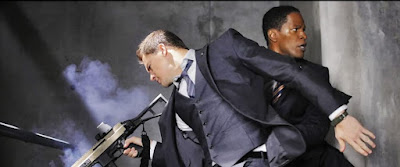
The second movie of 2013 where the White House comes under attack while a special agent tries to save a kid inside, this one was Roland Emmerich's continuation of his Edifice Complex, where he made movies just to see famous things blow up. Now, it should be noted that we are talking about White House Down and not Olympus Has Fallen—in which Gerard Butler plays the "die-hard" agent trying to stop an attack by North Korean terrorists. In THIS one, Channing Tatum plays a "die hard" agent trying to stop an attack by home-grown terrorists who are whiter than white.
Which one seems more likely? Well, neither of them. But since 2001 the terrorist attacks on the country has mostly been by white guys...as they were before 9/11. As they were on January 6, 2021
Oh, yes, and in both films, an African-American male is the president for a brief time. That's because, at the time, an African-American male was president full time.
The reason for attacking the White House doesn't have anything to do with the sitting President being an African-American—ostensibly it's to gain access to the nuclear codes to launch an attack on Iran for the deaths of relations and comrades of the attackers—but one can't help but wonder why the movie (and in fact, both movies) were timed to be at a time when an African-American was president. Did they think they could take advantage of bookings at White Supremacist Film Festivals?
Whatever the motives, the film looks at a day in the life of Capitol Police officer John Cale (Tatum), who's looking to move up from his job protecting Speaker of the House Eli Raphelson (Richard Jenkins) to a job with the Secret Service protecting the President, who happens to be James Sawyer (Jamie Foxx). His application does not go well, being rejected Deputy Special Agent Carol Finnerty (Maggie Gyllenhaal). Perhaps it has something to do with their past history. Perhaps it has something to do with his being a divorced parent to his daughter Emily (Joey King). If it has anything to do with work experience, he's going to get plenty of that. The plan for the terrorists (and one can not call them anything but that) is to blow up the Capitol (sounds familiar...) and in the resulting confusion, the Speaker of the House—Raphelson—gets sequestered because he's No 3 in the presidential chain of command. He's put in an underground bunker under the Pentagon. The Vice-President (played by Michael Murphy) is evacuated by Air Force One (because Air Force Two—the Veep's plane—supposedly isn't good enough). At that point, an assault team, led by some whacko former Delta Forcers storms the White House with the intention of taking the President hostage. The Secret Service—supposedly the best and the brightest—is easily overrun and the President (Foxx) is taken by his retiring head of protection Martin Walker (James Woods) to the Presidential Emergency Operations Center under the White House. Except for one thing: it's Walker who has planned the assault (which is why the Secret Service was taken out so easily). So, now, the President is held hostage, and Walker is free to use a hacker to get into the PEOC's command center and try to get the codes for a nuclear strike on Iran. Cale, however, takes down a couple of the terrorists, and using their communications and weapons is able to rescue the President from the PEOC. They are presumed killed trying to get out of the White House, and aboard Air Force One, the Vice President is sworn in. He orders the White House be attacked by air to try and take out the terrorists, which fails when all the attack helicopters are shot down. Walker has his hacker launch missiles from NORAD and Air Force One is blown out of the sky, thus making the Speaker of the House President. Watching this from a hotel room while doing some government work, I couldn't help giggling at the outlandishness of the whole thing (although kudos for having the President using a missile launcher from a moving vehicle). It is so over-the-top, so hysterically hyperventilating that I couldn't help seeing the whole thing as just a silly exercise in taking Die Hard to the federal government, every Yippee-ki-yay intact (I think Tatum was even wearing Willis' old wife-beater, too). The movie was already out of my mind when, that evening, I watched news coverage of Biden being declared the winner of the 2020 election. So imagine my surprise when on January 6th, 2021, the U.S. Capitol was overrun by a bunch of wacko's (including a "voice-over actor" dressed in a Buffalo headdress) storm the Capitol and gum up the gears of government with their own poo-flinging. This seemed over the top, as well, but I didn't giggle. Lives were lost. A coup had been attempted, and it, too, was an "inside job"—the National Guard had conveniently not been deployed that day. The President was apparently having too good a time watching it on TV. Our country is a fragile thing, expected to run on automatic pilot with the least amount of effort and the inevitable failings falling through the cracks when such an attitude is taken. That's how we do things in the U.S., in business and government. Do as little as possible. Hope for the best. And, as viscerally feverish as White House Down is, it still seemed more concerned with getting the most amount of property damage, than with the damage done to institutions that are expected to be just "there" for us when things are in crisis. I'll bet a lot of the terrorists on January 6th still expected their Social Security checks the next month. And I'm left with one little evil thought—the most satisfying moment of the movie for me, actually—that I mutter every time I see one of these jacko's complain about their harsh treatment being charged, or some mis-begotten throwback of a senator or representative talk about it being BLM behind it all—all those white people...really?—or that it was just "a normal tourist visit." It's become my mantra straight from the bile duct and it's from the scene below and I say it through clenched teeth and with quite a bit of dudgeon. I find it satisfying and I'll probably be saying it for quite awhile: "No jail for you, ya little bitch!"
 Harry Moseby (Gene Hackman) is your classic detective as tarnished knight. A lone-wolf ex-jock who plays the cards he's dealt and holds them close to the vest. Nobody gets in, not his wife, not his clients, not even his acquaintances. To accentuate the point, Director Arthur Penn surrounds Harry with glass and view-screens. He's a detective—a peeper—and he's always peering through those wind-shields, portals, and glass-bottomed boats at the world, though a little filtered, a little distorted. They are part of his job, but as they also provide him a view, they are also a hindrance...and a refuge. He can look through these transparent barriers, but he can't touch. And no one can get through to him. Frequently—so frequently you can't miss their use—the windows have one of those distorting fish-eye appliques that bend and distort the world in a round, limited circle—a fish-bowl—appropriate for someone so myopic as Harry.