Joel Coensteps away from "The Coen Brothers" partnership to present his own version of Shakespeare'sThe Tragedy of Macbeth (or "The Scottish Play" if you expect a sandbag to fall from the rafters). There's nothing to fear here: brother Ethan usually writes their stuff and Joel directs with some intersection of duties between the two. But, here, brother Joel already hasa collaboratorandthe materialhas been proven time and time again (and tomorrow and tomorrow and tomorrow), despite the superstitions that have hovered like crows over every stage production.
There have been so many filmed presentations of "Macbeth" and re-imagined scenarios in which it takes place that one wonders what Coen, taking the text, would do with it. He doesn't try to anachronise the story, moving it to Haiti or setting it in Nazi Germany, but keeps it in 16th century Inverness. Presentation of that historical "Macbeth" recalls the way Orson Welles did it in 1948—stage-bound, Academy ratio, black and white, with an eye towards German Expressionism.
It begins with a shot straight up into the sky, the wind blowing, smoke and clouds combining and birds gyrating into the sky. Nature is on alert and moving because man is up to something unnatural—a battle has just been fought. Meanwhile a lone figure (Kathryn Hunter) scuttles—there is no other word for it—across a dirt path in the fog, muttering to itself and to others. This is Coen's interpretation of Shakespeare's witches, one being, recalling Andy Serkis' Gollum from The Lord of the Rings, but not a CGI creation, but one of theatricality, with twisted limbs like a bird's and a hoarse croak of a voice that feels like nails on a file. The performance is weird without being traditionally spooky and sets you on edge for what is to come.
What is to come is a professional interpretation without too much weirdness. Hunter is a tough act to follow, and she is the highlight in a film that should be full of them. I say that, but it needs to be said with some context. "Macbeth" is a much performed play, both in theater and the cinema (every decade has one film of it, it seems), and, like a symphony—or other piece of music—it can be played in differing manners even if maintaining the ascribed tempo. I might have a "perfect" rendition of the piece (and other listeners another idea of what that might entail) and notice the change of "attack" or emphasis in certain sections. It comes down to interpretation, and "Macbeth" is just as susceptible to those variations.
Like the 1948 Welles version, this one depends on less being more (although Coen citesCarl Theodor Dreyer more than Welles), the backdrops shadowed or cloaked in mist and blocks of perfectly proportioned masonry with less emphasis on grit—as, say, Polanski's version—and the figures walking through them are like mice in a maze. Predestination has created their paths and their choice is to simply follow through or not. It's a curiously unpopulated world, the only crowds being the line of soldiers set to attack Macbeth's castle, hemmed in by the "Birnam wood" of the witches' prophecy, the rest being stark spaces shadowed by the blackest blacks.
Through these spaces, the characters pace, for the most part sheltered from the wild outside that knows no geometry of straight lines, but intrudes—once the Macbeths screw their courage to the sticking place by regicide—not only by physical presences, but by the sound of that nature booming (not just knocking) to be let in, like consciences made tactile.
The acting is great throughout, with Brendan Gleeson, Alex Hassell, Stephen Root (!!), Moses Ingram, and Frances McDormand all breathing new life into the texts, bridging that Elizabethan gap of Shakespearean prose by the sheer force of performance. Denzel Washington does well (as well), bringing a maturity to the role rather than—as in some versions—as a walking personification of overweening ambition. It is only in his interpretation of the "Out, brief candle" speech that leaves a little something to be desired at that critical junction of the play.
Up
until then, Washington's Macbeth is a pragmatist, slightly world-weary
and seems beaten down—he has just come from a war, after all. What
is most interesting is that both Macbeths in this iteration are older,
childless (so no chances of succession), and obviously have seen chances for advancement taken away
from them in the past, and that, now, with this hope given thought by a supernatural
origin, are almost desperate to take advantage of it, lest it pass from them one last time. Once he is king, and things start to fall apart, one would think there would be more shock, more realization that he might have been duped by the very forces that emboldened him. But, that's not there. Instead, it seems he's returned to the world-weariness at the beginning of the film—which is inconvenient as he still has much to fight. It feels false, and is missing a sense of bitter desperation that will carry him through the inevitable end.
Still, it's a beautiful, often mystical film to watch and listen to. And it's always a welcome break to just take in Shakespeare to relieve oneself of the mundane nature of everyday-speak, and glory in the poetry and precision of his story-telling.
Llewelyn Moss is out on the Texas veldt tracking a caribou he shot, following the blood-trail when it is suddenly crossed by another blood-trail. Following it, he finds a drug-deal gone bad--five vehicles, and several dead Latinos, a truck-bed full of cocaine and eventually a satchel filled with stacks of of money, $10,000 to a stack. Fate is good to him.
Anton Chigurh is hunting, too. He needs a vehicle, and as he's driving a stolen police car, he can pull over anyone he chooses. He walks over to the driver side of the car, carrying a gas canister and a nozzle. "Get out of the vehicle," he says. And the driver complies. "Hold still, please, sir," he says, and the driver complies. He points the nozzle at the man's forehead and fires.
Sheriff Ed Tom Bell has been Sheriff of Terrell County since he was 26 years old, and that was a long time ago. You'd think he'd seen everything, but he's beginning to wonder if such a thing is possible. Looking over that drug deal gone bad while horse-back, he surmises the way things went down. "That's very linear, Sheriff," says his deputy. "Age'll flatten a man, Wendell," he not particularly replies.
The first time I'd heard of the Coen Brothers was a Time Magazine review of their first movie Blood Simple. When it wound up being featured at the Seattle Film Festival I went, expecting great things and their quirky ways of telling a story, like that travelling shot (by future director Barry Sonenfeld) that glided over a bar-top, rising up and over a fallen bar-fly. But what I wasn't expecting was a sequence that is one of my favorite in all of film, and is such an obvious thing to do, I wondered why nobody'd thought of it before. Ray has just murdered his lover's husband and stashed him in the back-seat of his car to take him someplace remote to bury him. But as he drives the long, flat Texas highway at night, the corpse behind him moans and moves. He slams on his brakes, pulls to the side of the road and runs...runs in a panic to get away, into a field. He runs into the dark until he stops, panting in fright and exertion. He stands there, looking back at the car. Now what? He's "safe." He got away. but he's no better off than he was before. He has to go back. And he especially has to go back before another car or truck approach and bathe the scene in light.
He has no idea what he'll find when he goes back there, but back he must go. It's the center of the Big Undecipherable that is the heart of the Coen brothers' movies--when people start to ask "how did I get here? And how do I come out, if I can't go back?" There's no going back to Square One with the Coen's. There is only the going-forward, head up or head bowed.
In its way, No Country for Old Men has bits of other Coen movies all over it. The "cat-and-mouse" games of Blood Simple. The airy philosophy of O Brother, Where Art Thou? The sharply written common dialog of all their films. The questioning law officer with philosophical questions of Fargo, the "what's it all worth" tragedy of Miller's Crossing, and Barton Fink. It stands as a good primer for all that is good in their work.
Is it their best work? The "Masterpiece" that it's been touted as? Hard to say. There seems to be a decided effort on their part to NOT make it that, to undercut the impact that the film could have had had they been more direct, hit things on the nose, as they say, rather than leaving things unsaid and perhaps confounding their audience. They've left room for interpretation and controversy, to make one think about the importance of dreams, of Fate and Destiny. One has to review the film that is, not the film that could've been. And No Country, as is, has some exquisite cinematography (by Roger Deakins--night shooting has never looked more convincing or as beautiful as here), note-perfect performances by just about everybody in the cast, but especially all the leads--not just Tommy Lee Jones, and Javier Bardem and Josh Brolin, but also Tess Harper (where's she been?), Woody Harrelson, Stephen Root, and Barry Corbin.
What makes No Country for Old Men different from the other Coen movies is a departure from the insular, claustrophobic worlds they have presented in the past. Before the films never strayed beyond the orbits of the main characters of their films--the surroundings filled with extras were there as filler. But this feels like a fuller world, a complete world, where every character has worth and life seems to be going on beyond the frame. That's new, and it will be interesting to see where this aspect of their film-making will take them.
Written at the time of the film's release... That Sunday Night Feeling
A director's got to love a project...I mean, really love it... before they devote two to three years of their life, and millions of dollars to it. Maybe the incentive is financial, maybe it's prestige, or getting something someone else wants. But you have to wonder what George Clooney saw in Leatherheads, his "football at the dawn of the pro's" movie. It can't have been financial, although there would probably be a number of ticket-buyers who would go see him or Renee Zellweger in anything. I'm sure there wasn't a bidding war on it, and the studios tend to thumb their noses at "period pictures" (although that's all Clooney's directed so far) because they cost more than a modern-day movie. But Clooney can make any movie he wants as long as he's in front of the camera.
Why this?
Maybe it's a love of football, or the time-frame when liquor sales were banned and speakeasy's were the black-market--when the country was suffering and needed heroes, and when nobody looked twice if you broke the rules...because there weren't any. College football was the game, and pro-football was only for those lugs who never grew up. We believed in heroes hook, line and sinker, and didn't question anything. Life was tough enough. Was that it? Or does Clooney just get his jollies pulling off a movie-trick like making you believe you're really watching a movie set in the '30's, down to the cars, the wardrobe, and the fast way with lines that makes you realize you missed a joke two lines back on the way to the capper. Is it a tribute to Hawks? What is this amiable mutt of a movie?
It works, of course, because Clooney is a good director who's willing to stretch and teach at the same time. He's an artistic director who pulls things off like comic timing and the way a joke is told just by the way it's framed and by the stillness of the thing. He's a director of grace notes that linger because it would just be too sad to waste that held moment that might define a character or make a third-string player a second-string player, and he loves his cast--he knows that the best part of John Krasinski is he's got the wide open face of Gary Cooper hiding something, and he knows that Renee Zellweger should only be doing comedy, pinch-faced or not, because she looks like a kewpie-doll but she's got an iron spine and a zinger of a talent for timing--she's our Jean Arthur.
Or maybe because it's just another in a string of movies about people who do what they have to because it's their nature, and even if they take a flyer, it's worth it because they wouldn't have it any other way, no matter the cost. Because to not do it, would mean compromising their soul. Whether its Danny Ocean, or Edward R. Murrow, or Chuck Barris, or Michael Clayton, or Bob Barnes or Dodge Connelly. Or George Clooney. You do it because its yours to do. And you don't want to wake up on Monday morning knowing you missed your chance. It's when you know you've grown up.
"If Looks Could Kill" Despite an opening graphic that cautions "More of this is true than you might believe," The Men Who Stare at Goats is more of a fantasia based on the reporting of Jon Ronson than an actual true story. Yes, the truth is in the details; during the 1980's there was an army troop training as psychic warriors tasked with perfecting ways of defeating the enemy beyond fighting. These included perfectly legitimate examples of psychological disciplines, like moving past one's fears and one's predilections (it's pointed out that 15 to 20% of "fresh" soldiers usually shot above the heads of enemy combatants—not wanting to kill anybody), heightening one's powers of observation, gaining a psychological advantage over one's adversary by one's actions and thoughts, and moved beyond that into training that was anything but basic.
Ultimately the goal of the so-called "First Earth Battalion" was to make "super-soldiers," "psychic warriors," or "Jedi knights"*who could intuit answers from prisoners, psychically deflect attacks, become invisible, "phase" through objects, and, most diabolically, stop the hearts of their opponents by staring at them.
*WARNING* If you start to feel light-headed...look away.
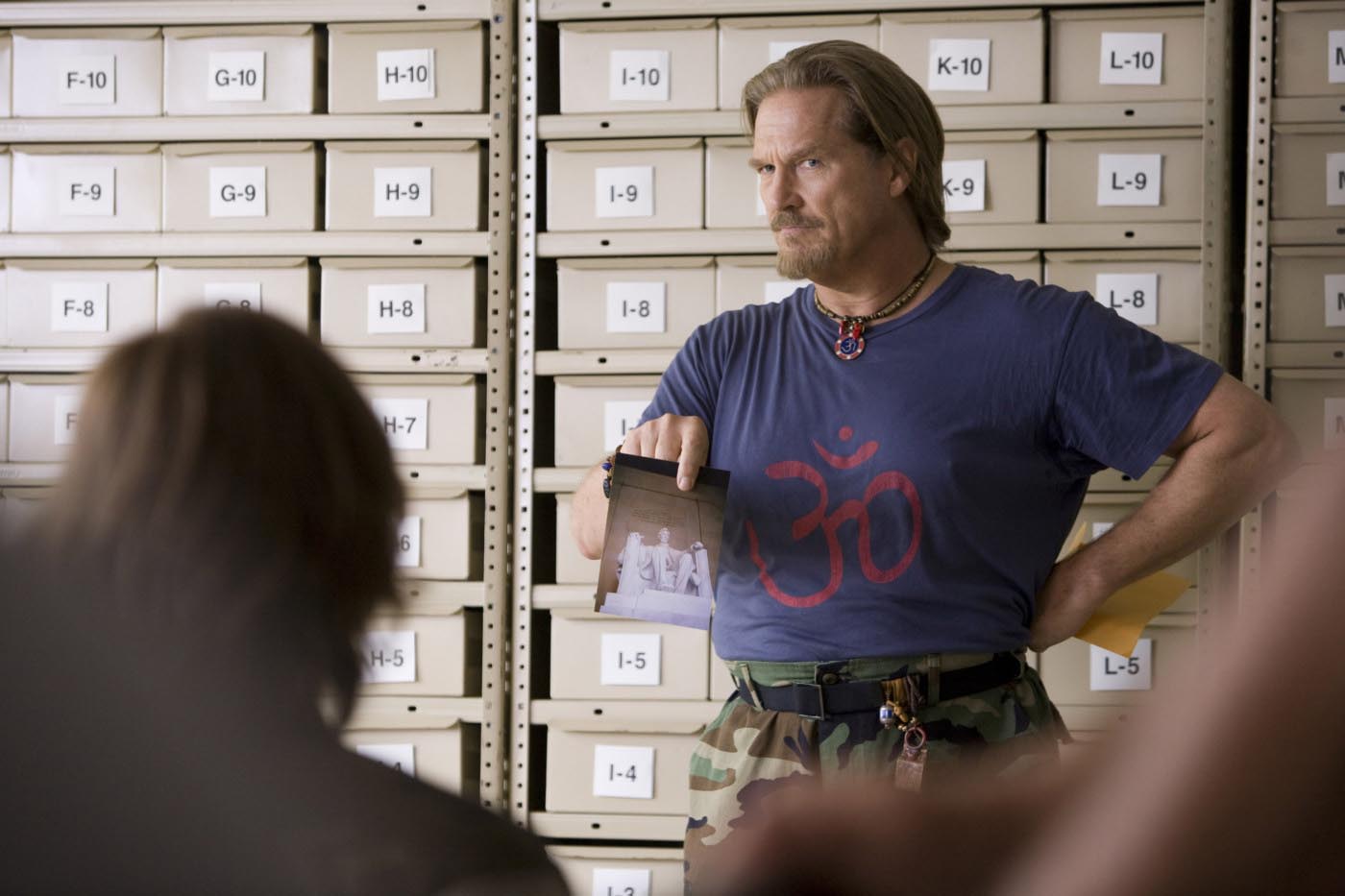
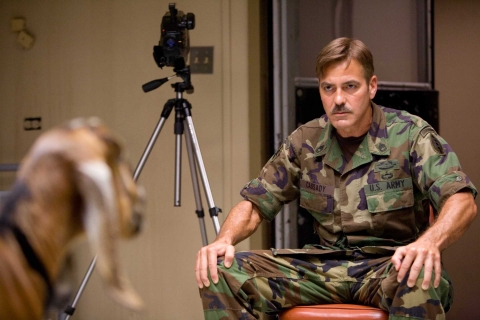
In the movie,Ewan McGregor's Ronson stand-in, Bob Wilton, gets wind of a "New Earth Army" doing some feature work for his local newspaper, but it isn't until he's in Iraq—trying to impress his estranged wife—that "the circle becomes complete" and he meets the closest thing to an adept among the psy-warriors, Lyn Cassidy (George Clooney, looking remarkably like Dennis Farina) who's "been re-activated" on a secret mission to find his former commanding officer and creator of the First Earth Army, Bill Django (Jeff Bridges, who perfects his Leibowskish "bubble-off-plumb" hippie personification and manages to make it poignant). Cassidy appears to be legit, capable of cloud bursting and the one Earther who could drop a goat with a look. He's less than expert in the "sparkly eyes" technique, despite being played byClooney (who manages to play it completely straight while pulling off some of the strangest actions of his career).
Director Grant Heslov, Clooney's production partner and script-writer for Good Night, and Good Luck, keeps things moving at a good clip, moving fast enough to avoid analysis or deep thinking. The story is slight, owing much to, of all things, Ishtar (two clueless guys, out of their depth in a Middle East war-zone) while waving an anti-establishment freak-flag that reeks of M*A*S*H (with Kevin Spaceyas the Frank Burns-type). The story, concocted of remnants of the original NEA operations in Iraq and Afghanistan, seems plausible (given the way those wars have been run), but the story merely exploits true concepts to spin the gauziest of screenplays, while poking fun at the "Be All That You Can Be" gonzo-ness of an Army that's trying "to be wonderful."
Semi-satirical movies are rarely more than semi-amusing. The Men Who Stare at Goats, however, delivers quite a few belly-laughs.
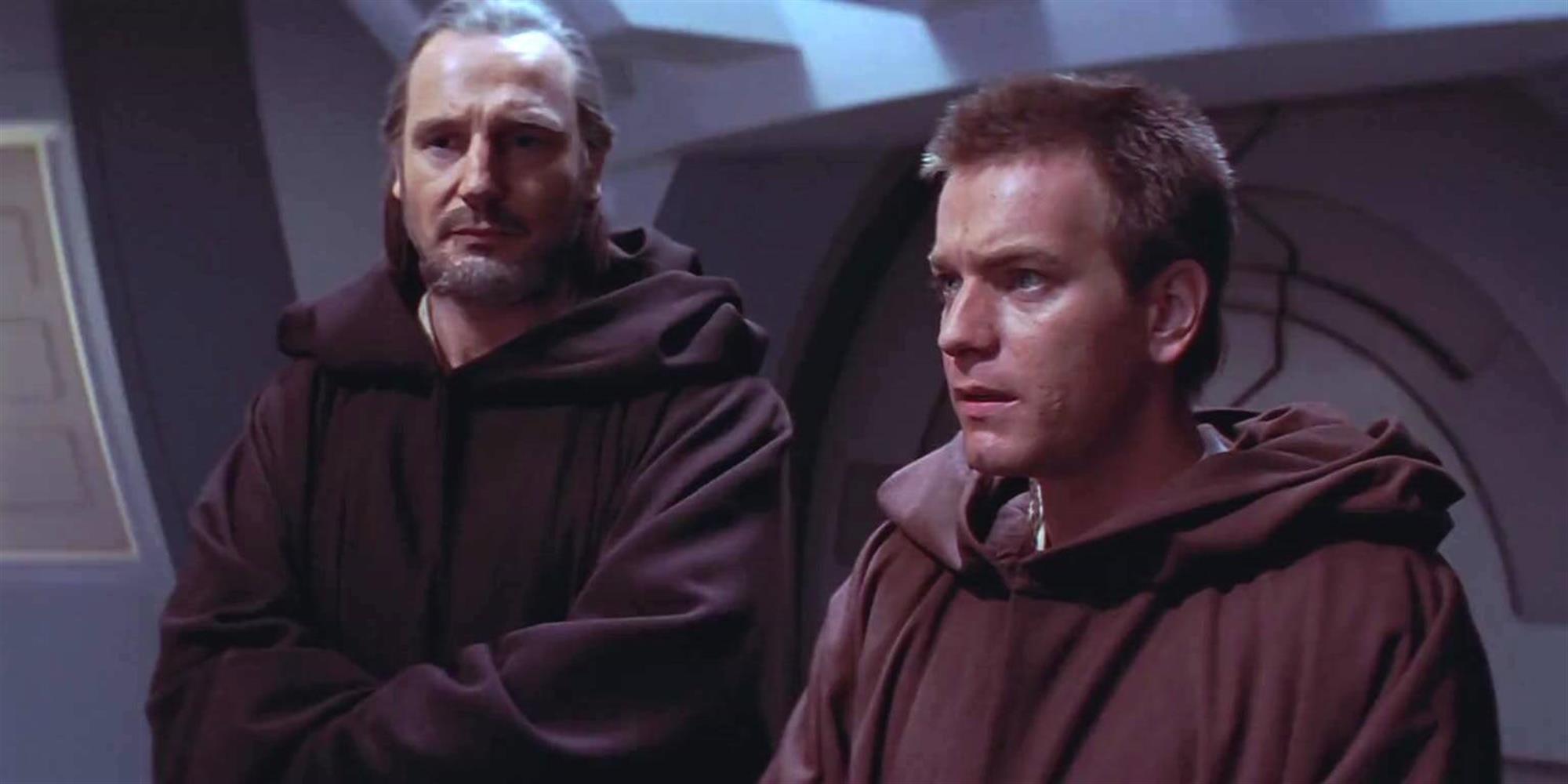
* The movie earns many—too many—knowing audience laughs by casting Ewan McGregor (the post/pre-GuinnessObi-Wan Kenobi) as the Ronson-surrogate reporter who is more of a "Doubting Thomas" than a "Padewan Apprentice." It's a little too "on the nose" and is, frankly, done to death, like some of the more winkingly obvious in-jokes in the "Ocean's Eleven" series. One more Ronson doc: "Stanley Kubrick's Boxes":
One Step Forward, Two Steps Back—That's a Western Waltz
or "Uncertainty. That is appropriate for matters of this world. Only regarding the next are vouchsafed certainty."
or "Misanthrope? I don't hate my fellow man, even when he's tiresome and surly and tries to cheat at poker. I figure that's just a human material, and him that finds in it cause for anger and dismay is just a fool for expecting better."
There is a sense of nostalgia that prepares you for The Coen Brothers' new Western anthology filmThe Ballad of Buster Scruggs(which makes its premier on Netflix and is playing a very few theaters in the U.S., presumably for Oscar award consideration). It starts with a nicely-composed shot of a dog-eared book bearing the same title as the film, familiar for the plain dust-jacket (from a time before marketing became the thing to sell the book) that will be recognized to anyone who's had to clear out the bookshelf of a recently-passed relative, or from a Sunday afternoon perambulation through a used book store. You can practically smell the dust and age of the pages, as a hand crawls into frame and gingerly opens the book to the artistically rendered end-papers and then to the "meat" of the book, where the page-turning pauses on the dedication page, which has these words:
To Gaylord Gilpin
Who shared with us these stories,
And many more alike, one night
in camp above the roaring fork
'til approach of morn stained the sky
and our esteem for him stained our trousers.
This Book is Dedicated
There are six stories in the book, the titles giving no clue as to what they might be about. Turn the page and we see a list of the color illustration plates included in the volume. A tissue protects the illustration and we see the first burst of material showing us the contents, a single image and an arbitrary line of prose that only hints at what's inside, creating a mystery and a void to be filled, a goal to move on to. And we begin...with "The Ballad of Buster Scruggs." 1. The Ballad of Buster Scruggs
Buster Scruggs (Tim Blake Nelson) is a singing cowboy riding out of Monument Valley into what passes for civilization in the day and age, his legs wrapped around his horse, his arms wrapped around his guitar and his throat wrapped around the traditional ballad "Cool Water." Buster is a white-hat cowboy, loquacious of song and speech (by which he is constantly addressing the audience as in "Don't let my white duds and pleasant demeanor fool ya. I, too, have been known to violate the statutes of man... and not a few of the laws of the Almighty!"). His story demonstrates his "downright Archimedean" skills with a gun, and his reputation as the "San Saba songbird" as he creates a quick comic elegy for one of miscreants of poor nature who have the fool-hardiness to draw on him.*
One can see why the Coens were tempted to start with this one, as it is the funniest and most arch of the six stories, recalling to mind the Looney-Tunes nature of Raising Arizona, and with a lovely, goony performance by Nelson that endears you to him, even if, occasionally, it creeps one out. It sets up the tone for the entire film, where The West challenges the expert and the novice alike and Death comes in unexpected and inconvenient ways and should also prepare viewers that, as such, they can be surprising and grisly, as well.
"The Ballad of Buster Scruggs" is a comic primer for the anthology, showing the film's approach to dusty death and the film's larger message of the nature of wilderness, and the efficacy of trying to rise above it.
"You seen 'em, you play 'em" sneered the hard man.
2. Near Algodones
An outlaw (James Franco) decides he's going to knock over the only game in town (except there's no town)—a bank that looks like it fell right out of the sky to land in the middle of the plains. But, it's just not his day. He has to contend with the institution's sole teller (Stephen Root), who's been through the procedure before, and who, in the opinion of the would-be robber, "doesn't fight fair." The outlaw will have very good luck today, but not so's you'd notice.
After waking up, he finds his neck in a noose, with a hanging party all ready to carry out its sentence. Fate steps in to get him out of the jam, but also put him deep into another one. He will ultimately learn that there's a good side to everything as long as he has the time to appreciate it.
"Pan-shot!" cried the old man.
3. Meal Ticket
A humble wagon makes its way through the scarce pockets of civilization that mark a mountain landscape. It is a traveling show, featuring a cultured orator, Harrison (Harry Melling), who has the added fascination that he is a quadriplegic. The show is fairly simple—the curtain of a small stage parts to reveal the orator, and after a dramatic pause that allows for gawking, he gives dramatic recitations of the story of Cain and Abel, and other sources as diverse as Shakespeare, Shelley, and Abraham Lincoln, to the spare audiences looking for diversion from the night and the cold.
Harrison is under the care of his manager (Liam Neeson), who drives the wagon, posts the bills, prepares the stage, does Harrison's make-up, and provides sound effects for the parts in which God appears and needs accompaniment. He also collects the spare change that the audience provides for their night's entertainment, enough to provide a hot meal cooked over a campfire. The manager does that, too, and feeds Harrison by hand. Lodgings would be too expensive and the audiences are noticeably dwindling the farther they head through the mountains.
The two are tied together in partnership, but the days are long and the rewards are meager. "Meal Ticket" is a story of entrepreneurship, reduced in all its hard-scrabble desperation, and the eye toward improving business at all costs with little regard to anything but the sound of coins in pockets, and it resonates as timely as the day's financial headlines that emphasize the bottom line at the cost of human dignity...and life.
"The quality of mercy is not strained, it droppeth as the gentle rain from heaven."
All Gold Canyon
Based on a Jack London story, "All Golden Canyon" tells the story of a grizzled prospector (Tom Waits), who enters a pristine valley with the intention of culling the riches hidden within it, without regard to the wonders that surround him.
He sets up an elaborate system, digging through the dirt, and noting the glittering specks of gold that he is able to pan out of it, to find the vein of gold that he knows must be there, the source of which he calls "Mr. Pocket," that will allow him to leave the valley a very rich man—if he can survive long enough to hit pay dirt.
And in all that mighty sweep of earth, he did not see a sign of man nor the handiwork of man.
The Gal Who Got Rattled
A mail-order bride, Alice Longabaugh (Zoe Kazan) travels with her brother by wagon train to meet her intended husband. But the journey is long and accompanied by cholera, natives, and her brother's dog, named Benjamin Pierce, whose instinct, owing to its city nature, is to bark at anything wild, upsetting the prickly members of the wagon train, already impatient by the deprivations of the long journey.
When her brother dies, Alice is left alone, on her own, with no experience, few prospects, and a singular disposition towards fretting, which endears her to the ramrod of the train, Billy Knapp (Bill Heck), who takes it upon himself to solve her cares and problems, much to the mute consternation of the train boss, Mr. Arthur (Grainger Hines), who has other considerations than those of a worrisome girl, out of her depth, and out in the wilderness.
The longest and most intricate of the stories, "The Gal Who Got Rattled" is based on a story by Stewart Edward White, and one could comment, here, on the top-tier performances and the exquisite photography (shot digitally, a Coen first) by Bruno Delbonnel, who's been doing a lot of work with the Coens, Jean-Pierre Jeunet, Tim Burton and Joe Wright, but that praise can be said for the entire anthology, no matter the conditions or weather they were recorded in. The film is beautiful to look at, frequently threatening to overwhelm the stories, but never quite doing that, becoming an intricate part of the story-telling fabric, the wide expanses of prairie and horizon looming and often overpowering the melancholy insignificances of the tiny figures making their ways through them.
Mr. Arthur had no idea what he would say to Billy Knapp.
The five could not be less compatible as they hold conversations as to the nature of man and the nature of love on the one side of the stage, while on the other the two partners, Thigpen and Clarence reveal themselves to be "reapers"—bounty hunters, who on this very ride are carrying their latest victim (on the roof of the cabin) to be dispatched at Fort Morgan...but is that the only one designated by the gentlemen who clearly revel in their work?
Unlike the other segments, "The Mortal Remains" is shot entirely on a sound-stage, even the fronts of the fort's houses are decidedly two-dimensional, but it ends the film on a decidedly creepy, if ambivalent note, the kind of campfire story best saved for when the last embers glow out and leave only wraiths of smoke.
Whether or not he heard, the coachman did not slow.
And there you have it: the cowboy, the outlaw, the entrepreneur, the prospector, the wagon train, the stagecoach—tropes and aspects of the Olde West, but given a determined melancholy twist that has become synonymous with the works of the Coen Brothers. The Ballad of Buster Scruggs is another genre-busting masterpiece that plants a flag in their careers, as they never do less than interesting work, but there are some that clearly stand out more than others. The Ballad of Buster Scruggs is one of those. Not a "return to form," so much as one of those where everything works and their experimentation reveals the strengths of the inspiration they've decided to sardonically play around with—in this case, the Western's ability to show us that whatever we may gain, we lose something in the transition, making the genre both the perfect home of triumph entangled with tragedy, sometimes inseparably. It is, indisputably, one of the best films of the year. Ironically, good luck finding it in a theater. *
Surly Joe, the gambler, he will gamble nevermore,
his days of stud and hold'em they are done.
It was long about last April, he stepped into this saloon,
but he never really took to anyone!
Surly Joe, Surly Joe!
Oh, wherever he's gamblin' now, I don't know!
He was slick but I was slicker,
he was quick, but I was quicker,
and the table stopped his ticker, Surly Joe!
Surly Joe, Surly Joe!
Won't be missed by anyone, will Surly Joe!
Humankind he frowned upon,
but not now, his face is gone!
Guess your frowning days are done, oh Surly Joe!
Surly Joe, Surly Joe!
A cedilla on the "c" of Curly Joe!
He was mean in days of yore,
now they're moppin' up the floor
One more sight to make him sore, oh Surly Joe!
Surly Joe, Surly Joe!
Where the rest his face has got to, we don't know!
He was never any fun, now his grumpy race has run,

 It begins with a shot straight up into the sky, the wind blowing, smoke and clouds combining and birds gyrating into the sky. Nature is on alert and moving because man is up to something unnatural—a battle has just been fought. Meanwhile a lone figure (Kathryn Hunter) scuttles—there is no other word for it—across a dirt path in the fog, muttering to itself and to others. This is Coen's interpretation of Shakespeare's witches, one being, recalling Andy Serkis' Gollum from The Lord of the Rings, but not a CGI creation, but one of theatricality, with twisted limbs like a bird's and a hoarse croak of a voice that feels like nails on a file. The performance is weird without being traditionally spooky and sets you on edge for what is to come.
  What is to come is a professional interpretation without too much weirdness. Hunter is a tough act to follow, and she is the highlight in a film that should be full of them. I say that, but it needs to be said with some context. "Macbeth" is a much performed play, both in theater and the cinema (every decade has one film of it, it seems), and, like a symphony—or other piece of music—it can be played in differing manners even if maintaining the ascribed tempo. I might have a "perfect" rendition of the piece (and other listeners another idea of what that might entail) and notice the change of "attack" or emphasis in certain sections. It comes down to interpretation, and "Macbeth" is just as susceptible to those variations.
 Like the 1948 Welles version, this one depends on less being more (although Coen cites Carl Theodor Dreyer more than Welles), the backdrops shadowed or cloaked in mist and blocks of perfectly proportioned masonry with less emphasis on grit—as, say, Polanski's version—and the figures walking through them are like mice in a maze. Predestination has created their paths and their choice is to simply follow through or not. It's a curiously unpopulated world, the only crowds being the line of soldiers set to attack Macbeth's castle, hemmed in by the "Birnam wood" of the witches' prophecy, the rest being stark spaces shadowed by the blackest blacks.
 Through these spaces, the characters pace, for the most part sheltered from the wild outside that knows no geometry of straight lines, but intrudes—once the Macbeths screw their courage to the sticking place by regicide—not only by physical presences, but by the sound of that nature booming (not just knocking) to be let in, like consciences made tactile.
 Up
until then, Washington's Macbeth is a pragmatist, slightly world-weary
and seems beaten down—he has just come from a war, after all. What
is most interesting is that both Macbeths in this iteration are older,
childless (so no chances of succession), and obviously have seen chances for advancement taken away
from them in the past, and that, now, with this hope given thought by a supernatural
origin, are almost desperate to take advantage of it, lest it pass from them one last time. Once he is king, and things start to fall apart, one would think there would be more shock, more realization that he might have been duped by the very forces that emboldened him. But, that's not there. Instead, it seems he's returned to the world-weariness at the beginning of the film—which is inconvenient as he still has much to fight. It feels false, and is missing a sense of bitter desperation that will carry him through the inevitable end.
Up
until then, Washington's Macbeth is a pragmatist, slightly world-weary
and seems beaten down—he has just come from a war, after all. What
is most interesting is that both Macbeths in this iteration are older,
childless (so no chances of succession), and obviously have seen chances for advancement taken away
from them in the past, and that, now, with this hope given thought by a supernatural
origin, are almost desperate to take advantage of it, lest it pass from them one last time. Once he is king, and things start to fall apart, one would think there would be more shock, more realization that he might have been duped by the very forces that emboldened him. But, that's not there. Instead, it seems he's returned to the world-weariness at the beginning of the film—which is inconvenient as he still has much to fight. It feels false, and is missing a sense of bitter desperation that will carry him through the inevitable end.