Plus, the venom I spewed at that time, seems almost quaint considering what has come after him since. Bush has been heard to remark about Trump "He makes me look pretty good." Michelle Obama and he are "besties," insisting on sitting together whenever "the formers" must gather. And Clinton and he act like they're joshing brothers, after Clinton and his father became close friends, post-presidencies (Clinton BEAT Bush in in the 1992 presidential election, but it didn't matter...).
One must acknowledge grace in our leaders...when they lead...and show us the way.

Oliver Stone is no one's idea of an objective film-maker, if there is such a thing. Once a screenwriter puts pen to paper, they've already started manipulating the movie to their point-of-view, whether it's from the left, right, center or upside-down (Why do you think they're called "directors?"). So, no one should be surprised that Stone has an ax to grind, with W..
Stone is a director of heart, but he frequently by-passes his brain when making his points. So, Platoon, still his best film, hi-jacks the gritty depiction of grunt jungle-fighting with Stone's own conflicted "Daddy" issues, his "Pvt. Chris Taylor" having to choose between two superiors with different moral ways of engaging the enemy. Lincoln and every fantasist depicting moral choice has put angels and devils on our shoulders. Stone burdens us with His Old Man. That same scenario was transferred to High Finance, with his very next film Wall Street. I haven't seen every film of Stone's, but most of them are concerned, in some capacity, with paternal conflicts. And because he's a better propagandist than scenarist, most Stone films stop dead whenever we get to each Stone "thesis," invariably a Message being presented by a single character who has center-stage and our undivided attention. JFK, a dazzling technical exercise of photography and editing, comes positively unglued in its presentation of conflicting conspiracy scenarios for Pres. Kennedy's assassination (Kennedy being another Stone father figure--"Our murdered King," as he's described in the screenplay (completely by-passing any thought that we might, you know, be living in a democracy with a representative government), until Kevin Costner's prosecutor Jim Garrison places in his summation a theory on military-industrial conspiracy behind the Vietnam War, a Stone obsession.* In W. Dick Cheney—Richard Dreyfuss clearly enjoys being given the opportunity to play him**—stops an Iraq War strategy session to pontificate on securing Middle East interests for oil exploitation for a hundred years. Give the man points for passion, but his movies become such a glut of emotion that the point becomes lost in the gnashing of teeth and the wringing of hands. His bio-pic of Nixon was such a slap-dash affair, it seemed like a badly-cast TV-movie gloss-over, skipping from high-light to low-light in time to shoe-horn the next commercial (A weirdly fictional conversation between Chairman Mao and Nixon was Stone's show-stopper there). By the end, with its End-Credits playing over a Mormon Tabernacle Choir-rendition of "Shenandoah," one almost felt some sympathy for the man. Nixon, not Stone.


That battle's still to come.


Bah. Bah...and Bah.

** Dreyfuss had a lovely phrase about working with Stone on W. when he was on "The View:" "You can still be a fascist...even if you're on the left."
**Josh Brolin does fine work, but the performance feels a bit "one-note," having to nail the too-familiar Bush mannerisms and vocal tendencies.
Tomorrow—merely by coincidence, another "period" film.


 Kaufman takes us into the dark-hole of the jet-engine, and inside we hear echoing voices and whistles and the sound of drums, and before we can register the change, we're not in the negative space of the engine anymore, we've transitioned to another channeled tube of energy—we're traveling through a tunnel riding atop a limousine from an astronaut's perspective...
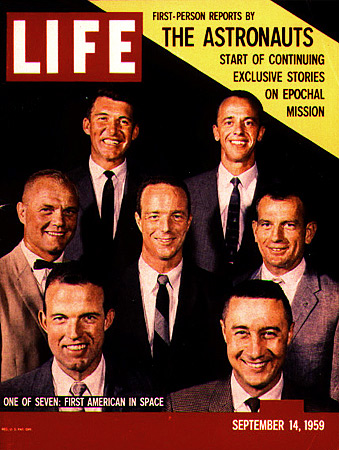
 ...as President Lyndon Johnson stands on a flag-draped stage and welcomes the seven Mercury astronauts to an out-sized barbecue in Houston--the new home for the Manned Space Center, as well as the astronauts and their families. Their homes, their furnishings are all paid for by the Houston developers who are benefiting from Johnson's earmarks. The Mercury 7 are living the good life, while the Man who Broke the Sound Barrier makes a run for space.
 Both these incidents happened and are mentioned in Wolfe's book, but they took place months apart, while Kaufman has them happening simultaneously. To what purpose will become clear later, but in the meantime, we follow Yeager (
 And in one spectacular shot, we see space bend and warp as we approach the feathery layer of a cloud-ceiling, then go through it...
 ...and the picture fades to an incident from that barbecue--an odd detail that Wolfe found funny and sad and a bit pathetic, but Kaufman turns into visual poetry. For some reason, the Houston event organizers chose as one of the entertainers stripper
  But Kaufman takes that incident and marries it with a running theme throughout the film. The Moon has been a beckoning image throughout The Right Stuff, and now, as the clouds that Yeagher is punching through become the delicate feathers of Sally Rand's fans, she dances to an orchestral version of the melancholy "
 Kaufman stays on his images of empty space and feathers and lights, then to shots of the astronauts and their wives reacting to the irrelevance and embarrassment of it all. And then, something strange happens....
 ...and Shepard's not even watching the stage-show. He's lost in thought...
 ...as is
  Glenn turns to look at
  ...who is already looking at him.
 Grissom turns and looks at his buddy,
  ...who is his usual grinning self, but he's subdued. We transition back to Sally Rand...
 ... and a blaze of kleig-lights to Yeager trying to "punch a hole in the sky."
 Yeager reaches top altitude, then his engines give out and he's given one tantalizing glimpse of the stars in space...

 ...before his fighter-jet begins to rapidly tumble back to Earth.
 Unable to bring it under control, Yeager makes a fiery ejection...
 ...and Kaufman holds on him--trailing smoke, because as we'll see his helmet is on fire--and we watch his long, long fall through space as he tumbles through the silence--a modern Icarus...


 ...who disappears into the clouds.
 The clouds fade back to the feathers of Sally Rand.
 ...and to the astronauts, who are somewhere else.

 Glenn, on edge, looks to Grissom and Cooper...
 Grissom is wary...
 Cooper, head bowed, tentatively looks up...
 as does Slayton...
 And Shepard cranes his gaze to the ceiling...
 We transition to Sally Rand, and on the soundtrack we hear a distant boom.
 With a hard cut, we're back in the California desert.
 Reverse angle to an ambulance approaching in the shimmering desert heat.
 The driver points ahead "Sir? Is that a man?"
 Amid the smoke and heat-waves, a silvery shape emerges.
 "Yeah," says Ridley (
 As the music swells, Yeager carrying his parachute, his face burned, but still chewing gum, approaches the ambulance.
 Yeah. You bet it is. It's great film-making, too. And a brilliant sequence by Kaufman that shuffles real time a little, but makes a point about the competitiveness of air-men, giving way to a brotherhood. All of the men in the sequence have competed with each other as well as Yeager to be "at the top of the ol' pyramid," going faster and higher than any person before. The astronauts were test-pilots competing with Yeager, then signed on to become astronauts, "spam in a can" in the test-pilots' jargon, achieving a fame Yeager never would...until Wolfe's book...and this movie