Showing posts with label Thandie Newton. Show all posts

Saturday, April 15, 2023

2012

Despite what "The Last Word" blurb—at the bottom of the page—says, I don't like writing reviews of bad movies. I just don't. (I don't even like WATCHING bad movies!)

But, I have to admit: I enjoyed writing this one.

Saturday is traditionally "Take Out the Trash" Day.


"...And I Feel Fine"

Earth to Roland Emmerich: "Cut it out!"

Between
Independence Day, The Day After Tomorrow, and, now,
2012, the German director has personally destroyed the world three times.

Well, enough is enough. Gaea's getting pissed.

And so am I.

Seventeen special effects companies, including Sony and Digital Domain (two heavy-weights and they're not even the first ones listed) were employed to create the global carnage on display in this flick, and there's still a recession going on. The attention to detail and dedication to photo-realism is the only evidence of professionalism in the enterprise. That's entirely appropriate as the only reason to see this monstrosity is to witness things blow up "real good." That they do.
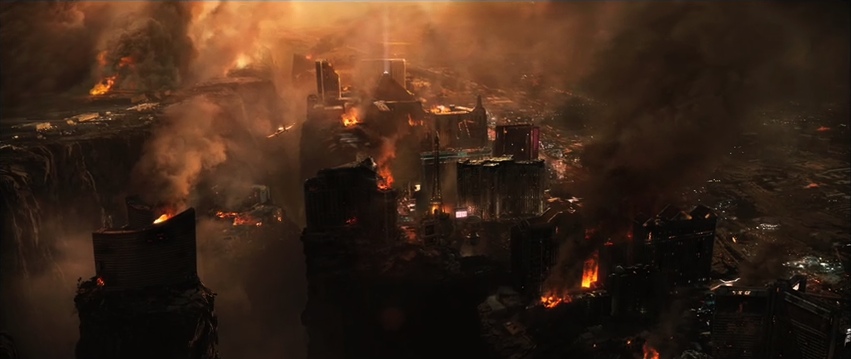
Los Angeles develops wrinkles and cracks that even Joan Rivers' supply of Retin-A can't erase and schlumpfs into the Pacific. Yellowstone faithfully incinerates in a verrry slow pyroclastic flow that the hero can out-run. Las Vegas becomes the new Grander Canyon (they were going to knock those buildings down anyway!). Hawaii's a volcano (but the surfing's great!). Washington D.C. becomes more chaotic than it already is.
I'll admit it. There is a giddy, monstrous 2-year old's glee in seeing the White House (which
Emmerich imploded with a shiny blue destructa-beam in Independence Day) being destroyed again—this time by the aircraft carrier John F. Kennedy, propelled on a Potomac tidal wave (That's about as "high concept" as this film gets). And St. Peter's. Tibet.
* All the hots spots become much hotter. The fly-over-and-through of Los Angeles over the splintering clover-leafs and under collapsing buildings is a thrilling roller-coaster ride through Hell with digi-people clinging to collapsing floors, all manner of auto-mayhem and even violence by Rolling Donut sign. But if you were to take out all the countdowns to disaster in 2012 ("We've got five minutes before everything blows!!") and just include the disasters, you'd have a 20 minute highlights reel, rather than a 158 minute poorly written series of contrivances and coincidences.

And everything blows, anyway.
You'd almost think the thing was worthwhile with
Chiwetel Ejiofor, Oliver Platt, John Cusack, Danny Glover, George Segal and Thandie Newton in the cast. But they're only mouth-pieces for exclamatory dialog with brows a-furrowed. Seems the whole thing starts with a planet re-alignment, which triggers solar flares which sends out neutrino's that miraculously microwave the Earth's core and destabilize the Earth's tectonic plates, reverse the Earth's magnetic field and create monster tsunami's.
Now, in this world-wide scenario, everybody in the cast has only one degree of separation to everybody else, so that they can look with surprise at their monitors and intone "Wait! I know that man/woman/dog!" Coincidences are the order of the doomsday, and little dialog goes unmatched without
the appropriate chunk of irony whistling through the air and squishing the speakers with a thud. It's the kind of movie where hubby says to wife "I feel like there's something pulling us apart" right before a fissure opens up between them. When St. Peter's Basilica starts to collapse, the cracks split down the Sistine Chapel right between Man and God's fingers. Roland Emmerich is not a subtle director. No man whose ambition is to make a better "Godzilla" movie can be.
And what Emmerich is re-making here is
When Worlds Collide,
** a 1950's sci-fi flick that imagined Earth hit by another planet, and its treasures, two-by-two's of animals and a lottery-chosen clutch of humans are rocketed off to the convenient companion planet that precedes it. Here, the art is rounded up, libraries accumulated, animals airlifted, and although a lottery is mentioned, the folks who go in the arks are world leaders (naturally), the folks who can afford to pay 1 billion euros per seat, and anyone conniving enough to smuggle themselves on-board. The Best and the Brightest, The Cream of Humanity. Everybody else becomes part of the new petroleum deposits the survivors will profit from in the future. Talk about your disasters. Imagine a world where among the survivors are Dick Cheney, Mahmoud Ahmadinejad, Hugo Chavez, Rod Blagojevich, Paris Hilton, Mike Tyson and Pat Robertson, but no research scientists—not even the guys who invented Post-it Notes! That's a version of Hell even Milton wouldn't have conjured.***
It was at this point, I would have been happy to see everybody die, but no such luck. The last few minutes of the film are
disaster heaped upon disaster, with survival dependent on the actions of one man—guess who? But, my concern was what exercises I could find to relieve the pain in my eyes from rolling them so much. They don't sell aspirins at the concession stand. Not even chocolate-covered ones.
Truth be told I don't enjoy writing reviews for bad movies, as there's more inspiration in good ones. But I'll leave it with this quote from the director (in a New York Times profile by Tyler Gray) complaining about people's reactions to his making a film like 2012 in a "post-9/11 environment."

"If I cannot destroy a big high-rise anymore, because terrorists blew up two of the most famous ones, the twin towers, what does this say about our world?”

Our world is fine, Rollie, no thanks to you. But it says your priorities are really shitty.

And the only way to make it good to us is to make all your digital models of people caught in wholesale slaughter based on your likeness.

Verstehen sie?

Verstehen sie nicht.

****
"thoughts and prayers..."

* But not Mecca. Fatwa's need not apply. Kinda lily-livered of Emmerich to not risk personal destruction when destroying the world for his art. Don't they have "sins of omission" in Islam?

** And just our luck, that master of the cinematic form Stephen Sommers (The Mummy, Van Helsing, G.I. Joe: The Rise of Cobra) is making his own direct re-make of "When Worlds Collide" to be released in 2010. Oh, the joy.
(As of 2023, IMDB lists it as still "In Develpment").

*** Not to politicize too much (or think, God help me) but given the Ark scenario envisioned by the movie, with the whole "two-by-two" concept, I'm imagining the passenger list is restricted to "breeders," meaning there are no gays and lesbians on the boats. Emmerich is gay. What is he thinking?

**** Part of the mission of these reviews is to promote the theatrical experience when it is deemed important to the presentation of the story. It is tempting to say that "The Big Screen" is the only way to watch 2012, because there are so many little demons in the details. But, no. The story is so lunk-headed and gleefully clap-happy nihilistic that the best presentation is merely putting a bow on a cess-pool.

Saturday, October 22, 2022

Interview With the Vampire: The Vampire Chronicles

Interview with the Vampire: The Vampire Chronicles
(Neil Jordan, 1994) I remember reading Anne Rice's novel of "Interview with a Vampire" many, many years ago and found it a dispiriting read. In fact, by the time I got around to watching the film, everything about the story had evaporated into the ether, like one of her vampires sun-bathing. I do remember the controversy of
Tom Cruise being cast as vampire-manipulator Lestat and that there was much consternation about it. My viewing of it made me think that Cruise was the best thing about it, one of his very few performances where he stretched as an actor and a personality. The rest of it, if you'll pardon the pun, sucked.

Certainly, director Neil Jordan isn't to blame. His direction and general look for the film is exemplary, giving the film an elegant if decaying look—after all, vampires are immortal, so why would they be concerned with daily chores (plus vampirism is 180° from Godliness). Casting is fine (even if some of the acting isn't), and Jordan even throws in a couple of touches of the surreal, if only for the sheer creepiness the effect has.
Daniel Molloy (
Christian Slater) is in a nondescript San Francisco apartment, waiting for his interview subject to arrive. Surely it will be an evening interview, as he is Louis de Pointe Du Lac (Brad Pitt), who is supposedly a vampire. Skeptical, Molloy quizzes him about the various vampire tropes, which he dismisses, the legends he says coming from "a demented Irishman". But, the coffins, yes.
Then, he tells his story—of how, in 1791, despite wealth and property in Louisiana, he falls into self-destructive depression when his wife dies during childbirth. During a drunken night, he is followed by the vampire Lestat de Lioncourt (Cruise) and after being attacked by him, is offered to be killed and turned into a vampire, "giving you the choice that I never had." The two become constant companions of the night-world, never again seeing the sun (in a neat little bit, Louis becomes obsessed with the sun, even going to see Sunrise: A Tale of Two Humans directed by F.W. Murnau, who, more famously, also directed Nosferatu, the first vampire movie).
But, the two have decidedly different ideologies of life...or after-life. Lestat is a libertine with no moral code, taking his victims at his pleasure, perhaps in vengeful bitterness for the way that he was turned without having any choice in the matter. Louis is appalled by this and regrets the taking of human life and would rather feed on animals, which is something that Lestat constantly mocks. He does make one exception. When a plague decimates the country-side, Louis finds a child (
Kirsten Dunst) whose mother has died of the disease and turns her, giving her immortal life. For him, this creates a sort of ersatz family. For the child, Claudia, it gives her immortality, but traps her forever in the body of a child. She may mature, growing older and wiser in her mind, but will remain at the age in which she is killed.
The novel and film have become favorites in the LGBTQ community for its metaphorical take on hidden societies and non-traditional families, and one can see that point of view. One rebels, though, that the metaphor is ensconced in such an anti-life trapping. These vampires are murderers, and even Louis, squeamish as he may be at homicide, loses his moral ambiguities when it suits his purposes. They seem more like a cult to me than a healthy representational metaphor. Your moral mileage may vary.
And, these vampires are also incredible narcissists. Everyone is selfish to a degree, but these nether-folk would be death at a party, fixating on themselves, bloviating their philosophies and negatively-lighted world-view and looking upon the lighted world as merely a buffet to exploit. Given the era in which it's set, one would half-expect them to become imperialist and invade other countries.
But, what leaves me as cold as a corpse about Interview with a Vampire is Brad Pitt's performance as Louis. Granted, that he was only a couple of years from his true break-out roles and was still finding his way to matter as more than a pretty face. But, his Louis is such an opaque presence that he seems at sea most of the time, not able to make depression, self-destruction, or even drunkenness very interesting. He internalizes so much as to make any emotion he's trying to convey invisible to the naked eye. He's turned into a phenomenal talent as actor. But, at this point, he wasn't.
And while I'm no fan of Tom Cruise, one has to give kudos to his Lestat, as grandiose and theatrical a performance as he's ever given. Sure, he can go too far in movies, but, his Lestat is such an unmitigated purveyor of debauchery (and loving it) that Cruise could never really go too far "out there" and not have it seem uncharacteristic. His Lestat simply wouldn't care, and it makes it one of Cruise's best works, horrific as it is.

Tuesday, August 18, 2020

W.

Written at the time of the film's release. I took out a long rant about the Bush Administration (when I wrote it Bush was still in office) and I wanted my prejudices out front. Here, the prejudices are for Oliver Stone's issues with film-making (for the most part).

Plus, the venom I spewed at that time, seems almost quaint considering what has come after him since. Bush has been heard to remark about Trump "He makes me look pretty good." Michelle Obama and he are "besties," insisting on sitting together whenever "the formers" must gather. And Clinton and he act like they're joshing brothers, after Clinton and his father became close friends, post-presidencies (Clinton BEAT Bush in in the 1992 presidential election, but it didn't matter...).

One must acknowledge grace in our leaders...when they lead...and show us the way.

"Somethin' 'Bout Bein' in the Barrel"

Oliver Stone is no one's idea of an objective film-maker, if there is such a thing. Once a screenwriter puts pen to paper, they've already started manipulating the movie to their point-of-view, whether it's from the left, right, center or upside-down (Why do you think they're called "directors?"). So, no one should be surprised that Stone has an ax to grind, with W..

Stone is a director of heart, but he frequently by-passes his brain when making his points. So,
Platoon, still his best film, hi-jacks the gritty depiction of grunt jungle-fighting with Stone's own conflicted "Daddy" issues, his "Pvt. Chris Taylor" having to choose between two superiors with different moral ways of engaging the enemy. Lincoln and every fantasist depicting moral choice has put angels and devils on our shoulders. Stone burdens us with His Old Man. That same scenario was transferred to High Finance, with his very next film Wall Street. I haven't seen every film of Stone's, but most of them are concerned, in some capacity, with paternal conflicts. And because he's a better propagandist than scenarist, most Stone films stop dead whenever we get to each Stone "thesis," invariably a Message being presented by a single character who has center-stage and our undivided attention. JFK, a dazzling technical exercise of photography and editing, comes positively unglued in its presentation of conflicting conspiracy scenarios for Pres. Kennedy's assassination (Kennedy being another Stone father figure--"Our murdered King," as he's described in the screenplay (completely by-passing any thought that we might, you know, be living in a democracy with a representative government), until Kevin Costner's prosecutor Jim Garrison places in his summation a theory on military-industrial conspiracy behind the Vietnam War, a Stone obsession.* In W. Dick Cheney—Richard Dreyfuss clearly enjoys being given the opportunity to play him**—stops an Iraq War strategy session to pontificate on securing Middle East interests for oil exploitation for a hundred years. Give the man points for passion, but his movies become such a glut of emotion that the point becomes lost in the gnashing of teeth and the wringing of hands. His bio-pic of Nixon was such a slap-dash affair, it seemed like a badly-cast TV-movie gloss-over, skipping from high-light to low-light in time to shoe-horn the next commercial (A weirdly fictional conversation between Chairman Mao and Nixon was Stone's show-stopper there). By the end, with its End-Credits playing over a Mormon Tabernacle Choir-rendition of "Shenandoah," one almost felt some sympathy for the man. Nixon, not Stone.

W. (his too-early summation of the second Bush Administration) suffers the same problems. It's a gloss of recent events, interspersed with flash-backs to the wastrel days of the young George W. Bush (played throughout by Josh Brolin),*** drunk with entitlement and just about anything else he could find. Particular heed is paid to his relationship with "Pappy" George H.W. Bush (James Cromwell, though he seems nothing like Bush the Elder, displays quiet bluster and submerged weakness), in which the good-for-nothing son is particularly eaten up, not by his own failures, but by his father's view of them.
The best part of the film—oddly for Stone—is Bush's conversion to The Faith. Struggling with his alcoholism, determined to become a Public Figure (as private industry success constantly eludes him), he is converted by Pastor Earl Hudd (Stacy Keach, playing it straight, and doing some of the best work of his long career), introducing Bush to the second "Daddy," the Divine One, slotting this film into the standard Stone scenario. One knew, as soon as Bob Woodward revealed that Bush, prior to the invasion of Iraq, didn't consult his father/former President, but, instead, relied on the advice of a "Higher Father to appeal to," that Stone would obsess on it and exploit it. The film-maker takes the one relationship as far as it will go, creating a fantasy sequence where Bush 41 challenges Bush 43 to fisticuffs, but Stone doesn't have "the stones" to have W. duking it out with his Savior, J.C.

That battle's still to come.
Stone starts "W." with a Sergio Leone close-up of Bush's steely gaze, what impressionist Frank Caliendo says "like he's always got the sun in his eyes." It's another fantasy sequence, where W. acknowledges the cheers of an empty baseball stadium from center-field--what he'll later reveal as "his favorite place on Earth." The movie will end back on those eyes, searching, confused, disoriented--having lost a pop-fly "in the lights." Those distorted lights show up twice more in the movie--in that previously mentioned conversion scene, as well as when a hung-over Bush collapses while jogging. That's it? That's what we get? A half-assed light show? Is Stone saying he's abandoned by God, or that Bush is overwhelmed by his circumstances? The metaphor's too half-baked to communicate as solid concept clearly.
One could look at W.'s story in Shakespearean terms, as a modern day Prince Hal, whoring and wenching in his oats-sewing days to become the Monarch his father couldn't be. The difference is Hal had Falstaff as guide to the back-alleys of Agincourt. George W. Bush is his own King. And his own Fool.
But Oliver Stone is too busy making room for his "Daddy" theories to create a proper condemnation. As with Nixon, you start to actually sympathize with the man. Any illumination into the man or the effect of his Administration is lost in the lights. To Stone, he is just another Yalie "poor little lamb who has lost his way."

Bah. Bah...and Bah.

* Any judge would have gaveled the irrelevancy, but Stone's judge was played by the real-life Garrison.

** Dreyfuss had a lovely phrase about working with Stone on W. when he was on "The View:" "You can still be a fascist...even if you're on the left."

**Josh Brolin does fine work, but the performance feels a bit "one-note," having to nail the too-familiar Bush mannerisms and vocal tendencies.


Tomorrow—merely by coincidence, another "period" film.

Wednesday, May 30, 2018

Solo: A Star Wars Story

What a Piece of Junk!
or
Too Many Crooks Spoil the Plot

As a witness to the fan-meltdowns that occurred after The Last Jedi, one would think that one would be quite capable of living up to the expectations of adhering to one's own philosophy; in my case, it is "don't go into a movie with expectations." That path leads to the fan-tantrum.

But, unfortunately, I did. I went in to Solo: A Star Wars Story besotted with the fan-speculation: "What if 'Chewie' is the smart one of the two?" I've managed to convince myself that he is in the couple years since I first heard the idea and just has confidence issues.

But, the name of the movie is Solo, he's a fan-favorite and the movie is directed (or re-directed should be the proper term, after Lego Movie directors Phil Lord and Christopher Miller were sacked over "creative differences") by Ron Howard, who has made a career out of making movies that are exactly what you think they will be going in. 
"Opie" the director doesn't surprise.

Which is why his last Lucasfilm project—Willow, way back in 1998*, done after his movie Gung Ho tanked and before he revived his career with Parenthood—was such an underwhelming dud of a film. I mean, let's face it, Howard is an artist who paints by numbers. He keeps things in focus, follows the shot-lists, doesn't go over-budget, "plays well with others" and is a dependable work-man with a good temperament. But, as a filmmaker, he's no "visionary." He's a general who holds the line but doesn't win the war.

Reportedly, in the creative tumult, he ended up shooting 80% of Solo, so...this one's on him. And the result is that I'd kinda liked to have seen what Lord and Miller were making of the film, because even if wrong, it might, at least, have been interesting.

Because Solo is the first "Star Wars" film I didn't like...or even admire for its ambitions, such as they are. Even though I have no "Han Solo movie I want to make," I can see why fans get upset when things "go South"—not that I've seen that happen, having avoided "The Holiday Special," "The Ewoks" TV movies and the entirety of the "Star Wars" animated series that give the characters such large Easter-Island-carved heads. This is one where there doesn't seem to be anything "Star Wars" about it and just goes through the motions.
"Star Wars" means something to different people, of course (with a bottom-line of competence, which also means different things to different people). But, this is the first really incompetent "Star Wars" film I've seen. And this one is incompetent from the git-go. Han Solo is the not the best character to make a movie of (as I'll get into later). Oh, he's beloved, but that's pretty much because of the first movie where he displayed some change-of-heart from his scoundrel days and found...dare we say it...redemption. Here, he's just a scoundrel. And not a very smart one. And he has no idea what he doesn't know. So, throughout the movie we get to see him stumble around a lot and learn a couple of lessons along the way...about how to be a scoundrel. That's not a great idea for a movie, unless your idea of a great film is Butch and Sundance: The Early Days.
So, the movie is basically "wrong," from conception. And the script from Lawrence Kasdan (who should know better) and his son Jon (who's got a screen credit) doesn't improve things one bit. In fact, they imagine a sort of space-spaghetti western where everybody's within a few shades of dark from each other...but nobody distinguishes themselves (certainly not character-wise) as being worth your attention, let alone trust. It's a movie filled with unreliable narrators and, as such, things get a little confusing.
What's really confusing is where it all fits in the Star Wars timeline. One can assume it fits in between Episode III: Revenge of the Sith and Episode VI: A New Hope, but where is a little difficult to pin. Harrison Ford's Han Solo was in the 29-31 age range (Ford was 34 at the time of filming) and Young Han (Alden Ehrenreich) looks to be a young 20's. The film takes us from "The Adventures of Han as a Young Man" to the point where he's going to Tatooine to work for Jabba the Hut. So, how long was he doing that? A few years? We only know about the disastrous last job where he dumped his cargo and had the slug sending bounty hunters after him, but that was about it. He didn't do anything else? Per this movie he didn't do anything really legendary—in fact, the Kessel Run isn't made much of, but, still, even if Han was a low-grade smuggler down the ladder of the profession, what's with the ego? Is he merely deluded? Is Chewie the smart one? It seems this story is there mainly to put a younger guy in the role. It certainly isn't there to broaden the character. So, the conception is ill-conceived and the ambitions for it a bit weak.
So, what's the story? You remember when Obi-Wan Kenobi said of the Tatooine backwater Mos Eisley "you will never find a more wretched hive of scum and villainy." Well, he obviously never went to Corellia, home of many crime syndicates ("food, medicine, and hyperfuel") as well as young Han (not yet dubbed "Solo") and his lady-love Qi'ra (Emilia Clarke). They're two street kid "scrumrats" "olivered" into the White Worms gang run by Lady Proxima (voiced by Linda Hunt) who have managed to squirrel away some hyper-fuel called coaxima, which they could either turn in to the syndicate or use to get off the planet. They decide on the latter, starting a chase through the back-alleys and passageways pursued by Moloch (voiced by Andrew Jack) and Rebolt (Ian Kenney) in a desperate bid to get to a transport depot. After crashing their speeder, they have to continue on the run, but Qi'ra gets captured, but Han uses the coaxium to bribe his way to become a pilot for the Imperial Fleet (they have to bribe them?). The recruitment asks him what his name is. Just "Han." By itself. He has "no people." The recruiter calls him "Han Solo."** Roll credits.
It's three years later and Han is an Imperial fighter and not loving it. He's been kicked out of the Flight Academy for insubordination and has the innate ability for "stickin' your nose where it don't belong." he's advised by an Imperial, Tobias Beckett (Woody Harrelson), who, with Val (Thandie Newton) and pilot Rio Durant (voiced by Jon Favreau), have less to do with the Empire than they appear. Then, Han (being Han—"Nobody cares," he's told), after voicing his suspicions of the three is disciplined, taken to a prisoner hold with what is called "The Beast," with the clear implication he won't emerge in one piece.
It's at this point that Solo starts becoming such a "call-back" machine that a checklist should be provided in the lobby with every purchase of a large popcorn. Meeting with Chewbacca (Joonas Suotamo)? ✓ Meeting Lando "He has a lot of capes" Calrissian (Donald Glover, who's the best player in the movie)? ✓  The Millenium Falcon?✓  "The Dice?"✓  Bar scene with lots of aliens?✓  Han gets his iconic blaster-pistol?✓  Han shoots first?✓  Chewbacca plays with the hologram board-game?✓ Hyper-space jump?✓  The mentoring by a scruffier older guy whose loyalties are questionable?✓  The passive-aggressive Han/Lando man-hug?✓  Re-meet with Qi'ra only to find she's not the woman he left behind?✓  A variation of the "I love you"/"I know" line?✓ 
Around the time Han dumps his cargo (✓ ), I had checked out. That last one happens fairly early on with a sci-fi variation of a train robbery on a monorail, up high in the mountains while going at a very fast clip, but without much wind resistance impeding their progress.*** Not that the way Howard shoots it gives you any sense of where anybody is, or just how much danger being on such a crazy contraption would pose. There's not an awful lot of detail about how the thing works—heck, nobody comes close to being ground in any gears—and just how bloody precarious the monorail is to evoke any sense of real danger for the people scrabbling along the top of it. Chalk it up to the perils of digital film-making; you can't imagine being crushed by megapixels.
That's one episode. But, the whole thing is built around the idea that there are so many roving gangs around every asteroid that eventually you can't tell one band of pirates from another, not what their loyalties might be. At some point, I stopped caring. So much scattered skull-duggery to so little effect. There is a through-line of a mission, but the goal is rather porous and Han and crew spend most of their time just running away—from everybody—for it to seem worth it or even have a clear goal in mind. After awhile, you're just going from one murkily imagined planet ('the subtitle could have been "Fifty Shades of Gray") to another with no distinct end-game.
New bad guys are brought in right up to the end to challenge our less-than-heroes, but you begin to suspect that the only difference between any of them is that the more powerful ones have merely lasted longer. Everybody has larceny in mind with no moral compass (and the way the thing is so dodgily shot, no compass at all!)
An Imperial Destroyer shows up in a nebular cluster during the Kessel Run.
No, no, really, it's in there.
This is Star Wars? The series with the Good Side and the Bad Side? And you have to make a choice between them? In Solo, there is no choice and the morality of things doesn't much enter into it at all. The series with such tag-lines as "Trust your feelings" and "May the Force be with you," sinks to the level where the most sage advice is "Trust nobody...and you'll never be disappointed."
Swell.
Finally, one must wonder why—except that Solo is a "fan-favorite"—that a solo Han Solo film was made in the first place. The main character arc for Solo had already been filmed in the first Star Wars, where Han turns from doubting scoundrel to turning around and diving out of the sun—a sun—to run defense for Luke in taking out the Death Star. That's the character's pivotal moment—a change in character and function. Before that, Han is just a drifter, talking big and not really living up to his own image of himself. He's a supporting character, a big brother, but less of an influence on Luke than Kenobi or Leia. It's "The Hero with a Thousand Faces," not "The Cynic with a Thousand Faces." Anything before that is preamble and not emblematic. It's just more of the same and not the most interesting aspect of the character at that.
It's a cautionary predictor of the type of shallow thinking that fan-wishes can produce and one hopes that the folks making the decisions at Disney don't heed when there are stray calls for a "Boba Fett" movie (to what end and why?) or the pursuit of a "Darth Maul" series—again, the character's presence (although alluded to as having survived his bisection from The Phantom Menace in "The Clone Wars") had no influence at all in the events of the original trilogy. Why, then, bother, other than appeasement to the voluble fan-base.

As William Goldman was fond of saying "Nobody knows anything" (an example of which is the many studio rejections of Star Wars when George Lucas was first pitching it). Don't entrust it to folks who know less than nothing.


* You don't remember it? Of COURSE you don't. It was a planned trilogy that never got past the first movie.

** Supposedly, it was this scene in the "pitch" to Disney head Bob Iger that prompted him to say "I'm in." Yeah, but, it's not exactly a "binary sunset."

*** Hey, I recently re-watched Michael Crichton's The Great Train Robbery and Sean Connery was getting knocked around when that train was going 35 miles an hour!