Showing posts with label Jeffrey Wright. Show all posts

Wednesday, January 24, 2024

American Fiction

And Everything Looks Worse in Black and White
or
"The Dumber I Behave, The Richer I Get!"
"It's Why My Parents Moved Here from Puerto Rico!"
 
One of the films selected for the National Film Registry last year was Spike Lee's 2000 film Bamboozled, which had its African-American television writer protagonist—after being told his material wasn't "black" enough—write a television pilot that is so racist (entitled "Mantan: The New Millennium Minstrel Show"), that he is taken aback when the show is accepted by his network and, when aired, becomes a big hit. Taking a script-page from Paddy Chayevsky's Network, where a middle-aged newscaster has a breakdown on television only to see the ratings go up and his network play up his insanity, Bamboozled takes a look at how extreme stereotypes in the form of entertainment—whether it's "Amos n' Andy" or gangsta videos or just satirical in its intent—can be equal in their power to reinforce prejudices, and even if the people getting paid to make the stuff are of that same minority. It says simultaneously that mass-entertainment appeals to the lowest common denominator, and that a conscienceless pursuit of money and prestige is a form of back-stabbing. It seems pretty obvious—did the popular "All in the Family" promote racism? Why are African-American television shows mostly comedies? Just because a minority is "represented" on a television show, does it have pander? The old "Candid Camera" had a line in its theme song that said "It's fun to laugh at ourselves." It never mentions that most people would rather laugh at others.
Or, "The Other." So, here we have American Fiction (based on the 2001 novel "Erasure" by Percival Everett) that does basically the same thing with a similar plot, but instead of being a blistering satire on the subject pushing the bounds of credulity, it feels all too real. Instead of a rant, it's a melancholic, ironic meditation. Sure, it's still satire, but instead of outrage, it produces an chagrined "Yeah, probably..."
Which is fine, especially when you have 
Jeffrey Wright doing the chagrinning. He plays Thelonious Ellison (call him "Monk"—everybody else does), a literature professor and author, whose books are still in print but also still on most store shelves. He writes great stuff, just not stuff that sells. After a classroom incident involving a particular Flannery O'Connor title ("With all due respect...'Brittany'...I got over it. You should be able to."), it's suggested that he take a breather for awhile and let things settle down. Fortuitously, his agent—who's a little lukewarm to his new book being a modern take on Aeschylus—suggests he go to a Book Festival in Boston for a panel discussion. "I hate Boston. My family's there," grouses Monk. But, he goes. The panel is less than rewarding. And considerably less than standing room only.
But, another panel is packed. Curious, Monk walks in to a discussion by author Sintara Golden (
Issa Rae), author of the new best-seller "We's Lives in Da Ghetto" and is a bit dumbfounded when a reading from the book is all ebonics and 'hood-slang, greeted adoringly by the mostly-white audience for "giving voice to the African-American experience." He gets the same expression on his face that I get when I see good directors aspiring to make B-movie grinders.
Then, it's off to visit his family. He's picked up by his Sister Lisa (
Tracee Ellis Ross), who works at a reproductive clinic and it's not as bad as all that. She admonishes him for not keeping in touch ("Everybody's busy. You drift away.") and they spend in the family home, still occupied by her and their mother, Agnes (Leslie Uggams), who is fading away to Alzheimer's—she has her "good" days and her "she's not there" days—and Lisa's the one doing the caretaking...because "the boys"—Monk and his L.A. based plastic surgeon brother Clifford (Sterling K. Brown)—aren't there and "let it happen." Monk promises to be more in touch, and the circumstances dictate that it happens.
But, Mom needs more care and that's expensive. So, one night Monk, in an alcoholic funk, sits down and starts to write. He calls it "My Pafology" under the nom de plume "Stagg R. Leigh" and—as Mario Puzo said about "The Godfather"—he "writes below his gifts" churning out a story about drugs and errant fathers and violence, always in the back of his mind thinking that he's writing a screed-parody and nobody'd touch it.
Wrong. He gets an advance of $750,000. His agent (
John Ortiz) is ecstatic—it's a hot property and Hollywood is already circling around to buy the rights. Really? It was supposed to be a joke, a parody, a protest...but this gets bought?...and bought big? But, the publishers want to know who "Stagg R. Leigh" is, and Monk and his agent have to come up with a story of why the author doesn't want to meet them. They come up with the idea that "Leigh" is a fugitive from justice—the idea of which makes the book so much "authentic", so much more "real" (when it's anything but!).
American Fiction is lovely. Funny, bitter, with a protagonist who's a bit of a jerk (and never really loses that quality), but learns that he is that way and can get better. In that way, he's a bit like his reading audience—yeah, it's really too bad about slavery and "the black experience" and all, but, maybe, I can be better by "embracing" the African-American voice (or as another character says "white people think they want the truth, but they just want to be absolved."). That is, if we want to set it down in monolithic black and white.
This is Cord Jefferson's first feature as writer and director (he's previously worked on HBO's "Watchmen" and "Station Eleven" series) and the writing is sharp, clever and well-considered. It's also, in places, damned funny and he knows how to make an ironic point without painting it in neon. That he's cast it so faultlessly probably made the job easier. Wright, as he always is, is the best—without being a poser about it—and it's nice to see him finally carrying the weight of a movie, instead of merely buttressing it. Plus, 
Leslie Uggams—who everybody knows is a very fine actress—finally gets another part to shine in, and Sterling K. Brown manages to make Monk's prodigal brother a best worst sibling in the world.
Very impressive for a first feature. And it's way-past time that Wright was top-lined in a project. But...you know progress, even when it's such a sure thing, always seems to take too long. But, this is a good project for him, fitting right in with his ability to make you feel like you could meet this guy on the street. It's light satire, nerf parody, that doesn't make you feel so bad even if you're in on the joke...and maybe part of it. Maybe it is fun to laugh at yourself.

Tuesday, July 4, 2023

Ride With the Devil

What to post on July 4th? I've done versions of Yankee Doodle Dandy almost to death. There isn't a Capra film that feels appropriate. 

But a Western...I've got a couple that I want to spend a bit more time on—both dealing with the "Native Question" (not sure why there was ever a question to begin with). But, looking at some "ready-to-go" things I'd done in previous years, this one jumped out at me. A Western at a critical juncture in the Nation's History (and there's never really been a time that wasn't) when we were in danger of blowing up the results of "The Democratic Experiment" due to the same issues that destroyed past dynasties, autocracies, kingdoms, and dictatorships...even home-owner associations—the power of greed and the greed of power. You can say all people will be equal, but inevitably somebody's going to be more equal than others. And character plays a big part in how that works itself out (if you're paying attention).
 
Also it's a complicated story, in the way that American history—outside of the beginners' text-books—can be complicated, that tests preconceptions and prejudices. As a democracy should.

So, here is that most American of genres, the Western, directed by Taiwanese director Ang Lee, which actually seems apropos, telling the story of a nation of immigrants. It's a great movie that nobody went to see. As I said, it was "wrongfully overlooked" but also, I think, vastly underappreciated.
 
 
"On the Western frontier of Missouri, the American Civil War was fought not by armies, but by neighbors. Informal gangs of local Southern bushwhackers fought a bloody and desperate guerrilla war against the occupying Union army and pro-Union Jayhawkers. Allegiance to either side was dangerous. But it was more dangerous still to find oneself caught in the middle ..."
 
The story of Quantrille's Raiders and the Missouri Irregulars were a sorry part of the Civil War story, but its tales of guerilla raids between two groups, the "bushwhackers" and the "jayhawkers," criss-crossing the Kansas-Missouri border, it's history with Quantrille, Bloody Bill Anderson and Jesse James and the murderous raid on Lawrence, Kansas in 1863 have been explored, somewhat tangentially, as the first battles in the Outlaw West.
Director
Ang Lee may seem an odd choice for a Western of this nature, but such was the case when he directed Sense and Sensibility. Versatile, facile, and able to make universally accepted films across genres, there seems little Lee cannot succed at whether period romance (Sense and Sensibility), spy-noir (Lust/Caution), martial arts flick (Crouching Tiger, Hidden Dragon), even cross-blending sci-fi/horror and superhero movies (Hulk).
Ride with the Devil
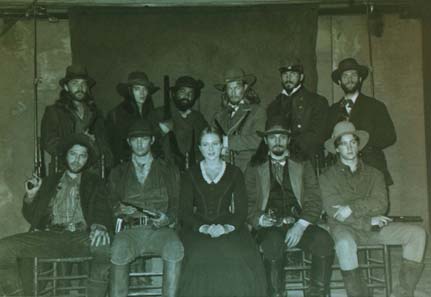
, with a screenplay by James Schamus (now head of Focus Features) was not a box-office success when it opened, perhaps as it was an unconventional western with controversial elements: four young people, Jake Roedel (Tobey Maguire), Jack Bull Chiles (Skeet Ulrich), George Clyde (Simon Baker), and Daniel Holt (Jeffrey Wright) all find themselves fighting as Confederate guerillas during the Civil War as "bushwhackers," not so much as they believe in the Southern cause—Holt is a freed slave—but because of issues with loyalty, friendship and attacks on their families. Soon, they're conducting murderous assaults on established Union positions with deadly accuracy, which Lee stages with a brutal efficiency: quick cuts, fast pace and attention to the damage a round bullet can inflict.
Housed for the winter in a make-shift shelter
, they are looked after by Southern sympathizers, with particular interest paid by a war-widow named Sue Lee (Jewel), who begins an affair with Chiles and offers support and food during the harsh winter. It's a nicely paced gritty portrayal of life led as an outlier, and the elements are mixed as to keep one guessing about what will happen next.
The revelation here is
Tobey McGuire, heretofore usually playing callow youths (which is why he was picked to play Peter "Spiderman" Parker), here he's got a versatile range of situations, starting out as a disillusioned follower, then his own man of a kind, backed by a steely gaze that turns durn creepy at times, and an "on-the-edge-of-cracking" voice that lolls over dialogue. Nice work, and Lee makes the most of him, using the boyish qualities of McGuire for moments of humor, terror and combinations of both.


Wrongfully overlooked.

Tuesday, June 27, 2023

Asteroid City

Meep! Meep!
or
Margot Robbie's in the Tupperware
 
Asteroid City does not exist. It is an imaginary drama created expressly for the purposes of this broadcast. The characters are fictional, the text hypothetical, the events an apocryphal fabrication."

Well, of course they are! It's a Wes Anderson movie!
 
Early on, with Anderson's movies—back before they got really stylistic with consistent lateral camera moves and a severe one-point perspective, and looked like they could have happened in the "real world"—there was a depth to the subject matter that was undeniable. That has remained to this day, even while the visual look of the films have become more juvenile and seem to be contained in toy-like play-sets that defy good construction practices or even three-dimensionality. Characters became types moving around in play-houses that seem to be defiantly artificial...like shooting in a western town that were deliberately shown to be propped up stage settings and mere facades. Most directors try to expand their horizons along with their budgets and to take pains to make things more realistic and less like pre-planned photographed dramatizations. Not Wes Anderson.
Hitchcock said of Spielberg that he was "the first one of us who doesn't see the proscenium arch" noting that Spielberg grew up with film, rather than the stage. But, Anderson is going a different direction. He WANTS you to see the proscenium arch, and will go out of his way...with a child-like glee...to make sure it's noticed and appreciated to be artificial. His new film, Asteroid City is one more step in that direction as it's story looks like it takes place in one of Maurice Noble's desert landscapes in the Road-runner cartoons.*
But, that's one aspect of Anderson's film (he usually has at least two he's presenting in his movies). Usually, he's as stringent in his story through-line as he is with a tracking shot (his The French Dispatch, with its a handful of stories, being an exception). This one, he's made a layered story, through several simulated media—television, stage, and film—each one has its place in the film and each one is subject to being violated, one by the other.
Now, Asteroid City tells the story of what happens when a bunch of "super-genius" kids arrive with their families at the titular city—famed for its vicinity to  the "Arid Springs Meteorite" impact crater—for the "Junior Stargazer/Space Cadet" convention put on by "The Larkings Foundation" and the U.S. Military under its United States Military-Science Research and Experimentation Division. They're to be given awards for their inventions—it should be noted that those inventions (jet-packs, destructo-rays, projecting on the Moon) were not viable in the setting of 1955, but would be just the sorts of things kids would want to invent. Each family have their issues and quirks, and they become unwitting witnesses to a major event in the history of mankind.
So, that's the plot. But, it's not the whole movie. We begin—in black-and-white and a square Academy ratio—with a television program (of the arts-programming "Omnibus" variety) where the host (
Bryan Cranston) intones that they are presenting a special production of a play by famed playwright Conrad Earp (Edward Norton) called "Asteroid City" and after a brief episode where Earp meets actor Jones Hall (Jason Schwartzman), we begin with a wide-screen version of the play in the colors of a faded post-card you'd find in a rack at a tourist trap.
Augie Steenbeck (played by Jones Hall played by Jason Schwartzman)—photographer—arrives (barely) at 'Roid City with his three daughters Andromeda, Pandora, and Casseiopeia as well as his son Woodrow (Jake Ryan), who is participating in the awards contest. Augie was a war photographer, still has shrapnel in his head, and takes his station wagon in to be serviced (by mechanic Matt Dillon)—it having given up the ghost miles down the road. It's decided that they will stay in town for the convention, rather than stay with Augie's father-in-law, Stanley Zak (Tom Hanks).
Stanley is concerned about this, but he's more distressed that Augie hasn't told the kids that Augie's wife/his daughter died two weeks ago, and don't you think it's about time to do that? So Augie stoically tells the kids—"Are we orphans now?" "No, I'm still alive."—which affects them all deeply, despite Woodrow being steeped in all things science and the three daughters, embracing mysticism seeing themselves as witches (well, two witches and one vampire). To allow the kids to grieve, Augie lets the kids bury their mother's ashes (contained in a Tupperware container) temporarily in the car-park until their grandfather can arrive to take them to his home for a more proper burial.
Also there for the awards ceremony is actress Midge Campbell (played by Mercedes Ford, played by
Scarlett Johansson), who is studying her lines for a new play and develops a curious relationship with Augie—seeing as their neighbors and all. Like the majority of the actor/characters, they are demonstratively undemonstrative, and—if I may use the word again—"stoic." These are, after all, adults in the 1950's, having lived through a ghastly world war, only to see it emerge with advances in technology and weaponry that dwarf, and could ultimately consume them. The many small inconveniences of living in a desert tourist trap not to far away from a nuclear test-site, leave them unfazed.
It is only when a cosmic event happens that is ultimately beyond their understanding that things change. Asteroid City, due to that happenstance is shut down and quarantined, leaving the temporary residents stranded. But, true to their nature—or perhaps the nature that Conrad Earp has given them—they react more to the minor annoyances that the quarantine imposes, rather than the perspective shock that its cause should have created.
Seems a bit like real life, doesn't it?
Anderson and consigliere Roman Coppola were writing this in 2020, so the COVID quarantine may not have been the genesis for the project, but filming during COVID restrictions certainly did, necessitating the recasting of Bill Murray when he came down with the plague. Still, when the outrage in real life is over the inconvenience of wearing masks rather than the loss of more than a million souls (you can't make this stuff up!), one can infer that it was on the creative minds.
Six feet apart?
But, there is one attitude shift present from the happenstance; Anderson abandons his persistent horizon-bisecting in the frame for something else—overhead shots looking down on the players. Oh, everything still has that one-point perspective, but from above with no horizon in sight, putting (in camera-terms) the people on screen at a disadvantage, making them smaller, vulnerable, putting them in their place—at least from the perspective of an observing extra-terrestrial. It's a bit jarring, but completely apt. It's the only evidence of a new perspective in the movie.
So, I found it fascinating, but then, I always look forward to Anderson's films. They may not come to an all-encompassing conclusion, but instead take on the mantle of a childish inquiry without answers. They make me feel a little younger, where playfulness was everyday, and not in those moments in between crises. They embrace innocence, but leave plenty of room for cynicism and mild bemusement, rather than a-musement. And the cultural touchstones he invokes are pretty sophisticated, even if he's not being sophisticated about them. I'm all in for that.
 
I hope he never grows up and loses it.
And Asteroid City is the perfect come-back for all those scary A-I generated parodies of "visionary director" Wes Anderson that are flooding YouTube now ad nauseum. Whatever the "brave new world" of AI generates, Anderson will always top it. I find that reassuring.

 * Anderson even throws in an occasional stop-motion road-runner just so we get the point.
"Wow"
 
Some more shots from Asteroid City, just because they amuse me... 

Friday, March 4, 2022

The Batman

It was a Dark and Stormy Knight
or
How Many Batmen Does It Take to Change a Light-bulb?

You know how it went: in "Peanuts", Snoopy would sit on top of his dog-house type-writing—"It was a dark and stormy night. Suddenly a shot rang out. The maid screamed. A door slammed.
 
 
That's how Matt Reeves' The Batman felt to me after I'd survived it. Just as suddenly as something is resolved, you think there's some breathing room, and then you think "Geez! They haven't even figured out the serial killer yet!" And then that starts and you think THAT's finished, and you go "Wait a minute, that seemed kind of easy", and that's when the guano really hits the fan, and things get even more complicated, and you start looking for something to tell you what time it is, because you really think that the thing is never going to end, and then, they distract you and you think "Oh no, they're going to bring him in?"
It's at that point you realize that it's no fun being the Batman—because the job just never stops. You wonder if you even want to admire the Batman or pity him, but you sure don't want to be him. 
 
And maybe...you don't want to watch him.
"So, is it even worth going?" Hell, yeah. Because The Batman is more like the Batman from the comics (depending on the period of origin—in this case, the 1930's and 70's) than he's ever been. Stripped down and deconstructed, this version escapes the taint that has hung on the character ever since the TV-series from the 1960's. There's no "camp". There's no crazy costumes...well, except for the Bat-suit (which is armored to the point that it's bullet-proof and probably tough to maneuver in—he even thuds when he walks)...and there's no goofy archness or hysterical theatricality, which still remained even in the Christopher Nolan-directed trilogy. Not even an artfully-choreographed fight; they're all thumping and brutal.
It's perfectly serious. And does things the "Batman" series has never done before. For instance, this is the first Batman movie since the series started (with Tim Burton back in 1980), where Batman doesn't kill anybody—oh, he messes people up really bad, but they don't die unless it's due to their own actions—and that was a "code" that an orphan who lost his parents to gun-violence strictly adhered to. And the "Batman" in the movies has always stood for vengeance, and here, the character arc has him realize how limiting that is—when he sees the main villain of the piece committing heinous acts to avenge his own circumstances. His self-imposed mission changes during the course of the movie; the film pointedly ends with Batman looking forward and not back.
Now to say I "survived" it takes an explanation. The Batman is just shy of three hours long. And it feels like it*—Reeves can make fascinating movies, but he's not an editorial trickster (like Nolan) so things happen at a steady, remorseless pace (Reeves uses Nirvana's "Something in the Way" as background, and that's the beat that he uses for the film). It's a long run-time, and the story covers a lot of ground, dealing with corruption, organized crime, and striking out against sins of the past. It's less a "super-hero" film than a police procedural along the lines of contemporary British mysteries or "Law and Order"—this Batman even walks through crime-scenes with the police (despite "official" disapproval of vigilantes by the Gotham City Police Department), making observations, providing lines of investigation. It's an intricate maze of clues and evidence that increases the run-time. What would I take out? Not a jot. Certainly not with the Warner studio's recent insistence of cutting things down to near-incomprehensibility.
Because it's a good story that has the construction of the best of the (Batman co-creator) Bill Finger-penned Batman stories: murder victims of a prominent vintage, all seemingly unrelated but leading inexorably to a far greater threat (it's nice that the clues are multi-layered without the usual *snap* "I've got it! He's going to rob the Obvious Clue Savings and Loan!"). And we've become so used to comic-book threats—penguins with rocket launchers, "fear-gas," 'memory-sucking devices" and ice-guns—that it's a little disconcerting—even creep-inducing—that the various plots all nudge at real-world headlines: "Zodiac" messages, "collar-bomb" extortion, mailed death-packages, internet zombies, even Hurricane Katrina.

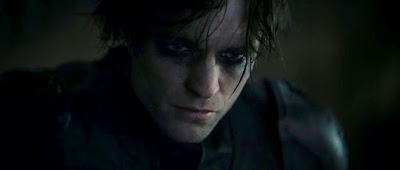
Ah, but you don't want to know all that. You want to know how the Patt-Bat is! He's darned good if you want to discard the whole "Zorro"/"Scarlet Pimpernel" vibe that inspired the character. Pattinson's Bruce Wayne is a brooding recluse holed up in Wayne Tower in the middle of Gotham City, and he'd probably be a prime suspect in the "Riddler" case if the police just looked at the power being used by the dingy bat-filled basement of the building (nah, they wouldn't—he has too much money). His Bruce is so emo, he almost wears a bat on his sleeve—so much for secret identities. But, his Batman is slow, hulking and fills a room, the eyes constantly moving and the perfect jaw-line not at all. It would almost be a mime act if he didn't have Jeffrey Wright doing heavy-lifting (and expositing) as Lieutenant James Gordon ("You could have pulled the punch..." "I did"). Wright makes a character important no matter how much he's pushed to the background, but here, he's the other half of a buddy act. By contrast, Andy Serkis' Alfred is the character who's given short shrift.
But, it's the villains that everybody pays attention to in Batman movies and there's a lot of them: It's a great cast and everybody does very good work.
Zoë Kravitz is a fine addition to the ever-growing litter of cat-women, with the appropriate fanged snark and a duplicitous sensuality that one expects of the character by this time. Her scenes with Pattinson fall a bit flat unless they're quarrelling, because he doesn't give out that much as far as any sort of response. That's on him; not her.
Paul Dano leans in to his cherubic looks to create an intensely creepy Riddler—he has several aliases—internalizing the schitzy nature of the character with the same intensity with which Heath Ledger externalized his Joker in The Dark Knight. Ledger is a tough act to follow, but Dano isn't as theatrical and does more with little expressions than anything playing to the loges.
Speaking of which, if Dano leans in,
Colin Farrell leads out with his take on "The Penguin" ("Call me 'Oz'") as a voluble Chicagoan gangster with none of the panache or freakishness in past portrayals, but bearing a family resemblance to Rod Steiger's Al Capone. He is wholly unrecognizable, physically or in performance, and it's not just the elaborate prosthetics he's forced to wear to pull off the job, the acting is larger than it can contain, making a huge impact in a role that's a supporting character to John Turturro's Carmine Falcone, the Gotham boss who's pulling all the strings only to find his organized crime operation being undone by a lone outlier. Also Peter Sarsgaard should be given a hand-clap for his portrayal of a weak Gotham D.A. caught up in the carnage.   
Is it the best Batman movie? I think it's too soon to tell. I didn't come away from it thrilled with it as a whole (as with others), but was delighted at its parts (and little touches like
the bust of Shakespeare in Wayne Tower, the very apt use of DOS graphics, the song that plays when Bruce Wayne visits Mob-boss Falcone)
There is no doubt that this is the best interpretation of the character if you want to do it as a straight-ahead portrayal, ignoring the many iterations that have made up its history, the bad and the good. Someone had to do it—to put the detective back in The Darknight Detective. And Reeves, who has proved time and again that he can make something special and unique out of retread material, has managed to make something original with Batman.

* It isn't helping that the theaters front-load this particular attraction with more than the usual number of commercials (even inserted between previews—which, let's be honest—are commercials, too). The whole presentation is like 4 hours long. One can see why the theater-chains are doing this—a 3 hour movie limits the number of times it can be screened, even though they've Bat-jammed as many  showings in as many plex's as they can manage. And those commercials pay the chains. But, it is testing the endurance of an audience not expecting an epic Lawrence of Arabia roadshow.