Showing posts with label Batman. Show all posts

Thursday, August 11, 2022

The Dark Knight Rises

Written at the time of the film's release.

The Bane of Our Existence

or
"Okay, What Joker Put Yeast in My Dark Knight?"


"All stories end in death, and he is no true story teller who would keep that from you"--Hemingway

"If you want a happy ending, that depends, of course, on where you stop your story"--Welles

So, Christopher Nolan's "Batman" trilogy ends in a nearly 3 hour film that neatly wraps up the story. How does it end? That would be telling. The comics went through a phase where Bruce Wayne ruminated that he was working towards a world where he wasn't needed. That's a nice little "buttoning up" of the "Dark Knight" story, but it's not complete. What of Bruce Wayne? Nolan has the opportunity in his version to really end it—he doesn't have to sell comic books next month—so, he can take it anywhere he wants to go. And one realizes (if one really wanted to end the story) that the only real happy ending that could be achieved is if Bruce Wayne became the one thing he never knew as a child—a caring, present father. Anything else makes the story a tragedy, and Bruce Wayne the last victim of the gunman's bullets that killed his parents. Given this series' downbeat tone (that of the sacrificial martyr) and of the available previews for The Dark Knight Rises, such a scenario does not seem likely. Given that, Nolan can take the tragedy of his hero in any number of directions.
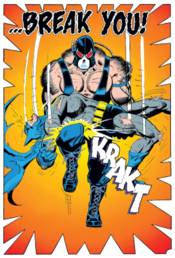
Bane (Tom Hardy here) is the perfect villain to bring into the mix. A hopped-up minor character, he is best known as the lead antagonist for the "Knightfall" storyline (that seemed to last a couple years). In "Knightfall," the drug-pumped super-villain released every criminal in Gotham's prison system for The Bat to deal with, while he hung back, biding his time. Then, when the Batman, weakened and exhausted, finally confronted him, Bane broke his back, leaving Wayne paralyzed and unable to fight on. It fell to the rest of "The Batman Family" (including the once-and-future "Robin's") to take on the mantle and continue the fight.

Nolan's canvas is a bit broader, taking into consideration the events of the two previous films to create something a bit more apocalyptic, a rumination on the fractious quality of good vs. evil and the slippery slope to Hell that ideology and good intentions can be tilted towards. Nobody's pure in this one, there's no whack-job with delusions of grandeur behind the assault on Gotham City, with avarice their sole motive. Everybody, wearing white or black, thinks they're doing the right thing. And everybody's wrong.

It's eight years since the events of The Dark Knight that resulted in the deaths of D.A. Harvey Dent, Rachel Dawes, and the subsequent disappearance of the man suspected in the killings, the Bat-man (Christian Bale). Now, Bruce Wayne is an exile in his newly-rebuilt Wayne Manor, walking stiffly with a cane due to some unknown injury (part of me wants to think it was due to him being stabbed by one of The Penguin's umbrellas). He sees no one, is a recluse, and there are rumors he's turned into a Howard Hughes-style eccentric, apparently due to a massive investment in a clean energy prototype that failed and cost Wayne Enterprises a fortune...or at least half of it.
The chief backer for the project, Miranda Tate (Marion Cotillard) tries to get past the constant guards of faithful butler Alfred (Michael Caine, putting in the most emotional performance he's done in years) and Wayne exec Lucius Fox (Morgan Freeman), who fill the functions of acting as Wayne's heart and brains (and conscience), if not as surrogate Mother and Father. A rival exec, Daggett, is trying to take over W.E., by any means necessary, in this case, employing a terrorist named Bane, who has his own bones to pick (and break) with Gotham's golden boy. At the beginning of the film, Gotham in morosely complacent (and obviously filled with exposition), having cleaned up crime by the draconian Dent Anti-Crime Act, which has incarcerated over a thousand criminals in Gotham's Blackgate Prison.

But things are percolating underground, disrupting Gotham's infrastructure.  Bane has an army of misfits and big plans that have outgrown the desires of his patron, and there's a lithe cat burglar named Selina Kyle (Anne Hathaway), who is caught with her hands in the Wayne Manor safe by the man himself ("Oops," she says, not very convincingly). Yes, she's pilfered Martha Wayne's pearl necklace, but more importantly, Bruce Wayne's fingerprints. What does she want with those?

It's only one piece in an intricate puzzle of escalating consequences that Batman must unravel if he is, once again, to save Gotham City, and he must confront his past and overcome great injury, physical and emotional, if he is to prevent a catastrophe...
one of his own devising.

That's the gist of it, but it is convoluted by elaborate set-pieces that are, frankly, jaw-dropping, and ends up with Gotham isolated from the rest of the nation, in the hands of criminals with big ideologies and little concern for how roughly they're applied. The police are paralyzed—most of them trapped in the deep infrastructure of the city (a little too conveniently) while Bane initiates a countdown to total destruction.

A countdown of five months.

To quote The Riddler:"????" Five months? How suspenseful is that? And you'd think that somebody, somewhere, would be able to unravel the plot or situation in such a time-frame. But, it's basically a set-up for what Nolan depends on to generate suspense throughout the movie—the last minute "save," that is usually explosive and comes from nowhere, because the writer-director has made motivations ambiguous enough as to be unreadable.* Everyone has got a secret that will be revealed at the most opportune moment of drama. If the mystery was revealed in a drawing room, it would feel like cheating, and the revelations almost psychic.
Speaking of unreadable, Tom Hardy's Bane is hampered by a mask of a morphine dispenser (to keep him from feeling pain), as opposed to the enhancement-juice-pumping-apparatus from the comics (This leads one to ask: if the guy can be stopped by breaking the mask, why does Our Hero employ so many body-blows?  Face-shots, man!!). He is perpetually muffled by this thing, which Hardy compensates for with an almost jolly Father Christmas speaking style, making a clever, unnerving ying-yang effect for the character. Ultimately, though, he's something of a vapor-tiger, like Darth Vader, the big bloated bloviator who's merely a "blind," a distraction for the real danger.


But...five months??**
Another thing: Nolan has come out publicly saying that he wants to make a Bond movie (and the snowbound facility infiltration in Inception is a bowler-tip to them). I would submit that he already has, this film being it. So much of it is borrowed from Bond that all one needs is a casino scene to make it complete (a costume party has to suffice
***). The opening sequence, the-villain-that-feels-no-pain, the duplicitous females, obligatory "Q" scene, the tick-tock final set-piece and other aspects can be attributable to Bond films of the past. At least someone is borrowing from the Bond series this time, instead of the other way around.
But, his world of comic-book fantasy is far more gritty and down-to-Earth than any other, and that's what makes "The Dark Knight Trilogy" good; it's relatable, it feels like it could happen, if someone had the will, the wherewithal and the wallet to do it. It also feels of our time. There's been a lot of gas about the politics in this film—uninformed, desperate gas—but the whole uprising scenario, the subjugation of the privileged with no benefit to the less fortunate, the breaking down of society and the cleaving of its people is the stuff of water-cooler vitriol and feels like the temper of the times. The Tea Party AND the Occupy Wall Streeters can both find things to point at and go:"See?"
I'm not going to speculate which side is right, and Nolan is obtuse (and politically slippery) enough to play it right down the yellow stripe of the road. But, this British director is saying something about the State of the Union with a full child-warbled rendition of The Star Spangled Banner (before a particularly horrific football game) and a shot of American flags in tatters on a city street, deep in the movie. They're there for a reason, but not for anything specific enough other than "we're a fragile alliance and we're in trouble."
And that we need heroes—selfless ones, for whom profit is not a motive—and that, "anyone can be Batman."****

* Case in point:  there's a scene where Catwoman uses a Wayne-supplied bat-bike to blow a hole in a tunnel to make an evacuation tunnel for the sealed-off city, a task initiated by the Caped Crusader.  Following it, Nolan sits on a pull-in shot of Hathaway with an enigmatic smile on her face that communicates...nothing. Except an odd complacency. It will only be resolved...if there's anything TO be resolved, later in the film. 

** There are neat touches, and a refresher of both The Dark Knight AND Batman Begins will help. One nice thing—Nolan recalls a scene from BB when a young Bruce Wayne falls down a tunnel and is subsequently rescued by his father, by having a similar scenario played out here, with the Obi-Wan presence of a dark father figure from his past. Nice touch.

*** A masked ball at which, like in Batman Returns, Bruce Wayne doesn't wear a mask.  Heh.

**** Just not Nicolas Cage, please...
What do they say at Marvel? "What a poser..."


Wednesday, August 10, 2022

The Dark Knight

The Warner Bros can't seem to catch a break making movies—although "The Sandman" mini-series is very good*—so, let's go back to those halcyon days (or knights) when they seemed to know what they were doing with their DC Comics properties. Like 2008.

Written at the time of the film's release.


"Ya Wanna See an Actor Disappear?"


No, that title is not what you think it is (and shame on you for going there), but Heath Ledger does such a sick, twisted, inspired version of Batman nemesis The Joker, he blows away all pre-conceived notions of the character and his own acting history. Ledger literally gets lost in The Joker, with the smeary, sloppy make-up, his voice that goes from wormy-Richard Dreyfuss to bellowing Ahab-roar (with occasional stops at Bugs Bunny chirpiness), and a gait that sometimes shambles, sometimes totters, sometimes Frankenstein-stomps. All that theatricality is entertaining, but it's the moments of lucidity that are scary. "You're insane!" says Gotham mob-boss Sal Marone (Eric Roberts, doing relaxed, sleazy work), not without reason. "No, I'm not," replies the self-proclaimed Agent of Chaos resignedly. "No...I'm no...tt!"
Ledger's not the only show in town in
The Dark Knight
. Aaron Eckhart makes a complicated "White Knight" of DA Harvey Dent (it's really his story), Christian Bale's Bruce Wayne and booming Batman are deeper than the portrayal of Batman Begins--more soulful, less Bush-brash--and Michael Caine and Morgan Freeman do able support for roles slightly more down-played than the last film's. This time, Gary Oldman's Lt. Gordon has more to do, and the longer he's on-screen, the better you like him, and Maggie Gyllenhall gives the character of Rachel Dawes more of a spine (with a contrarily slinky walk) than Katie Holmes was able to provide.
The buttoned-up script is full of triangulation. There's the good-guys—Gordon, Dent and Batman—against an Axis of Evil—The Mob, Joker and Chinese financiers (and when one disappears from the screen they're replaced by another). And that's about as black-and-white as things get. Everything else is in convoluted, mordant shades of gray. There's the romantic triangle of Dawes and Dent, with Bruce Wayne as third-wheel. The Batman "team" of Wayne,
Alfred and Lucius Fox (all ensconced in the Wayne Enterprises high-rise while Stately Wayne Manor is being rebuilt).
The plot devices are triangulated traps that have an either/or scenario with a third more-horrific option--which becomes The Joker's trademark, ensuring that something bad will
happen no matter what. Targets are coordinated in sets, separating the weak from the herd and laying a further trap. It's Joker's way of providing Gotham "a better class of criminal." Batman's vigilantism has made the common petty thief think twice about stepping out of line. Now the Joker sets up elaborate conspiracies that bait and switch and then turn on a dime to a more complicated and deadly resolution.
"You've changed things." he crows at Batman. "There's no going back." When Wayne begins to question whether he needs to take deadlier action because Joker has "crossed the line," Alfred reminds him "You crossed that line first, Master Bruce." Hours before, Wayne had considered giving up the fight with a legitimate civic-minded public figure arriving for Gotham in Dent. Now, he's fighting harder than ever, if only to not step further across that moral line dealing with the new criminal madness. And The Joker? He starts to take actions protecting The Dark Knight, realizing that they can't kill each other: "You.. complete me" he cackles, in one of the chilling laugh-lines he spouts in an interrogation scene.

The Dark Knight ticks along (although it's overlong by half an hour--Director Nolan has a hard time knowing where to stop the escalating madness), with increasingly bizarre acts of cruelty (the film gets a PG-13 only because Nolan cuts away from some of the more grisly aspects--but takes the character design of one iconic Bat-villain in a more charred and eaten-away manner than even the comics devised).
By the end, some of the cast has been culled, and a long entrapment scene has gone on far too long, with still another set-piece just around the corner. At some point, every one of the good guys takes a hit, usually for noble purposes, but each keeps plugging away, trying to prevent having to put tooth-paste back in the tube, as consequence upon consequence piles up. And in the end, The Batman must re-adjust his modus operandi, taking on a new guise in his battle, one that he can only accomplish alone. At the same time, he handicaps himself to ensure he can't cross the line with too much power. He's left running in front of a metaphorical fast-moving train, knowing that at any moment he's going to have to turn and stop it.
"Dark Knight?" This thing is black as pitch.

In fact its relentlessly gloomy, and the sick thing is one looks forward to Ledger showing up for some light sickness to contrast the darkness. In fact, what has distinguished the "Batman 2.0" series of films is how they take the super-hero tropes and make them...practical and familiar. Nolan has kept this film-world translation of Gotham City looking gritty and realistic--far more so than the high-spired, mono-railed futuristic Gotham of Batman Begins--and the feel of the film is of an intricate crime drama, rather than a super-hero epic. The opening bank robbery is a nicely taut set-piece with more than one twist. And Nolan is far more adept at staging his action than previously. But by de-clowning The Joker, one wonders how some of The Dark Knight's three-color villains will translate to this milieu. One wonders where one goes from here. And one anticipates the next installment when this one has ended.
And that's a genuine accomplishment.

* Will I do a review? We-ell, I don't usually do streaming mini-series (although I broke that rule with the old British mini "Edge of Darkness") We shall see. You can dream, can't you?
 

Friday, March 4, 2022

The Batman

It was a Dark and Stormy Knight
or
How Many Batmen Does It Take to Change a Light-bulb?

You know how it went: in "Peanuts", Snoopy would sit on top of his dog-house type-writing—"It was a dark and stormy night. Suddenly a shot rang out. The maid screamed. A door slammed.
 
 
That's how Matt Reeves' The Batman felt to me after I'd survived it. Just as suddenly as something is resolved, you think there's some breathing room, and then you think "Geez! They haven't even figured out the serial killer yet!" And then that starts and you think THAT's finished, and you go "Wait a minute, that seemed kind of easy", and that's when the guano really hits the fan, and things get even more complicated, and you start looking for something to tell you what time it is, because you really think that the thing is never going to end, and then, they distract you and you think "Oh no, they're going to bring him in?"
It's at that point you realize that it's no fun being the Batman—because the job just never stops. You wonder if you even want to admire the Batman or pity him, but you sure don't want to be him. 
 
And maybe...you don't want to watch him.
"So, is it even worth going?" Hell, yeah. Because The Batman is more like the Batman from the comics (depending on the period of origin—in this case, the 1930's and 70's) than he's ever been. Stripped down and deconstructed, this version escapes the taint that has hung on the character ever since the TV-series from the 1960's. There's no "camp". There's no crazy costumes...well, except for the Bat-suit (which is armored to the point that it's bullet-proof and probably tough to maneuver in—he even thuds when he walks)...and there's no goofy archness or hysterical theatricality, which still remained even in the Christopher Nolan-directed trilogy. Not even an artfully-choreographed fight; they're all thumping and brutal.
It's perfectly serious. And does things the "Batman" series has never done before. For instance, this is the first Batman movie since the series started (with Tim Burton back in 1980), where Batman doesn't kill anybody—oh, he messes people up really bad, but they don't die unless it's due to their own actions—and that was a "code" that an orphan who lost his parents to gun-violence strictly adhered to. And the "Batman" in the movies has always stood for vengeance, and here, the character arc has him realize how limiting that is—when he sees the main villain of the piece committing heinous acts to avenge his own circumstances. His self-imposed mission changes during the course of the movie; the film pointedly ends with Batman looking forward and not back.
Now to say I "survived" it takes an explanation. The Batman is just shy of three hours long. And it feels like it*—Reeves can make fascinating movies, but he's not an editorial trickster (like Nolan) so things happen at a steady, remorseless pace (Reeves uses Nirvana's "Something in the Way" as background, and that's the beat that he uses for the film). It's a long run-time, and the story covers a lot of ground, dealing with corruption, organized crime, and striking out against sins of the past. It's less a "super-hero" film than a police procedural along the lines of contemporary British mysteries or "Law and Order"—this Batman even walks through crime-scenes with the police (despite "official" disapproval of vigilantes by the Gotham City Police Department), making observations, providing lines of investigation. It's an intricate maze of clues and evidence that increases the run-time. What would I take out? Not a jot. Certainly not with the Warner studio's recent insistence of cutting things down to near-incomprehensibility.
Because it's a good story that has the construction of the best of the (Batman co-creator) Bill Finger-penned Batman stories: murder victims of a prominent vintage, all seemingly unrelated but leading inexorably to a far greater threat (it's nice that the clues are multi-layered without the usual *snap* "I've got it! He's going to rob the Obvious Clue Savings and Loan!"). And we've become so used to comic-book threats—penguins with rocket launchers, "fear-gas," 'memory-sucking devices" and ice-guns—that it's a little disconcerting—even creep-inducing—that the various plots all nudge at real-world headlines: "Zodiac" messages, "collar-bomb" extortion, mailed death-packages, internet zombies, even Hurricane Katrina.
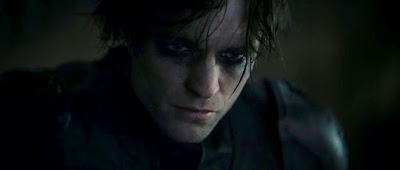
Ah, but you don't want to know all that. You want to know how the Patt-Bat is! He's darned good if you want to discard the whole "Zorro"/"Scarlet Pimpernel" vibe that inspired the character. Pattinson's Bruce Wayne is a brooding recluse holed up in Wayne Tower in the middle of Gotham City, and he'd probably be a prime suspect in the "Riddler" case if the police just looked at the power being used by the dingy bat-filled basement of the building (nah, they wouldn't—he has too much money). His Bruce is so emo, he almost wears a bat on his sleeve—so much for secret identities. But, his Batman is slow, hulking and fills a room, the eyes constantly moving and the perfect jaw-line not at all. It would almost be a mime act if he didn't have Jeffrey Wright doing heavy-lifting (and expositing) as Lieutenant James Gordon ("You could have pulled the punch..." "I did"). Wright makes a character important no matter how much he's pushed to the background, but here, he's the other half of a buddy act. By contrast, Andy Serkis' Alfred is the character who's given short shrift.
But, it's the villains that everybody pays attention to in Batman movies and there's a lot of them: It's a great cast and everybody does very good work.
Zoë Kravitz is a fine addition to the ever-growing litter of cat-women, with the appropriate fanged snark and a duplicitous sensuality that one expects of the character by this time. Her scenes with Pattinson fall a bit flat unless they're quarrelling, because he doesn't give out that much as far as any sort of response. That's on him; not her.
Paul Dano leans in to his cherubic looks to create an intensely creepy Riddler—he has several aliases—internalizing the schitzy nature of the character with the same intensity with which Heath Ledger externalized his Joker in The Dark Knight. Ledger is a tough act to follow, but Dano isn't as theatrical and does more with little expressions than anything playing to the loges.
Speaking of which, if Dano leans in,
Colin Farrell leads out with his take on "The Penguin" ("Call me 'Oz'") as a voluble Chicagoan gangster with none of the panache or freakishness in past portrayals, but bearing a family resemblance to Rod Steiger's Al Capone. He is wholly unrecognizable, physically or in performance, and it's not just the elaborate prosthetics he's forced to wear to pull off the job, the acting is larger than it can contain, making a huge impact in a role that's a supporting character to John Turturro's Carmine Falcone, the Gotham boss who's pulling all the strings only to find his organized crime operation being undone by a lone outlier. Also Peter Sarsgaard should be given a hand-clap for his portrayal of a weak Gotham D.A. caught up in the carnage.   
Is it the best Batman movie? I think it's too soon to tell. I didn't come away from it thrilled with it as a whole (as with others), but was delighted at its parts (and little touches like
the bust of Shakespeare in Wayne Tower, the very apt use of DOS graphics, the song that plays when Bruce Wayne visits Mob-boss Falcone)
There is no doubt that this is the best interpretation of the character if you want to do it as a straight-ahead portrayal, ignoring the many iterations that have made up its history, the bad and the good. Someone had to do it—to put the detective back in The Darknight Detective. And Reeves, who has proved time and again that he can make something special and unique out of retread material, has managed to make something original with Batman.

* It isn't helping that the theaters front-load this particular attraction with more than the usual number of commercials (even inserted between previews—which, let's be honest—are commercials, too). The whole presentation is like 4 hours long. One can see why the theater-chains are doing this—a 3 hour movie limits the number of times it can be screened, even though they've Bat-jammed as many  showings in as many plex's as they can manage. And those commercials pay the chains. But, it is testing the endurance of an audience not expecting an epic Lawrence of Arabia roadshow. 

Sunday, August 7, 2016

Don't Make a Scene: Batman (1989)

The Story:  Hallowe'en's coming. The costumes are coming out of moth-balls. Here's a scene featuring the one get-up that shows at every party, because the idea's just too powerful and too easy to get and everybody knows it. Plus, it's easy to do. And since The Dark Knight, you don't even have to do it well.

This scene is the "coming-out party" for "The Joker" from the Tim Burton version of Batman, done in 1989, on the 50th anniversary of the title character's creation. A "Batman" film had been talked about in Hollywood for many years, but nobody had the right "formula" for how to present it. "Batman" has always followed "Superman" in media: first, in comics. then as cheap movie serials, then television, with "Batman" making a bizarre addition to pop culture by emphasizing the bright-colored "antic" nature of the medium, which was labeled as "camp." Audiences didn't stay focused for long (two and a half seasons), so when "Superman" made his big budget movie splash in 1978, a "Batman" film seemed a natural next step. But how to play it? Like the television series, or like Superman: The Movie

It took Warner Brothers Studios (who own DC Comics, the owners of Batman) eleven years to figure it out. 

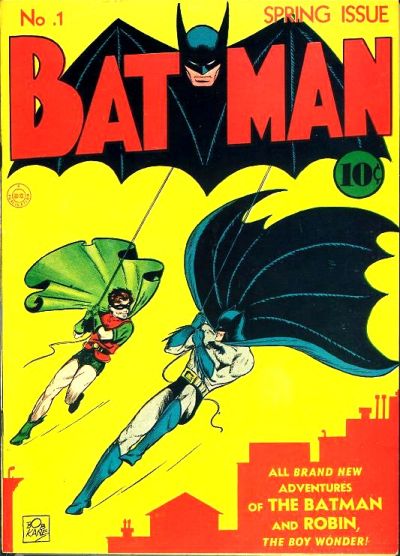
The Joker had been flitting around Batman since those days in 1939—he was one of the first of the Batman "rogues gallery" (in fact, there were not one but TWO "Joker" stories in the first issue of "Batman" comics. In the 60's, the Joker was a little late to the game, not showing up on the Batman TV series until the third week (after The Riddler and The Penguin).

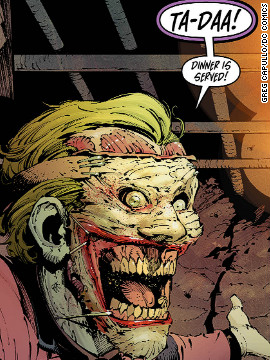
Over the years, though, "Joker" has become THE Batman villain, eclipsing all the others (and the one the writers seem to have the most fun using to compare and contrast with the Batman—order versus chaos, that sort of thing).  In the beginning, he was just another freakish hood, robbing banks, killing people. Then, he was softened to be more clownish, with an off-beat sense of humor as to how he'd pull off crimes. In the 70's, the comics writers took him back to his roots—murderous, mad, and motiveless. Lately, he's become truly grotesque in the dark "New 52" world of the comics—with a forked tongue, and now wearing his own face as a mask. Yeesh. 

The scene, as displayed, could use Danny Elfman's antic circus music in the background, but you've got the videos for that. 

The Set-Up:  A robbery by the Grissom gang, a notorious gangster mob in Gotham City, has been stopped at the Ace Playing Card Co.  One of the victims of the police shoot-out is Jack Napier (Jack Nicholson), first lieutenant to Carl Grissom (Jack Palance) and rival for the attentions of Grissom's woman, Alicia (Jerry Hall). A stray bullet has hit Napier in the face, and despite his best efforts, The Batman (Michael Keaton) cannot prevent the hoodlum from falling into a vat of toxic chemical waste. Incredibly, Jack survives, but an early morning visit to a butcherous physician cannot help matters on the face of it. 

Action!


INT. GRISSOM'S PENTHOUSE - NIGHT
The private elevator HISSES open. JACK steps out, bundled up in a trenchcoat, muffler, and slouch hat -- his face concealed from view. He plops in the big plush swivel chair behind Grissom's desk.
GRISSOM (O.S.) That you, sugar bumps?
Grissom WADDLES IN fresh out of the shower, a towel wrapped around him. Using a smaller towel to dry his hair, it's a moment before he sees the bundled-up figure at his desk.
GRISSOM Who the hell are you?
JACK It's me. "Sugar Bumps."
GRISSOM Jack? (advancing cautiously) Thank God you're alive. I heard you'd been... 
JACK Fried. Is that what you heard?
Jack stands and gestures him over to the empty chair. Grissom moves when he sees the gun pointing at his belly.
JACK YOU SET ME UP! (beat)
JACK Over a girl. You must be insane!
Grissom surreptitiously reaches for a desk drawer.
JACK Don't bother.
GRISSOM Your life won't be worth spit.
JACK I been dead once already. It's very liberating -- You have to think of it as therapy.
GRISSOM (beginning to panic) Jack, listen -- we'll cut a deal --
JACK Jack? Jack's dead, my friend.
JACK You can call me...
JACK ...Joker.
He flings away the hat. RIPS THE MUFFLER from his face. And --
as Grissom gasps in shock --
stands revealed in his full horrendous glory. His flesh is bleached bone-white. His hair is a luminous seaweed-green. And his cheeks are torn and puckered from the bullet wound, TWISTING HIS MOUTH INTO A HIDEOUS, PERPETUAL HARLEQUIN'S GRIN.
JACK And as you can see, I'm much happier.
Jack begins to GIGGLE, building to hysterical LAUGHTER.
Grissom makes a lunge towards his desk drawer.
Jack FIRES.
AND FIRES AGAIN 
...UNTIL THE CLIP IS EMPTY.
EXT. GRISSOM'S BUILDING - NIGHT We TILT UP the facade of the skyscraper, arriving finally at the TOP FLOOR: a PLATE GLASS WINDOW spiderwebbed with cracks where Jack's bullets hit.
INT. GRISSOM'S PENTHOUSE - NIGHT (THAT MOMENT)
Darkness. JACK -- or, as we'll know him from this moment on, The JOKER -- sits in Grissom's swivel chair and surveys the moon-drenched city.
JOKER (nostalgically) Gotham City.
JOKER It always brings a smile to my face.
As he swivels in the chair he notices a copy of the Globe (now blood-splattered) lying on Grissom's desk.
The head-line catches his eye. WINGED FREAK TERRORIZES GOTHAM'S GANGLAND.
JOKER: "Winged freak..."
JOKER: "...terrorizes"
He picks up the paper and starts HUMMING.
JOKER Watch it, Batman. Wait'll they get a load of me.
JOKER Oooooooo....
JOKER  Ooop.  Ooop....
Joker begins to GIGGLE, building to hysterical LAUGHTER.

Batman

Words by Sam Hamm and Warren Skaaren

Pictures by Roger Pratt and Tim Burton

Batman is available on DVD from Warner Home Entertainment.