Showing posts with label Maggie Gyllenhaal. Show all posts

Wednesday, August 10, 2022

The Dark Knight

The Warner Bros can't seem to catch a break making movies—although "The Sandman" mini-series is very good*—so, let's go back to those halcyon days (or knights) when they seemed to know what they were doing with their DC Comics properties. Like 2008.

Written at the time of the film's release.


"Ya Wanna See an Actor Disappear?"


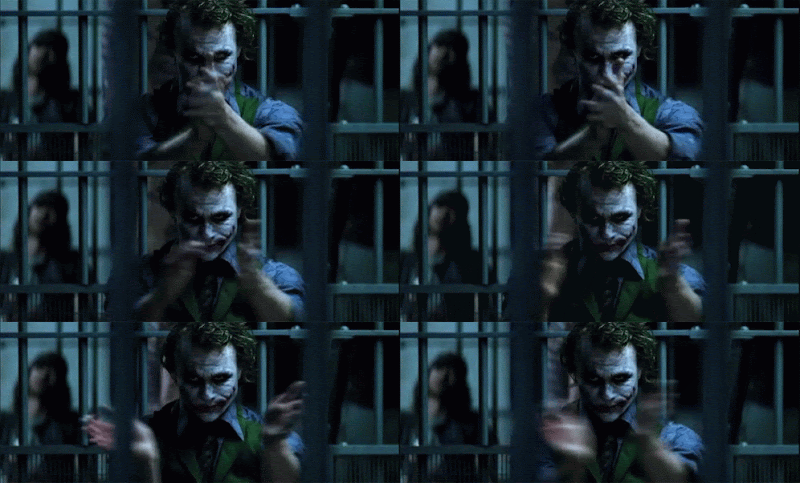
No, that title is not what you think it is (and shame on you for going there), but Heath Ledger does such a sick, twisted, inspired version of Batman nemesis The Joker, he blows away all pre-conceived notions of the character and his own acting history. Ledger literally gets lost in The Joker, with the smeary, sloppy make-up, his voice that goes from wormy-Richard Dreyfuss to bellowing Ahab-roar (with occasional stops at Bugs Bunny chirpiness), and a gait that sometimes shambles, sometimes totters, sometimes Frankenstein-stomps. All that theatricality is entertaining, but it's the moments of lucidity that are scary. "You're insane!" says Gotham mob-boss Sal Marone (Eric Roberts, doing relaxed, sleazy work), not without reason. "No, I'm not," replies the self-proclaimed Agent of Chaos resignedly. "No...I'm no...tt!"
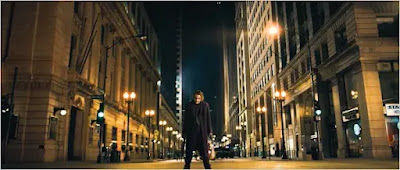
Ledger's not the only show in town in
The Dark Knight
. Aaron Eckhart makes a complicated "White Knight" of DA Harvey Dent (it's really his story), Christian Bale's Bruce Wayne and booming Batman are deeper than the portrayal of Batman Begins--more soulful, less Bush-brash--and Michael Caine and Morgan Freeman do able support for roles slightly more down-played than the last film's. This time, Gary Oldman's Lt. Gordon has more to do, and the longer he's on-screen, the better you like him, and Maggie Gyllenhall gives the character of Rachel Dawes more of a spine (with a contrarily slinky walk) than Katie Holmes was able to provide.
The buttoned-up script is full of triangulation. There's the good-guys—Gordon, Dent and Batman—against an Axis of Evil—The Mob, Joker and Chinese financiers (and when one disappears from the screen they're replaced by another). And that's about as black-and-white as things get. Everything else is in convoluted, mordant shades of gray. There's the romantic triangle of Dawes and Dent, with Bruce Wayne as third-wheel. The Batman "team" of Wayne,
Alfred and Lucius Fox (all ensconced in the Wayne Enterprises high-rise while Stately Wayne Manor is being rebuilt).
The plot devices are triangulated traps that have an either/or scenario with a third more-horrific option--which becomes The Joker's trademark, ensuring that something bad will
happen no matter what. Targets are coordinated in sets, separating the weak from the herd and laying a further trap. It's Joker's way of providing Gotham "a better class of criminal." Batman's vigilantism has made the common petty thief think twice about stepping out of line. Now the Joker sets up elaborate conspiracies that bait and switch and then turn on a dime to a more complicated and deadly resolution.
"You've changed things." he crows at Batman. "There's no going back." When Wayne begins to question whether he needs to take deadlier action because Joker has "crossed the line," Alfred reminds him "You crossed that line first, Master Bruce." Hours before, Wayne had considered giving up the fight with a legitimate civic-minded public figure arriving for Gotham in Dent. Now, he's fighting harder than ever, if only to not step further across that moral line dealing with the new criminal madness. And The Joker? He starts to take actions protecting The Dark Knight, realizing that they can't kill each other: "You.. complete me" he cackles, in one of the chilling laugh-lines he spouts in an interrogation scene.

The Dark Knight ticks along (although it's overlong by half an hour--Director Nolan has a hard time knowing where to stop the escalating madness), with increasingly bizarre acts of cruelty (the film gets a PG-13 only because Nolan cuts away from some of the more grisly aspects--but takes the character design of one iconic Bat-villain in a more charred and eaten-away manner than even the comics devised).
By the end, some of the cast has been culled, and a long entrapment scene has gone on far too long, with still another set-piece just around the corner. At some point, every one of the good guys takes a hit, usually for noble purposes, but each keeps plugging away, trying to prevent having to put tooth-paste back in the tube, as consequence upon consequence piles up. And in the end, The Batman must re-adjust his modus operandi, taking on a new guise in his battle, one that he can only accomplish alone. At the same time, he handicaps himself to ensure he can't cross the line with too much power. He's left running in front of a metaphorical fast-moving train, knowing that at any moment he's going to have to turn and stop it.
"Dark Knight?" This thing is black as pitch.

In fact its relentlessly gloomy, and the sick thing is one looks forward to Ledger showing up for some light sickness to contrast the darkness. In fact, what has distinguished the "Batman 2.0" series of films is how they take the super-hero tropes and make them...practical and familiar. Nolan has kept this film-world translation of Gotham City looking gritty and realistic--far more so than the high-spired, mono-railed futuristic Gotham of Batman Begins--and the feel of the film is of an intricate crime drama, rather than a super-hero epic. The opening bank robbery is a nicely taut set-piece with more than one twist. And Nolan is far more adept at staging his action than previously. But by de-clowning The Joker, one wonders how some of The Dark Knight's three-color villains will translate to this milieu. One wonders where one goes from here. And one anticipates the next installment when this one has ended.
And that's a genuine accomplishment.

* Will I do a review? We-ell, I don't usually do streaming mini-series (although I broke that rule with the old British mini "Edge of Darkness") We shall see. You can dream, can't you?
 

Saturday, January 8, 2022

The Lost Daughter

O Mother, Where Art Thou?
or
"They Really Put Us Through it, Huh?"
 
Leda Caruso (Olivia Colman) is on a "working holiday" in Greece and for awhile, it's quite idyllic. She has the beach to herself and time is not an issue. She works on her studies—she's a professor—and when she tires of that, she sleeps in the sun or goes floating. There is no intrusion on her time, and, for awhile, there's no intrusion on her solitude. At first, there's only Will (Paul Mescal), the resort "boy" whose job it is to be solicitous. He's useful, when you don't know where to get a glass of water or when he offers an ice treat. Then, there's Lyle (Ed Harris), an ex-pat American who owns the resort, and is your typical ex-pat—he's helpful but a little stand-offish. He likes things the way he has them, carved out a life for himself by carving out everything else, and is basically living in the "now." His "now." He has a past, but he's not going back to it.

And, for awhile, it's good. The weather is temperate, the water is warm. Oh, there's that annoying light house that, when conditions are right, slashes light into the night of a room and "whooms" so incessantly that you have to sleep with a pillow over your head to try and drown out the sound. But, responsibilities are few. With very few invasions of privacy, it's perfect.
It can't last. It might with somebody else, but not with Leda. Soon, a family from New York shows up at the resort, and, to her, it feels like an invasion. She watches them suspiciously, as they talk loud and curse casually. Vasilli (
Panos Koronis) and his young wife Callie (Dagmara Dominczyk) are the ostensible heads of the family, but there's also Toni (Oliver Jackson-Cohen) and his wife Nina (Dakota Johnson) and their daughter Elena (Athena Martin Anderson). Things get off on the wrong foot when Callie asks Leda if she'll move to another lounge chair so the family can all be together and Leda haughtily refuses. There's a lot of stink-eyes and muttering just within ear-shot, but Leda has been eying the family before.
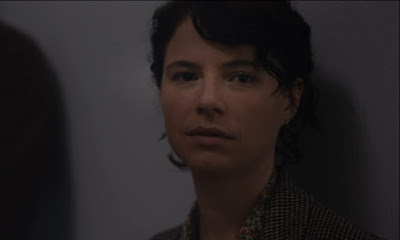
At the same time, Leda watches them—and director Maggie Gyllenhaal keeps us locked in on her point-of-view so that it almost becomes claustrophobic—she starts to think back to when she was a young mother (
Jessie Buckley takes over as Leda at this point) with two small girls. Two very needy little girls that tax Leda's time and her patience, taking her away from her translation work which takes a lot of concentration. There are little parallels between what she sees and what she remembers. And she catches every nuance of Nina's interaction with her child—the hesitations, the annoyances, the impatience, the reluctant giving-in—all to which she can relate.
Leda's "Kravitzing" does have a good result; when Nina is distracted by something, little Elena goes missing, and the family starts to panic, freaking out rather than trying to figure out where Elena could have wandered off. They're not organized at all. Leda, seeing Nina's distress and remembering a time when she experienced the same thing, assists in the search, and ultimately does find Elena to the relief and gratitude of the family. The earlier touchiness evaporates and Leda is empathetic enough that the family fairly embraces her. Nina, in particular, is drawn to Leda, seeing her as a kindred spirit who understands the pressures and toils of raising young kids. She does. But, Leda's approach is to internalize it as a burden, one that can come to a breaking point if allowed to fester.
Thank God for Olivia Colman. The Lost Daughter would be a very tough slog if it weren't for the excellent work done by her and the rest of the cast. Not that the movie is dull. It's that you have to spend so much time in Leda's head. It's a situation shared with the character. Leda is so internalized that there shouldn't be much of an exterior at all. All that studying, translating, her inner life is so much more fascinating to her than her external one. But, she indulges it to the detriment of those around her, be they friends, colleagues...family. And her obvious grasping for approval in the young Leda scenes contrasts with the less satisfying, messy, chaotic world of raising a child. Who gets acclaim for that?
It's a tough thing to raise children. It is not easy and there can't be a consistent plan or syllabus to cling to. So, Leda lives her life in her head, playing mind-games with herself and others, just her against the world. At times you see what the character is doing and wonder why on Earth do that? I have suspicions—which have to do with control and punishment and teaching lessons—but to delve deeper would be to take some of the shocks out of it, and deprive the viewer of questions that will inevitably arise.
And that would be a pity because Colman wears Leda's neurosis so much on her sleeve that it's fascinating to see her mercurial performance playing across her face. At times, you're aware that not even she understands why she does what she does and the film becomes less about the issues she has with the world than about her own, and how she imposes them on the world, with the inevitable consequences, intended or otherwise, that become self-fulfilled prophecies. It's a psychological adjunct to all those Kubrick movies where smart people make bad choices, intellect be damned, and gives truth to the old saw that people can be too smart for their own good.
 
It's like the thing I read on Twitter today that was attributed to Nicola Tesla: “One must be sane to think clearly, but one can think deeply and be quite insane.” The Lost Daughter walks that razor edge, fortunately, with Olivia Colman's nimbleness.

Thursday, January 6, 2022

White House Down

White House Down (, 2013) "It will start like any other day" said the tagline.
  
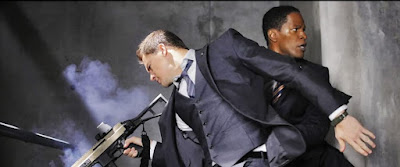
The second movie of 2013 where the White House comes under attack while a special agent tries to save a kid inside, this one was Roland Emmerich's continuation of his Edifice Complex, where he made movies just to see famous things blow up. Now, it should be noted that we are talking about White House Down and not Olympus Has Fallen—in which Gerard Butler plays the "die-hard" agent trying to stop an attack by North Korean terrorists. In THIS one, Channing Tatum plays a "die hard" agent trying to stop an attack by home-grown terrorists who are whiter than white.
 
Which one seems more likely? Well, neither of them. But since 2001 the terrorist attacks on the country has mostly been by white guys...as they were before 9/11. As they were on January 6, 2021

Oh, yes, and in both films, an African-American male is the president for a brief time. That's because, at the time, an African-American male was president full time.
The reason for attacking the White House doesn't have anything to do with the sitting President being an African-American—ostensibly it's to gain access to the nuclear codes to launch an attack on Iran for the deaths of relations and comrades of the attackers—but one can't help but wonder why the movie (and in fact, both movies) were timed to be at a time when an African-American was president. Did they think they could take advantage of bookings at White Supremacist Film Festivals?
Whatever the motives, the film looks at a day in the life of Capitol Police officer John Cale (Tatum), who's looking to move up from his job protecting Speaker of the House Eli Raphelson (
Richard Jenkins) to a job with the Secret Service protecting the President, who happens to be James Sawyer (Jamie Foxx). His application does not go well, being rejected Deputy Special Agent Carol Finnerty (Maggie Gyllenhaal). Perhaps it has something to do with their past history. Perhaps it has something to do with his being a divorced parent to his daughter Emily (Joey King). If it has anything to do with work experience, he's going to get plenty of that.
The plan for the terrorists (and one can not call them anything but that) is to blow up the Capitol (sounds familiar...) and in the resulting confusion, the Speaker of the House—Raphelson—gets sequestered because he's No 3 in the presidential chain of command. He's put in an underground bunker under the Pentagon. The Vice-President (played by Michael Murphy) is evacuated by Air Force One (because Air Force Two—the Veep's plane—supposedly isn't good enough). At that point, an assault team, led by some whacko former Delta Forcers storms the White House with the intention of taking the President hostage. 
The Secret Service—supposedly the best and the brightest—is easily overrun and the President (Foxx) is taken by his retiring head of protection Martin Walker (
James Woods) to the Presidential Emergency Operations Center under the White House. Except for one thing: it's Walker who has planned the assault (which is why the Secret Service was taken out so easily). So, now, the President is held hostage, and Walker is free to use a hacker to get into the PEOC's command center and try to get the codes for a nuclear strike on Iran.
Cale, however, takes down a couple of the terrorists, and using their communications and weapons is able to rescue the President from the PEOC. They are presumed killed trying to get out of the White House, and aboard Air Force One, the Vice President is sworn in. He orders the White House be attacked by air to try and take out the terrorists, which fails when all the attack helicopters are shot down. Walker has his hacker launch missiles from NORAD and Air Force One is blown out of the sky, thus making the Speaker of the House President.
Watching this from a hotel room while doing some government work, I couldn't help giggling at the outlandishness of the whole thing (although kudos for having the President using a missile launcher from a moving vehicle). It is so over-the-top, so hysterically hyperventilating that I couldn't help seeing the whole thing as just a silly exercise in taking Die Hard to the federal government, every Yippee-ki-yay intact (I think Tatum was even wearing Willis' old wife-beater, too). The movie was already out of my mind when
, that evening, I watched news coverage of Biden being declared the winner of the 2020 election.
So imagine my surprise when on January 6th, 2021, the U.S. Capitol was overrun by a bunch of wacko's (including a "voice-over actor" dressed in a Buffalo headdress) storm the Capitol and gum up the gears of government with their own poo-flinging. This seemed over the top, as well, but I didn't giggle. Lives were lost. A coup had been attempted, and it, too, was an "inside job"—the National Guard had conveniently not been deployed that day. The President was apparently having too good a time watching it on TV.
Our country is a fragile thing, expected to run on automatic pilot with the least amount of effort and the inevitable failings falling through the cracks when such an attitude is taken. That's how we do things in the U.S., in business and government. Do as little as possible. Hope for the best. And, as viscerally feverish as White House Down is, it still seemed more concerned with getting the most amount of property damage, than with the damage done to institutions that are expected to be just "there" for us when things are in crisis. I'll bet a lot of the terrorists on January 6th still expected their Social Security checks the next month.
And I'm left with one little evil thought—the most satisfying moment of the movie for me, actually—that I mutter every time I see one of these jacko's complain about their harsh treatment being charged, or some mis-begotten throwback of a senator or representative talk about it being BLM behind it all—all those white people...really?—or that it was just "a normal tourist visit."
It's become my mantra straight from the bile duct and it's from the scene below and I say it through clenched teeth and with quite a bit of dudgeon. I find it satisfying and I'll probably be saying it for quite awhile: "No jail for you, ya little bitch!"


Wednesday, August 19, 2020

Adaptation.

Adaptation. (Spike Jonze, 2002) I love Charlie Kaufman's writing. It reminds me of the old "Twilight Zone" series...but with depth*—but he's more of the Charles Beaumont style of TZ story-telling than Serling's or Richard Matheson's or Earl Hamner Jr.'s. Leaps are made every few minutes beyond the central conceit, and comes to a truly disconcerting kernel of truth at the end, which makes whatever frustrations made during the course of the film worth it. Being John Malkovich is a charming deconstruction of personality and wish-fulfillment, and Eternal Sunshine of the Spotless Mind is a jaded cynic's validation of love, and its intrinsic ability to be more than merely a process of instincts, chemistry and firing synapses. What's not to love?

But
Adaptation. is another animal. It's "Charlie Kaufman in crisis," and a bit of a cheat, while also being an ingenious way to solve a problem—that is, writing a screenplay for a book that is, basically, un-filmable. Given the opportunity (and contract) to write a treatment based on Susan Orlean's best-selling book "The Orchid Thief,"** Kaufman readily accepted the job, being attracted to the odd obsessive themes of the book, and found himself unable to translate it into a film-story.

So—he thought outside of the box and the story itself—he wrote about his difficulties translating it into a film-story! The book's subject, John Laroche, the poacher who was seeking the "Ghost Orchid" in the Florida Everglades was a real person who was determined to find the rare flower to clone it and sell it. The screenplay's subject is about Charles Kaufman, screenwriter, who's trying to adapt Susan Orlean's book, "The Orchid Thief," and wrestling with its themes and his own inability to create the screenplay.
Impeding his process is his twin, simpler brother Donald (both played by Nicolas Cage), who's decided he's also going to write screenplays, none of which Charlie likes. Susan Orlean figures in it (played by Meryl Streep), as does Laroche—he's the bespectacled fellow pictured to the right, not Chris Cooper's snaggle-toothed (though Oscar-winning) portrayal (pictured above)—but they're fictionalized versions of the real people, adapted to fit a more commercial film. Laroche is using the orchids to make a drug and sell it, hooks Orlean, and she begins a needy affair with him and, fueled by her addiction, becomes as obsessed with the Orchid Thief as much as he's obsessed with the orchids. Is any of that true? No. Are the people real? Yes. The website, Chasing the Frog.com had done a fairly succinct job of separating the fact from fiction here. Yes, these people do exist, as does screen-lecturer Robert McKee,*** but they're fictionalized versions of the real people. Can Kaufman get away with doing that? Yes, he obviously did, but they had to get permission from the real-life counterparts to do so (just as Jonez had to get permission from John Malkovich for Kaufman's Being John Malkovich or that would have been a moot project).
Look up the word "Adaptation" in the dictionary. "Any change in the structure or functioning of an organism that makes it better suited to its environment." There couldn't be a better explanation of the screen treatment of Adaptation. Kaufman couldn't, as they say in the trades, "crack it," so he changed the structure of the scenario...transplanted it, if you will...to make it work as a movie—especially a movie in the current environment of movie-making. And he made the debate between what he wanted to do and what he had to do part of the story in the form of the arguing screenwriting twins, Charles and Donald Kaufman.
Any writer of success must at some point deal with "the Other." The other writer, whose ideas are dismissed and shelved for work accomplished. Steven King did an experiment once to see if his writing would be as successful in other genres as opposed to the "scary fiction" writer, Steven King. So he created a psuedonym, Richard Bachman, much to the consternation of his publisher. Bachman sold well, but King had to deal with the success of his dopple-scrivener after several books were published. Ultimately, it inspired the concept of his novel "The Dark Half."
Noms de plume are as old as Bashō (and I'd bet cave paintings had false signatures, as well), and Adaptation. is credited to both Charlie and Donald Kaufman. Donald Kaufman is the first completely fictional person to be nominated for an Academy Award (at least not as a nom de plume). Donald also serves as a way for Charles to have conflict while doing something solitary—writing. For all the preciousness of the conceit, it still manages to work in a weirdly clear way, and it provides the means of this exchange, which re-defines the whole picture and sums it up: Donald and Charlie are talking about a time in school when Donald approached a girl he had a crush on, and when his back was turned, she and her gaggle of "Heathers" made fun of him.
Donald Kaufman: I knew. I heard them.
Charlie Kaufman: How come you looked so happy?
Donald Kaufman: I loved Sarah, Charles. It was mine, that love. I owned it. Even Sarah didn't have the right to take it away. I can love whoever I want.
Charlie Kaufman: But she thought you were pathetic.
Donald Kaufman: That was her business, not mine. You are what you love, not what loves you. That's what I decided a long time ago.


You are what you love. Not what loves you. For that little gem of a thought—multi-faceted, flawless and fundamental—I have enormous respect for Adaptation. for all its problems.
Oh, one more thing: My first impression of Adaptation. was to recall a punch-line from an ancient Warner Brothers cartoon (actually a couple of them, one of them being "Show Biz Bugs," another "Curtain Razor")—but because of what transpires (and the fear that kids would duplicate it) it's not much in circulation anymore. In it, the indefatigably fame-seeking Daffy Duck is auditioning for stage-time for his act. Each one fails miserably and he's rejected. "Next!" Finally, he shows up in a devil's costume. He eats gunpowder. He drinks gasoline and nitro-glycerine. Then...dramatically, he swallows a lit match. BOOM! There's a huge explosion. "That's incredible!" cries the ecstatic agent. "I can book you immediately!" "Yeah yeah," says the ghost of Daffy, drifting heavenward. "But I can only do it once!"****
The fictional Charles Kaufman—or is it Donald? (Nicolas Cage)
—on-set with the non-fictional Susan Orlean.

For Ned', who asked...on July 9th, 2008


* There are others who take that switcheroo-based style of writing, including M. Night Shamyalan, and Alejandro Amenábar.

**You can read the original Laroche article here, at Orlean's web-site.

***McKee suggested Brian Cox (the original Hannibal Lecter) to play him in the movie. Good suggestion, actually.


**** Because the bit is dangerous, violent...and, if improbable, actionable, it has, over the years, been censored, as has been catalogued by this YouTuber.