Showing posts with label Richard Jenkins. Show all posts

Thursday, January 6, 2022

White House Down

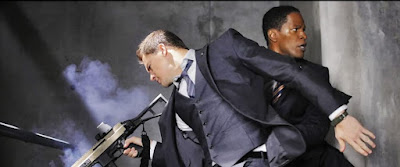
White House Down (, 2013) "It will start like any other day" said the tagline.
  
The second movie of 2013 where the White House comes under attack while a special agent tries to save a kid inside, this one was Roland Emmerich's continuation of his Edifice Complex, where he made movies just to see famous things blow up. Now, it should be noted that we are talking about White House Down and not Olympus Has Fallen—in which Gerard Butler plays the "die-hard" agent trying to stop an attack by North Korean terrorists. In THIS one, Channing Tatum plays a "die hard" agent trying to stop an attack by home-grown terrorists who are whiter than white.
 
Which one seems more likely? Well, neither of them. But since 2001 the terrorist attacks on the country has mostly been by white guys...as they were before 9/11. As they were on January 6, 2021

Oh, yes, and in both films, an African-American male is the president for a brief time. That's because, at the time, an African-American male was president full time.
The reason for attacking the White House doesn't have anything to do with the sitting President being an African-American—ostensibly it's to gain access to the nuclear codes to launch an attack on Iran for the deaths of relations and comrades of the attackers—but one can't help but wonder why the movie (and in fact, both movies) were timed to be at a time when an African-American was president. Did they think they could take advantage of bookings at White Supremacist Film Festivals?
Whatever the motives, the film looks at a day in the life of Capitol Police officer John Cale (Tatum), who's looking to move up from his job protecting Speaker of the House Eli Raphelson (
Richard Jenkins) to a job with the Secret Service protecting the President, who happens to be James Sawyer (Jamie Foxx). His application does not go well, being rejected Deputy Special Agent Carol Finnerty (Maggie Gyllenhaal). Perhaps it has something to do with their past history. Perhaps it has something to do with his being a divorced parent to his daughter Emily (Joey King). If it has anything to do with work experience, he's going to get plenty of that.
The plan for the terrorists (and one can not call them anything but that) is to blow up the Capitol (sounds familiar...) and in the resulting confusion, the Speaker of the House—Raphelson—gets sequestered because he's No 3 in the presidential chain of command. He's put in an underground bunker under the Pentagon. The Vice-President (played by Michael Murphy) is evacuated by Air Force One (because Air Force Two—the Veep's plane—supposedly isn't good enough). At that point, an assault team, led by some whacko former Delta Forcers storms the White House with the intention of taking the President hostage. 
The Secret Service—supposedly the best and the brightest—is easily overrun and the President (Foxx) is taken by his retiring head of protection Martin Walker (
James Woods) to the Presidential Emergency Operations Center under the White House. Except for one thing: it's Walker who has planned the assault (which is why the Secret Service was taken out so easily). So, now, the President is held hostage, and Walker is free to use a hacker to get into the PEOC's command center and try to get the codes for a nuclear strike on Iran.
Cale, however, takes down a couple of the terrorists, and using their communications and weapons is able to rescue the President from the PEOC. They are presumed killed trying to get out of the White House, and aboard Air Force One, the Vice President is sworn in. He orders the White House be attacked by air to try and take out the terrorists, which fails when all the attack helicopters are shot down. Walker has his hacker launch missiles from NORAD and Air Force One is blown out of the sky, thus making the Speaker of the House President.
Watching this from a hotel room while doing some government work, I couldn't help giggling at the outlandishness of the whole thing (although kudos for having the President using a missile launcher from a moving vehicle). It is so over-the-top, so hysterically hyperventilating that I couldn't help seeing the whole thing as just a silly exercise in taking Die Hard to the federal government, every Yippee-ki-yay intact (I think Tatum was even wearing Willis' old wife-beater, too). The movie was already out of my mind when
, that evening, I watched news coverage of Biden being declared the winner of the 2020 election.
So imagine my surprise when on January 6th, 2021, the U.S. Capitol was overrun by a bunch of wacko's (including a "voice-over actor" dressed in a Buffalo headdress) storm the Capitol and gum up the gears of government with their own poo-flinging. This seemed over the top, as well, but I didn't giggle. Lives were lost. A coup had been attempted, and it, too, was an "inside job"—the National Guard had conveniently not been deployed that day. The President was apparently having too good a time watching it on TV.
Our country is a fragile thing, expected to run on automatic pilot with the least amount of effort and the inevitable failings falling through the cracks when such an attitude is taken. That's how we do things in the U.S., in business and government. Do as little as possible. Hope for the best. And, as viscerally feverish as White House Down is, it still seemed more concerned with getting the most amount of property damage, than with the damage done to institutions that are expected to be just "there" for us when things are in crisis. I'll bet a lot of the terrorists on January 6th still expected their Social Security checks the next month.
And I'm left with one little evil thought—the most satisfying moment of the movie for me, actually—that I mutter every time I see one of these jacko's complain about their harsh treatment being charged, or some mis-begotten throwback of a senator or representative talk about it being BLM behind it all—all those white people...really?—or that it was just "a normal tourist visit."
It's become my mantra straight from the bile duct and it's from the scene below and I say it through clenched teeth and with quite a bit of dudgeon. I find it satisfying and I'll probably be saying it for quite awhile: "No jail for you, ya little bitch!"


Friday, December 24, 2021

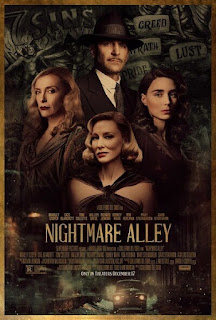
Nightmare Alley (2021)

The Smartest Man in the Room
or
"...It's All Geek To Me"
 
We meet Stanton Carlisle (Bradley Cooper) in the middle of committing a crime; in a soon-to-be-abandoned house, he drags a body to a waiting hole in the floor-boards, strikes a match—we see a gas-can on the floor behind him—and sets the room and the clapboard structure on fire. Then he simply walks away, next stop...anywhere, U.S.A.
 
It's a bus-ride to where he's going. And he gets off at the designated restaurant, but he moves on to the glowing lights of a carnival, drawn to it like a moth to a flame. He moves over to a structure blanketed with "'Odd'-i-torium" and he goes in; for a quarter, he can see "The Geek" described by carny boss Clem Hoatley (Willem Dafoe) as a "supreme oddity—is he man of beast?" And as the slack-jawed crowd of curious gawkers gathers around a small arena, "The Geek," mangy and disheveled, is let out of his cage and thrown a live chicken which he bites in the neck and tears its head off. Repulsed, Stan leaves but is followed by Hoatley: "What's your pitch, pal? You on the low?" 
Within ten minutes Carlisle is hired as a roustabout, and one of his jobs is to round up the geek when he escapes his cage. Stan is sent in through the demonically-themed fun-house, it's signs warning of damnation and sees the geek, cowering. Ignoring Hoatley's advice, he tries to entice the man on his own and ends up getting concussed by a brick. Before any more damage can be done, he's found, the geek trussed up and Hoatley, fearing repercussions, offers him a steady job with the carnival. At night, he dreams dreams of flames, but in the morning, he helps fold up the tent and move on with the show—they're meeting up with another troupe down the road.
The spot they stop is a lot with an already-established carnival and across the dirt road is the house of Madame Zeena (Toni Collette) and her husband, Pete (David Strathairn), a once very successful mentalist act, gone on to hard times because of Zeena's philandering and Pete taking to drink. There is still talent in the older gentleman, but his will is broken, but he sees talent in the young man who's come to the house with the newly-arrived vagandonds and wants a bath. Zeena sees something in him, too, and seduces him—not that it takes much—and reads his fortune with her Tarot cards and it's ominous. Carlisle doesn't believe in such nonsense, not believing in fate, but only in the weakness he notices in others. He thinks he'll do very well.
If you've seen the 1947 version, you'll recognize a lot of what's going on as gone before. Watching this version of Nightmare Alley, though, evokes the same feeling one had when watching Martin Scorsese's version of Cape Fear after having seen the original.  It's the same story, but in another location, one steeped in the obsessions of the director. Where the first story was done to get the material down, the new one is richer, more grandiose, and more nuanced. No one's worried about time or hurrying the scene along. There is so much detail that to have it go any faster would be to miss something. The screenplay—by director Guillermo del Toro and his wife Kim Morgan—author of the "Sunset Gun" blog—is based on the original novel by William Lindsay Gresham, not on the original's screenplay by Howard Hawks scribe Jules Furthman. As such, it's a bit more "on the nose" and spells things out, announcing its themes and intentions so that no one misses the point. Rather than hurting the movie, it only gives it more depth, as the story can take the weight.
The casting is top-notch in the way the original couldn't be—there everyone was attractive—and populated by character actors of great depth. Cooper is Tyrone Power handsome, but he has a boyish "something" that makes him attractive—a kid in a man's body. Rooney Mara plays Molly, who is far more waif-like, but still evokes an inner strength and del Toro veteran Ron Perlman plays her guardian, Bruno, the carnival strong-man. Collette and Strathairn are both studies in washed-up talent, resigned to their fates but capable of showing glimpses of their glory days, and as Dr. Lilith Ritter, a fellow con artist as psychiatrist, Cate Blanchett risks parody by playing a creature of constantly challenging seduction, as if Lauren Bacall was playing a villain. 
This is something of a first for del Toro, who leaves behind the monsters' realm (temporarily, I assume), even while keeping one separated foot planted firmly in the grotesque. It's not his usual genre, as it's not a horror movie (and hewing closer to noir), but it flirts with it, the way that Carlisle will flirt with the mystical and the spiritual when he thinks using mentalist tricks isn't enough of a high-stakes racket for him. Because it's not enough to play tricks on people, to "read" them and use it against them, convince them that you have a power that they don't have. It's an endlessly escalating mind-game for both players. But, the hubris that results can make the fall from great heights higher than it appears. 

And Carlisle is just a beginner. He's not a mind-reader. He's a weakness-reader. A need-reader. It would have been better if he'd learned the tarot, so he could learn the future, but even when he's told what it is, even when it's spelled out in so much detail, he doesn't believe it. And maybe that has something to do with control. The future isn't written; he has no way to sway it. No way to read it, like the past on a man's face. And he's as much a paying customer—a rube—as anybody else is when it comes to Fate.
And that just doesn't cut it for the smartest man in the room, the man who knows everything about everybody. 
 
Except himself. Except that he's not as smart as he thinks he is.
 
It's a cautionary tale, as so much of film noir is. And it's one people should listen to.
 

Friday, January 12, 2018

The Shape of Water

Animal Magnetism
or
"Monsters are the Patron Saints of Imperfection"
Guillermo del Toro

The cinema of Guillermo del Toro veers to and fro in the land of fantasy, never too far from the things that haunt, scare, and thrill us. But, as opposed to a director like Tim Burton, monsters are not a fun thing.

Del Toro treats them very seriously, be they friend or foe. And his monsters become us, even if his characters don't become monsters.


Monsters are a passion of his, but not a hobby. And when he considers a monster—particularly those featured in the films of his youth—there is always the embedded thought: "What are THEY feeling?" Most monster movies consider the feelings of the folks in the film who are like us, the better that we might understand their reactions when they encounter something strange and not like us. There is kinship there. Entertainment value.
And tribalism. But, rather than consider the "us against them" mentality that most monster movies (like his own Pacific Rim) encourage, del Toro will think about what the monster is feeling. He was thinking about his own reactions to The Creature from the Black Lagoon when he went to Universal Studios more than ten years ago to propose creating a remake with more sympathy for the "Creature." Universal, who was planning its own ways of screwing up their classic monsters, turned him down cold.

One hopes their their lawyers aren't monsters, and see his new film, The Shape of Water, for what it is—an extraordinarily well-done gene-splicing of Creature and "Beauty and the Beast"—rather than as a fishing expedition for a copyright infringement suit. Frankly, they don't have a case. The Shape of Water is its own magical animal, far removed from, and more highly evolved than, its source.
It starts, appropriately, in a dream-like state underwater with a narrator still trying to absorb his tale of "the princess without a voice, a love lost, and the monster who tried to destroy it all." The narrator is Giles (Richard Jenkins), who is a commercial artist who lives in a garret above a movie theater.* "The princess without a voice" is his across-the-hall neighbor Elisa Esposito (Sally Hawkins), mute since birth, who works as a cleaning woman for an organization that looks suspiciously like Hellboy's BPRD** but is the Occam Aerospace Research Center. She has a quick daily routine at home and usually shows up to work barely on time after a cross-town bus-ride, where she is saved a place to clock-in by her friend Zelda Fuller (Octavia Spencer) where they clean the facility at night.
One night, an elaborate container housing "what may well be the most sensitive asset ever housed in this facility" is brought into OARC, along with its caretaker Col. Richard Strickland (Michael Shannon), who captured the "asset" in a South American river. The "asset" is an amphibian creature, once worshiped as a god by the Amazonian natives, but Strickland is less enamored of it. OARC is interested in it for space research, but Strickland's military masters see no point in keeping it around to study it. They, like Strickland, are more intrigued in vivisection, seeing what makes (or made) the thing tick,,,once it stops ticking. Strickland doesn't see it so much as an asset as an affront.
But, two people have an interest in keeping it alive: Elisa sees it as an exotic beautiful thing, and she visits it regularly, feeding it hard-boiled eggs and playing it music; new OARC scientist Bob Hofstetler (Michael Stuhlbarg...the ubiquitous Michael Stuhlbarg) sees it as a waste of a scientific anomaly. But, he has another reason...Bob's real name is Dimitri, and he's a Soviet agent who has infiltrated OARC to find out what he can about the research going on there. Bob/Dimitri's Soviet contacts are intrigued by the creature and have no idea why the Americans would want it...but, if THEY want it, the Russians want it, too. 
On the flip-side, if the Russian CAN't have it, they want Dimitri to kill it. But, he IS conflicted as a scientist. And when Elisa discovers that the military has plans to destroy it, she makes a decision—not on her shift, and she begins an elaborate...and dangerous...plan to creature-nap the asset. But, Giles is hesitant; he has his own issues and is reluctant to do anything that might draw more attention to himself.
It's a fairy tale, but like most of del Toro's work it is not a complacent one. Here it is the task of the princess to save, rather than be saved. And the monster? Well, it's basically "corporate man." If The Shape of Water has a weakness it's that it's a little heavy-handed on the heavy, which is Strickland. Shannon is up to the task of playing it, of course, but Strickland is such a compendium of every perverted instinct he could probably have been portrayed as a studio head. He's insensitive to beyond the point of cruelty, he's prejudiced, elitist, a potential rapist, uses the Bible—or his interpretation of it—as his justification for his view of the creature ("W're created in the Lord's image. You don't think that's what the Lord looks like, do you?") and he has the audacity to be reading "The Power of Positive Thinking." If you want a comparison, look to the Nazi father of Pan's Labyrinth, but, there the ending is cathartic—you want him to suffer and he does. Strickland, not so much, not to my satisfaction, anyway. If you're going to consider how much the monster feels, there's no much feeling there. Someone so insufferable should suffer more, I think.
But, that's my big fish to fry with the film. Del Toro has made something gorgeous, taking some inspiration from Michael Powell for his vision of things. and filling it with the strong visuals needed to communicate the feelings of someone mute. He's aided, immeasurably, by Sally Hawkins here, who does the sort of effervescent acting that one rarely finds outside of silent pictures, one that incorporates body language, rhythm, even dance. Compared to what everybody else is doing, weakened by actually having to express themselves, Hawkins is a shining light throughout the film that draws you in.
And as his creature, del Toro has again tapped Doug Jones, maybe the least recognizable actor in films...even less than Andy Serkis. Jones played all of the creatures—distinctively—in Pan's Labyrinth, as well as Abe Sapien in both Hellboy movies, and his body-acting instincts as the creature, as much as we see of him, are stately and elegant (even during a black and white dance sequence) despite being done in full prosthetics—not even motion capture. One hopes, for his sake, that they kept the water warm.
It is not a movie for little kids (I shouldn't have to say it, but I'm thinking of those parents who dragged their children to Downsizing), ironic given that a viewing of The Creature from the Black Lagoon at 13 inspired it. But, if one is given to romantic fantasy with a harder edge, it's a great movie to see.


When I think of her all that comes to mind is a poem, made of just a few truthful words, whispered by someone in love, hundreds of years ago: 'Unable to perceive the shape of you, I find you all around me. Your presence fills my eyes with your love. It humbles my heart, for you are everywhere.


* Judging by the movie starting its run at the theater—The Story of Ruth—and that John Glenn is seen on television, the year must be 1960.

Saturday, December 31, 2016

The Core

The Core (Jon Amiel, 2003) An absolutely goofy high-concept sci-fi movie that has been deplored by scientists for its particularly "bad science." I can't argue with that. It is bad, very bad science and the contrivances of the screenplay are almost too many to mention.

But, I also can't argue that it's a lot of fun to watch, even if the movie fails on almost every technical accomplishment, including special effects.


Oh, that Mother Earth. She really is a Mother. Odd things are happening around the globe. The Northern Lights are heading South. Birds are starting to fly erratically in disorganized flocks and fly into buildings, buses and people. Worst of all, the space shuttle, the biggest bird of all, fires its retro-rockets to return to Earth, but, rather falling to its landing strip in Florida, it ends up off the coast of California, necessitating a landing in the sluices of the Los Angeles River, prompting an investigation of its Commander, Richard Iverson (Bruce Greenwood) and, most especially, its navigator and co-pilot Astronaut Major Rebecca "Beck" Childs (Hillary Swank).

On a less global scale, geophysicist Dr. Joshua "Josh" Keyes (Aaron Eckhart), a professor at the University of Chicago, is pulled out of class by Feds "Indiana" Jones-style, and asked for his expertise on what's going on in the world. His investigations startle him, and he brings in pal Serge Leveque (Tcheky Karyo) and prickly scientific populist Conrad Zinsky (Stanley Tucci) to confirm his findings—the Earth's magnetic field is out of whack and disappearing due to the lack of rotation in the Earth's liquid outer core. If that stuff doesn't start moving pretty quickly, then all electronics on Earth will be disabled throwing us back into the stone-age, and then the Earth will be bombarded by the Sun's micro-waves and solar wind, throwing us into the charcoal age.
Scientifically speaking, this is "bad news." Although, if you can reach into your video screen of this movie and turn on its news-channels, I'm sure you'd find all sorts of "charcoal-age" deniers willing to foam at the mouth on-camera for AFTRA minimum, making as much sense as those saying that the Earth can't have a core because it's flat. Maybe if we threw them down into the liquid core, we'd get enough "spin" to re-start the magnetic field. But, I digress...
That "talking-head-hot-air" option is not explored. Instead, the suggestion is that if somebody can drill down to the molten core and drop nuclear war-heads of sufficient magnitude, it just might work. After all, if you could launch shuttles to blow up asteroids, or shrink scientists and inject them into blood-streams to laser blood-clots, why not? Trouble is, it's hot down there—9,000°F hot—enough to melt steel or any other construct to make nuclear weapons, and there's enough pressure to crush anything down to pancake-width, so what to do?
When you have an impossible task, call an engineer. Fortunately, among the people Pinsky has pissed off in his career is a brilliant one, Dr. Edward "Brazz" Brazzleton (Delroy Lindo—always welcome). He's been living in the desert making very handy, impossible things that no one has heard about. For one thing, he's invented a laser "impeller" system that can liquefy anything in its path...except for the other thing he's invented—a substance called "unobtainium, "* which is a miracle metal that can stand up to incredible heat and crushing pressure—just the sort of thing you'd need to to build a ship to dig to the center of the Earth.** That seems awfully convenient to keep the movie going. But, then, the movie is powered by "suspendbelievium."
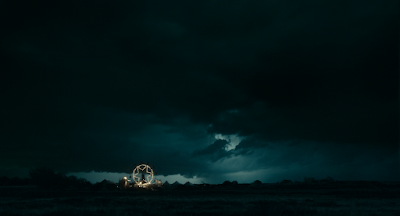
Brazzleton's inventions pitted against each other.
Once they have the impossible boring capacity and the material to build a ship that can't be cooked or crushed (and uses those things to supply power—even more convenient), they spend an incredible amount of money to build the good ship "Teflon" (dubbed "Virgil" after the author of "The Aeneid") to carry a crew of specialists to launch the nukes and then get out of town fast enough to get obliterated. Good luck with that. With such a suicide mission, you would think they would come up with a competent but disposable crew to carry it out. But guess who they choose—the very essential designers and theoreticians who came up with the crazy scheme in the first place. Okey-dokey. They only have one chance to do it and not get fried because nobody on Earth would be able to duplicate it.
Everything about this movie makes no sense, whatsoever. But, if something isn't sensible, it's at least Hollywood.
Later we will find out that the whole trip was, essentially, not necessary, and that the phenomenon that's affecting the Earth is not completely the natural disaster that it's presented to be—due to meddling humans, again, who can't leave well enough alone, and if they can't "monetize" something, they'll "weaponize" it. But, forget all that "unobtainium ad absurdium." The best part of the movie is the interplay between the characters once they get on board the good ship "Teflon," and, fortunately, you've got some truly gifted character actors on board, all who know how to fill time quickly and fill holes in the script (some of which are cavernous), even while they're boring holes in the crust, and method-acting staring at green-screens that actually show them nothing.
Sure. It's dumb. Sure, it's unscientific. Sure, it's unbelievable. But, the actors make it work, to the point where they could be fighting flaming Jell-o (sometimes the special effects look like that) and it would still be fun and still be inexplicably watchable. The story, the FX, are merely the crust. It's the actors that make up the solid core of the movie.
* Yeah, yeah, all you Avatar apologists out there—it's the same thing they're after in Avatar. But, The Core preceded Avatar by 6 years.

** When asked how soon he could get a vessel up and running with his inventions, Brazzleton cackles: "Three months?" Fifty billion dollars!" The general in charge of the project (Richard Jenkins, also welcome) deadpans "Will you take a check?" Keyes looks over: "Use a credit card. You'll get miles."