Showing posts with label Delroy Lindo. Show all posts

Thursday, July 25, 2024

Mountains of the Moon

Mountains of the Moon
(Bob Rafelson
, 1990) A recent book about the quest for the source of the Nile River, "River of the Gods" by Candice Millard tells of the epic journey of British explorers John Hanning Speke and Richard Francis Burton to solve that mystery. It was a quest as perilous and fascinating as that of Lewis and Clark, with two distinctly different personalities of men heading the expedition, which, after surviving travails and hardships on the journey, descended into bickering and enmity when they returned to what they supposed was "civilization."
 
Yeah, well, I've seen that movie. Bob Rafelson, he of Head and Five Easy Pieces, The King of Marvin Gardens, and The Postman Always Rings Twice, was as unlikely a person to tackle this international tale that rivaled fiction, but he managed to pull it off. Not only that, it's one of, if not his best movie. And no one went to see it. And I dare say, very few people know about it. Talk about trying to find something that's "lost."
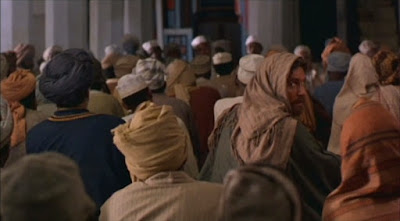
Burton: "...tends to mingle."
In 1854, Speke (Iain Glen) arrives on the East African coast on leave from the Indian Army with the purpose of hunting big game, but as he is informed, the coast "is closed", and it's suggested that he hook up with Richard Francis Burton (Patrick Bergin, easily his best role and his survey party with the Royal Geographical Society, which has been given permission to go deep into Africa. The RGS has bankrolled Burton's journey in order to find "the true source of the Nile"—that river being so important to British trade, it's beginnings will assure King and Parliament that trade will continue to flow not risking any disruptions to the economy.
Speke: his character in one shot. It will provoke an attack on the camp.
Burton just wants to find it and he'll use any excuse: "Every westerner's curiosity has been met with torture, mutilation and death. The river is shrouded in mystery. Who will be the first to discover its source?" For Burton, embarking on such an exploration is just as challenging as mastering another language (he would eventually speak 29) or translating a text ("One Thousand and One Nights," the "Kama Sutra" and "The Perfumed Garden") and for him the journey is as important as the destination as he was always gathering and noting facts, which is why he became one of the few non-Muslims to visit Mecca.
But, if Burton is there to get the lay of the land and everything set upon it, Speke just wants to hunt it. Burton needs a game hunter to supply food en route and Speke is a crack shot—he's hired immediately—but the two men couldn't be more different. For Speke, the goal is the thing, always interested in the target; for Burton, it's the journey, the process, the evidence. Each man will be tested, physically (both suffering from injuries that are horrendous—Burton, his face pierced through both cheeks by a native lance and Speke stabbed multiple times during a native attack) and mentally on their way to find the Nile's source. And despite their differences, they will prove essential to each other. Indeed, one wonders if either of them could have survived without the other.
One sub-plot of the movie is treachery, which both men will find in Africa and in England, belying the British chauvinism towards the African nations when they are equally capable of such behavior themselves, something Burton, in his studies of other cultures and his lectures, is trying to impress on a reluctant class-based society. But, those treacheries, both in Africa and England, will create circumstances that will challenge another major theme—loyalty. 
Burton and Speke are bound to each other in mission and friendship, and neither one would weaken their mutual trust were it not for the machinations of others. For all the tragedy—and triumph—that the two discoverers will encounter on their journey, it is only the influence of others that manages to come between them, sewing discord, and ultimately ending their partnership.
If the movie has a failing, it is that it tends to favor Burton's point of view over Speke's to the latter's detriment. It's easy to see why, though: Burton is a renaissance man, far before his time, and outside the status quo of those of his countrymen. His life was a constant quest for knowledge of the Earth and its peoples and seeking means to communicate similarities than promoting the stereotype of "the other." The movie could have made something of Burton's ego and his way of intimidating others, but he is pretty much given the benefit of the doubt in the movie.
And Speke has the disadvantage of class—too much of it, perhaps. He didn't seek adventure or Burton's loftier schemes (although he inherited Burton's zeal), he sought sport, and circumstances just conspired that he would make history.
Mountains of the Moon has Speke being fooled by the manipulations of others, and, once having discovered the subterfuge, only doubles-down on his claims lest he lose his newly-found reputation. It lays the blame for the two men's disputes entirely on him, when the truth is probably more nuanced.
But, there's a lot to admire, not only in performances—
Fiona Shaw is amazing as Burton's wife-to-be, Isobel, and Bernard Hill has a lovely turn as the legendary Dr. Livingstone, and one corker of a scene where he and Burton compare wounds they'd received on their travels—but also on the technical side, as well. The whole thing was photographed by the now-renowned Roger Deakins, edited by the ubiquitous Thom Noble, sound design by David Lynch's sound-man Alan Splet, with a resounding score by Michael Small. That's a lot of talent behind the scenes, making what's up on the screen so impeccable.
I can't recommend this movie enough. It's a great adventure story like The Man Who Would Be King or even Lawrence of Arabia, made without compromise and in some startling locations. I've always found Rafelson a little indulgent as a filmmaker. Not here. This is an amazing tale, well told by some of the best artisans of the movie-making craft.
 
It may be difficult to find, but the journey will be worth it.
 
The real Burton and Speke
 

Tuesday, October 2, 2018

Up

Written at the time of the film's release...

"Let Go/Don't Let Go"

First, the important stuff: Go.

Don't even hesitate. This is another of those Pixar films that not only entertains, but pushes the form of animation, the more specific discipline of computer animation...and basic film language.


You do not have to see it in 3-D, as the effects are subtle, though expertly done. 3-D does not make or break Up and I suspect it will be just as lovely and dimensional on a cyclopian screen (in fact, it might even be better, as the provided 3-D prism glasses tend to mute the film's Maxfield Parrish-like color palette).

Though just as rollicking as other animation films, Up stays somewhat down-to-Earth—no super-annuated cars or toys, no anthropomorphic mice (however, there are talking dogs, thanks to their master's creating speaking collars for them, in a situation that recalls The Island of Dr. Moreau—I kept expecting them to break into "Be Our Guest" at some point), and pains have been taken to keep the natural world natural: water-falls feel wet, however improbably they may be, you can practically feel the spray in a fog-bound scene, sunlight lazes across a wall convincingly, and vistas of escarpments or clouds seem picture-perfect.* It takes your breath away.
But there's a maturity to Up in its story-telling that's quite unlike any other Pixar film before it, not that the kids will care. As with the previous Wall•E, the opening sequences are the killer, as directors
Pete Docter and Bob Peterson map out the life of Carl (Edward Asner) and Ellie Frederickson, two kids with a mutual passion for adventure, dare-devil Charles Muntz (Christopher Plummer), and eventually each other. The sequence is done with a moving simplicity (with a stunning attention to detail) and no dialogue, just images telling the story of a marriage in all its depths. That sequence haunts the entire movie, not only for its subject matter but also for the task of trying to top it.

It gets enticingly close many times** and when it doesn't you're usually roaring with laughter,*** but the rest of the movie seems almost prosaic in its predicaments and complications. You don't want this one to end like your typical chase movie, and even though it does, it does so better than the vast majority of them. Even while the hi-jinks ensue you can't help but think that even these situations work best as allegory in setting up the big gambit of the movie, with precipitously floating dirigibles and houses and many, many situations of making the vertiginous decision to let go or not let go.
For technique, creative thoughtfulness and a painter's eye, Pixar's team of magicians and imagineers are unsurpassed in continuing to influence the art of film.

Update: Glenn Kenny has a concise "halleluia" for Up at "Some Came Running" that addresses some of the many joys encountered therein, but also touches philiosophically on the critical ennui of writing about the latest Pixar release ("Ho-hum, another brilliantly conceived and executed Pixar film"). There's no pleasing some people ("Hello, Stephanie Zacharek and Joe Morgenstern!" Perhaps their reviews were "inspired" by a bad meal at Cannes with a snooty waiter...) who have become so jaded with consistent quality that they wouldn't know A Great Movie if they tripped over it in a darkened theater.

* And for me, the favorite sound design element is the sound of the balloons above the house bouncing together, sounding like rubber petals.

** 
Including a "taking flight" sequence that is among the best in cinema


*** Best line: "Well, that won't work..." The adults in the audience laughed for a full minute. You have to be there.

Saturday, December 31, 2016

The Core

The Core (Jon Amiel, 2003) An absolutely goofy high-concept sci-fi movie that has been deplored by scientists for its particularly "bad science." I can't argue with that. It is bad, very bad science and the contrivances of the screenplay are almost too many to mention.

But, I also can't argue that it's a lot of fun to watch, even if the movie fails on almost every technical accomplishment, including special effects.


Oh, that Mother Earth. She really is a Mother. Odd things are happening around the globe. The Northern Lights are heading South. Birds are starting to fly erratically in disorganized flocks and fly into buildings, buses and people. Worst of all, the space shuttle, the biggest bird of all, fires its retro-rockets to return to Earth, but, rather falling to its landing strip in Florida, it ends up off the coast of California, necessitating a landing in the sluices of the Los Angeles River, prompting an investigation of its Commander, Richard Iverson (Bruce Greenwood) and, most especially, its navigator and co-pilot Astronaut Major Rebecca "Beck" Childs (Hillary Swank).

On a less global scale, geophysicist Dr. Joshua "Josh" Keyes (Aaron Eckhart), a professor at the University of Chicago, is pulled out of class by Feds "Indiana" Jones-style, and asked for his expertise on what's going on in the world. His investigations startle him, and he brings in pal Serge Leveque (Tcheky Karyo) and prickly scientific populist Conrad Zinsky (Stanley Tucci) to confirm his findings—the Earth's magnetic field is out of whack and disappearing due to the lack of rotation in the Earth's liquid outer core. If that stuff doesn't start moving pretty quickly, then all electronics on Earth will be disabled throwing us back into the stone-age, and then the Earth will be bombarded by the Sun's micro-waves and solar wind, throwing us into the charcoal age.
Scientifically speaking, this is "bad news." Although, if you can reach into your video screen of this movie and turn on its news-channels, I'm sure you'd find all sorts of "charcoal-age" deniers willing to foam at the mouth on-camera for AFTRA minimum, making as much sense as those saying that the Earth can't have a core because it's flat. Maybe if we threw them down into the liquid core, we'd get enough "spin" to re-start the magnetic field. But, I digress...
That "talking-head-hot-air" option is not explored. Instead, the suggestion is that if somebody can drill down to the molten core and drop nuclear war-heads of sufficient magnitude, it just might work. After all, if you could launch shuttles to blow up asteroids, or shrink scientists and inject them into blood-streams to laser blood-clots, why not? Trouble is, it's hot down there—9,000°F hot—enough to melt steel or any other construct to make nuclear weapons, and there's enough pressure to crush anything down to pancake-width, so what to do?
When you have an impossible task, call an engineer. Fortunately, among the people Pinsky has pissed off in his career is a brilliant one, Dr. Edward "Brazz" Brazzleton (Delroy Lindo—always welcome). He's been living in the desert making very handy, impossible things that no one has heard about. For one thing, he's invented a laser "impeller" system that can liquefy anything in its path...except for the other thing he's invented—a substance called "unobtainium, "* which is a miracle metal that can stand up to incredible heat and crushing pressure—just the sort of thing you'd need to to build a ship to dig to the center of the Earth.** That seems awfully convenient to keep the movie going. But, then, the movie is powered by "suspendbelievium."
Brazzleton's inventions pitted against each other.
Once they have the impossible boring capacity and the material to build a ship that can't be cooked or crushed (and uses those things to supply power—even more convenient), they spend an incredible amount of money to build the good ship "Teflon" (dubbed "Virgil" after the author of "The Aeneid") to carry a crew of specialists to launch the nukes and then get out of town fast enough to get obliterated. Good luck with that. With such a suicide mission, you would think they would come up with a competent but disposable crew to carry it out. But guess who they choose—the very essential designers and theoreticians who came up with the crazy scheme in the first place. Okey-dokey. They only have one chance to do it and not get fried because nobody on Earth would be able to duplicate it.
Everything about this movie makes no sense, whatsoever. But, if something isn't sensible, it's at least Hollywood.
Later we will find out that the whole trip was, essentially, not necessary, and that the phenomenon that's affecting the Earth is not completely the natural disaster that it's presented to be—due to meddling humans, again, who can't leave well enough alone, and if they can't "monetize" something, they'll "weaponize" it. But, forget all that "unobtainium ad absurdium." The best part of the movie is the interplay between the characters once they get on board the good ship "Teflon," and, fortunately, you've got some truly gifted character actors on board, all who know how to fill time quickly and fill holes in the script (some of which are cavernous), even while they're boring holes in the crust, and method-acting staring at green-screens that actually show them nothing.
Sure. It's dumb. Sure, it's unscientific. Sure, it's unbelievable. But, the actors make it work, to the point where they could be fighting flaming Jell-o (sometimes the special effects look like that) and it would still be fun and still be inexplicably watchable. The story, the FX, are merely the crust. It's the actors that make up the solid core of the movie.
* Yeah, yeah, all you Avatar apologists out there—it's the same thing they're after in Avatar. But, The Core preceded Avatar by 6 years.

** When asked how soon he could get a vessel up and running with his inventions, Brazzleton cackles: "Three months?" Fifty billion dollars!" The general in charge of the project (Richard Jenkins, also welcome) deadpans "Will you take a check?" Keyes looks over: "Use a credit card. You'll get miles."