Showing posts with label Aaron Eckhart. Show all posts

Wednesday, August 10, 2022

The Dark Knight

The Warner Bros can't seem to catch a break making movies—although "The Sandman" mini-series is very good*—so, let's go back to those halcyon days (or knights) when they seemed to know what they were doing with their DC Comics properties. Like 2008.

Written at the time of the film's release.


"Ya Wanna See an Actor Disappear?"


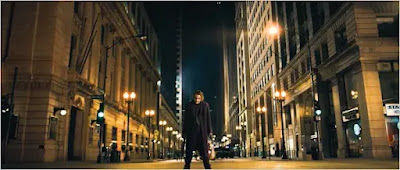
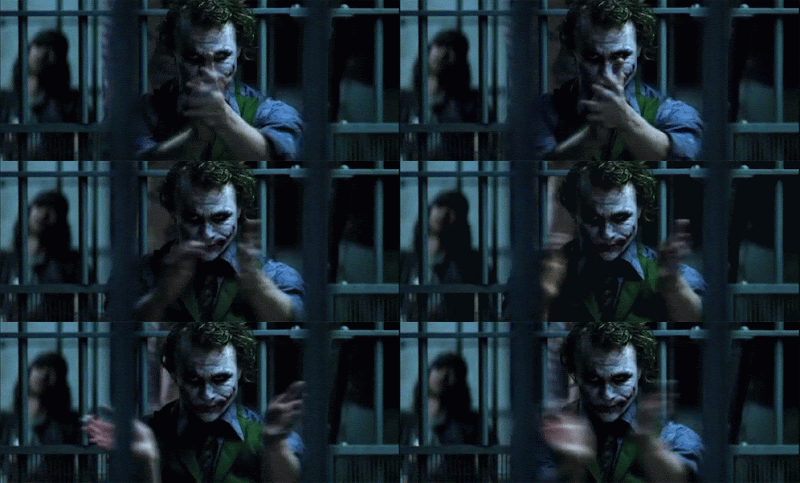
No, that title is not what you think it is (and shame on you for going there), but Heath Ledger does such a sick, twisted, inspired version of Batman nemesis The Joker, he blows away all pre-conceived notions of the character and his own acting history. Ledger literally gets lost in The Joker, with the smeary, sloppy make-up, his voice that goes from wormy-Richard Dreyfuss to bellowing Ahab-roar (with occasional stops at Bugs Bunny chirpiness), and a gait that sometimes shambles, sometimes totters, sometimes Frankenstein-stomps. All that theatricality is entertaining, but it's the moments of lucidity that are scary. "You're insane!" says Gotham mob-boss Sal Marone (Eric Roberts, doing relaxed, sleazy work), not without reason. "No, I'm not," replies the self-proclaimed Agent of Chaos resignedly. "No...I'm no...tt!"
Ledger's not the only show in town in
The Dark Knight
. Aaron Eckhart makes a complicated "White Knight" of DA Harvey Dent (it's really his story), Christian Bale's Bruce Wayne and booming Batman are deeper than the portrayal of Batman Begins--more soulful, less Bush-brash--and Michael Caine and Morgan Freeman do able support for roles slightly more down-played than the last film's. This time, Gary Oldman's Lt. Gordon has more to do, and the longer he's on-screen, the better you like him, and Maggie Gyllenhall gives the character of Rachel Dawes more of a spine (with a contrarily slinky walk) than Katie Holmes was able to provide.
The buttoned-up script is full of triangulation. There's the good-guys—Gordon, Dent and Batman—against an Axis of Evil—The Mob, Joker and Chinese financiers (and when one disappears from the screen they're replaced by another). And that's about as black-and-white as things get. Everything else is in convoluted, mordant shades of gray. There's the romantic triangle of Dawes and Dent, with Bruce Wayne as third-wheel. The Batman "team" of Wayne,
Alfred and Lucius Fox (all ensconced in the Wayne Enterprises high-rise while Stately Wayne Manor is being rebuilt).
The plot devices are triangulated traps that have an either/or scenario with a third more-horrific option--which becomes The Joker's trademark, ensuring that something bad will
happen no matter what. Targets are coordinated in sets, separating the weak from the herd and laying a further trap. It's Joker's way of providing Gotham "a better class of criminal." Batman's vigilantism has made the common petty thief think twice about stepping out of line. Now the Joker sets up elaborate conspiracies that bait and switch and then turn on a dime to a more complicated and deadly resolution.
"You've changed things." he crows at Batman. "There's no going back." When Wayne begins to question whether he needs to take deadlier action because Joker has "crossed the line," Alfred reminds him "You crossed that line first, Master Bruce." Hours before, Wayne had considered giving up the fight with a legitimate civic-minded public figure arriving for Gotham in Dent. Now, he's fighting harder than ever, if only to not step further across that moral line dealing with the new criminal madness. And The Joker? He starts to take actions protecting The Dark Knight, realizing that they can't kill each other: "You.. complete me" he cackles, in one of the chilling laugh-lines he spouts in an interrogation scene.

The Dark Knight ticks along (although it's overlong by half an hour--Director Nolan has a hard time knowing where to stop the escalating madness), with increasingly bizarre acts of cruelty (the film gets a PG-13 only because Nolan cuts away from some of the more grisly aspects--but takes the character design of one iconic Bat-villain in a more charred and eaten-away manner than even the comics devised).
By the end, some of the cast has been culled, and a long entrapment scene has gone on far too long, with still another set-piece just around the corner. At some point, every one of the good guys takes a hit, usually for noble purposes, but each keeps plugging away, trying to prevent having to put tooth-paste back in the tube, as consequence upon consequence piles up. And in the end, The Batman must re-adjust his modus operandi, taking on a new guise in his battle, one that he can only accomplish alone. At the same time, he handicaps himself to ensure he can't cross the line with too much power. He's left running in front of a metaphorical fast-moving train, knowing that at any moment he's going to have to turn and stop it.
"Dark Knight?" This thing is black as pitch.

In fact its relentlessly gloomy, and the sick thing is one looks forward to Ledger showing up for some light sickness to contrast the darkness. In fact, what has distinguished the "Batman 2.0" series of films is how they take the super-hero tropes and make them...practical and familiar. Nolan has kept this film-world translation of Gotham City looking gritty and realistic--far more so than the high-spired, mono-railed futuristic Gotham of Batman Begins--and the feel of the film is of an intricate crime drama, rather than a super-hero epic. The opening bank robbery is a nicely taut set-piece with more than one twist. And Nolan is far more adept at staging his action than previously. But by de-clowning The Joker, one wonders how some of The Dark Knight's three-color villains will translate to this milieu. One wonders where one goes from here. And one anticipates the next installment when this one has ended.
And that's a genuine accomplishment.

* Will I do a review? We-ell, I don't usually do streaming mini-series (although I broke that rule with the old British mini "Edge of Darkness") We shall see. You can dream, can't you?
 

Thursday, February 24, 2022

Rabbit Hole

Written at the time of the film's release...

Ghost-busting

or
Coping Mechanisms

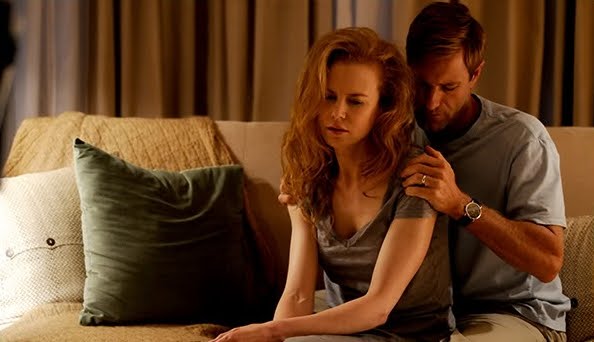
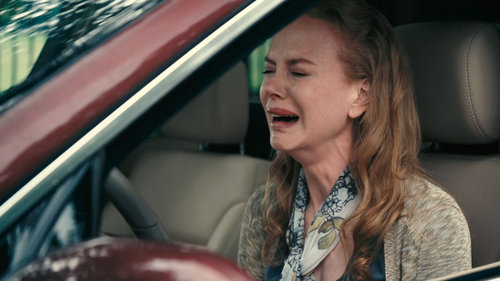
'Becca (Nicole Kidman) is going through the motions. She's doing everything expected of her and dutifully. The planting of new flowers in the garden, the making of stringent recipes of comfort food, the grief support group. All those motherly instincts and nothing to mother, and everything—absolutely everything—reminds her of the void in her life. Her child is dead, a victim of a car-pedestrian accident. Her sister (Tammy Blanchard) is pregnant, her mother (Dianne Wiest) keeps bringing up her own dead child—Becca's brother, friends with kids avoid her as if death were communicable, the flowers get crushed, the pans go empty. Life goes on, horribly.

Husband Howie (Aaron Eckhart, all clenched jaw and knotted body language) can't let go, sitting up every night endlessly watching a phone-video of little Danny  This frustrates 'Becca. So do the "professional wallowers" of the support group. She's avoiding grief, while Howie and the others are embracing it, and both sides are going too far  She starts to find ways of relieving herself of Danny's things, each one precious to Howie. They start to splinter, the pressures of the void hammering them from both sides.

Life goes on, horribly.
Audiences have been avoiding Rabbit hole like those parents avoid Becca, the subject matter presuming to be a downer. More's the pity as there is enough humor in the cracks of the angst to make it worth seeing and nod appreciatively at the simulations of life and death and the grief that comes between. Director John Cameron Mitchell stays out of the way, mostly, merely observing the struggles from sympathetic angles, while not making a big thing of the POV—making him a far subtler director than, say, Tom Hooper of The King's Speech.  The performances are pitch-perfect along the scale of emotional expression, from buried thought to screaming match, with Kidman sublimating technique for organic feeling to Wiest's haunted portrait of mother love. You pull for these people as they learn to live with death, even if they only get a "C" average.

It would be unfair to say too much of the plot other than the set-up, but
it touches briefly on comics and concepts of parallel universes and alternate realities—an alternate form of Heaven and the possibility that somehow, somewhere, things are different and that the cosmic dice might roll a different way. Possibilities erode the concept of the concrete reality, and sometimes the best way out of a trap is to imagine the way out, rather than accept that there isn't.

A downer? Maybe. But I found something heartening in a film that suggests that
the only way to fill the void of death is with larger doses of life. And that the holes those voids leave can only be healed—not so much in reality—but, in another dimension, the warrens of our soul.


Saturday, December 31, 2016

The Core

The Core (Jon Amiel, 2003) An absolutely goofy high-concept sci-fi movie that has been deplored by scientists for its particularly "bad science." I can't argue with that. It is bad, very bad science and the contrivances of the screenplay are almost too many to mention.

But, I also can't argue that it's a lot of fun to watch, even if the movie fails on almost every technical accomplishment, including special effects.


Oh, that Mother Earth. She really is a Mother. Odd things are happening around the globe. The Northern Lights are heading South. Birds are starting to fly erratically in disorganized flocks and fly into buildings, buses and people. Worst of all, the space shuttle, the biggest bird of all, fires its retro-rockets to return to Earth, but, rather falling to its landing strip in Florida, it ends up off the coast of California, necessitating a landing in the sluices of the Los Angeles River, prompting an investigation of its Commander, Richard Iverson (Bruce Greenwood) and, most especially, its navigator and co-pilot Astronaut Major Rebecca "Beck" Childs (Hillary Swank).

On a less global scale, geophysicist Dr. Joshua "Josh" Keyes (Aaron Eckhart), a professor at the University of Chicago, is pulled out of class by Feds "Indiana" Jones-style, and asked for his expertise on what's going on in the world. His investigations startle him, and he brings in pal Serge Leveque (Tcheky Karyo) and prickly scientific populist Conrad Zinsky (Stanley Tucci) to confirm his findings—the Earth's magnetic field is out of whack and disappearing due to the lack of rotation in the Earth's liquid outer core. If that stuff doesn't start moving pretty quickly, then all electronics on Earth will be disabled throwing us back into the stone-age, and then the Earth will be bombarded by the Sun's micro-waves and solar wind, throwing us into the charcoal age.
Scientifically speaking, this is "bad news." Although, if you can reach into your video screen of this movie and turn on its news-channels, I'm sure you'd find all sorts of "charcoal-age" deniers willing to foam at the mouth on-camera for AFTRA minimum, making as much sense as those saying that the Earth can't have a core because it's flat. Maybe if we threw them down into the liquid core, we'd get enough "spin" to re-start the magnetic field. But, I digress...
That "talking-head-hot-air" option is not explored. Instead, the suggestion is that if somebody can drill down to the molten core and drop nuclear war-heads of sufficient magnitude, it just might work. After all, if you could launch shuttles to blow up asteroids, or shrink scientists and inject them into blood-streams to laser blood-clots, why not? Trouble is, it's hot down there—9,000°F hot—enough to melt steel or any other construct to make nuclear weapons, and there's enough pressure to crush anything down to pancake-width, so what to do?
When you have an impossible task, call an engineer. Fortunately, among the people Pinsky has pissed off in his career is a brilliant one, Dr. Edward "Brazz" Brazzleton (Delroy Lindo—always welcome). He's been living in the desert making very handy, impossible things that no one has heard about. For one thing, he's invented a laser "impeller" system that can liquefy anything in its path...except for the other thing he's invented—a substance called "unobtainium, "* which is a miracle metal that can stand up to incredible heat and crushing pressure—just the sort of thing you'd need to to build a ship to dig to the center of the Earth.** That seems awfully convenient to keep the movie going. But, then, the movie is powered by "suspendbelievium."
Brazzleton's inventions pitted against each other.
Once they have the impossible boring capacity and the material to build a ship that can't be cooked or crushed (and uses those things to supply power—even more convenient), they spend an incredible amount of money to build the good ship "Teflon" (dubbed "Virgil" after the author of "The Aeneid") to carry a crew of specialists to launch the nukes and then get out of town fast enough to get obliterated. Good luck with that. With such a suicide mission, you would think they would come up with a competent but disposable crew to carry it out. But guess who they choose—the very essential designers and theoreticians who came up with the crazy scheme in the first place. Okey-dokey. They only have one chance to do it and not get fried because nobody on Earth would be able to duplicate it.
Everything about this movie makes no sense, whatsoever. But, if something isn't sensible, it's at least Hollywood.
Later we will find out that the whole trip was, essentially, not necessary, and that the phenomenon that's affecting the Earth is not completely the natural disaster that it's presented to be—due to meddling humans, again, who can't leave well enough alone, and if they can't "monetize" something, they'll "weaponize" it. But, forget all that "unobtainium ad absurdium." The best part of the movie is the interplay between the characters once they get on board the good ship "Teflon," and, fortunately, you've got some truly gifted character actors on board, all who know how to fill time quickly and fill holes in the script (some of which are cavernous), even while they're boring holes in the crust, and method-acting staring at green-screens that actually show them nothing.
Sure. It's dumb. Sure, it's unscientific. Sure, it's unbelievable. But, the actors make it work, to the point where they could be fighting flaming Jell-o (sometimes the special effects look like that) and it would still be fun and still be inexplicably watchable. The story, the FX, are merely the crust. It's the actors that make up the solid core of the movie.
* Yeah, yeah, all you Avatar apologists out there—it's the same thing they're after in Avatar. But, The Core preceded Avatar by 6 years.

** When asked how soon he could get a vessel up and running with his inventions, Brazzleton cackles: "Three months?" Fifty billion dollars!" The general in charge of the project (Richard Jenkins, also welcome) deadpans "Will you take a check?" Keyes looks over: "Use a credit card. You'll get miles."

Friday, October 14, 2016

Heroes and Villains, Part 1: Sully

"When one is young it seems so very easy to distinguish between right and wrong. But as one gets older it becomes more difficult, the villains and the heroes get all mixed up." 
 Rene Mathis, Quantum of Solace 

The wisdom of the mob plays tricks with reality. You see it a lot, especially as age gives you longevity and experience. You remember incidents that time glosses over in pertinent detail. On the other hand, the demands of the "24 hour news cycle" creates an urgency for happenstance when the "tube" needs to be filled, often with speculation and mis-information that gets refuted later with the clarity of time. Information and time yin and yang separating truth from fiction—but not everybody gets the message. And depending on when the hearing happens, people tend to hear something and believe it, even if it gets refuted. People believe what it is easier to believe...or merely what they want, never mind the facts.

Over the next couple of reviews, recent movies about individuals who are judged by single acts, and whether they are heroes or villains, depends on your point of view in the audience.

Okay, Let's Review...
or
Here, There and Everywhere

Clint Eastwood's new film Sully (based on the events of the US Airways Flight 1549 "Miracle on the Hudson" on January 15, 2009) is a low-key version of Rashomon (directed by Akira Kurosawa, a director Eastwood has some association with), where one event is distilled through different points of view. Eastwood, as is his wont, does it a little differently.

The first version of the flight starts over the standard studio logo's where the events are presented as just sound. These logos have become increasingly interminable and Eastwood, being rigorous, decides not to waste the 30 to 60 seconds of investor credits at the start to prevent just a taste of a normal take-off and the "We've got a problem" moment. Hard cut to Captain Chesley Sullenberger (Tom Hanks) and Captain Jeff Skiles (Aaron Eckhart) in the cockpit making assessments and trying to determine what they have to work with after birds fly into the engines. Both of them are out and Sullenberger calls the control tower to see if there's a landing strip he can get to while he still has momentum and air. The tower suggests either going back to LaGuardia or to Teterboro in New Jersey and he makes the decision to turn and return to New York. 

But, he doesn't have the altitude. With both engines gone, he is a heavy glider and altitude diminishes ever increasingly. Pretty soon, he's over New York tilting the plane to avoid skyscrapers, "deadsticking" it to minimize damage, but it is inevitable that he is going to hit one as he descends. And as alarms are screaming in the cockpit and "Terrain-Terrain-Terrain" monotonously blares over the speakers, he finally crashes into a low building in a fiery holocaust...

Sullenberger wakes up.

He is safe in his hotel room, but can't sleep.  It is the night after the ditching of his plane in the Hudson and he's having nightmares of what might have been, going through PTSD—as most of the crew and passengers did after the incident, (how could you not?). He calls Skiles in his hotel room; he's awake, too, and the two go off on a jog to try to work out the dreams and the memories that are becoming intertwined. It's the middle of the night, so it's the best time to do it...away from people. 
For Sullenberger—or "Sully" as everybody and their brother now calls him—is a hero. He is, at the very least, today's headline—taking a broken plane down in the Hudson without losing a single "soul" (as the air trade likes to call them) will tend to do that to a person. He can't walk out into the street without being mobbed by cameras and strobed by flashes. Questions are screamed at him from desperate reporters trying to get an angle on the story while it's "hot copy," and the experience of the attention and media overload might be a bit of a trauma in and of itself.  
"What just happened?"
People on the street stop and congratulate him. He has a free drink at every bar in town. Hell, the drink might even be named after him. Katie Couric wants an interview. Strangers congratulate him. Strangers hug him. That's all well and good. Weird...and uncomfortable, but okay.
But, inside his head, things aren't all blue skies and absolute ceiling. He's reliving the flight to the minutest detail, going over decision-points and alternatives, and each alteration ends in fiery disaster. He has long talks with Skiles and his wife, Lorraine (Laura Linney—her third film for Eastwood) on the phone, pouring over details. What could he have done different? What could he have done faster? His one take-away, that he clings to, is that no one died. People are hurt. People are suffering. But, no one on that doomed plane died.
It's probably good in the overall scheme, that he keeps worrying the details; the NTSB investigation is why he's being detained in New York. There will be briefings, questions and interrogations. To the public, the decision is over—"it's "The Miracle on the Hudson." But, there's a multi-million dollar plane sunk in the Hudson river and the airlines want to know what happened, the insurance companies are looking at the bottom line, and there will be lawsuits...oh, there will be lawsuits. The suits are in fear that all those lives saved will want money from them. So, fault must be found, and the investigation will find that fault. 
It all starts out civilly enough: good morning, hope you're okay, got a few questions...blah blah blah. And then, the dollars and cents comes into it. And a bombshell: seems that data indicates that one of the engines wasn't dead and Sullenberger might have been able to get it back going again if he had his head about him. And...simulations have been run given the parameters of the flight—the pilots in those simulations made it back to LaGuardia and landed safely. the Captain need never have ditched and the plane could have been salvageable.
Skiles and Sully are devastated by this news. The NTSB is looking for blame and the indication is that they're the ones who are going to take the fall. They're going to be thrown under the airport shuttle for the insurance companies. For both men, it will mean termination and punishment. It doesn't matter the outcome on the Hudson or how many lives were saved—or what the public perception is—Sullenberger and Skiles will be held accountable.

This starts another round of flashbacks and second-guessing, but now there's another element. Before, there was the assumption that nothing else could be done to maximize their chances. But, now with hindsight and digital replication—with all the facts and data at their disposal—there is evidence that,out of all the possibilities, the pilots might have chosen wrong. But, as it's noted in the NTSB hearing, the incident is "unprecedented." "Everything is 'unprecedented' until it happens for the first time." Sully remarks matter-of-factly. But, something about the accusation is starting to rankle him. "In the end, I'm going to be judged on two hundred eight seconds." His accuser is a computer that has all the data of the flight, but was never there. Second-guessing by humans is one thing. But second-guessing by computer? 

It puts the story into the territory of myth, of a John Henry-like competition between man and machine, like computer-chess or Watson "Jeopardy." The two have to defend their instinctual actions for something that's never happened before against a machine using the parameters of a past event—it comes prepared and programmed (it zigs when it's supposed to zig and zags when it's supposed to zag). It has no surprises programmed in, no alternative scenarios to explore, no questions, no doubts, and no instincts. Advantage: computer.
And that's how director Eastwood and screenwriter Todd Komarnicki parse out the 208 seconds over 90 minutes. There are different levels of reality going on, all dissecting the same limited amount of time. That's the basis of a "based on a true story" film anyway, flashing back and looking behind, in a simulacrum of life, where the brain, when not tasked, goes into "Rewind", whether nostalgic or regretful (unless you're a presidential candidate). Eastwood doesn't do anything fancy—no special effects pixels are wasted on anything that doesn't simulate reality. But, at the same time, he has created a complex scenario out of a simple story that everybody already knows. At the same time, he shows the details we may not know, like the efforts of the rescue crews who were johnny-on-the-spot to pluck the crew and passengers out of the freezing Hudson. The film shows that the "one-man-miracle" was a group effort of disparate parts and makes one realize that, perhaps, the movie is called Sully for a different reason—as the definition of the word is "damage the purity or integrity of; defile."

Indeed.