Showing posts with label Giancarlo Esposito. Show all posts

Sunday, March 9, 2025

Captain America: Brave New World

Re-Heated Leftovers
or
The President's a Red Hulking Jerk (So What Else is New?)
 
The new Captain America movie—Captain America: Brave New World—has been the #1 movie of the past three weekends, so it was about time I checked it out. It's the first new "Cap" movie with the retirement of the Steve Rogers (Chris Evans) character in Avengers: Endgame, and after a Disney+ series try-out, Anthony Mackie gets to stop being called The Falcon and being called Captain America in an actual movie from Marvel Studios. 
 
Too bad he feels like a co-star in his own movie, as the character flails around trying to solve a government conspiracy involving the big dump of adamantium that's been sitting in the Indian Ocean since The Eternals (and that was—what?—four years ago?), while at the same time a villain from the past (2008, specifically, but from another Marvel movie series from a previous studio), who has supposedly been rotting in a secure jail-cell somewhere apparently isn't and has his own plans for—muah-ha-ha—revenge. Already the "Brave New World" title of the movie feels like a stretch as it seems to be recycling old dangling plot-threads from the less-than-successful Marvel movies of the past.
And speaking of recycling, 
Harrison Ford takes over for the late William Hurt (who took over from Sam Elliott) playing General Thaddeus "Thunderbolt" Ross, who has previously been a thorn in The Avengers' boots and has parlayed that into becoming President of the United States (Ford is President again? Man, we ARE recycling). And as much as Ford tends to dominate the proceedings of the film, he overshadows Mackie's Sam Wilson/Cap and (I think) to the film's detriment.
So, the film begins after the events of "The Falcon and the Winter Soldier" (which I never saw, but it apparently doesn't matter much) where Cap and the new Falcon, Joaquin Torres (
Danny Ramirez) take part in an undercover operation in Mexico to stop a mercenary named Sidewinder (Giancarlo Esposito), who works for "Serpent" guess they're bad guys—to recover some MacGuffin (which turns out to be refined adamantium that the Japanese government had secured from that Eternals thing which has now been called "Celestial Island"). Don't worry if all of that sounds new, because it is, and no, you haven't missed anything.
Anyway, mission accomplished with the help of Cap's new, improved vibranium-infused wings from Wakanda and a lot of gee-whizardry. Despite doing well in Mexico, Cap insists that Torres train with one of America's super-soldiers, one Isaiah Bradley (
Carl Lumbly, always enjoyable), who was introduced in the Disney+ series. Long story short, he was a super-soldier in Korea, but had been imprisoned by the government for the past 30 years...but isn't now. Cool.
After the successful mission, everybody gets invited to the White House to meet the President (both the U.S. and Japanese variety), but while Ross is giving a presentation on how the world should be safe-guarding and sharing adamantium for the world's benefit (unlike those Wakandans!) and doing one of those "it's-for-your-own-good" speeches that American Presidents do, phones start erupting with a song by The Fleetwoods, which turns some in the audience—including Bradley—into "attack" mode (actually, The Fleetwoods aren't that bad!) and they start firing on the President. A big melee happens and Bradley is taken into custody even though he can't remember anything about trying to shoot the President. It's back to prison for Bradley, and Cap is on the "outs" with Ross because Cap's friend tried to shoot him.
Anyway, you get the gist. An international plot (that may involve World War III!) with personal repercussions for our Captain, and it just gets so complicated with mind-controlling cell-phones, nobody trusting anybody, Ross' potential heart-problems, on top of the lamest of character motivations at this late date—how  now-President Ross feels so bad that he's estranged from his daughter Betty (Liv Tyler) because he tried to kill her ex-boyfriend, Bruce Banner, The Hulk (back before he was Mark Ruffalo) making everything a bit of a mish-mash.
That last bit—the daughter thing—undercuts the movie quite a lot, and although Ford plays it gamely, it's a bit of weak tea for motivation, especially given the higher stakes globally, and finally makes President Ross a bit of a lame character, where his ambitions as President pale to his "just wanting to get along" with his own kid. If it was really such a big deal as the movie makes it out to be, it wouldn't be resolved so soporifically as it is in the movie.
But what am I complaining about, nobody cares much for all that thin "character stuff," as what they really want to see is Ross turn into The Red Hulk because it's promised in the poster and the previews. Given the character's history with the Green Hulk, this is irony with a capital SMASH! and, frankly, has nothing to do with the rest of the movie other than that the same bad guy responsible for all the mind-controlling has been setting up the Third Act Hulkitude as well, just so that...Ross can look bad in front of his daughter, frustrating him into full chili-pepper berserker mode. Oh, and cause all sorts of damage to prominent monuments...and cherry trees.
One senses in that final Cap vs. Red Hulk confrontation that a lot of screenplay back-filling was done in order to bring it about (there are five credited screenwriters), but even given the cheesiness that goes into a lot of the funny-book verisimilitude, the  efforts here strain the goodwill needed in order to accept it.
I mean I know it's based on comic books and superheroes, but it takes a Hulk-style leap of faith to accept the ways and means it takes to get there. It takes a lot of the geek-fun out of it to know you're being played. Still, it IS good to see Tim Blake Nelson come back. He's a good actor, a good director, and a heck of a nice guy. He plays evil good, too. But, just as he was ill-served in The Incredible Hulk movie so many years back, he's ill-served by this one, too.
So, it's disappointing, especially because it's Anthony Mackie's first Captain America movie and I've always liked him. And because...legacy. Of all the Marvel properties, the Captain America series was the last of the "majors" to come out before the first "Avengers" movie, and the studio managed to work with its old-fashioned and, frankly, jingoistic tendencies and make it work well. In fact, they did their job so well that
the Captain America series was the one trilogy of movies in the Marvel stable that didn't falter in any of its three films. 
 
Now, it has. And that leaves me feeling a bit sad...and disappointed.

Saturday, September 28, 2024

Megalopolis

Marcus Unrealius
or
Utopias Turn to Dystopias
 
"Look back over the past, with its changing empires that rose and fell, and you can foresee the future too."
Marcus Aurelius, Meditations

More than a decade ago, at a second-hand book store, I picked up a tome called "The Greatest Movies Never Made,"* which detailed a lot of films that had been proposed, had gotten to the script stage or pre-production and then for whatever reason, it was never made—films like Jodorowsky's conception of Dune, Hitchcock's Kaleidoscope, Philip Kaufman's Star Trek film: Planet of the Titans...
 
 
Now, that book was written a couple decades ago, but the sound of it was intriguing, although a little vague about the details.** It sounded like Fritz Lang meets Ayn Rand in a sci-fi setting. But, Coppola was determined to get it made.
A concept drawing of Megalopolis that I remember from that book.
 
And now, using his own money, he has, at the age of 84. 
 
"A man's worth is no greater than the worth of his ambitions."
 Marcus Aurelius, Meditations
 
Based very loosely on events known as the Catilerian Conspiracy, Coppola's film tells the story of Cesar Catilina (Adam Driver), nephew of the rich and powerful Hamilton Crassus III (Jon Voight) and head of the Design Authority of New Rome in the "Third Millennia, 21st Century," a city divided between the extremely rich and the poor. Catalina has access to a wonderful substance called Megalon—another wonder-element along the lines of adamantium or unobtainium—the purpose of which is simultaneously vague and omni-versatile. With it, Catilina intends to build a "perfect school-city for the future" in the heart of New Rome, while the Mayor of New Rome, Francis Cicero (Giancarlo Esposito) would rather build a new casino, another pleasure-dome for the rich and idle. At a televised unveiling for the proposed gambling complex, Catilina interrupts by reciting Hamlet's soliloquy (almost all of it) and accusing Cicero of being nothing more than a slum-lord.
But, before one gets any further into the plot, there is one curious thing to mention: In the preliminary sequence of the film, it's shown that Cesar seems to have the ability to stop time. Walking precariously to the edge of the Chrysler Building, he leans over and stops time—the fleeting clouds halt and the traffic below comes to a standstill with nary a honk. And in that gap, Cesar rights himself, defying gravity and moves back away from the edge. That would seem to be a really big story-point, but except for another sequence where he does it and some business about losing the ability later in the script, not much is done with it. Is it a fantasy (could be)? A vision (there is evidence of such in Megalopolis)? A delusion (there, too)? As a thesis statement for a movie, it's a powerful one, but rather than hammer it home, it's a neglected conceit. 
 
The movie will have a lot of those.
"The art of living is more like wrestling than dancing, because an artful life requires being prepared to meet and withstand sudden and unexpected attacks."
 Marcus Aurelius, Meditations
 
If Cesar was just in conflict with Mayor Cicero, things would be easy, despite the considerable clout the Mayor commands (aided and abetted by characters played by Jason Schwartzman, Dustin Hoffman, and others). But, there's others including his cousin Clodio Pulcher (Shia LaBeouf), heir to the Crassus fortune, who despises Cesar and seems to live for outliving his uncle to gain his inheritance, a deep-seated attraction to debauchery and finding any means to thwart Cesar at any cost. Then there's Wow Platinum (Aubrey Plaza), a tele-"journalist" with a ravenously ambitious streak attracted to power, starting first as Cesar's mistress and then marrying Crassus with the aim of becoming a rich and powerful widow. 
All of these characters are, to say the least, self-obsessed, but, then, so is Cesar, even if his devotion is to seeing the creation of his Megalopolis and done to his precise vision of what could be possible with Megalon. Aiding him in his quest are his chauffeur/historian Fundi Romaine (
Laurence Fishburne), and a fascinated acolyte, former good-time girl Julia Cicero (Nathalie Emmanuel), daughter of the Mayor, who begins to become fascinated with Cesar after witnessing him stop time during the demolition on the Megalopolis site (how come she isn't frozen and does anybody else notice that...?...let's not quibble as you're not going to get any answers).
The film follows the burgeoning relationship between Julia and Cesar and the various machinations to discredit our hero and his ambitions, even as we're led through the decadence and the moral lassitude of the upper-crust of New Rome, living like there's no tomorrow while the vast majority of New Rome can only gawp at them through chain-link barriers. Oh...and there's one other complication—A Russian space station has become de-stabilized in orbit and will probably land square on New Rome causing mass destruction on a convenient scale.
Coppola has been working on this project since Apocalypse Now, actually starting filming it in 2000—that's where he's getting the city-spires reflecting golden hour magic on a grand scale—but financial ruin, studio cold-feet, 9-11, and his fortune-making wine business all delayed progress, while he dabbled in small films with smaller budgets to see how he could make things more economically. All the time events in the press influenced the script, concept-artists came and went, and Coppola tinkered, re-wrote and tinkered again, the idea always in the back of his mind.

"It is the responsibility of leadership to work intelligently with what is given, and not waste time fantasizing about a world of flawless people and perfect choices."
 Marcus Aurelius, Meditations

So, how is it? A bit of a mess, really. But, a glorious mess. Not unlike his movie Twixt, and not unlike the Redux cut of Apocalypse Now—with the pace-killing French plantation scene which the under-the-gun Coppola finally cut completely, making a tighter more-focused film. One should always be wary of Directors' so-called "dream projects"—sometimes they're just too close to the things to be rigorous about it and lose the sense of the audience's dispassionate perspective. It's nice to have complete control, as long as you don't Ayn Rand the thing to death with the "purity" of your vision. There are whole little bits where the actors are encouraged to improvise (I'm thinking of a scene in Cesar's office where he's supervising co-workers in forming an odd human pyramid to create a geometric shape that—although it might have been fun to do on-set at the time—seems completely nonsensical and...unnecessary to advancing the story) that might have been better left on the cutting-room floor.

Though this be madness, yet there is method in't. 
 Hamlet (Polonius, Act 2 Scene 2)
William Shakespeare
 
But...but...there are moments where the imagery is just too exquisite to ignore. Coppola has always had a great eye, whether as a consumer or as a producer of movies, and there are odes to Fritz Lang (especially his Metropolis which is a spiritual cousin to this), German expressionism in general—even an ending nabbed from The Great Dictator—and his own experiments with practical effects in Bram Stoker's Dracula, Apocalypse Now, and techniques of the silent era—so many irises, split screens, and layered images (his way of showing the satellite's destruction of New York is far more interesting than just another CGI shock-wave and he had one act of violence that propelled me out of my seat) that you can't help but be dazzled.
But maybe not seduced. For all the luxuriousness of the visuals, the story is a little threadbare, lacking some connecting tissue that might have propelled the story along, little details (something Coppola is so good at) that might have prevented some thought-stuttering that wrenches you out of the flow of  experience that a more assured story-narrative would ensure. There are just too many leaps of faith that make the watching less comfortable and more precarious.
It also might have something to do with Coppola being much more versed in the Catilerian Conspiracy than your average movie-goer. Although there's nothing wrong with aspiring to connect with the lowest common demoninating audience, I doubt that many folks will recognize his references—"Oh, yeah, that 'vestal virgin' thing!"—and be merely puzzled as they go over your head like so much satellite debris.
"Everything we hear is an opinion, not a fact. Everything we see is a perspective, not the truth."
Marcus Aurelius, Meditations
 
So, what do we have in Megalopolis?  Let's call it a tentative failure. One should always be cautious with first impressions, even though one should trust their instincts. But, the shock of the new may blind-side you—it happened with Apocalypse Now, after all—and I'm always a bit cautious with late-era directorial efforts, like the casual dismissals of Stanley Kubrick's Eyes Wide Shut or John Ford's 7 Women, both of which get better with every viewing. And one should always give extra credit to a director swinging for the fences even if they never get out of the infield. 
One might go forward by looking back. Coppola has made a wide variety of films, some of which have connected with audiences and some that haven't. With very few exceptions—I'm thinking The Conversation—they have dealt with interconnectedness, of people relating to each other despite differing perspectives, and different personal agendas.
And they're about family, whether it's a formalized family or not, nuclear or not—of the stoic and disciplined against the passionate and unprincipled. And they're about ambition and how it can inspire...or destroy. Those conflicts can exist in any person, but most obviously in artists. It's like Coppola has been making autobiographies about his own conflicting artistic instincts in the same way Howard Hawks' "teamwork" movies were inherently metaphors for making movies. A much younger Coppola would have made Megalopolis end as a cautionary tale. The older, wiser, more hopeful Coppola ends this one with positive reconciliation.
 
Perhaps reappraisals can start with that.

“The first rule is to keep an untroubled spirit. The second is to look things in the face and know them for what they are.” 
 Marcus Aurelius, Meditations
 

* Or something like that. I lent it to someone and, as I'd read it cover to cover, I didn't care if I got it back. Since it's publication, there've been a couple of other books with similar titles about the same subject. 
 
** Coppola always played things tight to the vest. I read an interview with Coppola in Andrew Sarris' "Interviews with Film Directors" where he was asked about what his next movie was (this was around the time of The Rain People) and he answered "I've written a script called "The Conversation". It's about a guy on his 50th birthday." Technically true, but he left a lot of it out.

Thursday, February 24, 2022

Rabbit Hole

Written at the time of the film's release...

Ghost-busting

or
Coping Mechanisms

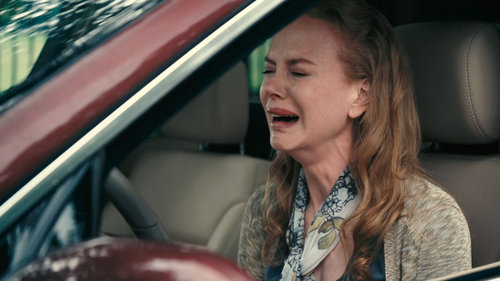
'Becca (Nicole Kidman) is going through the motions. She's doing everything expected of her and dutifully. The planting of new flowers in the garden, the making of stringent recipes of comfort food, the grief support group. All those motherly instincts and nothing to mother, and everything—absolutely everything—reminds her of the void in her life. Her child is dead, a victim of a car-pedestrian accident. Her sister (Tammy Blanchard) is pregnant, her mother (Dianne Wiest) keeps bringing up her own dead child—Becca's brother, friends with kids avoid her as if death were communicable, the flowers get crushed, the pans go empty. Life goes on, horribly.

Husband Howie (Aaron Eckhart, all clenched jaw and knotted body language) can't let go, sitting up every night endlessly watching a phone-video of little Danny  This frustrates 'Becca. So do the "professional wallowers" of the support group. She's avoiding grief, while Howie and the others are embracing it, and both sides are going too far  She starts to find ways of relieving herself of Danny's things, each one precious to Howie. They start to splinter, the pressures of the void hammering them from both sides.

Life goes on, horribly.
Audiences have been avoiding Rabbit hole like those parents avoid Becca, the subject matter presuming to be a downer. More's the pity as there is enough humor in the cracks of the angst to make it worth seeing and nod appreciatively at the simulations of life and death and the grief that comes between. Director John Cameron Mitchell stays out of the way, mostly, merely observing the struggles from sympathetic angles, while not making a big thing of the POV—making him a far subtler director than, say, Tom Hooper of The King's Speech.  The performances are pitch-perfect along the scale of emotional expression, from buried thought to screaming match, with Kidman sublimating technique for organic feeling to Wiest's haunted portrait of mother love. You pull for these people as they learn to live with death, even if they only get a "C" average.

It would be unfair to say too much of the plot other than the set-up, but
it touches briefly on comics and concepts of parallel universes and alternate realities—an alternate form of Heaven and the possibility that somehow, somewhere, things are different and that the cosmic dice might roll a different way. Possibilities erode the concept of the concrete reality, and sometimes the best way out of a trap is to imagine the way out, rather than accept that there isn't.

A downer? Maybe. But I found something heartening in a film that suggests that
the only way to fill the void of death is with larger doses of life. And that the holes those voids leave can only be healed—not so much in reality—but, in another dimension, the warrens of our soul.


Friday, March 1, 2019

Do the Right Thing

Do the Right Thing (Spike Lee, 1989)

"Now, watch and I'll show you the story of Life..."

It's been 22 years since Spike Lee launched his "Our Town" in Bed-Stuy, with Rosie Perez's aggressively pneumatic dance to Public Enemy's "Fight the Power." Twenty two years since the critics came out of the screening at Cannes saying that Lee's movie would foment race riots throughout the Summer, rather than cause the orderly lines around the block it did. Twenty two years since Lee debuted his movie about a particularly special day in the battle between Love and Hate: the hottest day of the Summer, the best day that Sal's Pizzeria ever had, the day Da Mayor (the late, great Ossie Davis) did another heroic thing in his life.

The day the music died.


And the worst day that Sal's Pizzeria ever had.
And someone's responsible—the least responsible member of the community.Do The Right Thing is Lee's version of Thornton Wilder's "Our Town" (but not with slices of middle-American white-bread life) and everyone (but everyone) thinks they're the Stage Manager. It's Charles Schulz's "Peanuts" with attitude, as all the characters have one aspect that defines their personality and, like the strip, something radical has to happen in order for them to break out of their self-inflicted stereotypes.* And maybe grow up.
The diverse, huge cast and series of one act diversions is a culmination of something Lee's been saying since the beginning and folk of all types have been mis-reading. It's not about black versus white versus Latino versus Korean versus Jewish. It's "us" against "them," cop versus citizen, young versus old, man against woman, and this particular pizza, forged in the heat, can be sliced all sorts of ways, but probably not equally. Because when it comes to hate, there's no such thing as fair.

Except your fair share of it.

What it is is the age-old tribal struggle of the pissing match between privilege and entitlement and who thinks who's got what. Everybody marks their territories with lines of death that no one can cross. And on the hottest day of the year, those lines get mighty stinky.


The last words of Lee's previous film, School Daze, are the first ones in Do the Right Thing: "Wake Up." In the previous film, they are hollered by Dap (Laurence Fishburne) in frustration and desperation, a protest. In DTRT, it's the reveille of Mister Senor Love Daddy (Samuel L. Jackson) at the start of his shift on We Love Radio, but the context is the same. Become awake. Become aware. Don't sleep-walk. Look alive. It's a warning, but still a wake-up call.  Open your eyes, people.
The wandering begins along the streets of Bedford-Stuyvesant color-filtered through Ernest Dickerson's floating lens.  Ugly attitudes have never been so beautifully filmed, approaching M-G-M Technicolor in its vibrancy and beauty.  The crowds ebb and flow, clash, curse and break apart, some wander like vagabonds, while others, acting as a Greek chorus, stay planted and observe and trash-talk. Locations vary between street and stage, at time, sometimes appearing to be aflame with color from the heat...but the constant music (like the American Graffiti soundtrack) emanates from boom-boxes and radios and the nearby station, mixing genres and styles—a polyglot of aural wallpaper, something for everyone. 
Do the Right Thing might not be Lee's most accomplished work—I think that might be Malcolm X, for its breadth and depth—but, it is the one that shows his love of movies. Take for example, the bling-knuckled demonstration by Radio Raheem (Bill Nunn)of Love and Hate, taken with few differences from The Night of the Hunter:
The Mitchum soliloquy ends with the old woman saying "I ain't ever heard it better told," whereas Lee's Mookie, after an uncomfortable pause, sums it up dead-pan comically ("There it is, Love and Hate") and non-committally (as he is wont to do until the end). Mookie is the fraying thread that holds the film together, despite his lack of ambition and any sense of active responsibility—Lee habitually plays characters in his films that are morally problematic (as opposed to M. Night Shamyalan's parts in his own films). He pairs him up with John Turturro's Pino (racist with no dolby and nor squelch and no backbone), when Sal treats Mookie's sister (Joie Lee) as a treasured customer. For both Mookie and Pino, the kindness crosses the line, is suspect and turns the heat up a bit on their attitudes. It's the one thing they agree on, but for different reasons (Pino, because she's black; Mookie, because she's family).
That complexity belies the simple tale of Love and Hate, pointedly, and Lee's entire film offers a tragic counter-point. It's never sure who to bet on in the fight, as both sides will take rounds and both sides will sustain damage. And we might not even know when the fight is over.

But I ain't ever seen it better told.

In 1999, The Library of Congress inducted Do the Right Thing into The National Film Registry, just 10 years after its debut, and the first year it was eligible.


* One character—Danny Aiello's top-lined Sal—is consistently inconsistent, due in part to Aiello's ad-libbing  sections of Lee's script, which Lee allowed him to do, perhaps to build dramatic tension about what the man is going to do.  We'll look at a key scene—and how it differs from Lee's script in this Sunday's "Don't Make a Scene."


Saturday, June 18, 2016

Money Monster

Fostering the Status Quo
or
Crumbs and Clowns, Not Bread and Circuses

Oh, their hearts are in the right place, those makers of Money Monster. Liberals all, they want to decry how the big-money-guys are destroying the little guy by sucking the shekles out of their retirement accounts (if they have them), pension funds (if they have them), life-savings (if they have them) or any amount of disposable cash by relying on the very greed that made them who they are to obtain the "other people's money" they depend on to get rich themselves. 

It's a shell-game for the selfish. The statistics show that we have such a lop-sided social strata that the top 20% of the people have 85.1% of the assets (the largest section, the bottom 40% of the population own 0.2%). You'd think that something that top-heavy would collapse under its own weight, but it resists crashing (or even trickling down) because that's gravity and gravity is Nature, and money has nothing to do with reality, especially these days. It works only because we agree on it for the purposes of barter, but these days—as the movie points out—money isn't even cash anymore, it's only pixels in theory in denominations of 1's and 0's. A bi-polar demarcation, like the "have's" and the "have-not's."
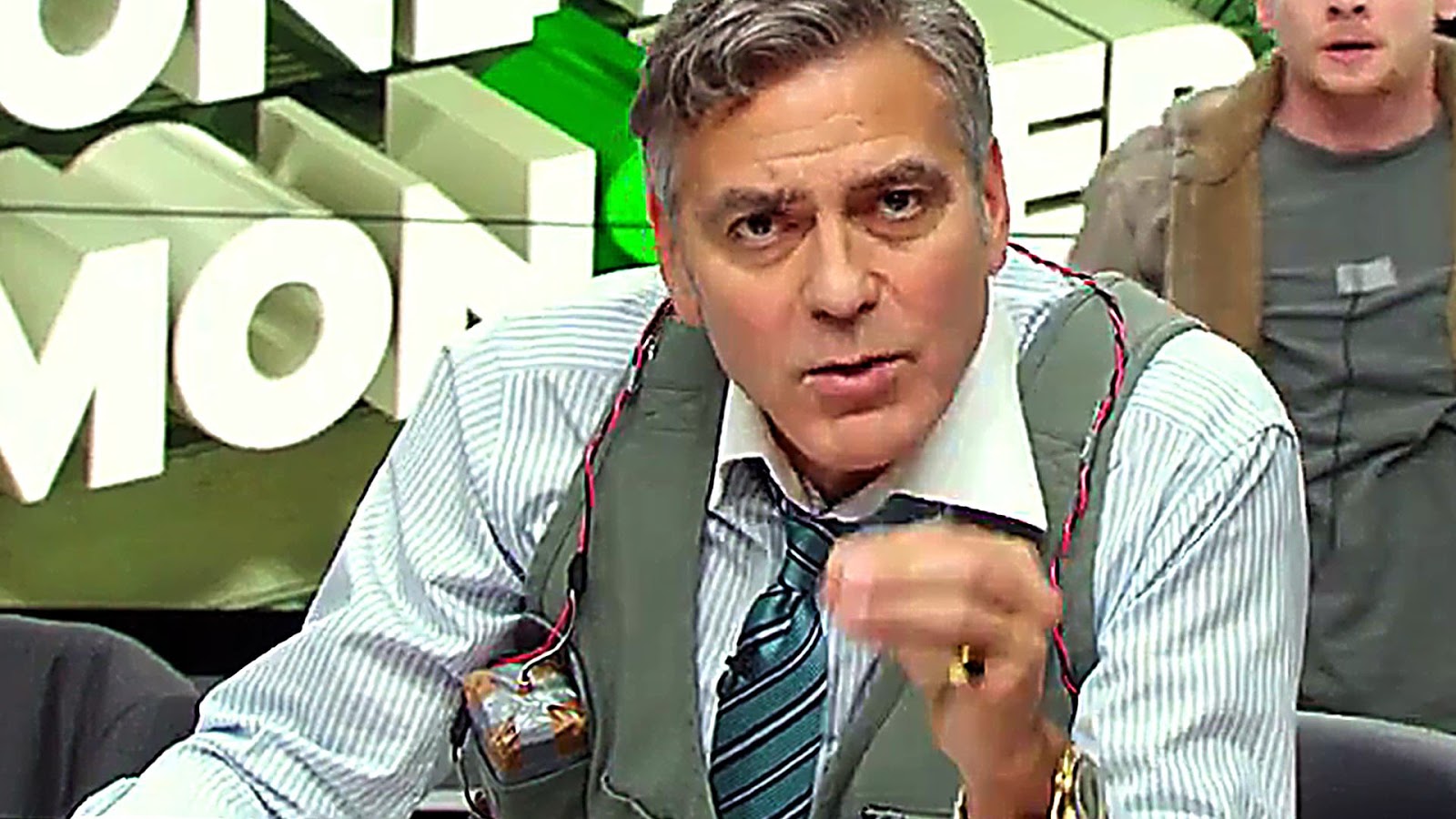
The barker for this circus is Lee Gates (George Clooney, who might be doing another of his "Idiot" roles for the Coen Brothers), a pompous ass of a guy who goes off-script, off-time, and off-color to shuck and jive his audience by proffering investment advice (think a nightmare blend of Jim Cramer, Glenn Beck, and a sports clown) for the good of the masses when actually his celebrity and clout are mostly used to prop up cronies and folks he can use to prop up the show. If somebody in the audience makes money, hey, it can only help ratings. 
Besides "caveat emptor." He's not saying you should actually buy the stuff. it's your decision and if something goes south, tough luck, there's fine print in the terms and conditions that you should have read if you read the prospectus carefully (if anybody had encouraged you to). The responsibility is all yours.
The show thrives on machismo and surface glamour and bling. Plus, there's the implied threat that you're a wimp if you don't take chances. You don't make the green if you're fifty shades of yellow. That sort of thing. And it's glitzed up like a game show with fast talk, goofy graphics, and bright shiny objects that defy analysis because it's all in fun.
But, Gates is a pain in the wallet. He's been doing this for years and the formula works and why change? He basically goes off-script every time the red light goes on and it drives his producer-director Patty Fenn (Julia Roberts) nuts. But, she's good, so she can ride the Gates tsunami every night. She's tired of it, though. She's leaving the gig to go direct somewhere else, so that she can...direct, rather than watch helplessly in the control room while Gates wings it.
If she thought she had lost control before, it's nothing like the day the movie portrays. In mid-broadcast, while Gates is clowning around, a million-dollar grin on his face, the control room sees a guy hiding behind the backdrops and video-screens. He waits just long enough for Gates to see him and think he's part of some "surprise bit." That is, until Kyle Budwell (Jack O'Connell) pulls out a gun and threatens Gates (on live television, one might add) with a bullet in the head unless he "gets some answers."

Budwell had invested his inheritance on one of Gates' recommendations, IBIS corporation—all of it, $60,000, to make a "big score" for himself and his pregnant girlfriend—and when the investment went south, he lost everything. Now, he wants answers as to what happened in the transaction, and he instructs Gates to put on a suicide vest (which Budwell holds the trigger to in a "chicken switch" configuration) to get the officers of IBIS on-camera to admit their failures.

The head of the company, Walt Canby (Dominic West), a favorite name Gates likes to drop on the program, cannot be found—he's out of the country. The company's mouth-piece, Diane Lester (Caitriona Balfe) burbles homilies, platitudes and corporate lines and boiler-plate, but that only causes Budwell to shoot out the video screen she's appearing on. Normally, the talking-head would remove their ear-piece and go have a congratulatory lunch for themselves, but in this fantasy, Lester starts a one woman crusade at IBIS to find answers to what's going on. She doesn't get fired for this, which might make the genre this one is classified under as "science fiction." She makes calls to the original programmers to determine what went wrong with the algorithms of the investment plan. They say there's nothing wrong with the algorithms (proving that they are, indeed, programmers—it's always somebody else's fault) and that something else caused the fund collapse. Lester investigates further, insuring that her pension gets taken away (and forget about a good recommendation).
Meanwhile, locked in the control room, Fenn coordinates with the police, evacuates the studio, negotiates with Budwell, and also has the time to do her own investigating into the IBIS corporate structure and its dealings. I'll bet her salary is a fraction of Gates'.

Gates, for his part, sweats. And, while wearing "the vest of doom" grows something that resembles a conscience, at least under the glare of television lights. He starts back-pedaling and comes up with a plan to take Budwell out of the studio and confront Canby about the apparent fraud.
He should have looked at his own monitor. Money Monster is, itself, a fraud, no "apparent" about it. The movie tries to gin up sympathy by channeling resentment against Wall Street by personifying it with a disgruntled investor who's gone off his rocker and decided to ultimately commit suicide by cop. That's like feeling bad for the Van Heflin character in Airport because he decided to blow a plane up for the insurance (as opposed to the Maureen Stapleton character, who's left behind to pick up the pieces). Thank you, I'd rather have somebody a bit more competent through whom to channel my righteous indignation. But, then, Budwell is always a schmuck throughout this movie, it's only O'Connell's earnestness that makes you take him at all seriously. It's what the movie-makers think of all the consumers of their bright shiny objects and their bread and circuses.
They give lip-service to Budwell's plight, but the sympathies seem to be with the one percenter's among the characters, because, after all, the bad guys still get away with their schemes and Gates gets to continue his job shucking and jiving. How like the economic crisis that the film-makers are wringing their hands about. Unfortunately, wringing your hands is visually indistinguishable from the silent movies' miming for "miserly greed." Frank Capra might have done something with it, making sure that phoniness is pilloried for its cravenness, and the true villains, if not completely thrown to the mob, are, at least, exposed to them. In the end, the movie really has nothing to say other than people are getting screwed, so maybe we ought to pay attention before torch and pitchfork futures go up. In the meantime, that Budwell guy's dead, but, hey, the show must go on. Oh, and Fenn decides to keep her crappy job that she is way too qualified for. Happy ending. All smiles. Cue the "Applause" sign.
The writers might not know better than this crap. But Foster does. Clooney might. Why was this Money Monster of a movie allowed to be released with so little thought attached to it?


Money Monster is a bad investment all the way around, certainly not of somebody's time.

Post-script: it's probably a good idea I had trouble writing this review, because the shooting in Orlando imbues Money Monster with a different perspective, one the writers were insensitive to and should have brought into the mix, if they wanted to make the thing more complex (but one suspects that was never the intention, or else the ending wouldn't be so superficially upbeat. 

Because whatever motivation behind his terrorist attack, Kyle Budwell is a terrorist. What did he think he could accomplish by his actions except suicide? Did he think because his motivations are so transparent, that the actions of the other villain of the piece, Walt Camby, would be equally as transparent? Camby is, after all, in the business of making money from other people's money, and so his motivation is always to keep his machinations in secret, only to reveal the results in an annual report of earnings, the way most businesses do. How they do so, whether it be Volkswagen by rigging emissions tests or Turing Pharmaceuticals (and its reprehensible little wanted poster-creep, Martin Shkreli) raising the price of Daraprim by 5,000% or the private contractors, like Halliburton, bilking the government and the tax-payers by charging $99 to wash a sack of laundry in Iraq, is their business, shady as it is. They do villainous, often obscene, things in order to look like heroes to their stock-holders. They're crooks, one and all, but just because he is victimized by the villains does not make Budwell a hero. He's a villain, too, and a pathetic one.

It's just one more facet to what makes Money Monster a cheat, an empty suit, and a badly thought-out entertainment.