Showing posts with label Toni Collette. Show all posts

Saturday, March 15, 2025

Mickey 17

Essential Worker
or
"Go Ye Forth and Multiply"

Mickey Barnes (Robert Pattinson) has a sketchy past-he has an issue with a loan-shark-and so he wants to get off-planet as soon as possible. Fortunately, there's a private mission to the planet Niflheim that has been spear-headed by a former Senator Kenneth Marshall (Mark Ruffalo) to form a colony where he's the Supreme Leader (Marshall has lost his last two elections and no doubt wants to leave democracy behind). Mickey, seeing the long lines of potential volunteers for the exploration flight, volunteers to be an "expendable"--a low-level worker position that no one wants, mostly because the fine-print is egregious, saying that he can be assigned guinea-pig positions that will probably kill him, at which point he will be "re-printed" body and mind, his memories downloaded into the new Mickey. In the 4.5 years it takes to get to Niflheim, he's died and been re-manufactured 11 times. Once land-fall occurs, Micky dies a few more times testing the environment and the various vaccines for the planet's endemic diseases, before anyone else is allowed out in the glacial environment. And, at the time of the movie's start, he is Mickey 17.
But, at the movie's start, that won't last long. 17's fallen into a crevasse in the freezing cold, nothing's broken, but there's no way he can get out. His co-hort from Earth, Timo (
Steven Yeun), has a job as a pilot and he could rescue him from his predicament...but, hey, why bother? They're just going to make another one, anyway. He leaves with a genuine "Hey, nice knowing you. Have a nice death." And a question everyone asks, "Hey...what's it like to die?" After all, Mickey's had experience.
I won't give too much away, but 17 survives the fall and the cold and is only too happy to get back to the base-camp where he gets a bit of a shock. Despite the lack of protocol and general laxity of safety conditions—especially in the science department—it seems they're very johnny-on-the-spot (or one should say Mickey-on-the-spot) for replacing their expendable: another Mickey has already been re-printed, who, of course, is Mickey 18. Because cloning is not an exact science, 18 is a bit more aggressive and less forgiving than his predecessor (hey, he's young, having only a few hours of life to his credit). But, the two have an immediate problem: duplicates are illegal in the colony and so, they it's a literal case of there not being room enough for the two of them, which makes both Mickeys beside themselves.
One of them, then, has to go. Although they basically have the same brain, they are of two minds on the matter. 18, of course, says that because 17 is considered dead, he's overstayed his welcome and he needs to die; 17 considers 18 to be unnecessary and superfluous and so he should be the one to die. Neither one of them wants to have a twin—do they split their rations?—and, besides, Mickey 17 has a girlfriend, Nasha (
Naomi Ackie), who's one of the base's security forces, and although she's intrigued with the possibilities, neither one of the Mickeys are into open relationships.
The problem is, the question of who lives and who dies is out of all of their hands—duplicates are illegal and if it's one thing former Senator Marshall is consistent at it's in following the rules that he's put in place (and that's just about the only thing he's consistent about other than maintaining absolute power over the colony). This puts Nasha and the two Mickeys in conflict with the social order and their functions, but, hey, movies need conflict and there's quite a lot of it in Mickey 17.
It's clever, entertaining, and adaptor-director Bong Joon Ho (he of Parasite, Mother, and The Host) has created another of his intricate little "trap" movies where you wonder where he might be going with it, but it's less devious then his previous films, and suffers from a "Chekhov's gun" situation which makes the resolution of the film feel slightly telegraphed and less of a surprise than in previous work. There are a couple superfluous characters (besides the extra Mickey) and one sees a trope (let's be kind and call it "inspiration") from an early "Star Trek" episode that makes it seem overly-familiar. That's a slight disappointment. 
And he gets entertaining work from his cast—Pattinson plays dual roles, of course (actual multiple versions of the same character), and, dang, if you can't tell the two of them apart merely by his playing of them, and Ackie has never been more kinetic as she is here. Ruffalo and Toni Collette (playing Marshall's Lady MacBeth of a wife) play it broad, but then, the characters are broad, as most autocratic figures are before they fall into the self-destruction of self-parody.
That broadness will, no doubt, raise hackles in some quarters, but those hackles are always on the alert, anyway. Best to look at the more subtle statement Mickey 17 is making about the irony of "essential workers" being regarded as the most disposable in business and governmental circles. Twas ever thus, whether it's in war, shirtwaist factories, or food-processing plants during a pandemic, this "dammit-I-can-have-it-both-ways" canard of the powerful sees far less exposure than it should. I'd like to see more of it, if only in the public interest.
 
The novel on which Mickey 17 is based has a sequel called "Antimatter Blues", but if it gets made into a movie, I'm sure they'll call it Mickey 19.

Wilhelm Alert @ 01:17:00
 

Thursday, November 7, 2024

Juror #2

A Rainy Night in Georgia
or
Juris-Imprudence (So, Help Us, God)
 
If I recall (having seen every episode) Clint Eastwood never appeared on the old "Perry Mason" TV show—one of the few elder statesmen-actors still working not to do so (and he was working for that show's network at the time). He seems to be making up for that with Juror #2, a courtroom drama with enough twists and turns to make Perry trip while hulking out of his chair at the defense table (come to think of it they rarely had juries on the "Mason" show—budget, you know).
 
James Michael Sythe (Gabriel Basso) is being tried for the brutal murder of his girlfriend, Kendall (Francesca Eastwood). They'd been seen fighting at a local watering-hole on a dark-and-stormy night and the politically-inclined District Attorney (Toni Collette) makes the case that Sythe was seen following after the victim as she was walking home in the torrential down-pour. Her body was found the next morning in a culvert under a bridge dead from blunt-force trauma. His attorney (Chris Messina) argues nobody saw the murder (even if a lot of people saw the fight at the bar). No murder weapon was found and Sythe maintains his innocence. One of the jurors, a retired copy (J.K. Simmons), says "He shoulda took the plea deal." 
But, one guy on the jury, Justin Kemp (
Nicholas Hoult), expectant father and reluctant jurist, isn't so sure. Once on the jury and hearing the details of the case, he starts having flash-backs of a night a year ago, when he was at the same bar the night that argument happened, but his wife had just lost twins, and he was thinking of having a drink, despite being in AA for four years sober. He remembers driving down the same road where the girl was killed and, distracted by his phone, took his eyes off the road and he hit something. Hit something hard. But, getting out of his car and looking around, he saw nothing, and, supposing he'd hit a deer and it ran off, he got back in his car and drove home.
Now, sitting in court, hearing the particulars, he's not so sure. Maybe it was this girl, Kendall, that he hit with his car. Day after day he sits in the courtroom hearing testimony from investigators and expert witnesses all leading to the suspicion that it was Sythe who did it deliberately. The trouble is: nobody saw him do it. It's all circumstantial and speculation. And the more Kemp hears, the more he thinks he might be the guilty party and the guy he's going to sit in judgment of is innocent.
What would you do, dear reader? I'd like to think that you'd do the right thing and turn yourself in and let an innocent man go free. But, my reading of "the times" (and the lack of civics classes in public education) tells me that nobody admits to doing anything wrong if nobody knows about it. Let sleeping dogs lie. Nobody's getting hurt. It wasn't my fault. I needed the money. I had a rotten childhood. In today's environment, George Washington would have hid the axe. Honesty's for suckers and losers. Kemp's excuse is he has a family with a baby due any minute, he can't do that to them.
But, what about Kendall? Her aggrieved family? What about the schlub who's being railroaded by the cops and the judicial system and may go to prison for life for something he didn't do? Is that justice? Kemp goes to his AA sponsor—a lawyer (Kiefer Sutherland)—who tells him vehicular man-slaugher will get him 30 years to life if he admits what he did, but maybe, just maybe, the jury will find the guy innocent and the problem will just...go away. And when closing arguments are over and the case goes to the jury, it is near-unanimous that Sythe should go to prison—except for one juror, Kemp. And he begins a methodical, near desperate process to convince the fellow jurists that Sythe is not guilty...within a reasonable doubt. And he's the perfect man for the job...as he may be the guilty party.
It sounds like an upside-down version of 12 Angry Men—the television-play and movie where one jury-member tries to convince his determined fellow jurists that the person they're supposed to judge is not guilty (and for a while it goes down that path)—but, there are complications and points of jurisprudence that threaten to up-end the entire trial. But, what none of the members of the court see is that they've got the wrong guy (sure, they've got the most likely guy), but what they don't see is the responsible party is right under their noses, and he is completely irresponsible to do what is expected of him—to do the right thing. Justice really is blind here, as Eastwood keeps visually reinforcing again and again and again.
It's a different movie, one that Eastwood's fans might not cotton to as it features nobody to root for, and the protagonist is dishonest, vulnerable, self-interested and...the worst sin of all, has self-doubts. Usually in Eastwood's film of choice, they're stalwart in the face of implacable enemies and chart a straight course towards what is a resolution or usually revenge. Sure, there have been vulnerable Eastwood protagonists, flawed Eastwood protagonists, even Clint veered off the straight and narrow in things like Bronco Billy and Tightrope. But, to have self-doubt come into play, I think you'd have to go all the way back to...Breezy. And not only self-doubt. In another age, at another time, one could see Kemp as a villain, a slightly sociopathic one with a narcissistic tunnel-vision that prevents him from seeing anything beyond his own situation. He's at least a coward, and a selfish one at that. Let another man rot in jail for something he did? What a lying skank.
But, that, the movie is saying is the point. At one point, the judge in the case tells the jurors "this process, as flawed as it is, is still the best way of finding justice." But, is it? In a world of people of good faith and strength of character, it very well may be. But, it is dependent on honesty and the penalty of the law. If everybody is lying on the stand, without the fear of perjuring themselves, the system ("flawed as it is") is worthless. Anybody not doing their job rightly, be they police, lawyers, judges, or witnesses threatens to derail any pretense of achieving "justice." And in a worthless system, where justice may actually be derailed, everybody is at risk. You only have to look at the work of the Innocence Project to see the results of a process that doesn't care about truth or innocence but only in the "feeling" that it's good enough or to make things seem done (hence the dependency on plea-deals). People fall through the cracks in such a system and then become lost in it. And some die in it. You can't seek to rid Society of corruption with a means that, in itself, is corrupt.
 
Eastwood hasn't done anything like this before—although Mystic River comes close—basing his movie around "the bad guy" (if we want to be simplistic about it), however self-serving the character's rationalizations for doing so. And he's aided immeasurable by the one thing Eastwood has always excelled at: casting. Everybody in this is playing top of their game, but none so much as the seemingly ubiquitous Nicholas Hoult. Hoult has an open face like a young Tom Cruise (back when he could play vulnerable) but the eyes are haunted and tentative like they're already seeing what's about to happen...and dreading it. And there's just enough doughy softness to him that you might end up caring about what happens to the guy, even though the moral quagmire the movie negotiates makes you want to see him get his "just desserts."
 
I was going to end this review with a rant about the Warner Brothers studio only releasing this one to 50 theaters (the reason being that Eastwood's last feature Cry Macho under-performed at the box office which rankled the WB CEO and made him wished he'd never financed it, despite Eastwood earning Warner a couple billion dollars easily from his output). Eastwood made this movie at the age of 93 (which is astonishing) and there is "talk" about his retiring—I doubt he will—so it seemed a churlish way to put one of your big earners out to pasture. But, evidently, the film is making enough money in the U.S. (and Eastwood's films always do well in Europe) that the studio is increasing the number of venues and extending its limited run in existing theaters by a week.
 
So, no rant. Merely a grumbling acknowledgment through my teeth that the theater situation is "not as bad as it could've been." And a grim smile while saying you should try to find a theater nearby that's showing it and see for yourself. This is a good one. And it might be the last chance you get.
"Courtesy Warner Brothers" Yeah, I suppose...

Friday, December 24, 2021

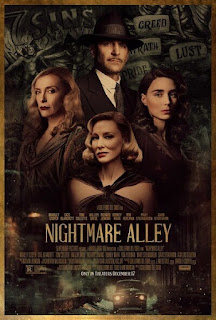
Nightmare Alley (2021)

The Smartest Man in the Room
or
"...It's All Geek To Me"
 
We meet Stanton Carlisle (Bradley Cooper) in the middle of committing a crime; in a soon-to-be-abandoned house, he drags a body to a waiting hole in the floor-boards, strikes a match—we see a gas-can on the floor behind him—and sets the room and the clapboard structure on fire. Then he simply walks away, next stop...anywhere, U.S.A.
 
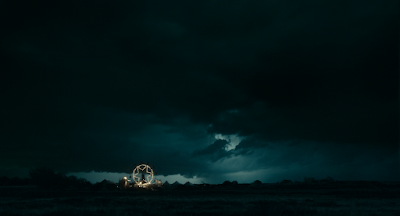
It's a bus-ride to where he's going. And he gets off at the designated restaurant, but he moves on to the glowing lights of a carnival, drawn to it like a moth to a flame. He moves over to a structure blanketed with "'Odd'-i-torium" and he goes in; for a quarter, he can see "The Geek" described by carny boss Clem Hoatley (Willem Dafoe) as a "supreme oddity—is he man of beast?" And as the slack-jawed crowd of curious gawkers gathers around a small arena, "The Geek," mangy and disheveled, is let out of his cage and thrown a live chicken which he bites in the neck and tears its head off. Repulsed, Stan leaves but is followed by Hoatley: "What's your pitch, pal? You on the low?" 
Within ten minutes Carlisle is hired as a roustabout, and one of his jobs is to round up the geek when he escapes his cage. Stan is sent in through the demonically-themed fun-house, it's signs warning of damnation and sees the geek, cowering. Ignoring Hoatley's advice, he tries to entice the man on his own and ends up getting concussed by a brick. Before any more damage can be done, he's found, the geek trussed up and Hoatley, fearing repercussions, offers him a steady job with the carnival. At night, he dreams dreams of flames, but in the morning, he helps fold up the tent and move on with the show—they're meeting up with another troupe down the road.
The spot they stop is a lot with an already-established carnival and across the dirt road is the house of Madame Zeena (Toni Collette) and her husband, Pete (David Strathairn), a once very successful mentalist act, gone on to hard times because of Zeena's philandering and Pete taking to drink. There is still talent in the older gentleman, but his will is broken, but he sees talent in the young man who's come to the house with the newly-arrived vagandonds and wants a bath. Zeena sees something in him, too, and seduces him—not that it takes much—and reads his fortune with her Tarot cards and it's ominous. Carlisle doesn't believe in such nonsense, not believing in fate, but only in the weakness he notices in others. He thinks he'll do very well.
If you've seen the 1947 version, you'll recognize a lot of what's going on as gone before. Watching this version of Nightmare Alley, though, evokes the same feeling one had when watching Martin Scorsese's version of Cape Fear after having seen the original.  It's the same story, but in another location, one steeped in the obsessions of the director. Where the first story was done to get the material down, the new one is richer, more grandiose, and more nuanced. No one's worried about time or hurrying the scene along. There is so much detail that to have it go any faster would be to miss something. The screenplay—by director Guillermo del Toro and his wife Kim Morgan—author of the "Sunset Gun" blog—is based on the original novel by William Lindsay Gresham, not on the original's screenplay by Howard Hawks scribe Jules Furthman. As such, it's a bit more "on the nose" and spells things out, announcing its themes and intentions so that no one misses the point. Rather than hurting the movie, it only gives it more depth, as the story can take the weight.
The casting is top-notch in the way the original couldn't be—there everyone was attractive—and populated by character actors of great depth. Cooper is Tyrone Power handsome, but he has a boyish "something" that makes him attractive—a kid in a man's body. Rooney Mara plays Molly, who is far more waif-like, but still evokes an inner strength and del Toro veteran Ron Perlman plays her guardian, Bruno, the carnival strong-man. Collette and Strathairn are both studies in washed-up talent, resigned to their fates but capable of showing glimpses of their glory days, and as Dr. Lilith Ritter, a fellow con artist as psychiatrist, Cate Blanchett risks parody by playing a creature of constantly challenging seduction, as if Lauren Bacall was playing a villain. 
This is something of a first for del Toro, who leaves behind the monsters' realm (temporarily, I assume), even while keeping one separated foot planted firmly in the grotesque. It's not his usual genre, as it's not a horror movie (and hewing closer to noir), but it flirts with it, the way that Carlisle will flirt with the mystical and the spiritual when he thinks using mentalist tricks isn't enough of a high-stakes racket for him. Because it's not enough to play tricks on people, to "read" them and use it against them, convince them that you have a power that they don't have. It's an endlessly escalating mind-game for both players. But, the hubris that results can make the fall from great heights higher than it appears. 

And Carlisle is just a beginner. He's not a mind-reader. He's a weakness-reader. A need-reader. It would have been better if he'd learned the tarot, so he could learn the future, but even when he's told what it is, even when it's spelled out in so much detail, he doesn't believe it. And maybe that has something to do with control. The future isn't written; he has no way to sway it. No way to read it, like the past on a man's face. And he's as much a paying customer—a rube—as anybody else is when it comes to Fate.
And that just doesn't cut it for the smartest man in the room, the man who knows everything about everybody. 
 
Except himself. Except that he's not as smart as he thinks he is.
 
It's a cautionary tale, as so much of film noir is. And it's one people should listen to.
 

Friday, January 22, 2021

I'm Thinking of Ending Things

The Beautiful Mind of Charlie Kaufman
or
"I Suppose I Watch Too Many Movies." "Everybody Does; It's a Societal Malady."

Writer-director Charlie Kaufman is a creator of a particular niche, but nothing so ephemeral as a consistent genre or style. He's not someone you go with expecting a "twist ending" or a particular visual "language". His projects take you down roads nobody has ever travelled before in movies with concepts wholly original, whether metaphorical or philosophical. You recognize the landscape as being of "the real world" but there it ends as far as a frame of reference for where he's taking you is filtered not though the physical eye, but the mental point of view. His fables and myths are of the mind and its undiscovered countries. 

Most movies make you feel. Kaufman's make you think. Sometimes painfully.

Whether they ponder identity and wish-fulfilment like Being John Malkovich, or emotional response as in Eternal Sunshine of the Spotless Mind and Anomalisa, or the act and process of creation—Adaptation. or Synecdoche, New York—Kaufman takes the "what if?" approach to crystallizing the concepts, the same way a science-fiction writer throws a magnifying lens on a subject by imagining its inverse or subverting traditional norms. Watching Kaufman is like watching "The Twilight Zone" but not going to a "fifth dimension" but definitely "to the pit of man's fears and the summit of his knowledge."
Kaufman's new film (streaming on Netflix) I'm Thinking of Ending Things is based on the 2016 novel by Iain Reid—but not the way Adaptation. is based on "The Orchid Thief". For that film, Kaufman made a screenplay of trying to "crack" the writing of the screenplay, and made his own difficulties doing so part of the narrative (and having done that, tossed away the book's specifics to get to its heart). For Reid's book, he took the method the writer was employing and wrote his own more visual ending while staying true to his resolution.
The result is a meandering stream of conscious quilt of a movie that involves the fears and tensions of interaction, the arbitrariness of life—and thought, and, something that might be of concern in these days of COVID, the bubble of "interiority". It can be a healthy mode of analysis or it can be a trap in a hall of mirrors.
We start out with a young couple (Jessie Buckley, Jesse Plemons) on that ritual step of dating—meeting the parents (his). This can be the stuff of comedy (Meet the Parents) or the stuff of horror (Get Out). With Kaufman, it's a little bit of both with a mutated dash of Lynch. We see the couple—her voice-over talking about how she's "thinking of ending things"—as they drive through the snow, the conversations of fits and starts, the mis-understandings of meaning, the doubts of the relationship despite having "so much in common." She's loquacious, even animated, while he has a nervous remoteness, bordering on a muted hostility, nervous, perhaps, about her entering into the family sphere he is only too familiar with...and (as they say) familiarity breeds contempt. 

He's driving. He'll always be driving.
Once we meet Jake's parents—after a prolonged, uncomfortable wait, where she meets the farm's dog with perpetual shaker syndrome and a door leading to the basement with scratch marks on one side and masking tape on the other—things to start really getting weird. Dad (David Thewliss) appears to be palsied and Mom (Toni Collette) is a paroxysm of nervous laughter. Jake turns slightly diffident and embarrassed by his parents and all she can do is try and make the most of it, but things are clearly out of whack here. It isn't long before she starts making excuses to leave because she has work in the morning.

Besides, the snow is starting to really come down. You have to be careful. The roads are treacherous.
Kaufman occasionally cuts away, without warning, to an elderly janitor cleaning a high school in the middle of the night. It's also snowing, and the theater troupe is practicing in the gym, and on his break he watches a TV movie.
But, things are getting weirder back at the farm. The snow's not letting up, and, although everybody's holding up their end of the conversation, there are things Jake doesn't want to talk about...like how they met at a trivia contest, and he was so good at it, and they had so much in common that he asked for her phone number. It's funny about the picture of him as a child on the wall, though. It looks just like her as a child. That's just...weird.
What...just, wait...what is going on here? After awhile, one wonders who's having the brain infarction: her or you? There appears to be a logic to it, but...no. To talk about details will be to spoil surprises...that is, if you have the patience to go along with it, and wonder exactly where you're being taken in this snowstorm. It may not be your idea of entertainment. In which case, reading the 1-star reviews over at IMDB might be more your style (some of them are almost clever!).
But, let's admit it: this one's not for everyone. For those who aren't engaged by a movie in the first 20 minutes it's a non-starter (and you'll think of ending it, lol—those IMDB commenters are a hoot!) If you have a favorite Charlie Kaufman movie, this isn't like it, and you'll like it only if you're into the off-beat and you're not comfortable in the David Lynch-end of the universe. Oh, there are joys: at one point Our Heroine goes into a straight-up imitation of Pauline Kael criticizing A Woman Under the Influence (1974), which is a hoot—even her cigarette comes out of nowhere. 
But, it's Kaufman playing around with the form, and sometimes that can be frustrated if one wants things tied up with a bow, or already chewed and spat into your brain. This one's about depression and loneliness and despair and "what-might've-been" and sometimes watching something like that can be depressing in and of itself.
But, it can also be intriguing and imaginative. Oh, I wouldn't blame ya for I'm Thinking of Ending Things

But, it's my cup of arsenic. 

Tuesday, September 22, 2020

Evening (2007)

Written at the time of the film's release...

Evening (Lajos Koltai, 2007) Okay, before we say anything about this movie, look at the cast--that'd be the reason people would be drawn to this movie: Vanessa Redgrave, Meryl Streep, Glenn Close, Eileen Atkins, Claire Danes, Natasha Richardson, Toni Collete. That is some heavy-duty fire-power and far eclipses the male contingent of Patrick Wilson, Hugh Dancy and Barry Bostwick.

Add in the stunt-casting: Natasha Richardson plays the daughter of Vanessa Redgrave's character, which should be easy to do as she's Vanessa Redgrave's daughter. Then there's Mamie Gummer, whose character's wedding is the centerpiece of the flash-backs for this film, and who is played in the present-day by Gummer's real-life mother, Meryl Streep.* All nice for a little conversation-starter at the coffee-klatsch.
But the reason to see this film is late in the proceedings: it's a scene between the two old friends played by Streep and Redgrave, both very old, and the latter, dying. And it's amazing. Redgrave is always good--surprising in how she can breathe life into any kind of scene. To see Streep and her play off of each other, is one of those rare moments of seeing two great actors at the top of their game combining their talents, even if the movie is no great shakes.** Upon finding out who her visitor is, Redgrave's arms fly out, reaching for her, a girlish gasp in delight escaping from this bed-ridden woman of no strength, but for that moment, she's young again, in memory and reality. And the two become gossipy friends again, though Streep's character is held in check somewhat by reality, and Redgrave's has no time for holding back. Great actresses. Great scene.
But the rest of the film is lacking. Whenever the film is off of Redgrave (her nurse is played by Eileen Atkins, who is Streep's counterpart in England), the film lags. Claire Danes plays the younger version in the flashbacks for the better part of the film, and though Danes can make her character dither at the drop of an impulse, that part feels soapy and over-written, and not as felt. And the present-day conflicts of the Redgrave character's children seem far less interesting than the flights of fancy of their dying mother, who flickers in and out of fantasy and reality. In the end, her obsessions are passed off as not amounting to much, though they're important to her, and the lesson of the film--there are no mistakes--comes off as hopelessly banal as saying "It is what it is."
Still, it's an impressive cast, but it's a mired chick-flick, that tested the patience of some chicks I know.

*"Nepotism," I hear you cry. And it is. Funny thing is, Gummer was cast first, and then and only then was Streep, who'd been in screenplay-writer Cunningham's The Hours, approached to play the older part. On the DVD, Gummer cracks: "Nice to be able to find my Mom a job!"

**I'm thinking here of DeNiro and Brando in The Score, or Brando and George C. Scott in The Formula, or Hepburn and Wayne in Rooster Cogburn or Hepburn and Fonda in On Golden Pond. These are events couched in humble films of limited means, and it's just fun to watch legends work together, even if you have to suffer through the rest of the movie to do it.

Wednesday, December 18, 2019

Knives Out

Thrombey-land
or
Ladies and Gentlemen Grieve in Different Ways

Mystery author Harlan Thrombey (Christopher Plumber) is celebrating his 85th birthday in a big way. His family is celebrating at the quirky family home for the old man and—as with most family-gatherings—there are issues and squabbles. They all involve money, because Thrombey has been quite a success.

The first clue to that is that he's 85 and living in his own home, as opposed to a facility no matter how healthy he is.

The family Thrombey has done very well for itself: daughter Linda (Jamie Lee Curtis) runs a real estate empire with her husband Richard (Don Johnson), but that was done with a considerable loan from Harlan—their son Hugh Ransom (Chris Evans) left the party early after a tiff; oldest son Walt (Michael Shannon) runs the successful Thrombey publishing empire, but is dissatisfied with the elder Thrombey's resistance to selling the filming rights—he's joined by his wife Donna (Riki Lindhome) and son Jacob (Jaeden Martell); daughter-in-law Joni (Toni Collette), widow of late son Neil, has a line of beauty products and her own self-help business and is paying for her daughter Meg (Katherine Langford) to go an ivy league college.

Then, there's "the help"—housekeeper Fran (Edi Patterson) views the family with a jaundiced eye and maintains her helping attitude with a hidden stash of dope; caretaker-nurse Marta (Ana de Armas) is well-regarded by the family (even if they can't remember her country of origin) and much favored by Harlan for her good heart and her proficiency with the game "Go." After the party, Harlan, after talking privately with all the family members, retires at 11:30.
When Fran brings up his coffee, she finds his bed unslept in and undisturbed. Continuing to his attic study, she finds it very much disturbed and Harlan dead from a slit throat, bled out, his dramatic knife/letter-opener still in his bloody hand. The police think it's suicide and they are in the process—in the form of Trooper Wagner (Noah Segan) and Lt. Elliott (Lakeith Stanfield)—of interviewing the family about the events of that evening, with one addition. He is Benoit Blanc (Daniel Craig, looking perpetually smug and utilizing the drawl of Shelby Foote), consulting detective of note (and "The New Yorker") who has been hired—by parties unknown—to determine if Harlan Trombley really did take his own life...or if it was done by the hand of another.
Like that double-conundrum, Knives Out is a multi-layered movie, not only in its plot, but in its timeline-juggling and presentation. There are complexities built on complexities: the mystery of Thrombey's death, which—at the beginning of the movie—is assumed to be one thing, which is called into question not once but twice for different motivations; the mystery of Benoit Blanc's benefactor as the detective is publicly seeking the truth of the first mystery, but privately is working on who hired him for the job.
He spends a lot of his time grilling the family members, not only looking for clues, but also for motivations about why he might be there. So he eyes the entire family like a smirking hawk, which, initially makes him an unwelcome guest and something of a detecting third wheel—he calms the family's fears by purring "My position here is purely ornamental."). But with the reading of Thrombey's newly-drafted will—"Think of it as a tax return by a community theater..."—the family gloms onto him to prove that Thrombey might actually have been killed, staged to look like a suicide, thus nullifying a will that would leave his family nothing.
And that's where things really get complicated. But, to say more would destroy the web of evidence, the suspicions and the dynamics going on amongst the suspected and suspecting family, as well as the timelines based on points of view that Johnson has intricately constructed like a jenga tower to tell a complicated story, while simultaneously building on it.
Now, the way Johnson has designed it, it puts some focus on the family members and the actors playing them. But, no one has more pressure put on them than the character of Thrombey's nurse, Marta Cabrera (de Armas). Of all the denizens of the Thrombey estate, she is the one closest to the old man, knowing him best and having his trust. She is also the most vulnerable—she's not family, but part of "the help." She has to be compliant and complacent, because her mother is an illegal immigrant and the Thrombey patronage keeps her employed and her mother safe. She fears any threat to that comfort, and the family, especially in the absence of the patriarch, is a hostile work-environment despite the smiles and the surface friendliness.
All the actors have a fine time chewing their respective scenery, but de Armas has the toughest role, playing someone "with a good heart" in a den of thieves while not looking like a victim but also looking competent. De Armas has to go through so many moods that swing back and forth like a pendulum, fading into the background, lest she betray something to the family. She must become simultaneously suspect and detective in order to protect herself and her family. It's a tough job, and de Armas pulls it off charmingly.
Knives Out carries out the time-honored game-plan of the mystery genre, but twists it in a gordian knot. to build audience expectations and then pulls the rug out from under them, staying ahead of the amateur sleuths who are trying to outguess the already-worked-out scenario. At the same time, it's a Christie-an exploration of the foibles and frailties of the upper crust, who are only too ready to break through and fall into the goo, and showing how far things can descend when greed is bad...not good.