Showing posts with label Tilda Swinton. Show all posts

Tuesday, November 28, 2023

The Killer (2023)

WWJWBD?
or
Skepticism is often mistaken for cynicism. (Suuuure, it is...)

Stick to your plan.
 
Anticipate. Don't improvise.
 
Trust no one.
 
Never yield an advantage.
 
Fight only the battle you're paid to fight.
 
Forbid empathy. Empathy is weakness. Weakness is vulnerability. 
 
Each and every step of the way ask yourself: what's in it for me? 
 
This is what it takes. 
 
What you must commit yourself to...if you want to succeed.

Simple.
 
It's the mantra by which the hired sniper (played by Michael Fassbender and unnamed except for some wildly amusing aliases on his I.D.'s and credit cards—he can't be accused of identity theft but might be in violation of the recent writer's strike) of David Fincher's The Killer (based on a graphic novel series by Alexis Nolent—ndp Matz—and Luc Jacamon) lives his life and dutifully repeats to himself after all the anticipation stops and he's actually required to pull a trigger—and only then, if his pulse-rate is hovering at 60.
It's the waiting that kills you. He keeps his body in shape with daily exercise, a light diet of protein—McDonald's...really?—and his mind focused with a steady stream of The Smiths and the aphorisms constantly scrolling through his head. 
 
He is in Paris, taking up temporary residence in an abandoned WeWork space across from a plush Paris penthouse that he constantly eyes for any sign of activity...or of a target. He's received an assignment, but the intended corpse is late. And this gun-man hates that. It's rude, for one thing. And if his intel is wrong about this, what else is off-track? Not that he knows anything about the target. He's not there to judge. "My process is purely logistical," he muses "narrowly focused by design. I'm not here to take sides. It's not my place to formulate any opinion. No one who can afford me, needs to waste time winning me to some cause. I serve no god, or country. I fly no flag. If I'm effective, it's because of one simple fact: I. Don't. Give. A. Fuck ."
But, he does, as far as the inefficiency goes. Cameras are everywhere. And though he purposely dresses as a German tourist to discourage any recognition...or interest...he can't help but think that his constant presence will gradually work against him, despite his M.O. of "redundancies, redundancies, and redundancies." On "Annie Oakley jobs" like this one, it's the details. "It only takes a few episodes of 'Dateline' to know there are countless ways to trip yourself up. If you can think of a dozen, you're a genius. I'm no genius." Later, he will get nostalgic: "When was my last, nice, quiet drowning?"
Maybe he should have waited until the guy got in the hotel pool. It wouldn't be a very interesting idea for a movie if everything went according to his plan. And little-by-little, that mantra becomes increasingly irrelevant and The Great Anticipator finds that he must improvise...a lot. The redundancies, redundancies, redundancies become complications, complications, complications. And, for once, he has to deal with the consequences as they hit closer to home. He finds it tough to be a target.
"I blame you...for having to bring my work home," he muses at one point. 
 
The Killer is fine, if you don't mind spend spending so much time with a conscienceless sociopath who has the advantage of never having to stick around for the aftermath—that's just something he never needs to calculate. But, when the tables turn and he actually has to give one of those fucks, there is no apparent empathy shift. He's still the coldly calculating death merchant with a penchant for pretense. And given his track record for playing sublimation and even mechanization, Fassbender is the perfect guy to play him. He's on-camera for most of the movie's running time, constantly in the sights of the view-finder and those types of marathons are tough to pull off. But, he does it with a seeming ease as the toughest thing his character can do is crack a smile.
Ultimately, it's a revenge movie—his clients don't like the outcome of the job he was hired for and so they go after him—and he has to methodically go up the chain, finding his contact, finding out his contacts, and taking them out one by one. He finds out "who", but the "why" is a bit of a mystery, unless you ascribe his own philosophy to their motivations:
"From the beginning of history, the few have always exploited the many. This is the cornerstone of civilization. The blood and mortar that binds all bricks. Whatever it takes, make sure you're one of the few, not one of the many." And so he goes about his business. Whatever it takes.
Fincher's direction is full of his feints and slights of hand—the time-transitions in a cut, the "impossible" shots (he did start out in special effects and he's in his wheel-house in a CGI-world—see the video below), all carefully controlled, composed and edited with a distinctive *snap* to them. It all looks simple, but what it takes to achieve that effect is extraordinarily complicated. That it's in service to another "revenge" plot is a bit disheartening. That it's something Fincher has wanted to make for years is more than a little depressing.
Fincher is such a craftsman, that he shouldn't be punching down. Maybe he had an extra commitment to Netflix for making Mank. Maybe he wanted to see if he could curb his instincts for budget and length and make something spare with both. Maybe the option to the graphic novel's film-rights were going to lapse. Or maybe this is his attempt to make a comedy ( although I've always considered Fincher's Fight Club more of a comedy) with its assassin who seems to have grown his habit for internal monologue watching "Dexter." Maybe it's his way of making a "John Wick" movie (why you'd want to, aside from the absurdity of it, escapes me). But, this is more This Gun For Hire than Le Samouraï.
 
If he was looking to make art, he was aiming a little low.
"Of those who like to put their faith in the inherent goodness of mankind,
 I have to ask, 'Based on what, exactly?'"


Tuesday, June 27, 2023

Asteroid City

Meep! Meep!
or
Margot Robbie's in the Tupperware
 
Asteroid City does not exist. It is an imaginary drama created expressly for the purposes of this broadcast. The characters are fictional, the text hypothetical, the events an apocryphal fabrication."

Well, of course they are! It's a Wes Anderson movie!
 
Early on, with Anderson's movies—back before they got really stylistic with consistent lateral camera moves and a severe one-point perspective, and looked like they could have happened in the "real world"—there was a depth to the subject matter that was undeniable. That has remained to this day, even while the visual look of the films have become more juvenile and seem to be contained in toy-like play-sets that defy good construction practices or even three-dimensionality. Characters became types moving around in play-houses that seem to be defiantly artificial...like shooting in a western town that were deliberately shown to be propped up stage settings and mere facades. Most directors try to expand their horizons along with their budgets and to take pains to make things more realistic and less like pre-planned photographed dramatizations. Not Wes Anderson.
Hitchcock said of Spielberg that he was "the first one of us who doesn't see the proscenium arch" noting that Spielberg grew up with film, rather than the stage. But, Anderson is going a different direction. He WANTS you to see the proscenium arch, and will go out of his way...with a child-like glee...to make sure it's noticed and appreciated to be artificial. His new film, Asteroid City is one more step in that direction as it's story looks like it takes place in one of Maurice Noble's desert landscapes in the Road-runner cartoons.*
But, that's one aspect of Anderson's film (he usually has at least two he's presenting in his movies). Usually, he's as stringent in his story through-line as he is with a tracking shot (his The French Dispatch, with its a handful of stories, being an exception). This one, he's made a layered story, through several simulated media—television, stage, and film—each one has its place in the film and each one is subject to being violated, one by the other.
Now, Asteroid City tells the story of what happens when a bunch of "super-genius" kids arrive with their families at the titular city—famed for its vicinity to  the "Arid Springs Meteorite" impact crater—for the "Junior Stargazer/Space Cadet" convention put on by "The Larkings Foundation" and the U.S. Military under its United States Military-Science Research and Experimentation Division. They're to be given awards for their inventions—it should be noted that those inventions (jet-packs, destructo-rays, projecting on the Moon) were not viable in the setting of 1955, but would be just the sorts of things kids would want to invent. Each family have their issues and quirks, and they become unwitting witnesses to a major event in the history of mankind.
So, that's the plot. But, it's not the whole movie. We begin—in black-and-white and a square Academy ratio—with a television program (of the arts-programming "Omnibus" variety) where the host (
Bryan Cranston) intones that they are presenting a special production of a play by famed playwright Conrad Earp (Edward Norton) called "Asteroid City" and after a brief episode where Earp meets actor Jones Hall (Jason Schwartzman), we begin with a wide-screen version of the play in the colors of a faded post-card you'd find in a rack at a tourist trap.
Augie Steenbeck (played by Jones Hall played by Jason Schwartzman)—photographer—arrives (barely) at 'Roid City with his three daughters Andromeda, Pandora, and Casseiopeia as well as his son Woodrow (Jake Ryan), who is participating in the awards contest. Augie was a war photographer, still has shrapnel in his head, and takes his station wagon in to be serviced (by mechanic Matt Dillon)—it having given up the ghost miles down the road. It's decided that they will stay in town for the convention, rather than stay with Augie's father-in-law, Stanley Zak (Tom Hanks).
Stanley is concerned about this, but he's more distressed that Augie hasn't told the kids that Augie's wife/his daughter died two weeks ago, and don't you think it's about time to do that? So Augie stoically tells the kids—"Are we orphans now?" "No, I'm still alive."—which affects them all deeply, despite Woodrow being steeped in all things science and the three daughters, embracing mysticism seeing themselves as witches (well, two witches and one vampire). To allow the kids to grieve, Augie lets the kids bury their mother's ashes (contained in a Tupperware container) temporarily in the car-park until their grandfather can arrive to take them to his home for a more proper burial.
Also there for the awards ceremony is actress Midge Campbell (played by Mercedes Ford, played by
Scarlett Johansson), who is studying her lines for a new play and develops a curious relationship with Augie—seeing as their neighbors and all. Like the majority of the actor/characters, they are demonstratively undemonstrative, and—if I may use the word again—"stoic." These are, after all, adults in the 1950's, having lived through a ghastly world war, only to see it emerge with advances in technology and weaponry that dwarf, and could ultimately consume them. The many small inconveniences of living in a desert tourist trap not to far away from a nuclear test-site, leave them unfazed.
It is only when a cosmic event happens that is ultimately beyond their understanding that things change. Asteroid City, due to that happenstance is shut down and quarantined, leaving the temporary residents stranded. But, true to their nature—or perhaps the nature that Conrad Earp has given them—they react more to the minor annoyances that the quarantine imposes, rather than the perspective shock that its cause should have created.
Seems a bit like real life, doesn't it?
Anderson and consigliere Roman Coppola were writing this in 2020, so the COVID quarantine may not have been the genesis for the project, but filming during COVID restrictions certainly did, necessitating the recasting of Bill Murray when he came down with the plague. Still, when the outrage in real life is over the inconvenience of wearing masks rather than the loss of more than a million souls (you can't make this stuff up!), one can infer that it was on the creative minds.
Six feet apart?
But, there is one attitude shift present from the happenstance; Anderson abandons his persistent horizon-bisecting in the frame for something else—overhead shots looking down on the players. Oh, everything still has that one-point perspective, but from above with no horizon in sight, putting (in camera-terms) the people on screen at a disadvantage, making them smaller, vulnerable, putting them in their place—at least from the perspective of an observing extra-terrestrial. It's a bit jarring, but completely apt. It's the only evidence of a new perspective in the movie.
So, I found it fascinating, but then, I always look forward to Anderson's films. They may not come to an all-encompassing conclusion, but instead take on the mantle of a childish inquiry without answers. They make me feel a little younger, where playfulness was everyday, and not in those moments in between crises. They embrace innocence, but leave plenty of room for cynicism and mild bemusement, rather than a-musement. And the cultural touchstones he invokes are pretty sophisticated, even if he's not being sophisticated about them. I'm all in for that.
 
I hope he never grows up and loses it.
And Asteroid City is the perfect come-back for all those scary A-I generated parodies of "visionary director" Wes Anderson that are flooding YouTube now ad nauseum. Whatever the "brave new world" of AI generates, Anderson will always top it. I find that reassuring.

 * Anderson even throws in an occasional stop-motion road-runner just so we get the point.
"Wow"
 
Some more shots from Asteroid City, just because they amuse me... 

Wednesday, May 17, 2023

Moonrise Kingdom

Written at the time of the film's release. A re-viewing of it recently, anticipating his new film, Asteroid City (due June 16th) only reinforced my joy watching it.

A Troubled Young Person's Guide to Themes of Defiant Youth (ala Antonioni) with Kubrickian Stylistics (as interpreted by Wes Anderson)
or
Full Metal Jackasses

Moonrise Kingdom might be my favorite Wes Anderson film yet.* The films of Wes Anderson have gotten more and more juvenile, regressing in sensibility, but progressive in terms of connecting with a child-like world-view. Like his dark companion in film, Tim Burton, Anderson chooses subjects and styles that appeal to his inner kid, pulling in favorite things from his growing up years  to include in his films. But, unlike Burton, he doesn't concentrate on the dark and morose, focusing instead on a sense of wonder, even if in his world-view the adult act like children and the children try to act like adults.
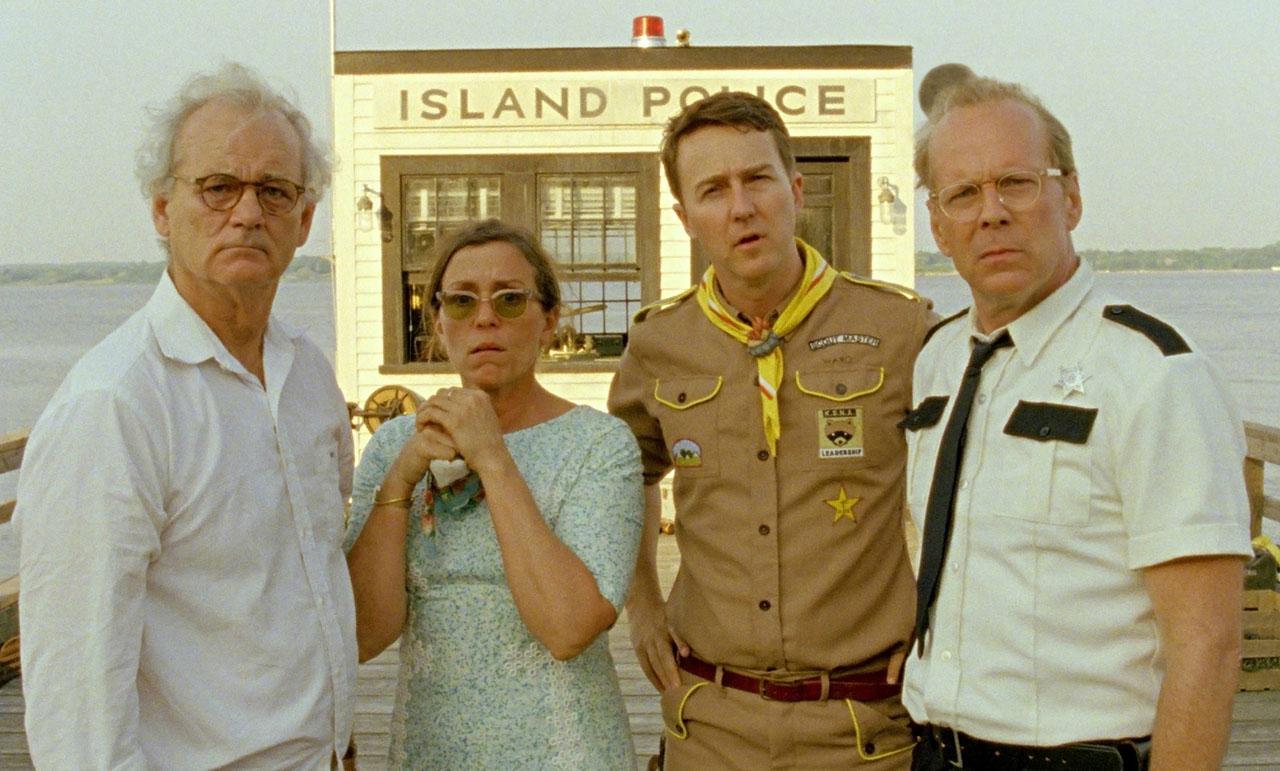
So, Moonrise Kingdom, co-written by Anderson and Roman Coppola (Francis' iconoclastic kid), set in the mid-60's and involving an East coast island community. There are two factions, the authorities, represented by island law enforcement—Captain Sharp (Bruce Willis) and the troop leader of a group of "Khaki Scouts"—Scout Master Ward (Edward Norton). There is a dysfunctional family, the Bishops (led by Bill Murray and Frances McDormand). Both factions represent authority, and empty authority at that. Their worlds are controlled, regimented, but still subject to outside forces and acts of God, like weather—there's a storm approaching as the film's exposition expert (played by Bob Balaban) is only too quick to report.

Into this mix come a pair of star-crossed likers, outcasts from both houses, like Romeo and Juliet.
Sam (Jared Gilman) is an orphan with enough issues that his foster parents no longer want him; Suzy (Kara Hayward) is the oldest child of the Bishops and already is labeled as a "very troubled child." They meet at an amateur production of Benjamin Britten's "Noye's Fludde"
**—he's on a scout outing, she plays a raven.
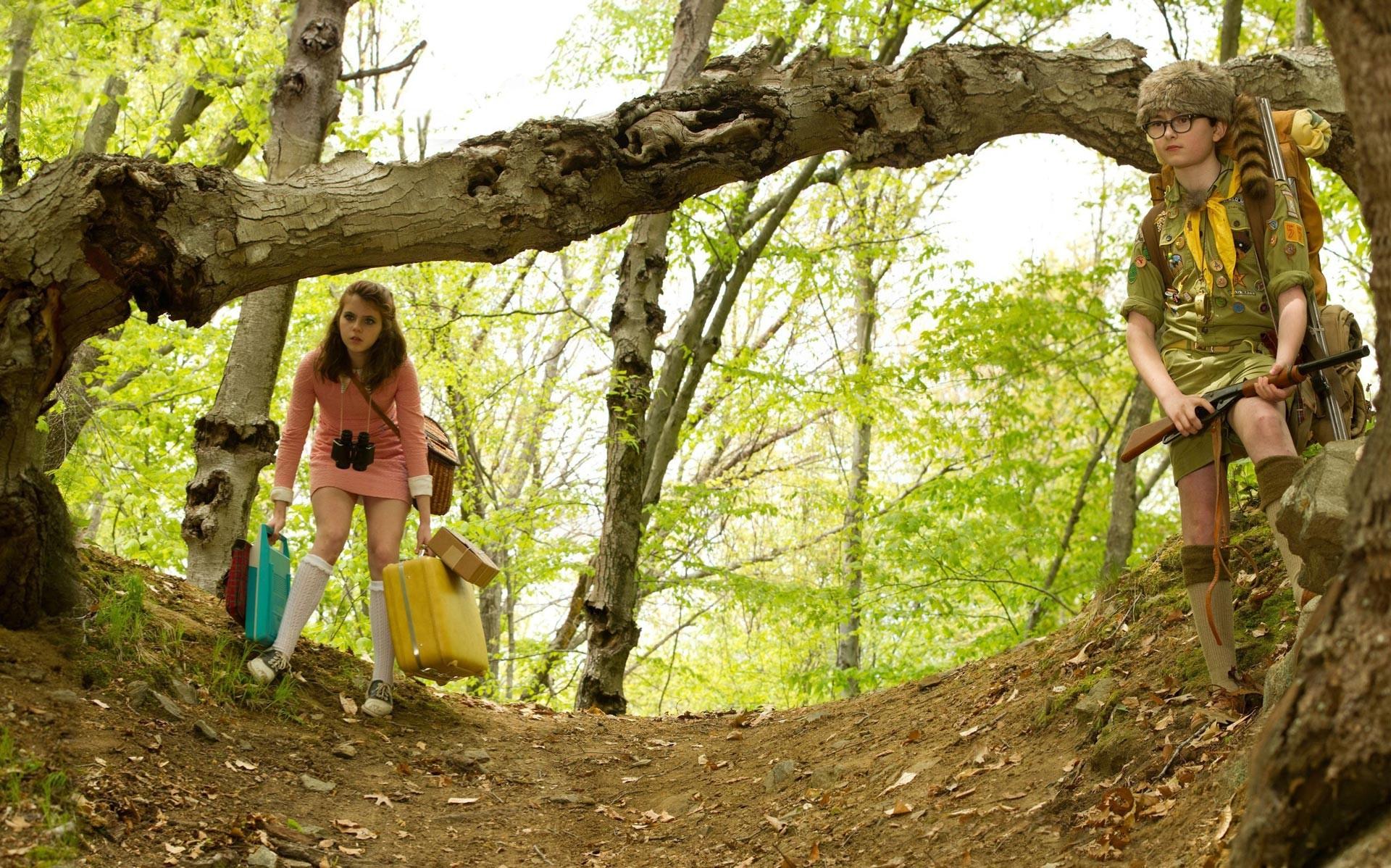
They begin corresponding in secret, and then both escape their cloisters, he from the Khaki Scouts camp, she from her family home.
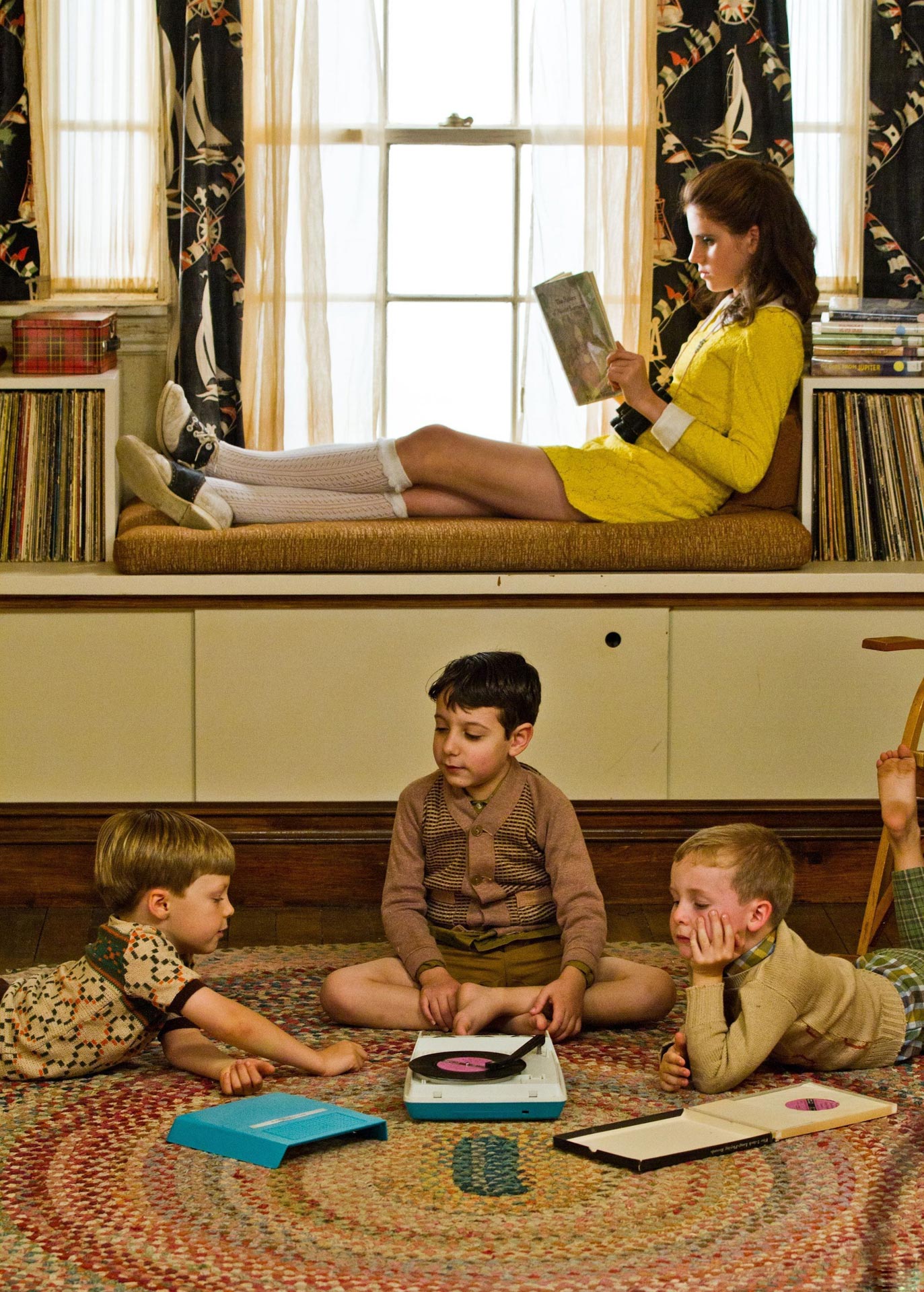
They live off the land, he with his survival skills and supplies, she with her books and records, a mutually dependent family with different roles. It doesn't take long for their disappearance to be discovered and the search parties form, the police led by Sharp and the Scouts, led by Ward, with the Bishops poking, prodding and threatening lawsuits. The kids lead them all a not-so-merry chase, and there are casualties along the way. But, the fugitives press on, despite the fact that, on an island, they can never really escape.

It's a romantic's version of 'the barefoot bandit" story
, but without the issues of ego, narcissism, and general public nuisance, and Anderson couches it all in an idiosyncratic format with scrupulous Kubrickian stylistic fluorishes—the measured tracking shots, the hand-held shots of freedom and chaos; the stylized expressionless acting, the structured mise en scene, perfectly balanced on a central fulcrum. On top of that, it's hilarious, with dialogue that's formal, distinct, played absolutely straight, betraying no irony, delivered in a deadpan lack of elevation.

It's charming
-no wonder these kids want out, left to their own devices. They still want structure, just their own structure, and, although self-imposed outcasts, seem far more together than those of their "betters."

It's fun
, odd, and rebellious in Anderson's over-stated understated fashion. Wonder what he'll do when he grows up.

* Oh, maybe this was premature. Anderson has since made The Grand Budapest Hotel, The French Dispatch (of the Liberty Kansas Evening Sun), and the wonderful animated Isle of Dogs, each getting increasingly richer, denser, and more sophisticated, all the while maintaining his quirky sense of humor and an almost child-like delight, as if he were playing (as Orson Welles put it) with "the greatest train set a boy ever had."

** Britten is the classical composer-thread rolling throughout Moonrise Kingdom, and his "Young Person's Guide to the Orchestra" is the starting theme for the film's opening sequence—a gliding, tracking tour of the Bishop's house.  They'll also do a version of it over Alexander Desplat's closing music over the credits.

Saturday, December 17, 2022

Guillermo del Toro's Pinocchio

Re-Tooling Pinocchio
or
"All Good Things Require Patience"

Good Lord, we're certainly in a nostalgia craze right now, but then self-isolation will do that to you. Spielberg did Fabelmans, Mendes does Empire of Light, and now del Toro makes a film that was inspired by an early childhood movie memory of his youth, his own version of Pinocchio. I can't fault him; I loved that movie as a child—and was obsessed with it, too. But, that was Disney's Pinocchio made in 1940. It's of a different time and a different sensibility.
 
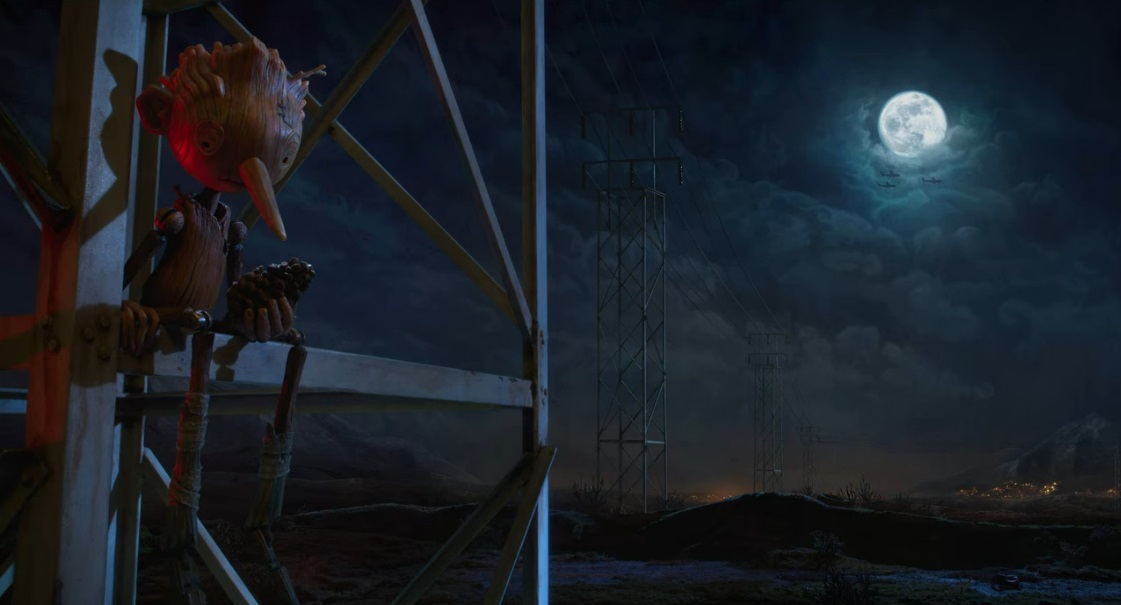
Guillermo Del Toro's Pinocchio is quite another creature entirely. For one thing, it's set in the fascist Italy of the 1930's. And the puppet is a puppet, never losing his bark (as it were) and without the embedded wish of being a real boy. He's real enough and high on, if not life, anthropomorphism. But, he's a block of wood, cut from a tree, without the benefit of paint or clothes as per the Disney version (and the recent Robert Zemeckis adaptation on Disney+). 

And this version isn't 2D animation or CGI as with those. This is stop-motion animation, that pain-staking movie-making done (as with most animation) frame by frame. I've always had a soft spot for this type of work, be it from its earliest days of King Kong, through the mesmerizing work of Ray Harryhausen to the improvements of "go-motion" developed by the wizards like Phil Tippett for the Star Wars films. To think of these guys, with their little play-sets, moving their figures inch by perceptible inch, bearing in mind the incremental differences in perceptible motion and speed!) to create the illusion of life on film reveals not only the imagination but the science and mechanics of making moving pictures. We won't even talking about the commitment of walking to a studio knowing you'll probably only get a minute of film done (if you're lucky) every day.
So, hats off to
Mark Gustafson, who co-directed this—while del Toro was off directing live features, promoting them, winning Oscars, getting married and supervising his vision of what "his" Pinocchio story should be. Gustafson's work is incredible...and convincing. You get lost in this world and its creatures, all with their individual quirks and personalities (they move differently—by design, Gustafson's design). Those are determined by del Toro, they are brought to life by Gustafson's steadfast and steady work.
You know the story. Simplified, the story goes like this; Gepetto is a wood-carver/toy-maker who makes a humanoid marionette with the wish that it might be a real boy. Supernatural powers animate the puppet and, after the usual chaos that an energized blunt instrument can inflict, Gepetto insists that the thing go to school to be socialized, forgetting that society sees Pinocchio as a puppet walking around without strings and thus, something exploitable. Pinocchio gets gathered like kindling and tied up in a traveling show. Much searching occurs until getting swallowed by a whale, at which point, Pinoke proves his worth saving everybody and is rewarded.
But, it's the details. Disney's version leaned on the "wants to be a 'real' boy" wish, starlet-pretty fairies, anthropomorphized animals, and an emphasis on good behavior (while, curiously, demonstrating smoking, drinking, gambling, and vandalism) tent-poled with a lot of classic songs that perpetually show up in modern culture as well as hawking trips to Disneyland. The lesson to it all is "Always Let Your Conscience Be Your Guide," which implies that the conscience leads to good behavior that is accepted by society, the church, and the family. And that "being a real boy" is the sine qua non of life.
 
As they say at "CinemaSins": "That's speciest!"
Del Toro tells a different story, while keeping the nuts and bolts holding the thing together. It's set in the 1930's during fascist Italy (as we've said), and Gepetto (
David Bradley) makes his figure after his beloved son, Carlo, is killed in a bombing. Despairing (and drinking) he builds it from the tree that has grown out of his son's grave. Wood spirits (in the form of a slightly angelic figure—voiced by Tilda Swinton) show up and grant life to the figure and appoint resident cricket Sebastian J. Cricket (Ewan McGregor playing Obi-Wan for Disney a-gain!) as his guide and tutor.
The sight of Pinocchio (Gregory Mann) gallivanting cluelessly and curiously around his work-shop filled with sharp objects understandably freaks out the hung-over Gepetto. And his instincts are to curb his enthusiasms or, failing that, lock him in the closet to minimize the damage he causes. It's easiest to do the latter, ironically when he's going to church) But, Pinocchio cannot be contained and he follows his "Papa" to the humble chapel adorned with a crucifix built by Gepetto.
But, the parishioners are aghast! What unholy thing has desecrated this House of God? It's an abomination and (not only that, says the town's fascist leader, Podesta-voiced by "del Toro regular" Ron Perlman) he's a "dissident. An independent thinker, I'd say." All because Pinocchio looks at the wooden Christ on the cross (also built by his "Papa") and wonder "How come they like him and not me?" Poor Pinocchio. He's a beginning student asking post-grad questions.
Time to send him to school, but he's easily distracted by an offer from the unscrupulous Count Volpe (
Christoph Waltz) to join his circus and become a performer in his traveling puppet act. Soon, Pinocchio is quite the attraction, attracting the attention of a desperate Gepetto and the fascist Podesta—who wants to gain favor with Il Duce, Benito Mussolino (Tom Kenny), who fancies puppets as much as he fancies being the ultimate puppeteer. Dictators always have that fantasy, whether they rule a puppet government or not.
This is all delightful, even if its satire is heavy-handed (fascists deserve no less) at times, and its humor is periodically ghastly (it is del Toro, after all), but it caroms along at a brisk pace, occasionally interrupted by songs (composed by the always inventive
Alexandre Desplat, with lyrics by del Toro and Roeban Katz) that are sometimes interrupted themselves by some boisterous activity that ends them in mid-note.
And it adheres to the "Always Let Your Conscience Be Your Guide" maxim in a way that works in a complicated way where Society may not always be in the right. I like that. Like the movie itself, its heart is is exactly the right place where it should be, even if there is no heart in evidence.
 
This is a Pinocchio I can admire, no strings attached.