Showing posts with label Chris Cooper. Show all posts

Wednesday, August 19, 2020

Adaptation.

Adaptation. (Spike Jonze, 2002) I love Charlie Kaufman's writing. It reminds me of the old "Twilight Zone" series...but with depth*—but he's more of the Charles Beaumont style of TZ story-telling than Serling's or Richard Matheson's or Earl Hamner Jr.'s. Leaps are made every few minutes beyond the central conceit, and comes to a truly disconcerting kernel of truth at the end, which makes whatever frustrations made during the course of the film worth it. Being John Malkovich is a charming deconstruction of personality and wish-fulfillment, and Eternal Sunshine of the Spotless Mind is a jaded cynic's validation of love, and its intrinsic ability to be more than merely a process of instincts, chemistry and firing synapses. What's not to love?

But
Adaptation. is another animal. It's "Charlie Kaufman in crisis," and a bit of a cheat, while also being an ingenious way to solve a problem—that is, writing a screenplay for a book that is, basically, un-filmable. Given the opportunity (and contract) to write a treatment based on Susan Orlean's best-selling book "The Orchid Thief,"** Kaufman readily accepted the job, being attracted to the odd obsessive themes of the book, and found himself unable to translate it into a film-story.

So—he thought outside of the box and the story itself—he wrote about his difficulties translating it into a film-story! The book's subject, John Laroche, the poacher who was seeking the "Ghost Orchid" in the Florida Everglades was a real person who was determined to find the rare flower to clone it and sell it. The screenplay's subject is about Charles Kaufman, screenwriter, who's trying to adapt Susan Orlean's book, "The Orchid Thief," and wrestling with its themes and his own inability to create the screenplay.
Impeding his process is his twin, simpler brother Donald (both played by Nicolas Cage), who's decided he's also going to write screenplays, none of which Charlie likes. Susan Orlean figures in it (played by Meryl Streep), as does Laroche—he's the bespectacled fellow pictured to the right, not Chris Cooper's snaggle-toothed (though Oscar-winning) portrayal (pictured above)—but they're fictionalized versions of the real people, adapted to fit a more commercial film. Laroche is using the orchids to make a drug and sell it, hooks Orlean, and she begins a needy affair with him and, fueled by her addiction, becomes as obsessed with the Orchid Thief as much as he's obsessed with the orchids. Is any of that true? No. Are the people real? Yes. The website, Chasing the Frog.com had done a fairly succinct job of separating the fact from fiction here. Yes, these people do exist, as does screen-lecturer Robert McKee,*** but they're fictionalized versions of the real people. Can Kaufman get away with doing that? Yes, he obviously did, but they had to get permission from the real-life counterparts to do so (just as Jonez had to get permission from John Malkovich for Kaufman's Being John Malkovich or that would have been a moot project).
Look up the word "Adaptation" in the dictionary. "Any change in the structure or functioning of an organism that makes it better suited to its environment." There couldn't be a better explanation of the screen treatment of Adaptation. Kaufman couldn't, as they say in the trades, "crack it," so he changed the structure of the scenario...transplanted it, if you will...to make it work as a movie—especially a movie in the current environment of movie-making. And he made the debate between what he wanted to do and what he had to do part of the story in the form of the arguing screenwriting twins, Charles and Donald Kaufman.
Any writer of success must at some point deal with "the Other." The other writer, whose ideas are dismissed and shelved for work accomplished. Steven King did an experiment once to see if his writing would be as successful in other genres as opposed to the "scary fiction" writer, Steven King. So he created a psuedonym, Richard Bachman, much to the consternation of his publisher. Bachman sold well, but King had to deal with the success of his dopple-scrivener after several books were published. Ultimately, it inspired the concept of his novel "The Dark Half."
Noms de plume are as old as Bashō (and I'd bet cave paintings had false signatures, as well), and Adaptation. is credited to both Charlie and Donald Kaufman. Donald Kaufman is the first completely fictional person to be nominated for an Academy Award (at least not as a nom de plume). Donald also serves as a way for Charles to have conflict while doing something solitary—writing. For all the preciousness of the conceit, it still manages to work in a weirdly clear way, and it provides the means of this exchange, which re-defines the whole picture and sums it up: Donald and Charlie are talking about a time in school when Donald approached a girl he had a crush on, and when his back was turned, she and her gaggle of "Heathers" made fun of him.
Donald Kaufman: I knew. I heard them.
Charlie Kaufman: How come you looked so happy?
Donald Kaufman: I loved Sarah, Charles. It was mine, that love. I owned it. Even Sarah didn't have the right to take it away. I can love whoever I want.
Charlie Kaufman: But she thought you were pathetic.
Donald Kaufman: That was her business, not mine. You are what you love, not what loves you. That's what I decided a long time ago.


You are what you love. Not what loves you. For that little gem of a thought—multi-faceted, flawless and fundamental—I have enormous respect for Adaptation. for all its problems.
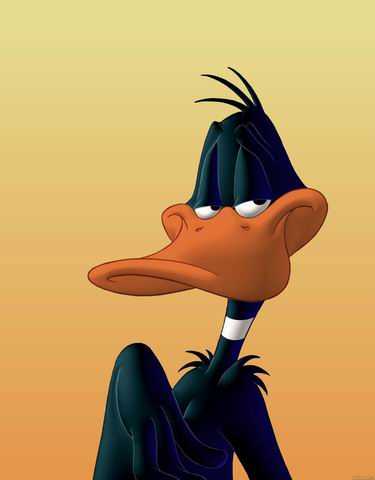
Oh, one more thing: My first impression of Adaptation. was to recall a punch-line from an ancient Warner Brothers cartoon (actually a couple of them, one of them being "Show Biz Bugs," another "Curtain Razor")—but because of what transpires (and the fear that kids would duplicate it) it's not much in circulation anymore. In it, the indefatigably fame-seeking Daffy Duck is auditioning for stage-time for his act. Each one fails miserably and he's rejected. "Next!" Finally, he shows up in a devil's costume. He eats gunpowder. He drinks gasoline and nitro-glycerine. Then...dramatically, he swallows a lit match. BOOM! There's a huge explosion. "That's incredible!" cries the ecstatic agent. "I can book you immediately!" "Yeah yeah," says the ghost of Daffy, drifting heavenward. "But I can only do it once!"****
The fictional Charles Kaufman—or is it Donald? (Nicolas Cage)
—on-set with the non-fictional Susan Orlean.

For Ned', who asked...on July 9th, 2008


* There are others who take that switcheroo-based style of writing, including M. Night Shamyalan, and Alejandro Amenábar.

**You can read the original Laroche article here, at Orlean's web-site.

***McKee suggested Brian Cox (the original Hannibal Lecter) to play him in the movie. Good suggestion, actually.


**** Because the bit is dangerous, violent...and, if improbable, actionable, it has, over the years, been censored, as has been catalogued by this YouTuber.

Wednesday, May 13, 2020

Breach

Written at the time of the film's release...

  Breach (Billy Ray, 2007) You look at Billy Ray's CV and you gotta wonder: this guy wrote Color of NightLegalese, Hart's War and Volcano, and he's still working?* 

Yeah, well, he's also directed..with a very clean, unfussy style..the wonderful Shattered Glass (which should be remembered for demonstrating just how GOOD an actor Hayden Christensen is) And he brings that same no-nonsense approach to Breach, the filmed account of the investigation and 2001 arrest of FBI analyst Robert Hanssen who had been selling secrets to the "Bolsheviks" right under the noses and within the confines of the FBI. Like Shattered..., Breach is concerned with the "Who" and "Why," as much as the "How," and Chris Cooper makes the contradictory/unreadable Hanssen a fine screen creep who would freak any employee, much less one recruited to spy and take notes

If Cooper plays a prominent spook, Phillipe has the unglamorous role of the kid who has to do the perversely dirty deed of turning in his boss, appear on the edge of paranoia without being too obvious about it, and walk the moral razor of doing the right thing and being a cheese-eater. Laura Linney's on hand, too, playing one of her few hard-ass roles. It's competent, involving, and scary to know that some semblance of this actually happened

And it has a gut-punching ending that's earned.

* Oh, he's still working, alright and doing quite well for himself, adapting and directing a version of Fitzgerald's The Last Tycoon, developing the original Hunger Games script, as well as Captain Phillips, the weird unique Overlord, contributing to the soufflé that was Terminator: Dark Fate, and taking sole credit on Richard Jewell.

Wednesday, January 29, 2020

Little Women (2019)

Lady Bard
or
"Who Wrote 'Little Women'?"*

It's the umpteenth remake of "Little Women" (Let's catalogue and differentiate them by "Jo's"- there's the 1917 and 1918 silent versions, 1933—the Katherine Hepburn version directed by George Cukor, 1949June Allyson's directed by Mervyn LeRoy, CBS-TV musical version in 1958, 1970 BBC version, 1978 TV version, 1994Winona Ryder's directed by Gillian Armstrong (a woman, fancy that!), PBS Masterpiece did one in 2017, 2018—a "modern re-telling", and that's not even counting the handful of TV series and an opera based on Louisa May Allcott's 1868-1869 classic novel about the March sisters, growing up and surviving love, war, societal pressures, class disparities—not to mention inherent entrenched sexism—during the U.S. Civil War and its aftermath. Pa March is a pastor by profession and away during the war and the March women have to fend for themselves in times of privation in a small rural town in Massachusetts...with no man in the house.

Despite that last part, the book became a classic, much to the surprise of Alcott and her publisher, who only went forward with its publication when his niece found and read the uncompleted manuscript and asked him "What happens to the little women?"
What doesn't? The daughters of Marmee March (Laura Dern in Greta Gerwig's new 2019 version) are as different as could be: oldest Meg (Emma Watson) is a beauty and is the most responsible of the girls, graceful and who should be an actress if she had such frivolities in mind; next is "Jo"—Josephine (Saoirse Ronan), the drama queen and tomboyish, who wants more to be a writer than a wife, writes plays for her sisters and holds aspirations outside the home—she is closest to the author in spirit; next is Beth (Eliza Scanlen), shy, domestically skilled and musical—she plays the piano—she is the most tranquil of the March girls, serves as the voice of reason in their squabbles and has no aspirations for a future career or husband and lives in the moment; the youngest is Amy (Florence Pugh), mercurial, vain and selfish and in a perpetual up-hill battle to make herself noticed apart from her sisters. She has a constant sense of being handed down and, to escape the shadow of her sisters, aspires to painting and achieves a new found maturity when she is taken by her Aunt (Meryl Streep) as a companion on a trip to Europe.
The film is familiar in incident if you've seen any film version or read the book. The Marsh's are taught to be empathetic to their neighbors and are rewarded by the attention of neighbor Mr. Laurence (Chris Cooper, never sentimentalizing) and his charming "black-sheep" grandson Theodore—who prefers the less formal "Laurie"—played by a brilliant Timothée Chalamet.  The Laurence's will rotate in and out of the Marsh's orbits during the course of the story, if not impacting them at least having a gravitational influence on their actions. There will be squabbles and jealousies and defiance and regrets, some that are quickly resolved and others that will forever simmer. One of them will die of scarlet fever. Two of them will travel and grow in the process and the survivors will find love but not in the places they (or the readers) expect.
What has always intrigued about "Little Women" is Alcott's subversive way of answering the publisher's daughter's question of what happened to the little women. And the versions that have been presented previously have gone down the path of a regular timeline following the Marsh women from adolescence to adulthood in the same way Alcott presented it in the story. If it's good enough for the author, after all...
But, I think Alcott would have been intrigued by Greta Gerwig's version just for its defiant way of trying to find a better means to tell the story, and in so doing, taking the book and making it an experiment in literary quantum mechanics.

Yeah, I know. Stay with me here.
When we first see Saoirse Ronan (and she's terrific in this but nobody's not), it is later in the timeline. She's in New York at a publisher's, screwing up her courage to present a story that she has written and the appointment that she has with the fellow in charge is not going well. What she's writing is not to buyers' tastes she is man-splained: "Morals don't sell these days. Make it short and spicy and if there's a woman in it make sure that, by the end, she's married...or dead." How Brönte. But, not entirely daunted, she goes back to her boarding house and is so distracted by her putting notes to page that she has to be told that she's on fire as she's standing too close to the grate.
At the same time, youngest March, Amy, is in Paris accompanying her dowager Aunt when she runs into Laurie all the way from Conchord, Mass. where he is drifting and she invites him to a party to which, as he has tended to be with one exception, noncommittal. Meanwhile, Jo, back in New York, is struggling with her writing and seeks the opinion of a Frederich Bhaer (Louis Garrel), a professor and fellow boarder, who has expressed interest in her work. His opinion, to Jo, is damning with faint praise. Another man, another set-back. But, a telegram from Conchord informs her that younger sister Beth is sick and not improving, and Jo sets her mind to returning home to help her sister's recovery. After all, she's done it before.
It is only then that Gerwig begins the story of "Little Women" in a semi-chronological and traditional manner, but she will interrupt that chronology at optimum times of contrast to deepen how things have changed between the girls' past and their present situations, providing back-story and insight as the Marsh women go through the toughest life-and-death situation of their lives, the one that will impact them the most, the repercussions of which effectively ends their childhoods and set their futures on a more sure track.
To my mind, this is the best version I've seen of "Little Women," and the best version of a "classic" since the Ang Lee-Emma Thompson version of Sense and Sensibility. It adheres to the times and constraints of the period in which it's based—no one goes around saying they're going to "throw someone under the bus" or some other hogwash-anachronism to satisfy contemporary audiences. It doesn't pander to modern audiences to buy cheap currency, and it does make sure that "the stakes" of the story conform to the limited status of women in the 1860's, almost out of desperation. There is no goal of emancipation shining at the top of the hill for the characters to reach. They are stuck with their lot and must make the best of it. At one point, Pugh's Amy comes right out and says it at a moment of desperation—she has been challenged by young Master Laurence over the man she has been seeing and from whom she expects a proposal (it is his way of worming his way into her affections after being turned down by Amy's older sister Jo):
Amy March: Well, I believe we have some power over who we love, it isn't something that just happens to a person.
Theodore 'Laurie' Laurence: I think the poets might disagree.
Amy March: Well. I'm not a poet, I'm just a woman. And as a woman I have no way to make money, not enough to earn a living and support my family. Even if I had my own money, which I don't, it would belong to my husband the minute we were married. If we had children they would belong to him not me. They would be his property. So don't sit there and tell me that marriage isn't an economic proposition, because it is. It may not be for you but it most certainly is for me.
Meanwhile, half a world away, Ronan's Jo ("I can't get over my disappointment at being a girl!") is arguing the other side of the coin (although she has always been the more independent of the two), is weakening, and is reconsidering young Master Laurence, more because she has been on her own and she misses her childhood and its possibilities rather than her lot as an adult and merely "being":
Marmee March: What is it?
Jo March: Perhaps... perhaps I was too quick in turning him down.
Marmee March: Do you love him?
Jo March: If he asked me again, I think I would say yes... Do you think he'll ask me again?
Marmee March: But do you love him?
Jo March: [Tearing up] I know that I care more to be loved. I want to be loved.
Marmee March: That is not the same as loving.
Jo March: Women, they have minds and they have souls as well as just hearts. And they've got ambition and they've got talent as well as just beauty, and I'm so sick of people saying that love is just all a woman is fit for. I'm so sick of it! But... I am so lonely.
And her choices are few. And within her own family there are limited options. To quote her publisher, end up either married or dead. Jo comes back to Conchord because her next-youngest sister Beth has had a reoccurrence of the scarlet fever she'd had years earlier, and Jo, thinking her singular care and devotion helped her previous recovery charges back. "You can't stop God's will," says Beth. "God hasn't met my will yet," she imperiously shoots back. "What Jo wills shall be done." And it's here where Gerwig's back and forth story-telling has its largest pay-off, emotionally and directorially and moves the story to its best gambit.

To help Beth's condition, she takes her to the seaside, where this exchange takes place: 
Beth March: I love to listen to you read, Jo, but I love it even better when you read the stories you've written.
Jo March: I don't have any new stories.
Beth March: Why not?
Jo March: Haven't written any.
Beth March: You have pencil and paper. Sit here and write me something.
Jo March: Uhh. I can't, I don't think I can anymore.
Beth March: Why?
Jo March: It's just, no one even cares to hear my stories anyway.
Beth March: Write something for me. You're a writer. Even before anyone knew or paid you. I'm very sick and you must do what I say. Do what Marmee taught us to do. Do it for someone else.

And she does. In a weeks-long effort, she writes, re-writes, edits, and organizes her story—which is a semi-autobiographical account of the life of the March family, her family, and submits it to her publisher who is less than enthusiastic, but it is found by his daughters who are enchanted and ask the question of him—"What happens to the little women?" And so the publisher takes a gamble—hedging the bet with some (of course) editorial suggestions, but Jo gets her book published and watches as the inks are mixed, the pages printed, folded and cut, the binding stitched and the title etched: "Little Women by Louisa May Alcott."
And that's what the cover of the book says: "Little Women by Louisa May Alcott." It's not the character of "Jo." It's Louisa...and Gerwig, by doing that, explodes her "Little Women" adaptation, not just telling the story of Jo and the March sisters and Marmie and Laurie and all the others, but providing the inspiration—as Alcott's life truly was—for the story, for the publication...and for the classic, before it became a classic and a "must-read" and then atrophied to be part of a list on someone's syllabus. 

It was a life. And it's publication as fiction changed things, not only in the prejudices of publishing, but what could be written of, what could be appreciated by children (and adults) and in the aspirations of women (even if the story ends in either marriage or death). Gerwig not only makes the best adaptation of the novel in her Little Women, she also shows how the book that she has adapted nudged things just a bit forward in a patriarchal society—even if the patriarch isn't present—and how women could be more than just fated to be the ingenue in a romance, but rather the vehicle of her fate. That's big. That's revolutionary. And it's been missing from other versions.

It's an adaptation made with considerable love...and considerable respect.
* This is a running gag they used to do on the old spy-comedy television show"Get Smart!", where they had rather insane passwords and call-signs, one of which was "Who Wrote 'Little Women'?" the contact usually said "The book or the picture?" or "The book or the Broadway musical?" and Maxwell Smart, Agent 86 of CONTROL would inevitably blurt out, incredulously "It was a BOOK?!" But, then, when the head of CONTROL first introduced the call-sign "Who wrote 'Little Women?'" to him, 86 replied "Lonely little men...?" Of course, he would.

Friday, January 3, 2020

A Beautiful Day in the Neighborhood

"Oh, God, Lloyd! Don't Ruin My Childhood!"
or
"This is More About YOU Than It Is About Mr. Rogers!"

Tom Hanks plays Fred Rogers and it's just wrong.

Oh, Hanks does a fair imitation, but it's an imitation and Rogers was an original.


The cadence is there and the carefulness, but when Hanks smiles there's a crinkly creepiness that borders on mild irritation and that was something you never saw in Rogers, whether on his long-running "Mr. Rogers' Neighborhood" program on PBS ("THANK you!") or in his public appearances, or in the very well-crafted 2018 Morgan Neville documentary Won't You Be My Neighbor? or the many Rogers tribute compilations trotted out by PBS during their fund-raisers.* Rogers smile was genuine, never calculated, and always seemed to be ready to dawn, even when he was talking seriously.

That's missing in the "Neighborhood" recreations done in A Beautiful Day in the Neighborhood (although every other recreation of the set is meticulous). There was a lack of artfulness to the Rogers persona, which seemed pure, whereas Hanks is pure calculation.
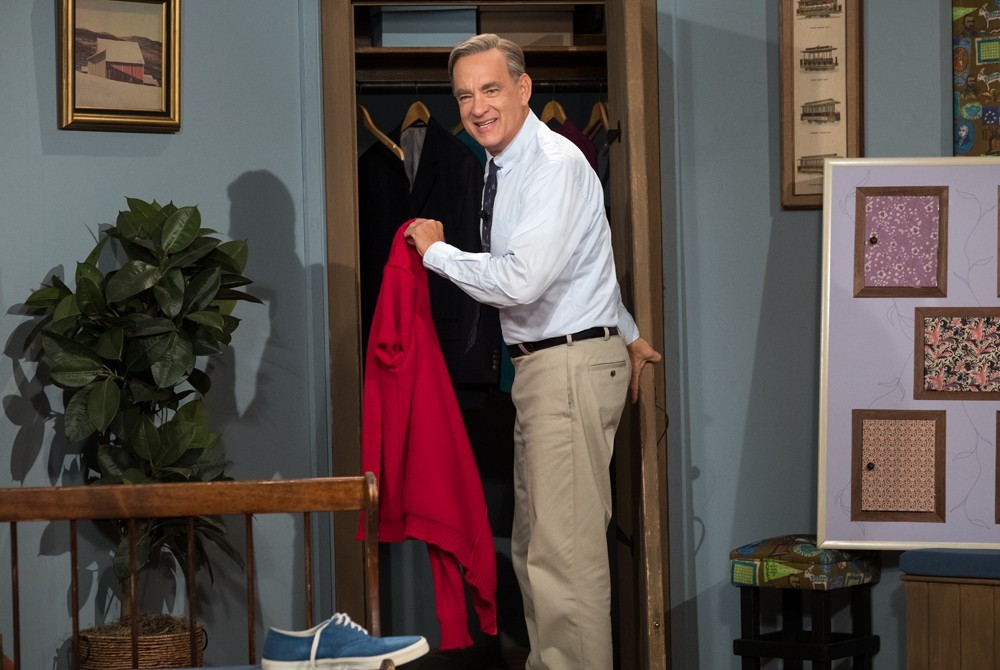
The film starts out preciously, with the standard "Mister Rogers' Neighborhood" open: Rogers walks through the set-door, singing "It's a Beautiful Day in the Neighborhood," his signature song, takes off his sports coat, hangs it carefully, puts on and zips up a sweater, and sits down, taking off his loafers and putting on a pair of boat-shoes. Then presents a picture-board with little doors that reveal members of the cast. Then, he opens a door that reveal a man who looks stunned and a little beat-up: "I want you to meet my new friend, Lloyd Vogle. Somebody has hurt him and not just his face." 
Cut to Lloyd Vogel (Matthew Rhys) in New York—recreated in toy dimensions as if part of Rogers' "Land of Make-Believe"—where he's receiving an award for his writing. Now, you need to know something about Lloyd Vogle. He doesn't exist. The movie is based around a Fred Rogers profile done for Esquire magazine by Tom Junod, who is a fine writer (he wrote the stunning "The Falling Man" article after 9-11) and, if you read that article (which I highly recommend), you'll find a lot of the incidences that A Beautiful Day in the Neighborhood dramatizes. But, a lot of it, certainly the personal stuff about Vogle (as Junod writes in a piece for The Atlanticis entirely the invention of writers Micah Fitzerman-Blue and Noah Harpster, whose screenplay made it to The Black List in 2013 (where it was called "I'm Proud of You"—curiously, also on that year's list was a Rogers biography script entitled "A Beautiful Day in the Neighborhood" by Alexis Jolly).

Now, the film warns us about this with a title that says "Inspired By a True Story" which means it's a couple of steps of separation removed from the usual "Based on a True Story" which, in itself, is no guarantee of veracity. So, there's some futzing going on here, though the general arc of the film is based on the Rogers-Junod story—a cynical reporter finds his "Obi-Wan Kenobi" in Fred Rogers and becomes a better person for it. Close enough for The Movies.
Back to the movie: Lloyd comes home to his gorgeous wife, Andrea (Susan Kelechi Watson) and his new baby boy and is greeted by the news that his father (Chris Cooper) is coming to his sister's wedding. Vogel darkens at the mention of his fathe, so there's history there. His wife asks if this means he's not going to attend? "No, I look forward to Sis' wedding every year..."
Well, it doesn't go well. Not at all. Dad, "Jerry," gets a little drunk, a little egotistical, a little pushy. At the reception, "Jerry" takes Lloyd aside and wants to have "a conversation," which, of course, is the last thing Vogel wants to do. Things are already a little bit antagonistic, and then Jerry's leaving Vogel's mother when she was sick leaving the kids comes up, so do fists. Lloyd socks Dad and a security guard socks Lloyd...but I'm sure the prime rib was delicious. Lloyd can put some on that on the shiner he gets from the incident.
Lloyd goes back to work sporting a black eye that he explains away from a wayward accident playing baseball over the weekend. People politely buy it. That's when he gets assigned the Rogers story by his editor (Christine Lahti), the idea of which Lloyd loathes. But, he does his due diligence, watching hours and hours of "Mr. Rogers' Neighborhood" in preparation for an interview, which after some delay, he gets. Rogers' producer Bill Isler (Enrico Colantoni) doesn't want Fred to do it and has given him some of Vogel's past articles. Despite this, Rogers says yes and quite enthusiastically.
At public television station WQED, he visits the "Neighborhood" studio where Rogers is being visited by an autistic fan-child. The studio crew is getting nervous—Fred is taking too long with the kid and the shooting schedule is tight. The director, crew—everybody—are rolling their collective eyes, but Rogers persists, focusing his attention on the child above all else. Then, he whispers something in the kid's ear, and the kid starts to focus on Rogers and gives him a big bear hug. They leave and Lloyd gets to meet Rogers. His subject is gracious, welcoming, giving him a greeting before starting a scene. When a take is completed and Rogers takes a look at it for his approval, Rogers takes a seat and the interview process begins.
But, it's an interview that Vogle has never experienced before and is, frankly, for him, a little counter-productive. He starts to ask Rogers questions and he answers deferentially, humbly, but then turns it around and starts to ask Vogle questions, asking him what his childhood was like, if he had a "special friend" when he was a kid, and, sure, Vogel had a plush toy that he called "Old Rabbit" and Rogers takes an interest in "Old Rabbit" and asks him about "him" and Vogel is a little freaked out about these questions about a ratty old toy that was tossed long ago, and, hey, he's the one doing the interview here. And Rogers is called away for another segment-taping, but, the conversation will continue soon.
This is where Hanks' interpretation gets a little off-target. Hanks' Rogers listens, but there's an appraising look in his eyes that is less open, more searching, scrutinizing, and there's enough footage of Rogers in interviews and interactions extant that the Hanks seemingly judgmental squint doesn't convey the man he's portraying. It's a small point, but it bugs me. Because I like Mr. Rogers and consider him to be a person that one should aspire to be. But—damn it—get it right, especially in a medium like the movies that could overshadow reality—and especially this movie where the reality is already suspect. "Inspired by...?" Sure. But, not in the way the actual Mr. Rogers inspires.
In the film, Rogers helps Vogel deal with his father when it reaches a crisis point, and, under Rogers' tutelage, there is a resolution and a reckoning and something that feels like closure. Those events in the film didn't happen, but the effect on Vogel is much the same as on Junod, and the two stayed friends and colleagues until Rogers' death in 2003.

And Rogers loved the article, both in the film and in real life.
Where the movie is successful is when it takes something specific that Junod related in the article and just lets it be—Rogers' openness, his taking on of burdens, his one-on-one personableness, his ability to make something good out of tragedy, his inclusiveness and his giving of self.

Where it fails is in the fabrications it imposes in its framework, falling back on inspiring tropes of religious-themed "true stories," those "very special episodes" of TV sit-coms in the 1980's, and of the current crop of dog movies—you know the ones...where a dog presents important life-lessons to his human companions who are struggling through life, when all we care to see is "the dog." And "Mr. Rogers," in this, is "the dog." When I saw the previews for this, that was the impression I was getting. And, unfortunately, the movie bears out those fears.

But, there may be something to that. Rogers represents something that is missing in a cynical age. I worked for a producer ages ago, who was telling me about the wonders the show instilled in her own child, and when she asked him why he was riveted by "Mr. Rogers Neighborhood," the child said simply "He likes me!"

Rogers through the TV-tube was never afraid to look a kid in the eye and tell them they had value, no matter what circumstances they lived in, what afflictions they had, what difficulties they faced in their lives. He did not present barriers to children, only possibilities. He was, and in re-runs is, an adult who could relate to kids, an authority figure who did not flaunt that authority but shared it and gave that singular kid he was looking at through the cathode-ray tube something that they also ascribe to dogs—unconditional love.

The "real" (and very nervous) Fred Rogers charms $20 million from the clenched fists of Sen. John Pastore.


* Those would be "Mr. Rogers and Me" and "PBS Presents: It's You I Like" (hosted by one of Fred Rogers' former employees, Michael Douglas, who would change his name professionally to Michael Keaton

Wednesday, August 8, 2018

The Company Men

The Economy and how it grinds up people has been on my mind of late. Here are some movies I've written about in that subject matter. 

Written at the time of the film's release.

"The Worst They Can Do..."
or
"Looking Out for No. 1"

John Wells cut his teeth on "China Beach," "ER," and "The West Wing" (his company produced, and had the unenviable task of following Aaron Sorkin and Thomas Schlamme as its shepherds), and excelled at the TV requirements of the easy irony and the clean, unfussy shot. He brings that same sensibility to The Company Men, which at least has the stones to risk box-office disaster addressing the financial meltdown.

While banks are failing and institutions too big to fail do so, Boston's GTX corporation is warding off a possible hostile take-over by fluffing their stock; the most expedient way to do that in an uncertain economy is cut overhead and "redundancies," meaning shoes on the floor. Wall Street looooves a good blood-letting. Bobby Walker (Ben Affleck), a cocky well-to-do sales associate is one of the first to go, getting the pink slip and the complimentary empty boxes on the desk. He's mad. He's angry. He's bitter
Life changes. The wife goes back to work (after he insists that she doesn't). The kids worry (though the parents attempt to keep it a secret). The long process of looking for a job is a full-time life-sucking process, while as time drags on, the cockiness fades, the budget tightens, the possessions fade away and the lying starts. Pride goeth before the fall. But, first go the Porsch', the house, the country-club membership, the perks, then goes to the bone—the self-respect...the self-worth. The things you say you'd never do, you do.
GTX rolls on and over. The CEO (Craig T. Nelson) continues to prop up the corporation in grand strokes of hubris. His ship-building division head, Gene McClary (Tommy Lee Jones) tries to protect his assets, like division chief Phil Woodward (Chris Cooper) and head of HR Sally Wilcox (Maria Bello)—who just happens to be his mistress—but those efforts make him look disloyal to his his boss and friend Nelson. It is telegraphed early on that they're at risk, too, and Wells doesn't surprise by following the most likely story path.
Bobby soon ends up working for his wife's brother (Kevin Costner) in construction, just to make what ends he has left meet, but it's too little too late, and he gets lectured on "how things are:" "GTX's President makes 700 times what the average guy on the floor makes; you think he works 700 times as hard?" brother-in-law asks at Thanksgiving dinner. Pass the cranberries, bro.'  Pretty soon the entire film feels like a lecture on the twin (somewhat negating) virtues of self-reliance and helping others, with the inevitable triumphs and tragedies that the script calls for before the final commercial break—even though this is a theatrical presentation and the commercials come at the beginning. 
It's all Wells and good. The writer-director is helped immeasurably by Coen Brothers lenser Roger Deakins, and he's got a great cast doing varying degrees of cagey work—Costner, in particular, plays his part completely, without sentiment, which is unusual for him and it's refreshing. But, its all a little too little too late. As a summing up of the human consequences of down-sizing, it's a noble effort, but its audience—if they can afford to go—already knows all this and may end up feeling like they've been watching a parrot tell them their lives for two hours (Thanks, John, appreciate the sermon—you don't need a sound designer, do you?).* 
One wishes that someone would mention that these economic bubbles aren't restricted to this one time, but to the cycles that come from risky, if not downright criminal, actions that take place every twenty years. That an increasing life in the fast lane runs the risk of losing control of the vehicle. That, even if one takes the safe, conservative approach, you can still lose everything if the timing isn't fortuitous. That life is a crap-shoot, at times, and the guy who does the best may be that crazy guy who doesn't contribute to the economy, but stuffs his mattress with cash.**
But, that's never said. Maybe it will be in the sequel, The Company Men 2: That Ship has Sailed, which will basically be the same thing twenty years later, when the next crash occurs. And when one says that, one realizes that the real message of Oliver Stone's Wall Street: Money Never Sleeps is that a sequel needed to be made at all.

* I watched your movie; and you did.

** I won't even mention that the messenger for all this comes from a tinsel-towned industry known for its waste and excess.  Kudos that everybody on your film got a wage, but at what proportion to the stars and the execs—as long as we're making comparisons? How's that for irony? Heal thyself, Preacher.