Written at the time of the film's release.
This is the last film directed by Australian director Peter Weir. On March 17, 2024 saying that he had "no more energy," Weir announced he was retiring from directing and that "for film directors, like volcanoes, there are three major stages: active, dormant and extinct. I think I've reached the latter! Another generation is out there calling "action" and "cut" and good luck to them."

"Strangers in a Strange Land"
or
"Every Journey Begins with the First Steppe"
A new Peter Weir film is something of an event. The Aussie director of Picnic at Hanging Rock, The Year of Living Dangerously, Gallipoli, The Truman Show, Witness, and Master and Commander makes meticulous, thoughtful films of ambiguity and great beauty, throwing civilized men and women into clashes of culture (frequently more primitive) exploring the impact, with an eye towards the rough, otherworldly beauty of this world. Along the way, you learn a lot even if the movie does not draw to a dramatic or philosophical conclusion.
So, with little fanfare, here is The Way Back, Weir's latest film, one that has been optioned many times since its source book, Slavomir Rawicz's "The Long Walk: The True Story of a Trek to Freedom," was published in 1956. The veracity of the tale has been questioned a lot in that time, but the evidence is clear: four emaciated men walked into an Indian village, saying that they had walked from a Communist gulag in Siberia across the Gobi Desert and the Himalayas to freedom, a journey on-foot of 4,000 miles.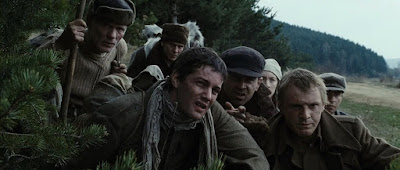 One could speculate—for the length of such a journey—why it had never come to the screen before: too depressing—but think what it would do for soda and popcorn sales! Elvis wasn't interested, indeed, what star would take on such a rugged movie, Burt Lancaster's brief interest notwithstanding; the movie has a lot of explaining to do about socio-political situations; the Russian market might not be too pleased with the film, and on and on. Weir made it (reportedly for less than $30 million, which seems incredible), but so few studios were interested in it that it almost went straight to video...which would have been a shame, as this is one of those movies demanding to be seen on a big screen.
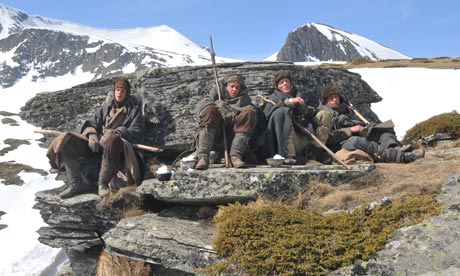
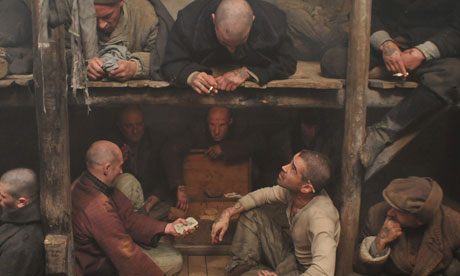
 Janusz (Jim Sturgess) begins the film under interrogation in occupied Poland. The year is 1940. He has been turned in (reluctantly) by his wife under torture, and he is sent to a Soviet gulag in the mountainous regions of Siberia. After a period of learning the ropes (and the whips of the guards and the barbed wire of the camp), he becomes a part of a loose group of prisoners of differing skills and supplies to make a fast surgical escape from the gulag and make their way to Mongolia. Based on a loose plan of prisoner Khabarov (Mark Strong), they plan to make it to Lake Baikal, following it to the Sino-Russian railway. Their supplies will run out in mere days, but Janusz is convinced they can live off the land, walking the entire way. Among the group of escaping stragglers are "Mr. Smith" (Ed Harris)—"First name: Mister"—a particularly mysterious American (he tells Janusz, "you have a weakness I can use: kindness"), and, as it seems all movie escape attempts must have, a plays-by-his-own-rules maybe-criminal named Valka (Colin Farrell). The group begins suspicious of each other, but soon forms a close-knit, surprisingly democratic structure, sharing ideas and resources, voting when they're at a crossroads—despite the occasional individual insurrection.
 Watching the movie is a slog. At 2 hours, 20 minutes, with the principal characters pushed to their endurance, the film feels longer than its running time, but one is never tempted to do a watch-check. The Way Back is one of those films that keeps you guessing, intrigued and involved every minute, like you were involved in the long walk, craning to see what is around every corner. Weir keeps the pace moving quickly, cutting scenes briskly from one episode to the next, so the film develops a natural rhythm.
 But, it's the director's eye for detail—as always—that is striking, with scenes of stark, natural beauty that astonish: taking refuge in ancient caves, the camera pans up, following a bedraggled Mr. Smith's gaze, to two large holes in the ceiling, like the angry eyes of God; walking up a scrabble hill, Weir directs our view up and over the weary travelers to a screen-stretching shot of the expansive Gobi desert; at one point, they find a single solitary structure—a gate with no walls—absurdly marking their goal, while announcing another set-back.
 It is a grueling adventure story with fine performances all around, interpreted through Weir's talent for keeping things real, even when they turn startlingly surreal. Go prepared for a tough movie, but a satisfying one, that, like all escapes, becomes a journey of the individual will and spirit, covering all manner of obstacles in physical space, mental discipline, and the longest journey...of time.


wearegoinupagainst.jpg)