Where do you go when the music stops? Switzerland, evidently. Composer Fred Ballinger (Michael Caine) is at a luxurious swiss spa with some other artists dealing with crises in their careers: film-maker Mick Boyle (Harvey Keitel) is working on his "testament" film—the one that will last as a classic—with a scruffy team of writers, actor Jimmy Tree (Paul Dano) who is chilling out and contemplating the route to his next role (he's worried because all people-on-the-street know him as is a favorite sci-fi character). Also, there are a famous sports figure, Diego Maradona (Roly Sorrano), the current Miss Universe (Mãdãlina Ghenea), and a parade of habitué's who are taking "the cleanse." Also, there's Fred's daughter Lena (Rachel Weisz), who is also his assistant, and who has issues with Dad about the "every-day" of being his employee and the lifetime of being his daughter.
Fred, see, is stuck. He hasn't written a thing in years, and has no real desire to. He's "retired." Retired, but remembered. He has been asked (by the Queen's stuffy emissary) to conduct one of his pieces, "Simple Song #3," at Prince Phillip's birthday concert. There's even a knighthood for him thrown into the deal. He refuses for reasons he won't reveal, other than "he doesn't perform anymore." Nor does he compose. If anything, he's "decomposing."
This is the problem. Fred won't "reveal" anything. It's why he's a composer. Music doesn't require words—it simply "is," reflecting feelings more akin to the real emotions than just mere words can express. Not that Fred can't express himself—he does and frequently, but just not about his own feelings. That's where the music is, and he's not writing it down on paper and he's not having it performed. But, the music is still there. In his head. Where it will remain. He'll broach no argument about it. And that is the way he conducts himself.
Such an interior existence is, of course, not unsocial, just selective. Mick has been his friend for years and the two can talk about anything or anyone, and they have shared boundaries that they do not cross to make the exchanges easier to navigate smoothly. They understand each other, which is a goal of Lena's, which she's having trouble negotiating. She doesn't understand anything these days, as he husband has just left her for some pop-star—"the most obscene job in the world"— (Paloma Faith) who makes music-videos. Was it her? Is it him? It can't be...the other her—so shallow!
Fred has very specific reasons why he's retired, all deeply personal and not to be revealed, until later in the film. But, Fred has the luxury of choice. Everybody else at the spa...at least, the prominent ones, the celebrated ones...are equally stymied and stuck in place. Mick has a concept, a grand scheme for his next film, but is dependent on a gaggle of screenwriters (Sorrentino doesn't even give them names, just attributes, Disney dwarves!) out of whom he tries to coach some profundity and there's also his on-screen muse (Jane Fonda) that he must coax into appearing in it. He is entirely engaged in the process, even if he might not know what movie he's making.
Maradona is retired from soccer, but he's dealing with the cost of his fame and the lifestyle it has afforded him. He is very overweight, unhealthily so, and has grown accustomed to being indulgent and indulged.
Miss Universe is spectacularly unapproachable, but worldly enough that she can cut down approaching suitors with a withering honesty.
And Jimmy? He's stuck in his own typecasting, looking to prove himself capable of more sophisticated roles and indulges in eccentric behaviors to express his depth. He wants to be perceived as deeper than his previous roles, which he thinks are shallow and puerile—he'll find out that those roles touched lives and have his crisis solved. Contrast that actor with Fonda's aging diva, who's far more practical—her choice is whether to take a role in Mick's magnum opus or to take on a television role for a fat paycheck.
I was a big fan of Sorrentino's La Grande Bellezza—which had its own issues of aimlessness—but, one couldn't argue with the beauty of the images. I sought out seeing Youth in a theater in 2015, but struggled with my opinion of it—I hadn't written a review of it because I, frankly, didn't understand it and if I can't bring anything of value to any discussion of the film, best to say nothing at all. When when is stuck—as so many of the people in the film are—one can either blame themselves or the movie. And I'm reluctant to say that Sorrentino didn't have a solid concept to base his film around.
But, I think that's the case. In looking at the theme of age, self-worth, and self-perception, I think he found it wasn't enough to just concentrate on an inarticulate composer (I kept think of Ballinger as a stand-in for Jerry Goldsmith—a brilliant composer, but a terrible communicator about his "process," constantly saying "I just hear it in my head!"), and so took an Altman-esque approach, making a collection of short stories on the theme, rather than one over-all novel.
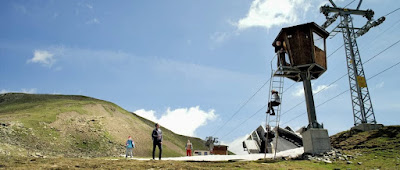
Mick lines up a shot for his proposed movie;
The movie he sees in his head, scattered individuals unrelated in a landscape.
As such, Sorrentino could have used the Mick-director character as a stand-in, looking for a story to fit the images he sees, rather they're related to each other or not. As such, I'm all for that. People are not monolithic—as much as the media, pollsters, statisticians, and business metrics want to pigeon-hole us. We all react to a given situation differently, we all have our ways of coping—some good, some bad, some effective, some utterly worthless. We learn that way. We grow, hopefully, even as we grow older and hopefully wiser.
Ultimately, the film feels very random. Much like life. Much like youth.
But, those images, though. Sorrentino has a particular "eye"—which I think is part of my point. I'm glad I saw Youth, as fleeting as it ultimately was.
“A child is born into a world of phenomena all equal in their power to enslave. It sniffs - it sucks - it strokes its eyes over the whole uncomfortable range. Suddenly one strikes. Why? Moments snap together like magnets, forging a chain of shackles.”
“Look...to go through life and call it yours - your life - you first have to get your own pain. Pain that's unique to you."
Peter Shaffer "Equus"
There is a sequence in Steven Spielberg's The Fabelmans that I found absolutely hilarious, but mine was the only laughter in the theater.
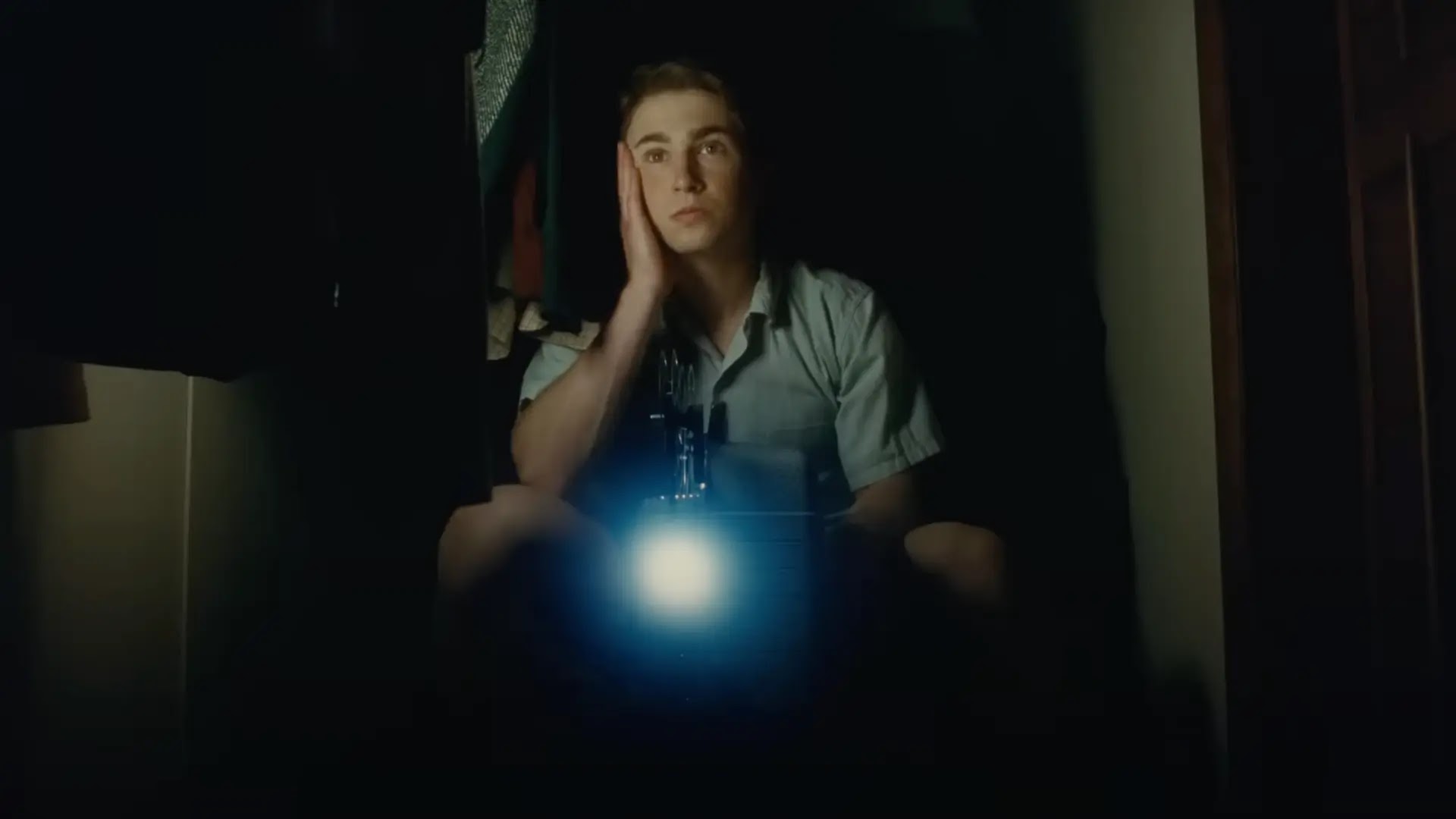
The set-up is that young Sammy Fabelman (at this point played by Mateo Zoryan) is being taken by his parents, Burt (Paul Dano) and Mitzi (Michelle Williams) to his first movie, The Greatest Show on Earth. Sammy is worried. It will be DARK and he's scared of the dark. Father explains the technical aspects of film running as still images that take advantage of the limitations of the eye's retention—the persistence of vision—to simulate a moving image, while Mom takes the romantic view: "Movies are dreams that you never forget." Already the family lines are drawn out between the adults: one is technical, one is artistic.
But, a child wouldn't know that. Driving home, Mitzi asks Sammy "What was your favorite part?" he can't answer...he doesn't answer, still gob-smacked by that approaching train and the disaster that he witnessed before his eyes. At Hannukah, Sammy gets trains as a present—Dad explains the scale and the connections and what makes it go. But, Sammy wants to watch them table-top height to re-create that scene from the movie and sets up elaborate things for it to crash into, inevitably breaking the engine and incurring Dad's disapproval. Break things? You're supposed to FIX things!
But, Mom gets it. Sammy's trying to recreate the scene to make it less scary—he wants to understand it, control it, master it. She gets some film for Dad's movie camera so Sammy can film the train again and again, so he won't be constantly breaking trains. And he shows Mom the movie he made of the train from various angles, various ways to make a model train scary.
But, before the part where Sammy shows his little movie to his thrilled audience, there's a sequence where adult director Steven Spielberg makes an honest-to-god recreation of that "Greatest Show on Earth" crash using miniature trains, toy cars and unsuspecting Hannukah decorations using the same angles DeMille did. And it's amazing. Also funny as Hell. To think Spielberg—at 75 years old—was determined to get that sequence he was trying to make at 6 years old look as good as possible. It's hilarious. It's fun. It's poignant. It's a little brilliant in its meta-sense.
The Fabelmans is Spielberg's telling (with a canny co-script by Tony Kushner*) of the story of his childhood, the birth of his love of making movies and the death of his parents' marriage. It's a story that spans two moves—from New Jersey to Arizona and Arizona to Los Angeles—and ten years and god knows how many hours with an eye to a viewfinder, hours squinting at film through a magnifying glass and cutting and splicing it together with glue as well as graduating from 8mm home movies to 16mm presentations. Oh. He also attended school, got bullied for being Jewish, and getting his first crush...on a shiksa.
Self-indulgent? Sure. But, then you're ignoring Hemingway's maxim "write what you know." Every film-maker (or author) taps into the well of their past** If you dismiss Spielberg doing it, you dismiss Richard Linklater or Francois Truffaut. You can't sneer at The Fabelmans and extoll Cinema Paradiso. Hell, Fellini made a career out of it. Howard Hawks used metaphorical occupations to tell stories about making movies. So, self-indulgent? Sure, join the club!
But, it's a fascinating exercise and an entertaining one, too, because it is Spielberg looking at himself through the rear-view-finder, looking through the aperture and seeing himself, fixing the story where it needs to be finessed or goosed (as he always does) and looking for the tell-tale detail that resonates. Only this time, it's personal, and it's fascinating to look at Spielberg's life as he observed it (or sees it now) and into his mind, as well.
For instance, there is a clear case of imposter syndrome where Sammy Fabelman is the family chronicler, filming everything as observer, story-teller, but ultimately outsider. The revelation comes out in a sequence that could be a horror movie. At a "family conference" it is announced by Mitzi and Burt that they are splitting up—he's going to remain in L.A. for his job and Mitzi is going back to Arizona for her sanity. It is a scene of tears and tearing apart. Spielberg
cuts to a shot of Sammy watching from the stairwell while the whole
traumatic scene unfolds. Cut to a closer shot of Sammy with a look of
horror in his eyes—is it suddenly dawning on him that his family is
splintering apart? Is he reacting to his sisters' emotional trauma? No.
He is reacting to the next shot Spielberg presents: Sammy sees himself (in a
fantasy sequence, inserting himself into the scene) figuring out how to
frame the scene with his camera.
That is a frightening scene. It shows that even in the most intimate, personal, affecting scene, he is outside, objectively looking for the angles, almost dispassionately when passions are running high. What has this "hobby," this obsession done to him that he can even see himself doing that, even if it is instinctually? It's a gift and a curse. As Sammy's Uncle Boris (a florid Judd Hirsch) informs him "Art. Family. It will tear you apart!"
The movie is full of small truths, revelations large and small, that inform the color of a life. I could go on and on about details, themes, structures, performance details that inform this movie (and have influenced Spielberg's entire body of work) but that would just be robbing you of a personal experience of discovery, the individual way of connecting dots and frames. In a way, all movie-makers are communicating personally, whether they are telling their own story or somebody else's.
There is another sequence in the L.A. apartment Sammy is sharing with his father. It's very simple; disarmingly simple. Sammy comes home. Burt, soon after. Sammy is tired, frustrated, isn't getting anywhere in L.A. looking for work. The mail's on the table and there's a letter from Mitzi in Arizona, with pictures, snapshots. Does Burt want to see them? Sure.
There's then the standard Hitchcock sequence of three shots. Burt looks at the pictures. Sammy looks at Burt looking. Back to Burt, as Sammy seems him. But, the two shots of the father are not the same, obviously so, even though from the same vantage point, more or less. The first shot includes Burt looking at the pictures. Cut to Sammy looking. The next shot of Burt does not include the pictures—the camera has moved up and the ceiling of the apartment is weighing down on him. That is the shot of Sammy seeing his father's reaction to the snapshot of his absent wife—the sadness, the contemplation, the emptiness. It is SO simple, but it is importantly different, delivering a visual gut-punch you can feel and that is communicated, even if you don't recognize the shift. That is communication in its rawest, visual way, the way that make movies unique in how they tell stories. And Spielberg finds the best way, subtle and overt, to convey that to the audience (whether they recognize it as such or not).
This is why I love Spielberg movies. This is why I love movies.
The movie may not be the story of Spielberg's past, so much as it's the story of his DNA.
** Some film-makers go back to recapture their youth. Supposedly, Orson Welles made The Magnificent Ambersons because it reminded him so much of his early childhood. Fellini made Amarcord. Francois Truffaut made The 400 Blows. George Lucas made American Graffiti. Francis Coppola drew on his family life on quite a few of his films. One always gets the impression from Wes Anderson's films that he's tapping into his early years. Robert Benton made Places in the Heart. Mel Brooks produced My Favorite Year. Noah Baumbach made The Squid and the Whale. The trend seems to be gathering momentum. Alfonso Cuaron made Roma. Lee Isaac Chung made Minari. Last year, Kenneth Branagh made Belfast. Paul Thomas Anderson made Licorice Pizza.
That's how Matt Reeves' The Batmanfelt to me after I'd survived it. Just as suddenly as something is resolved, you think there's some breathing room, and then you think "Geez! They haven't even figured out the serial killer yet!" And then that starts and you think THAT's finished, and you go "Wait a minute, that seemed kind of easy", and that's when the guano really hits the fan, and things get even more complicated, and you start looking for something to tell you what time it is, because you really think that the thing is never going to end, and then, they distract you and you think "Oh no, they're going to bring him in?"
It's at that point you realize that it's no fun being the Batman—because the job just never stops. You wonder if you even want to admire the Batman or pity him, but you sure don't want to be him.
And maybe...you don't want to watch him.
"So, is it even worth going?" Hell, yeah. Because The Batman is more like the Batman from the comics (depending on the period of origin—in this case, the 1930's and 70's) than he's ever been. Stripped down and deconstructed, this version escapes the taint that has hung on the character ever since the TV-series from the 1960's. There's no "camp". There's no crazy costumes...well, except for the Bat-suit (which is armored to the point that it's bullet-proof and probably tough to maneuver in—he even thuds when he walks)...and there's no goofy archness or hysterical theatricality, which still remained even in the Christopher Nolan-directed trilogy. Not even an artfully-choreographed fight; they're all thumping and brutal.
It's perfectly serious. And does things the "Batman" series has never done before. For instance, this is the first Batman movie since the series started (with Tim Burton back in 1980), where Batman doesn't kill anybody—oh, he messes people up really bad, but they don't die unless it's due to their own actions—and that was a "code" that an orphan who lost his parents to gun-violence strictly adhered to. And the "Batman" in the movies has always stood for vengeance, and here, the character arc has him realize how limiting that is—when he sees the main villain of the piece committing heinous acts to avenge his own circumstances. His self-imposed mission changes during the course of the movie; the film pointedly ends with Batman looking forward and not back.
Now to say I "survived" it takes an explanation. The Batman is just shy of three hours long. And it feels like it*—Reeves can make fascinating movies, but he's not an editorial trickster (like Nolan) so things happen at a steady, remorseless pace (Reeves uses Nirvana's "Something in the Way" as background, and that's the beat that he uses for the film). It's a long run-time, and the story covers a lot of ground, dealing with corruption, organized crime, and striking out against sins of the past. It's less a "super-hero" film than a police procedural along the lines of contemporary British mysteries or "Law and Order"—this Batman even walks through crime-scenes with the police (despite "official" disapproval of vigilantes by the Gotham City Police Department), making observations, providing lines of investigation. It's an intricate maze of clues and evidence that increases the run-time. What would I take out? Not a jot. Certainly not with the Warner studio's recent insistence of cutting things down to near-incomprehensibility.
Because it's a good story that has the construction of the best of the (Batman co-creator) Bill Finger-penned Batman stories: murder victims of a prominent vintage, all seemingly unrelated but leading inexorably to a far greater threat (it's nice that the clues are multi-layered without the usual *snap* "I've got it! He's going to rob the Obvious Clue Savings and Loan!"). And we've become so used to comic-book threats—penguins with rocket launchers, "fear-gas," 'memory-sucking devices" and ice-guns—that it's a little disconcerting—even creep-inducing—that the various plots all nudge at real-world headlines: "Zodiac" messages, "collar-bomb" extortion, mailed death-packages, internet zombies, even Hurricane Katrina.
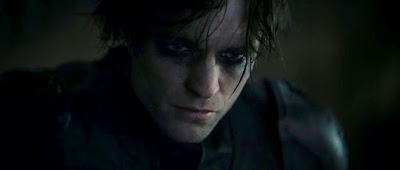
Ah, but you don't want to know all that. You want to know how the Patt-Bat is! He's darned good if you want to discard the whole "Zorro"/"Scarlet Pimpernel" vibe that inspired the character. Pattinson's Bruce Wayne is a brooding recluse holed up in Wayne Tower in the middle of Gotham City, and he'd probably be a prime suspect in the "Riddler" case if the police just looked at the power being used by the dingy bat-filled basement of the building (nah, they wouldn't—he has too much money). His Bruce is so emo, he almost wears a bat on his sleeve—so much for secret identities. But, his Batman is slow, hulking and fills a room, the eyes constantly moving and the perfect jaw-line not at all. It would almost be a mime act if he didn't have Jeffrey Wright doing heavy-lifting (and expositing) as Lieutenant James Gordon ("You could have pulled the punch..." "I did"). Wright makes a character important no matter how much he's pushed to the background, but here, he's the other half of a buddy act. By contrast, Andy Serkis' Alfred is the character who's given short shrift.
But, it's the villains that everybody pays attention to in Batman movies and there's a lot of them: It's a great cast and everybody does very good work.
Zoë Kravitz is a fine addition to the ever-growing litter of cat-women, with the appropriate fanged snark and a duplicitous sensuality that one expects of the character by this time. Her scenes with Pattinson fall a bit flat unless they're quarrelling, because he doesn't give out that much as far as any sort of response. That's on him; not her.
Paul Dano leans in to his cherubic looks to create an intensely creepy Riddler—he has several aliases—internalizing the schitzy nature of the character with the same intensity with which Heath Ledger externalized his Joker in The Dark Knight. Ledger is a tough act to follow, but Dano isn't as theatrical and does more with little expressions than anything playing to the loges.
Speaking of which, if Dano leans in, Colin Farrell leads out with his take on "The Penguin" ("Call me 'Oz'") as a voluble Chicagoan gangster with none of the panache or freakishness in past portrayals, but bearing a family resemblance to Rod Steiger's Al Capone. He is wholly unrecognizable, physically or in performance, and it's not just the elaborate prosthetics he's forced to wear to pull off the job, the acting is larger than it can contain, making a huge impact in a role that's a supporting character to John Turturro's Carmine Falcone, the Gotham boss who's pulling all the strings only to find his organized crime operation being undone by a lone outlier. Also Peter Sarsgaard should be given a hand-clap for his portrayal of a weak Gotham D.A. caught up in the carnage.
Is it the best Batman movie? I think it's too soon to tell. I didn't come away from it thrilled with it as a whole (as with others), but was delighted at its parts (and little touches like the bust of Shakespeare in Wayne Tower, the very apt use of DOS graphics, the song that plays when Bruce Wayne visits Mob-boss Falcone).
There is no doubt that this is the best interpretation of the character if you want to do it as a straight-ahead portrayal, ignoring the many iterations that have made up its history, the bad and the good. Someone had to do it—to put the detective back in The Darknight Detective. And Reeves, who has proved time and again that he can make something special and unique out of retread material, has managed to make something original with Batman.
* It isn't helping that the theaters front-load this particular attraction with more than the usual number of commercials (even inserted between previews—which, let's be honest—are commercials, too). The whole presentation is like 4 hours long. One can see why the theater-chains are doing this—a 3 hour movie limits the number of times it can be screened, even though they've Bat-jammed as many showings in as many plex's as they can manage. And those commercials pay the chains. But, it is testing the endurance of an audience not expecting an epic Lawrence of Arabia roadshow.