Showing posts with label Rachel Weisz. Show all posts

Saturday, February 18, 2023

Youth (2015)

Play On
or
"Hum a Few Bars and I'll Fake It"

Where do you go when the music stops?

Switzerland, evidently. Composer Fred Ballinger (Michael Caine) is at a luxurious swiss spa with some other artists dealing with crises in their careers: film-maker Mick Boyle (Harvey Keitel) is working on his "testament" film—the one that will last as a classic—with a scruffy team of writers, actor Jimmy Tree (Paul Dano) who is chilling out and contemplating the route to his next role (he's worried because all people-on-the-street know him as is a favorite sci-fi character). Also, there are a famous sports figure, Diego Maradona (Roly Sorrano), the current Miss Universe (
Mãdãlina Ghenea), and a parade of habitué's who are taking "the cleanse." Also, there's Fred's daughter Lena (Rachel Weisz), who is also his assistant, and who has issues with Dad about the "every-day" of being his employee and the lifetime of being his daughter.
Fred, see, is stuck. He hasn't written a thing in years, and has no real desire to. He's "retired." Retired, but remembered. He has been asked (by the Queen's stuffy emissary) to conduct one of his pieces, "Simple Song #3," at Prince Phillip's birthday concert. There's even a knighthood for him thrown into the deal. He refuses for reasons he won't reveal, other than "he doesn't perform anymore." Nor does he compose. If anything, he's "decomposing."

This is the problem. Fred won't "reveal" anything. It's why he's a composer. Music doesn't require words—it simply "is," reflecting feelings more akin to the real emotions than just mere words can express. Not that Fred can't express himself—he does and frequently, but just not about his own feelings. That's where the music is, and he's not writing it down on paper and he's not having it performed. But, the music is still there. In his head. Where it will remain. He'll broach no argument about it. And that is the way he conducts himself.
Such an interior existence is, of course, not unsocial, just selective. Mick has been his friend for years and the two can talk about anything or anyone, and they have shared boundaries that they do not cross to make the exchanges easier to navigate smoothly. They understand each other, which is a goal of Lena's, which she's having trouble negotiating. She doesn't understand anything these days, as he husband has just left her for some pop-star—"the most obscene job in the world"— (Paloma Faith) who makes music-videos. Was it her? Is it him? It can't be...the other her—so shallow!
Fred has very specific reasons why he's retired, all deeply personal and not to be revealed,  until later in the film. But, Fred has the luxury of choice. Everybody else at the spa...at least, the prominent ones, the celebrated ones...are equally stymied and stuck in place. Mick has a concept, a grand scheme for his next film, but is dependent on a gaggle of screenwriters (Sorrentino doesn't even give them names, just attributes, Disney dwarves!) out of whom he tries to coach some profundity and there's also his on-screen muse (Jane Fonda) that he must coax into appearing in it. He is entirely engaged in the process, even if he might not know what movie he's making.
Maradona is retired from soccer, but he's dealing with the cost of his fame and the lifestyle it has afforded him. He is very overweight, unhealthily so, and has grown accustomed to being indulgent and indulged.
Miss Universe is spectacularly unapproachable, but worldly enough that she can cut down approaching suitors with a withering honesty.
And Jimmy? He's stuck in his own typecasting, looking to prove himself capable of more sophisticated roles and indulges in eccentric behaviors to express his depth. He wants to be perceived as deeper than his previous roles, which he thinks are shallow and puerile—he'll find out that those roles touched lives and have his crisis solved. Contrast that actor with Fonda's aging diva, who's far more practical—her choice is whether to take a role in Mick's magnum opus or to take on a television role for a fat paycheck.
I was a big fan of Sorrentino's La Grande Bellezza—which had its own issues of aimlessness—but, one couldn't argue with the beauty of the images. I sought out seeing Youth in a theater in 2015, but struggled with my opinion of it—I hadn't written a review of it because I, frankly, didn't understand it and if I can't bring anything of value to any discussion of the film, best to say nothing at all. When when is stuck—as so many of the people in the film are—one can either blame themselves or the movie. And I'm reluctant to say that Sorrentino didn't have a solid concept to base his film around.
 
But, I think that's the case. In looking at the theme of age, self-worth, and self-perception, I think he found it wasn't enough to just concentrate on an inarticulate composer (I kept think of Ballinger as a stand-in for Jerry Goldsmith—a brilliant composer, but a terrible communicator about his "process," constantly saying "I just hear it in my head!"), and so took an Altman-esque approach, making a collection of short stories on the theme, rather than one over-all novel.
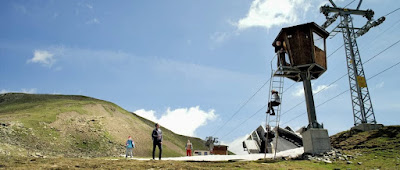
Mick lines up a shot for his proposed movie;
The movie he sees in his head, scattered individuals unrelated in a landscape.
As such, Sorrentino could have used the Mick-director character as a stand-in, looking for a story to fit the images he sees, rather they're related to each other or not. As such, I'm all for that. People are not monolithic—as much as the media, pollsters, statisticians, and business metrics want to pigeon-hole us. We all react to a given situation differently, we all have our ways of coping—some good, some bad, some effective, some utterly worthless. We learn that way. We grow, hopefully, even as we grow older and hopefully wiser.
 
Ultimately, the film feels very random. Much like life. Much like youth.
 
But, those images, though. Sorrentino has a particular "eye"—which I think is part of my point. I'm glad I saw Youth, as fleeting as it ultimately was.

Saturday, July 17, 2021

Black Widow (2021)

Giving the Widow Her Due
or
Lord Help the Min'ster Who Comes Between Me and My Sister.

The Marvel character, Black Widow (played eight previous times by Scarlett Johansson) has appeared in almost as many Marvel movies as Robert Downey Jr.'s Iron Man (and Samuel L. Jackson's Nicky Fury)...but, without a feature of her own. Sure, Marvel can crow about being progressive on roles for women after Captain Marvel, but, look at the facts: BW has appeared in an Iron Man movie, two Captain America films, an unbilled cameo in Captain Marvel, all four Avengers movies...and was the sacrificial lamb in the last one. Er, except that more attention was paid to the death of Tony Stark, and the Big Funeral at the end—with "everybody" in it—was for Stark. Just Stark.

At the end of Avengers: Endgame, Black Widow's sacrifice was merely an after-thought...maybe something was said at the reception (oh, except everybody was more concerned with who'd be the next Captain America...). Bowed heads was all she got. And then "Phase 3" ended.

Almost as an afterthought, Marvel Studios has given the character her own movie...now that she's safely dead and all—they'd been talking about it since 2004—and, like most initial Marvel films in a franchise, it's a good one (Marvel's second movies tend to be inferior bloats—the exceptions being the Captain America franchise—where all three films were good, and "Thor" where there wasn't a good film until the wildly irreverent third one).
Black Widow in Iron Man 2
But, Black Widow is on a par with the good introductory Marvel films, seeming fresh and giving much more back-story than had been given Natasha Romanoff in her previous appearances. In the MARVEL series, Nat was the glue that held people and missions together—if Nat was on your side, you were alright. Yet, her abilities, which were not super-powered, managed to put in her in the fray of most of the fights with the "Big Guns." Plus, she knew how to manipulate—calming down The Hulk, tricking Loki—she does something similar here ("Thanks for your cooperation" she says again here)—siding with Captain America while ostensibly trying to arrest him. She was a team-player while being her own person. And there was no questioning it that, after "The Blip," she would be the acting leader (as if they had one before...) of What Was Left Of The Avengers. Nat was the good soldier who didn't whine about things—she'd sit at conference tables with furrowed brow listening and thinking, while "The Boys" mansplained and postured. Not Nat, though. Just got 'er done, dude.
So, her self-titled movie is a good run—Johansson even got to Executive Produce *ka-ching!*—and it's a fast moving kind of "James Bond movie"—with several of the tropes on display, one former Bond "girl" in the cast and the plot of one of them taken whole-cloth (and combined with elements of the Mission Impossible franchise and In Like Flint)—but amped up to 11...It's a Bond movie for those who think a typical Bond movie is You Only Live Twice or Moonraker...with the stunts and situations moving beyond the outlandish to the preposterous. I was chortling in the theater watching Russian soldiers firing automatic weapons in free-fall. Tough to get volunteers with that kind of work.

Which is rather the point of the movie.

But, I digress. The movie, however, regresses.
We start out in Ohio, where two undercover Russian agents, Melina and Alexei (Rachel Weisz and David Harbour) live as "tyeepical" Americans (as long as the don't use the words "moose and squirrel") with their daughters Natasha and Yelena, when one night they make their escape to Cuba from agents of S.H.I.E.L.D. and report back to their contact Dreykov (Ray Winstone). Melina has been wounded in the escape and Alexei, part of the USSR's "super-soldier" program as "the Red Guardian" reassures the kids that "Uncle" Dreykov will take care of them, but he doesn't tell them it's by imprisoning them in the "Red Door" facility and training them to become killers in the Black Widow program.
Cut to a Main Title sequence which fast-forwards through their training and some history—set inexplicably to "Smells Like Teen Spirit!"—to the film's proper timeline, nestling between Captain America: Civil War—because Hawkeye, Falcon and Ant-Man are in prison and William Hurt's "Thunderbolt" Ross is on the hunt for Nat—and Avengers: Infinity War where things get hairy. Nat has gone to ground, and her mail has piled up while in hiding—one of the packages contains glowing red vials and puts her in the cross-hairs of a villain called "Taskmaster" who can duplicate an opponent's moves merely by watching them.
Hey! Taskmaster's watching that first gif on this page!

It turns out the mail came from step-sister Yelena Bovel (Florence Pugh, who is spot-on perfect—and she better be because the movie is her audition for any sequels), who, while working as one Russia's widows got a snoot-full of one of those vials, which released her from Dreykov's psychotropic grip, breaking his mental hold over her to do whatever evil deed he has put into both their minds. Yelena is as dedicated as a QVC host to get these vials into people's hands, so she sends them to Natasha because 1) she's not hiding from Dreykov in Budapest like she is, she's hiding from S.H.I.E.L.D, who is looking for Nat all around the whole frickin' world and 2) she's an "Avenger" so her scientific friends can make more of the glowing red stuff in the vials. So, what does Nat do?—she goes to Budapest to find her sister. Because..."movie"
Together, they plan their revenge on Dreykov, starting by springing Alexei from the gulag hell-hole where he's imprisoned and finding Melina at her compound/lab—as she knows where the secret "Red Door" facility is and planning their attack. Sounds simple—there's barely enough plot for a full movie—but they have to do this while being pursued by Dreykov's army of widows and Taskmaster, so there are lots of action set-pieces, lots of bone-crunching (with seemingly little effect) and bickering—so much bickering—between the reunited family. It's funny, fast-paced, and barely believable...but when has believability stopped a superhero movie?
It all leads to an action set-piece in one of those "yeah, I'm not buying it" supervillain lairs that beggars the imagination that it could ever maintain itself without a lot of expenditure and a lot of luck, making one believe that it's powered by "suspension of disbelief," which may be the most powerful force in the Marvel Universe. As I said, I was repressing giggles, even as people are running up the sides of blown apart architecture that is hurtling to the Earth. I'd heard some pre-publicity talk about the action being "gritty" and "down to Earth" but it isn't in any way shape or form, heavily dependent on CGI wizardry (all the big names and quite a number of small digital companies are in the credits) and "down to Earth" is only applicable on letting you know where everything lands...in conveniently sparse locations. 
We also get some check-boxes ticked off—if anybody had been keeping score—about Natasha's past activities, one of which comes back to haunt her. It's one of those convenient stories that drive continuity-conscious comics fans nuts, but what can you do? They're different worlds and the movie doesn't have the run-time to accommodate any lengthy back-story, or do justice to "Taskmaster" fans.
Director
Cate Shortland does wonderful work with the performances and the actors keeping the dialog breezy, overlapping and understandable (and the picture-editing that complicates it is adroit and nimble). Everybody's good when they're talking and interacting. But, the action scenes? Not so much. They seem to be story-boarded and shot to accomplish one move and it may or may not be related to the next shot/action or the one before it, as opposed to a cohesive whole that can be followed and a sense of the challenges and the surroundings inherent in it. It builds suspense and makes the action even more thrilling. Here, it's just a shot of an actor doing the action, there's a cut-away reaction, or meld with the stunt-double, but that's about it, and the next shot may be a larger perspective, or an insert of some particular aspect of the resulting conflagration. But, there's no flow to it—you get a kick-shot and the next shot is the kicked guy hitting the opposite wall. You know the two should be linked, but it's a leap for the audience.
And so much of it is action that it's a major chore to make your way through them, and once the Big "Blow-Uppy" Final Round starts happening, you might be forgiven for giving up and just letting things happen, looking at things uncritically. It's then that things get very dubious with a lot of fights happening in mid-air and shots of Natasha plummet/flying around hurtling debris and even a sequence where Nat crawls up some facade in free fall approaching terminal velocity with apparently no wind resistance. And then, you remember that Black Widow ultimately will die (or has already died if you're looking at it in movie-sequence) from a long fall* and one that isn't even as long as this one.
Okay, that's all dubiously on the surface. What made me smile as I was leaving the theater was that Black Widow, with all its talk about, and taking steps to stop, Dreykov's sapping of so many women's free will to do his nefarious bidding (without any dissent) makes it (when you reduce it down) a pro-choice movie. Pro-choice in a way that might impress both liberals and conservatives (but, I doubt it, I don't trust ideologies to be logical or consistent). With women executives and a woman director, I find that a lovely little shot-across-the-bow of the patriarchy, and gives this after-thought of the Marvel Studios...worth.
 
*
From Avengers: Endgame

Saturday, July 10, 2021

The Lovely Bones

Written at the time of the film's release...

Oh. And Saturday is traditionally "Take Out the Trash" Day.


"My Name is Salmon. Like 'Swimming Upstream.'" 

I had a heated movie discussion with a friend about Mystic Riverone evening. "Explain to me why you don't like it," I said, genuinely curious.For those who haven't seen it (and it is a tough slog), it's Clint Eastwood's film of the Dennis Lehane novel about the death of a hoodlum's daughter and his steps to exact revenge. The object of the hood's scrutiny becomes his childhood friend who was kidnapped by pedophiles as a child, a violent act that has colored his adulthood. Tough stuff, but I have high regard for the film, despite the broad (and Oscar-winning) acting by Sean Penn and Tim Robbins.
But the friend couldn't abide it. "Why?" I kept persisting. And finally it boiled down to "there are some subjects—like the victimization of children—that have no place in movies. Now, I could point out all sorts of films, from The Wizard of Oz to Empire of the Sun, that, unpleasant though they might be at times, convey the theme and are still great films. However, Peter Jackson's film of The Lovely Bones had me recalling this conversation, and sympathizing with my friend's attitude.
The award-winning and best-selling novel tells the story of a murder victim—a child of 14—and her experience after death, watching the effects her non-existence has on her family and murderer, as her sense of unfinished business keeps her tied to a "between-place," unwilling to move on, until there is some sense of closure on several fronts, those being her family's efforts to find her killer, her killer's obsession with her and with other family members, the internment of her corpse, and that first kiss with the boy she was falling in love with.

Eh?

Uh...we'll get back to that.
The Jackson film differs slightly from the novel (the parents' story is given an upbeat resolution and it's a first kiss, rather than a sexual experience with the boy), but, however much he tries to perfume it, it's still the story of a rotting corpse in a bank-safe. That may sound brutal, but that's what The Lovely Bones is, constantly winging back and forth from the girl's conception of heaven(which Jackson conveys as an ever-evolving series of candy-colored landscapes depending on the girl's mood, somewhat reflective of her earthly experiences) and the mordant reality back on terra firma. The lack of satisfying resolutions in some of the cases has a cruel feel to them and, perversely, that may be the only saving grace from the relentlessly oppressive pity-party of "The Lovely Bones"—there is no justice, shit happens and sometimes it happens appropriately in some karmic equation, but it's not the Universe's job to make us feel good by balancing the scales. Jackson provides some lex talionis (at the demand of preview audiences, bless their little Roman hearts), but it's an indifferent cosmos, not a buttoned-up drama, and certainly not a wonderful after-life.
That's the underlying theme of the story, which is creepy and morbid enough, but you throw in Jackson's interpretation and it turns downright cloying. Jackson and his writing collaborators Fran Walsh and Philippa Boyens make it dreamy and moony in that hormone-addled manner that appeals to young teenage girls (and made the "Twilight" series a phenom') and (lest I be accused of being sexist) not far from the über-romantic manner Francis Ford Coppola filmed his gang story The Outsiders.* And Jackson is a precise director, one who delves into the details, rather than the over-arching idea. This helps when given a vague impressionistic series of novels like Tolkien's, but it also leads to things like his monstrous 3-hour King Kong (Jackson's favorite film is the 1933 version), where the journey to Skull Island is interminable, sequences that flew by in the original drag on and on, and the general deep-love lethargy of the thing drops it like the big ape to the side-walk. The Lovely Bones is a series of close-ups, swooping camera moves that graze the edges of things and catch life in clusters and clumps and fussy little details. It has jokey little references to Jackson's other films and a cameo of him that seems indulgent. It's in those little moments that you wonder if the director has forgotten he's making a movie about a girl who's been raped and murdered.
The audience is spared the actual attack (in a spiritual slight-of-hand that sets up the way she can interact with the living that's a wee a bit...convenient), no thanks for small favors. But the creepiest thing about the movie, beyond the trivialization of an After-Life as merely a CGI Disney Channel fantasy (or worse, it reminded me of the land of the Teletubbies), the brutish smugness of its tone, or its moony-goony morbid romanticism is that, of all the characters in the scenario, the one we are given the most information about is the killer. Despite the herculean work of Saoirse Ronan (she was the youngest of the Briony's in Atonement**) as Our Girl in Purgatory, Susie Salmon, where the film-maker gets his jollies is showing the planning, the drafting, the intricate handiwork and the general creepiness of the serial killer hiding in plain sight. That he is portrayed by one of the better actors in the cast doesn't help. Mark Wahlberg, who can be quite good, here has the same puppy-earnestness that threatens to turn him into this generation's Steve Guttenberg, Rachel Weisz seems lost and her complicated motivations are lost between edits somewhere. Worst of all is Susan Sarandon as Susie's grandmother, meant to be comic relief, but who is so cluelessly self-centered and destructive, one can't help the stray thought that she had a hand in the killing. 
I haven't read the novel, so I can't account for the interest—evidently it is written well, but that doesn't translate to the screen. It shares one unique aspect that Jackson is a bit successful in communicating—the empathetic relationship that victims of the same attacker must feel for each other. It stems from author Alice Sebold's own violent attack, and her learning subsequently that an earlier victim had been killed. Certainly a novel life-experience, and probably too common in these berserk days. But, whatever empathy in the original is ground up in the film-making machinery. Perhaps it shouldn't have been made at all.
The only reason I can think of for the film to exist (outside of the monetary gain of the makers) is as a cautionary tale of warning to gullible teens...and fulsome directors.

* Coppola filmed two S.E. Hinton "young adult" stories, "The Outsiders" and "Rumble Fish." The Outsiders, he said, was filmed in the romantic way teenagers would make it, Rumble Fish the way he wanted to make it.

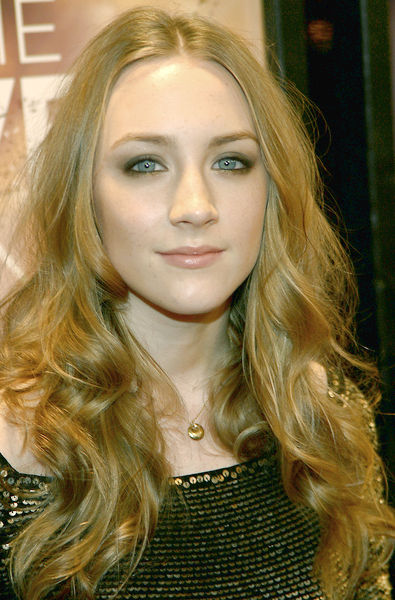
** It is a fine performance, and Ronan at the time of filming two years ago, still had the awkward duckling look of a developing teen. At the premiere, she looks like she could be a Redgrave
.

Tuesday, June 15, 2021

Oz the Great and Powerful

Written at the time of the film's release...

What a World, What a World;
or
There is no Baum in Gilead

Any movie attempting to resuscitate L. Frank Baum's "Oz" books has to deal with the series' own Wicked Witch of the West—that being M-G-M's musical version The Wizard of Oz, which had Judy Garland in it, and set the bar very high as far as expectations go (for quality that is, whereas for the box-office TWoO was not a box-office success at the time of its release and only became a classic after a couple decades worth of Thanksgiving showings on network TV). Walter Murch's attempt to take an OZ story back to its roots, 1986's Disney's Return to Oz, was an abysmal failure, although artistically it was a terrific show--but probably butted heads with too many memories for its own goodness as, for instance, the Lion, Tin Man, and Scarecrow were not vaudevillians in theater-suits, as was the 1939 version, but looked more in line with the book's illustrations.
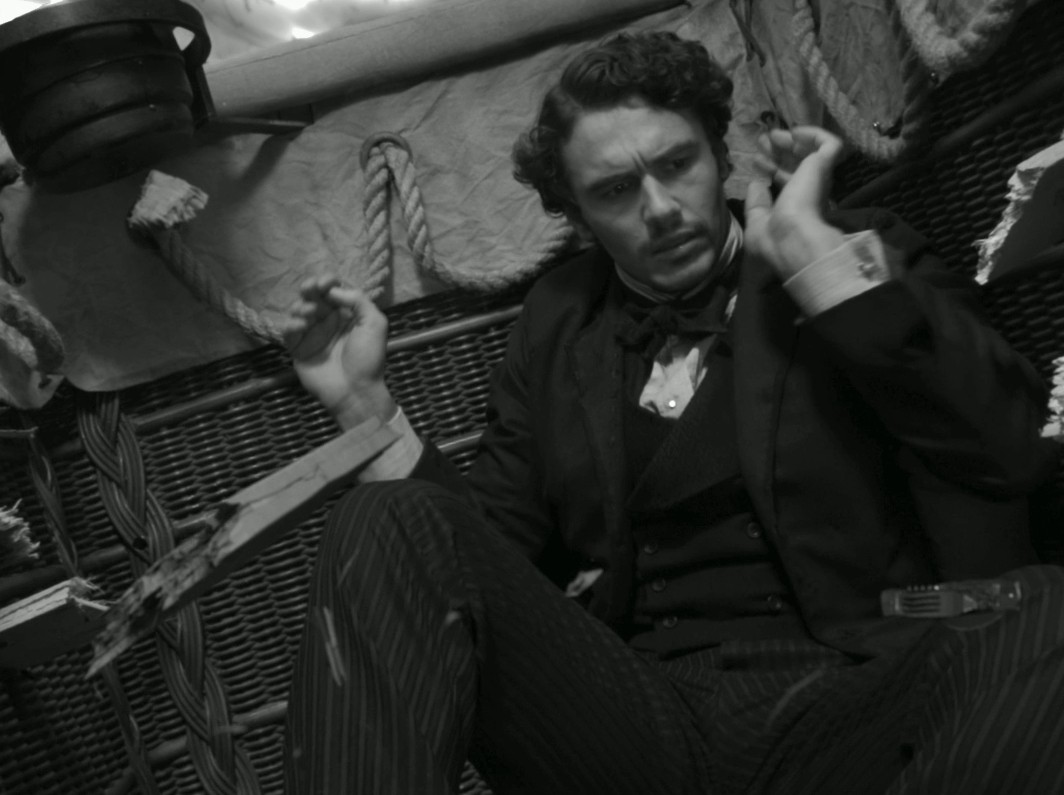
Sam Raimi, he of larky horror films and the Tobey Maguire Spidermen, is probably a very good choice for doing an OZ film, as he has equal qualities of sweetness and sour, where Tim Burton (the next usual suspect*) would have made the film travel heavier to the morose. Raimi's Disney's Oz the Great and Powerful (as convoluted and punctuationally challenged a title if ever, oh ever, there was one) manages to be its own thing while bowing and occasionally scraping to the previous' yellow brick road (which is revealed, as an aside, to have potholes, which nicely sums up the movie's respect, and lack thereof). A prequel, kinda sorta to The Wizard of Oz, it starts out in a black and white box-square format (with a special effect detail amusingly violating it here and there) on a sound-staged Kansas that creepily recalls the musical version. There scam-magician Oscar Diggs (James Franco) is conning rubes and comely assistants alike, and taking advantage of his stage-assistant, Frank (Zach Braff). He's a jerk, only revealed to better purposes when a lost love (Michelle Williams) comes to visit to tell him she's going to marry farmer John Gale (father of Dorothy, making her mother of), and he takes the higher road, telling her she chose the better man.
But his past catches up with him...or tries to...and his road goes even higher, escaping a vengeful cuckolded circus strong-man in a helium balloon. Kansas being Kansas, he is caught up in a tornado—one that presumably opens up a rip in the space-time continuum through some sort of meteorological consequence, and winds up in the storied land of Oz, where, true to movie-form, everything turns to color and the screen expands to wide-screen proportions.
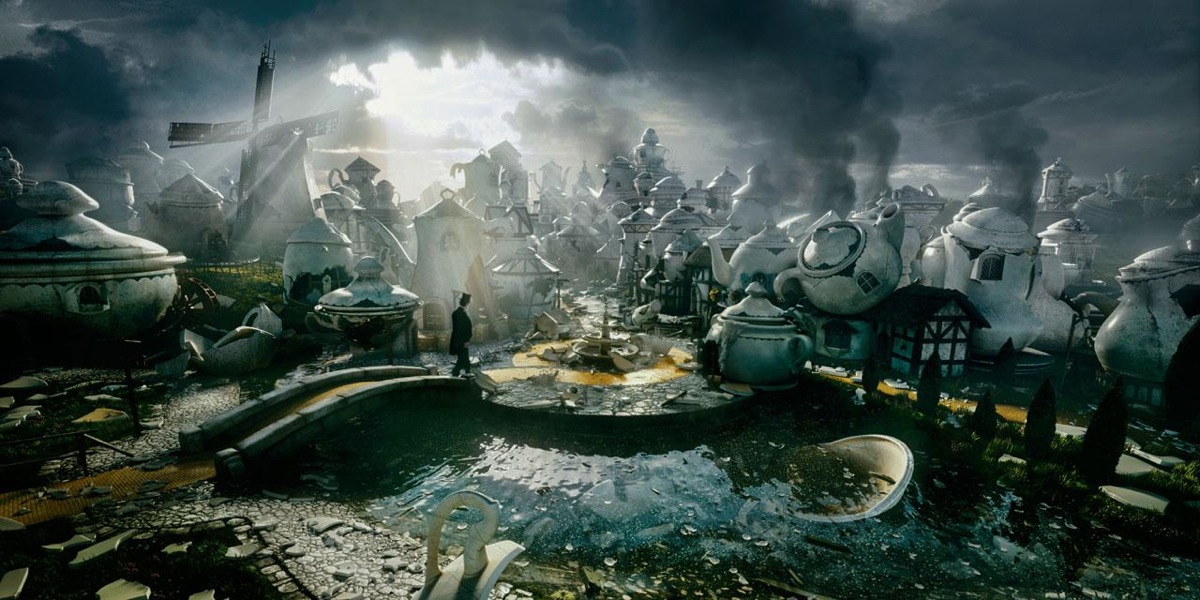
The pattern is set—Diggs is an outsider, a stranger in a strange land, but enough of a roué that any sense of wonder he initially feels is soon replaced by annoyance (Franco is great at that). Oh, it's nice to have a minor seduction with the first female he stumbles on, Theodora (Mila Kunis), but the flying monkeys (in the form of Finley, voiced by Braff), and the girl who comes from hummle beginnings, the fragile porcelain girl (who comes from the neighboring land of China town and voiced by Joey King). 
But before long he's
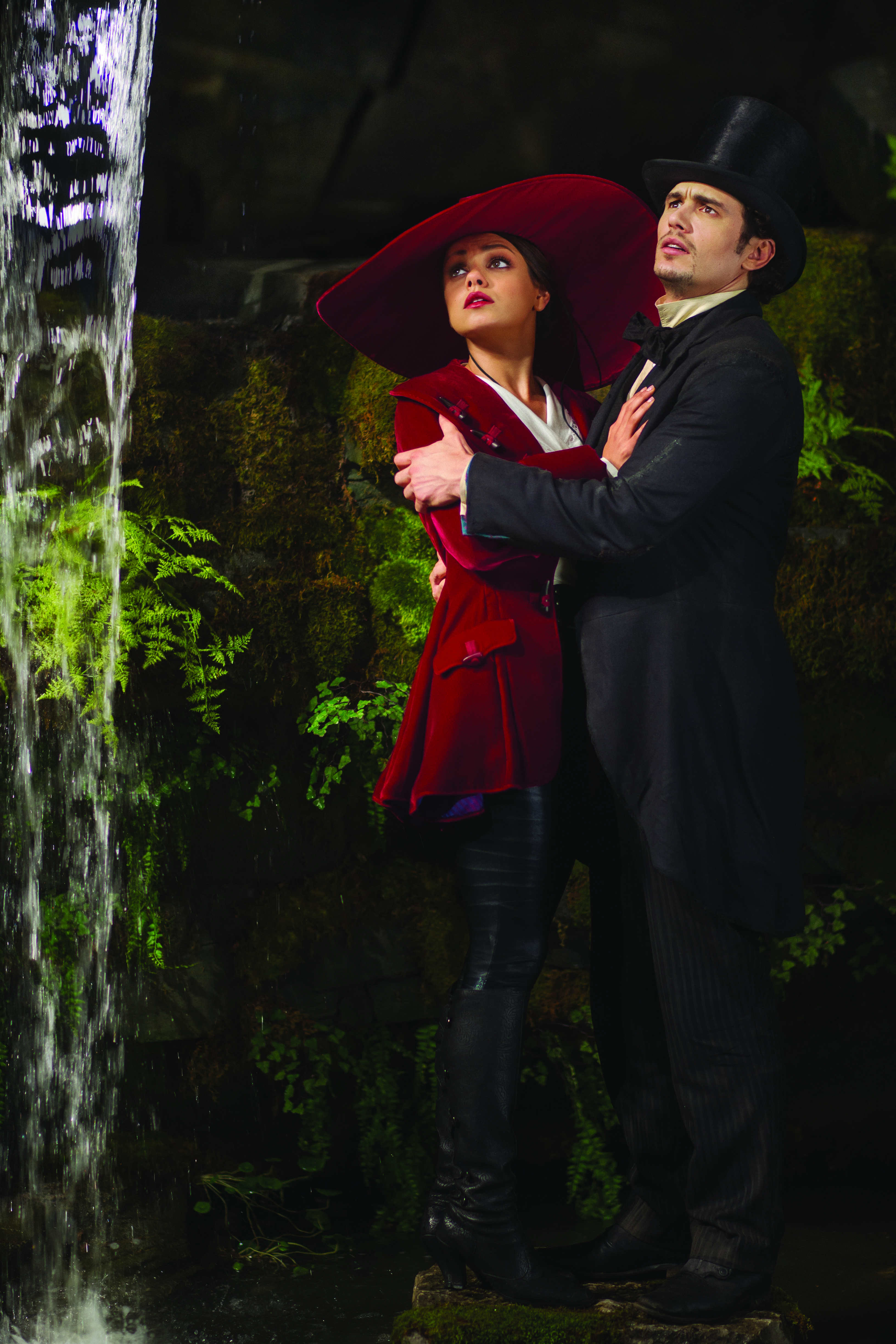
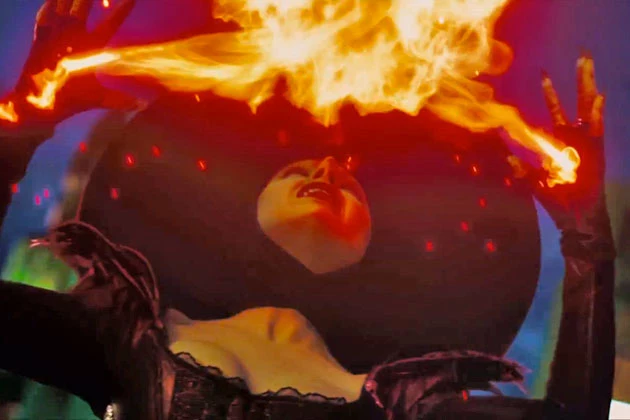
embroiled in Oz's matriarchal politics between witches Theodora and her evil sister Evanora (Rachel Weisz), 
who are lording it over the Emerald Cityand the witch Glinda (Williams again), who is protecting the provinces from the influence of the Big Bad City
This troika of females all think that Oscar will bring some sort of balance to Oz, and despite himself, he's got enough answers to help Finely and China, who become devotees. Evanora is the first to see Oscar and think "there goes the neighborhood," and the plot and the make-up thickens in a battle royale between the various forces of magic, Evanora and Theodora in the Emerald City, and Glinda and Oscar and her army of tinkers, winkies and munchkins.
Tinkers and winkies and munchkins. Oh my.

As Donald Rumsfeld said, you fight with the army you got.


And just to show this isn't Gramma's OZ (or Louis B. Mayer's) when we get welcomed to Munchkinland this time, and the town's welcome wagoneers start into a bouncy little song with high, tight voices (provided by composer Danny Elfman), Diggs just calls the whole thing off: "Stop! Stop it!" Musical numbers are not tolerated in this more cynical fantasyland. Nor is anything approaching the good-heartedness of Baum or Fleming. 

Even Glinda the Good Witch turns out to be something of a bad-ass here, far badder than in the '39 version. And that's just a little backwards because the original has an empowered little girl who saves the day, while in this one it's a man, a messiah, who must sort things out in the messy rule of a matriarchy.  
This is progress?
The movie ends with some fantasy-nastiness. Glinda is captured, tortured, and made to grovel before the sisters, Oscar comes to the rescue with his own Earth-bound pyrotechnics, similar to what he's use in the future. But the movie feels very much like a movie of today—things end not with a splash of water, but a lot of impressive fireworks. You want something a little meatier, though, something that might last and impress longer, but given the Oz that will come post-prequel, there's really nothing much to do about it. The great and powerful Oz is merely a humbug, the man behind the curtain. The evil sisters will remain evil, although Evanora's fashion sense (especially regards hosiery) will take a serious hit. And Oscar will become a patriarch based on big promises with nothing much to back it up. Sounds like any politician, really. This Oz is not so magical, not so great and not so powerful. What it needs is more brains, more heart and more courage.

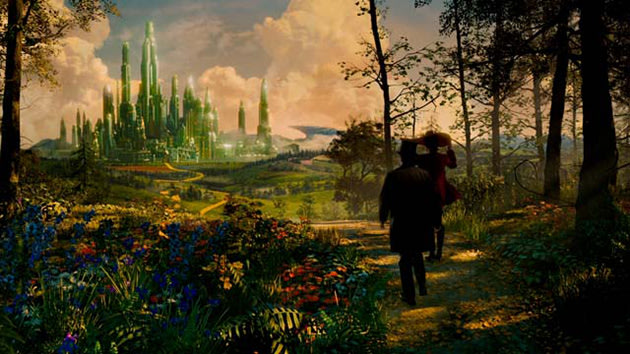
Yellow Brick Road?  Check.  Emerald City? Check.  Dark Forest?  Check.
So...what's wrong with this picture?


* Frequently recalled as this film is scored by Burton co-conspirator Danny Elfman.

Oh, yeah. Flying monkeys.