Showing posts with label Ang Lee. Show all posts

Tuesday, August 15, 2023

Taking Woodstock

Written at the time of the film's release...

"I Haven't Slept in Three Days, My Hip is Acting Up, and the Beer is Warm."/
"So...you're Good."
 
Ang Lee has spent almost his entire career showing the common humanity in the disenfranchised, whether they be the lower rungs of Class Society, gay cowboys, set-apart and -upon martial artists, political spies, and Incredible Hulks—the commonality of the different. Even with the slightly lighter touch he employs here, he does the same for Catskill Jews and Hippie culture in Taking Woodstock. Both groups are isolated and flung apart, but come together—initially uneasily, but soon in mutual satisfaction, to produce something intangible and real, that would change everything.
 
For a little while.
 
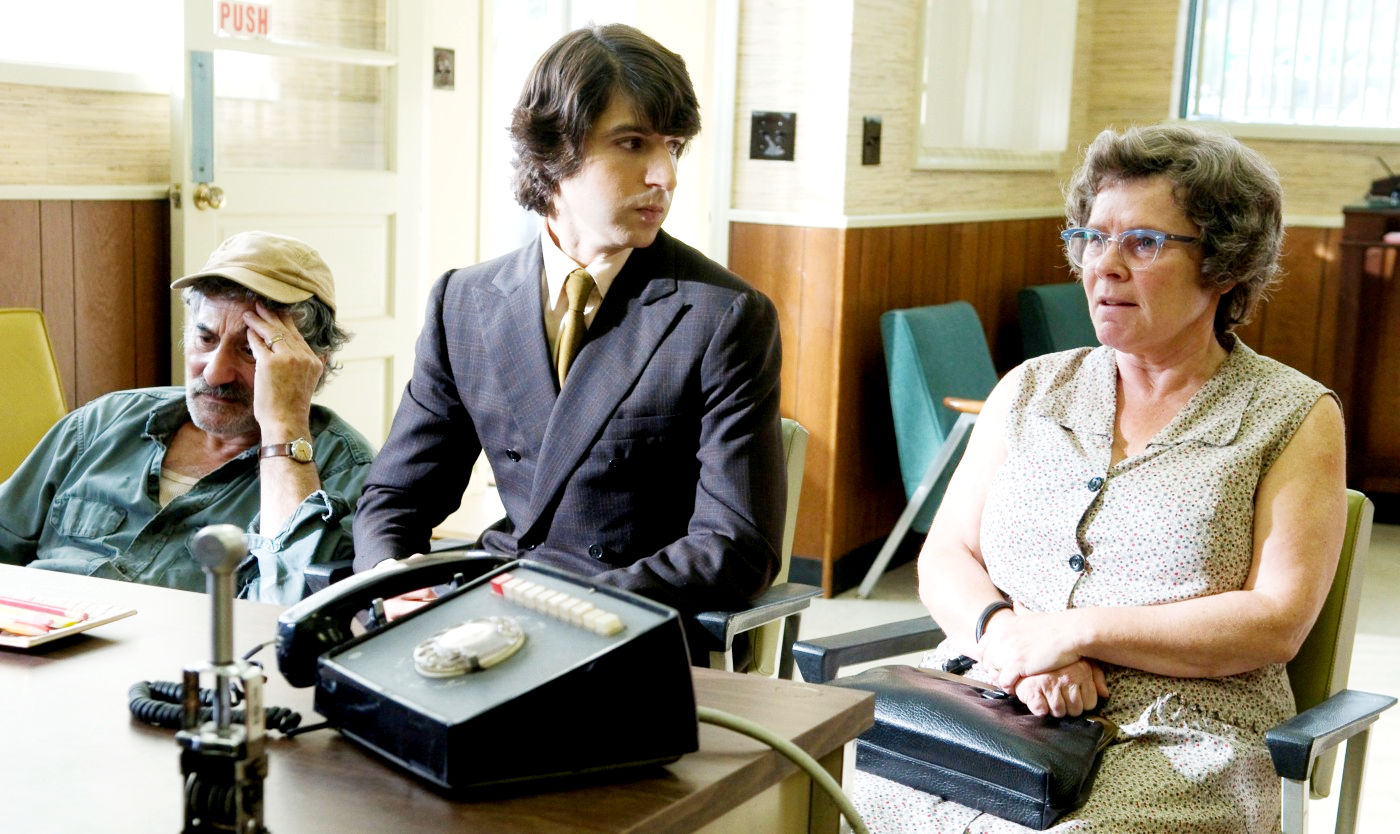
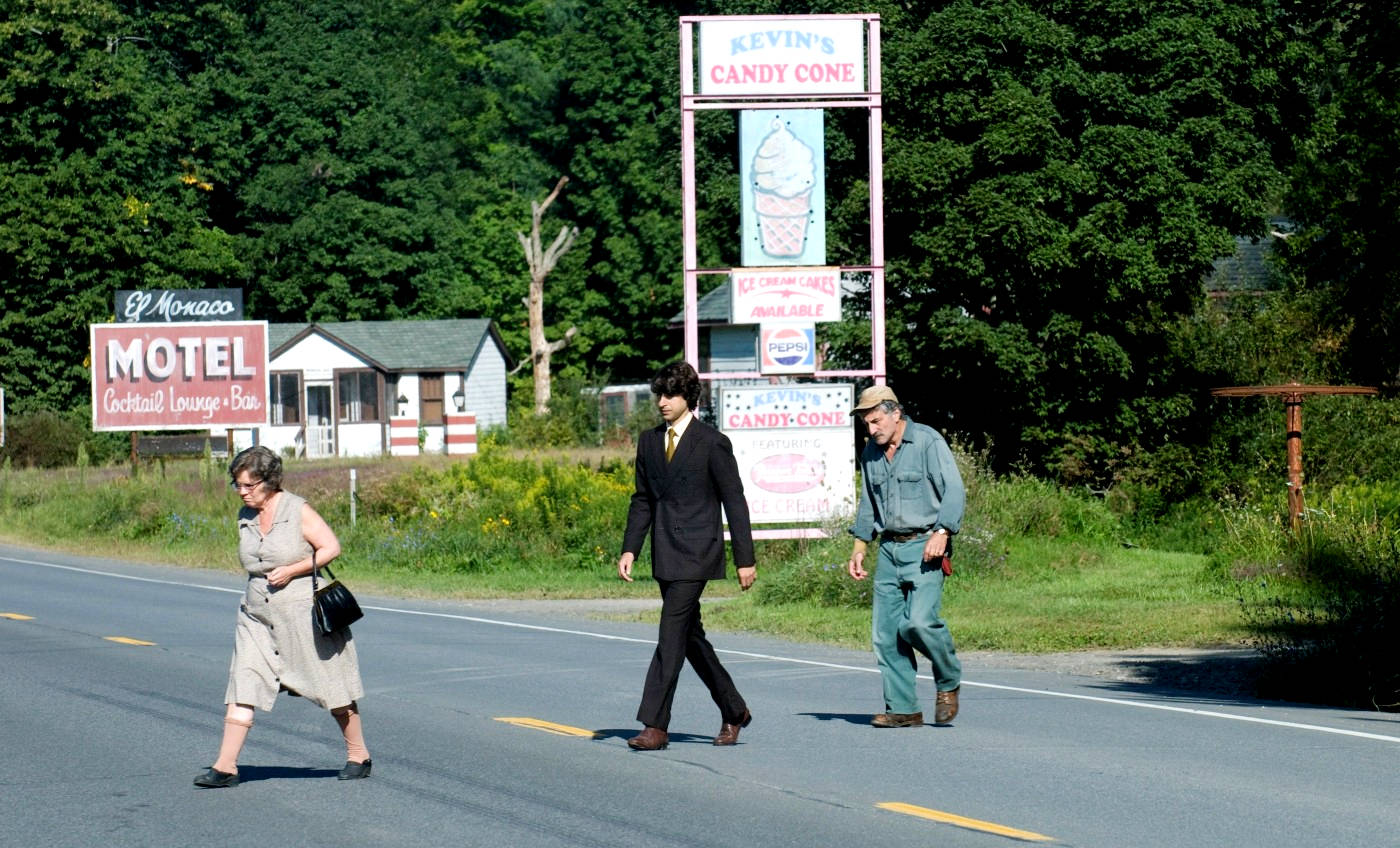
Elliott Tiber, nee Tieschberg, (Demetri Martin) is a repressed jangle of contradictions, a cosmopolitan boy lost in the woods. He's hasn't quite left the nest of his parents (Henry Goodman, Imelda Staunton) who own—barely—the El Monaco Hotel in the Catskills town of White Lake. He hasn't quite left the closet, either. A painter, he hasn't met with success in The Big Apple. He deals with the banks about the Hotel's financing, but has nothing to say about how it's run, despite trying to stir up business. He's the President of the White Lake Chamber of Commerce...which is basically just a Chamber, but in a Church basement, and little Commerce.
The one thing he has going for the Hotel is a low-key Arts Festival he puts on every year, featuring a couple folk-singers and the gonzo theater-troupe who inhabit the barn on their property. Until...the planned "Woodstock" festival with a few choice acts is driven out of their original venue by the locals, and Tiber makes it known to the organizers that he has a permit for an arts festival, a rare thing with the reluctant townspeople, who are content with the "regular crowd" and don't want much disruption. Pretty soon, the Tieschberg's and
local dairy farmer Max Yasgur (a genially subdued Eugene Levy, making more of less) are persona non grata around town as the area is crowded with a motley crew of organizers, "suits," crew-men, helicopters, expectant hippies, and, as the concert grows closer, one of the largest traffic jams in the Nation's history.
By that time, the Tieschberg's are in constant motion as their hotel is over-crowded, water-shortaged, beer-deficient and out of control, if not for the efforts of Mr. Tieschberg and self-appointed head-buster Vilma, a trans ex-Ranger with a baseball bat (Liev Schreiber, in a bad blonde wig and a Southern Belle's wardrobe, looking just like you'd expect him to, and bringing a rueful dignity to the enterprise).
As long as Lee focuses on the chaos, the film is a raucously good-natured train-wreck. Once he leaves the side-show for
Elliott's Odyssey to "The Festival," the film becomes one of those earnest little movies that tells you its important but can't show you, just as it can't show the concert going on. Oh, you hear snippets of song-track that was featured at Woodstock, but not the actual performances (as they're owned by somebody else, I guess) reverberating in the background. There's a couple of FX shots that suggest the scope of the thing (one an LSD-influenced version that shows the crowd turning into an undulating sea-scape that would be more effective...oh, if you really were on acid, say), but the whole sequence is not only un-involving, it diminishes the event...far-off, rather than far-out.
Woodstock has been romanticized so much over the last 40 years that it might better be called "Three Days of Peace, Love and Understanding and All the Crappy Parts You've Forgotten." But, Lee doesn't shy from the problems (segmented into easily focused nuggets of information through a split-screen technique which was the vogue at the time), although nothing is dwelled upon: the famous "brown acid" is mentioned, the muddy conditions,
the interminable traffic jams, the inconsistent weather and jerry-rigged wiring that combined to cause so much metal on the grounds to shock when touched, the unsanitary conditions, the constant air-lifting of accidents and overdoses. and the fact that damned few people heard much music. It was enough to "be there," and that entailed a super-human ability to "go with the flow," of which, with the rain, there seemed to be plenty. It's all catalogued, but briefly, because like a lot of movies about "big events," it boils down to who's telling the story and how much they really played a part in it.
For the sub-title of the movie should be "
Elliott Tiber and what he did at Woodstock." Tiber's account has been questioned by organizer Michael Lang
* who claims that he may have had the permit, but he wasn't present at all the places he claims he was. And so the movie is reduced to the old conundrum of who gets to re-write history as Tiber shows "how Woodstock was important to him," as well as how "he was important to Woodstock." This might have been a bit more convincing if Tiber weren't portrayed by Demetri Martin. Martin is a gifted comedian as his stints on "The Daily Show," and his own "Comedy Central" series have amply displayed. But, "Taking Woodstock" shows none of the puppyish energy that makes his observations so hilarious. Instead, his Tiber is slackly reminiscent of Chance the Gardener in Being There, wandering like a ping-pong ball through the movie, with just as much dramatic weight. He is handily eclipsed by Goodman and Staunton, Schrieber and Emile Hirsch's "Charlie"-obsessed Viet-vet.
In the end, it's a let-down—like being stuck in the traffic jam and missing the concert, although Lee does manage to show us a lot of entertaining portraits while missing the big picture.
In the final irony, the cost of a ticket to the "real" Woodstock was $8.00. An evening ticket to "Taking Woodstock" costs upwards of 10.
*Lang is played by Jonathan Groff as an intensely smooth corporate hippie, who never seems to sweat the small stuff...or the big stuff, for that matter. In fact, he rarely seems engaged in any of the complexities of the festival, concentrating on "The Big Picture."

Tuesday, July 4, 2023

Ride With the Devil

What to post on July 4th? I've done versions of Yankee Doodle Dandy almost to death. There isn't a Capra film that feels appropriate. 

But a Western...I've got a couple that I want to spend a bit more time on—both dealing with the "Native Question" (not sure why there was ever a question to begin with). But, looking at some "ready-to-go" things I'd done in previous years, this one jumped out at me. A Western at a critical juncture in the Nation's History (and there's never really been a time that wasn't) when we were in danger of blowing up the results of "The Democratic Experiment" due to the same issues that destroyed past dynasties, autocracies, kingdoms, and dictatorships...even home-owner associations—the power of greed and the greed of power. You can say all people will be equal, but inevitably somebody's going to be more equal than others. And character plays a big part in how that works itself out (if you're paying attention).
 
Also it's a complicated story, in the way that American history—outside of the beginners' text-books—can be complicated, that tests preconceptions and prejudices. As a democracy should.

So, here is that most American of genres, the Western, directed by Taiwanese director Ang Lee, which actually seems apropos, telling the story of a nation of immigrants. It's a great movie that nobody went to see. As I said, it was "wrongfully overlooked" but also, I think, vastly underappreciated.
 
 
"On the Western frontier of Missouri, the American Civil War was fought not by armies, but by neighbors. Informal gangs of local Southern bushwhackers fought a bloody and desperate guerrilla war against the occupying Union army and pro-Union Jayhawkers. Allegiance to either side was dangerous. But it was more dangerous still to find oneself caught in the middle ..."
 
The story of Quantrille's Raiders and the Missouri Irregulars were a sorry part of the Civil War story, but its tales of guerilla raids between two groups, the "bushwhackers" and the "jayhawkers," criss-crossing the Kansas-Missouri border, it's history with Quantrille, Bloody Bill Anderson and Jesse James and the murderous raid on Lawrence, Kansas in 1863 have been explored, somewhat tangentially, as the first battles in the Outlaw West.
Director
Ang Lee may seem an odd choice for a Western of this nature, but such was the case when he directed Sense and Sensibility. Versatile, facile, and able to make universally accepted films across genres, there seems little Lee cannot succed at whether period romance (Sense and Sensibility), spy-noir (Lust/Caution), martial arts flick (Crouching Tiger, Hidden Dragon), even cross-blending sci-fi/horror and superhero movies (Hulk).
Ride with the Devil
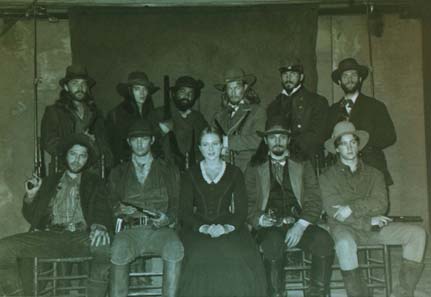
, with a screenplay by James Schamus (now head of Focus Features) was not a box-office success when it opened, perhaps as it was an unconventional western with controversial elements: four young people, Jake Roedel (Tobey Maguire), Jack Bull Chiles (Skeet Ulrich), George Clyde (Simon Baker), and Daniel Holt (Jeffrey Wright) all find themselves fighting as Confederate guerillas during the Civil War as "bushwhackers," not so much as they believe in the Southern cause—Holt is a freed slave—but because of issues with loyalty, friendship and attacks on their families. Soon, they're conducting murderous assaults on established Union positions with deadly accuracy, which Lee stages with a brutal efficiency: quick cuts, fast pace and attention to the damage a round bullet can inflict.
Housed for the winter in a make-shift shelter
, they are looked after by Southern sympathizers, with particular interest paid by a war-widow named Sue Lee (Jewel), who begins an affair with Chiles and offers support and food during the harsh winter. It's a nicely paced gritty portrayal of life led as an outlier, and the elements are mixed as to keep one guessing about what will happen next.
The revelation here is
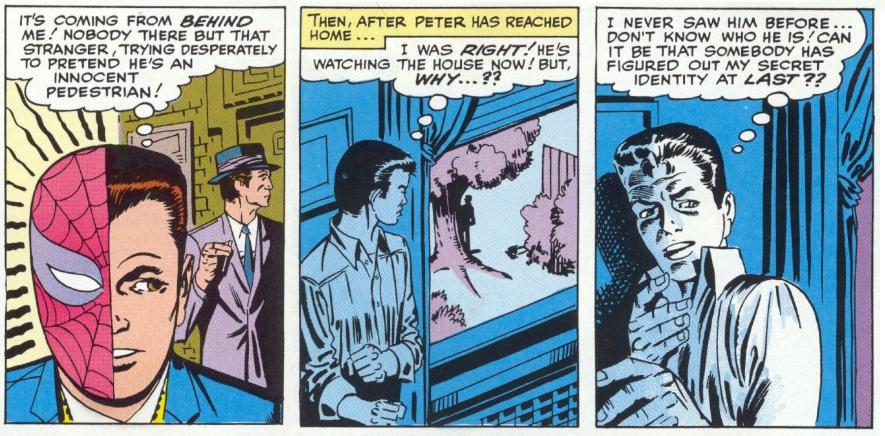
Tobey McGuire, heretofore usually playing callow youths (which is why he was picked to play Peter "Spiderman" Parker), here he's got a versatile range of situations, starting out as a disillusioned follower, then his own man of a kind, backed by a steely gaze that turns durn creepy at times, and an "on-the-edge-of-cracking" voice that lolls over dialogue. Nice work, and Lee makes the most of him, using the boyish qualities of McGuire for moments of humor, terror and combinations of both.


Wrongfully overlooked.

Thursday, May 21, 2020

Lust, Caution

Lust, Caution aka "Se, jie" aka 色,戒 (Ang Lee, 2007) Despite its NC-17 rating, Lust, Caution is a spy thriller, not a sex film (the "NC" rating was created to separate films of merit that had explicit sexual content from the porn-dominated "X" rating, but it doesn't seem to have translated for mainstream audiences). 

And yet, until later, it's not exactly a spy film, either. It involves infiltration and spying and deception with a means towards assassination, but the activities are not conducted by any government organization (at least not initially), but by activists against an organization. The differences and particulars are minute, as subterfuge and manipulation are the weapons—this could be the "Impossible Missions Force" at work.

If not that infiltrators are amateurs who might be considered just playing a part with severe delusions of grandeur.
It is 1938, and a group of drama students in Japanese occupied Hong-Kong put on a patriotic play that raises donations for the resistance. But the play's director ("Typical director," says one of the actors, "he never listens to anyone else.") decides it's not enough to raise money—a relative of his has discovered his employer is a Chinese collaborator, and the student troupe, in a surge of patriotism (and drunkenness) vow to assassinate the man, Mr. Yee (Tony Leung Chiu Wai). 
They set up an elaborate ruse insinuating two of the troupe as prominent business-people and over shopping trips and mah-jongg games befriend Mrs. Yee (Joan Chen). Before long, the smartest and most gifted of the actors, Wong Chia Chi (Wei Tang) has caught Yee's eye, and makes plans to set him up for the kill.
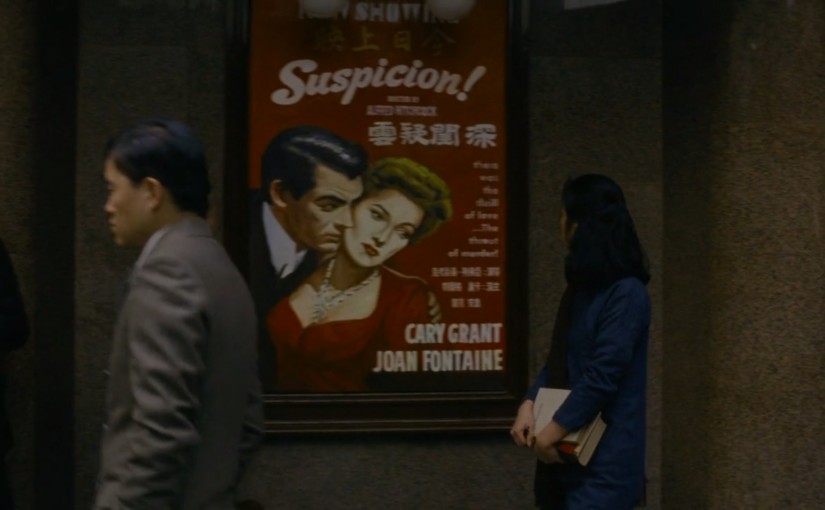
Despite spending hours at the movie theaters watching Ingrid Bergman and Cary Grant movies (Lee uses them specifically), she would have saved herself a lot of grief if she'd seen the only movie the two starred in together, Alfred Hitchcock's Notorious (1946)." Spying is probably the world's second oldest profession, seeing how inexorably linked it is with the first. In Notorious, Bergman's floozy socialite is used by intelligence services to infiltrate a Nazi cell by playing on the affections of one of its leaders. She's a honey trap, using her target's weakness for her as a weapon. Her superiors (in all matters, save moral) are only too willing to let Bergman's character prostitute herself for their ends. And like Louis Calhern and his hypocritical Notorious cronies, the actors-playing-resisters are only too willing (while feeling somewhat guilty) to let Chia Chi seduce Yee.
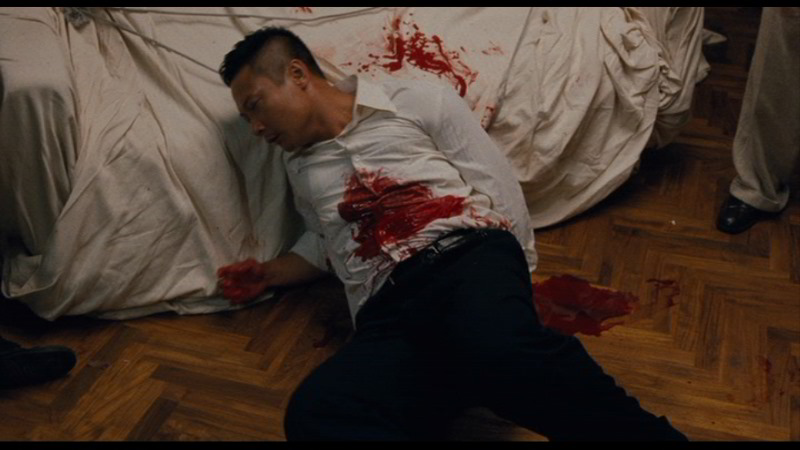
The preparations come for naught, however, even though Chia Chi has managed to put Yee under her spell and he is tempted by her. Before any real seduction/assassination can take place,  Yee and his wife move back to Shanghai and the company disbands, but not before killing one of Yee's circle, who had become aware of the plan.
Move ahead four years to 1942 Shanghai where things have changed: Kuang (Leehom Wang), the leader of the drama club now works for the Nationalist Party's secret service, the Juntong, and Mr. Yee is now head of the secret police, whose job is to eliminate Chinese resisters and members of the party—known as the KMT. Things have changed but, when Kuang encounters Chia that old plan resurfaces and with the Juntong's blessing, Kuang begins the process anew—upgraded with weapons training and being given a suicide pill if she is discovered—with the stakes now dangerously higher.
Chia Chi meets with Yang—who remembers her as "Mrs. Mai," her role in the initial attempt—and Yee, still smitten with the woman, falls for the plot. Discreet meals become clandestine meetings, schedules re-shuffled, sex initiated—first roughly, crudely and Yee is shamed by Chia's outrage and hurt, then more intimate, considerate—but Chia finds the details of arranging the assassination challenging, not only for the stalling of the KMT "for strategic reasons," but because she is starting to have feelings for Yee and she wants the assignment over, done with. She is starting to fall into dangerous ground, where, though she may betray her body, her mask of subterfuge is at risk and her core emotions may be exposed and threatened. The lie is becoming real and her initial sense of purpose and her love of self and country (in the larger scheme of things) may be compromised.
But this is where the drama is. Lust, Caution was attacked by some for its "plodding" pace (its far subtler than Hitchcock and the unsubtle sex is distracting) and for its contained emotions (it is a spy film, after all), but it deals with masquerades and the subjugation of self for appearance, something that everybody knows and buys into as a matter of course, especially in this sub-set of thrillers. But, in a game of manipulation, hearts can't be worn on sleeves and deception is a strategy of truth suppressed and artifice as shell. For Lee, its another of his "repression" films, be it Sense and Sensibility or Hulk or Brokeback Mountain where the Id's fight is the prominent conflict on-screen.
As far as spies are concerned, this is the very well-plowed field that John le Carré has toiled in for years, where the loyalty of the heart betrays loyalty to duty or country. Intimacy creates allegiance. Consideration creates confusion. Depending what side of the War (Cold or Hot) you situate the tale, it is a Triumph of the Will for good or bad. Do you betray the mission or do you betray yourself? The trail of the heart leads to rapture or an early grave.
Lust, Caution has been unfairly neglected as a great work, with accusations of more emphasis being paid on the key players to the detriment of the historical context (and the stakes involved that would lead a woman to such actions—one hesitates to say it, given political turmoil's costs, but in a tale of the Soul, it's nearly as dismissible as a McGuffin), and for its sexual content—which amounts to five minutes of the film's 2 1/2 hour length (in its unexpurgated form)—and for which, as a result, actress Wei Tang experienced a professional black-listing (but not Tony Leung, interestingly but not surprisingly) despite a truly great dramatic performance. These are small and smallish arguments. Looking at the larger picture, Lust, Caution slots in so well with both the intricacies of the spy genre and Lee's ouvre, and one day, one hopes it might be re-discovered as a highlight of both lists.
Ciang Chee realizes her friends have no problems prostituting her.


Thursday, August 15, 2019

Taking Woodstock

50 years ago today, the Woodstock Festival began...

Written at the time of the film's release.

"I Haven't Slept in Three Days, My Hip is Acting Up, and the Beer is Warm."
"So...You're Good."


Ang Lee has spent almost his entire career showing the common humanity in the disenfranchised, whether they be the lower rungs of Class Society, gay cowboys, set-apart and -upon martial artists, political spies, and Incredible Hulks—the commonality of the different. Even with the slightly lighter touch he employs here, he does the same for Catskill Jews and Hippie culture in Taking Woodstock. Both groups are isolated and flung apart, but come together—initially uneasily, but soon in mutual satisfaction, to produce something intangible and real, that would change everything. For a little while. Elliott Tiber, nee Tieschberg, (Demetri Martin) is a repressed jangle of contradictions, a cosmopolitan boy lost in the woods. He's hasn't quite left the nest of his parents (Henry Goodman, Imelda Staunton) who own—barely—the El Monaco Hotel in the Catskills town of White Lake. He hasn't quite left the closet, either. A painter, he hasn't met with success in The Big Apple. He deals with the banks about the Hotel's financing, but has nothing to say about how it's run, despite trying to stir up business. He's the President of the White Lake Chamber of Commerce...which is basically just a Chamber, but in a Church basement, and little Commerce.
The one thing he has going for the Hotel is a low-key Arts Festival he puts on every year, featuring a couple folk-singers and the gonzo theater-troupe who inhabit the barn on their property. Until...the planned "Woodstock" festival with a few choice acts is driven out of their original venue by the locals, and Tiber makes it known to the organizers that he has a permit for an arts festival, a rare thing with the reluctant townspeople, who are content with the "regular crowd" and don't want much disruption. Pretty soon, the Tieschberg's and local dairy farmer Max Yasgur (a genially subdued Eugene Levy, making more of less) are persona non grata around town as the area is crowded with a motley crew of organizers, "suits," crew-men, helicopters, expectant hippies, and, as the concert grows closer, one of the largest traffic jams in the Nation's history.
By that time, the Tieschberg's are in constant motion as their hotel is over-crowded, water-shortaged, beer-deficient and out of control, if not for the efforts of Mr. Tieschberg and self-appointed head-buster Vilma, a tranny ex-Ranger with a baseball bat (Liev Schreiber, in a bad blonde wig and a Southern Belle's wardrobe, looking just like you'd expect him to, and bringing a rueful dignity to the enterprise).
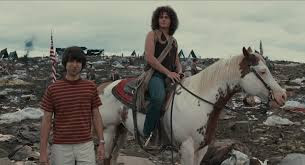
As long as Lee focuses on the chaos, the film is a raucously good-natured train-wreck. Once he leaves the side-show for Elliott's Odyssey to "The Festival," the film becomes one of those earnest little movies that tells you its important but can't show you, just as it can't show the concert going on. Oh, you hear snippets of song-track that was featured at Woodstock, but not the actual performances (as they're owned by somebody else, I guess) reverberating in the background. There's a couple of FX shots that suggest the scope of the thing (one an LSD-influenced version that shows the crowd turning into an undulating sea-scape that would be more effective...oh, if you really were on acid, say), but the whole sequence is not only uninvolving, it diminishes the event...far-off, rather than far-out.
Woodstock has been romanticized so much over the last 40 years that it might better be called "Three Days of Peace, Love and Understanding and All the Crappy Parts You've Forgotten." But, Lee doesn't shy from the problems (segmented into easily focused nuggets of information through a split-screen technique which was the vogue at the time), although nothing is dwelled upon: the famous "brown acid" is mentioned, the muddy conditions, the interminable traffic jams, the inconsistent weather and jerry-rigged wiring that combined to cause so much metal on the grounds to shock when touched, the unsanitary conditions, the constant air-lifting of accidents and overdoses. and the fact that damned few people heard much music. It was enough to "be there," and that entailed a super-human ability to "go with the flow," of which, with the rain, there seemed to be plenty. It's all cataloged, but briefly, because like a lot of movies about "big events," it boils down to who's telling the story and how much they really played a part in it.
For the sub-title of the movie should be "Elliott Tiber and what he did at Woodstock." Tiber's account has been questioned by organizer Michael Lang* who claims that he may have had the permit, but he wasn't present at all the places he claims he was. And so the movie is reduced to the old conundrum of who gets to re-write history as Tiber shows "how Woodstock was important to him," as well as how "he was important to Woodstock." This might have been a bit more convincing if Tiber weren't portrayed by Demetri Martin. Martin is a gifted comedian as his stints on "The Daily Show," and his own "Comedy Central" series have amply displayed. But, Taking Woodstock shows none of the puppyish energy that makes his observations so hilarious. Instead, his Tiber is slackly reminiscent of Chance the Gardener in Being There, wandering like a ping-pong ball through the movie, with just as much dramatic weight. He is handily eclipsed by Goodman and Staunton, Schrieber and Emile Hirsch's "Charlie"-obsessed Viet-vet.

In the end, it's a let-down—like being stuck in the traffic jam and missing the concert, although Lee does manage to show us a lot of entertaining portraits while missing the big picture.

In the final irony, the cost of a ticket to the "real" Woodstock was $8.00. An evening ticket to Taking Woodstock costs upwards of 10.


* Lang is played by Jonathan Groff as an intensely smooth corporate hippie, who never seems to sweat the small stuff...or the big stuff, for that matter. In fact, he rarely seems engaged in any of the complexities of the festival, concentrating on "The Big Picture."

Sunday, April 21, 2019

Don't Make a Scene: Sense and Sensibility

The Set-Up: Emma Thompson, Emma Thompson, and Emma Thompson. The answer to the question du Carnack "Who are some of my favorite actors, comedians, and screen-writers?"

That would actually be "Dame" Emma Thompson, whose work never ceases to amaze me or enchant me. She's one of those handful of actors whose work goes beyond portrayal to fully inhabited, without any tell-tale signs of performance or artifice. That's a very rare commodity. And she ranks with Vanessa Redgrave, Katherine Hepburn, Jean Arthur, Alfre Woodard, Barbra Stanwyck, Taraji P. Henson, Ingrid Bergman, and Viola Davis as actresses who are a treat to watch, personally.

Her double-duty as lead actress and chief scribe of Sense and Sensibility, though, has always knocked me out, because she took the work seriously enough to risk accentuating the comedy of it...something that the ardent frequently object to. You can't have light without dark, good without evil, and you can't have drama without a sense of the absurd (Well, you can, but it's a little melodramatic, which some folks like—but not me).

So, here is this scene from S and S, that has no comedy whatsoever. If there is, it's of a cruel variety and it is Thompson that risks it by making her practical and stiff-upper-lip Dashwood daughter, Elinor, completely lose it in this scene (only one of 2 1/2 instances where she allows herself to do so). Her Elinor suffers through so that her other family members do not, and she maintains a brave face throughout, but Thompson's facility playing it is so adroit that she allows the audience in to see the cracks of the veneer.

Like here...the almost mad fear she displays when pleading with her unconscious sister to pull through is heart-breaking, but so, also, is the look in her eyes when told by the doctor to "prepare" herself for the worst. It's an amalgamation of things—hurt, betrayal, anger, fear, loathing of the doctor, all mixed in her look back as he exits. A flash of...well, the five stages of grief in one composite stare.

It's open, it's vulnerable, it's strong, and it's...masterful.

The Story: The Dashwoods are in desperate straits. The death of the father, given the complexities of his relationships, has left his family by second wife (Gemma Jones) at loose ends. With an inheritance of only £500 a year, the second Mrs. Dashwood and her three daughters—Elinor (Emma Thompson), Marianne (Kate Winslet) and Margaret (Emilie Francois)—must move from the palatial Dashwood estate, and, seemingly, go begging. The situation might be eased if the elder daughters could be married off, but their financial situation does not entice, and Elinor's affection for Edward Farrars (Hugh Grant) is thwarted, while Marianne forsakes a comfortable marriage to Colonel Brandon (Alan Rickman) for the more dashing but inscrutable John Willoughby (Greg Wise).

Returning from a visit to London, the Dashwoods stay at the estate of the Palmers, which overlooks Willoughby's estate. Marianne, heartbroken by his choosing to wed another, goes out in a driving rain, walking miles hoping to catch a glimpse of her lost love. When she does not return, she is found by the visiting Colonel Brandon, but she becomes gravelly ill with pnuemonia. Brandon, at Elinor's request, fetches a doctor. But, his analysis, one fears, is grave.

Commence...

INT. CLEVELAND - ELINOR AND MARIANNE'S BEDROOM - LATER

The room is very still. MARIANNE is pale as wax. DR HARRIS puts on his coat. ELINOR looks at him fearfully.
DR HARRIS I must fetch more laudanum.
DR HARRIS I cannot pretend, Miss Dashwood, 

DR HARRIS ...that your sister's condition is not very serious.
DR HARRIS You must prepare yourself. 

DR HARRIS I will return very shortly.
He leaves the room.
DISSOLVE:
INT. CLEVELAND - ELINOR AND MARIANNE'S BEDROOM - LATER 

MARIANNE lies in the grip of her fever. ELINOR sits watching her. Slowly she rises and walks to the bed. When she speaks, her tone is very practical. 
ELINOR Marianne, Marianne, please try-- 

Suddenly, almost unconsciously, she starts to heave with dry sobs, wrenched out of her, full of anguish and heartbreak and all the more painful for being tearless. 
ELINOR Marianne, 

ELINOR please...try-

ELINOR -I

ELINOR cannot--I cannot

ELINOR ...do without you. 

ELINOR Oh, please, 

ELINOR I have tried to bear everything else-- 

ELINOR I will try--

ELINOR but please,

ELINOR ...dearest,

ELINOR ...beloved Marianne, 

ELINOR ...do not...
ELINOR ...leave me alone.
She falls to her knees by the bed, gulping for breath, taking MARIANNE's hand and kissing it again and again.

DISSOLVE:

Sense and Sensibility

Words by Emma Thompson (and Jane Austen)

Pictures by Michael Coulter and Ang Lee

Sense and Sensibility is available on DVD and Blu-Ray on Columbia-Tri-Star Home Video and Twilight Time.

Sadly, I could not find a video of this scene anywhere on the Internets, but give myself (and you) solace with Emma Thompson's wickedly funny acceptance speech for winning the Golden Globe for Best Adapted Screenplay: