Showing posts with label Katherine Waterston. Show all posts

Saturday, February 5, 2022

The Current War: Director's Cut

Written (really) at the time of the film's eventual release.

Saturday is traditionally "Take Out the Trash" Day...


AC/DC
or
Bringing It All to Light

The Current War was produced in 2017 and finally released—to theaters—in late 2019 (after premiering with a different cut at the Toronto International Film Festival in September, 2017). The script had been acquired by The Weinstein Company (after appearing on the legendary store-house of interesting but unproduced screenplays "The Blacklist"), and filmed, executive produced by Martin Scorsese and Steve Zaillian

Then, people finally paid attention to Harvey Weinstein's behavior, and the film, which had a lukewarm reception at the festival, was shelved and sold in the midst of TWC's implosion. Pulling strings with his final cut contract, director Alfonso Gomez-Rejon ordered re-shoots and did some trimming before the film was finally released to theaters in 2019.
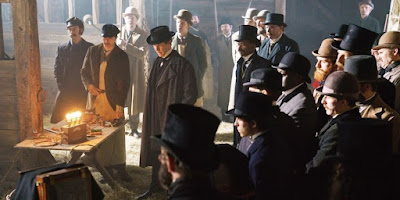
In what might be called its thesis statement, the film begins with top-hatted businessmen walking in the dark through the woods to a clearing, at which point they are blinded by a circle of light that appears magically before them, composed of many singular light bulbs piercing the darkness. From the center of the array walks Thomas Edison (Benedict Cumberbatch) who greets them with "I hope you brought your check-books." He'll need it. For Edison's plan isn't merely the use of light-bulbs, but the invention of something that no one has heard of—the electrical grid. Edison's Big Idea is to create a network of generators—that he'll own—generating direct current to cities and neighborhoods. But, given DC's limited range he's going to have to make a lot of them.
There's money to be made. And where there's money to be made, there is competition. George Westinghouse (Michael Shannon) wants to partner with Edison, but when his overtures are rebuffed, Westinghouse decides to find an alternate system. Alternating Current will travel over greater distances and given its on-again/off-again transmission could be safer and probably cheaper. The two go head-to-head trying to convince local governments to flip the switch, but they're reluctant with two systems in competition.
With the arrival of Nikola Tesla (
Nicholas Hoult) to his employ, Edison thinks he might have an inside track, but Tesla is a mercurial sort and soon bridles at Edison's single-mindedness and leaves, feeling his work is being ignored. He tries to develop his own system, but eventually joins forces with Westinghouse, who has taken his battle to the public.
As every politician knows, the best way to persuade people is with fear. Westinghouse starts a smear campaign claiming that DC is dangerous and should not be allowed in homes. Edison starts to say the same thing about AC and, to prove his point, submits a proposal for a method of execution that is far more humane—the electric chair (despite professing that he would never be a part of weapon development or something destructive to mankind).  When the first use of it sets the prisoner on fire, his reputation is damaged.
The movie sure looks interesting. The director—who's done a lot of second unit work on a lot of good movies—has a slightly cock-eyed way of framing that takes it out of the "vaunted past" look of period films and makes it a bit more surreal. But, despite a terrific cast and some sparks of nice writing, the film doesn't rise above being a more expensive version of one of those "The Inventions That Made America" episodes (but without the teasing before commercials and re-running of footage you've already seen afterwards).
And with all its talk of greatness consisting of what you leave behind, there is more than a little pissing on a live-wire when it shows the blight of a skyline cross-hatched with electrical lines. But, then I don't think the Grid is what it's celebrating: the most moving sequence is when Edison shows off a new invention—a machine that shows hundreds of individual photographs of his late wife that appears to make her move and live again. You spend two hours talking electricity, but ultimately it's about the birth of motion pictures.
 
No wonder Scorsese put his name on it.


Thursday, August 15, 2019

Taking Woodstock

50 years ago today, the Woodstock Festival began...

Written at the time of the film's release.

"I Haven't Slept in Three Days, My Hip is Acting Up, and the Beer is Warm."
"So...You're Good."


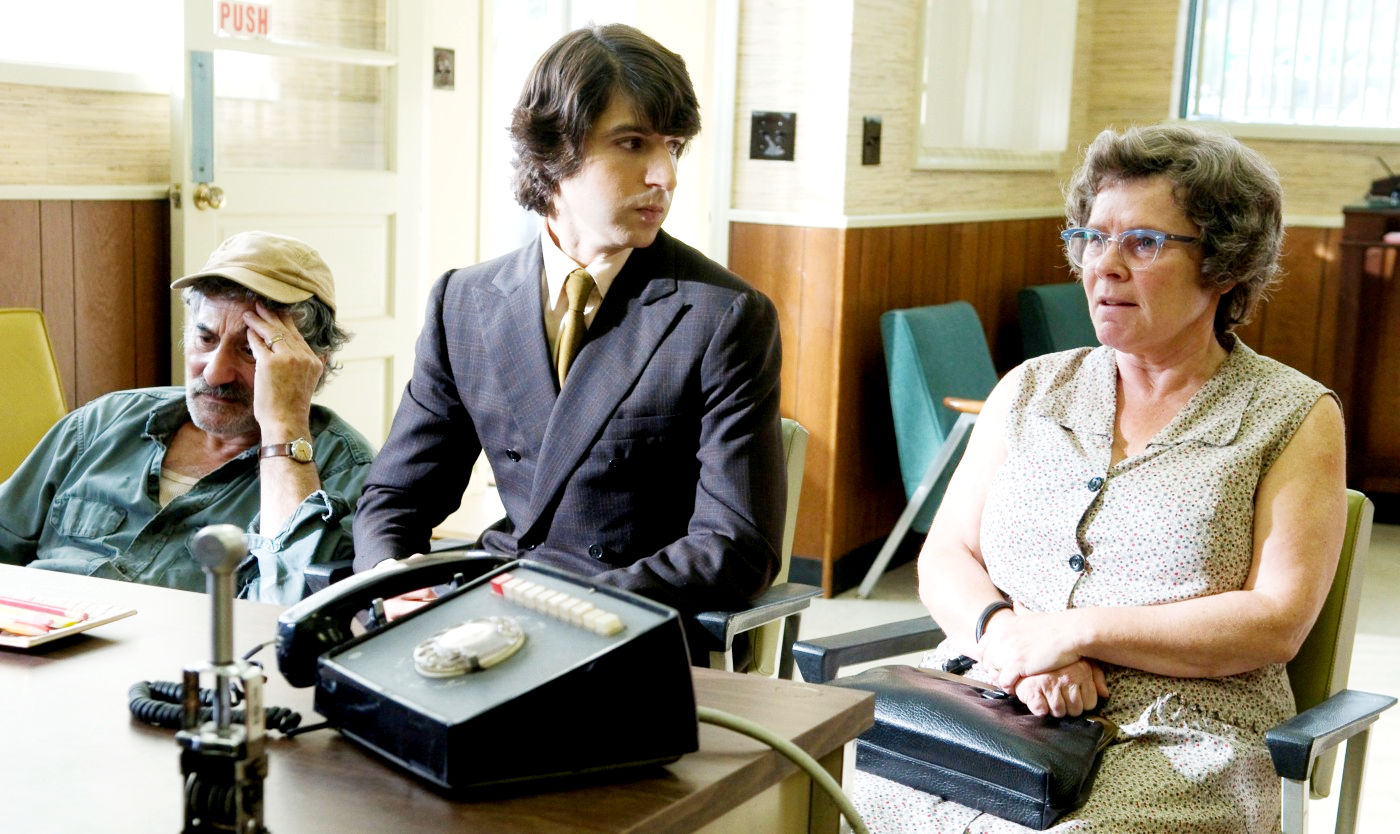
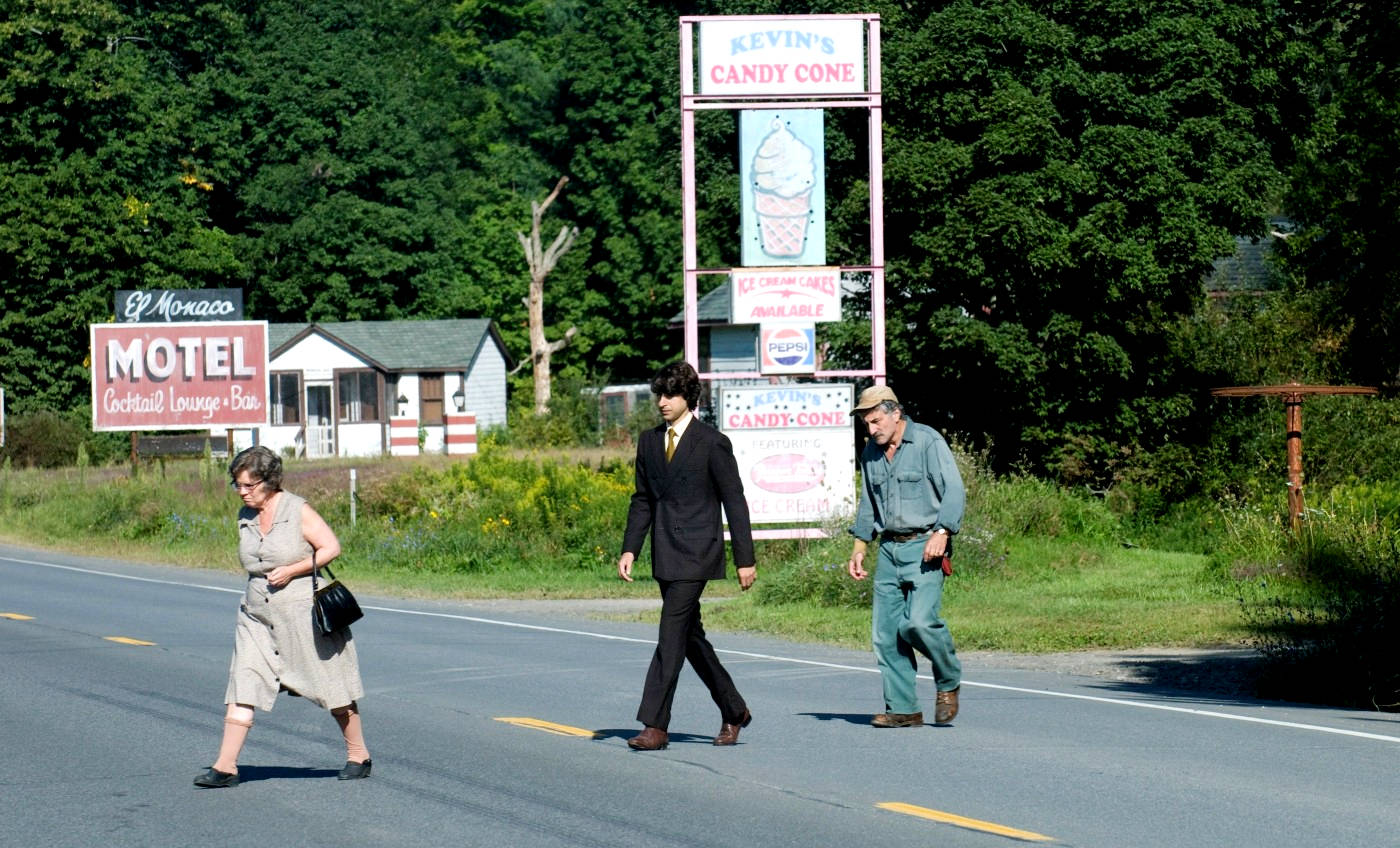
Ang Lee has spent almost his entire career showing the common humanity in the disenfranchised, whether they be the lower rungs of Class Society, gay cowboys, set-apart and -upon martial artists, political spies, and Incredible Hulks—the commonality of the different. Even with the slightly lighter touch he employs here, he does the same for Catskill Jews and Hippie culture in Taking Woodstock. Both groups are isolated and flung apart, but come together—initially uneasily, but soon in mutual satisfaction, to produce something intangible and real, that would change everything. For a little while. Elliott Tiber, nee Tieschberg, (Demetri Martin) is a repressed jangle of contradictions, a cosmopolitan boy lost in the woods. He's hasn't quite left the nest of his parents (Henry Goodman, Imelda Staunton) who own—barely—the El Monaco Hotel in the Catskills town of White Lake. He hasn't quite left the closet, either. A painter, he hasn't met with success in The Big Apple. He deals with the banks about the Hotel's financing, but has nothing to say about how it's run, despite trying to stir up business. He's the President of the White Lake Chamber of Commerce...which is basically just a Chamber, but in a Church basement, and little Commerce.
The one thing he has going for the Hotel is a low-key Arts Festival he puts on every year, featuring a couple folk-singers and the gonzo theater-troupe who inhabit the barn on their property. Until...the planned "Woodstock" festival with a few choice acts is driven out of their original venue by the locals, and Tiber makes it known to the organizers that he has a permit for an arts festival, a rare thing with the reluctant townspeople, who are content with the "regular crowd" and don't want much disruption. Pretty soon, the Tieschberg's and local dairy farmer Max Yasgur (a genially subdued Eugene Levy, making more of less) are persona non grata around town as the area is crowded with a motley crew of organizers, "suits," crew-men, helicopters, expectant hippies, and, as the concert grows closer, one of the largest traffic jams in the Nation's history.
By that time, the Tieschberg's are in constant motion as their hotel is over-crowded, water-shortaged, beer-deficient and out of control, if not for the efforts of Mr. Tieschberg and self-appointed head-buster Vilma, a tranny ex-Ranger with a baseball bat (Liev Schreiber, in a bad blonde wig and a Southern Belle's wardrobe, looking just like you'd expect him to, and bringing a rueful dignity to the enterprise).
As long as Lee focuses on the chaos, the film is a raucously good-natured train-wreck. Once he leaves the side-show for Elliott's Odyssey to "The Festival," the film becomes one of those earnest little movies that tells you its important but can't show you, just as it can't show the concert going on. Oh, you hear snippets of song-track that was featured at Woodstock, but not the actual performances (as they're owned by somebody else, I guess) reverberating in the background. There's a couple of FX shots that suggest the scope of the thing (one an LSD-influenced version that shows the crowd turning into an undulating sea-scape that would be more effective...oh, if you really were on acid, say), but the whole sequence is not only uninvolving, it diminishes the event...far-off, rather than far-out.
Woodstock has been romanticized so much over the last 40 years that it might better be called "Three Days of Peace, Love and Understanding and All the Crappy Parts You've Forgotten." But, Lee doesn't shy from the problems (segmented into easily focused nuggets of information through a split-screen technique which was the vogue at the time), although nothing is dwelled upon: the famous "brown acid" is mentioned, the muddy conditions, the interminable traffic jams, the inconsistent weather and jerry-rigged wiring that combined to cause so much metal on the grounds to shock when touched, the unsanitary conditions, the constant air-lifting of accidents and overdoses. and the fact that damned few people heard much music. It was enough to "be there," and that entailed a super-human ability to "go with the flow," of which, with the rain, there seemed to be plenty. It's all cataloged, but briefly, because like a lot of movies about "big events," it boils down to who's telling the story and how much they really played a part in it.
For the sub-title of the movie should be "Elliott Tiber and what he did at Woodstock." Tiber's account has been questioned by organizer Michael Lang* who claims that he may have had the permit, but he wasn't present at all the places he claims he was. And so the movie is reduced to the old conundrum of who gets to re-write history as Tiber shows "how Woodstock was important to him," as well as how "he was important to Woodstock." This might have been a bit more convincing if Tiber weren't portrayed by Demetri Martin. Martin is a gifted comedian as his stints on "The Daily Show," and his own "Comedy Central" series have amply displayed. But, Taking Woodstock shows none of the puppyish energy that makes his observations so hilarious. Instead, his Tiber is slackly reminiscent of Chance the Gardener in Being There, wandering like a ping-pong ball through the movie, with just as much dramatic weight. He is handily eclipsed by Goodman and Staunton, Schrieber and Emile Hirsch's "Charlie"-obsessed Viet-vet.
In the end, it's a let-down—like being stuck in the traffic jam and missing the concert, although Lee does manage to show us a lot of entertaining portraits while missing the big picture.

In the final irony, the cost of a ticket to the "real" Woodstock was $8.00. An evening ticket to Taking Woodstock costs upwards of 10.


* Lang is played by Jonathan Groff as an intensely smooth corporate hippie, who never seems to sweat the small stuff...or the big stuff, for that matter. In fact, he rarely seems engaged in any of the complexities of the festival, concentrating on "The Big Picture."

Thursday, November 22, 2018

Fantastic Beasts: The Crimes of Grindelwald

Bébé LeStrange (Losing All Credence)
or
Fantastic Beasts and Where NOT to Find Them.

It is a year after the capture of Gellert Grindelwald (Johnny Depp) in New York during the events of Fantastic Beasts, and Where To Find Them, and he has spent that year locked away in the prison run by the Magical Congress of the United States of America. Unable to break him, or even learn what the dark wizard might be planning, they decide to transport him to England's Ministry of Magic, so as to...well, one isn't sure what they can do with him, exactly. But, transport him they must in order to get the plot going. While Grindelwald is sent by flying Kestrel driven chariot, one of his followers in hiding effectively distracts the guards keeping him under lock-and-wand, and the seemingly placid prisoner, manages to take control of the vehicle and send his keepers plummeting to their deaths. Well, it would be their deaths if they weren't wizards...one of them manages to halt his fall before he hits the briney and then *splash* he goes into the drink, while Grindelwald flies off to what we eventually learn to be Paris, as he has business there and people to find and corrupt.

A wizard's work is never done. 
Three months later, Newt Scamander (Eddie Redmayne) is back in London, being called on the carpet (flying, presumably) for his part in the events in New York. The Ministry has revoked his travel privileges (as if they can't be worked around) and offer them as the price to work with the Ministry to find young Credence Barebone (Ezra Miller), an Obscurial he encountered in New York, but has now been located in London. Despite the Ministry's offer and the entreaties of both his brother Theseus (Callum Turner) and his fiance Leta LeStrange (Zoë Kravitz), an old chum of Newt's from their days at Hogwarts—although it is implied that she thinks she might be engaged to the wrong brother). Newt is a magi-zoologist and "doesn't do sides" in what looks to be a nasty struggle. Famous last words.
On his way home, he runs into his old teacher Albus Dumbledore (you remember him, but either as Richard Harris or Michael Gambon, when he was an even older teacher, not, as here, by Jude Law—who is quite good). Dumbledore also asks him to find Credence, but Newt remains a neutral party. He goes home to tend to his Fantastic Charges—such as the underwater critter, a "kelpie", who has a habit of nipping Newt's fawning helper, Bunty (Victoria Yeates), before retiring for the evening. No such luck.
He finds his friends from the last adventure, Jacob Kowalski (Dan Fogler, who's starting to remind me of a fuller Alan Arkin) and Queenie Goldstein (Alison Sudol), have traveled to London on their way to visit her sister Tina (Katherine Waterston) who is doing some investigating for the Ministry in the city of Paris. Coincidence? Hardly. Newt notices that Jacob is behaving strangely—he's completely agog with Queenie and he surmises that she's used a hex on him, of which Newt strongly disapproves. Her reason? She wants to marry Jacob, but there's some dumb rule about magical miscegenation that prevents it—and Jacob is too protective of Queenie to let the Ministry punish her for her actions.
Queenie runs off to find Tina on her own—there's some business about Tina not wanting to see Newt because she read somewhere that Newt and Leta were engaged—"fake news"—and despite her being an investigator she still decides to fall for it and have nothing to do with Newt. Well, now there's a reason for Newt to choose sides, so after getting his marching orders from Dumbledore, he and Jacob go off to Paris to find Queenie and Tina and Credence (which sounds like a heckuvan "oldies" concert).
Then, there's the Ministry's business: they're also looking for Credence, as well, as they think he may be the brother of Leta LeStrange, which is ridiculous because Zoë Kravitz looks gorgeous and Ezra Miller looks...like Ezra Miller. Maybe he could be the brother of Adam Driver, but he's not in this franchise. Grindelwald is looking for Credence, too, as he thinks he's the only person on Earth—the wizarding Earth—who could kill Albus Dumbledore (other than Severus Snape, who isn't alive yet). Oh, did I mention there's a half-brother named Yusuf Kama (William Nadylam), who is also looking for him because he thinks he's his step-brother? Credence is the most popular guy in town, but the one who finds him first is Queenie, when she visits a mystical street-circus where a hunched up Credence is acting as the protector of Nagini (Claudia Kim), who will at one point become the snakey familiar of Voldemort...
See? At this point, the movie kinda breaks down and gets lost in some Potter's field of arcana that only a small handful of people might give two wand-shakes about. There are so many people who think Credence is SOME-thing, that most of them must be wrong...in which case, who cares? Credence is the MacGuffin in this one, like the Sorcerer's/Philosopher's Stone, Chamber of Secrets, Goblet of Fire, or the horcruxes of the Deathly Hallows. It's something everybody wants, but we can't guess at each one's significance until the end.

And this series is set to be five films long.

It makes your brain hurt, sets it rolling with Rowling. But, the film went astray much further than that, at least to my mind. That point came when screenwriter J. K. Rowling decided to abandon the concept of her original "Fantastic Creatures" and make it's font smaller in the title than "The Crimes of Grindelwald." For the truth of the matter is, there aren't that many "Fantastic Creatures" here, after about ten minutes of them, and they are only used as a way out of getting out of a tricky situation, whether as distraction or destructive force. I found this very disappointing. You shouldn't go into any movie with preconceived notions, but after the first, I was hoping the movie would continue its ecology theme of preserving the bewitched bio-diversity of endangered—and vexing—creatures, despite the slimness of the source material.
Instead, the stakes are expanded, creating a world-wide threat by the actions of Grindelwald, which, if we're to believe this movie, are more far-reaching even than Voldemort's: his plan is to unite the many mages throughout the wizarding world and break the 100 year peace established with the Muggles, the unenchanted. 
Newt's greatest fear: "a job in an office"
In a meeting of French wizards in the LeStrange family tomb, Grindelwald makes a case for the magical forces taking over the world out of the hands of the non-magical, starting with telling them that he wants them to live openly and to love openly (which appeals to Queenie). It's how to accomplish that utopia that bubbles the cauldron. That involves taking charge of the Muggles, poor inferior souls, dominating them rather than maintaining any co-existence, then as a capper, Grindelwald plays on their fears by displaying images from the coming second World War that ends with the apocalyptic vision of an atomic explosion. 
But, then, Grindelwald is just telling them what they want to hear—control of their world, making it theirs. You don't have to to walk to the far to the right politically to see a political parallel with today's world—Rowling injected the Potter books with flirtations of authoritarianism. But, here the parallels are far too noticeable and in a series more in line with the blockbuster sensibility of the high-earning Potter films. The studio is Warner Brothers, which used to be known as a sanctuary for letting film-makers be film-makers, but now known for sticking their grubby little hands in their franchise films.
It's a disappointment. There's only a couple of new beasts, only one of which is effectively used and that as a deus ex machina to get the heroes (and the writer) out of a jam. Unfortunately, that would appear to be the template for the rest of the films—re-do the Potter films with their well-connected central villain and just give lip-service to the Fantastic Beasts concept. The idea seems to be it's better to do something that feels more like the popular Potter films than to strike out with something different that might expand the universe and bring a unique experience.
I just participated in a podcast put out by the Large Association of Movie Blogs (LAMB) on the film and the general consensus was that the film was a big drop in quality from the first film, whether you thought the initial movie was good or not. It was amusing that the one thing everybody said was exceptional was the costumes. That sounds like the old trope that you shouldn't walk out of a musical whistling the sets. You shouldn't. But, for a fantasy that should inspire a sense of wonder, it's particularly un-magical.
"Oh! There's one!"

Wednesday, September 6, 2017

Logan Lucky

Red State Blue Collar Crime
or
"Wahl, Tha's the Problem! Ah Put Too Many Twists in the Bag!"

When you're sitting through Logan Lucky, the latest return from retirement of director Steve Soderbergh,* you're thinking "This isn't very good." It's not as funny as it could be while you're sitting through it. There's just something a little ugly veering through it. It's like a heist version of "Dukes of Hazzard," where everybody's just a little "slow" or addled. You're not sure who's side it's on—is it making fun of its blue-collar protagonists or just "being satirical." You begin to feel for the conspirators that not only are they going up against "the system," but also have the film-makers making them look like fools.

Jimmy Logan (Channing Tatum) is a divorced father—divorced from Bobbie Jo (Katie Holmes), father of Sadie (Farrah Mackenzie)—working on his truck and explaining to her the story behind his favorite song, John Denver's "Take Me Home, Country Roads" ("Almost heaven, West Virginia"...the original lyrics were "Almost heaven, Massachusetts") about his home-state. She's looking for a song to sing in the talent portion of her adolescent beauty pageant. Thanks, but she'll sing Rihanna's "Umbrella," instead. Well, okay, so he drives her back to the ex's—she's married a car salesman, Moody (David Denman) who has two kids, and goes to work where he's working construction for the tunnels running underneath the Charlotte Motor Speedway. But, at the end of his shift, he's laid off—the insurance company for the construction company has noticed his limp—an old football injury that ended his promising career as a football quarterback.
He goes to the Duck Tape bar, run by his brother Clyde (Adam Driver), who has lost an arm in Iraq and now has a fairly useless prosthetic—it doesn't stop him from creating a meticulous drink one-handed for a British entrepreneur (Seth McFarlane), who's a bit of a dick, picking a fight with Jimmy and delaying the idea that's formulating in his head that he wants to tell Clyde—he wants to go back to their days when they were kids and rob something. But, something big.
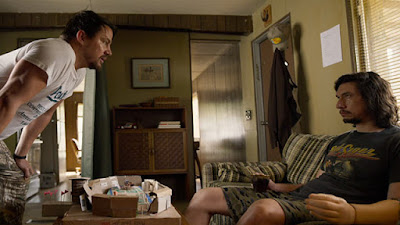
Clyde knows there's no way to talk Jimmy out of his idea—they're both down on their luck, so he throws in, especially after taunting Clyde with his "dare" code-word: "Cauliflower." The two decide that they will need help from the best safe-cracker they know—only he's still in prison. That would be Joe Bang (some guy named Daniel Craig) who, although he's glad to see the Logan Brothers thought enough of him to visit, still think they are crazy if they think they're going to recruit him for a job. He is, after all, "in-car-cer-rate-ted," and won't released for five months and Jimmy's timetable has the robbery happening in...what, five weeks?
People must be right: those Logan boys are crazy. ("Who says that?")
But, they're undeterred. They need Joe Bang, so they decide they'll expand the project: they'll figure out what they need to do to get the cash, then spring Joe Bang from prison, carry out the robbery, then put Joe Bang back into prison without anybody suspecting that he left in the first place. Some plan. But Joe is skeptical. 
But not skeptical enough not to suggest that when the Logan's are doing their reconnaissance that they get some aid from his brothers, Fish (Jack Quaid, son of Dennis Quaid and Meg Ryan) and Sam (Brian Gleeson, son of Brendan and brother of Domhnall) to do some leg-work. Although professing to have turned over new leafs and turned away from criminal activities, the brothers decide they will help the Logans this one time. With the driving aid of Logan sister Mellie (Riley Keogh, granddaughter of Elvis, the Elvis), they cement their plans and wait for the inevitable occurrence that makes all their planning go awry so that they have to punt in order to carry it off.
This is, after all, a "heist" film, something Soderbergh is familiar with, having previously directed Ocean's 11, 12, and 13. It's a format and genre with which he's comfortable and it offers a director a great deal of flexibility, especially if the target is a real location (and they can go into "documentary mode" which is attractive to Soderbergh). The elaborate "job" is the constant with all of its intricacies intact; everything else is up for grabs, interpretation, ad-libing and improvisation. As long as the skeleton of the caper is in place, everybody can flesh it out as they see fit.
The difference here is location, location, location. Even though the "Ocean" movies belong to the same genre, the same "type" of film, they couldn't be less similar. The differences are literally night and day—Logan Lucky is not a bunch of cynical smart-asses trying to trump each other in the twilight of the morally arid desert of Las Vegas, where the only thing natural is the celery in a Bloody Mary. The setting here is rural in the daylight, without the hint of glitz but only the aspiration of bling, and although the root of all enterprise is the money gained from the vice of gambling, it is not bathed in neon but motor-oil, the greed tempered with the sense of accomplishment, the inspiration centered around family values, which are seen as surpassing any monetary equivalent.**
"WE are DEALING with SCIENCE here"    
   
Unlike the Ocean's, the plot doesn't involve anything like hacking ("I know all the twitters" says the one computer "expert" of the group), or any real technology of any intricacy (and the only "bugs" used in the plot are cockroaches—real cockroaches). This is a low-dig' crime  depending on being able to tap into the technology of the track's own "money highway"—the Logan gang just provide an extra off-ramp for their convenience and enrichment.
The other thing different is that the circumstances reach an epiphany of sorts— something the other heist movies of Soderbergh's never achieve—that changes motivation and resolution, eventually creating a situation where it almost becomes a victimless crime for all the principles, ending in acts of charity that only enhance its theme of family. At the heart of it is not greed or revenge—leave that to the 1 percenters—but a conviction that if it's going to count, make it count for something.

* How many times is this—the second or third? I've lost count, but it doesn't really matter. Soderbergh will never really retire, as he has film running through his blood like red corpuscles. He's a natural film-maker. But, being a good film-maker is only part of the job if you're doing things through Hollywood. Soderbergh has always had the indie spirit, writing films, shooting films, editing films, even if they're not his own. But, in Hollywood, making movies is two jobs—the making and the financing. Soderbergh hates the capricious winds of Hollywood and seeing the next two years' work evaporate because a studio-head is having a bad day. So, he's always been looking for the new business model: self-financing, releasing through theaters and the internet simultaneously, his own production company—first with George Clooney and then by himself, television sales, and Logan Lucky's model—self-financed with a skeleton crew and with the financial help of states' funding and one big beneficiary-NASCAR, utilizing a new releasing company, Fingerprint Releasing, founded by Soderbergh. The end-titles say "Nobody was robbed during the making of this film. Except you."

Daniel Craig and...that's Dwight Yoakam, ladies and gentlemen

** I would suggest that "family values" was at the root of some of the casting, too, from the casting from so many branches of sow-buisness families, but Soderbergh did that in the Ocean films with lesser-names of the big name families of Caan and Affleck.

Friday, June 2, 2017

Alien: Covenant

The Horrifying Hybrid
or
I think I was trying to suggest something about the duality of man, sir.
The what?
The duality of man. The Jungian thing, sir.
Whose side are you on, son?

Ridley Scott is a really frustrating director (for me, one should reiterate). He is a master of the image. Think of a movie of his and some image will pop into your mind that is so beyond the norm of what has gone before that it takes your breath away. Below are a bunch of screen-captures of various Scott movies.* None of them have movie-star's faces in them, they're scattered throughout Scott's filmography (and thus, were achieved either photo-chemically or by CGI and, amazingly, it doesn't make a difference), but if you've seen these films, you can identify which of Scott's films they are from, just from the indelibility of the image. 

Take a look:
Beautiful. Amazingly composed, with a painterly color pallette, and exquisite in its detail. Artistic.

It's just too bad some of them are really bad movies. Gorgeous, sure. But bad.

And you're never sure what you're going to get with a Ridley Scott movie; it might be beautiful to look at, but also completely lunk-headed, insufferable, or botched, whether by studio interference (Blade Runner and Legend) or by Scott's way of over- or under-thinking his movies, so that he forgets what they're actually about in the process. It's why Ridley Scott is a well-regarded director, but he's not in the pantheon of innovators or "great" directors. He may make great looking art, but is not considered an artist pushing the art-form forward, sort of a Thomas Kincade of directors.

So, here's Alien: Covenant, Scott's second sequel to his 1979 Alien, his sequel (of a sorts) to 2012's Prometheus, and a return to form of what the series is—not speculative fiction as Prometheus lurched towards, but back to horror, as in the original.**  
After a brief scene between the android David (Michael Fassbender again) and his manufacturer's CEO Peter Weyland (Guy Pearce again) where they discuss "the big question" (where do we come from?), we jump forward in time (past Prometheus, time-wise, by ten years, to 2104) to the good ship Covenant, a colony spaceship tasked with establishing an outpost on a distant planet that has been surveyed from Earth, Origae-6. The ship is tended by its onboard computer, "Mother" and a lone android, Walter (Michael Fassbender...again), who oversees the automated systems*** keeping the cryo-sleeping crew and colonists, as well as a couple thousand embryo's to, I don't know, "seed" the planet (first thing they need to build on this planet is an orphanage!).
The crew of The Covenant: don't get too attached to any of them...
The ship is damaged in an ion storm (caused, presumably, by the meteor shower that damaged the Avalon from Passengers, six months earlier)**** which wakes up the crew before their appointed time. The captain of the vessel, Branson (an unbilled and only briefly seen James Franco) is killed in the resuscitation, leaving the ill-prepared First Mate Oram (Billy Crudup) as captain, and Branson's widow, terraforming expert Daniels (Katherine Waterston) grieving and alone. After making repairs to the ship, the pilot Tennessee (Danny McBride*****) receives a weird ghostly transmission in his helmet communicator that interferes with him getting back to the ship. Analysis of the signal shows it coming from a relatively nearby planet with Earth-like conditions. In a weird moment of "the-only-reason-to-do-this-is-to-keep-the-movie-going," the usually careful captain decides to check it out, rather than continue on the prescribed mission to the original destination.
Once in orbit, a landing party descends to the surface and they find an idyllic, if dramatic landscape of flora, but no fauna. Daniels remarks that there is no sound—no birds, no animals, nothing. To any rational person that would make one think that maybe, because they're the only life detectable on the planet, they should maybe get those thrusters warmed up and get out of there, but, no.
Recently, I heard some wag say that it doesn't matter what the first thing you say is important, but it will get really interesting if the second thing you say is  "...and then people began to die." Well, after some exploration of the planet and tromping around as humans do so delicately, that's exactly what happens—people begin to die. And they die in spectacular fashion, hatching those critters that we've come to expect. And then, because it needs to, their lander blows up.
So, after everybody's trapped on the surface with a couple rampaging beasties skittering through the high grass and their communication cut off from the main ship, they're rescued by a familiar face—it's the android David, who's been living on the planet for ten years after the crashing of the ship from Prometheus carrying him and Dr. Elizabeth Shaw (Noomi Rapace) in their quest to find the planet of the Engineers, whose little weapons experiment facility they found in the previous movie. David takes them to his hideout, while they figure out how to contact the Covenant and get out of there.
Really, that's all you need to know if you want a spoiler-free review, but, any viewing of the previous Alien films tells you exactly what will probably happen. It's familiar killing grounds in Alien: Covenant, it's just the way that they occur that makes them unique. Then, there's the added wrinkle that we have two androids in the series, David and Walter (Fassbenders, both) who are interacting with each other: David, with his Lawrence of Arabia fetish and genteel British accent and perverse curiosity, and Walter, whose accent is very American and is a bit of a neophyte...for an android, that is.
So, expect a lot of the expected in Alien: Covenant. That Scott abandoned the "Paradise Lost" project (albeit mentioning events briefly in flashback) and went back to "formula" is a bit of a disappointment. That he has made a hybrid film, borrowing liberally from the James Cameron episode and from his own Blade Runner (even to the admiration, even preference, that he showed for the synthetics rather than the humans involved) is also a bit of a downer, calling back elements from those films rather than offering something more challenging to the audience. One wishes there were some hope for the series going on (Scott is saying that he'll make two, no, three more sequels before we get to the original's time-line), but, really, there's no place for the series to go except to endlessly re-generate the same scenario in a nihilistic fashion.
That leaves me rather bugged.


* They are (in order): Alien (1979), The Counselor (2013), Legend (1985), Black Rain (1989), The Duellists (1977), Gladiator (2000), Blade Runner (1982), Thelma & Louise (1991), White Squall (1996), The Duellists, Prometheus (2012), 1492: Conquest of Paradise (1992), Gladiator, The Martian (2015), Blade Runner, The Duellists, Black Rain, Thelma & Louise, Legend, Gladiator.

** Scott originally wanted this to be a direct sequel to Prometheus, entitled "Alien: Paradise Lost", but when Prometheus proved divisive among the populace, he chucked that notion, handling the plot components in flash-backs (and internet-only sneak-peeks), and went with something a bit more like the original. Why Scott came back to Alien is a question in itself. The man's 80 years old now and perhaps he tired of working on things like The Counselor and Exodus: Gods and Kings that flop at the box-office and went the George Lucas route of going with "what works."

*** There would appear to be gravity and life-support on a ship where everybody human is in cryo-sleep, presumably to protect the very resources that are being squandered on one non-breathing android. Why?

**** And that wouldn't be as far-fetched a coincidence as some of the ones in the Alien series where the tag-line should be "In space, everybody runs into each other..."

***** I have to confess: while one shouldn't walk into movies with prior expectations, I was really looking forward to a scene where Danny McBride gets offed by one of the xenomorphs—I rarely have seen McBride in anything where I found him with an ounce of talent or charm, he's one of those few actors I actively don't like. But, here, he's terrific, taking an under-written part and bringing a lot of good choices and subtle nuances to the role. I'm now a fan.