Showing posts with label Ezra Miller. Show all posts

Saturday, June 24, 2023

The Perks of Being a Wallflower

Written at the time of the film's release...

Something from Nothing
or
No Man is an Island of Misfit Toys 

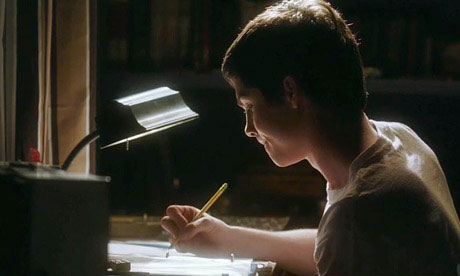
Charlie (Logan Lerman) is starting his first year in High School as a freshman and he has a lot to learn. He's shy, introverted, and fragile the result of some trauma we know not what going in. He walks the corridors friendless, a punching bag for the cool kids and their posses. His parents (Dylan McDermott and Kate Walsh) are lightly caring, and his English teacher (Paul Rudd) reassures—"If you make one friend on your first day, you'll do good." "If my English professor is the only friend I make today, that'll be sorta depressing."

But Charlie does have one friend, writing to him about his experiences, pouring out his frustrations and observations in letter after letter about his "trying not to be a loser." The friend is anonymous, may not even exist, or once existed, but those letters keep Charlie going and serve as his avenue of expression, rather than having his day pulled out of him at the family dinner table. It's an uphill battle from some valley that isn't discussed, but Charlie is self-aware enough to know some perspective. "My life is officially an after-school special," he grouses.

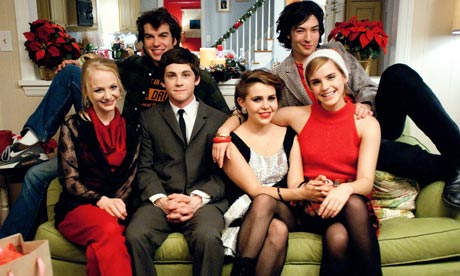
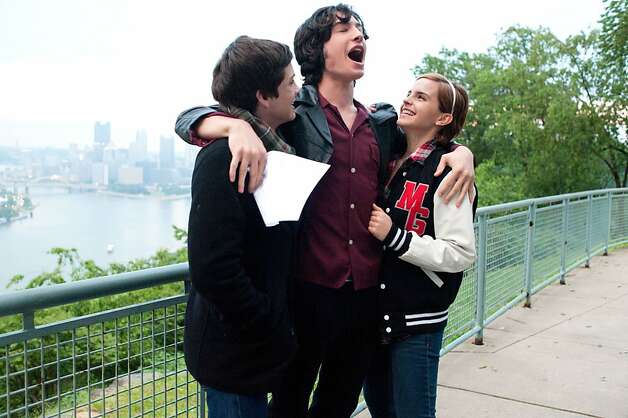
At a football game, he meets Patrick (Ezra Miller), a senior and the subject of some casual bullying, but Patrick has a wicked sense of humor that he throws out with no hesitancy as a shield. Charlie gravitates to him, and meets Patrick's step-sister Sam (Emma Watson), also a Senior, but who is coming back from "having a reputation." After the football game, the three hang out at a diner and compare notes of commonality, which involve a distinct lack of fitting in with the high school social structure, and Charlie is introduced to more of the group, who hold fast, hang out, and provide safety in numbers and a fresh perspective on the puerile benefits of normalcy.

The Perks of Being a Wallflower
(written and directed by Steven Chbosky from his own novel) is a fine quirky example of a "Coming of Age" movie, that sub-set of the teen flick where lessons are learned (his life really is an after-school special) and is not so much a film about growing up, as growing out. Growing out of the insular self-inspection, narcissism and selfishness that is comfortable and has no risk, it's dark and warm and safe in that little "black cave of the psyche." But is it? That cave only echoes one's own thoughts back to us, providing no perspective and no horizon to reach to or for.

Yeah, it's pretty safe in there...if there aren't any demons or other creatures of the nightmare lying in wait to strike when you're most vulnerable. And we all have those. And even if we don't, the echoes of our own thoughts are only phantoms and zephyrs, not sustaining, and if that's all we cling to, they become echoes of echoes, distorting, becoming less clear, and often impenetrably undecipherable—a feedback loop. 


And feedback loops, uninterrupted, can become weapons.
Charlie is scared. And ashamed. And that limits his choices, when he does make a choice. Most of the time, things are just foisted on him and he has to make a decision: like this, or don't? Comfortable or not? Aware, or comatose? And by the time, he makes a decision, it's usually too late, putting him a tail-spin, and another trap. His fellow wallflowers are in traps, too (isn't that what High School is all about?), but one thing he learns is that they're not the only ones and the traps, self-made or imposed are universal.

It's a good film, with good imagery, but a neophyte director's tendency to hit things a little too square—the shot from the communion wafer to the LSD tab, please—but the performances feel real, Emma Watson is a helluva dancer, and it's a good trip down memory lane, now that it's gone and out of our lives. "See ya, wouldn't wanna be ya"


For the truth of the matter is, we all grow out. We couldn't survive if we didn't. Yes, "we are infinite" as the movie's tag line wants to be sure we know.  

But not individually.

And not by ourselves.
Out of the black cave and into the light

Friday, June 16, 2023

The Flash

The Blade of Grass is Always Greener in the Other Meta-verse
or
Whatever Happened to The Scarlet Speedster?
 
Let's start with a bit of history: when I was a kid (and older), I loved "The Flash" comic books. The character had a lot of history, and (for some reason) was usually the lynch-pin for any big comics event. They re-invented the character (in the comics, his identity was police scientist "Barry Allen") with a more scientific basis to create what was dubbed "The Silver Age" of comics. In 1961, when "The Silver Age" Flash managed to traverse dimensions and meet "The Golden Age" Flash from the 1940's comics, it ushered in DC Comics Multiple Earths, a fictional representation of the Multiverse Theory. When sales of his comic weren't (shall we say?) "up to speed" the publisher decided to kill the character off in "Crisis on Infinite Earths" (designed to eliminate the multiple Earths and simplify the comics line for new readers. 
 
Demand for the Silver Age Flash to be resurrected led to that happening, and then soon after DC decided to "re-boot" its entire line of comics (the idea was called "The New 52"), they decided the catalyst for the change would be The Silver Age Flash, who —due to the machinations of one of his villains—finds himself in an altered reality where he has no powers, there is no Superman, there is a Batman (but he's Thomas Wayne, as it was Bruce who was shot in the alley in that reality), there is a war going on between the Atlanteans and the Amazons, where Wonder Woman assassinated Aquaman, and so on. And the Flash has to fix all of it, and get it back to his reality...which of course, would be the "New 52" revamp. That all happened in a comics "event" called "Flashpoint"
Got all that? You might think that comics are stupid, but they sure can get complicated.
So, this movie, The Flash, has its origin-bones in that "Flashpoint" story but grafts it into the DC Movie Universe sticking to the one "changing history" aspect of it and going its own way. In it, Barry Allen (Ezra Miller), on the eve of a potentially losing appeal by his father (Ron Livingston now)—in prison for being falsely convicted of killing his wife, Barry's mother (Maribel VerdĂș*)—discovers that he can go back in time, and, in fact, pick-and-choose many time-lines, and affect what has happened in his past. Cautioned by Batman/Bruce Wayne (Ben Affleck) that he could haphazardly "destroy...everything," Barry figures out a way that he can alter events without actually being seen or interacting with that time-line in order to prevent his mother's murder.
Yeah, well, going back in time to change things is...never easy. In fact, the only thing tougher is pleasing a rabid movie/comic fan-base with singular expectations of what would make a "good" Flash movie—is it related to the TV show? ("why not?"), Michael Keaton's Batman is in it? How about Val Kilmer's? ("why not?") What about "poor" Henry Cavill?—and for every "slight" to their expectations, the "Rotten Tomatoes" meter will drop closer and closer to a green blotch (as if that mattered). No, The Flash will not meet an awful lot of people's "wish lists." It's not world-building. Quite the opposite. It's not setting up the next chapter of a franchise (like we're used to). It is a self-contained story that could conceivably not have—or need—a sequel. It's just considering the possibilities. It's what DC used to call in the Silver Age "An Imaginary Story." Writer Alan Moore ("Watchmen," "V for Vendetta," "Batman: The Killing Joke," "From Hell") had the best rejoinder: "Aren't they all?"
So, how is it? I'll use a word that hasn't been much used since comic-movie-makers have been striving to make their super-heroes "credible"—"Let's dress them in leather!" "Let's make them bad-asses!"—it's hilarious.
And hilarious in a good way! From it's opening sequence where Barry Allen (Miller) aka "The Flash" must spend an excruciating amount of time waiting for his carb-filled PB&J order and gets interrupted by a call from the Justice League (well from Wayne butler, Alfred—Jeremy Irons) to race over to Gotham City where thieves have stolen a toxin from a local hospital. Thieves being so smart they're dumb, they've managed to undermine the foundation of the hospital where it's at the brink of collapse. While Bat-fleck goes after the thieves, Barry-Flash must save the people trapped in the hospital. What ensues is a sequence straight out of Rube Goldberg by way of Buster Keaton, as The Scarlet Speedster, must save falling babies out of maternity ward by "any means necessary." And in Barry's perceived bullet-time, all those babies each have their own individual perils that he must solve in the—to him—excruciatingly long time it takes them to fall.
Director Andy Muschietti has filled the sequence with such giddy malice that one cannot take any of it too seriously, especially when he and scenarist Christina Hodson build on the sequence, complicating it with more dangers that Flash has to solve. Sure, Batman gets to use all his toys for an extended chase, that strains credulity, dragging him along Gotham highways in the sturm-and-drangy way we've become accustomed to, but The Flash sequence sets up an atmosphere that dilutes suspense in favor of a pell-mell momentum that's rather exhilarating.
We'll stop there for a synopsis over-view because to say anything more would be like spoiling the punch-line of a joke. It's not as funny—or, at its core, surprising—if you can anticipate how it all ends. There are just too many twists and turns and laterals and feints that will be telegraphed, ruining little moments and small that are intended to take you places you had no idea were coming, or even existed. If you think you know what's coming, you're just wrong, even for all the hints and speculations that leaked out in the marketing.
Key to making this work is Ezra Miller. I've always had problems seeing him as The Flash and his presentations in both versions of Justice League (but especially Joss Whedon's) where he was a manic goof-ball and grating comic relief. But, Miller comes out of his supporting-role comfort zone and proves that he can carry a big splashy movie with amazing ease. And he's a hell of a performer, playing two versions of the same character, but with two different histories and stages of development. That's a trick in itself, but Miller makes it look easy, with a gutsy level of letting himself look stupid without losing the basic integrity of the character and making the drama and emotion of the thing work. And for all the manic energy that he throws out, he still manages to have one of the best dead-pan reactions for comedy. Say what you will about him (and everybody has!), but he's just damned good in this.
What else are people talking about? Oh...cameos! Yes, there are cameos, both voluntary and not. And, yes, Keaton is great—he always is. And the "Supergirl" we're introduced to (
Sasha Calle) is terrific.
And the special effects? There's been a lot of kvetching about that, but an early sequence in what will be called the chrono-globe (or some such—maybe we should call it "The Uncanny Valley?") sets up a non-photo-realistic quality that carries out throughout the rest of those sequences (assuming that's what everybody is talking about—I have no previous experience with what constantly shifting time-lines actually look like, so I couldn't judge!) that generally smudges perceptions of what we think we should be seeing.
I could quibble with a prolonged sequence based on Man of Steel where Michael Shannon seems less than engaged, but director Muschetti has always had an observable weakness when it comes to big set-pieces. One would have thought if he could juggle a bunch of falling babies, he could handle a super-hero slug-fest on four fronts, but it falls just shy of being super. I wasn't crazy about the "never-ending battle" in Man of Steel for that matter.
But, was I entertained? Heck, yeah. As much as when I used to close the cover of a good comic-book. So much so that I didn't mind when Muschetti pulls off a final "gotcha" that was just as amusing as its meant to be, upending people's pre-concieved notions and messing with their minds. It's a story, after all. One with limitless possibilities and a perverse willingness to "go there."
 
Aren't they all?
 
Well, no. But, they should be.

* One of the many joys of The Flash is to see VerdĂș again, who was in Coppola's Tetro, del Toro's Pan's Labyrinth, and Y Tu Mama Tambien.

Wednesday, September 15, 2021

Zack Snyder's Justice League

Zack Snyder's Justice League
(Zack Snyder, 2021) Buying the DVD of Zack Snyder's Justice League—his sanctioned "taking-back" of the Warner Brothers "studio-notes" theater version—cost as much as two months of HBOMax, and I must say, in comparison, it was a bargain. I have been reluctant to be swayed into buying into streaming services, maintaining that theaters will come back, and there are very few enticements for having them take money out of my accounts month after month, when the economic model necessitates other means of seeing them.
 
So...(I hear you ask) "is it better?" Yup. And by a wide margin. My initial review of the theatrical version of Justice League was somewhat laudatory—more concerned with knee-jerk backlash towards it—but, in seeing it again a couple times one could see the pacing issues, grating inconsistencies of tone, a certain desperation in the product to compress the content gracelessly and be winsomely attractive. "The Snyder Cut" takes more chances and takes a lot more time doing it. The Warner mandate to cut Snyder's intended two-part 4 1/2 hour opus into a single 2 hour film must have seemed an impossible feat to accomplish (and one must give kudo's to Joss Whedon for even attempting it and managing to meet their specs despite the ham-fisted result), especially when the evidence shows just how much of Snyder's film wasn't in the theatrical version (which we'll simply call "Josstice League"). The story is basically the same, but, good Lord, there are whole completely different versions of scenes throughout the thing, with nary a line repeated. There are bits and pieces in the story-line—the first Earth-war with Apokolips, the Gordon scenes, the confrontation at the "Superman memorial"—but for the most part the shot choices and dialogue are unique to this version. There are far fewer "oh, yeah..." moments than "that's new" moments. And, for me, there weren't any "I miss that" moments...at all.
The length is daunting, which is why I think it was never, ever intended to be one film (that and Snyder has a tendency to make super-hero films that are already prepping for sequels). Still, the overall experience of watching it feels much more organic than the cropped mess of the "Josstice League." Segments progress naturally—they "feel" right. And more importantly, the big action set-pieces—like the fight under the Gotham harbor—finally "work" in how they're shot and edited in sequence—they have geography and you see how things are playing out among all parties and how the stakes rise and fall as they intensify.
What's more, the film hinges on the characters given short-shrift in "Josstice League"—those being Jason Momoa's Aquaman, Ezra Miller's Flash, and especially Ray Fisher's Cyborg. Sure, there's plenty of scenes with Gal Gadot's Wonder Woman and a lot more with the Amazon's, a couple of tid-bits with Ben Affleck's Batman (with even more taken out), less haggling among the heroes, more of Alfred (Jeremy Irons), more of Joe Morton's Silas Stone and his co-hort at StarLabs, Ryan Choi (Ryan Zheng)—these are all improvements utilizing good actors—and you get representations from Jack Kirby's gallery of "Fourth World" villains (most prominently, Kirby's "Big Bad Guy" Darkseid), and a considerable "Steppenwolf" upgrade.
It's the three heroes-in-hiding from Batman v. Superman: Dawn of Justice, that get a lot more coverage and a bit more respect. Momoa's Aquaman has a lot more scenes with Mera (Amber Heard) and now, also Vulko (Willem Dafoe) and there's a bit of a continuity gaff in that here, nobody can talk underwater as in the Aquaman stand-alone film (they have to make air-bubbles to communicate). The Flash is given more background including a rescue of young Iris West (Kiersey Clemons) and the character's annoying geeking is toned down substantially and slightly matured. But, it's the story of Victor Stone/Cyborg that is the most expanded and the most from which the film benefits. Fisher is given much more chance to shine as he goes from bitter accident victim to reluctant super-paraplegic to confident team member.

But, it's not all roses. This version is rated "R" for a reason. There are a couple of prominent "f"-bombs* that may be earned but won't impress the parents of young superhero fans. And the level of carnage is greater with prominent blood spatters (that would have been digitally removed for theaters) and the final disposition of Steppenwolf by Wonder Woman (she is an sword-wielding Amazon, after all) that is far more MPAA-adverse than just letting the bad guy be dispatched by his own minions off-screen. Edgier, but not the way parents, censors (or even the Comics Code Authority) would like. One is always aware that in the movie-world, the film creators are always less concerned with body-counts than the comics-heroes (as dictated in the comics by parental watch-groups) would be.
This prompts the question for whom film-makers are making movies, even though, in this special case, Snyder has had the supported mandate to please himself. With the content far more unconstrained than the behavior displayed in the four-color versions, are they making it for themselves, for the fans, or for the studio? One would say the first, less the second, with the third being the cranky arbitrator between the two. Snyder makes them for himself—what he'd like to see—and for that imagined film audience that wants more realistic, mature versions of childhood heroes (ala the Christopher Nolan model—Nolan is still the exec. producer of this one)** It's interesting to think about, given the many hands involved.
So, I was pleased with what I saw, tarnished slightly by the fact that I'd seen a bastardized version before.*** But, what a difference it does make to have a singular vision, whatever issues one might have with it, rather than an elephant made by committee. In a subtle way the film makes that point, and one hopes that Warner learns it, and that Marvel takes the lesson as a cautionary tale.

 
* One was deliberately added by Snyder in his "new footage" shot for the Snyder version. If he doesn't have to fight over it with the studio, I suppose he said "why the fuck not?" So, Batman says it. And Cyborg says the other one at the height of his bitterness.
** Nolan has been working exclusively with Warner for almost two decades, but the recent rifts over the super-hero movies he and his wife have shepherded there (and the studio's insistence on simultaneous streaming) have had a consequence—Nolan's next film (involving J. Robert Oppenheimer) is being made with Universal. Warner wasn't even being negotiated with.
*** One curiosity I had was the way the theatrical version photographed Gadot's Wonder Woman—it's more sexualized, seeming to concentrate on her posterior than apparent when Snyder and director Patty Jenkins called the shots. And, yes, Snyder had no such prurience in his cut.

Batman gets Frank Miller's goofy Bat-tank.

Saturday, May 30, 2020

Notes on the DCEU

I'm going to be recording a podcast discussing the DC Extended Universe films later today and I thought I'd do a gut-check on current thoughts about them that have differed from my views in the offered posts...it's a way of putting things into perspective and eliminating free-ranging thoughts that aren't pertinent—the panel is going over five films and detours and dead-ends won't help much.

To review, here are the posts of the five films in question:


Man of Steel:
https://bloggingbycinemalight.blogspot.com/2016/03/man-of-steel.html
Batman v Superman: Dawn of Justice:
https://bloggingbycinemalight.blogspot.com/2016/03/batman-v-superman-dawn-of-justice.html
Wonder Woman
https://bloggingbycinemalight.blogspot.com/2017/06/wonder-woman.html
Justice League:
https://bloggingbycinemalight.blogspot.com/2017/11/justice-league.html
Aquaman:
https://bloggingbycinemalight.blogspot.com/2019/01/aquaman.html

1) There are films missing: Suicide Squad, Shazam!, Birds of Prey. There is a shared Universe aspect to these...Ben Affleck's Batman and Ezra Miller's Flash appear in Suicide Squad, and Henry Cavill's SUIT appears in Shazam! but these films are back-channel/alleyways to the main streets of the other films...the way Guardians of the Galaxy appeared when its trailer plunked down in the middle of the Marvel run of movies.*

Also, there are other films missing: Christopher Nolan's "Batman" films—it was Nolan's success with these that steered Warner Brothers to expand their DC Comics properties and drag them out of development hell, and they pegged Nolan to spear-head Man of Steel as executive producer. He was part of the decision-making team that hired Zack Snyder to direct and helm the project and oversee the accelerated the roll-out of the DCEU.

The biggest difference between the Marvel and DCEU game-plan is that DC had no executive overlord like Marvel's Kevin Feige to master-plan the films and the hired-hand directors must do battle with the Warner Brothers studio over all strategic matters. There once was a time when Warner Brothers would champion the films of directors like Stanley Kubrick and Robert Altman and so many others—the priority was the films. Now, it's the bottom line.

The money has always been important, of course. Everything about a film, especially its budget, is concerned with making that money back and extend it to profit. But, these superhero movies are considered less than movies: the goal is not to tell a good story or make a good film, but to make as much money as possible. They are properties, but more than that, they are considered "tent-poles" on which studios depend for their very existence lest they fold. That's a lot of weight to be put on a pole.

The emphasis should be on making one good movie, rather than a series of them. Don't count super-chickens before they're hatched; make a good one and then you have the right to make any further ones. But, not until. There's a story about Sean Connery: Christopher Reeve called him (when he was cast as Superman for the 1978 Richard Donner film) and asked the man who was James Bond how to avoid being typecast and Connery's reply was apt: "First, be good enough that you DO get typecast, then worry about it..."

Studios should heed the advice.

2) The reviews were written of their time; If the movies had premiered in a media-vacuum, there might have been less time spent on the reactions, assumptions, speculations...and outright mendacity upon (and even before) the films' releases. My reviews are a bit too much a push-back against all that noise; better to stick to the subject than the echo, of course. Perhaps I'm giving the two "Batman" films too much credit—I do think they took admirable chances—and the display of the fallibility of Batman (exploiting his cynical cautionary nature) is a good choice, but at the expense of the Superman-dark emphasis, which might have been a fatal flaw in Batman V Superman. Snyder's Superman is so morose and misunderstood, one doesn't feel tragedy at his death, merely a deepening depression—we never see "the big blue boy-scout," only Superman under siege and doubting, never sure of his purpose and offer inspiration. We only see Batman's view (exacerbated by Lex Luthor's machinations) and that is not a pleasant movie-going experience. At least Justice League allowed a glimpse of "that" Superman to offer the contrast, but by that time the murk of the DC Universe is so pervasive that it's almost jarring.  

3) It was announced this week that the mythical "Snyder-cut" (or "A Snyder-cut") of Justice League will be made available on HBO MAX next year. One wonders exactly if it's necessary or what it will entail. Some effects work needs to be completed, evidently, and this version is reportedly 4 hours long...whether it is the originally conceived two-part film or merely a really long part one, one can only speculate (and there's quite enough of that going on). One suspects it will be a mixture of good and bad, not unlike the "Donner-cut" of Superman II, but at least one would be able to see the original intention, rather than the make-shift corporate compromise Warner Brothers sanctioned. 


* And there is another one—2011's Green Lantern (plunked down between The Dark Knight and The Dark Knight Rises) pre-dating Man of Steel by a year. No one has mentioned 2019's Joker.


Thursday, November 22, 2018

Fantastic Beasts: The Crimes of Grindelwald

Bébé LeStrange (Losing All Credence)
or
Fantastic Beasts and Where NOT to Find Them.

It is a year after the capture of Gellert Grindelwald (Johnny Depp) in New York during the events of Fantastic Beasts, and Where To Find Them, and he has spent that year locked away in the prison run by the Magical Congress of the United States of America. Unable to break him, or even learn what the dark wizard might be planning, they decide to transport him to England's Ministry of Magic, so as to...well, one isn't sure what they can do with him, exactly. But, transport him they must in order to get the plot going. While Grindelwald is sent by flying Kestrel driven chariot, one of his followers in hiding effectively distracts the guards keeping him under lock-and-wand, and the seemingly placid prisoner, manages to take control of the vehicle and send his keepers plummeting to their deaths. Well, it would be their deaths if they weren't wizards...one of them manages to halt his fall before he hits the briney and then *splash* he goes into the drink, while Grindelwald flies off to what we eventually learn to be Paris, as he has business there and people to find and corrupt.

A wizard's work is never done. 
Three months later, Newt Scamander (Eddie Redmayne) is back in London, being called on the carpet (flying, presumably) for his part in the events in New York. The Ministry has revoked his travel privileges (as if they can't be worked around) and offer them as the price to work with the Ministry to find young Credence Barebone (Ezra Miller), an Obscurial he encountered in New York, but has now been located in London. Despite the Ministry's offer and the entreaties of both his brother Theseus (Callum Turner) and his fiance Leta LeStrange (ZoĂ« Kravitz), an old chum of Newt's from their days at Hogwarts—although it is implied that she thinks she might be engaged to the wrong brother). Newt is a magi-zoologist and "doesn't do sides" in what looks to be a nasty struggle. Famous last words.
On his way home, he runs into his old teacher Albus Dumbledore (you remember him, but either as Richard Harris or Michael Gambon, when he was an even older teacher, not, as here, by Jude Law—who is quite good). Dumbledore also asks him to find Credence, but Newt remains a neutral party. He goes home to tend to his Fantastic Charges—such as the underwater critter, a "kelpie", who has a habit of nipping Newt's fawning helper, Bunty (Victoria Yeates), before retiring for the evening. No such luck.
He finds his friends from the last adventure, Jacob Kowalski (Dan Fogler, who's starting to remind me of a fuller Alan Arkin) and Queenie Goldstein (Alison Sudol), have traveled to London on their way to visit her sister Tina (Katherine Waterston) who is doing some investigating for the Ministry in the city of Paris. Coincidence? Hardly. Newt notices that Jacob is behaving strangely—he's completely agog with Queenie and he surmises that she's used a hex on him, of which Newt strongly disapproves. Her reason? She wants to marry Jacob, but there's some dumb rule about magical miscegenation that prevents it—and Jacob is too protective of Queenie to let the Ministry punish her for her actions.
Queenie runs off to find Tina on her own—there's some business about Tina not wanting to see Newt because she read somewhere that Newt and Leta were engaged—"fake news"—and despite her being an investigator she still decides to fall for it and have nothing to do with Newt. Well, now there's a reason for Newt to choose sides, so after getting his marching orders from Dumbledore, he and Jacob go off to Paris to find Queenie and Tina and Credence (which sounds like a heckuvan "oldies" concert).
Then, there's the Ministry's business: they're also looking for Credence, as well, as they think he may be the brother of Leta LeStrange, which is ridiculous because ZoĂ« Kravitz looks gorgeous and Ezra Miller looks...like Ezra Miller. Maybe he could be the brother of Adam Driver, but he's not in this franchise. Grindelwald is looking for Credence, too, as he thinks he's the only person on Earth—the wizarding Earth—who could kill Albus Dumbledore (other than Severus Snape, who isn't alive yet). Oh, did I mention there's a half-brother named Yusuf Kama (William Nadylam), who is also looking for him because he thinks he's his step-brother? Credence is the most popular guy in town, but the one who finds him first is Queenie, when she visits a mystical street-circus where a hunched up Credence is acting as the protector of Nagini (Claudia Kim), who will at one point become the snakey familiar of Voldemort...
See? At this point, the movie kinda breaks down and gets lost in some Potter's field of arcana that only a small handful of people might give two wand-shakes about. There are so many people who think Credence is SOME-thing, that most of them must be wrong...in which case, who cares? Credence is the MacGuffin in this one, like the Sorcerer's/Philosopher's Stone, Chamber of Secrets, Goblet of Fire, or the horcruxes of the Deathly Hallows. It's something everybody wants, but we can't guess at each one's significance until the end.

And this series is set to be five films long.

It makes your brain hurt, sets it rolling with Rowling. But, the film went astray much further than that, at least to my mind. That point came when screenwriter J. K. Rowling decided to abandon the concept of her original "Fantastic Creatures" and make it's font smaller in the title than "The Crimes of Grindelwald." For the truth of the matter is, there aren't that many "Fantastic Creatures" here, after about ten minutes of them, and they are only used as a way out of getting out of a tricky situation, whether as distraction or destructive force. I found this very disappointing. You shouldn't go into any movie with preconceived notions, but after the first, I was hoping the movie would continue its ecology theme of preserving the bewitched bio-diversity of endangered—and vexing—creatures, despite the slimness of the source material.
Instead, the stakes are expanded, creating a world-wide threat by the actions of Grindelwald, which, if we're to believe this movie, are more far-reaching even than Voldemort's: his plan is to unite the many mages throughout the wizarding world and break the 100 year peace established with the Muggles, the unenchanted. 
Newt's greatest fear: "a job in an office"
In a meeting of French wizards in the LeStrange family tomb, Grindelwald makes a case for the magical forces taking over the world out of the hands of the non-magical, starting with telling them that he wants them to live openly and to love openly (which appeals to Queenie). It's how to accomplish that utopia that bubbles the cauldron. That involves taking charge of the Muggles, poor inferior souls, dominating them rather than maintaining any co-existence, then as a capper, Grindelwald plays on their fears by displaying images from the coming second World War that ends with the apocalyptic vision of an atomic explosion. 
But, then, Grindelwald is just telling them what they want to hear—control of their world, making it theirs. You don't have to to walk to the far to the right politically to see a political parallel with today's world—Rowling injected the Potter books with flirtations of authoritarianism. But, here the parallels are far too noticeable and in a series more in line with the blockbuster sensibility of the high-earning Potter films. The studio is Warner Brothers, which used to be known as a sanctuary for letting film-makers be film-makers, but now known for sticking their grubby little hands in their franchise films.
It's a disappointment. There's only a couple of new beasts, only one of which is effectively used and that as a deus ex machina to get the heroes (and the writer) out of a jam. Unfortunately, that would appear to be the template for the rest of the films—re-do the Potter films with their well-connected central villain and just give lip-service to the Fantastic Beasts concept. The idea seems to be it's better to do something that feels more like the popular Potter films than to strike out with something different that might expand the universe and bring a unique experience.
I just participated in a podcast put out by the Large Association of Movie Blogs (LAMB) on the film and the general consensus was that the film was a big drop in quality from the first film, whether you thought the initial movie was good or not. It was amusing that the one thing everybody said was exceptional was the costumes. That sounds like the old trope that you shouldn't walk out of a musical whistling the sets. You shouldn't. But, for a fantasy that should inspire a sense of wonder, it's particularly un-magical.
"Oh! There's one!"