Showing posts with label Eddie Redmayne. Show all posts

Wednesday, May 24, 2023

Les Misérables (Musical; 2012)

The Song of Angry Men
or
"To the Barricades!"

I realize I am not the man to do a critical analysis of Les Misérables, the filmed version of the long-running staged presentation of the concept album produced by Claud Michel Schönberg, Alain Boublil and Jean Marc Natel, (from the novel by Victor Hugo) for many reasons: 1) I'm not terribly fond of musicals, finding the form unnatural and artificial—the inclination to burst into song having the requirement of being necessitated by the surge of emotion, which, if you do it too much, is a bit unsufferable—but, if the words and music are clever, born out of character and need, my prejudices can be batted away in the sweep of sheer admiration; 2) I’ve never seen “Les Miz” on stage, so this is my first exposure to the material, which I found musically strong, with nice linking strains between songs, but the lyrics, for the majority of it, trite and of the “Moon-June” variety, and the propensity to insert (with a guillotine) moments of light-heartedness in the midst of the most dramatic moments; 3) I have never liked the direction of Tom Hooper (who directed the mini-series “John Adams” with a heavy emphasis on unnecessary dutch angles, tortured compositions, and camera movement “baggage” for its own sake, and then directed The King’s Speech with a somewhat less gaudy eye, but a penchant for “gilding the lily” of competent performances with camera and lens tricks.
So, Les Misérables is almost a “perfect storm” of things I don’t like in movies, making me feel a bit uncomfortable about even attempting to discuss it without the need to eviscerate it like an after-meal chicken. Oh, there are things I thought were marvelous—the grittiness of it, the general down-troddeness of the whole thing, the brio of the effort in dragging it, naturalistically, to the screen, when everything cries out to leave it on the stage where it seems the presentation would be at its optimum.
So, kids, let’s get started. I’ll leave out the show itself, which has more than silenced its original critical drubbing by becoming the wildly popular “people’s choice” at the box office, entirely appropriate given its liberté/fraternité themes. Vive “Les Miz” and all that.But the stage presentation was already an odd ying-yang of performers belting out their inner emotions to the cheap seats, confessing their shame at the top of their lungs. To then bring it back down to intimacy, forcing powerful song material to be played out with naturalistic emotions—crying, snuffling, doubt—then compounds the confusion by compromising the musical material from its original intentions.
Then, director Hooper further piles on the emotional dissonance by shooting everything in very tight close-up, so we have intimate emotions couched in thundering expressiveness delivered at a timid range right in our faces. Hooper did no service to his actors here, threatening to expose every mis-step of their performances (which, by the way, was sung and recorded on set in real time) so close that the audience can’t miss it.
How’d they do? Admirably well, considering. Anne Hathaway will surely win an Oscar for the “I Dreamed a Dream” sequence alone, finding the right balance of giving the song its due, while also expressing the grief, humiliation and moments of rage in her character.
*
Towards the end of the film, Eddie Redmayne pulls off a similar gift with “Empty Chairs at Empty Tables” and, surprisingly, Amanda Seyfried makes the most of her moments with a high, feathery voice that doesn’t betray fragility. Hugh Jackman and Russell Crowe are other matters. Both great performers with musical pasts (the former on Broadway, the latter with his vanity band), both are very capable, but the material, production and presentation get the better of both of them, exposing Jackman’s reedy voice (somewhere between Anthony Newley and David Bowie) and Crowe’s pop sensibility to pitch to the note he’s seeking.
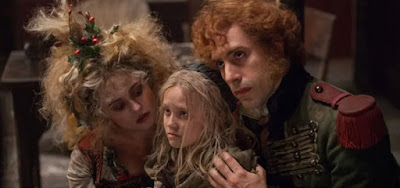
The unlikeliest successes are Sacha Baron Cohen and Helena Bonham Carter, as the unscrupulous Thénadier couple, because their song is a knockabout one with lots of stage business letting them loose from the trap of Hooper’s tight framing, and because Cohen is allowed to throw in a couple of ad-libs (in beat, mind you) between lyrics, allowing a little bit of fresh air into the proceedings.
For me, it was a train-wreck that seemed to go on forever, with only a couple of bright spots to give me hope. But, given the production’s history, I’m sure the people will rise above it all, despite the tyranny of the direction on display.

* One of the best lines at the Golden Globes was Amy Poehler’s about Hathaway’s performance: “I have not seen someone so totally alone and abandoned like that since you were on stage with James Franco at the Oscars."  And, yes, she did win the Best Supporting Actress Oscar.
  **  The creators of the stage version must have realized this, too, as they keep turning up and their capering has a tendency to undercut the heavy drama. Entertaining, yes, but at the expense of the rest of the play.

Thursday, January 21, 2021

The Trial of the Chicago 7

"'Fictionalizing History and Sorkin It Out"
 or
"Give Me a Moment, Would You, My Friend? I've Never Been On Trial For My Thoughts Before" ("It's a Revolution. We May Have to Hurt Some Feelings")

The Trial of the Chicago 7 has been in the works since somewhere around 2006 when Aaron Sorkin was introduced to the idea of writing it by Steven Spielberg, who wanted to make it as a directing project. Seemed like a good fit; Sorkin is the "dean" of writing compelling court-room dramas and has a knack for putting emotional juice into "wonk" arguments. That work results in some rapturous writing, even if one feels like opposing arguments are given short shrift for the "slam-dunk" moment. With him, it's a—you know—"a thing"

One wonders what Spielberg would have done with it. One knows it would have been a much more precise directing exercise. One hopes that Spielberg might have taken the script and roughed if up a little, textured it with a bit more grit, and thus friction, and thrown in some ambivalence to make the thing more of a courtroom "shit-show" (as it was) than anything too neat and tidy. Maybe an "anti-polish" of the script by the Coen Brothers could do that.

Because the way Sorkin tells it, it's all very neat and tidy with a wildly "boo-yah" finish, where the defendants are convicted on one of the charges—to incite a riot (rather ironic post-01/06/2021)—but their post-conviction statement is such a rousingly heart-felt protest that the crowd in the court-room (and even the prosecution!) gets up to applaud in solidarity.

In a word..."Nah!"

To be fair, trying to organize the ramshackle case number 69 Cr 180 The United States v. David Dellinger et al. into a coherent timeline of pertinent facts that has "a wow finish" is an almost impossible task. Yes, the case was a slap-dash collecting of "usual suspects" at the behest of the Nixon Administration, so that a consistent charge was specious at best. Yes, the trial went on despite one of the defendants not having the benefit of counsel. And, yes, that defendant ended up being bound and gagged for a good section of the trial. Yes, Judge Julius Hoffman was out of his depth trying to juggle the cats involved, ending up charging 175 combined contempt charges among the defendants and their lawyers, indicating not so much that there were violations, but rather that the judge had no control over his court.
What actually happened, you can find here and here. There are so many feints, fibs, and sleights of hand in Sorkin's "portrait" (rather than "a picture" he's said about the script, something he also said about his script for Steve Jobs) that I could write the rest of the review going over them. But, they're well-documented (the least of which is that there were eight defendants counting Bobby Seale, not seven—the man was only in Chicago to give a speech, but he was lumped in with the others because putting a Black Panther on trial was "good optics" for a cynical Department of Justice, until the optics turned horrifying).
It is a "given" that, unless someone is making a documentary, film-makers will swerve away from the facts (and even documentary film-makers will cherry-pick from their sources). No one was there in the room taking down notes for dialog (although, in this case, Sorkin did have the trial transcripts), so we don't know what was said behind closed doors. There's a writer's term/cop-out for making things up: "Writing to Silence," because there is no one around to object.
Except, of course, the audience.

What is the creator's responsibility—to the audience or to truth? Tough question. It should be kept in mind by any discerning audience member that when the line "Based on a True Story" appears that it is a hedge against accuracy: the actual Perdicaris taken hostage in The Wind and the Lion was a man, not a plucky widow, and we don't know what Neil Armstrong was doing by that moon crater, even though First Man has him completing an emotional story point in the film. It might be some dramatic license to make a better story, to tie up a dramatic loose end. Or, changing the facts might be some cathartic wish-fulfilment as Quentin Tarantino provided in Inglourious Basterds or Once Upon a Time in Hollywood.
John Ford famously used the sentiment "when the legend becomes fact, print the legend" even as, in his later films, he sought to negate it.

Sorkin is not above re-writing history for the perfect dramatic punch-line...he did it quite a bit in "The Newsroom," blending real-life events with a parallel universe news organization. And one can't forget the point in A Few Good Men when he ginned up false drama by making Tom Cruise's defense attorney appear unsure and faltering before delivering his final gavel blow. It makes no sense, other than to show his protagonist at his lowest point before his turn-around to triumph. He "had" to get one more dramatic beat in to make the ending suitably triumphant. Audience manipulation. Nothing more.

But, now—after this particular Inauguration Day—perhaps we should reflect on the responsibilities to Truth. Even if it makes the side you favor look bad...or less righteous. False narratives and wishful, even magical, thinking does not make it so. Rhetoric is the art of persuasion, but that art has to stand on the fundamentals of truth. Not just how we want the truth to be. No matter who's side you're on.
Well! "Other than that, how was the play, Mrs. Lincoln?"

Sorkin does a good job mixing in contextural news footage (and some of Haskell Wexler's footage from Medium Cool) from the times, with his DP Phedon Papamichael. Given the amount of material he has to cull from, Sorkin, as both writer and director manages to keep the personalities he's interested in—that is anybody except John Froines and Lee Weiner, who are given short shrift—engaged and sparring. Acting stand-outs negotiating the dialogue are Eddie Redmayne's Tom Hayden and Mark Rylance's William Kuntsler (Jeremy Strong's Jerry Rubin is a bit of a buffoon, unfortunately). But, the stand-out is Sacha Baron Cohen's Abbie Hoffman, not so much in how good he is portraying the trial's Merry Prankster, but in how good he is in the dramatic scenes, when the veneer drops and the words become measured and sharp as a knife.

Tuesday, May 12, 2020

The Good Shepherd (2006)

Written at the time of the film's release...

  The Good Shepherd (Robert DeNiro, 2006) Eric Roth's screenplay for The Good Shepherd seems to have gone through as many hands as states' secrets before actually being put before the cameras. A "personal" telling of the formation of the CIA, Francis Ford Coppola was the first director to have signed to it—then retained enough interest to keep an "executive producer" credit (although Wayne Wang, Philip Kaufman and John Frankenheimer—who interested his Ronin star, Robert De Niro in the project—were also briefly attached before De Niro, who was working on his own CIA project, took it over). Bless my tapped telephone line it has that same sort of "Godfather" family epic-feel to it, with just enough schmaltz and soap to keep it from getting too caught up in its overarching theme of constant paranoia. It also carries the similar pall of "the sins of the father" to it. You just know that the ambitions of the men in the movie will doom their families, if not themselves.
Edward Wilson (Matt Damon) is recruited out of college to join the Skull and Bones secret society, and with his first ratting out of a professor (Michael Gambon), his career as a spy takes the fast track. It's derailed slightly when a quickie with the Boss's precocious daughter (Angelina Jolie) results in pregnancy and a marriage of convenience. Then, when fencing with the Soviets keeps him overseas for years, his fair-weather family-life causes a Cold War on both sides of the Atlantic. 
Soon, Wilson learns, a little too late, that he should trust no one, as he plays against (and develops a mutual admiration with) his equal in the KGB. But its the same old story we've gotten used to in the spy genre. Everybody's a snake looking out for Number One, and trying to make "that Big Score," and yeah, okay, there's only a gray flanneled thread of difference between the spy network and Corporate America
Which brings us right back to "Godfather" country. CIA-Mafia-GM, there's no (*yawn*) difference. The only likable character in the entire film is director Robert DeNiro's turn as "Bill Sullivan"--a veiled version of Bill Donovan, but he's there for two quick dashes of cold-water perspective and is gone. Matt Damon seems not to age at all during the film, whereas Angelina Jolie does seem to gain twenty years. This film came out at the same time as The Good German, and I was hoping someone would combine them into "The Good German Shepherd". Well, I can dream...
It's interesting (well, to me, anyway) to wonder why Damon chose this part, seeing as how his "Bourne" films are merely the "fantasy" side of the "spy" franchise. If he thought that playing the "button-pusher," rather than the blunt instrument was an acting "stretch," he couldn't be more wrong.


Wednesday, May 22, 2019

My Week with Marilyn

The Battle of Mrs. Miller ("Whose Side Are You On?")
or
"What Becomes a Legend Most?"

"We are such stuff as dreams are made on" says Prospero in "The Tempest." Prospero and Shakespeare run through My Week with Marilyn (the latest confection of young love and fictionalized reality—with appearance by Judi Dench—from the Weinstein Company) like Caliban, a spirit of confused form and intent in Shakespeare's play. All the revelers in Simon Curtis' film (written—especially well by Adrian Hodges) are real, based on real individuals and events, but how true they are to the source is questionable, given as they are to interpretation and expectations, and to the dreams of the participants, for whom the movies and fame is a business, an art, as well as personal obsessions.
None more so than Norma Jeane Baker, who inhabited our world and our dreams as Marilyn Monroe, a free spirit trapped in prison bars formed of klieg lights, a vessel that men poured their love and lust onto and women their princess dreams of being the most popular girl in the world. Heavy, heavy burden, that, and she bore it from the lowliest, sleeziest agent in Hollywood to Kings of the Sports World and Men of Letters. She also bore it from other film stars, who looked at her fame and wanted a piece of it (and maybe her, as well), including Sir Laurence Olivier, who insisted on casting Marilyn in his production of The Prince and the Showgirl, a trifling movie if ever there was one, despite being written by Terence Rattigan, and despite having had a success of it on the stage. 
What Marilyn saw in doing the movie was obvious; she was working with the world's greatest Shakespearean actor and director on a film written by an acknowledged writer. Why Olivier wanted to do this is less so: financial success for his un-barded film; name recognition to draw the crowds for a film out of his metier; maybe he just wanted Marilyn, as so many men did, and the new bride of American playwright Arthur Miller (not the best looking guy in the world) might have provided a world to conquer for the actor who played so much ambitious Shakespearean royalty. Whatever the reason, Olivier was constantly frustrated with the fragile, neurotic actress, who had other concerns besides working with the exacting director—it was the only film she made outside of her protective home studio, 20th Century Fox, the only film she made outside of the United States, and the first film of her fledgling production company—all unique concerns that might have distracted the actress, on top of her new marriage to Miller and a hushed-up pregnancy during filming that resulted in a miscarriage.
The film that Hodges and Curtis have crafted from the events and a tell-all written about it by filmmaker Colin Clark (played by Eddie Redmayne), is one of the better ones to be made of this type. Casting has a lot to do with it. Michelle Williams is not the first person I would picture as Norma Jean, but the versatile actress manages to capture the presence of the human being at the core of the star and suggest the winsomeness that charmed so many in her orbit.
Kenneth Branagh has been linked with Olivier for most of his career, paralleling the legendary thesp by making his own film directing debut with a gritty, strapping version of Olivier's own first directorial effort of Henry V. His portrayal of Olivier might seem too easy, but there was nothing about the man that was 'easy," and Branagh has a fine time, mixing Olivier voices, accents, and mercurial swings throughout the film—his Olivier is never consistent in mood, manner or method, just as you'd expect a Master Thespian to be (he maximizes the precision of great lines like "Teaching Miss Monroe to ACT is like trying to teach URDU to a BADGER!"), but undermined with the idea that Monroe's "presence" on-screen had nothing to do with his efforts behind the camera.
Rounding out the cast are such fine performers as Toby Jones (hilariously indecent as Marilyn's publicist and future Planet of the Apes producer Arthur P. Jacobs), Dench—playing a woman she once acted with, Dame Sybil Thorndike, Dougray Scott as Arthur Miller, and Weinstein go-to girl Julia Ormond as Olivier wife-partner, Vivien Leigh, as well as turns by Zoë Wanamaker, Derek Jacobi, Emma Watson, and one of my favorites, Michael Kitchen. Redmayne is fine and callow, as he's supposed to be, eyes always a little bit wide at a new turn of events in the film business, and a tentative, crooked half-smile his constant fall-back.
The script is full of great zingers about fame, fortune, the madness of the movie business, and how hard people work to make things look effortless (and on-time), as well as loads of gossipy references for "the blue-hairs." It also has a nice undercurrent that touches on fantasy and reality—hence the Prospero—and the process by which reality and the illusion of reality can really mess us up...if we believe our own "press." Sometimes the illusion of reality is nothing more than fantasy—the very stuff that dreams are made on. And the makers of fantasy are just as susceptible as the rest of us—maybe even more. My Week with Marilyn brings to the imagination such thoughts, beyond just being a tale of the Myth of Marilyn. 
She did exist in reality. And her reality had little to do with her fantasy. The camera loved her and made us love her image. 

And that's what killed her. 

 Olivier and Monroe on-set and Monroe at the premiere party

Tuesday, May 7, 2019

The Other Boleyn Girl (2008)

Written at the time of the film's release...and before Mark Rylance, Benedict Cumberbatch, and Eddie Redmayne became "Big Deals" (and failed to be mentioned).

"Lord help the Mister who comes between and my Sister/
and Lord help the Sister who comes between me and my Man"


"Gettin' tickets for the 'girlie-show?'" the ticket-taker said to me.

*Sigh* If only...

Sadly, there's not much life in The Other Boleyn Girl--either of them. Peter Morgan's script (from the Phillipa Gregory novel and the BBC production) is a bit cut-and-dried---er, poor choice of words---and it doesn't create anything other than a proper colonist's righteous indignation over the way women in prominent positions were treated back then. Now, the sexism isn't so much like horse-trading (as it is in this film), as in just making sure that standards for men are inequitable with those for women, as we do in these oh-so-much-more-enlightened times. I came away thinking Morgan--who's probably set up a script-writing mill by this time--might want to take a script or two off, and sharpen the quill a bit. But it's not all Morgan's fault--he does get some choice words in once in awhile. The direction by Justin Chadwick is flat and staid--even by Masterpiece Theater standards--without even the benefit of some Merchant-Ivory snootiness to breathe life into the thing.
Then you've got the actors. As "the two Boleyn whores," Scarlett Johansson, as younger sister Mary*, uses 1.5 expressions throughout the entire movie and both involve mouth-breathing--no, sorry, that's unfair--2.5, she has a child-birth scene, and Natalie Portman looks like she's going to run away with the thing, having a fine old time as the smarter, more manipulative Anne but her hysterics towards the end have an air of high-school production--when the chords of her neck stand out you begin to worry that the court is going to catch fire like Sissy Spacek did in Carrie.
As for Eric Bana, it's not good to be the King. Henry VIII is one of those characters that most actors relish playing whether its Charles Laughton, Robert Shaw or Keith Michell. Bana, though is a sometime thing--he can be "on" (MunichBlack Hawk DownTroy), or he can be totally "off" (Hulk), giving nothing up for the camera (or audiences) to grab onto. Here he plays a weak King by giving a weak performance--as if that'll do the job convincingly enough. But it would be better to have this lusty, conscience-less King do his selfish terrible deeds and have a good time once in a while. I mean, why completely sever the ties between England and the Catholic Church if you're not having any fun while doing it? The same point is made, it's just not so spot-on...or so deadly dull.
One looks for any good performance in the thing, seeing how its not an action-piece at all, and Kristin Scott Thomas continually looks like there's a bad smell on-set and is allowed one moment of high dudgeon, and Jim Sturgess, the chirpy "Paul-ish" lead of Across the Universe seems to threaten to belt out another Beatles tune any minute. There is one ray of sunshine in the whole thing and that is Ana Torrent as Catherine of Aragon, speaker of the earlier "Boleyn whore" line. Every moment she's on the screen there is a power and command that every other member of the cast is lacking. She looks and acts like a Queen who belongs there, rather than one merely playing dress-up.

* "Is the story true", I hear you cry. Well, Gregory defends any historical inaccuracies in the book—or agreed-upon inaccuracies—by saying that it's from the character's point of view, in this case Mary's. But nothing is made of the fact that Mary is rumored to have had an affair with another King—of France, leading to her expulsion from the French court—earlier than her time with Henry, and even the most unreliable of narrators might get the fact that Mary was the older of the two sisters correct.

Thursday, November 22, 2018

Fantastic Beasts: The Crimes of Grindelwald

Bébé LeStrange (Losing All Credence)
or
Fantastic Beasts and Where NOT to Find Them.

It is a year after the capture of Gellert Grindelwald (Johnny Depp) in New York during the events of Fantastic Beasts, and Where To Find Them, and he has spent that year locked away in the prison run by the Magical Congress of the United States of America. Unable to break him, or even learn what the dark wizard might be planning, they decide to transport him to England's Ministry of Magic, so as to...well, one isn't sure what they can do with him, exactly. But, transport him they must in order to get the plot going. While Grindelwald is sent by flying Kestrel driven chariot, one of his followers in hiding effectively distracts the guards keeping him under lock-and-wand, and the seemingly placid prisoner, manages to take control of the vehicle and send his keepers plummeting to their deaths. Well, it would be their deaths if they weren't wizards...one of them manages to halt his fall before he hits the briney and then *splash* he goes into the drink, while Grindelwald flies off to what we eventually learn to be Paris, as he has business there and people to find and corrupt.

A wizard's work is never done. 
Three months later, Newt Scamander (Eddie Redmayne) is back in London, being called on the carpet (flying, presumably) for his part in the events in New York. The Ministry has revoked his travel privileges (as if they can't be worked around) and offer them as the price to work with the Ministry to find young Credence Barebone (Ezra Miller), an Obscurial he encountered in New York, but has now been located in London. Despite the Ministry's offer and the entreaties of both his brother Theseus (Callum Turner) and his fiance Leta LeStrange (Zoë Kravitz), an old chum of Newt's from their days at Hogwarts—although it is implied that she thinks she might be engaged to the wrong brother). Newt is a magi-zoologist and "doesn't do sides" in what looks to be a nasty struggle. Famous last words.
On his way home, he runs into his old teacher Albus Dumbledore (you remember him, but either as Richard Harris or Michael Gambon, when he was an even older teacher, not, as here, by Jude Law—who is quite good). Dumbledore also asks him to find Credence, but Newt remains a neutral party. He goes home to tend to his Fantastic Charges—such as the underwater critter, a "kelpie", who has a habit of nipping Newt's fawning helper, Bunty (Victoria Yeates), before retiring for the evening. No such luck.
He finds his friends from the last adventure, Jacob Kowalski (Dan Fogler, who's starting to remind me of a fuller Alan Arkin) and Queenie Goldstein (Alison Sudol), have traveled to London on their way to visit her sister Tina (Katherine Waterston) who is doing some investigating for the Ministry in the city of Paris. Coincidence? Hardly. Newt notices that Jacob is behaving strangely—he's completely agog with Queenie and he surmises that she's used a hex on him, of which Newt strongly disapproves. Her reason? She wants to marry Jacob, but there's some dumb rule about magical miscegenation that prevents it—and Jacob is too protective of Queenie to let the Ministry punish her for her actions.
Queenie runs off to find Tina on her own—there's some business about Tina not wanting to see Newt because she read somewhere that Newt and Leta were engaged—"fake news"—and despite her being an investigator she still decides to fall for it and have nothing to do with Newt. Well, now there's a reason for Newt to choose sides, so after getting his marching orders from Dumbledore, he and Jacob go off to Paris to find Queenie and Tina and Credence (which sounds like a heckuvan "oldies" concert).
Then, there's the Ministry's business: they're also looking for Credence, as well, as they think he may be the brother of Leta LeStrange, which is ridiculous because Zoë Kravitz looks gorgeous and Ezra Miller looks...like Ezra Miller. Maybe he could be the brother of Adam Driver, but he's not in this franchise. Grindelwald is looking for Credence, too, as he thinks he's the only person on Earth—the wizarding Earth—who could kill Albus Dumbledore (other than Severus Snape, who isn't alive yet). Oh, did I mention there's a half-brother named Yusuf Kama (William Nadylam), who is also looking for him because he thinks he's his step-brother? Credence is the most popular guy in town, but the one who finds him first is Queenie, when she visits a mystical street-circus where a hunched up Credence is acting as the protector of Nagini (Claudia Kim), who will at one point become the snakey familiar of Voldemort...
See? At this point, the movie kinda breaks down and gets lost in some Potter's field of arcana that only a small handful of people might give two wand-shakes about. There are so many people who think Credence is SOME-thing, that most of them must be wrong...in which case, who cares? Credence is the MacGuffin in this one, like the Sorcerer's/Philosopher's Stone, Chamber of Secrets, Goblet of Fire, or the horcruxes of the Deathly Hallows. It's something everybody wants, but we can't guess at each one's significance until the end.

And this series is set to be five films long.

It makes your brain hurt, sets it rolling with Rowling. But, the film went astray much further than that, at least to my mind. That point came when screenwriter J. K. Rowling decided to abandon the concept of her original "Fantastic Creatures" and make it's font smaller in the title than "The Crimes of Grindelwald." For the truth of the matter is, there aren't that many "Fantastic Creatures" here, after about ten minutes of them, and they are only used as a way out of getting out of a tricky situation, whether as distraction or destructive force. I found this very disappointing. You shouldn't go into any movie with preconceived notions, but after the first, I was hoping the movie would continue its ecology theme of preserving the bewitched bio-diversity of endangered—and vexing—creatures, despite the slimness of the source material.
Instead, the stakes are expanded, creating a world-wide threat by the actions of Grindelwald, which, if we're to believe this movie, are more far-reaching even than Voldemort's: his plan is to unite the many mages throughout the wizarding world and break the 100 year peace established with the Muggles, the unenchanted. 
Newt's greatest fear: "a job in an office"
In a meeting of French wizards in the LeStrange family tomb, Grindelwald makes a case for the magical forces taking over the world out of the hands of the non-magical, starting with telling them that he wants them to live openly and to love openly (which appeals to Queenie). It's how to accomplish that utopia that bubbles the cauldron. That involves taking charge of the Muggles, poor inferior souls, dominating them rather than maintaining any co-existence, then as a capper, Grindelwald plays on their fears by displaying images from the coming second World War that ends with the apocalyptic vision of an atomic explosion. 
But, then, Grindelwald is just telling them what they want to hear—control of their world, making it theirs. You don't have to to walk to the far to the right politically to see a political parallel with today's world—Rowling injected the Potter books with flirtations of authoritarianism. But, here the parallels are far too noticeable and in a series more in line with the blockbuster sensibility of the high-earning Potter films. The studio is Warner Brothers, which used to be known as a sanctuary for letting film-makers be film-makers, but now known for sticking their grubby little hands in their franchise films.
It's a disappointment. There's only a couple of new beasts, only one of which is effectively used and that as a deus ex machina to get the heroes (and the writer) out of a jam. Unfortunately, that would appear to be the template for the rest of the films—re-do the Potter films with their well-connected central villain and just give lip-service to the Fantastic Beasts concept. The idea seems to be it's better to do something that feels more like the popular Potter films than to strike out with something different that might expand the universe and bring a unique experience.
I just participated in a podcast put out by the Large Association of Movie Blogs (LAMB) on the film and the general consensus was that the film was a big drop in quality from the first film, whether you thought the initial movie was good or not. It was amusing that the one thing everybody said was exceptional was the costumes. That sounds like the old trope that you shouldn't walk out of a musical whistling the sets. You shouldn't. But, for a fantasy that should inspire a sense of wonder, it's particularly un-magical.
"Oh! There's one!"