Showing posts with label Gal Gadot. Show all posts

Saturday, March 29, 2025

Snow White (2025)

What Do You Mean By "Fairest"?
or
Snow White (and the Height-Challenged, but Competently-Abled and Platonic POSSLQ's)—There, That "Woke" Enough For Ya?
 
The seven dwarfs were each on different little trips. Happy was into grass and grass alone … Happy, that's all he did. Sleepy was into reds. Grumpy, too much speed. Sneezy was a full blown coke freak. Doc was a connection. Dopey was into everything. Any old orifice will do for Dopey. He's always got his arm out and his leg up. And then, the one we always forget, because he was Bashful. Bashful didn't use drugs. He was paranoid on his own. Didn't need any help on that ladder.
George Carlin
 
Disney made the first Snow White and the Seven Dwarfs in the mid-1930's, and gosh, "not much has changed". I'm being sarcastic, of course. It premiered during The Great Depression, Hitler had not yet attacked Poland (but the Japanese had invaded China). And the world was about to evolve, rendering the tropes of "Snow White"—the biases, the weak role of women, the "princessy" thing, the deus ex machina of the necessity of a rescuing handsome prince—all of that would age as gracefully as an Evil Queen into a Crone. It's almost unfathomable that, at the time, Disney's Snow White and the Seven Dwarfs was something of a revolution in the animated art-form. It was the first cel-animated feature film (the ads announced it "in multiplane technicolor"), and the first animated feature ever made in the United States. At the time, Disney was discouraged by business partners, other Hollywood moguls, and potential backers that a feature cartoon just couldn't "work," for diametrically opposed reasons: either it couldnt hold an audience's attention for longer than the accustomed 7 to 10 minute running time, or the length would simply exhaust them (and in fact, at the time, the young Disney company depended on the more robust RKO Studios to distribute the film to theaters—Disney is still very much around; RKO is not). It's release and success changed everything, and despite its calcified ideals, it remains a classic of the form, still topping recent 10 best lists for animated films. And, in fact, the United States Library of Congress deemed the film "culturally, historically, or aesthetically significant" and selected it as one of the very first 25 films for preservation in the National Film Registry in its first year in existence in 1989.
So, why remake it? To make money, of course (one does have to go back to the mine...and the well). And maybe, aesthetically, as a way to "update" it for a new generation not born in the previous century. Then, also, there's the legal matter that the original 1937 film is going to become part of the public domain in 1933. There is that. Plus, there has been an awful lot of competition lately from other versions of the exact same story: Snow White and the Huntsman (2012) and its Snow White-less sequel (2014), 
Tarsem's Mirror, Mirror (2012), Snow White: A Tale of Terror (1997). Of the Grimm fairy tales, it is the most adapted for film. And Disney's version is iconic. Were it not for the 1937 film, one doubts the other versions would exist.
Now, the optimal movie-going experience is to go in without prejudices or expectations (I mean, if one is doing it "right"). However, as this is a remake, you can pretty much throw that out the window. This puts me on an even par with about every single movie reviewer or internet hack, as the grousing, bitching, and over-dramatic moaning about this release has reached new levels of "hair-on-fire." Me, I wanted to see what they could do to make it less of a dinosaur of the Depression-era (I mean, the first feature came out before Gone With the Wind!), how much of the classic songs were retained, and if the new film-makers—
Marc Webb, primarily, he of the Andrew Garfield Spider-mans, the films (500) Days of Summer and Gifted, and I'm something of a fan—could make their third act top the action scene of the dw...oh, let's call them "colliers", shall we? (nobody can argue with that unless they're being trenchantly snippy)...chasing the evil crone who poisoned Snow White to fall off a cliff. And if they could balance the light and dark as effectively as old Walt did back in the day (the thing that's always impressed me about Disney is that he could scare of the tar out of his intended audience of children, and in such a way that he'd gain the cynical respect of their parents).
So...how is it? Actually, quite good, better than I was anticipating.
To my points, it is still quite a dinosaur and of another time, but, this iteration of
Snow White (and Disney's Snow White, if there were any questions) still tries to be relevant to the times, even if it can't quite distance itself from the ghosts of the earlier version, rooted as it was in what was being done in films of the time, still taking cues from Broadway, vaudeville and musical theater. Even more than the first one, you can smell a song coming on, and there are far more of those song-breaks than previously.
How are those songs? Genuinely good...and smart. Yes, they trot out "Heigh-ho" (and damn if that song doesn't still work) and they've done a buff-and-polish on the lyrics, using it as an introduction to the various...colliers. "Whistle While You Work" is revived, also with new lyrics, some of them quite surprisingly funny.* Some of the lyrics make use of modern idioms, which is momentarily jarring, but it passes. "I'm Wishing" (the first of the now de rigeur Disney "I Wish" songs) is pitched, replaced with a new one "Waiting on a Wish", and "Some Day my Prince Will Come" has been been tossed for all sorts of reasons, the primary one being the story's lack of an actual prince, handsome or otherwise. Instead, there is a roguish thief (
Andrew Burnap), living with his band of cut-throats out in the forest, having been banished from the kingdom.
And there are a bunch of new ones. One song in particular stands out, as it makes a point of calling out the story's short-comings and considers the world at large (much more than the film's opening "world-building" number "Good Things Grow") and that there might be bigger fish to fry than Snow's deposition and loss of status, and that is the ingeniously titled "Princess Problems":
Self-aware and brings up a point that if you're living under an evil regime, there might be some people suffering worse than you. I found that refreshing—but, then, I've never been concerned with the "plights" of royalty.
How about that ending, which was visceral and exciting (if a little too much an easy fix)? Well, I can't say this one's that exciting, although it does work in a story-logic kind of way and I like how, metaphorically, the Queen (
Gal Gadot) is dispatched by her own narcissism. It just doesn't get the heart pumping as much, but then Disney animators have always had a penchant for making dramatically hysterical resolutions.
Okay, you want to know about the casting. Let's start with Snow White. As far back as my review of Spielberg's version of West Side Story, I've thought that Zegler seems to have been genetically engineered to be a Disney princess with eyes too big for her head just like she was animated that way (it's a Disney design trope to draw big eyes in order inspire warm feelings like you were looking at a baby). So, she looks preternaturally perfect for this. And the thing is, Snow is a tough sell—just as Maria in West Side Story is—where the character is just so cutesy—and not in a self-aware way—you want to sit her down on a tuffet and tell her to wise up and stop being such a victim. Snow in this has a bit more grit and certainly is more expressive than the plasticene-rotoscoping allowed in the 1937 version. And she's not a sap...or a simp. I like that. Plus, Zegler's singing voice has always been astounding and she belts out the songs the way every Disney princess should, full-throated but with enough character to make her more relatable when she drops the arias.
And Gal Gadot is great as the Evil Queen. I don't know what she's done to deserve this "bad-Kevin-Costner" phase of her career, But she trods the thin line between camp and making her Evil Queen a serious threat, which is what she should do. It's the same tactic Michelle Pfeiffer takes when playing villains: be evil but show you're enjoying it, like any good autocrat. There's one moment when Gadot's Queen snaps her head in fury at the huntsman (
Ansu Kabia) ordered to kill Snow White and I swear she did it in a mere film-frame of time that was jolting. And the theatricality she throws into her musical numbers threatens the set-rafters, CGI or not.
So...uh...how are the "colliers?" I must admit, I was a bit taken aback by them, but then they don't have the rubbery cartoonishness of their animated ancestors.  They're a lot more starchy and have a bizarre facial structure that makes them all-jaw—they look like hummel figurines you'd find in a some rural backyard in Ochsenwerder (Hey, why didn't we just call them "gnomes" in the first place?) and they're the same attribute-centric personalities they were in the 1937 version ( rejected contenders at the time were Hoppy, Jumpy, Baldy, Hickey, Stuffy, Burpy, Tubby and Dizzy). After awhile, you get used to them, although the character of Dopey kept reminding me of Alfred E. Neuman
of Mad Magazine fame.
Those are quibbles. I find the 2025 to be a fairly successful effort to make a problematic—if beloved—part of history a bit more "present". It's certainly nothing—nothing—to engender the vitriol I've been seeing online. Look. I'm as evil as they come when I see something bad and write something snarky. But, then, I don't have an "agenda" other than a critical one and I certainly don't make a living at it, amping up my outrage as a cottage industry). I don't know what they're "on" or "on about" but it's not there in the movie.
Children (as I witnessed) will be delighted by it. "Bro's" who haven't grown up...won't (Hence, the film's low IMDB score perpetrated by basement-dwellers who haven't actually seen it, as IMDB has no way of checking veracity). There's a big difference between having prejudices (as I had) and agendas.**

So, the new truncated Snow White is good, sometimes incrementally better in places and a good effort, but it is hardly revolutionary. And so nobody should treat it as if it is.
 
 
* Even if it can't quite shake the specter of how the song was satirized and mocked by—of all things—Disney's own Enchanted. Sometimes, you just have to hand it to the Mouse-house for being so smart, clever, and self-aware:

** Oh, one little piece of advice to the "bro's" out there who swamped IMDB with negative scores—don't do the job "too well" or the basic law of averages will point out the obviousness of the ploy.
Live by the aggregate, die by the aggregate.

Friday, March 24, 2023

Shazam! Fury of the Gods

It's Always 🗲Shazammy🗲 in Philadelphia
or
"It's Fam-i-ly Feud!"

"All happy families are alike, but every unhappy family is unhappy in its own way."
Leo Tolstoy, "Anna Karenina" 1878
 
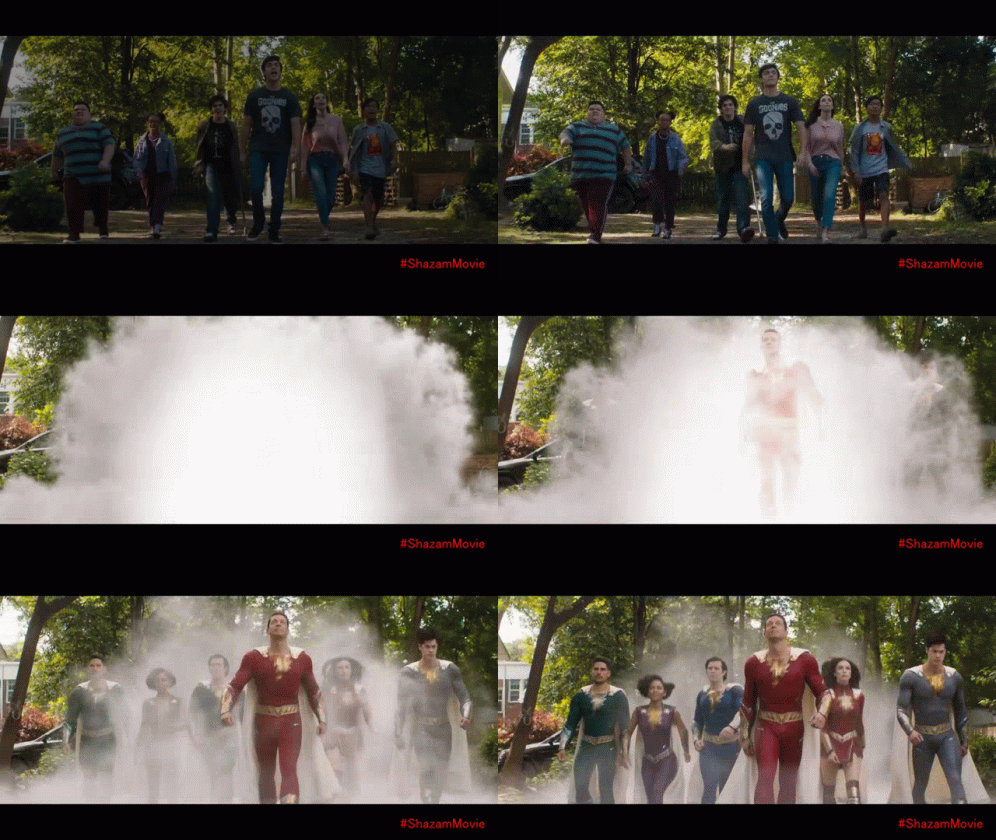
When last we left Billy Batson (Asher Angel), he'd just turned his foster-brothers and sisters into a collection of super-heroes to defeat an evil threat. By invoking the name of the wizard "Shazam"(Djimon Hounsou), they turn into the "Marvel Family" (but nobody calls them that because...lawyers), with, collectively, the wisdom of Solomon, the strength of Hercules, the stamina of Atlas, the power of Zeus, the courage of Achilles, the speed of Mercury...and the neuroses of foster teens. Strange brew.
 
Particularly shouldering these burdens is Billy, who, in his superhero guise as an adult-looking "Captain Marvel" (shhh..."lawyers"...but played by Zachary Levi), he is responsible for the safety of the city of Philadelphia and the management of his family, super-powered and not. It can weigh on a guy. But, then, he has the stamina of Atlas, so, "no big deal," right?
"Say my name!" ("'Destiny's Child' did it better")
Well, it depends on your point of view. He does have the stamina of Atlas, but as Atlas is dead and all, he's probably not using it anymore. Right? So, why not have it? Right? Possession is 9/10 of the law, right? Even if you're "possessed" by a super-hero.
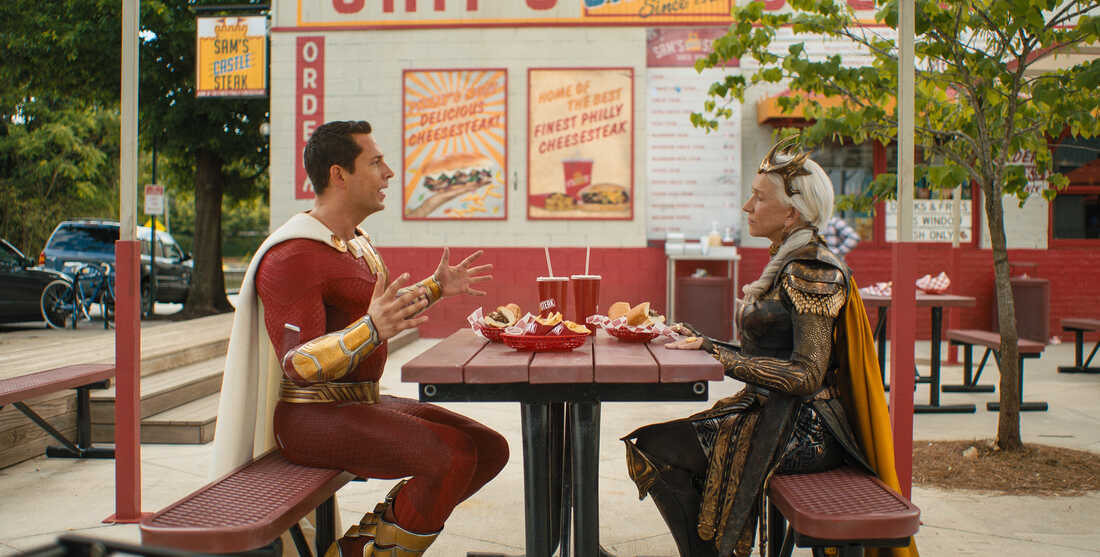
Except for one thing. Three things, really. Atlas had children, a few from different sources, but like all family fights, it usually comes down to the most outspoken ones to stir the pot, so the ones that matter are his daughters Hespera (Helen Mirren), Calypso (Lucy Liu) and Anthea (Rachel Zegler)* Notice the family resemblance? No? Well, like I said "different sources"; call them the step-daughters of Atlas.
  
Being heirs, they're not too thrilled with "family assets" being seized and given to "strangers..."—why, it's not even someone in the family, for god's sake (literally). Besides, not having Atlas' power is making living in whatever god-realm they inhabit in their pearly-gated community less than optimal. I mean, so what if you're a god, even an unfashionable god—a god that's not exactly making people hit their knees anymore—they still have a right to what's theirs!
And so, they deem to get their sandals sullied on real Earth and take back the Wizard's staff that contained all of the power of the gods that were transferred to "The Marvel Family" rather than "The Atlas Family" during the kerfluffle with Dr. Sivana in the last movie. Just putting their mitts on it is enough to generate some power out of it and they use it to smash up a museum and turn all of its patrons into stone. And before you can say "who in their right mind would put something that powerful into a museum?" the Marvels go into action.
Well, not immediately. First, Billy has to visit a doctor about his issue with "imposter syndrome"—he is a 17 year old who becomes an adult super-hero, after all!—the burdens of great power/great responsibility, that he might be a redundant in a world full of super-hero movies (he doesn't mention that, I just added it), and...that at 17, he's going to "age-out" of the foster-care system, and his parents won't be getting support for him. That's a big issue, one that occupies his thoughts even while the "Marv's" try to stop a bridge from collapsing during rush-hour.
But, the Wizard tells them of the impending threat, and the kids try to figure out how to fight mad adults who are gods, or "children of god." The humor of the film comes from the awkwardness of 'tweens trying to be adults, as well as the odd arcana of their Rock of Eternity headquarters that is as idiosyncratic as Hogwarts (heat is provided by an eternally burning violin—Nero's?—and there's an enchanted auto-pen named "Steve"). 
Meanwhile the Atlas kids are using the Wizard's staff to suck the shazam! out of the Marvel kids individually, while also trying to acquire a "golden apple" to rebuild Earth into their kingdom. Oh, and there's a dome—a big impenetrable energy dome surrounding Philadelphia that traps everybody, including our heroes inside. And creatures that look like they came out of Harryhausenland. And unicorns. And a dragon. At one point, Cap just comes out and says "I never thought I'd be saying this, but the dragon is the least of our problems now."
Sounds like it would be a mess, but, it surprisingly isn't. The humor isn't strained, as much as is going on. Levi maintains the "gee-whiz-I'm a dork" persona that makes the adult Captain Marvel such a fun character, and there's "just enough" individualism in the Marvel kids to make you give a rip about 'em when they're getting slammed around. And there are joys, little unexpected "bits" where you shake your head at the cleverness—like Helen Mirren reading a negotiating note from the Marvels—who have no filters—dictated by an enchanted pen—that has no editing skills. And the youngish cast, who are riffing, and moving things along at warp-speed.
The characters' powers have settled in, so there's none of that training awkwardness about their abilities as in the first movie, and maybe all the opportunities of kids acting like adults with super-powers isn't explored nearly enough. But, there's enough mocking earnestness that there were times when the matinee kid in me had their blood pressure up and wanted to see the bad guys get their comeuppance, just because they're very mean people...or demi-gods...or whatever. That hasn't happened to me for awhile in movies. Maybe it's because we've become used to evil that is so blatant and is constantly excused away with sanctimonious self-righteousness.
And ultimately (as Billy evokes "The Fast and the Furious" series in one scene—to Mirren, no less!) The Fury of the Gods really is about family—families that function and families that don't—compare and contrast—and the squabbling and scorched Earth that ensues—and, of course, it all takes place in Philadelphia and the villains are trashing the City of Brotherly Love (ironically). One can't help but see this as another episode of Family Feud...but without Steve Harvey to break the fourth wall to let you know he thinks it's all a little dumb, too.
 
There's a lot of entertainment value in it, a bit lighter in tone, but not lighter in content that the kids can see it and not be zombiefied. And as jokey as it is, as juvenile as it can be, a lot of it will go over kids' heads.
 
* Shazam! Fury of the Gods makes a mystery of the third one for a time, and her identity is revealed as a surprise that doesn't really "land." I mean, why did she suddenly turn up in the first place if she didn't have something crucial to do with the plot?

Tuesday, February 15, 2022

Death on the Nile (2022)

Too Heiress Human
or
"It's Nor Just a River in Egypt, Honey..."
 
We talked about the John Guillermin version of Agatha Christie's "Death on the Nile" last year in anticipation of this year's release. The story's not one of Dame Agatha's best and is the weakest part of the film, which relies heavily on trying to repeat the success of the earlier all-star Murder on the Orient Express, but with fewer A-listers and an eye to luring the older audiences who flocked to Murder... with older stars like Bette Davis, Angela Lansbury, and Peter Ustinov.
 
Well, now Kenneth Branagh follows up his version of Murder on the Orient Express with his version of Death on the Nile (given this route, can Evil Under the Sun be next?), which fixes some things from the earlier version—mostly performance—adds a little tension with a limited time-frame, as well as giving Christie's Belgian detective Hercule Poirot (Branagh and his mustache again) more of an emotional reason to solve the murder, rather than merely see justice done and the puzzle solved. It has already been well established in the Branagh version of Christie's world that Poirot prefers a tidier world, but, evidently, that is not enough.
Nor is it enough, apparently, that Poirot has a particularly fussy mustache—more than Ms. Christie implied and it was obsessed over in many reviews of Branagh's Murder—now we must know why it is. Necessary? No. But, at least in the opening black and white sequence which shows a particularly glorious and tragic day in Poirot's WWI service, we get to meet Catherine, whose history was hinted at in the previous Murder... Again, none of this is Christie's creation, but if it keeps Branagh engaged, then scripter
Michael Green can play with the elements all he wants.
And play he does. Eliminating book characters, substituting others and swapping attributes from one character to another. The basic mystery is the same—a person is murdered on a closed stage—a ship going down the Nile—and no one goes missing and the obvious person with a motive has an airtight, can't-get-by-it alibi, and Poirot must find the killer before the ship docks and they disembark, the culprit possibly to go loose. The only thing helping in determining "whodunnit" is that two of the suspects are also murdered before the issue is solved. Process of elimination had to occur somewhere.
This is it in very general, non-spoilery turns, because the way Branagh and Green set it up, surprises come early and often, whether you've read the book or seen the earlier versions, and they're done in quite inventive ways that would have put Dame Agatha in a dead faint. It is for sure that she would not have approved of the steamy, sweaty dance sequences that open the film proper, not would she have approved of turning one of the passengers from a gossipy (and drunk) romance novelist to an African-American blues chanteuse* (
Sophie Okonedo). The socialist on the boat is no longer a radical, but a member of the upper class (Jennifer Saunders), and there are no kleptomaniacs this time, but there is no longer a jewel thief being pursued by a friend and fellow-passenger of Poirot.
That role gets substituted by Poirot pal Bouc (
Tom Bateman), back from the Murder... film, and this time accompanied by his mother Euphemia (Annette Bening), who just happens to be a friend of the family on the celebratory but doomed boat trip; in fact, everybody has some relation with the happy couple—they being Linnett and Simon Doyle (Gal Gadot, Armie Hammer), she being the heiress of the super-rich Ridgeway family. 
So, why is Poirot there? Well, that's one of those spoilery secrets unique to this version—although I can say that the happy Doyle's have asked Poirot for his assistance, as they are being stalked by Simon's former fiance Jacqueline de Bellefort (
Emma Mackey), who it seems can't let go. They think she's off her nut, and things get dangerous when Simon and Linnett escape being crushed at Abu Simbel. The thing is: "Jackie" hasn't arranged to smuggle herself on the boat yet and crash the party.
The production is lush, and perhaps too much so. The vista is given the full CGI treatment where everything looks so picture-postcard perfect that it feels like it was photographed in Egypt's uncanny valley—there doesn't even appear to be dust in the air, no grit (unusual in a desert environment), no one even sweats in the heat (certainly as much as they do on the dance floor), and there is a distinct difference between underwater shots of the Nile being dragged for clues, and the shots below the boat suggesting the carnivorous nature of life below the surface—there's plenty to show it on the ship, so the pixelated watery detours are completely unnecessary. And the film has a fetish for the Gilded Age right down to the glistening silverware and the sheen on a champagne bottle, lit as carefully as the stars.
And they're good, by the way. Branagh has some moments to flex his acting muscles with both comedy and tragedy masks. Gadot and Hammer are terrific (rumors to the contrary) and
Emma Mackey's jilted fiancee simmers to a broil without the full-on hissy-fits that Mia Farrow brought to the 1978 version. Letitia Wright gets to play some drama, instead of playing "the sprite" (and she's great at it), Okonedo pleasantly threatening, Russell Brand just fine without relying on comedy, Jennifer Saunders delightfully brassy along with Dawn French, and Annette Bening a highlight, probably better than is called for.
Branagh direction is a bit stagey and geometric, keeping in mind a proscenium arch throughout as if the curtain just lifted. And the geometry extends to some almost too-perfect tracking shots that would make you suspect Wes Anderson was directing (if you didn't know any better). That being said, his version of a John Woo Mexican standoff lacks the tension that one should expect, except to wonder why there are so many guns allowed during international travel. Maybe it's movies like this that convinced the cruise lines to ban them.
In fact, the movie is a bit like a cruise trip—superficially opulent, until you realize you're stuck on a boat with people you don't like, and you swear to never do it again. But, then there's the lure to get away. Death on the Nile gets away with a lot.


* Dame Agatha was never afraid to use the "n-word" and in fact one of her most famous works contained the word in the title, before it was changed to something equally racist (in today's terms) at the hands of the publisher's, lest sales were hurt. (And you thought "cancel culture" was a new thing? It's been around as long as evolution).

Sunday, January 9, 2022

Red Notice

Saturday is traditionally "Take Out the Trash" Day.

Three Eggs Make an Omelette
 or
A Gal Caught Between a Rock and a Nut-Case
 
So, the story is that Cleopatra received three ornate eggs given to her by Marcus Antonius on their wedding day (historical note: they never married), and over the centuries, two of those jewel-encrusted eggs had fallen into the hands of museums or private collectors, after being discovered by a farmer in 1907, and the third is still out there, it's whereabouts unknown.
 
That's the McGuffin of Red Noticethose three eggs—but as they're McGuffins, they could be anything. Precious jewels, gold bullion, carved birds, lottery tickets, Arks of the Covenant, Sacred Stones, The Holy Grail or Crystal Skulls. That's the curious thing about these types of movies—we as the audience don't care about what the stakes are as much as the people in the story care about them. If the story of the hunt is entertaining, we're along for the ride, whatever the thingamabob is. They can be Sacred Sow's Ears as long as they make a silk purse of a movie out of it. For the viewer, it's a lot like buying crypto-currency; Perception is all. (That's three simple words, Matt Damon)
 
The perception, of course, is that Red Notice would work. You have three stars, each capable of having a movie financed as long as they're in it (forget that the last couple of movies of each have been lackluster at the box office). They're all entertaining in their own right and have a favorable public perception, so putting them in one movie will make it three times as good. Right?
Right? Well, we'll get there. There's a lot of activity at Rome's
Museo Nazionale di Castel Sant'Angelo, where one of those Cleopatra eggs is on display. Inspector Urvasi Das (Ritu Arya) is leading a team of Interpol agents and massive FBI criminal profiler John Hartley (Dwayne Johnson) on his suspicion that the egg is about to be stolen by the legendary art thief Nolan Booth (Ryan Reynolds). The Museo's security chief is dismissive because his security measures are unbreakable, there have been no attempts, he doesn't know anything about Hartley, and, look, the egg's right there in front of all these crowds here.
But, this is The Rock, after all. He rips his own shirts, jumps around skyscrapers and pilots boats over tsunami's! He sings, he dances, he even has snit-fits with Vin Diesel! Of course, there's reason to be concerned! To everyone's surprise, Hartley breaks through security and melts the displayed egg with a can of product placed Coke®—not even the Diet or Zero Sugar version! The egg has already been stolen! Displaying his crack comic timing, Booth (who is in the crowd because he's so subtly stealthy) immediately lights out while the Museo's security measures slooooooowly go into place, allowing Hartley' FBI agent to manfully wrestle them from closing entirely in his pursuit. Booth is amazingly spry and quick-thinking and makes fast-work of evading the guards and creating a lot of damage in the museum's conveniently safety-defying construction zone—there's a Wilhelm scream and many sound-alike ones for the sharp eared. The sharp-eyed will merely start rolling them.
But, when Das and Hartley track Booth down at his home in Bali, the egg is stolen by Booth's rival Sarah "The Bishop" Black (
Gal Gadot) while it is being secured...because Gal Gadot looks so much like an Interpol strike force commando. Because of the botched recovery, Das has Hartley arrested—instead of investigating it for six weeks—and has him and Booth incarcerated...in a high security Russian penitentiary. That's right, a Russian penitentiary. Why? I don't know, I'm just reading the graphics! But, Booth and the man who arrested him get to share the same cell (!!) and plan to make their escape, after Black confronts them and offers to have them released if Booth tells her where the third egg is...as he apparently knows its location.
By now, you're asking why Booth needed to steal the museum egg if he already knew where the third one was. By now, I had stopped asking questions like that as I knew that I would have to call 9-1-1 to have them put me in a padded cell for observation if I was going to make it all the way through this 90 minute movie...and I was only 30 minutes into it. Let's just summarize that the movie continues in this throbbing vein with lots of set-pieces, changes of locale, and a snarky quip from Reynolds' Booth every 9.5 seconds—the best one is
"Man, we've got bad fathers. It's a miracle we're not strippers!"—and double, triple and quadruple crosses (if you're even bothering to keep track), underpinning the many plot-holes that the movie digs for itself.
Did I like the movie? I didn't have enough Xanax to be absolutely sure, but I will say this: with a film this that has the consistency—and nutritional value—of cotton candy, one desperately clings to the stars as if it were the last hanging thread of a rapidly fraying rope. And each, in their own way, disappoints. One can hardly blame them, the script gives them nothing—absolutely nothing—to work with, and one gets the sense that they're riffing with whatever star-stuff they can ooze from their pores. Reynolds has the "Bob Hope" role; he takes nothing seriously and just does the free-ranging Deadpool "schtick" devoid of context and appropriateness. Very early on, you get the sense that anything this character achieves is done by accident, as he is such a jabbering screwball, he must be thinking up zingers rather than keeping his mind on what he's doing. Frequently, his character is bound or tied up, but they never gag him because, as a result, 90% of the movie would just go away.
Gal Gadot is another matter. I'm a big fan of hers, my opinion only increasing after watching out-takes of the Wonder Woman movies, where she cracks up incessantly over the sheer absurdity of what she's being asked to wear and do. Yet, when the cameras roll, there is a professional dedication to making the uncredible credible and through sheer force of will makes you believe. The stakes to "make it work" aren't as high here, and so Gadot falls back on personality. Perhaps inspired by Reynolds' irreverence for the material, she, at times, just "has fun with it" (as the useless direction goes), prancing, singing, trying anything she can to make what she's got to do seem lively, but it's inconsistent throughout the movie, which, although it works when scenes are dragging, makes you take her less seriously when she drops it in scenes where she has less to do. A consistent attitude to one or both of the male leads would have helped...but that's the script's fault.
Finally, there's "The Rock". I think Dwayne Johnson is a national treasure. He is quite capable of doing anything, and he does comedy and drama equally well, and as a personality has a propensity for not taking himself seriously which puts him head and shoulders above the Schwarzeneggers and Stallones when it comes to the action genre. They're capable of dull heat, but Johnson sparkles with star quality, risking the perception that his physicality or power won't be taken seriously. The truth is he can overpower any presence sharing the screen with him, and has done so frequently. Here, though, maybe in deference to his co-stars, maybe to set himself apart and find his own lane, maybe to ground the thing a bit, he puts in less of an effort and coasts. It's disappointing, and one wonders what might have happened if he pushed it just a bit more, stepping on a Reynolds line, being more of a rogue, instead of playing straight man. Johnson should not set up, when he's capable of hitting things out of the park.
And they each got $20 million bucks doing this. The market will bear what it bears, and I don't begrudge them taking a big front-end pay-off than depending on the gamble of any back-end profits in a time of empty theaters and a streaming pandemic. But, the results are so meager and discouraging that you wonder if anybody could have made this movie work at all. All three of them are capable of "carrying" a movie by themselves, but sharing the responsibilities is a case of diminished returns, a train-wreck, and a disappointment. 
 
It feels like a "third wheel" problem, and maybe one of the three characters should have been dropped, but it's a mystery as to who it should be—it could be any of them, frankly. It's just the shell of a movie and empty inside. Like an egg. Maybe that's the real McGuffin of the movie, if anyone cared.

Wilhelm Alert at 09:50

Wednesday, September 15, 2021

Zack Snyder's Justice League

Zack Snyder's Justice League
(Zack Snyder, 2021) Buying the DVD of Zack Snyder's Justice League—his sanctioned "taking-back" of the Warner Brothers "studio-notes" theater version—cost as much as two months of HBOMax, and I must say, in comparison, it was a bargain. I have been reluctant to be swayed into buying into streaming services, maintaining that theaters will come back, and there are very few enticements for having them take money out of my accounts month after month, when the economic model necessitates other means of seeing them.
 
So...(I hear you ask) "is it better?" Yup. And by a wide margin. My initial review of the theatrical version of Justice League was somewhat laudatory—more concerned with knee-jerk backlash towards it—but, in seeing it again a couple times one could see the pacing issues, grating inconsistencies of tone, a certain desperation in the product to compress the content gracelessly and be winsomely attractive. "The Snyder Cut" takes more chances and takes a lot more time doing it. The Warner mandate to cut Snyder's intended two-part 4 1/2 hour opus into a single 2 hour film must have seemed an impossible feat to accomplish (and one must give kudo's to Joss Whedon for even attempting it and managing to meet their specs despite the ham-fisted result), especially when the evidence shows just how much of Snyder's film wasn't in the theatrical version (which we'll simply call "Josstice League"). The story is basically the same, but, good Lord, there are whole completely different versions of scenes throughout the thing, with nary a line repeated. There are bits and pieces in the story-line—the first Earth-war with Apokolips, the Gordon scenes, the confrontation at the "Superman memorial"—but for the most part the shot choices and dialogue are unique to this version. There are far fewer "oh, yeah..." moments than "that's new" moments. And, for me, there weren't any "I miss that" moments...at all.
The length is daunting, which is why I think it was never, ever intended to be one film (that and Snyder has a tendency to make super-hero films that are already prepping for sequels). Still, the overall experience of watching it feels much more organic than the cropped mess of the "Josstice League." Segments progress naturally—they "feel" right. And more importantly, the big action set-pieces—like the fight under the Gotham harbor—finally "work" in how they're shot and edited in sequence—they have geography and you see how things are playing out among all parties and how the stakes rise and fall as they intensify.
What's more, the film hinges on the characters given short-shrift in "Josstice League"—those being Jason Momoa's Aquaman, Ezra Miller's Flash, and especially Ray Fisher's Cyborg. Sure, there's plenty of scenes with Gal Gadot's Wonder Woman and a lot more with the Amazon's, a couple of tid-bits with Ben Affleck's Batman (with even more taken out), less haggling among the heroes, more of Alfred (Jeremy Irons), more of Joe Morton's Silas Stone and his co-hort at StarLabs, Ryan Choi (Ryan Zheng)—these are all improvements utilizing good actors—and you get representations from Jack Kirby's gallery of "Fourth World" villains (most prominently, Kirby's "Big Bad Guy" Darkseid), and a considerable "Steppenwolf" upgrade.
It's the three heroes-in-hiding from Batman v. Superman: Dawn of Justice, that get a lot more coverage and a bit more respect. Momoa's Aquaman has a lot more scenes with Mera (Amber Heard) and now, also Vulko (Willem Dafoe) and there's a bit of a continuity gaff in that here, nobody can talk underwater as in the Aquaman stand-alone film (they have to make air-bubbles to communicate). The Flash is given more background including a rescue of young Iris West (Kiersey Clemons) and the character's annoying geeking is toned down substantially and slightly matured. But, it's the story of Victor Stone/Cyborg that is the most expanded and the most from which the film benefits. Fisher is given much more chance to shine as he goes from bitter accident victim to reluctant super-paraplegic to confident team member.

But, it's not all roses. This version is rated "R" for a reason. There are a couple of prominent "f"-bombs* that may be earned but won't impress the parents of young superhero fans. And the level of carnage is greater with prominent blood spatters (that would have been digitally removed for theaters) and the final disposition of Steppenwolf by Wonder Woman (she is an sword-wielding Amazon, after all) that is far more MPAA-adverse than just letting the bad guy be dispatched by his own minions off-screen. Edgier, but not the way parents, censors (or even the Comics Code Authority) would like. One is always aware that in the movie-world, the film creators are always less concerned with body-counts than the comics-heroes (as dictated in the comics by parental watch-groups) would be.
This prompts the question for whom film-makers are making movies, even though, in this special case, Snyder has had the supported mandate to please himself. With the content far more unconstrained than the behavior displayed in the four-color versions, are they making it for themselves, for the fans, or for the studio? One would say the first, less the second, with the third being the cranky arbitrator between the two. Snyder makes them for himself—what he'd like to see—and for that imagined film audience that wants more realistic, mature versions of childhood heroes (ala the Christopher Nolan model—Nolan is still the exec. producer of this one)** It's interesting to think about, given the many hands involved.
So, I was pleased with what I saw, tarnished slightly by the fact that I'd seen a bastardized version before.*** But, what a difference it does make to have a singular vision, whatever issues one might have with it, rather than an elephant made by committee. In a subtle way the film makes that point, and one hopes that Warner learns it, and that Marvel takes the lesson as a cautionary tale.

 
* One was deliberately added by Snyder in his "new footage" shot for the Snyder version. If he doesn't have to fight over it with the studio, I suppose he said "why the fuck not?" So, Batman says it. And Cyborg says the other one at the height of his bitterness.
** Nolan has been working exclusively with Warner for almost two decades, but the recent rifts over the super-hero movies he and his wife have shepherded there (and the studio's insistence on simultaneous streaming) have had a consequence—Nolan's next film (involving J. Robert Oppenheimer) is being made with Universal. Warner wasn't even being negotiated with.
*** One curiosity I had was the way the theatrical version photographed Gadot's Wonder Woman—it's more sexualized, seeming to concentrate on her posterior than apparent when Snyder and director Patty Jenkins called the shots. And, yes, Snyder had no such prurience in his cut.

Batman gets Frank Miller's goofy Bat-tank.