Showing posts with label Ryan Reynolds. Show all posts

Wednesday, August 7, 2024

Deadpool & Wolverine

Despite Claws and Swords, Not Much of a Point
or
"Get Your Special Sock Out, NerdsThis is Going to Be Good."

It was as inevitable as the title "When Titans Clash" showing up in any Marvel comic. 
 
Around the time that X-men Origins: Wolverine was being conceived, Ryan Reynolds lobbied hard to play the character Deadpool—"The Merc with a Mouth"—a comic super-powered mercenary with regenerative powers and a meta-influenced line of snarky patter that quickly made him a fan favorite from "The House of Ideas." It would have been a nice break-through role for Reynolds (as the man can be funny...and irreverent...as hell), but, for some reason the character was revised for the movie—his mouth was fused together, therefore couldn't speak. 
 
Well, what fun was that? They wouldn't even let him make guttural sounds—which would have been funny if they'd had him trying to say words like he was perpetually eating peanut butter—But, no, "they" wouldn't even allow that. It was Wolverine's movie, Wolverine was—and always was, even in the comics—the breakout character in the "X-men" series, so Deadpool was muted, lest he actually upstage the titular character of the film.*
Ryan Reynolds on "Mute" during X-men Origins: Wolverine.
X-men Origins: Wolverine did okay at the box-office—but not enough to generate any more "X-men Origins" movies. It did generate some animus with Reynolds, who'd been trying to get a "Deadpool" movie into production** and thought X-MO:W killed it and killed it dead. Silly man. Deadpool, after all, has regenerative powers—shoot him and the bullet will work its way out, cut his arm off and it'll grow back—so after having a proposed budget slashed and a rather kicking "sizzle" reel made, the film was made and did blockbuster box-office. It also slightly regenerated the "superhero" genre of films which, at the time, was starting to lose its buy-back value.
Deadpool had no shame in its humor, lampooning superheroes, superhero movies, Marvel, DC, Reynolds, and 20th Century Fox, but seemed to take particular hyena-glee when making fun of Hugh Jackman and X-men Origins: Wolverine, setting my movie-blogger sense tingling about a possible collaboration between the two. It seemed inevitable.
Happily, it's happened in Deadpool & Wolverine, which, after a rather moribund effort with Deadpool 2, has revived the series a few deep-cut notches above its predecessor. The (this time unfunnily not written by Reynolds) synopsis goes like this:
"A listless Wade Wilson toils away in civilian life with his days as the morally flexible mercenary, Deadpool, behind him. But when his home-world faces an existential threat, Wade must reluctantly suit-up again with an even more reluctant Wolverine."

Um. Sure. That's sounds..."listless", but serviceable. But, it doesn't really talk about what's happened since the last movie, of which the most important event is that Disney bought 20th Century Fox, home of the X-men franchise, as well as Marvel Studios, which has everybody else, so that The House of Mouse can claim all things Marvel and wait for the money-truck to drive up to the receiving dock. The movie is rife with opportunity to make all sorts of in-jokes on that subject including using the old corporate logo in a Cosmic Garbage Dump called "The Void".
"Welcome to the MCU," Deadpool says at one point. "You're joining at a bit of a low point."
 
(Now, bear in mind this will be confusing) What happens is that Deadpool has been using the time-dimensional device of the Marvel mercenary Cable*** to go back in time and try to fix things to get his girlfriend (Morena Baccarin) back, right? Well, things aren't going too well on that front, so he goes to another Marvel Earth ("The Sacred Timeline" one) to join the Avengers (with just the first of many cameo's), but he's turned down...flat. But, his time-hopping has attracted the attention of the TVA (the Time Variance Authority), and its agent Mr. Paradox (Matthew Macfadyen), who informs Deadpool that his timeline is starting to unravel owing to the fact that its "anchor being", Wolverine has died (because of Logan). Paradox makes Deadpool the opportunity to be put in "The Sacred Timeline" to spare his life and help with future events.
Wade, wanting to spare his ex and friends from extinction decides he'll do something else (naturally). He transports himself to the spot where the Wolverine died, digs up his grave and finds...a metallic corpse. Not very useful to preserving the timeline, but the parts come in handy in a fight when TVA troops arrive to try and stop him. So, the next step is to find another Wolverine...a "live" one this time...so he goes multiverse-hopping to find a suitable Wolverine—there are some lovely variants, including a comics-accurate version (funny!) and one cameo by a super-hero actor in need a of a job (blink and you'll miss him), until, finally, he finds a "suitable" Wolverine.
Taking him back to the TVA, he discovers that not all adamantium-encrusted Canadian super-heroes are alike, and is told he's brought back "the worst" Wolverine (owing to a failure in his past), Paradox whisks them off to "The Void" (from the Disney series "Loki")—the place at the end of time where discarded super-heroes go to await disposal. Lots of interesting cameo's here (see the picture below for some), but the place is lorded over by Charles Xavier's twin sister Cassandra Nova (played—and quite entertainingly—by
Emma Corrin) who has her brother's head-messing-with powers and is (to put it kindly) "resentful."
Just some of the "discarded" heroes in "The Void"
There are so many "in-jokes" and references to past Marvel movies "before they were popular" that some audience-members may get lost in the mix. One merely has to "go with it" as Deadpool's running snarkiness will be providing references and laughs all along the way. Besides, there are so many variants of characters in the Void—there's a "Dogpool" portrayed by Peggy, the recently crowned "Britain's Ugliest Dog"—that details really don't matter, as something funny will be said in the next 30 seconds, anyway.
This, of course, is the film's strength—along with the R-rated "evisceration humor" exhibited in the fights (nobody gets hurt with these regenerative powers, so they're as impactful as injuries in a "Looney Tunes" cartoon)—so much so that the story really doesn't matter. At all. It's all played for laughs, and if the film twists itself in gordian knots trying to generate plot-points, it's going to become a punch-line anyway—maybe because of the lengths the writers have to go through to get there. The Deadpool series has its own wall of incredulity to run interference on "the Plausibles" in the audience trying to see plot-holes in the movie as that's the character of Deadpool himself. He's a one-man "Mystery Science Theater," poking holes (often literally) in everything.
Cassandra Nova's "headquarters" is the corpse of Ant-Man/Giant-Man
Deadpool's comment: "Huh. Paul Rudd finally aged..." 
I guess the poor box-office of Ant-Man and the Wasp: Quantumania had ramifications.
But, then, nobody really cared what happened to Hope and Crosby after each "Road" movie, or to the Marx Brothers, or Laurel and Hardy. People just came for the laughs. So let it be with Deadpool. And if things in the movie end merely to the default state at the beginning, at least it insures that another one will come along after awhile, that's okay, too. That's entertainment. Sometimes you have to let go of the continuity consciousness and not expect transformative story-lines and major changes to the characters, as long as they're having a good time and taking us along with them.
 
Now, that's a real regenerative power.

* Never mind that the scenario might have spawned another movie tent-pole series with Deadpool—a pretty good bet in hindsight because that is exactly what happened, due to Ryan Reynolds' persistence.
 
** Reynolds loved the comic, especially when it described Wade Wilson as looking like "a cross between Ryan Reynolds and a Shar Pei." 
 
*** Cable was in Deadpool 2...you know...played by Josh Brolin (No, not Thanos...the other...*siiigh*...(this is going to take a long time...) Look, just go with it, okay? You probably don't believe in multi-verses anyway! ("Did you know Dr. Dre's "Nothing but a 'G' Thang" has the most verses?") That's NOT what I'm talkin....just keep reading, okay? No more questions.

Wednesday, May 29, 2024

IF (2024)

A Big IF'n Steal
or
"What Kind of a Kid Comes Up with an Invisible IF???"

Everybody loves bed-time stories. That ritual of childhood that settles one down from the turbulent activities of childhood and lulls the mind and the nerve-endings to slowly limbo under the bar of sleepiness and gather the necessary 40 winks of REM sleep needed to recharge the batteries and the burgeoning brain-cells of the aware recently-minted child. It can also work for the preoccupied and agitated adult who is lucky to eke out 30 winks without resorting to warm milk and a couple of pills. Bed-time stories are nice and cozy and curatives for the sleep-reluctant child and the sleep-resistant adult and that's a good thing.
 
IF (standing for "Imaginary Friend" and not to be confused with the 1968 Lindsey Anderson movie starring Malcolm McDowell) is not unlike a good bed-time story. But more on that later.
 
IF tells the story of little Bea (Cailey Fleming), who would bristle at that "little" adjective. As she's likely to tell anyone stoically "I'm not a kid anymore." No. She's 12. And as much as her grandmother (Fiona Shaw) wants to treat her like the kid she was, she is highly resistant. There's bad reason for that. She's visiting grandma's in New York, because her Dad (director John Krasinski) is in the hospital there for an upcoming operation—we're not given a lot of specifics but one guesses that it's heart surgery, and Bea is determined to tough it out, be grown-up about it, and not to be a child.
She's had experience at that, as we're shown in the opening credits sequence filled with home movies, she had a rather bucolic childhood full of laughs and the love of her parents. So bucolic that only rarely do you see Mom wearing a warm hat (which will fly by any child watching this movie, but adults will see it and think "cancer"). Bea, you see, lost her Mom at any early age, and now Dad's in the same hospital and she's going to be serious about it, act like an adult, and won't let him or his mother try to cheer her up.
That will be somebody else's job, as she stumbles into the orbit of various "Imaginary Friends" who are at loose ends because their own "Real" friends have grown up and forgotten them. They're employing a placement service run by Calvin (Ryan Reynolds) who is trying to find them new humans, and Bea eventually decides to help out. Cal takes her to the Memory Lane Retirement Home, located in Coney Island, and, with a slightly frayed older teddy bear IF named Lewis (Louis Gossett Jr., in his final role) to start the process of finding new kids for the old IF's.
It does not go well, and Lewis suggests a change of tack—rather than finding replacement people for the IF's, they should try to re-unite them with their old Unimaginary Friends. At this point, you begin to realize that the rules governing IF's is rather arbitrary, and it only gets more arbitrary as the movie goes along. The plot if as untethered as the orphan IF's and lacks any real depth, which puts it at odds with the inspiration that Krasinski was going for when he imagined this movie.
IF references two staples of the Imaginary Friend trope, the movie Harvey (of course) and Bill Watterson's "Calvin and Hobbes" cartoon strip. But, the true inspiration is the output of Pixar Studios. Krasinski has gone on-record to say that his intention was to make a "live action Pixar movie." One can certainly see it when one considers the steals from Up, Monsters, Inc., touches of Inside Out, some character designs that certainly are inspired by Pixar creations. And, admittedly, it is a high bar to set oneself as Pixar has consistently been at the top of the form as far as story-telling, film-making ingenuity, and artistic craftsmanship.
But, there's something that Pixar consistently accomplishes that Krasinski utterly fails at: emotional depth. Yes, it's fun to make a movie about toys, about monsters hiding in the closet, about any high-concept merchandisable gimmick that looks fun. But, Toy Story is just play-things without the concept of abandonment (that's checked off rather clean-fingered in IF), the motivations behind monsters and their creators) in Monsters, Inc., the yearning for something better despite prejudice in Ratatouille, the overcoming of grief in Up (big IF'n steal there!), or the deep-dive into the psychological stew of Inside Out. Krasinski begs, borrows and steals parts from Pixar, but he can't make them work together for a satisfying, mind-blowing epiphany the way that the Pixelators can.*
And, gosh, everybody tries so hard to make it work it was causing me to grind me teeth down to the root. Krasinski—the actor—is constantly working the comedy card, quite winningly, Reynolds, as if sensing he should play against type, dials down the clownishness he excels at, and Cailey Fleming comes off the best, gamely tossing any "cute-kid" shenanigans to survive this zombie of a movie. 
But, one of the big selling points of the movie is the list of star-voices for the Imaginary Friends. It's quite impressive looking at the list: besides Gossett, there's Steve Carell and Phoebe Waller-Bridge with the more prominent roles, plus Awkwafina, Emily Blunt, George Clooney, Bradley Cooper, Matt Damon, Bill Hader, Richard Jenkins, Keegan-Michael Key, Blake Lively, Sebastian Maniscalco, Christopher Meloni,** Matthew Rhys, Sam Rockwell, Maya Rudolph, Amy SchumerAllyson Seeger and Jon Stewart. That would all be great...if anybody really registered as distinctive personalities. As it is, everybody comes and goes so fast that there really isn't any time to register who they are and how those voices related to the characters they play. They don't. For all the personality they bring to the roles they could have just had Frank Welker do all of them—and given Welker's versatility it would probably be an improvement.
Reynolds, Fleming and Gossett's Lewis interview Wall•e...er, uh, Jon Stewarts's Robot
(not that you could tell)

It's a bit like the trick John Huston played with his mystery film of The List of Adrian Messenger, where big A-lister guest stars were scattered in disguise around the movie to see if audiences could guess if they could see them. A nice gimmick, that. But, the real reason to do it was to draw audiences to a movie that only boasted George C. Scott as its lead actor. Here, they're just padding the resumé.

And it results in one of those little things that's emblematic of IF's problems. There is a running gag (more of a stumbling gag...) where Reynolds' Cal keeps tripping over an invisible IF named "Keith." He trips. Yells "KEITH!" After he does it the first time, Cal muses "What kind of a kid comes up with an invisible IF???" And they do the joke again...and again...and again. If you miss the first one, you don't get the rest of them.
 
To top that off, when they're running the credits (which I noticed people stayed through to figure out who's voice was what) at the end of the IF voices, Brad Pitt is listed as the voice of "Keith." Even though...he never says anything throughout the entire movie.*** It would be tempting to say that, like Keith, IF has no "there" there, but some things do work, just not enough to make a movie that's more than only "surface" deep, merely gets by, and certainly doesn't have the resonance of its Pixar betters.
 
Jon Krasinski has done some good work in the past. But, here he bunts and expects it to be a home run. Now, that's imaginary.  
 
Oh, and how is IF like a good bed-time story? Because I was fighting sleep the entire movie.

* Oh, there's an epiphany, but if you don't see it coming a mile away, then you should have your movie-watching credentials revoked (or your movie-chain club card). Oh, and it's a steal from M. Night Shymalan.

Surprise Ending once, Shame on You. Surprise Ending Repeated, Shame on Me.

 
**  ♪Chung-Chung
 
*** The same joke was played when Brad Pitt played an invisible character in Deadpool 2

Thursday, May 26, 2022

Free Guy

BFD for the NPC
or
Thumb-Twitching at the Movies
 
Guy (Ryan Reynolds) wakes up every morning, feeds his fish ("Good morning, Goldie!"), pulls out his usual outfit—short-sleeved blue shirt, khakis—from a closet full of short-sleeved blue shirts and khakis, brushes his teeth, eats breakfasts, grabs a coffee (medium coffee, cream, two sugars) and goes to his job as a bank teller ("Don't have a good day. Have a great day!")...which will be robbed...every day. Without fail.
 
Oh, I didn't mention the commute.
 
Guy lives in Free City, which is a video-game. Walking to work, he is constantly witness to all sorts of disasters, natural and unnatural, none of which can kill him if he's on his normal route to the bank. He is an NPC—a non-playing character, an extra, a background figure. He's coded, but he's robotic. Unless something hits him and kills him, he's going to do the same thing, go the same route, be the same Guy, a nobody, a drone, a cog, a non-essential worker.

And I know how he feels.
Guy's a part of the landscape, but Free City is constantly invaded by the muckery inflicted by real-world players, all represented by avatars wearing sunglasses. The chaos they cause is just part of the routine, until Guy notices a woman (Jodie Comer) walking down the street, bopping to the Mariah Carey song "Fantasy" which he recognizes. Why, you may ask? Well, that would be spoilery (and, frankly, a little unbelievable—but, go with it). He's intrigued by her, wants to know who she is, and inspires him to don player sun-glasses he's acquired from one of the bank-heist perps.
What he finds is a real-player's perspective of his world—pixelated mind blown! He is made aware of an entirely new world in which he is not merely a part, but could become a participant; he has some measure of control and he knows that the woman—named "Molotovgirl"—is somehow involved. So, he must find her, and find out what he needs to know to become the master of his own fate.
Tough work. But, the cast—especially in the Free City sections—makes it enjoyable. Because that whole area is a fantasy and anything can happen (including cameos) there are surprises and Easter eggs galore, plus it has Ryan Reynolds at his most winsome. The movie is more of a slog out in the real world where the issues are creative rights over code rather than self-actualization, and despite the best efforts of these actors—
Taika Waititi tries damned hard for laughs and Comer's real-life programmer Millie has less jolt than Molotovgirl—these sections of the film must be endured, rather than enjoyed.
Of course, you've seen it before...and better. The "Simulation Hypothesis" has been around since people decided they liked their dreams better than being awake. The trope was used in a lot of "Twilight Zone's" and other sci-fi/fantasy product like
Rainer Werner Fassbinder's World on a Wire, the "Men in Black" series, The Matrix (of course) and Ready Player One. One of my favorite instances was in an episode of "Star Trek: The Next Generation"—"Ship in a Bottle"—where, after trapping a hologram of Professor Moriarty in a small cube version of a holo-suite, Captain Picard muses "Who knows? Our reality may be very much like theirs, and all this might just be an elaborate simulation, running inside a little device sitting on someone's table." 
 
Just so.
The concept is so fascinating that real-world people can abandon their limited lives to immerse themselves in the video-worlds to imagine themselves as better versions (in the things they admire—like kill-ratios) while their biological clock is ticking down, all in the quest of earning more imaginary lives. Video games are the crypto-currency in our biological banking system. But, do they value their psuedo-lives more? Than their actual lives? Results may vary.  I sense a screenplay synopsis coming on.
For me, I don't play video games anymore. I find them a waste of my dwindling time here on Earth. So, I didn't "geek" over Free Guy, a lot of the inside referenced going right over my head. But, I enjoyed enough of it that I didn't care—and the movie plays well enough without insider knowledge. I also liked the fact that I got to watch it on free HBO while staying in a hotel in Oregon, a way to pass the time where I didn't "want those two hours of my life back"—real or virtually.

Sunday, January 9, 2022

Red Notice

Saturday is traditionally "Take Out the Trash" Day.

Three Eggs Make an Omelette
 or
A Gal Caught Between a Rock and a Nut-Case
 
So, the story is that Cleopatra received three ornate eggs given to her by Marcus Antonius on their wedding day (historical note: they never married), and over the centuries, two of those jewel-encrusted eggs had fallen into the hands of museums or private collectors, after being discovered by a farmer in 1907, and the third is still out there, it's whereabouts unknown.
 
That's the McGuffin of Red Noticethose three eggs—but as they're McGuffins, they could be anything. Precious jewels, gold bullion, carved birds, lottery tickets, Arks of the Covenant, Sacred Stones, The Holy Grail or Crystal Skulls. That's the curious thing about these types of movies—we as the audience don't care about what the stakes are as much as the people in the story care about them. If the story of the hunt is entertaining, we're along for the ride, whatever the thingamabob is. They can be Sacred Sow's Ears as long as they make a silk purse of a movie out of it. For the viewer, it's a lot like buying crypto-currency; Perception is all. (That's three simple words, Matt Damon)
 
The perception, of course, is that Red Notice would work. You have three stars, each capable of having a movie financed as long as they're in it (forget that the last couple of movies of each have been lackluster at the box office). They're all entertaining in their own right and have a favorable public perception, so putting them in one movie will make it three times as good. Right?
Right? Well, we'll get there. There's a lot of activity at Rome's
Museo Nazionale di Castel Sant'Angelo, where one of those Cleopatra eggs is on display. Inspector Urvasi Das (Ritu Arya) is leading a team of Interpol agents and massive FBI criminal profiler John Hartley (Dwayne Johnson) on his suspicion that the egg is about to be stolen by the legendary art thief Nolan Booth (Ryan Reynolds). The Museo's security chief is dismissive because his security measures are unbreakable, there have been no attempts, he doesn't know anything about Hartley, and, look, the egg's right there in front of all these crowds here.
But, this is The Rock, after all. He rips his own shirts, jumps around skyscrapers and pilots boats over tsunami's! He sings, he dances, he even has snit-fits with Vin Diesel! Of course, there's reason to be concerned! To everyone's surprise, Hartley breaks through security and melts the displayed egg with a can of product placed Coke®—not even the Diet or Zero Sugar version! The egg has already been stolen! Displaying his crack comic timing, Booth (who is in the crowd because he's so subtly stealthy) immediately lights out while the Museo's security measures slooooooowly go into place, allowing Hartley' FBI agent to manfully wrestle them from closing entirely in his pursuit. Booth is amazingly spry and quick-thinking and makes fast-work of evading the guards and creating a lot of damage in the museum's conveniently safety-defying construction zone—there's a Wilhelm scream and many sound-alike ones for the sharp eared. The sharp-eyed will merely start rolling them.
But, when Das and Hartley track Booth down at his home in Bali, the egg is stolen by Booth's rival Sarah "The Bishop" Black (
Gal Gadot) while it is being secured...because Gal Gadot looks so much like an Interpol strike force commando. Because of the botched recovery, Das has Hartley arrested—instead of investigating it for six weeks—and has him and Booth incarcerated...in a high security Russian penitentiary. That's right, a Russian penitentiary. Why? I don't know, I'm just reading the graphics! But, Booth and the man who arrested him get to share the same cell (!!) and plan to make their escape, after Black confronts them and offers to have them released if Booth tells her where the third egg is...as he apparently knows its location.
By now, you're asking why Booth needed to steal the museum egg if he already knew where the third one was. By now, I had stopped asking questions like that as I knew that I would have to call 9-1-1 to have them put me in a padded cell for observation if I was going to make it all the way through this 90 minute movie...and I was only 30 minutes into it. Let's just summarize that the movie continues in this throbbing vein with lots of set-pieces, changes of locale, and a snarky quip from Reynolds' Booth every 9.5 seconds—the best one is
"Man, we've got bad fathers. It's a miracle we're not strippers!"—and double, triple and quadruple crosses (if you're even bothering to keep track), underpinning the many plot-holes that the movie digs for itself.
Did I like the movie? I didn't have enough Xanax to be absolutely sure, but I will say this: with a film this that has the consistency—and nutritional value—of cotton candy, one desperately clings to the stars as if it were the last hanging thread of a rapidly fraying rope. And each, in their own way, disappoints. One can hardly blame them, the script gives them nothing—absolutely nothing—to work with, and one gets the sense that they're riffing with whatever star-stuff they can ooze from their pores. Reynolds has the "Bob Hope" role; he takes nothing seriously and just does the free-ranging Deadpool "schtick" devoid of context and appropriateness. Very early on, you get the sense that anything this character achieves is done by accident, as he is such a jabbering screwball, he must be thinking up zingers rather than keeping his mind on what he's doing. Frequently, his character is bound or tied up, but they never gag him because, as a result, 90% of the movie would just go away.
Gal Gadot is another matter. I'm a big fan of hers, my opinion only increasing after watching out-takes of the Wonder Woman movies, where she cracks up incessantly over the sheer absurdity of what she's being asked to wear and do. Yet, when the cameras roll, there is a professional dedication to making the uncredible credible and through sheer force of will makes you believe. The stakes to "make it work" aren't as high here, and so Gadot falls back on personality. Perhaps inspired by Reynolds' irreverence for the material, she, at times, just "has fun with it" (as the useless direction goes), prancing, singing, trying anything she can to make what she's got to do seem lively, but it's inconsistent throughout the movie, which, although it works when scenes are dragging, makes you take her less seriously when she drops it in scenes where she has less to do. A consistent attitude to one or both of the male leads would have helped...but that's the script's fault.
Finally, there's "The Rock". I think Dwayne Johnson is a national treasure. He is quite capable of doing anything, and he does comedy and drama equally well, and as a personality has a propensity for not taking himself seriously which puts him head and shoulders above the Schwarzeneggers and Stallones when it comes to the action genre. They're capable of dull heat, but Johnson sparkles with star quality, risking the perception that his physicality or power won't be taken seriously. The truth is he can overpower any presence sharing the screen with him, and has done so frequently. Here, though, maybe in deference to his co-stars, maybe to set himself apart and find his own lane, maybe to ground the thing a bit, he puts in less of an effort and coasts. It's disappointing, and one wonders what might have happened if he pushed it just a bit more, stepping on a Reynolds line, being more of a rogue, instead of playing straight man. Johnson should not set up, when he's capable of hitting things out of the park.
And they each got $20 million bucks doing this. The market will bear what it bears, and I don't begrudge them taking a big front-end pay-off than depending on the gamble of any back-end profits in a time of empty theaters and a streaming pandemic. But, the results are so meager and discouraging that you wonder if anybody could have made this movie work at all. All three of them are capable of "carrying" a movie by themselves, but sharing the responsibilities is a case of diminished returns, a train-wreck, and a disappointment. 
 
It feels like a "third wheel" problem, and maybe one of the three characters should have been dropped, but it's a mystery as to who it should be—it could be any of them, frankly. It's just the shell of a movie and empty inside. Like an egg. Maybe that's the real McGuffin of the movie, if anyone cared.

Wilhelm Alert at 09:50

Wednesday, November 17, 2021

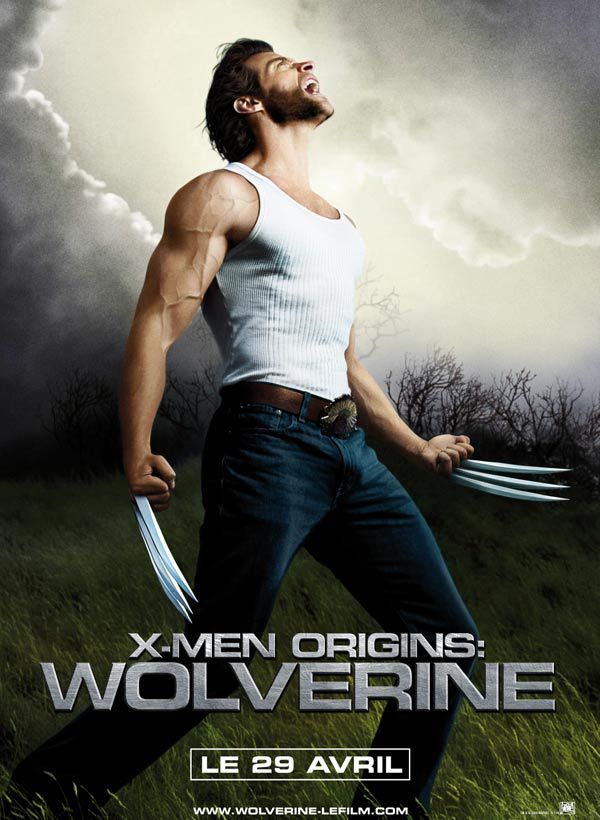
X-Men Origins: Wolverine

Noooooooo! Written at the time of the film's release....

Shmukt!: Claws for Alarm
   
When the X-Men movies lost its chief stylist Bryan Singer to do Superman Returns it was a double disappointment. X-Men III: The Last Stand was the most expensive movie ever made—at the time), and looked terrible. Top-heavy with stars that not only bloated the budget but capsized the script to fulfill their demands, it brought the X-series to a sad ending, x-hausted, x-cessive, and x-cremental (while Superman Returns felt like going to The Church of Kal-El and Klan).
 
Time to re-boot, so here we have, rising as he always does from his own ashes, "Wolverine Begins" with Hugh Jackman reprising his break-out role. It's a smart move. Jackman was "the" star of the "X-men" movies and after the first, they were tailored for him, like his strategically ripped wife-beaters. One is hard-pressed to think of another movie where he is used so effectively (and succeeded at the box-office).
But this is a curious re-boot. At a time when most super-hero movies are dusting off the cliches,
X-Men Origins: Wolverine (the title says it all) coats itself in the dust and the muck and the mire and revels in it. For instance: there is not one, but two scenes where Jim Logan (Jackman) looks up at a conveniently omniscient overhead camera and yells his frustration to the skies and his x-communicating God
.
 
Are you kidding me? Hasn't that shot been decommissioned after all the easy laughs it's garnered on "The Daily Show?"**
It has. But nobody told director
Gavin Hood (Rendition). He seems unconcerned about cliches or recycled material (or "sell-past" dates), as the movie lurches like lead villain Sabretooth (Liev Schreiber, but it was Tyler Mane in the original where they didn't know each other) bounding from one bad idea to the next, linked as they are by that most mainstream of transitions—the one-to-one dissolve. We get a lot of them in the Main Title. After the Bruce-Wayne-Meets-Oedipus childhood trauma opening, Hood shows the brothers Logan fighting in war after war, guns fading into guns and helmets into helmets. It's quite "artily" if unimaginatively done,* but Hood keeps using it until you start looking for the detail he might use in the next transition. Flames? Ocean waves? How about a dusk to dawn transition? That hasn't been done since...well, since I started writing this.
A lot of the problem is that
Marvel—"The House of Ideas," as it likes to trumpet—has culled so much from other stories that the whole Wolverine opus reads like a Reader's Digest Omnibus of Comic Literature. Logan gets recruited to join a Dirty X-Dozen black-ops unit, then declares himself "Wolverine no more" and becomes a lumberjack (and that's okay) until his school-teacher gal-pal is killed, and he swears revenge (cue the overhead camera and the underhanded cliche). 
He then submits to a "Frankenstein" experiment under the control of his former superior Stryker (Danny Huston, prequeling for Brian Cox), that coats his skeleton with indestructible adamantium. He escapes Stryker, and hides out with an old farm couple, the Kent's...er, no, the Hudson's, before being attacked—again—and hooking up with Gambit (Taylor Kitsch) for a full assault on the villain's headquarters, where like Spartacus, he leads a "mutie" revolt, that includes a young Scott Summers (Tim Pocock, looking like Ben Stiller rather than James Marsden). 
Ryan Reynolds' first depiction of Deadpool, an event which he never forgot and has inspired countless jokes about Hugh Jackman, as well as a very popular larky film about the character—...oh, and Deadpool 2.
 
There are lots of Marvel folk appearing (briefly): Bolt, Deadpool, The Blob, Agent Zero, and Kestrel. The inconsistency with their comic-book counter-parts will drive some fan-boys nuts (not to mention Wolverine's brylcreemed pompadour from the first two films is gone, too). This fan-boy had trouble with the fights, all based on other movies: the war action from Saving Private Ryan (by way of Crank), another based on John Woo's hyper-dramatics and aerodynamics, and another, straight out of the "Star Wars" prequels
So much recycled material to so little effect. Using the character's own onomatopoeia, it's ten pounds of snikt!TM in a five pound bag.  
"C'mere, Kid. Got a lousy movie to show ya!"

* If you ever want to see it done to death, check out Danny DeVito's direction of Hoffa

** A word of explanation from 2021: This refers to "The Daily Show" when Jon Stewart was hosting it...he'd make frequent use of an overhead shot (in moments of duress) and scream to the heavens "Noooooooooooooo!" Often they'd put a reverberating echo on it (That's how it SHOULD be done!)

*** Spoiler Alert: Good place to put spoilers, isn't it? In case you think you're missing something, you're not. There's a cameo by Professor X (Patrick Stewart reprising his role), although why is Scott (Cyclops) the only guy X was reaching out to?—seems he could have contacted all the escaping mutants (because it would have killed the suspense is why), and the by-now standard "Marvel Tag" at the end of the credits is no big deal—Wolverine at a bar: "Drinking to forget?" "No. Drinking to remember." Supposedly, there are three others. If they're all that "good," don't bother collecting them all.