Vantage Point (Pete Travis, 2008) An American news crew sits in their van in Salamanca, Spain, technically coordinating coverage of a Presidential visit. No sooner does POTUS (William Hurt) take the podium when two shots ring out, sending him flying, to the horror of the news-people, the Secret Service, the crowded throng and the millions who are (probably not) watching at home. For a split-second, there is reaction all around, and then the confusion starts: where did the shots come from, who's that running guy, get the president to the hospital, foot-chase. At the end of it, a lot of people are dead, and the ramifications are huge, while the news channels try to play catch up...and one suspects never will.
This one's just plain crazy. The same 15 minutes, played out, rewound, clock started again, and POV switched. Technically, it's a daunting challenge, with all the shots of things that have gone before shifted into the background, and having to match what went before in the same time-frame that it did before, although one later incident seems to be fudged a little longer to allow some exposition in one segment (all the better to build suspense). The director, Pete Travis, mostly known for his British television work) does one thing that always drives me nuts in pot-boiler novels—he takes you to one pop-eye inducing moment...and then...stops and goes back. Next chapter. We'll get back to that...That would make it "a relentless page-turner" if it had a spine, but you're stuck watching the movie, wondering, "Yeah, but what about..." Annoying. But, not enough to make you hit the "Eject" button.
Source Code did this a little better this year, and had the decency to make all the populace in it more than innocent by-standers. Most of the characters are there to serve a function in the plot, rather then being motivated, save for Dennis Quaid's Secret Service agent, who has just come back to active duty after taking a bullet for this President six months earlier. The speculation is that he might be a little gun-shy (if so, he wouldn't be put on active duty, now would he?) 
Written at the time of the film's release...there's a bit of an up-date at the end...The Lookout (Scott Frank, 2007) When one samples a lot of movies, one notices trends. Sometimes, they're small things like the string of copy-cat movies that ride the financial coat-tails of a box office smash. Maybe it's a theme, like "pregnant woman" movies, or "kids who have sex meet a grisly death."
Or superhero movies, be they light, grim, or attitude-of-the-month.
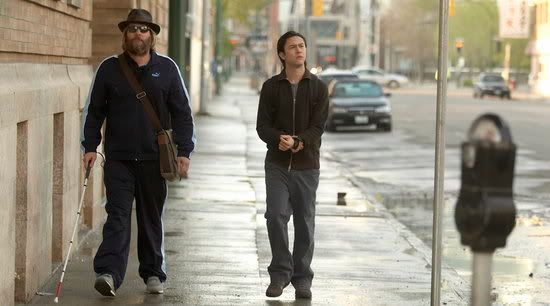
Maybe I don't get out much, but it seems odd that a lot of the teen "thrillers" I've seen lately begin with a spectacular and traumatic car-crash. Is that part of the teen-zeitgeist that the acquisition of the freedom that "wheels" represent also is uppermost on their minds as the most ironic of deaths--especially at a time when they're feeling most invulnerable. They can't imagine a "Dead Man's Curve" that could turn them into "teen angels" when they've seen themselves as an immortal "Leader of the Pack." There's something emblematically horrific about the symbol of your freedom turning against you. So, too, does The Lookout, screenwriter Scott Frank's directorial debut. Frank's made a reputation for tough-guy neo-noirs along the lines of Get Shorty, Minority Report, Out of Sight,—he has inexplicably written the screenplay for Marley & Me—and The Lookout is in the same vein. Chris Pratt (Joseph Gordon-Levitt) was a promising high-school athlete who, due to a stupid driving accident, has a variation of short-term memory loss and a crippling case of "Survivor's Guilt." For one, he has to make lists to keep him task-focused, and for the other he lives with his blind room-mate, Lewis (Jeff Daniels--fine, understated work). Cognitively, he's so "in the moment" that the only job he can reasonably function at is as clean-up crew at a local bank. That puts him under the watchful eye of a skanky team of heisters who blackmail Chris into being their entree into the facility. One wishes that with a screenwriter of Frank's freshness that The Lookout would keep you guessing, but it does not—playing out as one might expect a movie with this particular character arc, would. This is no Memento that would turn the complications and moral implications of a brain condition like this on its medulla oblongata. Here, Scott treats it as a deficiency that needs to be overcome for the world to work right for the young Mr. Pratt. And there are enough complications that affect him personally that he is compelled to pull himself out of his funk, and get his head on straight. Sounds a bit rote--a bit Hollywood-convenient--when boiled down to those essentials. But there are compensations with the likes of actors like Daniels, and Bruce McGill, and Carla Gugino lending supporting roles. One hopes for better things from the talented Frank, but considering he's in line to helm the next attempt to jump-start a "Planet of the Apes" franchise for 20th Century Fox, they might be empty hopes. Note from 2021: Yeah, that :Planet of the Apes: thing didn't happen (well, it happened and happened well, but Frank wasn't credited on it. He turned to television platforms—when he wasn't writing for Marvel's "Wolverine" character—and had, it would seem a bit more freedom, and creative control. There, he made the TV series "Godless" and "The Queen's Gambit" which burned up Netflix for quite a time (and I'm watching it now...move by deliberate move).
Written at the time of the film's release. I took out a long rant about the Bush Administration (when I wrote it Bush was still in office) and I wanted my prejudices out front. Here, the prejudices are for Oliver Stone's issues with film-making (for the most part).
Plus, the venom I spewed at that time, seems almost quaint considering what has come after him since. Bush has been heard to remark about Trump "He makes me look pretty good." Michelle Obama and he are "besties," insisting on sitting together whenever "the formers" must gather. And Clinton and he act like they're joshing brothers, after Clinton and his father became close friends, post-presidencies (Clinton BEAT Bush in in the 1992 presidential election, but it didn't matter...).
One must acknowledge grace in our leaders...when they lead...and show us the way.
"Somethin' 'Bout Bein' in the Barrel"
Oliver Stone is no one's idea of an objective film-maker, if there is such a thing. Once a screenwriter puts pen to paper, they've already started manipulating the movie to their point-of-view, whether it's from the left, right, center or upside-down (Why do you think they're called "directors?"). So, no one should be surprised that Stone has an ax to grind, with W..
Stone is a director of heart, but he frequently by-passes his brain when making his points. So, Platoon, still his best film, hi-jacks the gritty depiction of grunt jungle-fighting with Stone's own conflicted "Daddy" issues, his "Pvt. Chris Taylor" having to choose between two superiors with different moral ways of engaging the enemy. Lincoln and every fantasist depicting moral choice has put angels and devils on our shoulders. Stone burdens us with His Old Man. That same scenario was transferred to High Finance, with his very next film Wall Street. I haven't seen every film of Stone's, but most of them are concerned, in some capacity, with paternal conflicts. And because he's a better propagandist than scenarist, most Stone films stop dead whenever we get to each Stone "thesis," invariably a Message being presented by a single character who has center-stage and our undivided attention. JFK, a dazzling technical exercise of photography and editing, comes positively unglued in its presentation of conflicting conspiracy scenarios for Pres. Kennedy's assassination (Kennedy being another Stone father figure--"Our murdered King," as he's described in the screenplay (completely by-passing any thought that we might, you know, be living in a democracy with a representative government), until Kevin Costner's prosecutor Jim Garrison places in his summation a theory on military-industrial conspiracy behind the Vietnam War, a Stone obsession.* In W. Dick Cheney—Richard Dreyfuss clearly enjoys being given the opportunity to play him**—stops an Iraq War strategy session to pontificate on securing Middle East interests for oil exploitation for a hundred years. Give the man points for passion, but his movies become such a glut of emotion that the point becomes lost in the gnashing of teeth and the wringing of hands. His bio-pic of Nixon was such a slap-dash affair, it seemed like a badly-cast TV-movie gloss-over, skipping from high-light to low-light in time to shoe-horn the next commercial (A weirdly fictional conversation between Chairman Mao and Nixon was Stone's show-stopper there). By the end, with its End-Credits playing over a Mormon Tabernacle Choir-rendition of "Shenandoah," one almost felt some sympathy for the man. Nixon, not Stone.

W. (his too-early summation of the second Bush Administration) suffers the same problems. It's a gloss of recent events, interspersed with flash-backs to the wastrel days of the young George W. Bush (played throughout by Josh Brolin),*** drunk with entitlement and just about anything else he could find. Particular heed is paid to his relationship with "Pappy" George H.W. Bush (James Cromwell, though he seems nothing like Bush the Elder, displays quiet bluster and submerged weakness), in which the good-for-nothing son is particularly eaten up, not by his own failures, but by his father's view of them.

The best part of the film—oddly for Stone—is Bush's conversion to The Faith. Struggling with his alcoholism, determined to become a Public Figure (as private industry success constantly eludes him), he is converted by Pastor Earl Hudd (Stacy Keach, playing it straight, and doing some of the best work of his long career), introducing Bush to the second "Daddy," the Divine One, slotting this film into the standard Stone scenario. One knew, as soon as Bob Woodward revealed that Bush, prior to the invasion of Iraq, didn't consult his father/former President, but, instead, relied on the advice of a "Higher Father to appeal to," that Stone would obsess on it and exploit it. The film-maker takes the one relationship as far as it will go, creating a fantasy sequence where Bush 41 challenges Bush 43 to fisticuffs, but Stone doesn't have "the stones" to have W. duking it out with his Savior, J.C.
That battle's still to come.
Stone starts "W." with a Sergio Leone close-up of Bush's steely gaze, what impressionist Frank Caliendo says "like he's always got the sun in his eyes." It's another fantasy sequence, where W. acknowledges the cheers of an empty baseball stadium from center-field--what he'll later reveal as "his favorite place on Earth." The movie will end back on those eyes, searching, confused, disoriented--having lost a pop-fly "in the lights." Those distorted lights show up twice more in the movie--in that previously mentioned conversion scene, as well as when a hung-over Bush collapses while jogging. That's it? That's what we get? A half-assed light show? Is Stone saying he's abandoned by God, or that Bush is overwhelmed by his circumstances? The metaphor's too half-baked to communicate as solid concept clearly.

One could look at W.'s story in Shakespearean terms, as a modern day Prince Hal, whoring and wenching in his oats-sewing days to become the Monarch his father couldn't be. The difference is Hal had Falstaff as guide to the back-alleys of Agincourt. George W. Bush is his own King. And his own Fool.
But Oliver Stone is too busy making room for his "Daddy" theories to create a proper condemnation. As with Nixon, you start to actually sympathize with the man. Any illumination into the man or the effect of his Administration is lost in the lights. To Stone, he is just another Yalie "poor little lamb who has lost his way."
Bah. Bah...and Bah.
* Any judge would have gaveled the irrelevancy, but Stone's judge was played by the real-life Garrison.
** Dreyfuss had a lovely phrase about working with Stone on W. when he was on "The View:" "You can still be a fascist...even if you're on the left."
**Josh Brolin does fine work, but the performance feels a bit "one-note," having to nail the too-familiar Bush mannerisms and vocal tendencies.
Tomorrow—merely by coincidence, another "period" film.
Written at the time of the film's release....
 "Playing the Plame Game"
or
"The Problems of Two Little People Don't Amount to a Hill of Yellow-Cake in this Crazy World."
Those of us in the United States know the story: Ramp-up to the Iraq war; alleged yellow-cake uranium sales from Niger to Iraq; aluminum tubes thought to be nuclear weapons parts; ambassador Joe Wilson's editorial calling fraud on those suspicions; shock and awe tactics by the White House leaking information to the press, publicly exposing Wilson's wife as a CIA agent; the furor that created; the investigation; the prosecution and resignation of a key Bush administration official; the President's commuting of his fine and prison term. That's the headlines.
But, the nice thing about Doug Liman's film about the case, Fair Game, is that he immediately makes it personal. Using the same gritty techniques used in The Bourne Identity and Go (he is also the director of photography on this one, as he was making Go), he takes us to hot-spots of the world, the cold corridors of power, and the warm cozy homes of the participants, finding the nuances of life and feeling. We watch as Plame (Naomi Watts), posing as a chemical consultant, travels to Kuala Lampur to talk business, effectively dodging a trap with hockey trivia, then, when things get dicey, turns the table on her contact. Plame's cool friendly exterior turns icy when she looks her hostage in the eye and says calmly "If you help us, we can help you. And I promise you one thing: you have no idea what we can do."
Truer words. And she has no idea how true those words are.
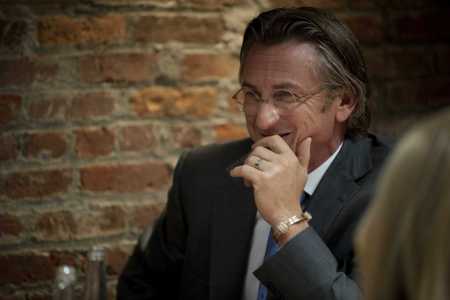
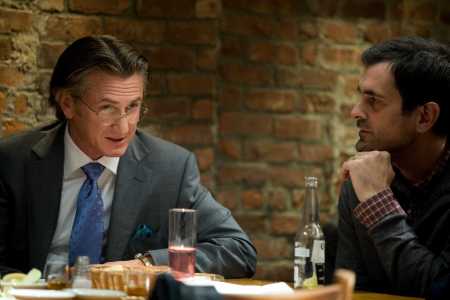
Plame knows stuff. She knows a lot of stuff*. A prized CIA investigator, she regularly travels to the Middle East coercing, cajoling and charming nuclear scientists and terrorist contacts, making promises, making contacts, hovering in the peripheries, returning home to domesticity with her husband, former ambassador Joe Wilson (a nicely rumpled Sean Penn), currently trying to turn his connections into a consulting business. Because of his knowledge on Niger, the CIA asks him to investigate the yellow-cake sale for their investigation for the Vice-President's office...the logistics of which would have been impossible to pull off unseen. Plame, on the other hand, has all the facts that the Bush operatives don't have (or won't acknowledge) about those aluminum tubes that, it turns out, are completely unsuitable for bomb-building.
"Playing the Plame Game"
or
"The Problems of Two Little People Don't Amount to a Hill of Yellow-Cake in this Crazy World."
Those of us in the United States know the story: Ramp-up to the Iraq war; alleged yellow-cake uranium sales from Niger to Iraq; aluminum tubes thought to be nuclear weapons parts; ambassador Joe Wilson's editorial calling fraud on those suspicions; shock and awe tactics by the White House leaking information to the press, publicly exposing Wilson's wife as a CIA agent; the furor that created; the investigation; the prosecution and resignation of a key Bush administration official; the President's commuting of his fine and prison term. That's the headlines.
But, the nice thing about Doug Liman's film about the case, Fair Game, is that he immediately makes it personal. Using the same gritty techniques used in The Bourne Identity and Go (he is also the director of photography on this one, as he was making Go), he takes us to hot-spots of the world, the cold corridors of power, and the warm cozy homes of the participants, finding the nuances of life and feeling. We watch as Plame (Naomi Watts), posing as a chemical consultant, travels to Kuala Lampur to talk business, effectively dodging a trap with hockey trivia, then, when things get dicey, turns the table on her contact. Plame's cool friendly exterior turns icy when she looks her hostage in the eye and says calmly "If you help us, we can help you. And I promise you one thing: you have no idea what we can do."
Truer words. And she has no idea how true those words are.
Plame knows stuff. She knows a lot of stuff*. A prized CIA investigator, she regularly travels to the Middle East coercing, cajoling and charming nuclear scientists and terrorist contacts, making promises, making contacts, hovering in the peripheries, returning home to domesticity with her husband, former ambassador Joe Wilson (a nicely rumpled Sean Penn), currently trying to turn his connections into a consulting business. Because of his knowledge on Niger, the CIA asks him to investigate the yellow-cake sale for their investigation for the Vice-President's office...the logistics of which would have been impossible to pull off unseen. Plame, on the other hand, has all the facts that the Bush operatives don't have (or won't acknowledge) about those aluminum tubes that, it turns out, are completely unsuitable for bomb-building.

But that doesn't stop the Administration from using both fraudulent claims as pretexts for invading Iraq to stop a non-existent nuclear program—selling the war is easier if the motivation is fear. Both Plame and Wilson (and their colleagues) watch in horror as the invasion occurs under false pretenses (and Wilson, having met, and been threatened by Saddam Hussein, is no apologist calling him "a monster"). Wilson calls "bull-shit" on the White House, and, fearing "a trust issue," the President's advisers start to spin the story in the Press, starting by leaking that Plame is a CIA officer. Suddenly, this spy, with enemies around the world and friends out of the loop at home, is besieged with questions and the protective bubble she has lived in is popped. Considered toxic by her colleagues in the CIA, she loses her clearances and her job, the phone rings off the hook with confused friends and death-threats and just-plain crazies. The stories start to spin out of control, with Wilson fighting back, but Plame trying to retreat back to an anonymity she will never have again, and a truth that has become irrelevant in the fire-fight at home.

The emphasis on the home situations of Wilson and Plame (and their two children) is what makes this personal political thriller so interesting**: he fights his battles out in the open, but she works in the shadows—when the couple must fight the same battle against their oppressors, the divergent styles splinter the two of them apart. Watts and Penn have worked together before (21 Grams and The Assassination of Richard Nixon), so they're old hands at making a relationship look believable, both, in turn, have moments of weakness and vulnerability, alternating with a fierceness in strength which they share, but rarely at the same time.*** That internal squabble inside the larger fight makes up the heart and soul of Fair Game, Liman and his camera catching moments of temperament between two "inside" outsiders at war at home.

* One of the amusing things about Plame's book on the subject (that shares the same name as the movie) was the redacting of so much of it; Plame was still bound to pass her book's galley to the CIA for review to prevent the dissemination of sensitive state secrets. So much of the book was blacked out that Plame published the censored document as is, and a relative not tied to the CIA explained the deleted segments—using completely public documents—in the Appendix. The credits for the movie black out many of the names of the characters. Heh.
** And somewhat akin to Liman's earlier fanciful, fictional spy film Mr. & Mrs. Smith...
*** They're just the marquee names in a great cast, including Bruce McGill—always fine—as Plame's boss, Michael Kelly—who I've been watching since Eastwood's Changeling—as one of Plame's colleagues, a very subtle Polly Holliday (remember "Flo?") as Plame's mother and Sam Shepard, who has a very short, but very significant, cameo as Plame's Air Force father.
2019 update:

 That would make it "a relentless page-turner" if it had a spine, but you're stuck watching the movie, wondering, "Yeah, but what about..." Annoying. But, not enough to make you hit the "Eject" button.