Showing posts with label Bio-Pic. Show all posts

Friday, December 27, 2024

A Complete Unknown (2024)

How Does It Feeeeeeeeeel?

or
The Freewheelin' (Inscrutable) Bob Dylan
 
"Seven simple rules of going into hiding: one, never trust a cop in a raincoat. Two, beware of enthusiasm and of love, both are temporary and quick to sway. Three, if asked if you care about the world's problems, look deep into the eyes of he who asks, he will never ask you again. Four, never give your real name. Five, if ever asked to look at yourself, don't. Six, never do anything the person standing in front of you cannot understand. And finally, seven, never create anything--it will be misinterpreted, it will chain you and follow you for the rest of your life."
Bob Dylan
 
Musicians performing on-stage use something called "foldback speakers" so that they can hear themselves accurately against the wash of sound coming from auditorium reverberation or the cacophony of crowd noise fighting against them—modern musicians use ear-buds to have their music pumped backed to them without any deleterious feed-back from similar music sources competing. 
 
That little bit of insider trivia is what I was thinking about walking out of A Complete Unknown, the new bio-pic of a slice of Bob Dylan's life as he was becoming more known and making a name (and history) for himself prowling around the Greenwich Village clubs, riding a burgeoning folk-music wave and expanding the subject matter of the genre like his heroes, Woody Guthrie and Pete Seeger into advocacy-folk or what would become known as "protest songs," which formed the soundtrack of the youth movement of the early 1960's.
 
Dylan has been mixed up with movies before—the documentary Bob Dylan: Don't Look Back, various music videos, he wrote the music for and played in Pat Garrett and Billy the Kid, wrote and starred in Masked and Anonymous, and Renaldo and Clara, and although not mentioned by name is seen through a prism of stories and interpreters in I'm Not There.
Well, this one has his seal of approval, sticks to one actor as Dylan, and covers January 24, 1961 to July 25, 1965 (when Dylan first arrived in New York City at the age of 19 to his controversial performance set at the 1965 Newport Folk Festival). And it does a pretty good job of clearing away all the myths about Bob Dylan, his absences from the public eye (hard to believe these days, he's even done commercials), his changing personas more than Madonna or Bono, and just concentrates on that initial section where he became a performer, then The Brand New Thing, then The Highly Exploitable Thing, to The Voice of His Generation, all the while navigating the rigors of performing, the inanities of being a product, and the desire to start breaking things and doing something fresh.
Frankly, that's enough. It was never his mission to be understood, and the movie never tries to psychoanalyze or explain his actions, but merely the context into which he arrived and the way things changed once he started performing. He came in with talent and a poet's way of putting thoughts into words in a way no one had ever done before, inspired by folk music and its tendency towards metaphor. 
That is immediately recognized by practitioners of the art—Pete Seeger (
Edward Norton, wonderfully essaying the man as appeaser rather than rebel) and a hospitalized-by-Huntington's Woody Guthrie (Scoot McNairy, in a non-verbal performance), and he is promoted, signed by a label (Dan Fogler plays Columbia A & R guy Albert Grossman), and starts playing bigger venues, all the while already established folkies like Joan Baez (Monica Barbaro) start interpreting his material for the mainstream. The maxim is "it's the singer, not the song" but Dylan's "voice" (as far as his writing) was so distinct, he bobbed up through the commercialization as the Genuine Article quickly and, with his ungussied-up vocal stylings, bereft of soothing harmonies and homogenizing orchestrations.
So...back to that foldback speaker: Imagine you're putting yourself out there, performance after performance, and you're leading the field. Then, you start hearing yourself over and over again and not necessarily your voice. People are singing your songs, and then imitating your songs—Pete Seeger's "Where Have All the Flowers Gone" begets your "Blowin' In The Wind" and then that begets Phil Ochs' "There But For Fortune"—or imitating your composing-process, and then parroting and parodying your songs and then you're suddenly surrounded by the newest versions of "you" while (as movie-Dylan gripes) "you just want me singing 'Blowin' In The Wind' solo for the rest of my life." It's stifling. It's maddening. It makes you want a change.
But, that's not what your label wants. It's not what your manager wants. It's not what your fans want. They want the rebellion and the "new" sound to be what they're comfortable with...or what they're making money with. You want to create. They want to cash in. Or get their comforting nostalgia. No one gets it.
But it gets creepy. There's a scene in Don't Look Back where Dylan is talking to a fan and the exchange is this:
Fan: I just don't like any of the "Subterranean Homesick Blues" stuff. 
Bob Dylan: Oh, you're that kind - I understand, right now. 
Fan: It's not you. It doesn't sound like you at all! 
Bob Dylan: But, my friends, my friends were playing with me on that song. You know, I have to give some work to my friends too. I mean, you don't mind that, right? Huh? You don't mind them playing with me if they play the guitar and drums and all that stuff, right?
Fan: It just doesn't sound like you at all. It sounds like you're having a good ole laugh. 
Bob Dylan: Well, don't you like to have a good ole laugh once in awhile? Isn't that all right with you?
 
"That's not you." How the "homesick blues" does he know? Because he attended a concert? Because he bought himself a record? It's no wonder that at one point Dylan just blurted "Just because you like my stuff doesn't mean I owe you anything." See it as ingratitude if you must or see it as not "playing the game" but "you gotta do you" because "you" is what got you there in the first place. All artists go through this. Some have even rebelled. Some have got away with it. Some have not. Some have walked the tight-rope of practicality where you're either an "artist" or you pay the bills (you know...like we non-artists do).
A Complete Unknown is wonderful in every way for putting you not in Dylan's head but in his head-space. And if the man is still an enigma after you see it, you can, at least, understand why. If I have anything negative to say about it, it's that Ricky Nelson said the same thing in just over three minutes.* That's efficient.

Now, I've gotta pay the bills, do what's expected of me: how is Chalamet? Spot on. Pretty amazing, actually, but I've never ever been disappointed by a Chalamet performance. Of course, he's prettier than Dylan, but, like Joaquin Phoenix did with Johnny Cash in director Mangold's previous music bio-pic I Walk the Line, he suggests Dylan rather than does a full-on imitation. He has a less-is-more approach which is entirely appropriate for the subject, but there's a nice touch that he brings to his Dylan which is lovely—a defiant, almost predatory stare, observing, analyzing, like a biding-his-time hawk. And, considering his vocal talents in Wonka, of course he can do a dead-on imitation of Dylan's singing style. You have to listen very closely to tell the difference between Chalamet's versions of Dylan's songs and the memories of the real deal.

I mean, the real "real deal."

"I'm not angry. I'm delightful."
Bob Dylan 
*
 

Thursday, March 7, 2024

An Angel at My Table

An Angel at My Table (Jane Campion, 1990) Incredible tale of the New Zealand author who was institutionalized for schizophrenia, and narrowly avoided a leucotomy procedure* by winning a prestigious book award. Talk about your narrow escapes. But escapes were what Janet Frame specialized in, from her "magic realism" writing style to her globe-trotting adventures that took her to England and Spain, while keeping herself locked inside her own creative mind.

Partly due to her diagnostic history, and partly due to her "odd duckishness" Frame had a ying-yang non-relationship with Society. The film portrays her as "odd man out" in various capacities, the one Campion seems to relish most is that while she is being socially shunned by a group of boorishly egotistical literati, she is the only one of them that has been critically acclaimed...or, for that matter, even published, already achieving what the full-of-themselves coffee klatsches only hope to accomplish. They dismiss her for her dowdy clothes and chia-pet hairstyle out of hand, not bothering to consider that they couldn't tell a book (they hadn't written) by its cover.
Made for television, the film is more conventionally framed than most Campion films, known for their stark use of isolating empty space, and sometimes fractured story-telling style, but Campion gets compelling performances from the three women playing Frame—Karen Fergusson, Alexia Keogh, and finally, settling on Kerry Fox for the second half of the film exploring the author's wandering adulthood. As an introduction to Campion's work, this is a good start, with a compelling true story with a straight-forward approach to the aspects of magic-realism that infuse her work.
My favorite shot of An Angel at My Table: Janet "does the twist" by herself
in the dark by the light of her camper/writing-garret.
 
* A leucotomy was a specific form of lobotomy back in the dark ages when the practice was given enough medical credence to actually give a unique name to it rather than calling it what it was—hammering an ice-pick behind someone's eye-ball to sever neural connections in the brain. I'm wondering if insurance companies covered that.
Author Janet Frame "framed" by
Karen Fergusson, Alexia Keogh, and Kerry Fox
 

Friday, December 22, 2023

Napoleon (2023)

Napoleon Blown Apart
or
Ridley Scott Tells Complaining Historians To "Get a Life" (Presumably One With Just the Highlights)
 
I'd been vacillating whether to see Ridley Scott's film of Napoleon (was it really originally called "Kitbag"?)—did I want to see the 2 hour 38 minute version in the theaters, or did I want to subscribe to Apple television and watch Scott's already-made "Director's Cut" which is more than 4 hours long?* 
 
I tend to favor "Director's Cuts" because a lot of movies cut to theater-length are sometimes near-incomprehensible once the connecting tissue of themes and sub-plots get eliminated for time. But then, some "Director Cuts" are just plain indulgent. A movie's "first cut" is always a disaster (Martin Scorsese has said “If you don't get physically ill seeing your first rough cut then something's wrong."), but films are supposed to find their shape and their rhythm during the editing process and sometimes the more brutal the better.
There's a "Hollywood story" where director Robert Rossen wasn't happy with the length of his film All the King's Men (and neither was the studio), so he merely took "the center" of each scene and cut 100 feet from the front of it and 100 feet from the back and released it like that. The film went from a length of 250 minutes to 109, and won the 1950 Best Picture Oscar (and was nominated for the editing).
The decision for me was seconds long in the thinking—all this other stuff was back-story—I went with the theatrical version (I could always look at the longer one) and Scott is usually pretty good at getting the gist of the story he wanted to tell in the shorter running times. And his films at the shorter length tend to be "snappier" and less padded and one doesn't get the sense that one is missing anything. With a subject like Napoleon Bonaparte (played by
Joaquin Phoenix), though, there is bound to be omissions, whole swaths of them. Scott's film follows Bonaparte from the French Revolution in France in 1789 until his death in 1821.
Toulon
The highlights are his witnessing of the death of Marie Antoinette (didn't happen) during the Revolution, his Siege of Toulon, his controversial quelling of a civilian rebellion in 1795, his campaign against Egypt in 1798, his taking control of France in a coup in 1799, his coronation as Emperor in 1804, and a bit of the Napoleonic Wars, particularly the Battle of Austerlitz, and his ill-fated Invasion of Russia in 1812, leading to his exile in Elba, his subsequent return to France, the Battle of Waterloo, and his final exile on St. Helena. That's a lot of territory and politics to cover with a big gap in places before his becoming Emperor and during the Napoleonic Wars, although those battles listed are given quite a bit of depth.
Swirling around all of this is Napoleon's obsessive marriage to
Joséphine de Beauharnais (played in the film by Vanessa Kirby), whom he meets at a Survivor's Ball after the Reign of Terror—her first husband was guillotined and she was in prison during it—and begins an affair that informs and influences some of Napoleon's decisions (yes to some, no to others the movie would have you think). Those scenes have less fire-power, but they're still battles of wills as they bicker and bite over who has control over the other, Joséphine's indiscretions (and Napoleon's, too), her inability to provide him a male heir leading to their marriage annulment and his subsequent political marriage to the Austrian Emperor's daughter, Marie Louise. (It's rather amazing that Scott's film is only 2½ hours long! Abel Gance's "definitive" cut of his Napoleon film ran for nearly 9½ hours and only got up to the marriage of Joséphine!)
Performances are good throughout, the standouts are Kirby and 
Rupert Everett's Duke of Wellington. The big pressure, of course, is on Phoenix, as Napoleon has always had a Sphinx-like quality to him, and what we know of him is his accomplishments, his many portraits, flattering and unflattering depending on the nationality of the painter, and his letters to Joséphine (many of which are quoted in voice-over in the film). Phoenix manages to keep his Napoleon as unknowable after the film as before—imperious in matters of State and war, but almost petulantly child-like in moments of lust or humiliation, very much in command backed by great numbers, but a bit panicky when having to act solo. There is the whiff of "keeping up appearances" when given to a grandiose equating of his fortunes with those of France, but, there are times in the private chambers when Phoenix can't overcome some lame dialog ("Destiny has brought me here. Destiny has brought me this lamb-chop.")
Some of Scott's more arresting shots are based on period paintings.
Phoenix could have been a cardboard cut-out for all Scott cares during the battle sequences. They're staged brilliantly with the emphasis on numbers and the only identifiable character is Napoleon, whether he's catching a cat-nap on his feet before a battle or deciding the fate of many with just the drop of an arm. Scott has had lots of research to draw on, and one sees the way they unfold without any coaching about tactics. The Austerlitz battle is particularly impressive. Scouts signal by lights the positions of the enemy, which Napoleon enables to come to a seemingly sleep encampment. Then once his enemies are deep within their territory, he unleashes camouflaged infantry from the hills, provoking a retreat. But, the battle isn't over. The cannon are uncovered and fired deep into their own camp, forcing the troops into another direction...onto a frozen lake, allowing Bonaparte to unleash cannon-fire that either kills troops or breaks the ice, sending them to a watery frozen grave with no escape. Brutal.
The trap of Austerlitz
I'm always a little suspicious going into a Ridley Scott movie (violating a rule to enter a theater without prejudices). There are a lot of good ones and there are some quite bad ones. All are made with an attention to detail and artistic zeal—if I haven't written it, I've thought it: he's a better art director than a director, which is a little harsh—but, the quite good ones are those where the stakes might be a little lower than the "buzz"-generating ones. In one year, he made two movies—The Last Duel and House of Gucci—the first was quite good, but was little-seen, while Gucci was a self-generating publicity machine that was a mess. And one can go through his entire output and look at the ones that were triumphs (whether humble or not) and audacious failures, quite the checkered career. But, they always looked good. That much is consistent.
Moscow burns, but not by him.
And I tend towards saying Napoleon is good, despite its eccentricities. The battle sequences are amazing whether channeling the battle approaches of Kubrick, Welles, or Jackson, and some will be impressed with how Scott really goes for re-creating famous Napoleon tableaux into living, breathing set-pieces. But, I like it for following the Kubrick model** for considering Napoleon—the same theme that informed a lot of Kubrick's work: no matter how smart or able a human being might be, they can be undone by their own faults. Successful people can be destroyed by their very nature. Geniuses can be very stupid.
 "Well...shall we vote?" No recounts necessary.
It's a comedy. Not a very funny one, but certainly an ironic one. There is some black comedy to be had with such a person as publicly arrogant and as privately sniveling as Napoleon could be, whose ambitions were the world, but could be cowed in the bedroom. Scott follows that model to a fleur-de-lis. It is said that Scott considered making the Kubrick script, but passed on it for "creative differences", and made something of his own. But, it still has the spine and the thesis of the unmade Napoleon film at its core, and something of the French 2002 mini-series in its portrait recreations.
If I have a quibble it would be with the last scene, presumably showing Napoleon's death at St. Helena. Dramatically, it doesn't work, although it does work visually—Napoleon seen from behind, eating a mid-day meal, merely falls over out of frame. It's almost absurd. But, it does make a point: this powerful man, a former emperor of a great and powerful nation, who once had the world playing defense against his every move merely disappears, and the scene goes on—life goes on—as if he never existed. It visually makes the point that death makes us all equal, even irrelevant. Still, it's a bit underwhelming.
An underwhelming death for such a world-shaking individual. Irony, again. And then, Scott and his screen-writer (
David Scarpa) tally up the deaths from his battles and campaigns. Three million. Three million souls. We know very little about them—their numbers are just too great—but they all have something in common. They were all people whose deaths were the results of the actions of one man, a man of consummate ambition, with his own vision of what the world should be, not satisfied with his own borders or the extent of his domain. They were caught up in the gears of one man's machinations.
And when given the first opportunity, when his reach exceeded his grasp, the world found a way to deal with him that was far less costly in political capital, and the various monetary denominations he would waste, and the blood that he would spill. They sent him away, exiled him, found a little rock that he could rule over, and when he escaped from that, they found a farther-away little rock with no rule at all and left him there to rot. After all, better him than them.
Waterloo
What else could they do with such a man? His punishment and possible execution would have caused too much unrest, and might have even made him a martyr to his supporters. No, the best punishment was to get him out of their sight and out of his spheres of influence. For such a man of power, the worst thing they could do was take his power away. Napoleon was just one man who so destabilized the world that he was just too dangerous to the peace and tranquility to not be exiled to a place where he could do no harm. The world would be better off without him and there would maybe be better things to think about and act on. The world might actually be improved, rather than merely re-shaped to suit a man's ego. 
Wellington and  Napoleon 
St. Helena is still out there, and I'm sure it has some vacancies.

Got anybody in mind?
Napoleon and Joséphine
* I still find it unfair that George Lucas has perpetually been criticized for tinkering with his movies (usually because the special effects looked sub-par on better TV's, or because he wanted to add things that he didn't originally have the budget for). But, Scott's been doing it for years and years and years, and because he always had to shred his movies to get them to an acceptable run-time in theaters...or because he was dithering with them long after the fact. See also Oliver Stone, Francis Ford Coppola, and Zack Snyder.
 
** Stanley Kubrick worked on a screenplay on the life of Napoleon for some ten years. He did extensive research, logistics, costume tests, location scouting, and had a full screenplay ready to shoot.*** He'd just had two successful films with Dr. Strangelove and 2001: A Space Odyssey and negotiating with M-G-M to finance it. They rejected it. The reason? The financial failure of the film Waterloo. Kubrick abandoned the idea, but it influenced his next two films: he made A Clockwork Orange to use the new wireless audio technology in audio, and to really make an independent film with a minimum crew, and Barry Lyndon with the idea of trying to achieve painterly compositions photographically, simulating the pace of the 18th century, and staging large artillery battles. Steven Spielberg is executive producing a mini-series for HBO, and (as of this writing) it's still on track, with Cary Joji Fukunaga directing. We'll see if the project gets derailed again by a rival production (as it was the first time). However, if one checks out their movie history, there's usually some "take" on Napoleon every decade or so. 

*** The screenplay sits on my home-screen half-read, but a deluxe box-set of the script and all the pre-production material can be purchased.

Thursday, December 21, 2023

Maestro (2023)

Learning How to Conduct Yourself
or
Waiting in the Wings ("Any Questions?")

A work of art does not answer questions, it provokes them; and its essential meaning is in the tension between the contradictory answers.
Leonard Bernstein

I have a lot of favorite composers, but the one who always made music that brought tears to my eyes was Leonard Bernstein. There are sections of his score to On the Waterfront that does it, sections of "West Side Story", a recent viewing of Bernstein's "Mass" on PBS "Great Performances" did it to me, even though the thing was going right over my head. And it happened here, in this movie, in the end-credits without an extended segment of his "Candide." 
 
There are moments of great sublimity in Bernstein's music that you wonder that a human being could come up with something like that, tones and phrases so heavenly that they punch you right in the heart. And that he was able to write for theater, film, and the concert house is another of those un-ponderables. Add that he was not only a gifted composer, but also an outstanding student and interpreter of other composers' music, creating some definitive (to my ears, anyway) interpretations. And along with being a great student, he was a great teacher, becoming known for "Young Peoples Concerts" and lectures on "Omnibus". He was a genius, while acknowledging that word is so devalued these days.
But, the thing about geniuses is you never want to work for one. And maybe you don't want to become "involved" with them. Their work, their inspiration is an insular part of that person and sometimes it is a Rubicon you cannot cross. Bernstein was a great teacher, composer, conductor, but was also a celebrity, insatiably curious and had appetites. As Bernstein's sister (played imperiously by 
Sarah Silverman in the film Maestro) says: "There's a price for being in my brother's orbit..." That price is an isolation, that, although he may be a partner, he will never be a constant one (not that he couldn't be dedicated). He may be loyal, but by giving that loyalty is given permission to be disloyal. Mercurial, temperamental, capricious. Reliable, certainly to his craft and his art, but unreliable in his steadfastness and his exclusivity.
Maestro tells the story of the Bernstein-Montealegre marriage, which lasted 27 years until her death in 1978 (Bernstein died in 1990). And, interspersed with it are individual triumphs—Bernstein's star-making substitution for an ailing Bruno Walter conducting the New York Philharmonic (without any rehearsal) for a CBS Radio broadcast, his work making "On the Town," Montealegre's stage career, his work on the Mahler catalog—and disappointments, the most central of which was Bernstein's philandering with both men and women, as well as Montealegre's eventual death from cancer. It's staged as three acts (naturally), shot in different formats: the early years in academy ratio black and white; the troubled years of success—academy ratio color; Bernstein's life after Montealegre in wide-screen color. Why the marriage years are in the boxy square format and the solo years in wide-screen seems to be making a comment, but I haven't been able to come up with anything that doesn't seem to be in contradiction to the rest of the movie.
The film is centered by the performances of 
Bradley Cooper as Bernstein and Carey Mulligan as Felicia Montealegure—everybody else in the film are background characters, no matter how well-know (Comden and Green, Jerome Robbins, Aaron Copland), and the film revolves around them, sometimes literally. One's immediate impression is that Mulligan is doing some of her strongest work in years—until you realize that she's always been doing her hardest work. Cooper directed (and co-wrote the screenplay with Josh Singer) and he's given Mulligan and himself some pretty dexterous argument scenes where they're required to talk over each other incessantly and pausing only to spark off something the other person said. There's some deft timing done at high volume and dudgeon that's very impressive.
Cooper's performance is going to be the one that people will have an opinion on—as Bernstein was such a media presence that most people have an instinctive sense-memory about him—the make-up work is quite good with only moments of Cooper managing to emerge through it, and he's given Bernstein three distinctive voices for each section, products of a life-long cigarette habit and a cultivated life-style. I have the benefit of knowing someone who worked with Bernstein later in his life and they give Cooper high marks for his work citing "moments when you'd swear it was him" in postures and hand-work.* I will defer to them for any comments on his work, and will add that their impression of Bernstein—"casual" and "generous"—and that the film was far more honest than was expected.
As far as Cooper's direction, I found it interesting. He is not a great director for the poetic artistic shot, but he is a great director of sequences. After a prologue of the older Bernstein (in wide-screen), breaking down while performing a piano piece in front of the cameras ("So to answer your question, yes, I carry her around with me quite a bit"), the film cuts to black and white box as Bernstein gets his fateful call to conduct in 1943, and Cooper has Bernstein open his drapes, fly out of his room in his shorts and robe, opens a door in the hall and (wham) he opens it onto a balcony in a vast concert hall. The camera zooms out to the stage and a waiting podium, and then back to Bernstein, who turns on a dime and goes back through the door to emerge in a tux and make his grand entrance for the performance. It's very bravura (and all done to the heavy percussive part of Bernstein's On the Waterfront score).
And I began to worry: Is he trying to out-Spielberg Spielberg?** He's not—as the subsequent movie would show—it's just that he likes long "takes." In fact, it's amazing how long a scene will last without cutting away—those "argument" scenes are done in one shot.
Cooper will do a couple of other "showman" sequences during the "early days" sequences, but then he stops. Did he run out of energy? No, it's more a matter of putting the energy into the performances and letting the camera settle down as an uninvolved observer with merely a slow Barry Lyndon-style approach for comment. Those exuberant camera routines merely reflect the heady days of promising youth and endless possibilities...where you think you can do anything. And significantly, as things get more serious, Cooper's camera work gets more placid. Rather clever, that.
Oh, there's a fumble or two. A scene where a clearly cavalier Bernstein drives onto the family estate with his new lover in tow is overlaid with the sneaky opening bars of "West Side Story" and that's a little "on-the-nose." But, for the most part, the choices are good, sometimes surprising in their subtlety, and show a freshman movie-maker still learning some tricks and experimenting and seeing what the possibilities are in this train-set he gets to play with.
The film sets up a mystery with that opening Bernstein quote at the top of the page, and then, at key points, breaks a scene off with a final "Any Questions?" That's not much of a provocation, is dramatically awkward, and I'm not sure the movie fulfills its promise of demonstrating the tension between contradictory answers, so much as showing that any two human beings will have conflicts and must fight their inclination toward selfishness and ego (on both sides) in order to form a more perfect union. But, at least the movie is reaching, and exuberantly so, and Bernstein would appreciate that. He'd have hated a boring bio-pic, even if he had to look bad to get one.
In other words, the movie conducts itself well. Any questions?

* I made a remark that, unlike, say, Joaquin Phoenix in Walk the Line, Cooper's work was more imitation than performance and got the reply "Yeah, well, that's Lenny."

** Spielberg was going to direct Maestro, but an early peak at Cooper's rough cut of A Star is Born made him say "You should direct Maestro."

Wednesday, November 8, 2023

J. Edgar

The F.B.I. (Love) Story
or
"What Determines a Man's Legacy is Sometimes That Which Isn't Seen"

J. Edgar Hoover ruled the Federal Bureau of Investigation for 45 years under the Department of Justice. Over the course of his tenure, he made the FBI his personal weapon in defending the nation from threats as he saw them, even as they changed form—from Bolshevik radicals to hayseed bootleggers and bank robbers to Communists to Civil Rights Activists to his very bosses. He did this unsubtly and unequivocally with press-trumpeted raids and whispered-about secret files that, if it didn't make him (as the phrase goes) "the most powerful man in the country," he was certainly the most feared. It was always assumed that Hoover had "the goods" on everyone, and guaranteed his long-held government post with weapons in manila files.
When he died (in office), Hoover's mug had
the well-known face of a haggard bulldog—keeping secrets is something that can age you rapidly—and keeping secrets is something Hoover did best. Not only those of others, but his own.  Rumors swirled about the nature of his relationship with FBI Associate Director Clyde Tolson—that they were secretly gay lovers rather than "gentleman cops," that Hoover was a cross-dresser, and that the reason Hoover didn't pursue the gangsters of La Cosa Nostra in the '40's and '50's was because of compromising photographs in the hands of Meyer Lansky. Nothing has ever been confirmed. It's all just rumor, the smirking kind that the powerful get (but there's never any proof).


Which is why news of a Hoover bio-pic, written by Dustin Lance Black and directed by Clint Eastwood seemed so intriguing. Eastwood isn't afraid to take chances, turning cliches on their ear and Black's clear-eyed script for Milk garnered an Oscar. Their film J. Edgar promised "red meat," of the kind that could be delightfully and salaciously chewed.
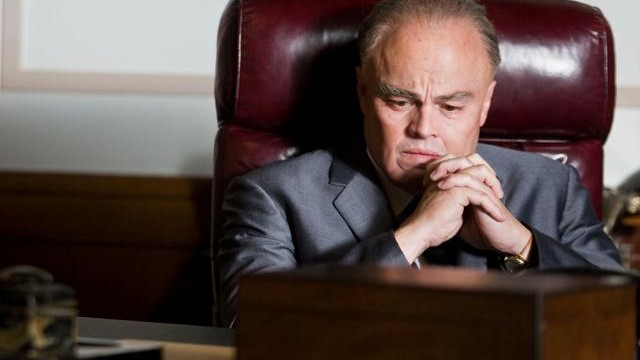
And the two men have taken chances...but not with the result you would think.  Rather than being a rant or skreed, J. Edgar is actually a sympathetic look at the FBI director and his peccadilloes and shortcomings. There's nothing hysterical (save for one fist-fight that breaks out between Leonardo DiCaprio's Hoover and Armie Hammer's Tolson) in script or direction, but it offers a look at a severely closeted man who had to be in the times he lived and with the mantle he carried. Ambitious, yes. Paranoid, certainly. Vain and glory-hunting, without a doubt. Hoover craved the spotlight and his role in being "Head G-Man," while at the same time operating in the shadows, single-mindedly hoarding the secrets of others, while keeping his own is the height of ironies. At the same time that he espoused the Bureau ethic for red-blooded American males as agents, one wonders if it is done for appearances' sake, a beard that would mask his own leanings while also serving as a "hiding-in-plain-sight" revelation of his own taste in men.

Black and Eastwood conduct the story-telling in flashback, as
Hoover in his latter years, decides to set the record straight, dictating his memoirs to an amusingly rotating number of agent-stenographers who disappear as soon as a point is questioned, or a weakness revealed. The story is a white-wash, reflecting the man's "official" view of the Bureau's history in a mix of incident and myth. At many times, J.Edgar is a bit reminiscent of Citizen Kane, with its fracturing point-of-view, shifting perspective, and ironic commentary on some of the incidents.*

It also shares Kane's sense of the unattainable summation of a life. C.F. Kane's had little to do with "Rosebud," just as Hoover's gay leanings was a small part of his whole story. It began with
a controlling mother (Judi Dench), determined to keep young John Edgar from becoming a drunk like his father. Groomed to become "the most powerful man in the country," Mother Hoover controls her son's life to make him the image of the perfect son, diction lessons to force past a stammer, impeccable grooming, and the enforcement of all of her prejudices. And the nullification of any behavior less than manly. He is made in the image of his Mother's "perfect son," even though that image may be completely counter to reality. It sets him on a lifelong course of fighting her battles, never really being his own man, as much as posing in the presentation he wanted to project. A performance. An act. Myth and lies.

It is a story soaked in ironies: the man who kept secrets on everybody, but the biggest being his own; the investigator who saw no harm in exposing other's private lives, while keeping an iron grip on his own; the policeman who targeted and made war on many enemies, the primary one being himself. Black and Eastwood present
a case for sympathy, even empathy, for a man who shaped, and was shaped, by his times, who rose through the ranks of power in society, to not be shunned by it, and who searched for verifiable fact while living in denial, and closeted by the bureau of his own making.

Hoover and Tolson at their regular table at The Stork Club.

* Not to mention that DiCaprio's "old-man" make-up makes him look more like the aged Charles Foster Kane than the jowly Hoover (still, it's better than the never convincing make-up that Hammer sports as an aging Tolson), and the shots of Hoover witnessing the Inaugural parades of Franklin Roosevelt and Richard Nixon are shot from the same angle as the "newsreel" shot of Kane in a balcony appearance with Adolph Hitler.