One suspects that I'm the perfect demographic for Thelma*, seeing as I'm on the waning edge of the Boomers and having looked at life from both sides now. One sees mentors and peers and Alphabet-gens in the cast and nods one's head in sage recognition.
If only theater seats could rock it would be perfect.
I've seen movies about scammers and hackers and other denizens of the sight-unseen chicanery of cyber-criminality, which if my google search is correct is 2328 times a day, 8 million in a year. That's a lot of possible stories to tell, but at some point, one becomes numb to the stories as they seem so commonplace these days, whether its victims are corporations, infrastructures, or the most common among us. No one seems safe except those off the grid or those without cards of any kind, I.D. or credit/debit. And out rush to make things so "convenient" seems to have made us more vulnerable, oftentimes, ironically, with our enthusiastic permission.
When was the last time you read the "Terms and Conditions?"
But, I can't recall—except implied for heist movies, government conspiracy films, or spy flicks—of anyone telling the story about a victim of one of these things. But, then...my memory isn't what it used to be. Movies either, for that matter.
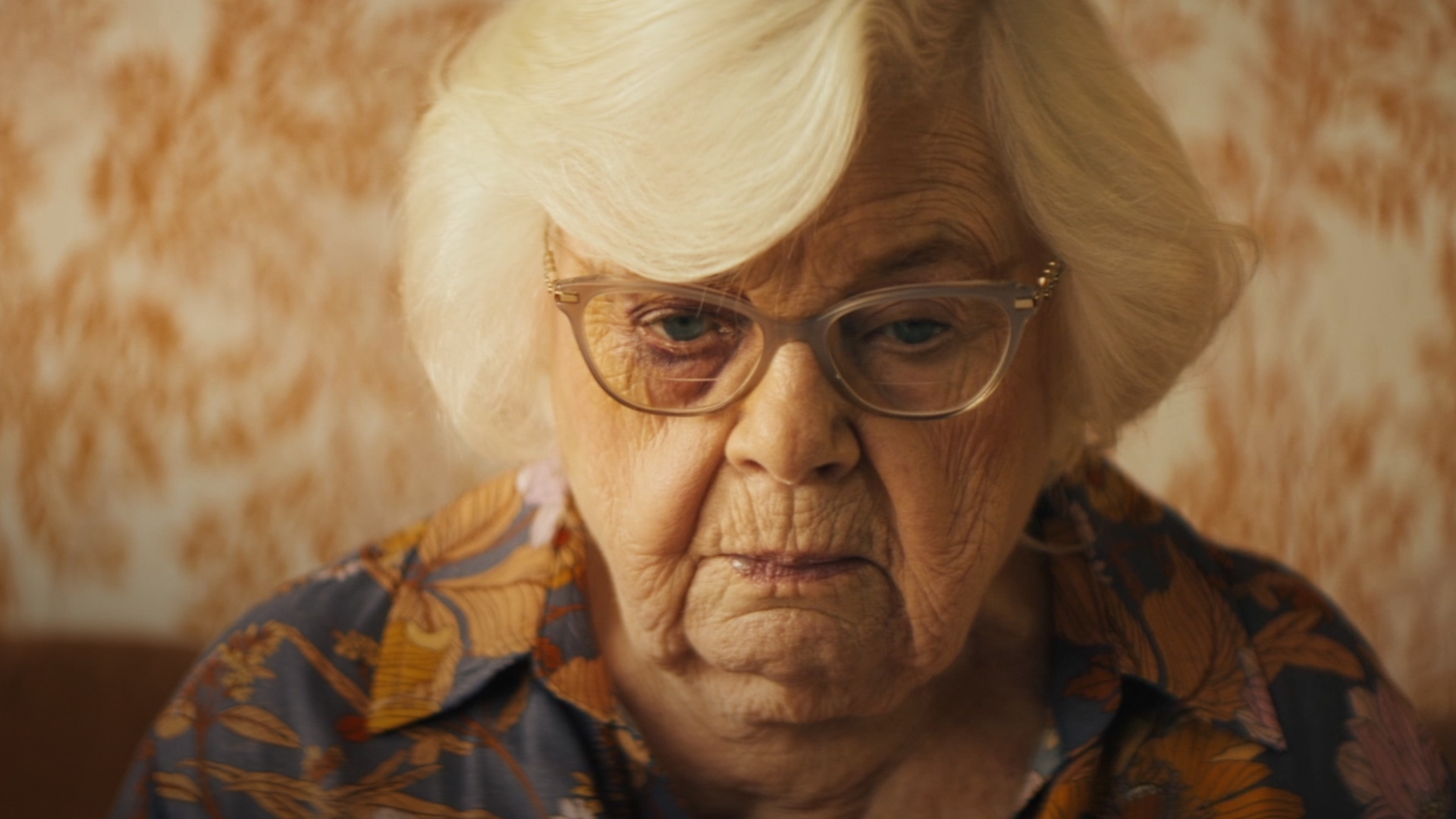
Thelma puts a face on the news stories of oldsters being conned out of their legitimately-earned savings and that face is June Squibb's, all 94 years of it, where she finally has a lead-role—and executive produces at the same time, no doubt for back-end compensation (way to go, June!)—playing the title character, who not only is getting "up there", she's reached the top and is looking down. She has a little trouble navigating new technology—she needs the help of her grandson, Daniel (Fred Hechinger), who has his own issues, but loving gramms isn't one of them—she is a perpetual quilter, is ambulatory, and can take of herself. Not only physically but also in attitude. She plays mah-johngg on the computer and hates wearing that Life-Alert button. Her memory for trivia isn't good, but she's still sharp as a tack—her motivation hasn't dulled at all. She's a little creaky, but when she has a goal...
One day she gets a phone call. It's Daniel. He's been in an accident and he's in jail. He needs $10,000 to get out. She's given an address to a lawyer and she's to mail the money immediately to spring Danny. She calls her daughter Gail (Parker Posey), but she's in a therapy session and lets it go to voice-mail. Thelma can't drive, but gets a cab, gathers the money up and sends it. Gail gets the voice-mail, panics and calls Daniel—he's asleep—calls her husband Alan (Clark Gregg) and everybody tries to call Thelma, goes to her place and are alarmed that she's not there! When everybody manages to get to the same place, they all are relieved that Danny is safe...but, who called Thelma? They come to the realization that she's been scammed, but filing a police report does no good.
There is much discussion of what to do about Thelma—Danny feels responsible, but doesn't think he's good enough to take care of her and Alan and Gail, who are the most helicoptering of parents start to consider whether Thelma should be put in a home. Thelma, however, has one thing on her mind—getting the money back. The kids want to let it go, but not her, and while they're deciding what their next steps are going to be, Thelma decides what she's going to do. She has the address of where she sent the money, and all she needs to do is get some wheels. The kids aren't going to help, so she calls as many friends as she can, only to find that everybody on her contact list is either dead or incapacitated.
Finally, she calls her friend Ben (the late, greatRichard Roundtree) who has an electric scooter and they embark on a journey across L.A. to find her money and get it back. Hilarity...and a substantial dose of what the hurdles the elderly face in this ultra-teched but indifferent world. It could be maudlin, it could be a shallow romp about "those frisky oldsters", but it deftly negotiates those pit-falls and turns into something funnier and a bit more life-affirming. Thelma's kids tend to lean toward caricature, but in the hands of Gregg and Posey, less damage is done toward the proceedings, and Roundtree and Squibb are delightful all the way through.
It's a better-than-you'd-think version of a geriatric heist movie, and, if you see it, stick around for the credits for a little surprise as to its inspiration. It'll bring a smile to your face and a warmth to your heart. And that never gets old.
While doing work on The B/C-L Index—you are using it, aren't you?—I come across reviews that haven't been thrown on here. This one is an oddity. It's the first movie review I wrote after a long time of just letting movies rattle around in my head. It's rough with way Too Much Information about my personal life for me to be comfortable with it, and too much "What I Had for Dinner"-type information that just seems irrelevant to the subject at hand (that being the movie). Still, it was an interesting read (for me, at least). If I haven't improved since then, I've at least learned to stay more on track...which for a blog about movies is important.
You'll Believe a Man Can Float
Driving home from Superman Returns in 4-story IMAX and 3-freepin'-D on Wednesday night, I was listening to KIRO Newsradio. Thousands were evacuating, fearing the cresting of the Delaware River. Andrea Yates was convicted (again) of killing her kids. A public official was lost in the Olympic Forest.
"Man!" I thought. "We could really use Superman."
I knew I needed him. It had been a rough week of moving furniture and hauling myself from The Island to The Redmond. I was swamped at work and I had to take Tuesday off for the transfer of our big stuff from The Place What We're Selling to the current domicile, so my Wednesday started at 4 am (just in time for the sunrise) to get started early on due assignments. After all this, I was looking forward to seeing friends I hadn't seen...in ages, and seeing the new "Superman movie". I was really looking forward to that. I've been pretty discouraged lately, and a new Superman movie...well, that seemed just the ticket. The previews for it were great.
But everyone will be comparing it to the first one. As well they should. Superman Returns should be called "Son of Superman" (*ahem* cough!) as it's so closely tied to the first film. It recycles Marlon Brando as Father Jor-El, and recycles whole sections of the first film's Mario Puzo/Robert Benton/David Newman/Tom Mankiewicz script, including my favorite Lex Luthor line: "My father always told me..." "Get out!"
But, Superman: The Movie was really three films: The deadly earnest Krypton section ("This is no fantasy" intoned Brando at the beginning); the equally serious Smallville/Fortress of Solitude section (with Glenn Ford's last great performance, and a farewell to Ma Kent scene in a seemingly endless epic wheat field); and finally, the Metropolis movie, with its antic screwball comedy pace (brilliantly achieved, by the way), it's cartoonish villains ("Otis-burg? O-TIS-BURG???!!!") with their absurdly successful attempts at stealing nuclear missiles, and at its soul the "Superman Meets Girl" romantic comedy story-line. I've always felt that lurching shift in tone was a bit out of step with the rest of the film (though you could make a case for showing that stalwart Superman is needed in such a crazy, zany world). Now, I'm not so sure. Because Superman Returns keeps the earnest tone of the first couple sections of the original throughout its considerable length. More cohesive it may be, but it's not more entertaining. In fact, it tends to bog down the proceedings, which consists of "regrets and things unsaid" which would have made Richard Donner's His Girl Friday pacing inappropriate. Which only points out how large the gulf is between that first film and this one.
Donner's Superman was a frothy entertainment, that, in the days of disco, long sideburns, and flaired pants, winked at the concept of heroics. This one is heavier, darker, meaner and less entertaining. There's less joy to it. And it takes its heroes deadly seriously. You think a guy like Spider-man has great power, thus great responsibility? Hell! Try being "Superman!"
Donner's flying scenes in the first (with a lot of credit going to licensed pilot Christopher Reeve) showed the joy of flight--the freedom of it--the grace. Who wouldn't want to fly after "Superman?" "SR's" flights are rarely graceful, and powered by stress. This Superman is always in a hurry. He doesn't stop to smell the up-drafts or do a lazy roll through the clouds. He's making a bee-line from one emergency to another. There's another quality to the SR aerial scenes--isolation. Superman is often seen as a small speck in a big, empty sky with life going on far below him. He's not a part of this Earth, and Singer drives the point home again and again. It's no fun being Superman.
I'll bet audiences have a problem with that: if they were Superman, of course, they'd enjoy it. It brings to mind the Superman scene I'd like to see. Howard Chaykin, of "American Flagg!" comics fame said in an interview how he'd like to start off a Superman comic. Lots of panels of ordinary Metropolitans going about their day only to have them interrupted by a blue-red streak going by their window. BOOM!Another about to sip his coffee. BOOM!A couple more of those until you get to the "splash" page: Superman, over the ocean, wearing a pair of shades, and popping his fingers, listening to "I Believe in You" (from "How to Succeed in Business (Without Really Trying)) on his Walkman. "You have the cool, clear eyes /of a seeker of wisdom and truth."
Yeah. I'd love to see that Superman.
But despite Returns' seriousness, there are joys. Brandon Routh looks and sounds so much like Christopher Reeve that it doesn't take a big leap (or a single bound) to accept him in the role. He exhibits a bit more life as Clark Kent than the more stalwart Superman, breaking into a goofy grin at the slightest provocation, and restraining the klutz routine (he doesn't constantly punch up his glasses the way Reeves' CK did). I also like the fact that his performance doesn't have the same "I'm sharing a joke with the audience" quality that Reeve brought to the role. Kate Bosworth is damned cute as Lois Lane** (as a blonde, she barely registers on the screen, but here, her hair darkened brown, she seems to have a bit more depth) and has little of the Margot Kidder neuroticism and (here's a plus!) I don't remember hearing her scream once. I do miss Kidder's whiskey baritone cracking on "Clark!," however.
There could be a bit more life to Frank Langella's Perry White and Kevin Spacey's Lex Luthor. Spacey's Luthor is self-contained malice and only sparks to life during a confrontation scene with Lois. Gene Hackman expertly tred the mine-field of jokes in the first film, but it was tough to buy him as a real threat to anybody but his cronies. Spacey's Luthor is a villain who does bad things...and enjoys doing bad things. Unfortunately, here, you mostly see him prepare to do bad things, and so there's no real pay-off for the character until 2/3 of the way through the film.
There is one cracker-jack sequence involving a doomed airliner that shows that it's pretty darned hard task to stop a plane in free-fall. It's note-perfect, right down to showing the skin of the craft buckling from a lurching halt. The movie has a good bead on the concept of heroism, too. There are a lot of heroics in this film (not just from der Ubermensch) where people who could take the easy way out, go against their better judgement and do What Must Be Done, despite the jeopardy it may put them in. It makes a statement that heroism doesn't come from powers and abilities far beyond those of mortal men. It comes from the heart, the conscience and the will.
Good movie/bad movie? Thumbs up/Thumbs down? Hard to say at this point. There are some movies that are merely okay while you suffer through them, but are better in memory (Napoleon Dynamite is one of those films: I can laugh at parts of it in retrospect, but I'd have to be kidnapped and a gun placed to my skull to watch it again***). Superman Returns was just the opposite: enjoyable while sitting through it (though I was aware of just how long it was, I didn't quite get to the point of checking the time), but the farther I get from it, I remember what's wrong with it more than what was right. If I had my "druthers," Superman Returns would be lighter than the Batman Begins, the "X-men" films, Spider-man, certainly lighter than Ang Lee's Hulk. At least it wasn't as frivolous as the Fantastic Four. My opinion of it is evolving, and that brings up another issue.
I've noticed an interesting trend in on-line reviews over the weekend. Initially, they're scathing, criticizing every aspect of the film..and harshly, to a ridiculous , often hysterical level. Second viewings produce a more favorable response, even admiration. I suspect that folks go, expecting to see the first film or worse yet, their idealized memory of the first...or second film. In that regards, this one will fail, but it can't help but fail. You can't fight a cherished favorite, or the memory of a cherished favorite. My advice: Go, expecting Superman IV. I know I'm going to see it again. Through the double exposure of the 3-D glasses, I couldn't tell whether the cribbed...sorry, the "homage"...final shot of Superman flying up, up and away past the audience had its Superman smile benignly at the audience. Like the George Reeves wink at the end of some of the TV shows, and Christopher Reeve's shared smile, it would have been nice to see it in this one. The fact that I didn't disappoints me, and makes me wonder why a decision not to include it, was made. Don't we want Superman on our side? I'll have to see it again.*
My favorite sum-up is by The Stranger's Andrew Wright who grumped: "For a movie featuring a hero who can conceivably give God a wedgie, there's precious little zowie to be found." "Zowie!" as in Adam West clobbering Ceasar Romero "Zowie?"
* And, sad to say, there is no smile on the final fly-by of 2006 Superman. He merely scans the audience with his eyes on the way past, ever vigilant. He probably isn't smiling because of the relatively few bodies he sees in the seats. And the ones that were there are already heading for the Exits. Not exactly what a super-hero expects when he sets out to "watch your back."
** Hey, c'mon, younger me: Lois Lane shouldn't be "cute". Lois Lane would curl her lip if you called her that.
*** Yeah, I don't know what my problem was here. I watched it a few years later and fell in love with it and regard it fondly.
A bit of hind-sight from here in 2024: James Gunn is making a new Superman movie with a new "from-scratch" cast and I just read the Internet News says that the "CW" is making a Superman series with Brandon Routh playing the role again—although as it's from the Internet, I'll believe it when I see it on my TV screen. I like Routh. He's gotten looser and more charismatic with age and I bet he could do a fine performance as "Supes" these days (as he did on those recent CW shows).
But, my long-distance memory of Superman Returns tilts it to a "bit of a drag" movie. There WAS no "ZOWIE!" to it. It was dark, dispiriting, mean and vengeful. It lingered on the negative and dismissed the positive. It should be bright, three-colored and direct. It should take pride in the right and look down on the wrong, not dwell on it. Bad guys shouldn't be taken so seriously; they should be ridiculed...but not by Superman. That would be mean. But, they should be dispatched so that life can go on positively.
And no brooding. Zack Snyder spent so much time having Henry Cavill doubting himself and "his way" that he never got around to showing a good portrait of Superman. And I, for one, am glad he got stopped before he could carry out his "Superman-as-villain" scenario for his planned Justice League series. That would have been just a dreary exercise. As dreary as making Superman a "fair-weather father" as he is in Superman Returns. Not to mention a serial-peeper. The crux of Superman is he's a good guy. Just because he CAN do something, doesn't mean he does. There's a thinking, moral filter there...that the recent incarnations have forgotten about.
Maybe it's because all I see these days (because they're the loudest) are politicians as "anti"-Supermen who don't believe in "Truth" (that's for damn sure!), "Justice" ("Delay, Delay, Delay") and I don't know what the Hell their idea of "The American Way" is (but it probably involves a lead pipe). It would be nice to have that...as an alternative for what America supposedly stands for now.
The Impending Twilight of The Magic Hour
or What Makes Bobby Run Away?
I have not seen American Ultra—the second pairing of Jesse Eisenbergand Kristen Stewart (after their 2008 Adventureland), but I'll hazard a guess it isn't anywhere nearly as impressive as the work from either of them asCafé Societyis. Woody Allen's new film, set in the 1930's features the two as on-again, off-again lovers in Hollywood with big dreams and big hearts, all the better to crush them with. This is Allen's version of "The Great Gatsby," with more domestic judaism and less dream-swept into absurdity, and thus, it is more relatable for that. The setting is more Hollywood than West Egg and so the surface glamour seems thinner and less substantial and more easily dismissed than the Ivy League prestige that is taken SO seriously. Legacy, ya know.
Bobby Dorfman (Eisenberg) moves to the West Coast from the Bronx without any prospects. His mother Rose (Jeanne Berlin) calls her brother Phil Stern (Steve Carell), an established Hollywood agent, to give Bobby a leg up and maybe find him some work. He's family, after all. Stern is a big wheeler-dealer and a name-dropper of some magnitude, and, if anything, he'd just as soon forget he has any family on the East Coast, but after a week of prevaricating, he deigns to see Bobby and likes what he sees—an eager, puppy-eyed, but not naive intellectual who obviously looks up to his Uncle. There's no job in the mail-room, but maybe he can do some odd-jobs for Stern, he'll let his assistant Vonnie (Stewart) show him around town, and, hey, there's a party Phil's throwing where Bobby can meet a lot of IMPORTANT people. Important people.
Bobby does well. He mingles professionally, and meets a nice couple Steve and Rad Taylor (Paul Schneider and Parker Posey), who take a liking to Bobby. And his city-tours with Vonnie are his favorite part, riding around town looking at the extravagant homes, taking in shows at the bijou (the StanwyckThe Woman in Red is showing so it must be 1935), talking, getting familiar, both with the city and with Vonnie, with whom he starts to fall in love. For her part, Vonnie likes him but she has a boyfriend-journalist she tells Bobby about and they remain friends and confidantes.
Back in the Bronx, the Dorfman's are excited about Bobby's prospects, but the family is in turmoil with the youngest being so far from home—Rose worries but father Marty (Ken Stott) is unconcerned, sister Evelyn (Sari Lennick) and her communist husband Leonard (Stephen Kunken) are fighting with their neighbor, and brother Ben (Corey Stoll) has moved up from being a petty thief to a shady businessman with gangsterish tactics.
Back in Hollywood, the boyfriend falls out of the picture and Bobby and Vonnie become lovers. Bobby is already thinking about moving back to the Bronx with her as his wife, by Vonnie is slightly ambivalent about the prospect. Before long, the absent boyfriend comes back and Vonnie chooses him over Bobby, and he is left bereft-especially considering who that boyfriend is.
Anyone who's seen a Woody Allen in the past might be able to predict who the boyfriend is (even if IMDB didn't "spill the beans" in their "spoiler free" synopsis). The Woody-verse is pretty limited, even when doing multiple stories in a single movie (like To Rome With Love), so the acorns don't fall too far from The Woodman. There is no way Bobby can live with the humiliation, so he slinks back to the Bronx, back to his family. Brother Ben takes him at the juice joint he's running (the former business partner having become the cornerstone of some highway in the outskirts).
He makes a "go" of it, the nightclub becoming a New York hot-spot attracting the rich and powerful and under indictment. It's where Bobby meets his socialite shiksa wife (Blake Lively), also named Veronica, and life moves on successfully.
But, life has a way of cycling back on you, and Vonnie shows up at the nightclub like Ilsa Lund in Casablanca, and Bobby goes from the BMOC to also-ran in the blink of an entrance. He's happy and successful, but his disappointing past shows up to haunt him. And despite his success he still has to right the wrong. How messed up is that?
It's "Gatsby," yes, with a little bit of Billy Wilder thrown in to the mix, because Allen can't help but make things a little bit more complex than Fitzgerald was capable of—Allen is just as much a romantic, but can't quite get past the point being a realist about it, and looking past the glamour. It's only natural—that Hollywood angle again. Allen has always been deeply cynical about the veneer of Hollywood—maybe it's the constant sun (one of his early jokes was "I'm red-haired and fair-skinned; I don't tan, I stroke!"), the appropriated architecture. Hollywood both fascinates and repels; it's a foreign country to Allen as much as Rome or London or Spain.
And, with the artist's touch of Vittorio Storaro, Café Society is assuredly the most beautiful movie Allen has done since he and Gordon Willis parted ways...but in color, a popping, vivid color that suggests a 24 hour sunset (or what they call in the trade "The Magic Hour"). Not the rainbow Technicolor that Allen suggests in his opening narration (he's starting to sound his age), but Storaro's organic rich color from his work with Coppola and Bertolucci. It's a revelation that makes the most of Allen's compositions and Santo Loquasto's production design, which usually is invisible in Allen's lived-in world, but becomes exotic in the light of Storaro.
But where Allen lucks out is in the casting. He has gotten two very subtle transformative performances out of Eisenberg and Stewart, two young actors who've taken a lot of hits lately—Eisensberg for his manic, burbling Lex Luthor in Batman v Superman, Stewart for her "damsel" roles in Twilight and Snow White. These two are character actors, not stars. They have quirks and rough edges that make them interesting. If you scraped them down to the least common denominator to make them more palatable and A-list, they'd only become more dull.
They're anything but dull here. Stewart is the "Daisy" it's been impossible to recreate in the official "Gatsby" adaptations, undeniably smart but with the annoying tendency to be vapid in moments of comfort and leaning to the path of least resistance, inspiring the need to strangle in the same moment you want to hug her. She's capable of showing you the woman you want her to be, while steadfastly being the woman she wants to be, even if they're in opposition. That, in "Gatsby" has lead to a character seeming weak or indecisive, but Stewart never betrays that or her character. And Eisenberg does something amazing here. The temptation is to say he's the "Woody Allen stand-in" for this movie, but the character and the way he plays it belies that. Bobby is too smart, too forthright. He doesn't natter or stammer uncertainly, for all the puppyish enthusiasm at the beginning, he pretty much knows who he is and stays direct, which is far afield from Allen's typical characters. He doesn't waffle. And when conflicts come, if anything, he internalizes, going uncharacteristically quiet when confronted with Vonnie again, and when appraising his situation in the latter part of the movie, his eyes don't appear to be seeing, but looking inward, not looking for a way out, but trapped in a self-realization that paralyzes him. For all the talk of dreams and romance, those eyes betray a melancholic amusement at his own fallibility.
Allen is lucky to have these two. They raiseCafé Society out of its slim pretensions and give it a living, breathing soul.
Woody? Won't He? or Ego Occidam, Ergo Sum (Et Non Est)
Immanuel Kant was a real piss-ant who was very rarely stable. Heidegger, Heidegger was a boozy beggar who could think you under the table. David Hume could out-consume Wilhelm Friedrich Hegel. And Whittgenstein was a beery swine who was just as sloshed as Schlegel. There's nothing Nietzsche couldn't teach 'ya 'bout the raising of the wrist. Socrates, himself, was permanently pissed. John Stewart Mill, of his own free will On half a pint of shanty was particularly ill. Plato they say could stick it away, Half a crate of whiskey every day. Aristotle, Aristotle was a bugger for the bottle, And Hobbes was fond of his dram. And Rene Descartes was a drunken fart. 'I drink, therefore I am.' Yes, Socrates himself is particularly missed; A lovely little thinker, but a bugger when he's pissed.
There is no article in the title ofIrrational Man, the 47th Woody Allen film*, indicating that the malady of the lead male of the film, a philosophy professor with no particular philosophy except self-absorption, named Abe Lucas (Joaquin Phoenix) is not limited to him alone. It expands the malady from the individual to mass phenomenon, and not so phenomenal as to be uncommon. It turns a human condition into a syndrome.
Abe has a reputation. He's well known to the philosophy department (and most other departments) of Braylin College, not only for his writings and well-regarded classes, but also for his behavior. He's a bit of a rebel, clashing with administrators and other philosophers. He's controversial, and good for livening up the rather staid atmosphere of upper class Braylin.
But Abe's in a bit of a slump and a funk. He's self-medicating, taking a swig from a perpetually available flask, which adds to the beer-gut he doesn't much care about, and that book he's writing isn't writing itself (not that, Abe admits, anyone will want to read it—"Who wants to read another book about Heidegger and the Nazi's?"). He's getting desperate—at one point, he drunkenly tries his hand at Russian Roulette, shocking his students. Nothing makes him feel alive. Even the de rigeur affair with a cougarish chemistry professor (Parker Posey—she's a little young for the role, but then we are talking Woody Allen here) goes a little...limp (you'd think somebody who knew chemistry might help). At some point, philosophy isn't enough.
"Not in front of the children..."
In the world of Woody Allen, such a specimen of manhood would be a chick magnet, whether the setting is Manhattan or upstate New York. Not only does the chemistry professor start to become clingy, but so does one of his academically brighter students, Jill (Emma Stone), who goes so far as to break it off with her current stable boyfriend (Jamie Blackley) in order to pursue a relationship with Abe.
It is that relationship that puts the spark back into Abe, but not in the way a traditional romantic dramedy would have it. At a diner with Jill, he overhears a woman tell her friends how her life has been turned upside down by a bitter custody case and Abe is incensed. He investigates, finds the name of the judge and begins to stalk him, finding out his habits, his routines, and decides that, to make the world a better place, he is duty-bound to kill him. He plots, schemes, finally coming up with a fool-proof plan to get away with murder—all the time he thinks about the details, he never once questions the big picture—murder is not a rational solution to anything. And any time you come up with a fool-proof plan for murder, you're not looking in the mirror where the fool is.
To say anything more will just rob the movie of any suspense—there isn't much, and the results feel inevitable as the movie goes along, a lot of which is taken from Hitchcock in substance rather than style. That there is no "shadow of a doubt" runs counter to this film's basic source of inspiration. Style would have nudged the pace a little bit, but this is Woody Allen, so an awful lot of time is spent talking about things and not doing anything, but the players do manage to avoid the mannerisms that come with Allen's movies (it is surprising that nobody is the "Woody stand-in" in this movie, and the only time it feels like his work is during a particularly ad-libbed feeling argument ("I know, I know") and the unraveling of the plot seems that it might be missing a psychological component of believing the best in people even when you suspect the worst. The only jolt comes towards the end in a brief moment of ironic karma that catches you off-guard. Ultimately it's a comedy about anything being perfect in a world ruled by chance, no matter what you do to understand it. It's also a caution about existing in ivory towers: the view from the cloister is great, but it's a long way down no matter how you go, whether you jump, are pushed, or just trip.


%20Filming%20Locations7.png)
 There is much discussion of what to do about Thelma—Danny feels responsible, but doesn't think he's good enough to take care of her and Alan and Gail, who are the most helicoptering of parents start to consider whether Thelma should be put in a home. Thelma, however, has one thing on her mind—getting the money back. The kids want to let it go, but not her, and while they're deciding what their next steps are going to be, Thelma decides what she's going to do. She has the address of where she sent the money, and all she needs to do is get some wheels. The kids aren't going to help, so she calls as many friends as she can, only to find that everybody on her contact list is either dead or incapacitated.


