Showing posts with label Richard Roundtree. Show all posts

Wednesday, July 3, 2024

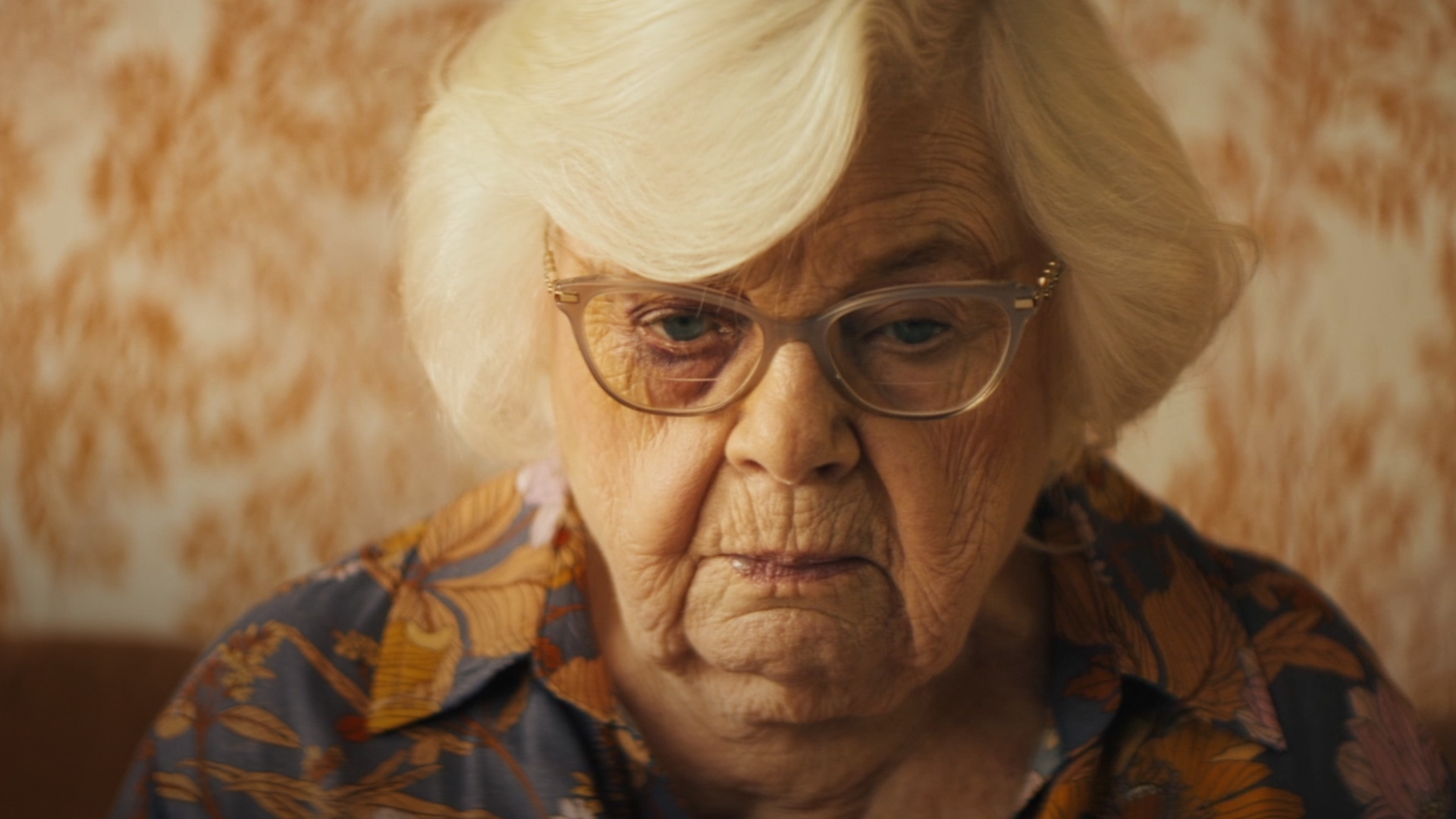
Thelma (2024)

A "Going-Back-To-The-Buffet" Situation
or
Is a Bad Mother... (Shut Your Mouth!)

One suspects that I'm the perfect demographic for Thelma*, seeing as I'm on the waning edge of the Boomers and having looked at life from both sides now. One sees mentors and peers and Alphabet-gens in the cast and nods one's head in sage recognition. 

If only theater seats could rock it would be perfect.
 
I've seen movies about scammers and hackers and other denizens of the sight-unseen chicanery of cyber-criminality, which if my google search is correct is 2328 times a day, 8 million in a year. That's a lot of possible stories to tell, but at some point, one becomes numb to the stories as they seem so commonplace these days, whether its victims are corporations, infrastructures, or the most common among us. No one seems safe except those off the grid or those without cards of any kind, I.D. or credit/debit. And out rush to make things so "convenient" seems to have made us more vulnerable, oftentimes, ironically, with our enthusiastic permission.

When was the last time you read the "Terms and Conditions?"
But, I can't recall—except implied for heist movies, government conspiracy films, or spy flicks—of anyone telling the story about a victim of one of these things. But, then...my memory isn't what it used to be. Movies either, for that matter.
Thelma
puts a face on the news stories of oldsters being conned out of their legitimately-earned savings and that face is June Squibb's, all 94 years of it, where she finally has a lead-role—and executive produces at the same time, no doubt for back-end compensation (way to go, June!)—playing the title character, who not only is getting "up there", she's reached the top and is looking down. She has a little trouble navigating new technology—she needs the help of her grandson, Daniel (
Fred Hechinger), who has his own issues, but loving gramms isn't one of them—she is a perpetual quilter, is ambulatory, and can take of herself. Not only physically but also in attitude. She plays mah-johngg on the computer and hates wearing that Life-Alert button. Her memory for trivia isn't good, but she's still sharp as a tack—her motivation hasn't dulled at all. She's a little creaky, but when she has a goal...
One day she gets a phone call. It's Daniel. He's been in an accident and he's in jail. He needs $10,000 to get out. She's given an address to a lawyer and she's to mail the money immediately to spring Danny. She calls her daughter Gail (Parker Posey), but she's in a therapy session and lets it go to voice-mail. Thelma can't drive, but gets a cab, gathers the money up and sends it. Gail gets the voice-mail, panics and calls Daniel—he's asleep—calls her husband Alan (Clark Gregg) and everybody tries to call Thelma, goes to her place and are alarmed that she's not there! When everybody manages to get to the same place, they all are relieved that Danny is safe...but, who called Thelma? They come to the realization that she's been scammed, but filing a police report does no good.
There is much discussion of what to do about Thelma—Danny feels responsible, but doesn't think he's good enough to take care of her and Alan and Gail, who are the most helicoptering of parents start to consider whether Thelma should be put in a home. Thelma, however, has one thing on her mind—getting the money back. The kids want to let it go, but not her, and while they're deciding what their next steps are going to be, Thelma decides what she's going to do. She has the address of where she sent the money, and all she needs to do is get some wheels. The kids aren't going to help, so she calls as many friends as she can, only to find that everybody on her contact list is either dead or incapacitated. 
Finally, she calls her friend Ben (the late, great
Richard Roundtree) who has an electric scooter and they embark on a journey across L.A. to find her money and get it back. Hilarity...and a substantial dose of what the hurdles the elderly face in this ultra-teched but indifferent world. It could be maudlin, it could be a shallow romp about "those frisky oldsters", but it deftly negotiates those pit-falls and turns into something funnier and a bit more life-affirming. Thelma's kids tend to lean toward caricature, but in the hands of Gregg and Posey, less damage is done toward the proceedings, and Roundtree and Squibb are delightful all the way through.
It's a better-than-you'd-think version of a geriatric heist movie, and, if you see it, stick around for the credits for a little surprise as to its inspiration. It'll bring a smile to your face and a warmth to your heart. And that never gets old.

* No, it's not Selma with a lisp.

Tuesday, February 16, 2021

Speed Racer

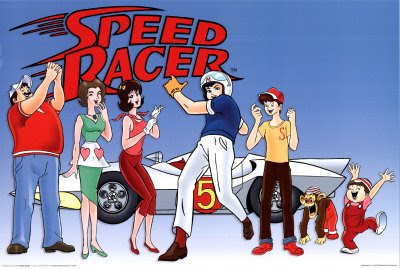
Speed Racer (Andy Wachowski/Larry Wachowski, 2008) "This will change everything," said an editor friend of mine. He was referring to the cutting style, I think—the fast blink-of-an-eye editing that has become the norm for action movies, to the point where it seems like a competition to see just how little footage can be used to create an impression that the eye-ball will retain so that an idea can be processed. The cutting style for Speed Racer stills allows a thought to sink in your head, even if that thought is: "That's a complicated move—not that it matters." Crowds stayed away in droves from "Speed Racer" and it's just as well. It's another of those all-flash-no-substance muddled-message Wachowski Brothers films. 

But it looks pretty—an all-CGI-spit-shined, "there's no there-there" green-screened hybrid of live-action and cartoon and a fair imitation of the limited animation style of the Japanese cartoon that inspired it, in all ways a cotton candy movie.

But it's also a kid's movie—race-winners get a bottle of milk to drink at the Winner's Circle—with curse words and crudities (Bad guy Snake-Oiler says at one point in a race "Let's pinch theses turds off!"), kids giving the finger, and an adult's curdled cynicism.

All the heroes are naively game, but the movie regards them as something to be pitied. It's a paean to the independent spirit that conspires in the shadows, and it teaches kids the Golden Rule: "Screw them before they screw you." 

Welcome to Dick Cheney's "Speed Racer."

But that's the way it is with the Wachowski Brothers. Fanboys like to see them as deep-thinkers, but you don't get far beyond the shallows before drowning in ambiguity. Folks crowed over the FX of The Matrix, and the veneer of the thing implied that it was a "Spartacus-frees-the-slaves" liberal message movie, but it was basically a fascist power fantasy where a superman saves the day as a Master of the Universe. And the crowd goes wide-eyed grateful for the benevolence of their new dictator. Leni Riefenstahl has brethren in the Wachowski Brothers.

But, it's just a movie, Ingrid; How is it? Technically brilliant in recreating a simplified reality with as much respect for photo-realism as anime, and no respect for the laws of physics, as demonstrated by a series of race-tracks that seem more like clamped-together Hot-Wheels patterns on which the cars cantilever and skid more often than they seem to be under any power other than centrifugal force. One begins to suspect that subliminal messages are flashed in front of our eyes in the form of "racing ads" and the whole film is dunked in Day-glo colors that haven't seen the silver screen since Warren Beatty's Dick Tracy. Too much use is made of travelling wipes in transitions—things float by taking the old scene with them (one of the devices is a race car driver on fire! Funny, huh, kids?).
The story is the basic "evil man" story of the cartoons transported to
multi-corporation conglomerates trying to control everything, and an awful lot of time is spent showing just how eee-vil and corrupt (and surrounded by cool stuff) the bad guys are. The movie is over-crowded with incident and made busy with jokey things on the soundtrack with such regularity that one can start to predict when a "goose" will happen, such is the clockwork dependability of the movie.
Not that it matters, but how's the acting
? Well, the best are old pros John Goodman and Susan Sarandon who know how to best exploit weak material. Christina Ricci puts in a spunky try, but Emile Hirsch, who is terrific playing real human beings is at a loss realistically playing a type with conviction. Matthew Fox plays "Racer X" anonymously, as if thinking it not worth fighting against the costume. And the kid playing Sprightle (Paulie Litt)is annoying as hell, but at least he's a professional kid, as all the others in the cast speak with mush-mouths. The monkey obeys orders well. Richard Roundtree makes a welcome appearance; he may be the coolest guy on Earth.
It's a movie that just ruins your day.
The snarky cynicism and bad feelings can be summed up in this exchange that was probably going through the Wachowski's minds throughout making this car-crash of a movie—"The fans love it, don't they?" "They do, God help them."

"Go Speed Racer, Go!" ("...far away from us")

(Wilhelm Alert at 00:46:43)

Saturday, September 19, 2015

Brick (2006)

Brick (Rian Johnson, 2006) One can see why the writer-director of this "high school noir" wanted to do this: the societal stratification of high school resembles the noir tiers of authority and outlaws, be they penny-ante, or high rollers. But, instead of the mooks and frails, we have the sosh's, the jocks, the drama queens, the brains, etc. Instead of the mean streets of the city, there are the sterile hallways and cold, hard walkways of the courtyards of high school (specifically, San Clemente High School--located in Richard Nixon's Elba). There's the police, but also the school administration (Richard "Shaft" Roundtree plays the vice-principal, bless him). Then there are the crimes--against society and the obligatory ones of the heart. And there's the melodrama, at its sulphurously volcanic peak in noir and high-school; everybody has their blood up and the rocket-fuel of pulsing testosterone and estrogen becomes toxic and explosive. It's amazing that anyone gets out of high school alive, let alone graduates with honors. They're the lucky few.
So, one can see why they'd do it. And there's the advantage that film noir's are traditionally the down-side of the studio system. They weren't expected to be "prestige," in fact, the cheaper, the better. So, if there's a bit of amateurishness, that's part of the charm--as with high school theatrics. Brick benefits from that, too. These are teen actor's. We're not expecting them to be too good, although there are some pleasures in the performances.
But, the amateurishness hurts. This is one of the first English language films I've had to watch with subtitles "on." Two reasons for that: the tough-as-nails patter from all parties is more exotic (and phony) than the teen-speak of Juno, and it's delivered at break-neck speed with little inflection by soft-palette actors who haven't learned to e-nun-ci-ate. You can get lost pretty quickly in all the muttered asides and rolled together phrases. One section of early, extremely important dialogue is phone-filtered on top of being delivered by a semi-hysterical character and it's undecipherable without a libretto. The lone exception is "The Pin," played by grown-up kid actor Lukas Haas with a laser-like intensity, and the costuming of Barnabas Collins.
Fortunately, Johnson has enough visual pyrotechnics to lean on, but just as he's borrowed elements of the script from Hammett, his visual style is cribbed from, of all people, Leone--all negative space and extreme proximity's. One is propelled by the occasional good idea or a visual joke that thrusts into his frame. Every punch is a hay maker. No clue is left without a tilted close-up. Johnson couldn't be more obviously visual, while being tone-deaf with the sound.
In the end, with the pro's and the con-artists, one begins to see it as the one thing it shouldn't be--precious. The effect is a bit like all those kids playing gangsters shooting marshmallow bullets in Alan Parker's Bugsy Malone. The dialogue wants to impress you with its toughness, but ultimately its out of the mouth of babes, with the visual sense of Danny DeVito, rather than Dassin or Hawks or Mann. In the words of Bogart's Philip Marlowe, "The cheaper the hood, the gaudier the patter." Or as P.I. Milton Arbogast (before he climbs the stairway to heaven), "If it ain't gellin', it ain't aspic." And this ain't gellin.'