Showing posts with label Gangster. Show all posts

Wednesday, April 16, 2025

The Alto Knights

De Niro 17 (And Just Beside Himself)
or
Keep Your Friends Close and Your Enemies Closer (Tough to Do When They're One and the Same)
 
It wasn't the stunt-casting of Robert De Niro in the two lead roles that made me want to see The Alto Knights. It was that this property had been "in the works" since the 1970's (when it was known as "Wise Guys"), being produced by legendary producer Irwin Winkler (who is now 93), with a script by Nicholas Pileggi (he wrote the screenplays and source-books for Goodfellas, Casino, as well as writing City Hall and executive producing American Gangster) and directed by Barry Levinson—who started out writing for Tim Conway, "The Carol Burnett Show", Mel Brooks, and directed such films as Diner, The Natural, Rain Man, Good Morning, Vietnam and his previous gangster movie, Bugsy. Levinson was the draw for me and considering the amazing work he's done in the past—he also executive-produced "Homicide: Life on the Street", a personal favorite—that was more than enough reason.

The Alto Knights tells the story of the Luciano mob family that went from bootlegging during Prohibition to gambling, and controlling criminal activities in Manhattan's Lower East Side. It concentrates on the relationship between Frank Costello, Luciano's consigliere and Vito Genovese, the gang's underboss, who grew up as friends but became bitter rivals once they achieved higher status in the Mafia. And it covers the time from when Costello ran the mob to the helter-skelter Apalachin meeting, the "mob convention" so flagrant that even the FBI's J. Edgar Hoover finally had to admit that organized crime actually existed (why he never had before has been an unexplained mystery).
If you've seen The Godfather, the story will have echoes of the same gun-fire—author Mario Puzo used details and scrambled them for his novel—but, at one point, Genovese (who'd been put in charge of Luciano's mob after its head was sent to prison for running a prostitution operation) fled to Sicily to avoid a murder charge, and was replaced with Costello. Costello and Luciano had deep contacts with New York politicians, and, with Costello in charge, it was easier to get away with murder. 
But when Genovese returned to America in 1945—witnesses to the murder had been very conveniently murdered before any trial could take place—the re-patriated mobster assumed that Luciano would put him back in charge, but, instead, Costello kept himself as the mob's boss, making him an enemy in the mercurial, less steady Genovese's eyes and for the rest of their lives the two stayed bitter rivals. 
The film chronicles that rivalry—from Costello's point of view, so it's more than a bit prejudiced—picking through pages of Mob history back and forth in time in flashback, beginning with the most obvious example of their rivalry, the botched assassination of Costello by Genovese's son on his Dad's orders (Genovese was never said to be subtle). It's that act that convinces the more strategic Costello to retire from the mob, but not without some manipulation of the volatile Genovese. Of course, it's all from Costello's self-sympathetic view of things. But, the film also has Genovese's wild divorce trial, the killing of Costello's hand-picked successor Alberto Anastasia, the Senate hearings of Estes Kefauver, and that ill-fated Mob convention.
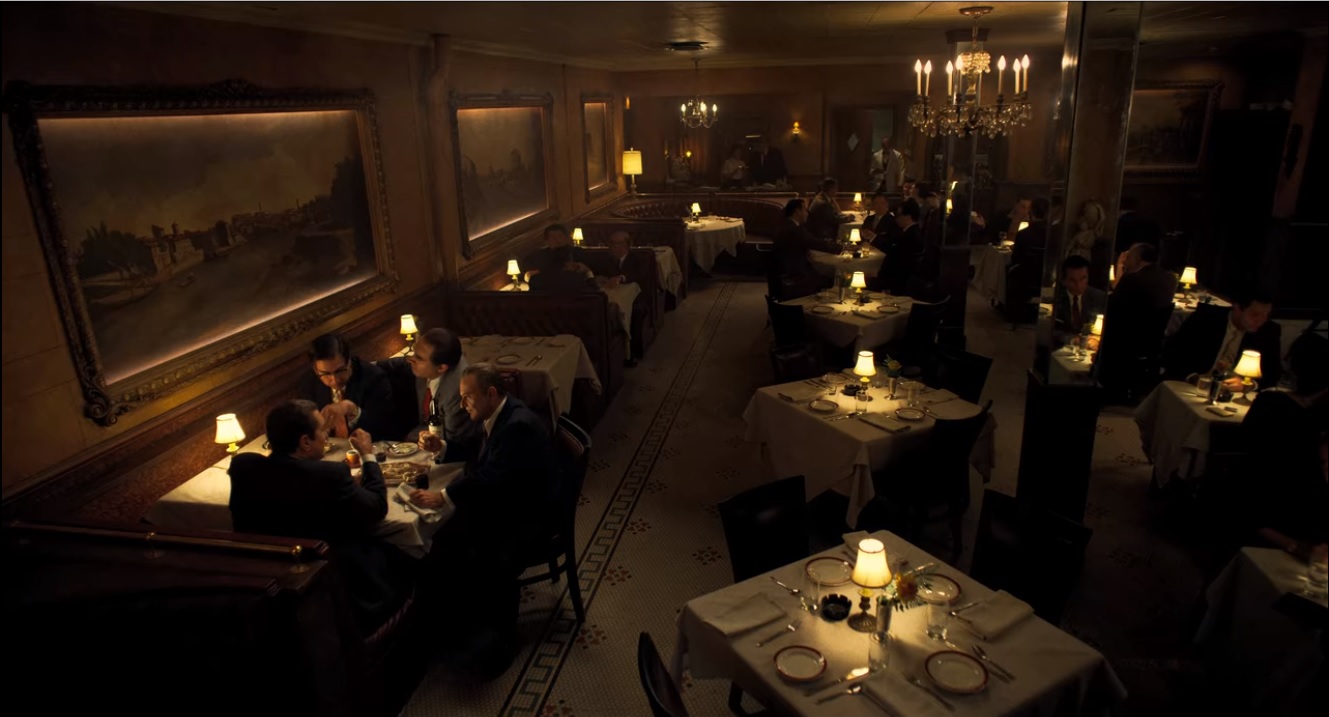
Pileggi and Levinson keep it moving and some of the set-pieces are nicely conceived, with the director sometimes evoking Edward Hopper paintings (as he has done in the pas) this time with the aid of 81 year old cinematographer Dante Spinotti. 
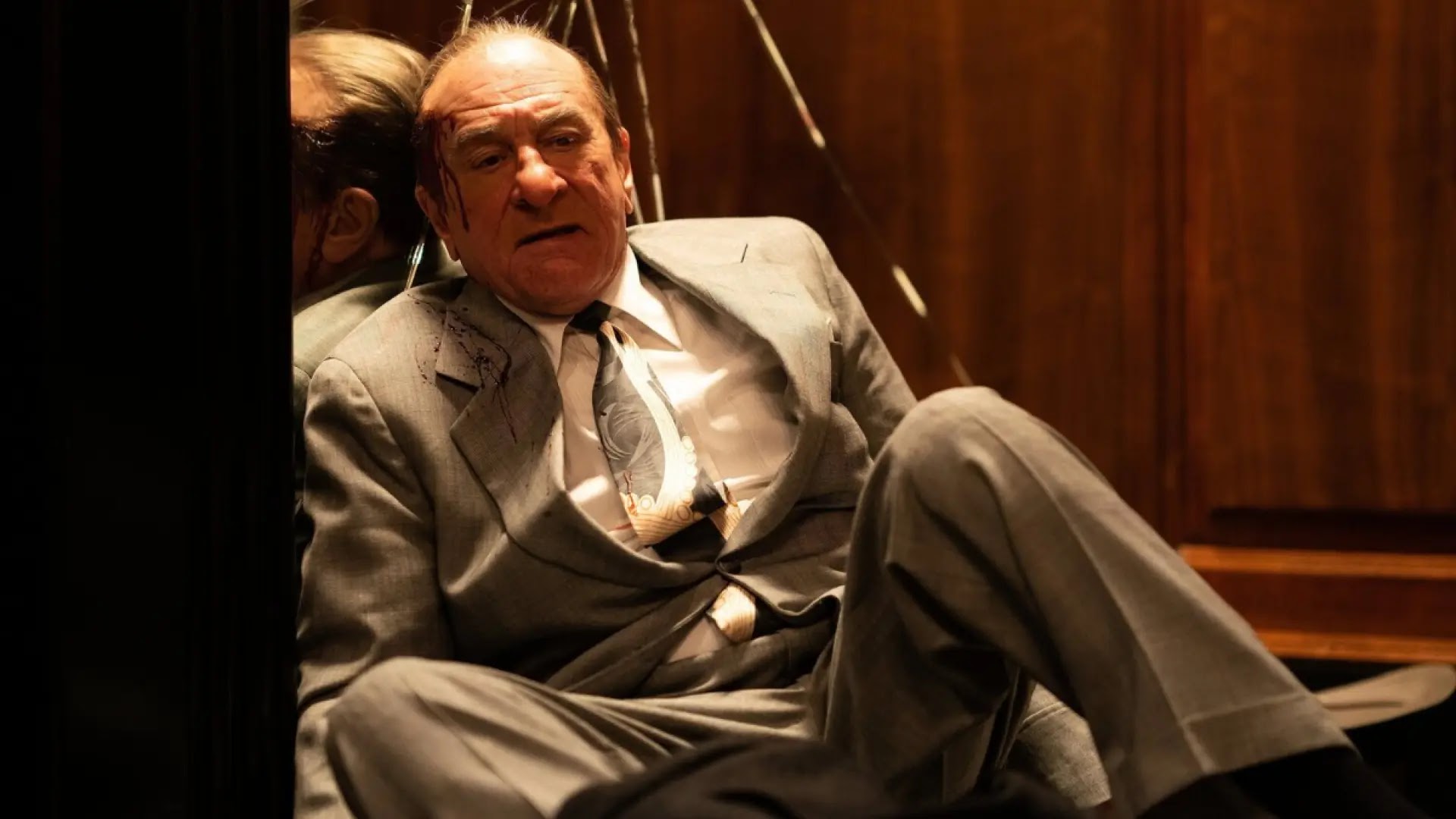
So, since he's all over the movie, is De Niro any good? I mean, at playing two different characters in the same movie? Yeah, it's quite the show. Early on in the movie De Niro takes pains to separate the two personas—his Costello is more soft-spoken and cagey-eyed, while his Vito Genovese spits out his dialog and has a nervous energy (it's almost like De Niro is doing an impression of Joe Pesci). And the few scenes where the two characters are together and De Niro is literally beside himself, it's something of a wonder as the dialog flows naturally but the two characters interrupt each other, react to the others' accusations and gives the impression that, hey, this is two different guys here having a rather diffident conversation with each other (but it's the same actor doing both parts!). I have no idea why they did this (I've read that it was Warner CEO David Zaslav's), but it's an amazing to see. 
And, really, who is De Niro going to play against? Who has the caliber to go toe to toe with him? Pacino, maybe (but they've made a pact that they're not going to do anything together unless it's really good). Alec Baldwin would have been an interesting choice and quite capable. But, watching De Niro play two different characters...with two different energies...is a fascinating exercise. That he pulls it off (despite never fully convincing us that it isn't a "twins" act) impresses. "Molto rispotto."
But, any gangster movie is going to have that weird quality of upside-down absurdism (Costello wants to retire and lead a "normal" life...really?), which Levinson, with his comedy background, leans into heavily. The thing that's missing is any sense of moral outrage. These were gangsters, after all. Their day-to-day illegal activities are mentioned ("just business") and prominent assassinations are portrayed (because "if it bleeds, it leads"), but like Levinson's Bugsy, there isn't the sensibilities of penance being paid that you'd find in Catholic filmmakers like Scorsese or Coppola. For the criminal record, Genovese died in prison, while Costello died in his retirement penthouse at the Waldorf Astoria. A lot of their victims, we'll never know.
Frank Costello and Vito Genovese mug shots
 

Saturday, January 23, 2021

King of the Roaring Twenties: The Story of Arnold Rothstein

Saturday is traditionally "Take Out the Trash" Day here.

King of the Roaring Twenties: The Story of Arnold Rothstein (aka The Big Bankroll) (Joseph M. Newman, 1961) In the early 1960's, "the Roaring 20's" was a big deal. "The Untouchables" was on TV and there was even a series called..."The Roaring 20's." It seemed to break up the glut of westerns, gumshoes, and family-comedies—as well as the Kefauver Hearings—that saturated small screens in the 1950's.  

Amidst all this, there were a spate of low-budget movies that also looked back at those days, but it was not what you would call a trend. Mickey Rooney starred as "Baby Face" Nelson. Rod Steiger as Al Capone. Charles Bronson as "Machine Gun" Kelly. There was Studs Lonigan. Just before this film was The Rise and Fall of Legs Diamond.

And at the tail end of the cycle was King of the Roaring 20's: The Story of Arnold Rothstein. Rothstein was featured in Legs Diamond. Nicknamed "The Brain", he is credited with putting the "organized" into organized crime, turning the scatter-shot "wild west" approach of mobstering into a business model of bankrolling potential racketeering schemes (but just be advised to check your receipts). I suppose at the end of the film-cycle, after finishing all the tommy-gun action, they had to include the accountants. You're not done until you do the paperwork.
KOTR2:TSOAR (geez, even the abbreviation is too long!) follows Rothstein's rise  in turn of the century New York as a troublesome kid-grifter (played by Jimmy Baird), giving the local police guff and his upright, serious father (Joseph Schildkraut) so much tsuris for not applying his mathematical gifts to rabbinical studies like his older brother. Rothstein (eventually played by David Janssen) would rather calculate odds and gamble, and eventually, partnering first with a neighborhood pal (Mickey Rooney) on booking centers and poker networks and then with "Big Tim" O'Brien (Jack Carson) on casinos and bigger game.
The film is a little vague on what made Rothstein so successful, other than a careful sizing up of the percentages, making sure that he got his cut and finding strategies that would either undercut the pay-out to his partners or negotiate deals that would have lucrative rewards to himself if his partners screwed up and have to sell out.

One such long con is the eventual prosecution of a tarnished cop (Dan O'Herlihy) who always made sure Rothstein got nicked from boyhood on. The obsession—at least in Jo Swerling's treatment (his last credit)—would prove to be his undoing, as well as a long-held desire to win a poker game with a royal flush. Everything else is as spur-of-the-moment as a dice-roll, and with as much attention as that requires, such as selling out his friends and a "fair-weather" marriage to a chorus girl (Dianne Foster).
That would take somebody extraordinarily charismatic to pull off, and the saddest thing about King of the Roaring 20's is that David Janssen, fine as an actor as he could be, is incapable of doing it. Always an interior kind of actor—as he proved in his long stretch as TV's "The Fugitive"—Janssen is more than capable of luring the audience in and winning their respect if not sympathy, without resorting to theatrics. But here the role is so repellant than no amount of casual inscrutability provokes any interest. And his lack of remorse—or much of anything beyond surface cool—inspires nothing but our own indifference. The audience reflects the performance.

It's too bad because the cast is flush with good character actors—Rooney, O'Herlihy, William Demarest, Keenan Wynn, Diana Dors (in a "blink-and-you'll-miss-her" role), and, one of my favorites, Jack Carson in his last role before his death. But, they're circling around an empty suit, and there's not even enough venom in Janssen's performance to inspire that he get his just desserts, which occurs in a contrivance that's too "on-the-nose." All the way around, the movie's just a bad bet.

Saturday, March 21, 2020

Get Carter (1971)

Saturday is "Take Out The Trash" Day.

  Get Carter (Mike Hodges, 1971) In 2004, BFI Magazine conducted a poll of British film critics of what was the greatest British film of all time.

Out of all British films, the work of Lean and early Hitchcock, The Archers, Carol Reed, Tony Richardson, Ken Russell, the output of Alexander Korda and Ealing Studios and Hammer and Rank, the critics chose Get Carter, a decidedly off-beat and down-beat gangster film that anticipated the odd-ball and ultra-violent Christmas releases of 1971, by 9 months.*

It was the first film of director Mike Hodges, hired at the behest of a producer trying to make a film that would capitalize on the recent conviction of British gangsters, the Kray brothers. Hodges didn't set his film in London, but in the north, Newcastle-upon-Tyne, shooting it almost documentary style, employing locals as extras, and the gangsters aren't robbers, they're integrated into society, supplying the citizenry what they want in vice and taking their cut. There is no law enforcement to be seen and the hoods work in the open, comfortable in their position in society.
Carter reads Raymond Chandler on his way home to Newcastle.
He must think of it as a romance novel.
Jack Carter (Michael Caine) is taking the train from London to his old home-town of Newcastle to arrange and attend his brother Frank's funeral, Frank's death being the result of a drunk-driving accident, officially. Jack isn't buying any of that. Jack, you see, is in the employ of the Fletcher Brothers gang out of London, and he suspects brother Frank was murdered and his other intent to go to Newcastle is to arrange and attend the killing of those responsible. This does not sit well with the Fletcher boys, who want Jack around taking care of their business, so they send out a couple of boys to bring Jack back.
Either that, or they've found out that he's been sleeping with Gerald Fletcher's girlfriend, Anna (Britt Ekland) and plans on running away with her to South America when he returns. Maybe they want to have a "talk" with him before then. It might be that, it might be that he's taken time off from his work for their gang and you just don't do that to the Fletcher's. More than once, anyway.
But, travel, he does, reading Raymond Chandler's "Farewell, My Lovely," perhaps as a primer on how to be a detective trying to solve a mystery, something a bit more intricate and nuanced than being an enforcer/hit-man for the mob. And he will have to be a detective: the story he unfolds is complicated with agendas that are hidden as well as obvious, as crime happens out in the open and is part of the fabric of day-to-day Newcastle—as far afield as one could get from the London that had become familiar to audiences of the Swinging '60's—it's not psychedelia and mini-skirts and free-wheeling poshness, but grubby and constricting and hiding in the shadows.
The plot is as convoluted as a Chandler novel, and with family just as embedded in the gears of it. At the funeral, Jack meets Frank's mistress (the last of them, anyway) Margaret (Dorothy White), and his own niece Doreen (Petra Markham), Frank's daughter (although, even that's unclear). They give him an added incentive, certainly, but, as Jack digs deeper, he finds the task more labyrinthine with players, subterfuge, hidden motives, and where he becomes the convenient means to others' ends in the midst of turf-wars and long-held vendettas. Jack leaves a bloody trail of bodies in his path to vengeance, cutting a swath through the Newcastle underworld, to the point where he himself becomes a target for his bosses, who send a couple of underlings to bring him back, dead or alive not a consideration given his activities.
But, they're just another road-block on his hunt, and although he might be an efficient and remorseless killer, the very fact that he's so committed to his task reveals that he has one weakness—family. And his distance and isolation in London has kept him from knowing the seamier sides of his brother's past, from which no one is left untarnished. If Carter starts out with any sentimentality before getting to Newcastle, he loses it the deeper he digs and the closer he gets to the truth.
Conversely, the scope of his work expands to the point where it is not enough to deal with his brother's killer (or killers), but also to set up and exact revenge on the whole network of criminality through planted evidence and black-mail, reaching up to its highest ranks in Cyril Kinnear (played in an eccentric performance by playwright John Osborne), using evidence he's found along the way and using—of all people—the police to handle the more difficult work.
One wonders where Carter thinks this all headed—yes, he's planning on retiring to South America with Anna (and maybe niece Doreen)—but he acts with such a pitiless ruthlessness that one wonders if he actually can make a plan more than one target away. His defection from the Fletchers for his "personal time" and his dalliance with Anna will surely make him a perpetual target. If he's capable of such dogged retribution, wouldn't they be as well?
Get Carter is a tough film to follow, given the number of players involved in the web of criminality that finally did in brother Frank, but eventually it comes down to just latching onto Caine's Avenging Devil and holding on tight, the surrounding characters aren't going to last very long, anyway, and given their lack of screen-time, there's no danger of attachment, even if any of them were in the slightest bit sympathetic. One almost needs a Newcastle map to keep track of it.
Hodges isn't much of a help. This is his first film and one can see that he's trying to maintain the threads of the story and the many characters by any means necessary. Every so often, there's a wonderful shot that neatly framed and composed for both atmosphere and efficient exposition. But, a lot of the time, it feels a bit slap-dash, even random, as if Hodges were trying to make something off-beat but with no underlying story-telling need behind it, lest any veneer betray the location work and the underlying seediness of the story.
There would be no sequel. But, there would be a remake in 2000, directed by Stephen Kay and starring Sylvester Stallone (with a cameo by Caine, of all people). One wonders why, if this film is held in such high regard, it was even necessary. The second had that polish that I profess missing, but even that doesn't make it a better film than the original. 

* Really. Does anyone wonder how Brexit happened?


Friday, March 20, 2020

Brighton Rock (1948)

Brighton Rock (John Boulting, 1948) Brighton is a seaside resort town on England's southern coast, a holiday spot for the working class, and the subject of Graham Greene's "Brighton Rock," a story of the dark side that can infest a tourist attraction, where money can be loosened in many ways and in great amounts, which would attract the criminal element in the same amounts that they attract the punters.

When a film was made of Graham Greene's novel, the resort was, understandably, nervous, preventing the film-makers from shooting at the local racetracks, and to use hidden cameras during the crowd scenes on location. Oh. And there was enough of a nervousness that a calming opening card is used:

"Brighton today is a large, jolly, friendly seaside town in Sussex, exactly one hour's journey from London. But in the years between the two wars, behind the Regency terraces and crowded beaches, there was another Brighton of dark alleyways and festering slums. From here, the poison of crime and violence and gang warfare began to spread, until the challenge was taken up by the Police. This is a story of that other Brighton - now happily no more."
Quite happily. The film takes place in 1935—Greene had written a previous book "A Gun For Sale" and the events of that one are a bit of prologue for Brighton Rock, involving the death of the gangster Kite after a newspaper article has exposed the corruption involving slots and race-tracks and the resulting turf wars that have blighted Brighton. Kite's gang is now run by by a 17 year old tough and psychopath named "Pinkie" Brown (played by a 24 year old Richard Attenborough, with the deadest eyes in the world). And the film begins with a bit of news about a contest with lots of potential winners. They never gave any thought to anybody losing.
The Daily Messenger newspaper arrives at the boarding house populated by the Kite gang with news of a promotional contest; "Kolley Kibber" is coming to Brighton. A promotional stunt, a representative from the paper comes to town distributing cards to various businesses that lucky patrons can turn in for cash rewards...and the first person who finds the person posing as "Kolley Kibber" and says "You are Kolley Kibber and I claim the Daily Messenger prize" you win a bigger more desirable prize. So who does the messenger send out to be "Kolley Kibber?" Reporter Fred Hale (Alan Wheatley), the one who broke the story on the Kite gang. I suppose, at least, they didn't also fasten a target to his back, but, really, that's like sending Salman Rushdie on a book-tour to Iran.
But, it's an opportunity for the Kite Gang, now under Pinkie's control, to take revenge. After all, as one of the mob says "Pinkie loved Kite and Kite trusted Fred. And if Fred hadn'ta written that paragraph about slot machines Kite would've been alive now." Pinkie is informed of the contest and it's his intention to kill the reporter.
It isn't long before Hale arrives in Brighton, before he realizes he's being hunted. Trying to blend in with the seaside visitors, he runs into a theater performer Ida Arnold (Hermione Baddeley) and when he ends up dead, she informs the local constabulary that the reporter's death is more than suspicious, but when they rule that the man died of an apparent heart attack, she begins her own amateur sleuthing.
It becomes a cat-and-mouse game as Ida busy-bodies her way into the investigation, while Pinkie tries to cover his tracks, using one of the gang to distribute the cards to confuse the police. But, one of the cards is left at a restaurant where a waitress (Carol Marsh) can identify who left it. Pinkie chats up the girl, asking her out, but when he finds out she can identify the accomplice, he starts a plan to kill the man. And, if anybody gets suspicious, he'll marry the waitress to keep her from testifying against him in court. 

It's an odd combination of an Agatha Christie-like amateur against the most vicious of sociopaths—Miss Marple against Hannibal Lecter—and the Boulting Brothers production team construct it in the manner of a Hitchcock-like stylist, contrasting the most innocent of local color and injecting pure menace into it. Greene was the most Catholic of writers, adept at creating angels and devils, and in Pinkie, he created a terrifying monster with savage intent and no remorse, a wolf among sheep (and a teenager!). Although the film ends with a note of deluded sanctity—Greene has a wonderful phrase "You or I cannot fathom the appalling strangeness of the mercy of God"—even Greene didn't believe in it, only providing a note of hope to get past Britain's supervisory boards.
"You asked me to make a record of me voice. Well, here it is. What you want me to say is 'I love you.'
Here's the truth. I hate you, you little slut. You make me sick."
And Attenborough creates a memorable villain, contained and malicious without a thread of decency, making one think that the sympathetic, cherubic characters he'd play for the rest of his life may have been some form of atonement.


Thursday, March 19, 2020

The Irishman (I Heard You Paint Houses) (2019)

A Tragic Loyalty
or
Tales From the Last Man Standing ("It's What It Is...")

“Blind faith in your leaders, or in anything, will get you killed.”
Bruce Springsteen

“I don’t see them. I tried, you know? But that’s not cinema. Honestly, the closest I can think of them, as well-made as they are, with actors doing the best they can under the circumstances, is theme parks. It isn’t the cinema of human beings trying to convey emotional, psychological experiences to another human being.”
Martin Scorsese, Empire Magazine interview

Martin Scorsese and Francis Ford Coppola say (in their own ways) that Super-hero movies are not cinema and they are right to a certain extent, at least in how it creates a studio myopia on what gets made and what doesn't. Because unless the movie has people with emblems on their chest (and are seriously marketable as action figures), they're consigned to streaming services like Netflix, which, if you think about it, is one step up from premiering on the SYFY channel (which is one step up from direct-to-video..if such a thing still exists).
Nerd's eye opinion of Martin Scorsese.
We could go on about how tent-pole films dominate theater-schedules (when theaters have schedules again once we're past our pandemic focus) and even major film-makers are having trouble attracting studio interest, but that would just be kvetching ("All you kids get out of my theater!"). But, Scorsese did manage to get Netflix to buy into The Irishman, his long-in-the-works adaptation of Charles Brandt's book "I Heard You Paint Houses" when Robert De Niro first proposed it after its publication in 2004, and Scorsese's been working on it since 2007.
Better late than never. And without a Miramax (and Harvey Weinstein) breathing down his neck, one can see what a late-Scorsese film without studio badgering looks like. What we get is a 3 hour film told in nested-flashback of Sheeran's (one must say disputed) reminiscinces of his war experience, brief work as a trucker, and his being enfolded into the world of the Mafia and Teamsters politics as a hit-man and then as body-man for Teamsters president Jimmy Hoffa (played by Al Pacino).
That "nested flashback" structure is interesting, as it's a bit more complex than, say, Once Upon a Time in America, where Sergio Leone has an elderly De Niro return to New York to investigate a past mystery, or Arthur Penn's Little Big Man where Dustin Hoffman's Jack Crabbe narrates his own fanciful take on History. Here, Sheeran resides in a nursing home and relates his history ("It's what is is..."), flashing back and forth between a fateful trip to the wedding of the daughter of lawyer Bill Bufalino (Ray Romano) in 1975, and the events that led up to that road trip.

It takes a bit of patience and a reliance on our memory of how people look—which is very risky as so much of that is dependent on CGI de-aging technology, particularly of De Niro, Pacino and Joe Pesci—who came out of retirement for this role (and who gives the best and most subtle performance of his career).*
That road-trip is given the most detail and the most dialing-down of information because of its implications in how it affects the rest of the world and in Sheeran's moral decline.
Sheeran briefly looks to us when backed into a corner on the road-trip ("It is what is is")
De Niro's Sheeran is a perpetual foot-soldier, following orders with the same mind-set instilled in him during WWII—you're given a job, you follow orders and you don't question them, but merely carry them out. Yes, he considers the consequences, but there is a moral disconnect of responsibility, whether in war-time, or in civilian duties, to the point where the escalating consequences only produce a larger amount of hesitation before accepting the job." "In for a penny, In for a pound." He carries out his role without a second thought, other than the means to the various ends. 
Sheeran understands his role. He also understands the consequences of not carrying it out, which is always done quickly, coldly and efficiently—the body disposed of (or not) and the weapons used, just one of a growing number tossed into the river. He understands the consequences very well; one of the neat touches that Scorsese tosses in, whenever a new character is introduced, is a short title identifying the person and the date and the means by which they died. You just met them and you already see their death sentence. The rule is: don't get attached. Relationships are short and fragile in that sphere of influence. 
And it is one of influence. The Irishman is one of Scorsese's quietest, more subdued pictures—there's not a lot of fancy camera moves, merely an angular movement done at a steady pace. And there are no acting fire-works...except from Pacino—who seems to have taken on the Pesci "wild card" role in this one—or some of the more volatile actors in the game. But, there is such—I hate to use the term "civility" among mobsters—but shrewd, measured calmness, that when someone does get volatile—or a little out of whack—they're going to get "whacked." It may just be a matter of time.
The Irishman is so measured that you take note of the silences and there are many, especially on the part of De Niro's Sheeran, as he digests what is expected of him, sometimes that takes a little understanding and realization. These aren't mobsters, who come right out and Cagney-like, say "I'm gonna kill ya"—that would be too obvious, especially in a world of wire-tape and undercover cops, and especially as so many are done is social gatherings. The words, when they come, are calm and proceeded by justification, an understanding and presentation of larger issues, arguments that make it difficult to say "no" (except by personal choice and then it's "on you") and that just seems impossible in Sheeran's case.
The final fate of Jimmy Hoffa
Nobody comes out and talks murder or assassination—too obvious and too traceable. The title of Brandt's book, based on Sheeran, "I Heard You Paint Houses"—which is also revealed by a separate title card as a continuation of the title of the film—refers to one's reputation as a killer or hit-man, as "painting houses" refers to blood spray-patterns. That abstract circumlocution is the manner in which things are conveyed—words best left unsaid, but woe if they are not done.
It's all done, so that there is no price to pay. But, there is. Being a Scorsese film, The Irishman does have a conscience, a cost, and for Sheeran, it is placed in his daughter Peggy (played first by Lucy Gallina as a child, and then by Anna Paquin), who early on, when she is pushed by a grocer, Dad goes over and throws the guy through his own glass door. When, Ed becomes involved with Russell Bufalino (Pesci), the older man tries to ingratiate himself—constantly—with the little girl, but she almost has an aversion to him, reverting to a stony silence at the presentation of a present. She does, however, appreciate Hoffa for his efforts to help "the common guy" in his Union, and when Hoffa disappears without a trace, she gets only evasions from her Teamster-father, which estrange him from her forever.
Scorsese has a daughter—she's the one who challenged her Dad to "make a movie people like" (which resulted in Hugo, which set no box office records, but it's certainly likable)—so, it's no surprise that she would be the cost for his lack of character, for his survival in a world of ultimate costs and truncated lives. It's ironic—what would a Scorsese film be without irony?—that his survival to old-age in a world of short-life expectancy should be lived along and apart and shuttered away from his family. That's the cost for long-life.
The Irishman is getting the best reviews of Scorsese's considerable career, and one can guess why: access. On wide-release, you get one or two chances to see and then the judgment gavel comes down. But Scorsese is subtle, even in excess. And having The Irishman immediately available for repeated consumption, one can see the touches, the intricacies in this, one of his most subtle films.

* An aside on this de-aging thing, especially in regarding The Irishman. Sure, you can erase wrinkles from a man's face, sharpen his nose, shave the jowls, and the loose skin. But you can not put bounce in a step, spryness in a gait, or unhunch the shoulders and the careful, gingerly pace of a 76 year old actor. That's the big betrayal of time. The only way you could conquer that is to replace the actor with a younger man...in which case, you wouldn't have De Niro. The made the best choice by compromising with time...as we all do.